

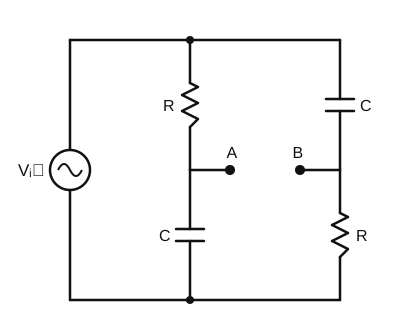
For the ac circuit shown in the figure, $R = 100\ \text{k}\Omega$ and $C = 100\ \text{pF}$. Two branches are connected across the source $V_{in}$: one has R (top) in series with C (bottom), with A the point between them; the other has C (top) in series with R (bottom), with B the point between them. The phase difference between $V_{in}$ and $(V_B - V_A)$ is $90^\circ$. The input signal frequency is $10^x\ \text{rad/s}$, where $x$ is ______.
Numerical value type. Enter your answer.
Answer: 5
Measure potentials from the bottom wire and write $u = \omega RC$.
Branch 1 (R above C): $V_A = V_{in}\dfrac{1/j\omega C}{R + 1/j\omega C} = \dfrac{V_{in}}{1 + ju}$.
Branch 2 (C above R): $V_B = V_{in}\dfrac{R}{R + 1/j\omega C} = \dfrac{ju\,V_{in}}{1 + ju}$.
$$V_B - V_A = V_{in}\frac{-1 + ju}{1 + ju}$$
This has the same magnitude as $V_{in}$ and leads it by $(180^\circ - \tan^{-1}u) - \tan^{-1}u$. Setting this to $90^\circ$ gives $\tan^{-1}u = 45^\circ$, so $u = 1$:
$$\omega = \frac{1}{RC} = \frac{1}{10^5\times10^{-10}} = 10^5\ \text{rad/s}$$
So $x = 5$.
 Solution by Sreeraj P, M.Sc Physics