

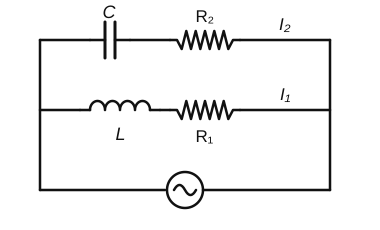
In the circuit shown, $C = \dfrac{\sqrt3}{2}\ \mu$F, $R_2 = 20\ \Omega$, $L = \dfrac{\sqrt3}{10}$ H and $R_1 = 10\ \Omega$. Current in $L$-$R_1$ path is $I_1$ and in $C$-$R_2$ path it is $I_2$. The voltage of AC source is given by, $V = 200\sqrt2\sin(100t)$ volts. The phase difference between $I_1$ and $I_2$ is:
Answer: (D) $150^\circ$
$L$–$R_1$ branch: $X_L = 100\times\dfrac{\sqrt3}{10} = 10\sqrt3\ \Omega$, so $\tan\phi_1 = \dfrac{10\sqrt3}{10} = \sqrt3$: $I_1$ lags the voltage by $60^\circ$.
$C$–$R_2$ branch: $X_C = \dfrac{1}{100\times\frac{\sqrt3}{2}\times10^{-6}} \approx 1.15\times10^{4}\ \Omega \gg R_2$, so $I_2$ leads the voltage by almost $90^\circ$.
Phase difference $\approx 60^\circ + 90^\circ = 150^\circ$.
 Solution by Sreeraj P, M.Sc Physics