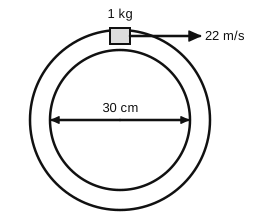
A particle of mass $M$ moves along a horizontal $x$ axis from $x = 0$ to $x = L$. The coefficient of kinetic friction varies as a function of $x$ as $\mu_k(x) = \mu_0 - \alpha x$, where $\mu_0$, $\alpha$ are constants of appropriate dimensions, so that $\mu_k(L) = 0$. The total work done by the frictional force during the motion is $n\mu_0 MgL$, where $g$ is the acceleration due to gravity. The value of $n$ is :
Step 2. Compare. $n = \dfrac12$ (in magnitude; friction's work is negative).
Answer. $\dfrac12$ (Option D).
Solution by Sreeraj P, M.Sc Physics
Q 11-05-003NEETNEET 2026Top questionEasy
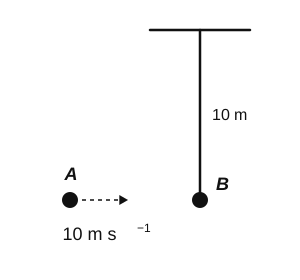
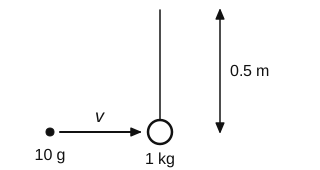
Bob $B$ of mass $m$ at rest is hanging vertically from the ceiling via a massless string of length $10$ m, as shown in the figure. Point mass $A$ of mass $m$ travelling horizontally with speed $10\ \text{m s}^{-1}$ hits bob $B$ elastically. The bob $B$ rises $h$ meter after the collision. Taking the acceleration due to gravity $g = 10\ \text{m s}^{-2}$ and neglecting the size of the bob, the value of $h$ is :
Concept. Elastic collision of equal masses exchanges velocities; then energy conservation for the bob.
Step 1. After collision. B moves off at $10$ m/s.
Step 2. Height. $h = \dfrac{100}{20} = 5$ m (less than the string length, so the string stays taut).
Answer. $5$ (Option C).
Solution by Sreeraj P, M.Sc Physics
Q 11-05-004NEETNEET 2025Top questionEasy
The kinetic energies of two similar cars A and B are $100$ J and $225$ J respectively. On applying breaks, car A stops after $1000$ m and car B stops after $1500$ m. If $F_A$ and $F_B$ are the forces applied by the breaks on cars A and B, respectively, then the ratio $F_A/F_B$ is
Step 1. Forces. $F_A = \dfrac{100}{1000} = 0.1$ N, $F_B = \dfrac{225}{1500} = 0.15$ N.
Step 2. Ratio. $\dfrac23$.
Answer. $\dfrac23$ (Option B).
Solution by Sreeraj P, M.Sc Physics
Q 11-05-005NEETNEET 2025Top questionHard
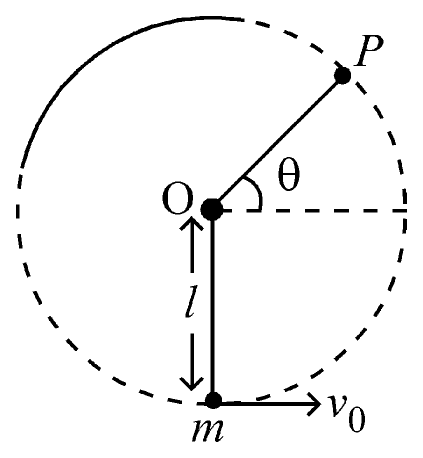
A bob of heavy mass $m$ is suspended by a light string of length $l$. The bob is given a horizontal velocity $v_0$ as shown in figure. If the string gets slack at some point $P$ making an angle $\theta$ from the horizontal, the ratio of the speed $v$ of the bob at point $P$ to its initial speed $v_0$ is:
Concept. The string goes slack when tension is zero, so gravity's radial component alone gives the centripetal force; energy is conserved from the bottom.
Step 1. At P. $mg\sin\theta = \dfrac{mv^2}{l} \Rightarrow v^2 = gl\sin\theta$.
Two bodies A and B of same mass undergo completely inelastic one dimensional collision. The body A moves with velocity $v_1$ while body B is at rest before collision. The velocity of the system after collision is $v_2$. The ratio $v_1 : v_2$ is :
At any instant of time $t$, the displacement of any particle is given by $2t - 1$ (SI unit) under the influence of force of $5$ N. The value of instantaneous power is (in SI unit):
A particle is released from height S from the surface of the Earth. At a certain height its kinetic energy is three times its potential energy. The height from the surface of earth and the speed of the particle at that instant are respectively :
Water falls from a height of $60$ m at the rate of $15$ kg/s to operate a turbine. The losses due to frictional force are $10\%$ of the input energy. How much power is generated by the turbine ? ($g = 10\ \text{m/s}^2$)
A ball is dropped from a height $h$ on to a floor of coefficient of restitution $e$. The total distance covered by the ball just before the second hit is
In two separate collisions, the coefficients of restitution $e_1$ and $e_2$ are in the ratio $3 : 1$. In the first collision the relative velocity of approach is twice the relative velocity of separation. Then, the ratio between the relative velocity of approach and the relative velocity of separation in the second collision is
A sphere of mass $m$ moving with constant velocity $u$ collides with another stationary sphere of the same mass. If $e$ is the coefficient of restitution, the ratio of the final velocities of the first and second sphere is
A cannon shell fired breaks into two equal parts at its highest point. One part retraces the path to the cannon with kinetic energy $E_1$ and the kinetic energy of the second part is $E_2$. The relation between $E_1$ and $E_2$ is
A body of $200$ g begins to fall from a height where its potential energy is $80$ J. Its velocity (in m/s) at a point where its kinetic and potential energies are equal is
The work done by a force $\vec{F} = 2\hat{i} - \hat{j} - \hat{k}$ in moving an object from the origin to a point whose position vector is $\vec{r} = 3\hat{i} + 2\hat{j} - 5\hat{k}$ is
A ball at rest is dropped from a height of $12$ m. If it loses $25\%$ of its kinetic energy on striking the ground and bounces back to a height $h$, the value of $h$ is
A block of mass $2.9$ kg is suspended from a string of length $50$ cm and is at rest. Another block of mass $100$ g, which is moving with a speed of $150$ m/s, strikes and sticks to the first block. Subsequently, when the string makes an angle of $60°$ with the vertical, the tension in the string will be ($g = 10\ \text{m s}^{-2}$)
A body of mass $300$ kg is moved through $10$ m along a smooth inclined plane of inclination $30°$. The work done in moving it (in joules) is ($g = 9.8\ \text{m s}^{-2}$)
A ball of mass $m$ moving with a horizontal velocity $v$ strikes the bob of mass $m$ of a pendulum at rest. During this collision, the ball sticks with the bob of the pendulum. The height to which the combined mass rises is ($g$ = acceleration due to gravity)
The velocity $v$ reached by a car of mass $m$ on moving a certain distance from the starting point, when driven by a motor with constant power $P$, is such that
A ball A of mass $m$ moving along the positive $x$-direction with kinetic energy $K$ and linear momentum $P$ undergoes an elastic head-on collision with a stationary ball B of mass $M$. After the collision, ball A moves along the negative $x$-direction with kinetic energy $K/9$. The final linear momentum of ball B is
The displacement of a body is $(5\hat{i} + 3\hat{j} - 4\hat{k})$ m due to the action of a force $(6\hat{i} + 6\hat{j} + 4\hat{k})$ N on it for $5$ s. The power in watt is
A ball at rest is dropped freely from a height of $20$ m. It loses $30\%$ of its energy on striking the ground and bounces back. The height to which it bounces back is
Concept. Kept energy becomes PE at the top of the bounce.
Step 1. Height. $0.7 \times 20 = 14$ m.
Answer. $14$ m (Option A).
Solution by Sreeraj P, M.Sc Physics
Q 11-05-025NEETEAMCET 2012 (Medical)Easy
A $3$ kg sphere makes an inelastic collision with another sphere at rest and they stick after the collision. If the composite mass moves with a speed of $\dfrac{1}{4}$ of the initial speed of the $3$ kg sphere, the mass of the second sphere is
Step 1. Equation. $3u = (3 + m)\dfrac u4 \Rightarrow m = 9$ kg.
Answer. $9$ kg (Option B).
Solution by Sreeraj P, M.Sc Physics
Q 11-05-026JEE MainEAMCET 2011 (Engineering)Hard
A ball is let fall from a height $h_0$. It makes $n$ collisions with the horizontal ground. If after $n$ collisions it rebounds with a velocity $v_n$ and the ball rises to a height $h_n$, then the coefficient of restitution for the collision is
A bullet is fired normally towards an immovable wooden block. If it loses $25\%$ of its kinetic energy in penetrating the block at thickness $x$, the further distance penetrated by the bullet into the block is
A ball is falling freely from a certain height. When it reaches $10$ m height from the ground its velocity is $v_0$. It collides with the horizontal ground and loses $50\%$ of its energy and rises back to a height of $10$ m. The value of $v_0$ is ($g = 10\ \text{m/s}^2$)
A motor of power $P_0$ is used to deliver water at a certain rate through a given horizontal pipe. To increase the rate of flow of water through the same pipe $n$ times, the power of the motor is increased to $P_1$. The ratio of $P_1$ to $P_0$ is
A body of mass $5$ kg makes an elastic collision with another body at rest and continues to move in the original direction after the collision with a velocity equal to $\dfrac{1}{10}$ of its original velocity. The mass of the second body is
Step 2. Solve. $m_2 = \dfrac{45}{11} \approx 4.09$ kg.
Answer. $4.09$ kg (Option A).
Solution by Sreeraj P, M.Sc Physics
Q 11-05-031NEETEAMCET 2007 (Medical)Easy
A ball of mass $0.6$ kg attached to a light inextensible string rotates in a vertical circle of radius $0.75$ m such that it has a speed of $5\ \text{m s}^{-1}$ when the string is horizontal. The tension in the string when it is horizontal on the other side is ($g = 10\ \text{m s}^{-2}$)
A body of mass $2$ kg is thrown up vertically with kinetic energy of $490$ J. If $g = 9.8\ \text{m/s}^2$, the height at which the kinetic energy of the body becomes half of the original value is
Step 1. Height. $mgh = 245 \Rightarrow h = \dfrac{245}{19.6} = 12.5$ m.
Answer. $12.5$ m (Option C).
Solution by Sreeraj P, M.Sc Physics
Q 11-05-033JEE MainAIEEE 2012Medium
Two springs $S_1$ and $S_2$ of force constants $k_1$ and $k_2$ respectively, are stretched by the same force. It is found that more work is done on spring $S_1$ than on spring $S_2$.
Statement I: If stretched by the same amount, the work done on $S_1$ will be more than that on $S_2$.
A $2$ kg block moving at $6$ m/s on a rough horizontal floor comes to rest after sliding $4.5$ m. The coefficient of kinetic friction is ($g = 10\ \text{m/s}^2$)
A pump lifts $600$ kg of water per minute through a height of $25$ m and delivers it with a speed of $10$ m/s. If the pump is $75\%$ efficient, its input power is ($g = 10\ \text{m/s}^2$)
Concept. Useful power $= \dfrac{dm}{dt}\left(gh + \dfrac{v^2}{2}\right)$; input $=$ useful/efficiency.
Step 1. Useful. $10(250 + 50) = 3000$ W.
Step 2. Input. $\dfrac{3000}{0.75} = 4$ kW.
Answer. $4$ kW (Option D).
Solution by Sreeraj P, M.Sc Physics
Q 11-05-038NEETJEE MainMedium
A car of mass $1000$ kg moves up a slope rising $1$ m for every $20$ m along the road at a steady $36$ km/h. Friction and air resistance together are $500$ N. The power delivered by the engine is ($g = 10\ \text{m/s}^2$)
An engine of constant power $60$ kW drives a car of mass $1200$ kg on a level road. The resistance to motion is a constant $2000$ N. The maximum speed of the car is
Concept. At top speed the driving force equals the resistance.
Step 1. Speed. $\dfrac{60000}{2000} = 30$ m/s.
Answer. $30$ m/s (Option B).
Solution by Sreeraj P, M.Sc Physics
Q 11-05-040NEETJEE MainEasy
A stone tied to a string of length $0.4$ m is whirled in a vertical circle. The minimum speed it must have at the lowest point to just complete the circle is ($g = 10\ \text{m/s}^2$)
A small block slides without friction down a track that ends in a vertical circular loop of radius $R$. The minimum height above the bottom of the loop from which it must be released to go round the loop is
A body of mass $m$ moving with speed $v$ collides with an identical body at rest and sticks to it. The fraction of the initial kinetic energy lost in the collision is
A $4$ kg body moves along a straight line with velocity $v = 3t$ m/s, where $t$ is in seconds. Find the work done by the net force on it during the first $2$ s, in joules.
A bob hangs from a light string $2$ m long. It is given a horizontal speed of $\sqrt{60}$ m/s at the lowest point. Find the tension in the string, in newtons, when the string becomes horizontal, if the mass of the bob is $0.5$ kg. ($g = 10\ \text{m/s}^2$)
Concept. Energy to the horizontal position; there tension alone gives the centripetal force.
Step 1. Speed. $v^2 = 60 - 40 = 20$.
Step 2. Tension. $\dfrac{0.5 \times 20}{2} = 5$ N.
Answer. $5$.
Solution by Sreeraj P, M.Sc Physics
Q 11-05-049JEE MainJEE Main 2026 (6 Apr, Shift 1)Easy
The rain drop of mass $1$ g, starts with zero velocity from a height of $1$ km. It hits the ground with a speed of $5\ \text{m/s}$. The work done by the unknown resistive force is ______ J. (Take $g = 10\ \text{m/s}^2$)
Concept. Two forces do work on the drop: gravity and the air resistance. The work–energy theorem, $W_g+W_r=\Delta K$, gives the unknown resistive work once the gravity work and the change in kinetic energy are known.
Step 1. Work by gravity. The drop falls $h=1$ km $=1000$ m, with $m=1$ g $=10^{-3}$ kg: $$W_g=mgh=10^{-3}\times10\times1000=10\ \text{J}$$
Step 2. Change in kinetic energy. It starts at rest and lands at $5$ m/s: $$\Delta K=\tfrac12\times10^{-3}\times5^2-0=0.0125\ \text{J}$$
Step 3. Work by the resistive force. $$W_r=\Delta K-W_g=0.0125-10=-9.9875\ \text{J}$$
Answer. Option D, $-9.98$ J (to the given precision). The sign is negative because the resistance opposes the motion; almost all the potential energy is lost to the air.
Solution by Sreeraj P, M.Sc Physics
Q 11-05-050JEE MainJEE Main 2026 (6 Apr, Shift 1)Medium
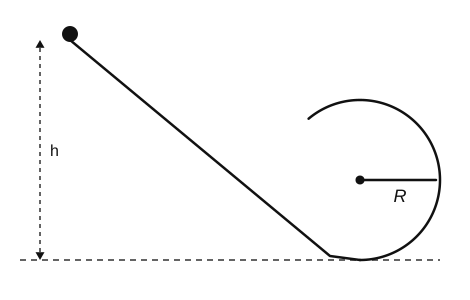
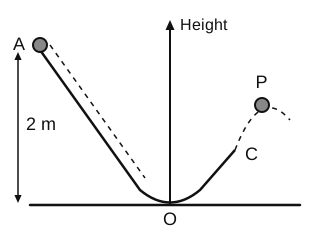
A smooth inclined plane ends in a vertical circular loop, as shown in the figure. A small body is released from height $h$ as shown. If the body exerts a force of three times its weight on the plane at the highest point of circle then the height $h = \alpha R$. The value of $\alpha$ is ______
Concept. At the top of the loop the body is upside down: the normal force from the track and gravity both point down, towards the centre, and together supply the centripetal force. Energy conservation along the smooth track then gives the release height.
Step 1. Speed at the top. The body presses on the track with $3mg$, so by Newton's third law the track pushes it with $N=3mg$, towards the centre: $$N+mg=\frac{mv^2}{R}\ \Rightarrow\ 4mg=\frac{mv^2}{R}\ \Rightarrow\ v^2=4gR$$
Step 2. Energy from release to the top. The top of the loop is at height $2R$: $$mgh=mg(2R)+\tfrac12mv^2=2mgR+\tfrac12m(4gR)=4mgR$$
Step 3. Height. $$h=4R\ \Rightarrow\ \alpha=4$$
Answer. Option B. For the minimum case ($N=0$) the same steps give $h=\tfrac52R$.
Solution by Sreeraj P, M.Sc Physics
Q 11-05-051JEE MainJEE Main 2026 (6 Apr, Shift 2)Easy
A body of mass $1$ kg moves along a straight line with a velocity $v = 2x^2$. The work done by the body during displacement from $x = 0$ to $5$ m is ______ J.
Q 11-05-052JEE MainJEE Main 2026 (5 Apr, Shift 2)Medium
A mass of $1$ kg is kept on a inclined plane with $30^\circ$ inclination with respect to horizontal plane and it is at rest initially. Then the whole assembly is moved up with constant velocity of $4$ m/s. The work done by the frictional force in time $2$ s is ______ J. (Take $g = 10\ \text{m/s}^2$)
Concept. The block does not slide on the incline, so static friction exactly balances the component of gravity along the slope. The whole assembly moves straight up, so the displacement is vertical; only the vertical component of the friction force does work, and because it points up (with the motion) the work is positive.
Step 1. Friction force. Along the slope, friction balances $mg\sin\theta$ and acts up the slope: $$f=mg\sin30^\circ=1\times10\times\frac12=5\ \text{N}$$
Step 2. Vertical component of friction. Friction acts along the incline, which makes $30^\circ$ with the horizontal, so its vertical part is $$f\sin30^\circ=5\times\frac12=2.5\ \text{N (upwards)}$$
Step 3. Displacement. At constant velocity $4$ m/s for $2$ s, the block rises $$s=4\times2=8\ \text{m (vertically up)}$$
Step 4. Work by friction. $$W_f=(f\sin30^\circ)\,s=2.5\times8=20\ \text{J}$$
Answer. Option A, $20$ J. Check: friction and normal force together balance $mg$, so their total work is $mgs=80$ J; the normal force supplies $N\cos30^\circ\cdot s=mg\cos^230^\circ\cdot s=60$ J and friction the remaining $20$ J.
Solution by Sreeraj P, M.Sc Physics
Q 11-05-053JEE MainJEE Main 2026 (4 Apr, Shift 1)Easy
A $1$ kg block subjected to two simultaneous forces $(2\hat{i} + 3\hat{j} + 4\hat{k})$ N and $(3\hat{i} - \hat{j} - 2\hat{k})$ N is moved a distance of $25$ m along $(3\hat{i} - 4\hat{j})$ direction. The work done in this process is ______ J.
Concept. Work done by a constant force is the dot product $W=\vec F\cdot\vec s$. Two forces act at once, so we first add them to get the net force, and the displacement must be written as a vector before the dot product can be taken.
Step 1. Net force. Add the two forces component by component: $$\vec F=(2+3)\hat i+(3-1)\hat j+(4-2)\hat k=5\hat i+2\hat j+2\hat k\ \text{N}$$
Step 2. Displacement as a vector. The block moves $25$ m along $3\hat i-4\hat j$. The unit vector in that direction is $\dfrac{3\hat i-4\hat j}{\sqrt{3^2+4^2}}=\dfrac{3\hat i-4\hat j}{5}$, so $$\vec s=25\times\frac{3\hat i-4\hat j}{5}=15\hat i-20\hat j\ \text{m}$$
Step 3. Dot product. Multiply matching components and add. The displacement has no $\hat k$ part, so the $z$-component of the force does no work: $$W=(5)(15)+(2)(-20)+(2)(0)=75-40=35\ \text{J}$$
Answer. $35$ J. A common slip is to dot with $3\hat i-4\hat j$ itself (giving $7$ J) instead of the actual $25$ m displacement vector.
Solution by Sreeraj P, M.Sc Physics
Q 11-05-054JEE MainJEE Main 2026 (4 Apr, Shift 1)Medium
A body of mass $2$ kg begins to move under the influence of time dependent force $\vec{F} = (2t\hat{i} + 6t^2\hat{j})$ N, where $\hat{i}$ and $\hat{j}$ are unit vectors along $x$ and $y$-axis respectively. The power produced by the force at $t = 2$ s is ______ W.
Concept. Use the work–energy theorem from the moment of release to the moment the ball stops. It starts and ends at rest, so the total work by all forces is zero. Gravity acts over the whole fall plus the penetration; the sand's force acts only over the penetration.
Step 1. Distances. Gravity acts through $h+d=10+0.1=10.1$ m. The sand's average force $F$ (upwards) acts through $d=0.1$ m, opposite to the motion.
Step 2. Work–energy theorem. $$mg(h+d)-F\,d=0-0$$
Step 3. Solve for $F$. $$F=\frac{mg(h+d)}{d}=\frac{2\times10\times10.1}{0.1}=2020\ \text{N}$$
Answer. Option B, $2020$ N. Option C ($2000$ N) is what you get if you forget that gravity keeps doing work while the ball moves through the sand.
Solution by Sreeraj P, M.Sc Physics
Q 11-05-056JEE MainJEE Main 2026 (24 Jan, Shift 2)Medium
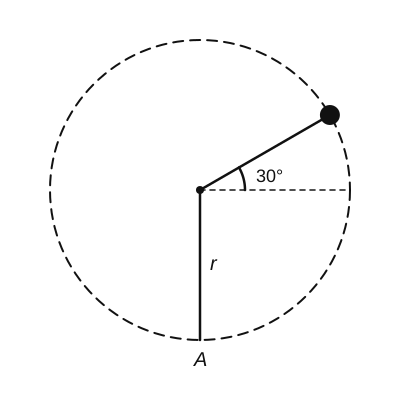
In case of vertical circular motion of a particle by a thread of length $r$ if the tension in the thread is zero at an angle $30^\circ$ shown in figure, the velocity at the bottom point $(A)$ of the circular path is (g = gravitational acceleration)
Concept. At any point on a vertical circle, the net force towards the centre must be $\dfrac{mv^2}{r}$. When the tension is zero, only the component of gravity along the thread (towards the centre) is left. Energy conservation then takes us back to the bottom.
Step 1. Position of the particle. In the figure the thread is $30^\circ$ above the horizontal, so the particle is $r\sin30^\circ=\dfrac r2$ above the centre, that is $r+\dfrac r2=\dfrac{3r}{2}$ above the bottom point $A$.
Step 2. Speed there. The component of $mg$ along the thread towards the centre is $mg\sin30^\circ$. With $T=0$: $$mg\sin30^\circ=\frac{mv^2}{r}\ \Rightarrow\ v^2=\frac{gr}{2}$$
Step 3. Speed at $A$. Tension does no work: $$v_A^2=v^2+2g\cdot\frac{3r}{2}=\frac{gr}{2}+3gr=\frac72gr$$
Answer. Option A, $v_A=\sqrt{\dfrac72gr}$. This is less than $\sqrt{5gr}$, so the thread goes slack at this point and the particle does not complete the circle.
Solution by Sreeraj P, M.Sc Physics
Q 11-05-057JEE MainJEE Main 2025 (22 Jan, Shift 1)Medium
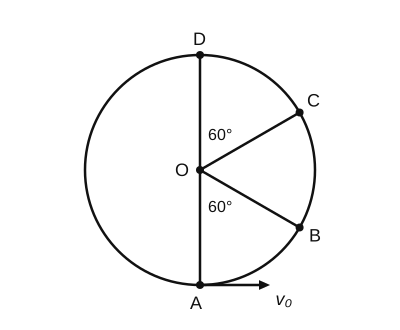
A bob of mass $m$ is suspended at a point $O$ by a light string of length $l$ and left to perform vertical circular motion as shown in the figure. Initially, by applying horizontal velocity $v_0$ at the point $A$, the string becomes slack when the bob reaches the point $D$. The ratio of the kinetic energy of the bob at the points $B$ and $C$ is
Concept. The string goes slack exactly at the top $D$, so there $T=0$ and $mg=\dfrac{mv_D^2}{l}$: $v_D^2=gl$. Energy conservation then gives the speed at any height.
Step 1. Heights above $A$ (from the figure: $B$ is $60^\circ$ from $OA$, $C$ is $60^\circ$ from $OD$). $$h_B=l(1-\cos60^\circ)=\frac l2,\qquad h_C=l+l\cos60^\circ=\frac{3l}{2},\qquad h_D=2l$$
Step 2. Speeds. $v_A^2=v_D^2+2g(2l)=5gl$. Then $$v_B^2=5gl-2g\frac l2=4gl,\qquad v_C^2=5gl-2g\frac{3l}{2}=2gl$$
Q 11-05-058JEE MainJEE Main 2025 (22 Jan, Shift 2)Medium
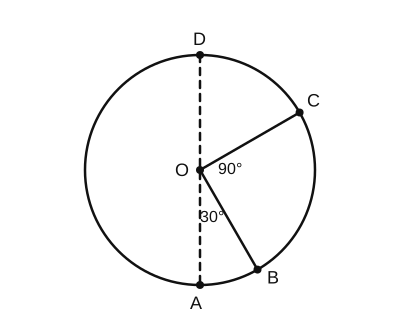
A body of mass $100\ \text{g}$ is moving in a circular path of radius $2\ \text{m}$ on a vertical plane as shown in the figure. The velocity of the body at point $A$ is $10\ \text{m/s}$. The ratio of its kinetic energies at points $B$ and $C$ is (Take acceleration due to gravity as $10\ \text{m/s}^2$)
Q 11-05-059JEE MainJEE Main 2025 (22 Jan, Shift 2)Easy
A force $\vec F = 2\hat i + b\hat j + \hat k$ is applied on a particle and it undergoes a displacement $\hat i - 2\hat j - \hat k$. What will be the value of $b$, if work done on the particle is zero?
Concept. Work by a constant force is the dot product $W=\vec F\cdot\vec d=F_xd_x+F_yd_y+F_zd_z$. Zero work means the force is perpendicular to the displacement.
Step 2. Set to zero. $1-2b=0\Rightarrow b=\tfrac12$.
Answer. $\dfrac12$ (Option B).
Solution by Sreeraj P, M.Sc Physics
Q 11-05-060JEE MainJEE Main 2025 (24 Jan, Shift 1)Easy
A force $F = \alpha + \beta x^2$ acts on an object in the $x$-direction. The work done by the force is $5\ \text{J}$ when the object is displaced by $1\ \text{m}$. If the constant $\alpha = 1\ \text{N}$, then $\beta$ will be
Answer: (B) Both A and R are true but R is NOT the correct explanation of A
Concept. A force has a potential energy (and path-independent work) only if it is conservative. A central force that depends only on the distance from the centre is conservative.
Step 1. Assertion. In a central force field ($F$ depends on $r$ only, along the radius), the work depends only on the end points. True.
Step 2. Reason. Friction and other non-conservative forces have no potential energy, so not every force has one. True.
Step 3. Explanation? R is a general remark; it does not explain why central forces are conservative.
Answer. Both are true but R is not the correct explanation of A (Option B).
Solution by Sreeraj P, M.Sc Physics
Q 11-05-062JEE MainJEE Main 2025 (28 Jan, Shift 1)Hard
A bead of mass $m$ slides without friction on the wall of a vertical circular hoop of radius $R$ as shown in the figure. The bead moves under the combined action of gravity and a massless spring ($k$) attached to the bottom of the hoop. The equilibrium length of the spring is $R$. If the bead is released from the top of the hoop with (negligible) zero initial speed, the velocity of the bead when the length of the spring becomes $R$ would be (spring constant is $k$, $g$ is acceleration due to gravity)
Concept. The hoop is smooth and its normal force is perpendicular to the motion, so mechanical energy is conserved: kinetic energy + gravitational potential energy + spring energy stays constant. We need the spring's extension and the bead's height at the start and at the moment the spring has its natural length.
Step 1. At the top. The spring runs from the bottom of the hoop to the top, so its length is $2R$ and its extension is $2R-R=R$. Spring energy $\tfrac12kR^2$, height $2R$ above the bottom, speed zero.
Step 2. Where the length is $R$. The spring is now a chord of length $R$ from the bottom point. With the bottom of the hoop as origin and the centre at height $R$, a point at height $h$ on the circle is at distance $c$ from the bottom with $c^2=2Rh$. So $$h=\frac{c^2}{2R}=\frac{R^2}{2R}=\frac R2$$ (Equivalently: the bottom, the centre and the bead form an equilateral triangle of side $R$.) The spring is unstretched, so its energy is zero.
Step 3. Energy conservation. $$mg(2R)+\tfrac12kR^2=mg\frac R2+\tfrac12mv^2$$ $$\tfrac12mv^2=\frac{3mgR}{2}+\tfrac12kR^2\ \Rightarrow\ v^2=3gR+\frac{kR^2}{m}$$
Answer. Option A, $v=\sqrt{3Rg+\dfrac{kR^2}{m}}$.
Solution by Sreeraj P, M.Sc Physics
Q 11-05-063JEE MainJEE Main 2025 (29 Jan, Shift 1)Medium
As shown below, bob $A$ of a pendulum having a massless string of length $R$ is released from $60^\circ$ to the vertical. It hits another bob $B$ of half the mass that is at rest on a frictionless table in the centre. Assuming elastic collision, the magnitude of the velocity of bob $A$ after the collision will be (take $g$ as acceleration due to gravity)
Concept. Three stages: energy for the swing down, then the elastic collision (momentum and KE), with the standard result $v_1=\dfrac{m_1-m_2}{m_1+m_2}u$.
Step 1. Speed at the bottom. Drop $R(1-\cos60^\circ)=\dfrac R2$: $u=\sqrt{gR}$.
Step 2. Collision with mass $m/2$ at rest. $$v_A=\frac{m-m/2}{m+m/2}u=\frac13\sqrt{gR}$$
Answer. $\dfrac13\sqrt{Rg}$ (Option D).
Solution by Sreeraj P, M.Sc Physics
Q 11-05-064JEE MainJEE Main 2025 (29 Jan, Shift 1)Medium
A body of mass $m$ connected to a massless and unstretchable string goes in a vertical circle of radius $R$ under gravity $g$. The other end of the string is fixed at the centre of the circle. If the velocity at the top of the circular path is $n\sqrt{gR}$, where $n \ge 1$, then the ratio of the kinetic energy of the body at the bottom to that at the top of the circle is
Step 2. Ratio of kinetic energies. $$\frac{K_{\text{bottom}}}{K_{\text{top}}}=\frac{n^2+4}{n^2}$$
Answer. Option B.
Solution by Sreeraj P, M.Sc Physics
Q 11-05-065JEE MainJEE Main 2025 (29 Jan, Shift 2)Medium
Given below are two statements. One is labelled as Assertion (A) and the other is labelled as Reason (R).
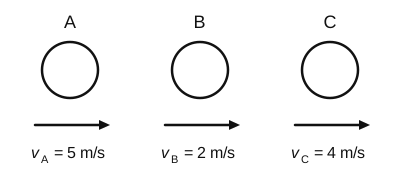
Assertion (A): Three identical spheres of the same mass undergo one-dimensional motion as shown in the figure with initial velocities $v_A = 5\ \text{m/s}$, $v_B = 2\ \text{m/s}$, $v_C = 4\ \text{m/s}$. If we wait sufficiently long for elastic collisions to happen, then $v_A = 4\ \text{m/s}$, $v_B = 2\ \text{m/s}$, $v_C = 5\ \text{m/s}$ will be the final velocities.
Reason (R): In an elastic collision between identical masses, two objects exchange their velocities.
In the light of the above statements, choose the correct answer from the options given below:
Concept. Identical spheres colliding elastically head-on exchange velocities. Follow the collisions in order (from the figure: A, B, C left to right, all moving right).
Step 1. A catches B ($5>2$): swap. A: $2$, B: $5$.
Step 2. B catches C ($5>4$): swap. B: $4$, C: $5$.
Step 3. Any more? A ($2$) is behind B ($4$) and slower; B is behind C and slower. No more collisions.
Step 4. Compare. Final $v_A=2$, $v_B=4$, $v_C=5$ m/s, not $4,2,5$. Assertion false; Reason true.
Answer. (A) is false but (R) is true (Option A).
Solution by Sreeraj P, M.Sc Physics
Q 11-05-066JEE MainJEE Main 2024 (1 Feb, Shift 1)Easy
A simple pendulum of length $1\ \text{m}$ has a wooden bob of mass $1\ \text{kg}$. It is struck by a bullet of mass $10^{-2}\ \text{kg}$ moving with a speed of $2\times10^{2}\ \text{m s}^{-1}$. The bullet gets embedded into the bob. The height to which the bob rises before swinging back is (use $g = 10\ \text{m s}^{-2}$)
Concept. The bullet sticks: momentum is conserved in the short impact (energy is not). Then mechanical energy is conserved as the bob swings up.
Step 1. Common speed. $$V=\frac{0.01\times200}{1.01}\approx1.98\ \text{m s}^{-1}$$
Step 2. Height. $h=\dfrac{V^2}{2g}=\dfrac{3.92}{20}\approx0.20$ m.
Answer. $0.20$ m (Option B).
Solution by Sreeraj P, M.Sc Physics
Q 11-05-067JEE MainJEE Main 2024 (4 Apr, Shift 1)Easy
A rubber ball falls from a height $h$ and rebounds up to a height of $h/2$. The percentage loss of total energy of the initial system and the velocity of the ball just before it strikes the ground, respectively, are
Concept. Energy $\propto$ height reached; impact speed $\sqrt{2gh}$.
Step 1. Loss. From $mgh$ to $\dfrac{mgh}{2}$: $50\%$.
Step 2. Speed. $\sqrt{2gh}$.
Answer. $50\%,\ \sqrt{2gh}$ (Option A).
Solution by Sreeraj P, M.Sc Physics
Q 11-05-068JEE MainJEE Main 2024 (4 Apr, Shift 2)Medium
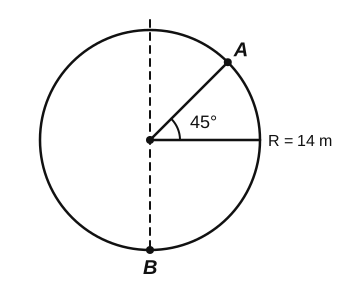
A body of mass $m$ kg slides from rest along the curve of a vertical circle from point $A$ to $B$ on a frictionless path, as shown. The velocity of the body at $B$ is (given $R = 14\ \text{m}$, $g = 10\ \text{m/s}^2$ and $\sqrt2 = 1.4$)
Concept. Smooth path: $v=\sqrt{2g\,\Delta h}$. From the figure, $A$ is on the circle $45^\circ$ above the horizontal radius and $B$ is the lowest point, so $A$ is $R+R\sin45^\circ$ above $B$.
Step 1. Height drop. $\Delta h=R(1+\sin45^\circ)=14(1+0.7)=23.8$ m.
Q 11-05-069JEE MainJEE Main 2024 (5 Apr, Shift 1)Easy
A body of mass $50\ \text{kg}$ is lifted to a height of $20\ \text{m}$ from the ground in two different ways: Case 1, pulled straight up; Case 2, moved along a ramp inclined at $30^\circ$ to the horizontal. The ratio of the work done against gravity in the two respective cases will be
Q 11-05-071JEE MainJEE Main 2024 (6 Apr, Shift 1)Easy
A bullet of mass $50\ \text{g}$ is fired with a speed of $100\ \text{m/s}$ on a plywood and emerges with $40\ \text{m/s}$. The percentage loss of kinetic energy is
Q 11-05-075JEE MainJEE Main 2024 (29 Jan, Shift 1)Easy
A block of mass $100\ \text{kg}$ slides over a distance of $10\ \text{m}$ on a horizontal surface. If the co-efficient of friction between the surfaces is $0.4$, then the work done against friction (in J) is:
Concept. Kinetic friction on a level surface is $\mu mg$; the work done against it over a distance $s$ is $\mu mgs$.
Step 1. Substitute. $W=0.4\times100\times10\times10=4000$ J.
Answer. $4000$ (Option C).
Solution by Sreeraj P, M.Sc Physics
Q 11-05-076JEE MainJEE Main 2024 (29 Jan, Shift 1)Easy
The potential energy function (in J) of a particle in a region of space is given as $U = (2x^2 + 3y^3 + 2z)$. Here $x$, $y$ and $z$ are in metre. The magnitude of $x$-component of force (in N) acting on the particle at point $P(1, 2, 3)\ \text{m}$ is:
Concept. A conservative force is minus the gradient of its potential energy. Its $x$-component is $F_x=-\dfrac{\partial U}{\partial x}$, the derivative with respect to $x$ while $y$ and $z$ are held fixed.
Step 1. Differentiate with respect to $x$. The terms $3y^3$ and $2z$ do not contain $x$, so they give zero: $$F_x=-\frac{\partial}{\partial x}\left(2x^2+3y^3+2z\right)=-4x$$
Step 2. Evaluate at $P(1,2,3)$. $$F_x=-4(1)=-4\ \text{N}$$
Answer. Option C, magnitude $4$ N. The coordinates $y=2$ and $z=3$ are distractors.
Solution by Sreeraj P, M.Sc Physics
Q 11-05-077JEE MainJEE Main 2024 (29 Jan, Shift 2)Easy
The bob of a pendulum was released from a horizontal position. The length of the pendulum is $10\ \text{m}$. If it dissipates $10\%$ of its initial energy against air resistance, the speed with which the bob arrives at the lowest point is: [Use, $g = 10\ \text{m s}^{-2}$]
Concept. Released from the horizontal position, the bob falls through a height equal to the string length $L$. Without losses $\tfrac12mv^2=mgL$; here $10\%$ of the energy is dissipated, so only $90\%$ of $mgL$ becomes kinetic energy.
Step 1. Energy available. The tension is perpendicular to the motion and does no work. Drop in height $=L=10$ m: $$\text{initial energy}=mgL$$
Step 2. Energy kept. $$\tfrac12mv^2=0.9\,mgL\ \Rightarrow\ v^2=2\times0.9\times10\times10=180$$
Q 11-05-078JEE MainJEE Main 2024 (29 Jan, Shift 2)Medium
A bob of mass $m$ is suspended by a light string of length $L$. It is imparted a minimum horizontal velocity at the lowest point $A$ such that it just completes a half circle, reaching the topmost position $B$. The ratio of kinetic energies $\dfrac{(K.E.)_A}{(K.E.)_B}$ is:
Concept. For a bob on a string to reach the top just barely, the string must still be taut there with zero tension, so gravity alone supplies the centripetal force. Energy conservation then links the speed at the top to the speed at the bottom.
Step 1. Speed at the top $B$. With $T=0$: $$mg=\frac{mv_B^2}{L}\ \Rightarrow\ v_B^2=gL$$
Step 2. Speed at the bottom $A$. The tension does no work; $B$ is $2L$ above $A$: $$\tfrac12mv_A^2=\tfrac12mv_B^2+mg(2L)\ \Rightarrow\ v_A^2=gL+4gL=5gL$$
Step 3. Ratio of kinetic energies. $$\frac{K_A}{K_B}=\frac{v_A^2}{v_B^2}=\frac{5gL}{gL}=5$$
Answer. Option B, $5:1$.
Solution by Sreeraj P, M.Sc Physics
Q 11-05-079JEE MainJEE Main 2024 (8 Apr, Shift 1)Easy
A stationary particle breaks into two parts of masses $m_A$ and $m_B$ which move with velocities $v_A$ and $v_B$ respectively. The ratio of their kinetic energies $(K_B : K_A)$ is:
Concept. A body at rest that splits has zero total momentum, so the parts have equal and opposite momenta $p$. With $K=\tfrac12pv$, the kinetic energies are in the ratio of the speeds.
Q 11-05-080JEE MainJEE Main 2024 (8 Apr, Shift 1)Easy
Three bodies A, B and C have equal kinetic energies and their masses are $400\ \text{g}$, $1.2\ \text{kg}$ and $1.6\ \text{kg}$ respectively. The ratio of their linear momenta is:
Q 11-05-081JEE MainJEE Main 2024 (8 Apr, Shift 2)Medium
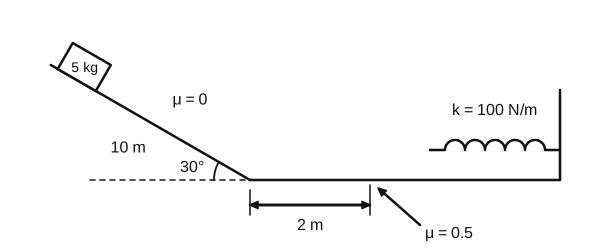
A block is simply released from the top of an inclined plane as shown in the figure. The maximum compression in the spring when the block hits the spring is:
Step 3. Spring. $\dfrac12(100)x^2 = 200 \Rightarrow x = 2$ m.
Answer. $2\ \text{m}$ (Option D).
Solution by Sreeraj P, M.Sc Physics
Q 11-05-082JEE MainJEE Main 2024 (8 Apr, Shift 2)Hard
A circular table is rotating with an angular velocity of $\omega\ \text{rad/s}$ about its axis. There is a smooth groove along a radial direction on the table. A steel ball is gently placed at a distance of $1\ \text{m}$ on the groove. All the surfaces are smooth. If the radius of the table is $3\ \text{m}$, the radial velocity of the ball w.r.t. the table at the time the ball leaves the table is $x\sqrt2\,\omega\ \text{m/s}$, where the value of $x$ is ______.
Concept. In the frame of the rotating table, the ball in the smooth radial groove feels only the centrifugal force $m\omega^2r$ along the groove (the groove's sideways push does no work along it). So $\tfrac12v_r^2=\displaystyle\int_{r_0}^{r}\omega^2r\,dr$.
Step 2. Radial speed at the edge. $v_r=2\sqrt2\,\omega$, so $x=2$.
Answer. $2$.
Solution by Sreeraj P, M.Sc Physics
Q 11-05-083JEE MainJEE Main 2024 (9 Apr, Shift 1)Easy
A particle of mass $m$ moves on a straight line with its velocity increasing with distance according to the equation $v = \alpha\sqrt x$, where $\alpha$ is a constant. The total work done by all the forces applied on the particle during its displacement from $x = 0$ to $x = d$ will be:
Concept. When the force changes with position, $W=\vec F\cdot\vec s$ cannot be used directly. Split the path into small steps $dx$, on each of which the force is almost constant, and add: $W=\displaystyle\int_{x_1}^{x_2}F\,dx$.
Step 1. Set up the integral. The force acts along $x$ and the body moves from $x=2$ m to $x=4$ m: $$W=\int_2^4(3x^2+2x-5)\,dx$$
Step 2. Integrate term by term. $$W=\Big[x^3+x^2-5x\Big]_2^4$$
Step 3. Put in the limits. $$W=(64+16-20)-(8+4-10)=60-2=58\ \text{J}$$
Answer. $58$ J. The integral is the area under the $F$–$x$ graph between the two positions.
Solution by Sreeraj P, M.Sc Physics
Q 11-05-085JEE MainJEE Main 2024 (30 Jan, Shift 1)Easy
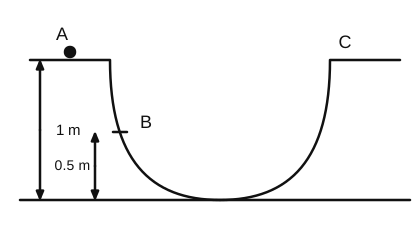
A particle is placed at the point $A$ of a frictionless track $ABC$ as shown in the figure. It is gently pushed towards the right. The speed of the particle when it reaches the point $B$ is: (Take $g = 10\ \text{m s}^{-2}$)
Concept. On a frictionless track only gravity does work: $v=\sqrt{2g\,\Delta h}$, where $\Delta h$ is the drop from the start (the particle starts from rest; "gently pushed").
Step 1. Drop. From the figure, $A$ is $1$ m and $B$ is $0.5$ m above the lowest level: $\Delta h=0.5$ m.
Step 2. Speed. $v=\sqrt{2\times10\times0.5}=\sqrt{10}$ m s$^{-1}$.
Answer. Option B.
Solution by Sreeraj P, M.Sc Physics
Q 11-05-086JEE MainJEE Main 2024 (30 Jan, Shift 2)Easy
A block of mass $1\ \text{kg}$ is pushed up a surface inclined to the horizontal at an angle of $60^\circ$ by a force of $10\ \text{N}$ parallel to the inclined surface. The coefficient of friction between the block and the surface is $0.1$. When the block is pushed up by $10\ \text{m}$ along the inclined surface, the work done against the frictional force is: ($g = 10\ \text{m s}^{-2}$)
Q 11-05-087JEE MainJEE Main 2024 (31 Jan, Shift 1)Easy
An artillery piece of mass $M_1$ fires a shell of mass $M_2$ horizontally. Instantaneously after the firing, the ratio of the kinetic energy of the artillery and that of the shell is:
Q 11-05-088JEE MainJEE Main 2024 (31 Jan, Shift 2)Medium
A body of mass $2\ \text{kg}$ begins to move under the action of a time dependent force given by $\vec F = (6t\,\hat i + 6t^2\,\hat j)\ \text{N}$. The power developed by the force at time $t$ is given by:
Q 11-05-089JEE MainJEE Main 2023 (29 Jan, Shift 1)Easy
A $0.4\ \text{kg}$ mass takes $8\ \text{s}$ to reach ground when dropped from a certain height $P$ above surface of earth. The loss of potential energy in the last second of fall is ______ J. [Take $g=10\ \text{m s}^{-2}$]
Concept. Work is positive when the force has a component along the displacement and negative when against it.
Step 1. Check each.
(A) The man pulls up and the bucket moves up: positive, not negative. False.
(B) Gravity acts down while the bucket rises: negative. True.
(C) Friction acts up the slope while the body slides down: negative. False.
(D) At uniform velocity on a rough floor the applied force balances friction and points along the motion: positive. False.
(E) Air resistance always opposes the bob's motion: negative. True.
Answer. B and E only (Option A).
Solution by Sreeraj P, M.Sc Physics
Q 11-05-091JEE MainJEE Main 2023 (30 Jan, Shift 1)Easy
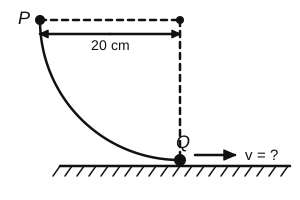
As per the given figure, a small ball $P$ slides down the quadrant of a circle and hits the other ball $Q$ of equal mass which is initially at rest. Neglecting the effect of friction and assuming the collision to be elastic, the velocity of ball $Q$ after collision will be ($g=10\ \text{m s}^{-2}$)
Q 11-05-092JEE MainJEE Main 2023 (30 Jan, Shift 1)Medium
A ball of mass $200\ \text{g}$ rests on a vertical post of height $20\ \text{m}$. A bullet of mass $10\ \text{g}$, travelling in horizontal direction, hits the centre of the ball. After collision both travel independently. The ball hits the ground at a distance $30\ \text{m}$ and the bullet at a distance of $120\ \text{m}$ from the foot of the post. The value of initial velocity of the bullet will be (if $g=10\ \text{m s}^{-2}$)
Concept. After the impact, the ball and the bullet both leave the top of the post horizontally, so each is a horizontal projectile from $20$ m. Their times of fall are equal, and the ranges then give their horizontal speeds just after the collision. Momentum conservation during the impact links these to the bullet's initial speed.
Step 1. Time of fall. Both start with zero vertical velocity: $$20=\tfrac12(10)t^2\ \Rightarrow\ t=2\ \text{s}$$
Step 2. Speeds after the impact. $$v_{\text{ball}}=\frac{30}{2}=15\ \text{m s}^{-1},\qquad v_{\text{bullet}}=\frac{120}{2}=60\ \text{m s}^{-1}$$
Step 3. Momentum conservation. Masses $0.01$ kg (bullet) and $0.2$ kg (ball): $$0.01\,u=0.01\times60+0.2\times15=0.6+3=3.6$$ $$u=360\ \text{m s}^{-1}$$
Answer. Option D, $360\ \text{m s}^{-1}$. The collision is far from elastic: most of the bullet's kinetic energy is lost.
Solution by Sreeraj P, M.Sc Physics
Q 11-05-093JEE MainJEE Main 2023 (30 Jan, Shift 2)Medium
A body of mass $2\ \text{kg}$ is initially at rest. It starts moving unidirectionally under the influence of a source of constant power $P$. Its displacement in $4\ \text{s}$ is $\dfrac13\alpha^2\sqrt P\ \text{m}$. The value of $\alpha$ will be ______.
Q 11-05-094JEE MainJEE Main 2023 (31 Jan, Shift 1)Easy
A lift of mass $M=500\ \text{kg}$ is descending with speed of $2\ \text{m s}^{-1}$. Its supporting cable begins to slip thus allowing it to fall with a constant acceleration of $2\ \text{m s}^{-2}$. The kinetic energy of the lift at the end of fall through to a distance of $6\ \text{m}$ will be ______ kJ.
Q 11-05-095JEE MainJEE Main 2023 (31 Jan, Shift 2)Easy
A ball is dropped from a height of $20\ \text{m}$. If the coefficient of restitution for the collision between ball and floor is $0.5$, after hitting the floor, the ball rebounds to a height of ______ m.
Concept. The coefficient of restitution for a ball hitting the fixed floor is $e=\dfrac{\text{rebound speed}}{\text{impact speed}}$. The height reached is proportional to the square of the speed ($v^2=2gh$), so heights scale by $e^2$.
Answer. $5$ m. Directly: $h'=e^2h=0.25\times20=5$ m.
Solution by Sreeraj P, M.Sc Physics
Q 11-05-096JEE MainJEE Main 2023 (24 Jan, Shift 1)Easy
A spherical body of mass $2\ \text{kg}$ starting from rest acquires a kinetic energy of $10000\ \text{J}$ at the end of $5^\text{th}$ second. The force acted on the body is ______ N.
Q 11-05-097JEE MainJEE Main 2023 (24 Jan, Shift 2)Medium
A body of mass $1\ \text{kg}$ begins to move under the action of a time dependent force $\vec F=\left(t\hat i+3t^2\hat j\right)$ N, where $\hat i$ and $\hat j$ are the unit vectors along $x$ and $y$ axis. The power developed by above force, at the time $t=2$ s, will be ______ W.
Concept. Instantaneous power is $P=\vec F\cdot\vec v$. The force is given, but the velocity must be found by integrating the acceleration $\vec a=\vec F/m$ from rest.
Step 1. Acceleration. With $m=1$ kg, $$\vec a=t\,\hat i+3t^2\,\hat j$$
Step 2. Velocity. The body starts from rest, so integrate from $0$ to $t$: $$\vec v=\frac{t^2}{2}\hat i+t^3\hat j$$
Step 3. Values at $t=2$ s. $$\vec F=2\hat i+12\hat j\ \text{N},\qquad \vec v=2\hat i+8\hat j\ \text{m s}^{-1}$$
Q 11-05-098JEE MainJEE Main 2023 (25 Jan, Shift 1)Medium
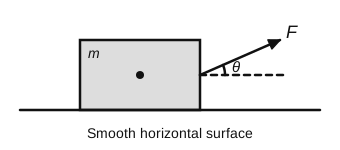
An object of mass $m$ initially at rest on a smooth horizontal plane starts moving under the action of force $F=2\ \text{N}$. In the process of its linear motion, the angle $\theta$ (as shown in figure) between the direction of force and horizontal varies as $\theta=kx$, where $k$ is a constant and $x$ is the distance covered by the object from its initial position. The expression of kinetic energy of the object will be $E=\dfrac nk\sin\theta$. The value of $n$ is ______.
Concept. Only the horizontal component $F\cos\theta$ does work on a body moving horizontally. With $\theta=kx$, integrate; the work equals the kinetic energy gained from rest.
Q 11-05-099JEE MainJEE Main 2023 (25 Jan, Shift 2)Easy
A body of mass $1\ \text{kg}$ collides head on elastically with a stationary body of mass $3\ \text{kg}$. After collision, the smaller body reverses its direction of motion and moves with a speed of $2\ \text{m s}^{-1}$. The initial speed of the smaller body before collision is ______ $\text{m s}^{-1}$.
Concept. In a head-on elastic collision with the second body at rest, momentum and kinetic energy conservation together give the first body's final velocity $v_1=\dfrac{m_1-m_2}{m_1+m_2}\,u$. A negative $v_1$ means it bounces back.
Step 2. Use the given rebound speed. The smaller body moves back at $2\ \text{m s}^{-1}$: $$\frac u2=2\ \Rightarrow\ u=4\ \text{m s}^{-1}$$
Answer. $4\ \text{m s}^{-1}$. Check: the $3$ kg body gets $\dfrac{2(1)}{4}\times4=2\ \text{m s}^{-1}$; momentum $1(-2)+3(2)=4$ and kinetic energy $\tfrac12(4)+\tfrac12(3)(4)=8=\tfrac12(16)$ both match.
Solution by Sreeraj P, M.Sc Physics
Q 11-05-100JEE MainJEE Main 2023 (13 Apr, Shift 2)Easy
A car accelerates from rest to $u\ \text{m s}^{-1}$. The energy spent in this process is $E$ J. The energy required to accelerate the car from $u\ \text{m s}^{-1}$ to $2u\ \text{m s}^{-1}$ is $nE$ J. The value of $n$ is ______.
Concept. By the work–energy theorem, the energy needed to change a car's speed equals the change in its kinetic energy, $\tfrac12mv_2^2-\tfrac12mv_1^2$. Because $K\propto v^2$, equal steps in speed need more and more energy.
Step 1. From rest to $u$. $$E=\tfrac12mu^2-0=\tfrac12mu^2$$
Step 2. From $u$ to $2u$. $$\Delta K=\tfrac12m(2u)^2-\tfrac12mu^2=\tfrac12m(4u^2-u^2)=3\cdot\tfrac12mu^2=3E$$
Answer. $n=3$. Doubling the speed multiplies the kinetic energy by $4$, and $E$ of that was already there.
Solution by Sreeraj P, M.Sc Physics
Q 11-05-101JEE MainJEE Main 2023 (15 Apr, Shift 1)Easy
A block of mass $10\ \text{kg}$ is moving along $x$-axis under the action of force $F=5x$ N. The work done by the force in moving the block from $x=2$ m to $4$ m will be ______ J.
Q 11-05-102JEE MainJEE Main 2023 (10 Apr, Shift 2)Easy
If the maximum load carried by an elevator is $1400\ \text{kg}$ ($600\ \text{kg}$ passengers $+\ 800\ \text{kg}$ elevator), which is moving up with a uniform speed of $3\ \text{m s}^{-1}$ and the frictional force acting on it is $2000\ \text{N}$, then the maximum power used by the motor is ______ kW. ($g=10\ \text{m s}^{-2}$)
Concept. At uniform speed the motor's force balances the weight and the friction: $P=(Mg+f)v$.
Step 1. Force. $1400\times10+2000=16000$ N.
Step 2. Power. $16000\times3=48000$ W $=48$ kW.
Answer. $48$.
Solution by Sreeraj P, M.Sc Physics
Q 11-05-103JEE MainJEE Main 2023 (11 Apr, Shift 1)Easy
A force $\vec F=(2+3x)\hat i$ acts on a particle in the $x$ direction where $F$ is in newton and $x$ is in metre. The work done by this force during a displacement from $x=0$ to $x=4$ m is ______ J.
Q 11-05-104JEE MainJEE Main 2023 (11 Apr, Shift 2)Medium
A block of mass $5\ \text{kg}$ starting from rest is pulled up on a smooth incline plane making an angle of $30^\circ$ with horizontal with an effective acceleration of $1\ \text{m s}^{-2}$. The power delivered by the pulling force at $t=10$ s from the start is ______ W. [Use $g=10\ \text{m s}^{-2}$] (Calculate the nearest integer value)
Concept. The power delivered by a force at an instant is $P=Fv$ when the force is along the velocity. Newton's second law along the smooth incline gives the pulling force; constant acceleration from rest gives the velocity at $t=10$ s.
Step 1. Pulling force. Along the incline, the pull must overcome $mg\sin30^\circ$ and also accelerate the block: $$F-mg\sin30^\circ=ma\ \Rightarrow\ F=5\times10\times\tfrac12+5\times1=25+5=30\ \text{N}$$
Step 2. Velocity at $t=10$ s. $$v=at=1\times10=10\ \text{m s}^{-1}$$
Step 3. Power. $$P=Fv=30\times10=300\ \text{W}$$
Answer. $300$ W.
Solution by Sreeraj P, M.Sc Physics
Q 11-05-105JEE MainJEE Main 2023 (12 Apr, Shift 1)Easy
Given below are two statements:
Statement I: A truck and a car moving with same kinetic energy are brought to rest by applying brakes which provide equal retarding forces. Both come to rest in equal distance.
Statement II: A car moving towards east takes a turn and moves towards north, the speed remains unchanged. The acceleration of the car is zero.
In the light of given statements, choose the most appropriate answer from the options given below.
Answer: (A) Statement I is correct but Statement II is incorrect
Concept. Work–energy theorem: a retarding force $F$ stops a body of kinetic energy $K$ in distance $d=K/F$, whatever its mass. Acceleration is the rate of change of the velocity *vector*.
Step 1. Statement I. Same $K$ and same $F$: same stopping distance. Correct.
Step 2. Statement II. Turning from east to north changes the direction of velocity, so there is an acceleration even at constant speed. Incorrect.
Answer. Statement I is correct but Statement II is incorrect (Option A).
Solution by Sreeraj P, M.Sc Physics
Q 11-05-106JEE MainJEE Main 2023 (12 Apr, Shift 1)Easy
To maintain a speed of $80\ \text{km h}^{-1}$ by a bus of mass $500\ \text{kg}$ on a plane rough road for $4\ \text{km}$ distance, the work done by the engine of the bus will be ______ kJ. [The coefficient of friction between tyre of bus and road is $0.04$]
Concept. At constant speed the net force is zero, so the engine's force equals the friction $\mu mg$, and its work equals the work against friction. The speed itself does not matter.
Step 1. Friction. $f=0.04\times500\times9.8=196$ N.
Q 11-05-107JEE MainJEE Main 2023 (13 Apr, Shift 1)Medium
The ratio of powers of two motors is $\dfrac{3\sqrt x}{\sqrt x+1}$, that are capable of raising $300\ \text{kg}$ water in $5$ minutes and $50\ \text{kg}$ water in $2$ minutes respectively from a well of $100\ \text{m}$ deep. The value of $x$ will be
Q 11-05-109JEE MainJEE Main 2023 (6 Apr, Shift 1)Medium
A particle of mass $10\ \text{g}$ moves in a straight line with retardation $2x$, where $x$ is the displacement in SI units. Its loss of kinetic energy for above displacement is $10^{-n}x^2$ J. The value of $n$ will be ______.
Concept. A retarding force that depends on position: the loss of kinetic energy equals the work done against it, $\displaystyle\int F\,dx$.
Step 1. Force. $F=ma=0.01\times2x=0.02x$ N.
Step 2. Loss of KE. $$\Delta K=\int_0^x0.02x\,dx=0.01x^2=10^{-2}x^2\ \text{J}$$
Answer. $n=2$.
Solution by Sreeraj P, M.Sc Physics
Q 11-05-110JEE MainJEE Main 2023 (6 Apr, Shift 2)Easy
A body is dropped on ground from a height $h_1$ and after hitting the ground, it rebounds to a height $h_2$. If the ratio of velocities of the body just before and after hitting ground is $4$, then percentage loss in kinetic energy of the body is $\dfrac x4$. The value of $x$ is ______.
Answer. $125\%$. The trap is to answer $100\%$ (doubling the $50\%$); the square acts on the factor $1.5$, not on the percentage.
Solution by Sreeraj P, M.Sc Physics
Q 11-05-112JEE MainJEE Main 2023 (8 Apr, Shift 2)Medium
A bullet of mass $0.1$ kg moving horizontally with speed $400\ \text{m s}^{-1}$ hits a wooden block of mass $3.9$ kg kept on a horizontal rough surface. The bullet gets embedded into the block and moves $20$ m before coming to rest. The coefficient of friction between the block and the surface is ______.
Q 11-05-113JEE MainJEE Main 2023 (8 Apr, Shift 2)Easy
A body of mass $5$ kg is moving with a momentum of $10\ \text{kg m s}^{-1}$. Now a force of $2$ N acts on the body in the direction of its motion for $5$ s. The increase in the kinetic energy of the body is ______ J.
Q 11-05-114JEE MainJEE Main 2023 (10 Apr, Shift 1)Easy
A particle of mass $m$ moving with velocity $v$ collides with a stationary particle of mass $2m$. After collision, they stick together and continue to move together with velocity
Concept. Perfectly inelastic collision: momentum is conserved and the bodies move together.
Step 1. Common velocity. $mv=(m+2m)V\Rightarrow V=\dfrac v3$.
Answer. Option A.
Solution by Sreeraj P, M.Sc Physics
Q 11-05-115JEE MainJEE Main 2023 (10 Apr, Shift 1)Medium
A closed circular tube of average radius $15$ cm, whose inner walls are rough, is kept in vertical plane. A block of mass $1$ kg just fits inside the tube. The speed of block is $22\ \text{m s}^{-1}$, when it is introduced at the top of tube. After completing five oscillations, the block stops at the bottom region of tube. The magnitude of work done by the tube on the block is ______ J. (Given $g=10\ \text{m s}^{-2}$)
Concept. Only two agents act on the block: gravity and the tube (normal force plus friction). By the work–energy theorem, $W_{\text{tube}}+W_g=\Delta K$. We only need the start and end states; how many oscillations happen in between does not matter.
Step 1. Change in kinetic energy. The block enters at the top at $22\ \text{m s}^{-1}$ and finally stops: $$\Delta K=0-\tfrac12\times1\times22^2=-242\ \text{J}$$
Step 2. Work by gravity. It ends at the bottom, a diameter ($2\times0.15=0.3$ m) below the top: $$W_g=mgh=1\times10\times0.3=3\ \text{J}$$
Step 3. Work by the tube. $$W_{\text{tube}}=\Delta K-W_g=-242-3=-245\ \text{J}$$
Answer. $245$ J. All the initial kinetic energy plus the potential energy lost is taken away by the rough walls.
Solution by Sreeraj P, M.Sc Physics
Q 11-05-116JEE MainJEE Main 2023 (1 Feb, Shift 1)Easy
A small particle moves to position $5\hat i-2\hat j+\hat k$ from its initial position $2\hat i+3\hat j-4\hat k$ under the action of force $5\hat i+2\hat j+7\hat k$ N. The value of work done will be ______ J.
Q 11-05-117JEE MainJEE Main 2023 (1 Feb, Shift 2)Easy
A force $F=(5+3y^2)$ acts on a particle in the $y$-direction, where $F$ is in newton and $y$ is in metre. The work done by the force during a displacement from $y=2$ m to $y=5$ m is ______ J.
Q 11-05-118JEE MainJEE Main 2022 (24 Jun, Shift 1)Easy
A particle experiences a variable force $\vec F = (4x\hat i + 3y^2\hat j)$ in a horizontal $x$–$y$ plane. Assume distance in metres and force in newton. If the particle moves from point $(1, 2)$ to point $(2, 3)$ in the $x$–$y$ plane, then kinetic energy changes by:
Q 11-05-119JEE MainJEE Main 2022 (24 Jun, Shift 1)Medium
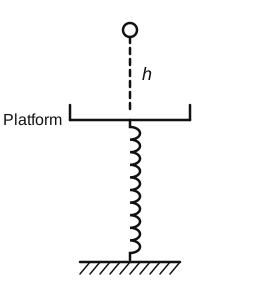
A ball of mass $100\ \text{g}$ is dropped from a height $h = 10\ \text{cm}$ on a platform fixed at the top of a vertical spring (as shown in figure). The ball stays on the platform and the platform is depressed by a distance $\dfrac h2$. The spring constant is ______ $\text{N m}^{-1}$. (Use $g = 10\ \text{m s}^{-2}$)
Q 11-05-120JEE MainJEE Main 2022 (24 Jun, Shift 2)Easy
Potential energy as a function of $r$ is given by $U = \dfrac{A}{r^{10}} - \dfrac{B}{r^5}$, where $r$ is the interatomic distance, $A$ and $B$ are positive constants. The equilibrium distance between the two atoms will be:
Answer. Option C. This is a minimum of $U$, so the equilibrium is stable.
Solution by Sreeraj P, M.Sc Physics
Q 11-05-121JEE MainJEE Main 2022 (25 Jun, Shift 1)Easy
A $0.5\ \text{kg}$ block moving at a speed of $12\ \text{m s}^{-1}$ compresses a spring through a distance $30\ \text{cm}$ when its speed is halved. The spring constant of the spring will be ______ $\text{N m}^{-1}$.
Concept. While the block compresses the spring (on a smooth surface), mechanical energy is conserved: the kinetic energy lost by the block is stored as elastic potential energy $\tfrac12kx^2$.
Step 1. Kinetic energy lost. The speed falls from $12$ to $6\ \text{m s}^{-1}$: $$\Delta K=\tfrac12(0.5)(12^2-6^2)=0.25\times108=27\ \text{J}$$
Step 2. Energy in the spring. Compression $x=30$ cm $=0.3$ m: $$\tfrac12k(0.3)^2=0.045\,k$$
Step 3. Equate and solve. $$0.045\,k=27\ \Rightarrow\ k=600\ \text{N m}^{-1}$$
Answer. $600\ \text{N m}^{-1}$. Use the loss in kinetic energy, not the final kinetic energy.
Solution by Sreeraj P, M.Sc Physics
Q 11-05-122JEE MainJEE Main 2022 (26 Jun, Shift 1)Medium
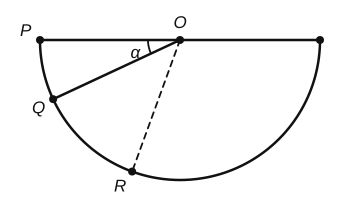
A ball is released from rest from point $P$ of a smooth semi-spherical vessel as shown in figure. The ratio of the centripetal force and normal reaction on the ball at point $Q$ is $A$, while the angular position of point $Q$ is $\alpha$ with respect to point $P$. Which of the following graphs represents the correct relation between $A$ and $\alpha$ when the ball goes from $Q$ to $R$?
Concept. In a smooth hemispherical bowl released from the rim, at an angle $\alpha$ below the rim the ball has fallen $R\sin\alpha$. Energy gives the speed; the radial equation gives the normal force.
Step 1. Speed. $v^2=2gR\sin\alpha$, so the centripetal force is $\dfrac{mv^2}{R}=2mg\sin\alpha$.
Step 2. Normal force. Towards the centre: $N-mg\sin\alpha=\dfrac{mv^2}{R}\Rightarrow N=3mg\sin\alpha$.
Step 3. Ratio. $A=\dfrac{2mg\sin\alpha}{3mg\sin\alpha}=\dfrac23$, a constant: a horizontal line.
Answer. Option C.
Solution by Sreeraj P, M.Sc Physics
Q 11-05-123JEE MainJEE Main 2022 (26 Jun, Shift 2)Medium
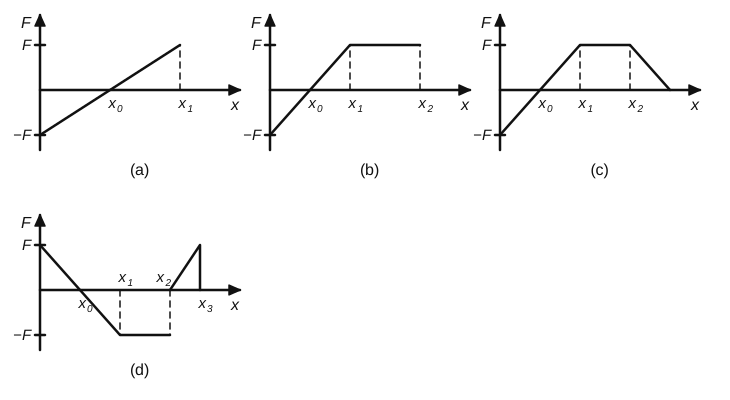
Arrange the four graphs in descending order of total work done, where $W_1, W_2, W_3$ and $W_4$ are the work done corresponding to figures $a, b, c$ and $d$ respectively.
Concept. Work is the signed area under the $F$–$x$ graph: area above the axis is positive, below it negative.
Step 1. Compare the graphs. Call the first part of each graph (the sloping line up to $x_1$) the "ramp".
(a) The ramp from $-F$ to $+F$: a small negative triangle and a positive triangle. $W_1$ is small.
(b) The same ramp, then a rectangle $F(x_2-x_1)$ above the axis: $W_2=W_1+F(x_2-x_1)>W_1$.
(c) As (b), plus a triangle above the axis after $x_2$: $W_3>W_2$.
(d) The mirror-image ramp (from $+F$ down to $-F$, about $-W_1$), then a rectangle $-F(x_2-x_1)$ below the axis, and only a small positive triangle at the end: $W_4\lt W_1$ (negative).
Step 2. Order. $W_3>W_2>W_1>W_4$.
Answer. Option A.
Solution by Sreeraj P, M.Sc Physics
Q 11-05-124JEE MainJEE Main 2022 (25 Jul, Shift 1)Easy
A body of mass $0.5\ \text{kg}$ travels on a straight line path with velocity $v = (3x^2 + 4)\ \text{m s}^{-1}$. The net work done by the force during its displacement from $x = 0$ to $x = 2\ \text{m}$ is
Concept. The work–energy theorem says the net work by all forces equals the change in kinetic energy. The velocity is given as a function of position, so we only need the speeds at the two end points; there is no need to find the force.
Step 1. Speeds at the ends. $$v(0)=3(0)^2+4=4\ \text{m s}^{-1},\qquad v(2)=3(2)^2+4=16\ \text{m s}^{-1}$$
Step 2. Apply the work–energy theorem. $$W=\tfrac12m\left(v_2^2-v_1^2\right)=\tfrac12(0.5)\left(16^2-4^2\right)=0.25\times(256-16)$$
Q 11-05-125JEE MainJEE Main 2022 (25 Jul, Shift 2)Medium
A bag of sand of mass $9.8\ \text{kg}$ is suspended by a rope. A bullet of $200\ \text{g}$ travelling with speed $10\ \text{m s}^{-1}$ gets embedded in it. Then the loss of kinetic energy will be
Concept. Momentum in the collision; loss $=$ KE before $-$ after.
Step 1. Speed. $v = \dfrac{2}{10} = 0.2$ m/s.
Step 2. Loss. $10 - 0.2 = 9.8$ J.
Answer. $9.8\ \text{J}$ (Option B).
Solution by Sreeraj P, M.Sc Physics
Q 11-05-126JEE MainJEE Main 2022 (26 Jul, Shift 1)Medium
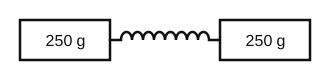
As per the given figure, two blocks each of mass $250\ \text{g}$ are connected to a spring of spring constant $2\ \text{N m}^{-1}$. If both are given velocity $v$ in opposite directions, then the maximum elongation of the spring is
Concept. No external horizontal force acts, so the momentum of the pair is conserved. The blocks have equal masses and equal, opposite velocities, so the total momentum is zero and the centre of mass stays at rest. At maximum elongation the blocks have no relative velocity, so both are momentarily at rest, and all the kinetic energy is in the spring.
Step 1. Initial kinetic energy. Each block has $m=0.25$ kg and speed $v$: $$K=2\times\tfrac12(0.25)v^2=0.25\,v^2$$
Step 2. Spring energy at maximum stretch. $$\tfrac12kx^2=\tfrac12(2)x^2=x^2$$
Step 3. Energy conservation. $$x^2=0.25\,v^2\ \Rightarrow\ x=\frac v2$$
Answer. Option B. General form: $\tfrac12\mu v_{\text{rel}}^2=\tfrac12kx^2$ with $\mu=\tfrac{m}{2}=0.125$ kg and $v_{\text{rel}}=2v$ gives the same result.
Solution by Sreeraj P, M.Sc Physics
Q 11-05-127JEE MainJEE Main 2022 (26 Jul, Shift 2)Easy
A body of mass $8\ \text{kg}$ and another of mass $2\ \text{kg}$ are moving with equal kinetic energy. The ratio of their respective momenta will be
Q 11-05-128JEE MainJEE Main 2022 (27 Jun, Shift 1)Medium
What percentage of kinetic energy of a moving particle is transferred to a stationary particle when it strikes the stationary particle of $5$ times its mass? (Assume the collision to be head-on elastic collision)
Concept. In a head-on elastic collision with the target at rest, the target's velocity is $v_2=\dfrac{2m_1}{m_1+m_2}u$. The fraction of kinetic energy transferred is $\dfrac{\tfrac12m_2v_2^2}{\tfrac12m_1u^2}=\dfrac{4m_1m_2}{(m_1+m_2)^2}$.
Answer. Option C. The transfer is complete ($100\%$) only for equal masses.
Solution by Sreeraj P, M.Sc Physics
Q 11-05-129JEE MainJEE Main 2022 (27 Jun, Shift 1)Medium
A pendulum of length $2$ m consists of a wooden bob of mass $50$ g. A bullet of mass $75$ g is fired towards the stationary bob with a speed $v$. The bullet emerges out of the bob with a speed $\dfrac{v}{3}$ and the bob just completes the vertical circle. The value of $v$ is ______ $\text{m s}^{-1}$ (if $g = 10\ \text{m s}^{-2}$).
Q 11-05-130JEE MainJEE Main 2022 (27 Jun, Shift 2)Medium
A stone tied to a string of length $L$ is whirled in a vertical circle with the other end of the string at the centre. At a certain instant of time, the stone is at its lowest position and has a speed $u$. The magnitude of change in its velocity, as it reaches a position where the string is horizontal, is $\sqrt{x(u^2 - gL)}$. The value of $x$ is
Concept. Velocity is a vector, so the change in velocity needs the directions as well as the speeds. Energy conservation gives the speed when the string is horizontal; the two velocities are perpendicular, so the size of the change follows from Pythagoras.
Step 1. Speed with the string horizontal. The stone rises by $L$: $$v^2=u^2-2gL$$
Step 2. Directions. At the lowest point the velocity is horizontal. With the string horizontal the velocity is vertical (tangent to the circle). So $\vec u\perp\vec v$.
Step 3. Magnitude of the change. $$|\Delta\vec v|=\sqrt{u^2+v^2}=\sqrt{u^2+u^2-2gL}=\sqrt{2(u^2-gL)}$$
Answer. Option A, $x=2$. Subtracting the speeds ($u-v$) is the common mistake.
Solution by Sreeraj P, M.Sc Physics
Q 11-05-131JEE MainJEE Main 2022 (27 Jul, Shift 1)Medium
Sand is being dropped from a stationary dropper at a rate of $0.5\ \text{kg s}^{-1}$ on a conveyor belt moving with a velocity of $5\ \text{m s}^{-1}$. The power needed to keep belt moving with the same velocity will be
Concept. Sand lands on the belt with no horizontal velocity and must be brought up to the belt's speed $v$. The horizontal momentum given to the sand per second is $v\,\dfrac{dm}{dt}$, which is the extra force the belt must supply. Power is that force times the belt speed.
Step 1. Force needed. $$F=v\frac{dm}{dt}=5\times0.5=2.5\ \text{N}$$
Step 2. Power. $$P=Fv=2.5\times5=12.5\ \text{W}$$
Answer. Option D. Only half of this, $\tfrac12v^2\,\tfrac{dm}{dt}=6.25$ W, becomes the sand's kinetic energy; the other half is lost to friction while the sand slips on the belt.
Solution by Sreeraj P, M.Sc Physics
Q 11-05-132JEE MainJEE Main 2022 (27 Jul, Shift 1)Medium
Two cylindrical vessels of equal cross-sectional area $16\ \text{cm}^2$ contain water upto heights $100$ cm and $150$ cm respectively. The vessels are interconnected so that the water levels in them become equal. The work done by the force of gravity during the process, is [Take density of water $= 10^3\ \text{kg m}^{-3}$ and $g = 10\ \text{m s}^{-2}$]
Concept. Work by gravity $=-\Delta U$. When the levels equalise, only the top layer of the taller column moves: it drops into the other vessel. Use the centre of mass of that layer.
Step 1. Final level. Equal areas: $\dfrac{100+150}{2}=125$ cm.
Step 2. Water moved. The layer from $125$ to $150$ cm: volume $16\times25=400$ cm$^3$, mass $0.4$ kg. Its centre was at $137.5$ cm; it ends up between $100$ and $125$ cm in the other vessel, centre at $112.5$ cm. Drop $=25$ cm.
Step 3. Work. $W=0.4\times10\times0.25=1$ J.
Answer. $1$ J (Option B).
Solution by Sreeraj P, M.Sc Physics
Q 11-05-133JEE MainJEE Main 2022 (28 Jul, Shift 1)Easy
A block of mass $m$, sliding on a smooth horizontal surface with kinetic energy $E$, hits a spring fixed to a wall and compresses it through a distance $25$ cm when its speed is halved. The value of spring constant of used spring will be $nE\ \text{N m}^{-1}$ for $n$ = ______ .
Concept. On a smooth surface, the kinetic energy lost by the block is stored in the spring: $\Delta K=\tfrac12kx^2$.
Step 1. KE lost. Speed halved: KE becomes $\tfrac E4$, so the loss is $\tfrac34E$.
Step 2. Spring. $\tfrac34E=\tfrac12k(0.25)^2\Rightarrow k=\dfrac{1.5E}{0.0625}=24E$ N m$^{-1}$.
Answer. $24$.
Solution by Sreeraj P, M.Sc Physics
Q 11-05-134JEE MainJEE Main 2021 (27 Jul, Shift 1)Easy
Three objects $A$, $B$ and $C$ are kept in a straight line on a frictionless horizontal surface. The masses of $A$, $B$ and $C$ are $m$, $2m$ and $2m$ respectively. $A$ moves towards $B$ with a speed of $9\ \text{m s}^{-1}$ and makes an elastic collision with it. Thereafter $B$ makes a completely inelastic collision with $C$. All motions occur along the same straight line. The final speed of $C$ is:
Concept. Two separate collisions, taken one at a time. The first ($A$ on $B$) is elastic with $B$ at rest, so $v_B=\dfrac{2m_A}{m_A+m_B}u$. The second ($B$ on $C$) is perfectly inelastic, so they stick and only momentum conservation is needed.
Step 1. $A$ hits $B$ elastically. $$v_B=\frac{2m}{m+2m}\times9=\frac23\times9=6\ \text{m s}^{-1}$$ ($A$ itself moves back at $\tfrac{m-2m}{3m}\times9=-3\ \text{m s}^{-1}$, away from the others.)
Q 11-05-135JEE MainJEE Main 2021 (27 Jul, Shift 2)Medium
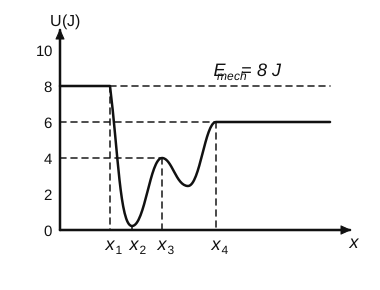
Given below is the plot of a potential energy function $U(x)$ for a system, in which a particle is in one dimensional motion, while a conservative force $F(x)$ acts on it. Suppose that $E_{\text{mech}} = 8$ J, the incorrect statement for this system is: [where K.E. = kinetic energy]
Answer: (B) at $x < x_1$, K.E. is smallest and the particle is moving at the slowest speed.
Concept. For a conservative force the mechanical energy is constant, so at every point $K=E-U$. Reading $U$ from the graph gives $K$ directly. The particle can be only where $U\le E$; where $U=E$ its kinetic energy is zero, so it is at rest.
Step 1. Read the graph. With $E=8$ J:
For $x<x_1$: $U=8$ J.
At $x_2$: $U$ is at its lowest, about $0$.
At $x_3$: $U=4$ J.
For $x>x_4$: $U=6$ J, constant.
Step 2. Check each statement with $K=8-U$.
(A) $x>x_4$: $K=8-6=2$ J everywhere there. Constant, so true.
(B) $x<x_1$: $K=8-8=0$. The particle is at rest, not "moving at the slowest speed". False.
(C) $x=x_2$: $U$ is least, so $K$ is greatest and the speed is greatest. True.
(D) $x=x_3$: $K=8-4=4$ J. True.
Answer. Option B is the incorrect statement. Where $U=E$ the speed is zero.
Solution by Sreeraj P, M.Sc Physics
Q 11-05-136JEE MainJEE Main 2021 (27 Jul, Shift 2)Medium
An automobile of mass $m$ accelerates starting from the origin and initially at rest, while the engine supplies constant power $P$. The position is given as a function of time by:
Concept. Constant power from rest: the work done $Pt$ equals the kinetic energy $\tfrac12mv^2$ (work–energy theorem). Solve for $v(t)$ and integrate to get $x(t)$.
Step 2. Position. Starting from the origin: $$x=\int_0^t\sqrt{\frac{2P}{m}}\;t^{1/2}\,dt=\sqrt{\frac{2P}{m}}\cdot\frac23t^{3/2}$$
Step 3. Tidy the constant. Bring $\tfrac23$ inside the square root as $\tfrac49$: $$x=\sqrt{\frac{2P}{m}\cdot\frac49}\;t^{3/2}=\left(\frac{8P}{9m}\right)^{1/2}t^{3/2}$$
Answer. Option D. Option B has the wrong power of $t$; a dimension check ($P/m$ has units $\text{m}^2\text{s}^{-3}$) confirms $t^{3/2}$.
Solution by Sreeraj P, M.Sc Physics
Q 11-05-137JEE MainJEE Main 2021 (27 Jul, Shift 2)Easy
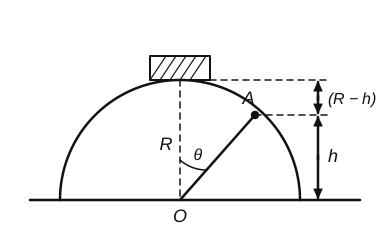
A small block slides down from the top of hemisphere of radius $R = 3$ m as shown in the figure. The height $h$ at which the block will lose contact with the surface of the sphere is ______ m. (Assume there is no friction between the block and the hemisphere)
Concept. The block moves on a circle of radius $R$. Along the radius, Newton's second law gives $mg\cos\theta-N=\dfrac{mv^2}{R}$, where $\theta$ is measured from the vertical. The block leaves the surface when $N=0$. Energy conservation (smooth surface) gives $v$ at each angle.
Step 1. Speed at angle $\theta$. The height of the block above the centre $O$ is $R\cos\theta$, so it has fallen $R(1-\cos\theta)$: $$v^2=2gR(1-\cos\theta)$$
Step 2. Condition for leaving. Put $N=0$: $$mg\cos\theta=\frac{mv^2}{R}=2mg(1-\cos\theta)$$ $$3\cos\theta=2\ \Rightarrow\ \cos\theta=\frac23$$
Step 3. Height above the base. In the figure $h$ is measured from $O$: $$h=R\cos\theta=\frac23\times3=2\ \text{m}$$
Answer. $2$ m. The block always leaves a smooth hemisphere at $\tfrac23R$ above the centre, whatever the radius or mass.
Solution by Sreeraj P, M.Sc Physics
Q 11-05-138JEE MainJEE Main 2021 (31 Aug, Shift 1)Hard
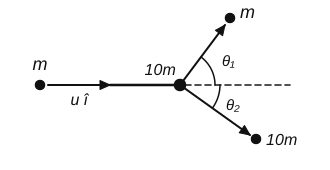
A body of mass $M$ moving at speed $V_0$ collides elastically with a mass $m$ at rest. After the collision, the two masses move at angles $\theta_1$ and $\theta_2$ with respect to the initial direction of motion of the body of mass $M$. The largest possible value of the ratio $\dfrac Mm$, for which the angles $\theta_1$ and $\theta_2$ will be equal, is:
Concept. Momentum (two components) and energy for the elastic collision with $\theta_1 = \theta_2$.
Step 1. Perpendicular. $mv_2 = Mv_1$.
Step 2. Along. $V_0 = 2v_1\cos\theta$.
Step 3. Energy. $4\cos^2\theta = 1 + \dfrac Mm \Rightarrow \dfrac Mm \le 3$.
Answer. $3$ (Option A).
Solution by Sreeraj P, M.Sc Physics
Q 11-05-139JEE MainJEE Main 2021 (31 Aug, Shift 1)Easy
A block moving horizontally on a smooth surface with a speed of $40\ \text{m s}^{-1}$ splits into two equal parts. If one of the parts moves at $60\ \text{m s}^{-1}$ in the same direction, then the fractional change in the kinetic energy will be $x : 4$ where $x$ = ______.
Q 11-05-140JEE MainJEE Main 2021 (31 Aug, Shift 2)Easy
A block moving horizontally on a smooth surface with a speed of $40\ \text{m s}^{-1}$ splits into two parts with masses in the ratio of $1 : 2$. If the smaller part moves at $60\ \text{m s}^{-1}$ in the same direction, then the fractional change in kinetic energy is:
Q 11-05-141JEE MainJEE Main 2021 (24 Feb, Shift 1)Easy
A ball with a speed of $9\ \text{m s}^{-1}$ collides with another identical ball at rest. After the collision, the direction of each ball makes an angle of $30^\circ$ with the original direction. If the ratio of velocities of the balls after the collision is $x : y$, then what is the value of $x$?
Step 2. Ratio. $1:1$, so $x=1$. (Forward: $2v\cos30^\circ=9\Rightarrow v=3\sqrt3$ m s$^{-1}$ each.)
Answer. $1$.
Solution by Sreeraj P, M.Sc Physics
Q 11-05-142JEE MainJEE Main 2021 (24 Feb, Shift 2)Easy
Two solids $A$ and $B$ of mass 1 kg and 2 kg respectively are moving with equal linear momentum. The ratio of their kinetic energies $(K.E.)_A : (K.E.)_B$ will be $\dfrac{A}{1}$, so the value of $A$ will be ______.
Q 11-05-143JEE MainJEE Main 2021 (25 Feb, Shift 1)Easy
The potential energy $(U)$ of a diatomic molecule is a function dependent on $r$ (interatomic distance) as $U = \dfrac{\alpha}{r^{10}} - \dfrac{\beta}{r^5} - 3$ where, $\alpha$ and $\beta$ are positive constants. The equilibrium distance between two atoms will be $\left(\dfrac{2\alpha}{\beta}\right)^{\frac{a}{5}}$, where $a$ = ______.
Step 2. Solve. $r^5=\dfrac{2\alpha}{\beta}\Rightarrow r=\left(\dfrac{2\alpha}{\beta}\right)^{1/5}$, so $a=1$. (The constant $-3$ does not affect the force.)
Answer. $1$.
Solution by Sreeraj P, M.Sc Physics
Q 11-05-144JEE MainJEE Main 2021 (18 Mar, Shift 2)Medium
An object of mass $m_1$ collides with another object of mass $m_2$, which is at rest. After the collision the objects move with equal speeds in opposite direction. The ratio of the masses $m_2 : m_1$ is:
Q 11-05-145JEE MainJEE Main 2021 (18 Mar, Shift 2)Easy
A ball of mass 4 kg, moving with a velocity of $10\ \text{m s}^{-1}$, collides with a spring of length 8 m and force constant $100\ \text{N m}^{-1}$. The length of the compressed spring is $x$ m. The value of $x$, to the nearest integer, is ______.
Concept. All KE goes into the spring at maximum compression.
Step 1. Compression. $\dfrac12(4)(100) = \dfrac12(100)d^2 \Rightarrow d = 2$ m.
Step 2. Length. $8 - 2 = 6$ m.
Answer. $6$.
Solution by Sreeraj P, M.Sc Physics
Q 11-05-146JEE MainJEE Main 2021 (20 Jul, Shift 1)Easy
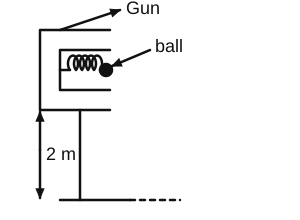
In a spring gun having spring constant $100\ \text{N m}^{-1}$ a small ball $B$ of mass 100 g is put in its barrel (as shown in figure) by compressing the spring through 0.05 m. There should be a box placed at a distance $d$ on the ground so that the ball falls in it. If the ball leaves the gun horizontally at a height of 2 m above the ground. The value of $d$ is ______ m.
Step 2. Time to fall 2 m. $t=\sqrt{\dfrac{2\times2}{10}}=\sqrt{0.4}\approx0.632$ s.
Step 3. Distance. $d=vt=\sqrt{2.5\times0.4}=\sqrt1=1$ m.
Answer. $1$.
Solution by Sreeraj P, M.Sc Physics
Q 11-05-147JEE MainJEE Main 2021 (20 Jul, Shift 2)Easy
A body at rest is moved along a horizontal straight line by a machine delivering a constant power. The distance moved by the body in time $t$ is proportional to:
Q 11-05-149JEE MainJEE Main 2021 (22 Jul, Shift 1)Easy
A porter lifts a heavy suitcase of mass 80 kg and at the destination lowers it down by a distance of 80 cm with a constant velocity. Calculate the work done by the porter in lowering the suitcase. (take $g = 9.8\ \text{m s}^{-2}$)
Q 11-05-150JEE MainJEE Main 2021 (26 Feb, Shift 1)Easy
Given below are two statements: one is labelled as Assertion A and the other is labelled as Reason R.
Assertion A: Body $P$ having mass $M$ moving with speed $u$ has head-on collision elastically with another body $Q$ having mass $m$ initially at rest. If $m \ll M$, body $Q$ will have a maximum speed equal to $2u$ after collision.
Reason R: During elastic collision, the momentum and kinetic energy are both conserved.
In the light of the above statements, choose the most appropriate answer from the options given below:
Answer: (C) Both A and R are correct and R is the correct explanation of A
Concept. Elastic head-on collision with the target at rest: $v_2=\dfrac{2M}{M+m}u$. Both momentum and kinetic energy conservation are used to derive it.
Step 1. Assertion. For $m\ll M$, $v_2\to\dfrac{2M}{M}u=2u$, the largest possible. True.
Step 2. Reason. In an elastic collision momentum and kinetic energy are both conserved. True, and the result in A comes from exactly these two conditions.
Answer. Both correct and R is the correct explanation of A (Option C).
Solution by Sreeraj P, M.Sc Physics
Q 11-05-151JEE MainJEE Main 2021 (25 Jul, Shift 2)Easy
A force of $F = (5y + 20)\hat{j}$ N acts on a particle. The work done by this force when the particle is moved from $y = 0$ m to $y = 10$ m is ______ J.
Step 1. Integrate. $\Big[2.5y^2 + 20y\Big]_0^{10} = 450$ J.
Answer. $450$.
Solution by Sreeraj P, M.Sc Physics
Q 11-05-152JEE MainJEE Main 2021 (26 Aug, Shift 1)Medium
A uniform chain of length $3$ m and mass $3$ kg overhangs a smooth table with $2$ m laying on the table. If $K$ is the kinetic energy of the chain in J as it completely slips off the table, then the value of $K$ is (Take $g = 10$ m s$^{-2}$)
Concept. The table is smooth, so mechanical energy is conserved: the kinetic energy gained equals the potential energy lost. For a chain, the potential energy of each part is found from the height of that part's centre of mass.
Step 1. Choose the zero. Take the table top as $U=0$. The part on the table has $U=0$ throughout. The chain has $1$ kg per metre.
Step 2. Initial potential energy. $1$ m (mass $1$ kg) hangs, its centre of mass $0.5$ m below the edge: $$U_i=-1\times10\times0.5=-5\ \text{J}$$
Step 3. Final potential energy. When it just leaves the table, all $3$ m (mass $3$ kg) hang, centre of mass $1.5$ m below the edge: $$U_f=-3\times10\times1.5=-45\ \text{J}$$
Q 11-05-153JEE MainJEE Main 2021 (27 Aug, Shift 1)Easy
Two persons $A$ and $B$ perform same amount of work in moving a body through a certain distance $d$ with application of forces acting at angles $45^\circ$ and $60^\circ$ with the direction of displacement respectively. The ratio of force applied by person $A$ to the force applied by person $B$ is $\frac{1}{\sqrt{x}}$. The value of $x$ is ______.
Q 11-05-154JEE MainJEE Main 2021 (27 Aug, Shift 2)Medium
A bullet of $10$ g, moving with velocity $v$, collides head-on with the stationary bob of a pendulum and recoils with velocity $100$ m s$^{-1}$. The length of the pendulum is $0.5$ m and mass of the bob is $1$ kg. The minimum value of $v$ in m s$^{-1}$, so that the pendulum describes a circle. (Assume the string to be inextensible and $g = 10$ m s$^{-2}$)
Concept. Two stages. In the impact, the string is vertical and gives no horizontal impulse, so horizontal momentum is conserved. After the impact, the bob must have at least $\sqrt{5gl}$ at the bottom to go round a full vertical circle on a string.
Step 1. Minimum speed of the bob. $$V=\sqrt{5gl}=\sqrt{5\times10\times0.5}=5\ \text{m s}^{-1}$$
Step 2. Momentum in the impact. Take the bullet's initial direction as positive. The bullet recoils, so its final velocity is $-100\ \text{m s}^{-1}$: $$0.01\,v=0.01(-100)+1\times5$$
Answer. $400\ \text{m s}^{-1}$. Taking the recoil velocity as $+100$ would give $600\ \text{m s}^{-1}$; always keep the sign of a rebound.
Solution by Sreeraj P, M.Sc Physics
Q 11-05-155JEE MainJEE Main 2020 (8 Jan, Shift 2)Medium
A particle of mass $m$ is dropped from a height $h$ above the ground. At the same time another particle of the same mass is thrown vertically upwards from the ground with a speed of $\sqrt{2gh}$. If they collide head-on completely inelastically, the time taken for the combined mass to reach the ground, in units of $\sqrt{\dfrac{h}{g}}$ is:
Concept. First find where and when they meet (relative motion: they close at the constant speed $\sqrt{2gh}$), then their velocities; the sticking conserves momentum; then the combined mass falls freely.
Step 2. Velocities then (up positive). Dropped: $-gt=-\sqrt{\dfrac{gh}{2}}$. Thrown: $\sqrt{2gh}-\sqrt{\dfrac{gh}2}=+\sqrt{\dfrac{gh}2}$. Equal masses, opposite velocities: the combined mass is at rest.
Step 4. Fall time. $\sqrt{\dfrac{2(3h/4)}{g}}=\sqrt{\dfrac32}\sqrt{\dfrac hg}$.
Answer. Option D.
Solution by Sreeraj P, M.Sc Physics
Q 11-05-157JEE MainJEE Main 2020 (9 Jan, Shift 1)Medium
Two particles of equal mass $m$ have respective initial velocities $u\hat{i}$ and $u\left(\dfrac{\hat{i} + \hat{j}}{2}\right)$. They collide completely inelastically. The energy lost in the process is:
Q 11-05-158JEE MainJEE Main 2020 (9 Jan, Shift 2)Medium
A particle of mass $m$ is projected with a speed $u$ from the ground at an angle $\theta = \dfrac{\pi}{3}$ w.r.t. horizontal ($x$-axis). When it has reached its maximum height, it collides completely inelastically with another particle of the same mass and velocity $u\hat{i}$. The horizontal distance covered by the combined mass before reaching the ground is:
Concept. At the top the projectile's velocity is horizontal, $u\cos\theta$. The sticking conserves horizontal momentum; then the combined mass falls from the maximum height as a horizontal projection.
Step 1. At the top. $v=u\cos60^\circ=\dfrac u2$; height $H=\dfrac{u^2\sin^260^\circ}{2g}=\dfrac{3u^2}{8g}$.
Q 11-05-159JEE MainJEE Main 2020 (5 Sep, Shift 2)Medium
A body of mass $2$ kg is driven by an engine delivering a constant power of $1\ \text{J s}^{-1}$. The body starts from rest and moves in a straight line. After $9$ s, the body has moved a distance (in m) ______.
Concept. With constant power, the work done in time $t$ is $Pt$, and by the work–energy theorem it equals the kinetic energy gained. This gives the speed as a function of time; integrating the speed gives the distance.
Step 1. Speed as a function of time. From rest: $$Pt=\tfrac12mv^2\ \Rightarrow\ v=\sqrt{\frac{2Pt}{m}}=\sqrt{\frac{2\times1\times t}{2}}=\sqrt t\ \text{m s}^{-1}$$
Step 2. Distance. $v=\dfrac{dx}{dt}$, so $$x=\int_0^9\sqrt t\,dt=\frac23t^{3/2}\Big|_0^9=\frac23\times27=18\ \text{m}$$
Answer. $18$ m. With constant power $v\propto t^{1/2}$ and $x\propto t^{3/2}$; constant-acceleration formulas do not apply.
Solution by Sreeraj P, M.Sc Physics
Q 11-05-160JEE MainJEE Main 2020 (6 Sep, Shift 1)Medium
If the potential energy between two molecules is given by $U = -\dfrac{A}{r^6} + \dfrac{B}{r^{12}}$, then at equilibrium, the separation between the molecules and the potential energy are:
Q 11-05-161JEE MainJEE Main 2020 (6 Sep, Shift 1)Medium
Two bodies of the same mass are moving with the same speed, but in different directions in a plane. They have a completely inelastic collision and move together thereafter with a final speed which is half of their initial speed. The angle between the initial velocities of the two bodies (in degree) is ______.
Concept. In a perfectly inelastic collision the bodies stick, and momentum (a vector) is conserved. The total initial momentum is the resultant of two equal vectors $mv$ at angle $\theta$, which has magnitude $2mv\cos\dfrac\theta2$.
Step 1. Initial momentum. By the parallelogram rule, $$|\vec p|=\sqrt{(mv)^2+(mv)^2+2(mv)^2\cos\theta}=mv\sqrt{2(1+\cos\theta)}=2mv\cos\frac\theta2$$
Step 2. Final momentum. Mass $2m$ moving at $\tfrac v2$: $$p_f=2m\cdot\frac v2=mv$$
Q 11-05-162JEE MainJEE Main 2020 (6 Sep, Shift 2)Medium
Particle A of mass $m_1$ moving with velocity $(\sqrt3\hat i + \hat j)\ \text{m s}^{-1}$ collides with another particle B of mass $m_2$ which is at rest initially. Let $\vec v_1$ and $\vec v_2$ be the velocities of particles A and B after the collision respectively. If $m_1 = 2m_2$ and after the collision $\vec v_1 = (\hat i + \sqrt3\hat j)\ \text{m s}^{-1}$, the angle between $\vec v_1$ and $\vec v_2$ is:
Step 1. Velocity of B. $\vec v_2 = 2(\sqrt3 - 1)(\hat i - \hat j)$, at $-45°$.
Step 2. Angle. $\vec v_1$ at $60°$: difference $105°$.
Answer. $105°$ (Option D).
Solution by Sreeraj P, M.Sc Physics
Q 11-05-163JEE MainJEE Main 2020 (7 Jan, Shift 1)Easy
A $60$ HP electric motor lifts an elevator having a maximum total load capacity of $2000$ kg. If the frictional force on the elevator is $4000$ N, the speed of the elevator at full load is close to: ($1$ HP $= 746$ W, $g = 10\ \text{m s}^{-2}$)
Concept. At steady speed the motor's power goes into lifting against the weight and the friction: $P=(Mg+f)v$.
Step 1. Power. $60\times746=44760$ W.
Step 2. Force. $2000\times10+4000=24000$ N.
Step 3. Speed. $v=\dfrac{44760}{24000}\approx1.87\approx1.9$ m s$^{-1}$.
Answer. Option B.
Solution by Sreeraj P, M.Sc Physics
Q 11-05-164JEE MainJEE Main 2020 (7 Jan, Shift 1)Easy
A particle ($m = 1$ kg) slides down a frictionless track (AOC) starting from rest at a point A (height $2$ m). After reaching C, the particle continues to move freely in air as a projectile. When it reaches its highest point P (height $1$ m), the kinetic energy of the particle (in J) is ______. (Figure drawn is schematic and not to scale; take $g = 10\ \text{m s}^{-2}$)
Concept. The track is frictionless and the normal force does no work, and in the air only gravity acts. So mechanical energy is conserved all the way from $A$ to $P$. The shape of the track does not matter; only the heights of the two points do.
Step 1. Energy at $A$. At rest at $2$ m: $$E_A=0+mgh_A=1\times10\times2=20\ \text{J}$$
Step 2. Energy at $P$. At the top of its flight the particle is at $1$ m and still moving horizontally: $$E_P=K_P+mgh_P=K_P+1\times10\times1=K_P+10$$
Step 3. Equate. $$K_P=20-10=10\ \text{J}$$
Answer. $10$ J. At the highest point of a projectile the speed is not zero; the horizontal component remains.
Solution by Sreeraj P, M.Sc Physics
Q 11-05-165JEE MainJEE Main 2020 (7 Jan, Shift 2)Easy
An elevator in a building can carry a maximum of $10$ persons, with the average mass of each person being $68$ kg. The mass of the elevator itself is $920$ kg and it moves with a constant speed of $3$ m/s. The frictional force opposing the motion is $6000$ N. If the elevator is moving up with its full capacity, the power delivered by the motor to the elevator ($g = 10\ \text{m/s}^2$) must be at least:
Answer. Option D, $66000$ W. Forgetting the friction gives $48000$ W, option C.
Solution by Sreeraj P, M.Sc Physics
Q 11-05-166JEE MainJEE Main 2020 (8 Jan, Shift 1)Medium
A body A of mass $m = 0.1$ kg has an initial velocity of $3\hat i\ \text{m s}^{-1}$. It collides elastically with another body B of the same mass which has an initial velocity of $5\hat j\ \text{m s}^{-1}$. After the collision, A moves with a velocity $\vec v = 4(\hat i + \hat j)\ \text{m s}^{-1}$. The energy of B after the collision is written as $\dfrac{x}{10}$ J. The value of $x$ is ______.
Q 11-05-167JEE MainJEE Main 2020 (2 Sep, Shift 1)Medium
A particle of mass $m$ with an initial velocity $u\hat{i}$ collides perfectly elastically with a mass $3m$ at rest. It moves with a velocity $v\hat{j}$ after collision, then, $v$ is given by
Concept. In an oblique (2-D) collision, momentum is conserved as a vector, so separately along $x$ and $y$. "Perfectly elastic" adds conservation of kinetic energy. These give enough equations to find $v$.
Step 1. Momentum gives the velocity of $3m$. Let it be $\vec V$: $$mu\,\hat i=mv\,\hat j+3m\vec V\ \Rightarrow\ \vec V=\frac{u\,\hat i-v\,\hat j}{3}$$ $$V^2=\frac{u^2+v^2}{9}$$
Step 2. Kinetic energy. $$\tfrac12mu^2=\tfrac12mv^2+\tfrac12(3m)\frac{u^2+v^2}{9}$$ Multiply by $\dfrac{6}{m}$: $$3u^2=3v^2+u^2+v^2$$
Q 11-05-168JEE MainJEE Main 2020 (2 Sep, Shift 1)Medium
A small block starts slipping down from a point $B$ on an inclined plane $AB$, which is making an angle $\theta$ with the horizontal. Section $BC$ is smooth and the remaining section $CA$ is rough with a coefficient of friction $\mu$. It is found that the block comes to rest as it reaches the bottom (point $A$) of the inclined plane. If $BC = 2AC$, the coefficient of friction is given by $\mu = k\tan\theta$. The value of $k$ is ______.
Concept. The block starts at rest at $B$ and comes to rest at $A$, so its kinetic energy does not change. By the work–energy theorem the work done by gravity over the full length $AB$ equals the work done against friction over the rough part $CA$ only.
Step 1. Lengths. Let $AC=l$. Since $BC=2AC=2l$, the full length is $AB=3l$.
Step 2. Work by gravity. The component of gravity along the incline is $mg\sin\theta$, acting over all of $AB$: $$W_g=mg\sin\theta\,(3l)$$
Step 3. Work against friction. On the rough part the normal force is $mg\cos\theta$, so friction is $\mu mg\cos\theta$, acting over $AC=l$: $$W_f=\mu mg\cos\theta\,(l)$$
Answer. $k=3$. In general $\mu=\tan\theta\,\dfrac{AB}{AC}$.
Solution by Sreeraj P, M.Sc Physics
Q 11-05-169JEE MainJEE Main 2020 (2 Sep, Shift 2)Medium
A particle of mass $m$ is moving along the $x$-axis with initial velocity $u\hat i$. It collides elastically with a particle of mass $10m$ at rest and then moves with half its initial kinetic energy (see figure). If $\sin\theta_1 = \sqrt{n}\,\sin\theta_2$ then value of $n$ is ______.
Concept. Elastic 2-D collision: the incoming particle keeps half its KE, so the target gets the other half. Then conserve momentum perpendicular to $u$.
Step 1. Speeds. $v_1=\dfrac u{\sqrt2}$. For $10m$: $\tfrac12(10m)v_2^2=\tfrac14mu^2\Rightarrow v_2=\dfrac{u}{\sqrt{20}}$.
Q 11-05-170JEE MainJEE Main 2020 (3 Sep, Shift 1)Medium
A cricket ball of mass $0.15\ \text{kg}$ is thrown vertically up by a bowling machine so that it rises to a maximum height of $20\ \text{m}$ after leaving the machine. If the part pushing the ball applies a constant force $F$ on the ball and moves horizontally a distance of $0.2\ \text{m}$ while launching the ball, the value of $F$ (in N) is ______ $(g = 10\ \text{m s}^{-2})$
Q 11-05-171JEE MainJEE Main 2020 (3 Sep, Shift 2)Medium
A particle is moving unidirectionally on a horizontal plane under the action of a constant power supplying energy source. The displacement $(s)$ – time $(t)$ graph that describes the motion of the particle is (graphs are drawn schematically and are not to scale):
Concept. Constant power from rest gives $s\propto t^{3/2}$: the $s$–$t$ graph starts at the origin with zero slope ($v=0$) and bends upward (speed keeps increasing).
Step 1. Reject. A straight line means constant speed; a flat line means rest; a curve bending down means slowing.
Answer. Graph (B) (Option B).
Solution by Sreeraj P, M.Sc Physics
Q 11-05-172JEE MainJEE Main 2020 (3 Sep, Shift 2)Medium
A block of mass $1.9\ \text{kg}$ is at rest at the edge of a table, of height $1\ \text{m}$. A bullet of mass $0.1\ \text{kg}$ collides with the block and sticks to it. If the velocity of the bullet is $20\ \text{m s}^{-1}$ in the horizontal direction just before the collision then the kinetic energy just before the combined system strikes the floor, is [Take $g = 10\ \text{m s}^{-2}$. Assume there is no rotational motion and loss of energy after the collision is negligible.]
Concept. Momentum in the collision, then energy in the fall.
Step 1. After collision. $v = 1$ m/s, KE $= 1$ J.
Step 2. Fall. $+20$ J: total $21$ J.
Answer. $21\ \text{J}$ (Option A).
Solution by Sreeraj P, M.Sc Physics
Q 11-05-173JEE MainJEE Main 2020 (4 Sep, Shift 1)Medium
Blocks of masses $m$, $2m$, $4m$ and $8m$ are arranged in a line on a frictionless floor. Another block of mass $m$, moving with speed $v$ along the same line, collides with the block of mass $m$ in a perfectly inelastic manner. All the subsequent collisions are also perfectly inelastic. By the time the last block of mass $8m$ starts moving the total energy loss is $p\%$ of the original energy. Value of $p$ is close to:
Concept. Every collision is perfectly inelastic, so the blocks keep joining. By the time the $8m$ block starts moving, all the blocks move together. Momentum is conserved through every collision, so only the total mass at the end matters.
Step 1. Final speed. Total mass $m+m+2m+4m+8m=16m$: $$mv=16m\,V\ \Rightarrow\ V=\frac v{16}$$
Step 2. Kinetic energy kept. $$\frac{K_f}{K_i}=\frac{\tfrac12(16m)\left(\tfrac{v}{16}\right)^2}{\tfrac12mv^2}=\frac{16}{256}=\frac1{16}$$
Step 3. Energy lost. $$p=\left(1-\frac1{16}\right)\times100=93.75\%\approx94\%$$
Answer. Option B. For sticking collisions with the rest of the system initially at rest, $\dfrac{K_f}{K_i}=\dfrac{m}{M_{\text{total}}}$.
Solution by Sreeraj P, M.Sc Physics
Q 11-05-174JEE MainJEE Main 2020 (4 Sep, Shift 2)Medium
A particle of charge $q$ and mass $m$ is subjected to an electric field $E = E_0(1 - ax^{2})$ in the $x$-direction, where $a$ and $E_0$ are constants. Initially the particle was at rest at $x = 0$. Other than the initial position the kinetic energy of the particle becomes zero when the distance of the particle from the origin is:
Concept. The only force is the electric force $qE$, which varies with $x$. By the work–energy theorem, the kinetic energy at position $x$ equals the work done by this force from $0$ to $x$, found by integration. The particle stops again where this work becomes zero.
Step 1. Force. $$F=qE=qE_0(1-ax^2)$$
Step 2. Kinetic energy at $x$. It starts at rest at $x=0$: $$K(x)=\int_0^x qE_0(1-ax^2)\,dx=qE_0\left(x-\frac{ax^3}{3}\right)$$
Step 3. Set $K=0$. $$x\left(1-\frac{ax^2}{3}\right)=0$$ Apart from $x=0$, this gives $x^2=\dfrac3a$, so $x=\sqrt{\dfrac3a}$.
Answer. Option C. Note the force reverses at $x=1/\sqrt a$; the particle slows down after that and stops at $\sqrt{3/a}$, where the negative work cancels the positive work.
Solution by Sreeraj P, M.Sc Physics
Q 11-05-175JEE MainJEE Main 2020 (4 Sep, Shift 2)Medium
A small ball of mass $m$ is thrown upward with velocity $u$ from the ground. The ball experiences a resistive force $mkv^{2}$ where $v$ is its speed. The maximum height attained by the ball is:
Q 11-05-176JEE MainJEE Main 2020 (4 Sep, Shift 2)Easy
A person pushes a box on a rough horizontal platform surface. He applies a force of $200\ \text{N}$ over a distance of $15\ \text{m}$. Thereafter, he gets progressively tired and his applied force reduces linearly with distance to $100\ \text{N}$. The total distance through which the box has been moved is $30\ \text{m}$. What is the work done by the person during the total movement of the box?
Concept. For a force that varies with distance, the work done is the area under the force–distance graph. Here the graph has two simple pieces: a constant part (a rectangle) and a linearly falling part (a trapezium).
Step 1. Draw the graph in words. From $0$ to $15$ m the force is a constant $200$ N. From $15$ m to $30$ m it falls in a straight line from $200$ N to $100$ N.
Step 2. First $15$ m (rectangle). $$W_1=200\times15=3000\ \text{J}$$
Step 3. Next $15$ m (trapezium). For a linear change, the area equals the average force times the distance: $$W_2=\frac{200+100}{2}\times15=150\times15=2250\ \text{J}$$
Step 4. Add. $$W=3000+2250=5250\ \text{J}$$
Answer. Option D, $5250$ J. The question asks for the work done by the person only, so friction does not enter.
Solution by Sreeraj P, M.Sc Physics
Q 11-05-177JEE MainJEE Main 2019 (9 Jan, Shift 2)Easy
A force acts on a $2\ \text{kg}$ object so that its position is given as a function of time as $x = 3t^2 + 5$. What is the work done by this force in first 5 seconds?
Q 11-05-178JEE MainJEE Main 2019 (10 Jan, Shift 1)Medium
A block of mass $m$ is kept on a platform which starts from rest with a constant acceleration $g/2$ upwards. Work done by normal reaction on the block in time $t$ is
Concept. Work done by a single force is that force times the displacement along it. We need the normal force (from Newton's second law in the accelerating platform) and the displacement in time $t$ (from kinematics). Both point upwards, so the work is positive.
Step 1. Normal force. Forces on the block: $N$ up, $mg$ down. The block accelerates up at $g/2$: $$N-mg=m\cdot\frac g2\ \Rightarrow\ N=\frac{3mg}{2}$$
Step 2. Displacement in time $t$. The platform starts from rest with constant acceleration $g/2$: $$s=\frac12\cdot\frac g2\cdot t^2=\frac{gt^2}{4}\quad\text{(upwards)}$$
Step 3. Work by $N$. $N$ and $s$ are in the same direction, so $\cos0^\circ=1$: $$W_N=Ns=\frac{3mg}{2}\cdot\frac{gt^2}{4}=\frac{3mg^2t^2}{8}$$
Answer. Option D. Check with the work–energy theorem: $W_N+W_g=\tfrac12mv^2$ gives $W_N=\tfrac{mg^2t^2}{8}+\tfrac{mg^2t^2}{4}=\tfrac{3mg^2t^2}{8}$.
Solution by Sreeraj P, M.Sc Physics
Q 11-05-179JEE MainJEE Main 2019 (10 Jan, Shift 1)Medium
A piece of wood of mass $0.03\ \text{kg}$ is dropped from the top of a $100\ \text{m}$ height building. At the same time, a bullet of mass $0.02\ \text{kg}$ is fired vertically upward, with a velocity $100\ \text{m s}^{-1}$, from the ground. The bullet gets embedded in the wood. Then the maximum height to which the combined system reaches above the top of the building before falling below is: $(g = 10\ \text{m s}^{-2})$
Concept. Relative speed constant; momentum in the collision; then rise under gravity.
Step 1. Meeting. After $1$ s, at $95$ m; wood $10$ m/s down, bullet $90$ m/s up.
Step 2. Collision. $0.02(90) - 0.03(10) = 0.05v \Rightarrow v = 30$ m/s up.
Step 3. Rise. $45$ m: top at $140$ m, i.e. $40$ m above the building.
Answer. $40\ \text{m}$ (Option A).
Solution by Sreeraj P, M.Sc Physics
Q 11-05-180JEE MainJEE Main 2019 (10 Jan, Shift 2)Easy
A particle which is experiencing a force, given by $\vec F = 3\hat i - 12\hat j$, undergoes a displacement of $\vec d = 4\hat i$. If the particle had a kinetic energy of $3\ \text{J}$ at the beginning of the displacement, what is its kinetic energy at the end of the displacement?
Q 11-05-181JEE MainJEE Main 2019 (10 Apr, Shift 2)Easy
A bullet of mass $20\ \text{g}$ has an initial speed of $1\ \text{m s}^{-1}$, just before it starts penetrating a mud wall of thickness $20\ \text{cm}$. If the wall offers a mean resistance of $2.5\times10^{-2}\ \text{N}$, the speed of the bullet after emerging from the other side of the wall is close to:
Concept. Work–energy theorem: the work done by the mean resistance over the thickness equals the loss of kinetic energy.
Step 1. Energy equation. $$\tfrac12m(u^2-v^2)=Fd\ \Rightarrow\ \tfrac12(0.02)(1-v^2)=0.025\times0.2=0.005$$
Step 2. Solve. $1-v^2=0.5\Rightarrow v=\sqrt{0.5}\approx0.7$ m s$^{-1}$.
Answer. $0.7$ m s$^{-1}$ (Option A).
Solution by Sreeraj P, M.Sc Physics
Q 11-05-182JEE MainJEE Main 2019 (9 Jan, Shift 1)Easy
Three blocks A, B and C are lying on a smooth horizontal surface, as shown in the figure. A and B have equal masses, $m$, while C has mass $M$. Block A is given an initial speed $v$ towards B due to which it collides with B perfectly inelastically. The combined mass collides with C, also perfectly inelastically. $\frac{5}{6}$th of the initial kinetic energy is lost in the whole process. What is the value of $M/m$?
Concept. Each collision is perfectly inelastic, so momentum $mv$ is conserved all the way; the final kinetic energy is $\dfrac{p^2}{2M_{\text{total}}}$.
Step 1. Final KE. $p=mv$ throughout, so $$K_f=\frac{(mv)^2}{2(2m+M)},\qquad K_i=\frac{(mv)^2}{2m}$$
Q 11-05-183JEE MainJEE Main 2019 (8 Apr, Shift 1)Easy
A particle moves in one dimension from rest under the influence of a force that varies with the distance traveled by the particle as shown in the figure. The kinetic energy of the particle after it has traveled $3\ \text{m}$ is
Concept. From rest, the kinetic energy gained equals the work done, which is the area under the $F$–$x$ graph.
Step 1. Areas.
$0$ to $2$ m: rectangle $2\times2=4$ J.
$2$ to $3$ m: trapezium $\tfrac12(2+3)\times1=2.5$ J.
Step 2. Kinetic energy. $K=4+2.5=6.5$ J.
Answer. $6.5$ J (Option C).
Solution by Sreeraj P, M.Sc Physics
Q 11-05-184JEE MainJEE Main 2019 (8 Apr, Shift 2)Easy
A body of mass $m_1$ moving with an unknown velocity of $v_1\hat i$, undergoes a collinear collision with a body of mass $m_2$ moving with a velocity $v_2\hat i$. After the collision, $m_1$ and $m_2$ move with velocities of $v_3\hat i$ and $v_4\hat i$, respectively. If $m_2 = 0.5m_1$ and $v_3 = 0.5v_1$, then $v_1$ is
Q 11-05-186JEE MainJEE Main 2019 (9 Apr, Shift 1)Easy
A uniform cable of mass $M$ and length $L$ is placed on a horizontal surface such that its $\left(\frac1n\right)^{\text{th}}$ part is hanging below the edge of the surface. To lift the hanging part of the cable upto the surface, the work done should be
Concept. Lifting a flexible body slowly, the work done equals the gain in its gravitational potential energy, $mg\,\Delta h_{cm}$, where $\Delta h_{cm}$ is the rise of its centre of mass. Only the hanging part moves up; the part on the table does not change height.
Step 1. The hanging part. It is $\tfrac1n$ of the cable, so its mass is $\dfrac Mn$ and its length is $\dfrac Ln$.
Step 2. Rise of its centre of mass. The hanging piece is uniform and vertical, so its centre of mass is at its middle, $\dfrac{L}{2n}$ below the edge. Once pulled onto the table it is at table level, so its centre of mass rises by $\dfrac{L}{2n}$.
Step 3. Work done. $$W=\frac Mn\,g\cdot\frac{L}{2n}=\frac{MgL}{2n^2}$$
Answer. Option A. Example: half the cable hanging ($n=2$) needs $\tfrac{MgL}{8}$.
Solution by Sreeraj P, M.Sc Physics
Q 11-05-187JEE MainJEE Main 2019 (9 Apr, Shift 1)Easy
A body of mass $2\ \text{kg}$ makes an elastic collision with a second body at rest and continues to move in the original direction but with one fourth of its original speed. What is the mass of the second body?
Concept. Elastic collision with the target at rest: $v_1=\dfrac{m_1-m_2}{m_1+m_2}u$.
Step 1. Set $v_1=u/4$. $$\frac{2-m_2}{2+m_2}=\frac14\ \Rightarrow\ 8-4m_2=2+m_2\ \Rightarrow\ m_2=1.2\ \text{kg}$$
Answer. $1.2$ kg (Option B).
Solution by Sreeraj P, M.Sc Physics
Q 11-05-188JEE MainJEE Main 2019 (9 Apr, Shift 2)Medium
A wedge of mass $M = 4m$ lies on a frictionless plane. A particle of mass $m$ approaches the wedge with speed $v$. There is no friction between the particle and the plane or between the particle and the wedge. The maximum height climbed by the particle on the wedge is given by
Concept. The floor is smooth, so the wedge recoils. There is no horizontal external force on the particle–wedge system, so horizontal momentum is conserved. There is no friction anywhere, so mechanical energy is conserved. At the maximum height the particle has no velocity relative to the wedge, so both move with the same velocity $V$.
Step 3. Solve for $h$. $$mgh=\frac{mv^2}{2}-\frac{mv^2}{10}=\frac{4mv^2}{10}=\frac{2mv^2}{5}\ \Rightarrow\ h=\frac{2v^2}{5g}$$
Answer. Option C. If the wedge were fixed, $h$ would be $\tfrac{v^2}{2g}$; the free wedge takes part of the energy, so $h=\dfrac{M}{M+m}\cdot\dfrac{v^2}{2g}$.
Solution by Sreeraj P, M.Sc Physics
Q 11-05-189JEE MainJEE Main 2019 (9 Apr, Shift 2)Easy
A particle of mass $m$ is moving with speed $2v$ and collides with a mass $2m$ moving with speed $v$ in the same direction. After the collision, the first mass is stopped completely while the second one splits into two particles each of mass $m$, which move at an angle $45^\circ$ with respect to the original direction. The speed of each of the moving particles will be
Concept. Momentum along the original direction; the pieces' perpendicular components cancel.
Step 1. Initial. $4mv$.
Step 2. Pieces. $2mu\cos45° = 4mv \Rightarrow u = 2\sqrt2v$.
Answer. $2\sqrt2v$ (Option C).
Solution by Sreeraj P, M.Sc Physics
Q 11-05-192JEE MainJEE Main 2019 (12 Jan, Shift 2)Easy
An alpha-particle of mass $m$ suffers 1-dimensional elastic collision with a nucleus at rest of unknown mass. It is scattered directly backwards losing $64\%$ of its initial kinetic energy. The mass of the nucleus is
Concept. In a 1-D elastic collision with the target at rest, the projectile's final velocity is $v_1=\dfrac{m-M}{m+M}u$. The kinetic energy left tells us $|v_1|$, and "scattered directly backwards" tells us $v_1$ is negative.
Step 1. Final speed of the alpha particle. It loses $64\%$, so it keeps $36\%$: $$\frac{v_1^2}{u^2}=0.36\ \Rightarrow\ |v_1|=0.6\,u,\qquad v_1=-0.6\,u$$
Step 2. Use the elastic-collision formula. $$\frac{m-M}{m+M}=-0.6\ \Rightarrow\ m-M=-0.6m-0.6M$$
Step 3. Solve for $M$. $$1.6m=0.4M\ \Rightarrow\ M=4m$$
Answer. Option B, $4m$. Check: $\tfrac{4(m)(4m)}{(5m)^2}=0.64$, the fraction transferred, as stated.
Solution by Sreeraj P, M.Sc Physics
Q 11-05-193JEE MainJEE Main 2019 (12 Apr, Shift 1)Hard
A person of mass $M$ is sitting on a swing of length $L$ and swinging with an angular amplitude $\theta_0$. If the person stands up when the swing passes through its lowest point, the work done by him, assuming that his centre of mass moves by a distance $l$ ($l \ll L$), is close to:
Concept. At the lowest point the person moves in a circle, so in the swing's frame the effective gravity is $g+\dfrac{v^2}{L}$. Raising the centre of mass by $l$ against this needs $W=Ml\left(g+\dfrac{v^2}{L}\right)$.
Step 1. Speed at the lowest point. For a small amplitude, $v^2=2gL(1-\cos\theta_0)\approx gL\theta_0^2$.
Q 11-05-194JEE MainJEE Main 2018 (15 Apr, Shift 2)Easy
A proton of mass $m$ collides elastically with a particle of unknown mass at rest. After the collision, the proton and the unknown particle are seen moving at an angle of $90^\circ$ with respect to each other. The mass of unknown particle is:
Concept. In an elastic collision with a stationary target, the two bodies move off at $90^\circ$ to each other only if their masses are equal ($\vec u=\vec v_1+\vec v_2$ and $u^2=v_1^2+v_2^2$ make $\vec v_1\perp\vec v_2$).
Step 1. Apply. The unknown mass equals the proton's mass.
Answer. $m$ (Option D).
Solution by Sreeraj P, M.Sc Physics
Q 11-05-195JEE MainJEE Main 2018 (16 Apr, Shift 1)Medium
A body of mass $m$ starts moving from rest along $x$-axis so that its velocity varies as $v = a\sqrt s$ where $a$ is a constant and $s$ is the distance covered by the body. The total work done by all the forces acting on the body in the first $t$ second after the start of the motion is
Concept. The total work by all forces equals the kinetic energy gained (work–energy theorem). So we only need the speed at time $t$. The law $v=a\sqrt s$ gives $v^2=a^2s$, which is the form $v^2=2(\text{acceleration})s$ for constant acceleration.
Step 1. Find the acceleration. Compare $v^2=a^2s$ with $v^2=0+2As$ (start from rest): $$2A=a^2\ \Rightarrow\ A=\frac{a^2}{2}\quad\text{(constant)}$$ Equivalently, $A=v\dfrac{dv}{ds}=\dfrac12\dfrac{d(v^2)}{ds}=\dfrac{a^2}{2}$.
Step 2. Speed after time $t$. Starting from rest with constant acceleration: $$v=At=\frac{a^2t}{2}$$
Step 3. Work done. $$W=\tfrac12mv^2=\tfrac12m\cdot\frac{a^4t^2}{4}=\frac18ma^4t^2$$
Answer. Option D.
Solution by Sreeraj P, M.Sc Physics
Q 11-05-196JEE MainJEE Main 2017 (2 Apr)Easy
A time dependent force $F = 6t$ acts on a particle of mass $1$ kg. If the particle starts from rest, the work done by the force during the first $1$ s will be:
Concept. Work–energy theorem with $v = \displaystyle\int a\,dt$.
Step 1. Speed. $v = 3t^2 = 3$ m/s at $1$ s.
Step 2. Work. $\dfrac12 \times 9 = 4.5$ J.
Answer. $4.5$ J (Option B).
Solution by Sreeraj P, M.Sc Physics
Q 11-05-197JEE MainJEE Main 2017 (8 Apr)Medium
An object is dropped from a height $h$ from the ground. Every time it hits the ground it loses $50\%$ of its kinetic energy. The total distance covered as $t\to\infty$ is:
Concept. After each bounce the object rises until its kinetic energy has all become potential energy, so the rebound height is proportional to the kinetic energy just after the bounce. Losing $50\%$ each time halves every successive height. The total distance is a geometric series; each rebound height is covered twice (up and down).
Step 1. Heights after each bounce. $$h_1=\frac h2,\quad h_2=\frac h4,\quad h_3=\frac h8,\ \dots$$
Step 2. Total distance. The first drop $h$ is covered once; every rebound height twice: $$d=h+2\left(\frac h2+\frac h4+\frac h8+\dots\right)$$
Step 3. Sum the series. A geometric series with first term $\tfrac h2$ and ratio $\tfrac12$ sums to $\dfrac{h/2}{1-1/2}=h$: $$d=h+2h=3h$$
Answer. Option A, $3h$. Here $e^2=\tfrac12$; the general result $h\dfrac{1+e^2}{1-e^2}$ gives $h\cdot\dfrac{3/2}{1/2}=3h$.
Solution by Sreeraj P, M.Sc Physics
Q 11-05-198JEE MainJEE Main 2017 (9 Apr)Medium
Two particles $A$ and $B$ of equal mass $M$ are moving with the same speed $v$ as shown in figure. They collide completely inelastically and move as a single particle $C$. The angle $\theta$ that the path of $C$ makes with the $X$-axis is given by:
Concept. In a 2-D perfectly inelastic collision the combined body moves along the total momentum. Equal masses and speeds: add the two velocity vectors.
Step 1. Velocities (from the figure: A comes up from the lower left at $30^\circ$ to the $Y$-axis; B comes up from the lower right at $45^\circ$ to the $Y$-axis). $$\vec v_A=v(\sin30^\circ,\cos30^\circ)=v\left(\tfrac12,\tfrac{\sqrt3}{2}\right),\qquad\vec v_B=v(-\sin45^\circ,\cos45^\circ)=v\left(-\tfrac1{\sqrt2},\tfrac1{\sqrt2}\right)$$
Step 3. Angle with the $X$-axis. Multiply top and bottom by 2 (note $2/\sqrt2=\sqrt2$): $$\tan\theta=\frac{\tfrac{\sqrt3}{2}+\tfrac{1}{\sqrt2}}{\tfrac12-\tfrac1{\sqrt2}}=\frac{\sqrt3+\sqrt2}{1-\sqrt2}$$ negative, so $C$ moves slightly to the left of the $Y$-axis ($\theta\approx97^\circ$).
Answer. Option D.
Solution by Sreeraj P, M.Sc Physics
Q 11-05-199JEE MainJEE Main 2018 (8 Apr)Medium
A particle is moving in a circular path of radius $a$ under the action of an attractive potential $U = -\dfrac{k}{2r^2}$. Its total energy is:
Concept. For a central force, the magnitude is $\left|\dfrac{dU}{dr}\right|$. In a circular orbit this force supplies the centripetal force $\dfrac{mv^2}{r}$, which gives the kinetic energy. The total energy is then $E=K+U$.
Step 1. Force from the potential. $$\frac{dU}{dr}=\frac{d}{dr}\left(-\frac{k}{2}r^{-2}\right)=\frac{k}{r^3}$$ So the force has magnitude $\dfrac{k}{r^3}$ and points inwards (attractive).
Step 3. Total energy. $$E=K+U=\frac{k}{2a^2}-\frac{k}{2a^2}=0$$
Answer. Option D, zero. Compare gravity ($U\propto-1/r$), where $K=-U/2$ and $E$ is negative.
Solution by Sreeraj P, M.Sc Physics
Q 11-05-200JEE MainJEE Main 2018 (8 Apr)Medium
In a collinear collision, a particle with an initial speed $v_0$ strikes a stationary particle of the same mass. If the final total kinetic energy is $50\%$ greater than the original kinetic energy, the magnitude of the relative velocity between the two particles, after the collision, is:
Concept. Momentum is conserved; the kinetic energy is given (a "superelastic" collision that releases energy). Use $(v_1-v_2)^2=2(v_1^2+v_2^2)-(v_1+v_2)^2$.
It is found that if a neutron suffers an elastic collinear collision with a deuterium at rest, the fractional loss of its energy is $P_d$, while for its similar collision with a carbon nucleus at rest, the fractional loss of energy is $P_c$. The values of $P_d$ and $P_c$ are respectively:
Concept. In an elastic head-on collision with a body at rest, the fraction of kinetic energy transferred is $\dfrac{4m_1m_2}{(m_1+m_2)^2}$; that is the neutron's fractional loss.
An electric lift with a maximum load of $2000$ kg (lift + passengers) is moving up with a constant speed of $1.5\ \text{m s}^{-1}$. The frictional force opposing the motion is $3000$ N. The minimum power delivered by the motor to the lift in watts is : ($g = 10\ \text{m s}^{-2}$)
Q 11-05-204JEE MainJEE Main 2025 (3 Apr, Shift 1)Easy
A particle is released from height $S$ above the surface of the earth. At a certain height its kinetic energy is three times its potential energy. The height from the surface of the earth and the speed of the particle at that instant are respectively:
Concept. In free fall only gravity does work, so $K+U$ stays equal to the initial value $mgS$ (ground as zero). At the required height, the condition $K=3U$ shares this total in the ratio $3:1$.
Step 1. Total energy. Released from rest at height $S$: $$E=mgS$$
Step 2. Find the height $x$. At height $x$, $U=mgx$ and $K=3U$: $$K+U=4mgx=mgS\ \Rightarrow\ x=\frac S4$$
Step 3. Find the speed. $$\tfrac12mv^2=K=\tfrac34mgS\ \Rightarrow\ v^2=\frac{3gS}{2}\ \Rightarrow\ v=\sqrt{\frac{3gS}{2}}$$
Answer. Option D. Options B and C give a speed without the square root, which has the wrong units.
Solution by Sreeraj P, M.Sc Physics
Q 11-05-205JEE MainJEE Main 2025 (3 Apr, Shift 2)Medium
Consider two blocks A and B of masses $m_1 = 10\ \text{kg}$ and $m_2 = 5\ \text{kg}$ that are placed on a frictionless table. The block A moves with a constant speed $v = 3\ \text{m/s}$ towards the block B kept at rest. A spring with spring constant $k = 3000\ \text{N/m}$ is attached to the block B as shown in the figure. After the collision, suppose that the blocks A and B, along with the spring in constant compression state, move together. Then the compression in the spring is: (Neglect the mass of the spring)
Concept. Moving together: momentum gives the common speed; lost KE is stored in the spring.
Step 1. Speed. $2$ m/s.
Step 2. Stored energy. $45 - 30 = 15$ J.
Step 3. Compression. $x = \sqrt{\dfrac{30}{3000}} = 0.1$ m.
Answer. $0.1\ \text{m}$ (Option C).
Solution by Sreeraj P, M.Sc Physics
Q 11-05-206JEE MainJEE Main 2025 (3 Apr, Shift 2)Easy
A block of mass $1\ \text{kg}$, moving along $x$ with speed $v_i = 10\ \text{m/s}$, enters a rough region ranging from $x = 0.1\ \text{m}$ to $x = 1.9\ \text{m}$. The retarding force acting on the block in this range is $F_r = -kx\ \text{N}$, with $k = 10\ \text{N/m}$. Then the final speed of the block as it crosses the rough region is:
Q 11-05-207JEE MainJEE Main 2025 (4 Apr, Shift 2)Medium
A block of mass $25\ \text{kg}$ is pulled along a horizontal surface by a force at an angle $45^\circ$ with the horizontal. The friction coefficient between the block and the surface is $0.25$. The work done by the force for a displacement of $5\ \text{m}$ of the block (moving with uniform velocity) is: (take $g = 9.8\ \text{m/s}^2$)
Concept. At uniform velocity the net force is zero, so the forces balance in both directions. The upward part of the pull, $F\sin\theta$, reduces the normal force to $N=mg-F\sin\theta$, which reduces the friction. The work done by $F$ uses only the component along the motion, $F\cos\theta$.
Step 3. Work by $F$. Only the horizontal part $F\cos45^\circ=\tfrac{F}{\sqrt2}$ is along the displacement: $$W=F\cos45^\circ\times5=49\times5=245\ \text{J}$$
Answer. Option C, $245$ J. Notice that $F/\sqrt2$ came out directly; there is no need to find $F$ itself.
Solution by Sreeraj P, M.Sc Physics
Q 11-05-208JEE MainJEE Main 2025 (7 Apr, Shift 1)Medium
An object of mass $1000\ \text{g}$, starting from rest at $t = 0$, experiences a time dependent force $\vec F = (2t\,\hat i + 3t^2\,\hat j)\ \text{N}$. The power generated by the force at time $t$ is:
Concept. A potential energy exists only for conservative forces (work independent of path, zero round a closed loop).
Step 1. Check. Coulomb, gravitational and spring (restoring) forces are conservative. Friction always opposes motion and does negative work round any closed path: no potential energy.
Answer. Frictional force (Option C).
Solution by Sreeraj P, M.Sc Physics
Q 11-05-210JEE MainMedium
Given below are two statements: one is labelled as Assertion A and the other is labelled as Reason R.
Assertion A: The work done by static friction on a body can be positive.
Reason R: Static friction on a body always acts opposite to the direction of motion of the body.
In the light of the above statements, choose the correct answer from the options given below:
Concept. Static friction opposes the relative motion that would occur between the surfaces, not the motion of the body itself.
Step 1. Assertion. A box resting on the floor of a truck that speeds up is carried forward by static friction, which acts forward along its displacement. The work done on the box is positive. A is true.
Step 2. Reason. In that same example static friction acts along the box's motion, so it does not always oppose the motion. R is false.
Answer. A is true but R is false (Option D).
Solution by Sreeraj P, M.Sc Physics
Q 11-05-211JEE MainMedium
A particle of mass $2$ kg starts from rest at $x = 0$ and moves along the $x$-axis under a force $F$ that varies with position as shown in the graph. The maximum speed of the particle in the region $0 \le x \le 8$ m is
Concept. By the work–energy theorem, the kinetic energy at any $x$ is the signed area under the $F$–$x$ graph from $0$ to $x$. The speed is greatest where the force changes sign, at $x = 6$ m.
Step 1. Work up to $x = 6$ m. $$\tfrac12(2)(10) + (2)(10) + \tfrac12(2)(10) = 10 + 20 + 10 = 40\ \text{J}$$ Beyond $x = 6$ m the force is negative and the particle slows down.
Step 2. Maximum speed. $$\tfrac12(2)v^2 = 40 \;\Rightarrow\; v = 2\sqrt{10}\ \text{m/s}$$
Answer. $2\sqrt{10}$ m/s (Option B). The speed at $x = 8$ m is $\sqrt{30}$ m/s; adding all the areas as positive gives $5\sqrt2$ m/s.
Solution by Sreeraj P, M.Sc Physics
Q 11-05-212JEE MainMedium
A ball of mass $m$ moving with speed $u$ collides head-on with a stationary ball of mass $2m$. The coefficient of restitution is $\dfrac12$. The fraction of the initial kinetic energy lost in the collision is
Step 2. Solve. Adding twice the second to the first: $3v_2 = \dfrac{3u}{2} \Rightarrow v_2 = \dfrac u2$, and then $v_1 = 0$. The first ball stops.
Step 3. Energy. $$K_f = \tfrac12(2m)\frac{u^2}{4} = \frac{mu^2}{4} = \frac12K_i$$ Half the kinetic energy is lost.
Answer. $\dfrac12$ (Option C).
Solution by Sreeraj P, M.Sc Physics
Q 11-05-213JEE MainMedium
A block of mass $1$ kg is dropped from a height of $40$ cm onto the top of a light vertical spring of force constant $100$ N/m fixed on the ground. The maximum compression of the spring is ______ cm. (Take $g = 10\ \text{m/s}^2$)


 Solution by Sreeraj P, M.Sc Physics