

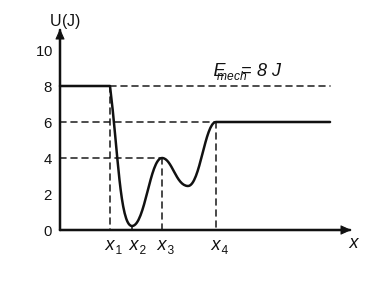
Given below is the plot of a potential energy function $U(x)$ for a system, in which a particle is in one dimensional motion, while a conservative force $F(x)$ acts on it. Suppose that $E_{\text{mech}} = 8$ J, the incorrect statement for this system is: [where K.E. = kinetic energy]
Answer: (B) at $x < x_1$, K.E. is smallest and the particle is moving at the slowest speed.
Concept. For a conservative force the mechanical energy is constant, so at every point $K=E-U$. Reading $U$ from the graph gives $K$ directly. The particle can be only where $U\le E$; where $U=E$ its kinetic energy is zero, so it is at rest.
Step 1. Read the graph. With $E=8$ J:
- For $x<x_1$: $U=8$ J.
- At $x_2$: $U$ is at its lowest, about $0$.
- At $x_3$: $U=4$ J.
- For $x>x_4$: $U=6$ J, constant.
Step 2. Check each statement with $K=8-U$.
- (A) $x>x_4$: $K=8-6=2$ J everywhere there. Constant, so true.
- (B) $x<x_1$: $K=8-8=0$. The particle is at rest, not "moving at the slowest speed". False.
- (C) $x=x_2$: $U$ is least, so $K$ is greatest and the speed is greatest. True.
- (D) $x=x_3$: $K=8-4=4$ J. True.
Answer. Option B is the incorrect statement. Where $U=E$ the speed is zero.
 Solution by Sreeraj P, M.Sc Physics


