

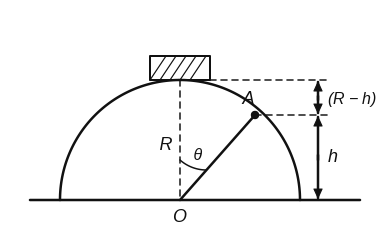
A small block slides down from the top of hemisphere of radius $R = 3$ m as shown in the figure. The height $h$ at which the block will lose contact with the surface of the sphere is ______ m. (Assume there is no friction between the block and the hemisphere)
Numerical value type. Enter your answer.
Answer: 2
Concept. The block moves on a circle of radius $R$. Along the radius, Newton's second law gives $mg\cos\theta-N=\dfrac{mv^2}{R}$, where $\theta$ is measured from the vertical. The block leaves the surface when $N=0$. Energy conservation (smooth surface) gives $v$ at each angle.
Step 1. Speed at angle $\theta$. The height of the block above the centre $O$ is $R\cos\theta$, so it has fallen $R(1-\cos\theta)$:
$$v^2=2gR(1-\cos\theta)$$
Step 2. Condition for leaving. Put $N=0$:
$$mg\cos\theta=\frac{mv^2}{R}=2mg(1-\cos\theta)$$
$$3\cos\theta=2\ \Rightarrow\ \cos\theta=\frac23$$
Step 3. Height above the base. In the figure $h$ is measured from $O$:
$$h=R\cos\theta=\frac23\times3=2\ \text{m}$$
Answer. $2$ m. The block always leaves a smooth hemisphere at $\tfrac23R$ above the centre, whatever the radius or mass.
 Solution by Sreeraj P, M.Sc Physics


