

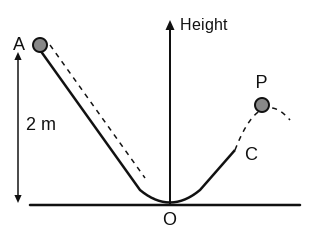
A particle ($m = 1$ kg) slides down a frictionless track (AOC) starting from rest at a point A (height $2$ m). After reaching C, the particle continues to move freely in air as a projectile. When it reaches its highest point P (height $1$ m), the kinetic energy of the particle (in J) is ______. (Figure drawn is schematic and not to scale; take $g = 10\ \text{m s}^{-2}$)
Numerical value type. Enter your answer.
Answer: 10
Concept. The track is frictionless and the normal force does no work, and in the air only gravity acts. So mechanical energy is conserved all the way from $A$ to $P$. The shape of the track does not matter; only the heights of the two points do.
Step 1. Energy at $A$. At rest at $2$ m:
$$E_A=0+mgh_A=1\times10\times2=20\ \text{J}$$
Step 2. Energy at $P$. At the top of its flight the particle is at $1$ m and still moving horizontally:
$$E_P=K_P+mgh_P=K_P+1\times10\times1=K_P+10$$
Step 3. Equate.
$$K_P=20-10=10\ \text{J}$$
Answer. $10$ J. At the highest point of a projectile the speed is not zero; the horizontal component remains.
 Solution by Sreeraj P, M.Sc Physics


