

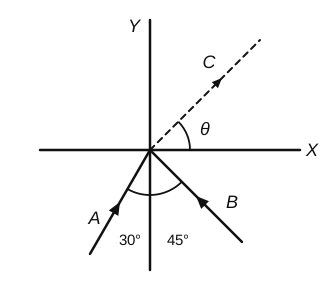
Two particles $A$ and $B$ of equal mass $M$ are moving with the same speed $v$ as shown in figure. They collide completely inelastically and move as a single particle $C$. The angle $\theta$ that the path of $C$ makes with the $X$-axis is given by:
Answer: (D) $\tan\theta = \dfrac{\sqrt3 + \sqrt2}{1 - \sqrt2}$
$A$ moves towards the origin along a line at $30^\circ$ to the $Y$-axis (from the left), $B$ along a line at $45^\circ$ to the $Y$-axis (from the right):
$$\vec v_A = v(\sin30^\circ\,\hat i + \cos30^\circ\,\hat j),\qquad \vec v_B = v(-\sin45^\circ\,\hat i + \cos45^\circ\,\hat j)$$
Momentum is conserved, so $C$ moves along $\vec v_A + \vec v_B$:
$$\tan\theta = \frac{\frac{\sqrt3}{2} + \frac{1}{\sqrt2}}{\frac12 - \frac1{\sqrt2}} = \frac{\sqrt6 + 2}{\sqrt2 - 2} = \frac{\sqrt3 + \sqrt2}{1 - \sqrt2}$$
(The value is negative: $C$ actually moves slightly to the left of the $Y$-axis, as $B$'s sideways momentum is larger.)
 Solution by Sreeraj P, M.Sc Physics