

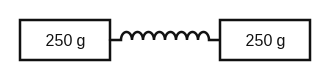
As per the given figure, two blocks each of mass $250\ \text{g}$ are connected to a spring of spring constant $2\ \text{N m}^{-1}$. If both are given velocity $v$ in opposite directions, then the maximum elongation of the spring is
Answer: (B) $\dfrac v2$
Concept. No external horizontal force acts, so the momentum of the pair is conserved. The blocks have equal masses and equal, opposite velocities, so the total momentum is zero and the centre of mass stays at rest. At maximum elongation the blocks have no relative velocity, so both are momentarily at rest, and all the kinetic energy is in the spring.
Step 1. Initial kinetic energy. Each block has $m=0.25$ kg and speed $v$:
$$K=2\times\tfrac12(0.25)v^2=0.25\,v^2$$
Step 2. Spring energy at maximum stretch.
$$\tfrac12kx^2=\tfrac12(2)x^2=x^2$$
Step 3. Energy conservation.
$$x^2=0.25\,v^2\ \Rightarrow\ x=\frac v2$$
Answer. Option B. General form: $\tfrac12\mu v_{\text{rel}}^2=\tfrac12kx^2$ with $\mu=\tfrac{m}{2}=0.125$ kg and $v_{\text{rel}}=2v$ gives the same result.
 Solution by Sreeraj P, M.Sc Physics


