
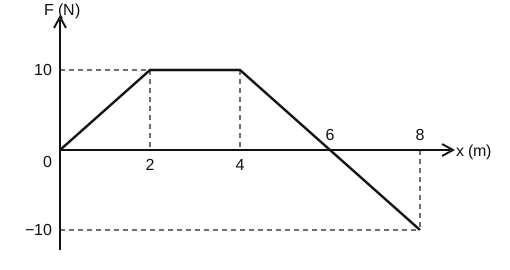
A particle of mass $2$ kg starts from rest at $x = 0$ and moves along the $x$-axis under a force $F$ that varies with position as shown in the graph. The maximum speed of the particle in the region $0 \le x \le 8$ m is
Answer: (B) $2\sqrt{10}$ m/s
Concept. By the work–energy theorem, the kinetic energy at any $x$ is the signed area under the $F$–$x$ graph from $0$ to $x$. The speed is greatest where the force changes sign, at $x = 6$ m.
Step 1. Work up to $x = 6$ m.
$$\tfrac12(2)(10) + (2)(10) + \tfrac12(2)(10) = 10 + 20 + 10 = 40\ \text{J}$$
Beyond $x = 6$ m the force is negative and the particle slows down.
Step 2. Maximum speed.
$$\tfrac12(2)v^2 = 40 \;\Rightarrow\; v = 2\sqrt{10}\ \text{m/s}$$
Answer. $2\sqrt{10}$ m/s (Option B). The speed at $x = 8$ m is $\sqrt{30}$ m/s; adding all the areas as positive gives $5\sqrt2$ m/s.
 Solution by Sreeraj P, M.Sc Physics