

Given below are two statements. One is labelled as Assertion (A) and the other is labelled as Reason (R).
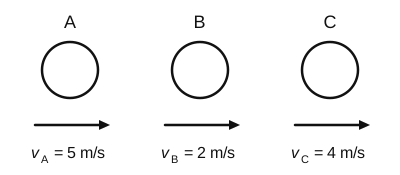
**Assertion (A):** Three identical spheres of the same mass undergo one-dimensional motion as shown in the figure with initial velocities $v_A = 5\ \text{m/s}$, $v_B = 2\ \text{m/s}$, $v_C = 4\ \text{m/s}$. If we wait sufficiently long for elastic collisions to happen, then $v_A = 4\ \text{m/s}$, $v_B = 2\ \text{m/s}$, $v_C = 5\ \text{m/s}$ will be the final velocities.
**Reason (R):** In an elastic collision between identical masses, two objects exchange their velocities.
In the light of the above statements, choose the correct answer from the options given below:
Answer: (A) (A) is false but (R) is true
(R) is true: in a head-on elastic collision of equal masses the velocities are exchanged.
Apply it step by step (all moving to the right):
1. $A$ (5) catches $B$ (2): now $v_A = 2$, $v_B = 5$.
2. $B$ (5) catches $C$ (4): now $v_B = 4$, $v_C = 5$.
3. $A$ (2) is slower than $B$ (4) and $B$ is slower than $C$ (5): no more collisions.
Final: $v_A = 2$, $v_B = 4$, $v_C = 5\ \text{m/s}$, not the values stated. (A) is false.
 Solution by Sreeraj P, M.Sc Physics