

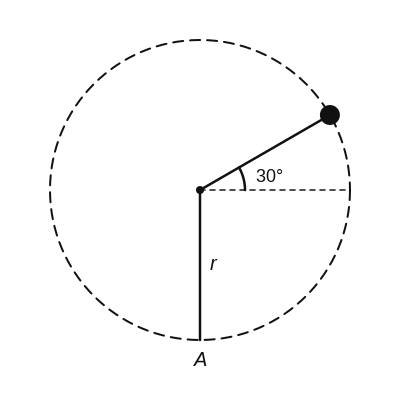
In case of vertical circular motion of a particle by a thread of length $r$ if the tension in the thread is zero at an angle $30^\circ$ shown in figure, the velocity at the bottom point $(A)$ of the circular path is (g = gravitational acceleration)
Answer: (A) $\sqrt{\dfrac72gr}$
Concept. At any point on a vertical circle, the net force towards the centre must be $\dfrac{mv^2}{r}$. When the tension is zero, only the component of gravity along the thread (towards the centre) is left. Energy conservation then takes us back to the bottom.
Step 1. Position of the particle. In the figure the thread is $30^\circ$ above the horizontal, so the particle is $r\sin30^\circ=\dfrac r2$ above the centre, that is $r+\dfrac r2=\dfrac{3r}{2}$ above the bottom point $A$.
Step 2. Speed there. The component of $mg$ along the thread towards the centre is $mg\sin30^\circ$. With $T=0$:
$$mg\sin30^\circ=\frac{mv^2}{r}\ \Rightarrow\ v^2=\frac{gr}{2}$$
Step 3. Speed at $A$. Tension does no work:
$$v_A^2=v^2+2g\cdot\frac{3r}{2}=\frac{gr}{2}+3gr=\frac72gr$$
Answer. Option A, $v_A=\sqrt{\dfrac72gr}$. This is less than $\sqrt{5gr}$, so the thread goes slack at this point and the particle does not complete the circle.
 Solution by Sreeraj P, M.Sc Physics


