

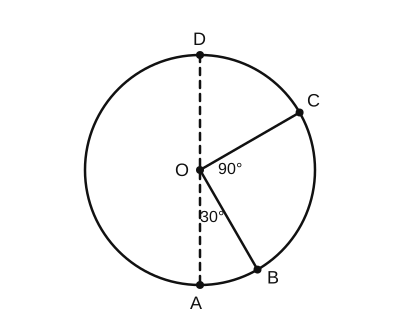
A body of mass $100\ \text{g}$ is moving in a circular path of radius $2\ \text{m}$ on a vertical plane as shown in the figure. The velocity of the body at point $A$ is $10\ \text{m/s}$. The ratio of its kinetic energies at points $B$ and $C$ is (Take acceleration due to gravity as $10\ \text{m/s}^2$)
Answer: (C) $\dfrac{3+\sqrt3}{2}$
Heights above the lowest point $A$ (radius $r = 2\ \text{m}$):
- $B$ is $30^\circ$ from $OA$: $h_B = r(1-\cos30^\circ) = 2 - \sqrt3$
- $OC$ is $90^\circ$ from $OB$, so $C$ is $120^\circ$ from $OA$: $h_C = r(1+\cos60^\circ) = 3\ \text{m}$
Energy conservation with $v_A^2 = 100$:
$$v_B^2 = 100 - 2(10)(2-\sqrt3) = 60 + 20\sqrt3, \qquad v_C^2 = 100 - 2(10)(3) = 40$$
$$\frac{K_B}{K_C} = \frac{60+20\sqrt3}{40} = \frac{3+\sqrt3}{2}$$
 Solution by Sreeraj P, M.Sc Physics