

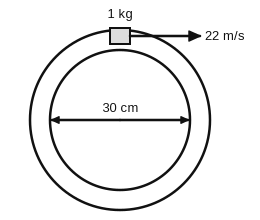
A closed circular tube of average radius $15$ cm, whose inner walls are rough, is kept in vertical plane. A block of mass $1$ kg just fits inside the tube. The speed of block is $22\ \text{m s}^{-1}$, when it is introduced at the top of tube. After completing five oscillations, the block stops at the bottom region of tube. The magnitude of work done by the tube on the block is ______ J. (Given $g=10\ \text{m s}^{-2}$)
Numerical value type. Enter your answer.
Answer: 245
Concept. Only two agents act on the block: gravity and the tube (normal force plus friction). By the work–energy theorem, $W_{\text{tube}}+W_g=\Delta K$. We only need the start and end states; how many oscillations happen in between does not matter.
Step 1. Change in kinetic energy. The block enters at the top at $22\ \text{m s}^{-1}$ and finally stops:
$$\Delta K=0-\tfrac12\times1\times22^2=-242\ \text{J}$$
Step 2. Work by gravity. It ends at the bottom, a diameter ($2\times0.15=0.3$ m) below the top:
$$W_g=mgh=1\times10\times0.3=3\ \text{J}$$
Step 3. Work by the tube.
$$W_{\text{tube}}=\Delta K-W_g=-242-3=-245\ \text{J}$$
Answer. $245$ J. All the initial kinetic energy plus the potential energy lost is taken away by the rough walls.
 Solution by Sreeraj P, M.Sc Physics


