

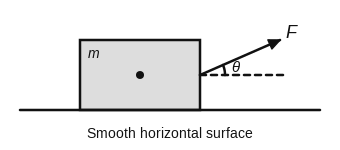
An object of mass $m$ initially at rest on a smooth horizontal plane starts moving under the action of force $F=2\ \text{N}$. In the process of its linear motion, the angle $\theta$ (as shown in figure) between the direction of force and horizontal varies as $\theta=kx$, where $k$ is a constant and $x$ is the distance covered by the object from its initial position. The expression of kinetic energy of the object will be $E=\dfrac nk\sin\theta$. The value of $n$ is ______.
Numerical value type. Enter your answer.
Answer: 2
Concept. Only the horizontal component $F\cos\theta$ does work on a body moving horizontally. With $\theta=kx$, integrate; the work equals the kinetic energy gained from rest.
Step 1. Work.
$$W=\int_0^x F\cos(kx)\,dx=\frac Fk\sin(kx)=\frac2k\sin\theta$$
Step 2. Compare. $E=\dfrac nk\sin\theta\Rightarrow n=2$.
Answer. $2$.
 Solution by Sreeraj P, M.Sc Physics


