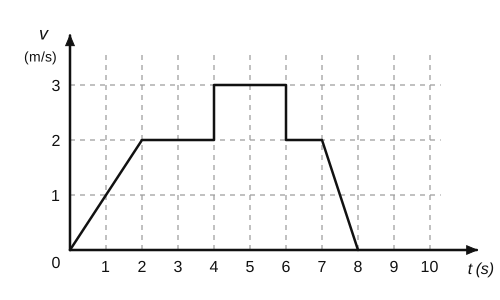
Consider a particle moving along a straight line, whose position as a function of time is given by $s(t) = \alpha t^2 - \beta t + \gamma$, where $\alpha = 1\ \text{m s}^{-2}$, $\beta = 6\ \text{m s}^{-1}$ and $\gamma = 5\ \text{m}$. The average speed of the particle, in $\text{m s}^{-1}$, from $t = 0$ to $t = 6$ s is :
Two cities X and Y are connected by a regular bus service with a bus leaving in either direction every T min. A girl is driving scooty with a speed of $60$ km/h in the direction X to Y notices that a bus goes past her every $30$ minutes in the direction of her motion, and every $10$ minutes in the opposite direction. Choose the correct option for the period T of the bus service and the speed (assumed constant) of the buses.
Step 3. Divide. $\dfrac{v + 60}{v - 60} = 3 \Rightarrow v = 120$ km/h.
Step 4. Period. $vT = \dfrac12(120 - 60) = 30$ km, so $T = \dfrac{30}{120}$ h $= 15$ min.
Answer. $15$ min, $120$ km/h (Option D).
Solution by Sreeraj P, M.Sc Physics
Q 11-02-005NEETNEET 2024Top questionEasy
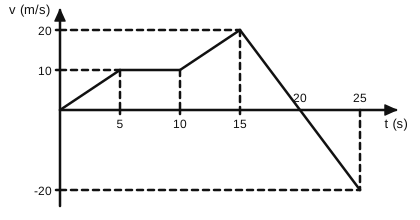
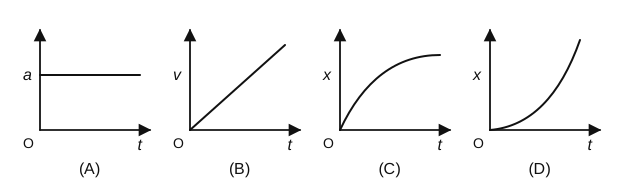
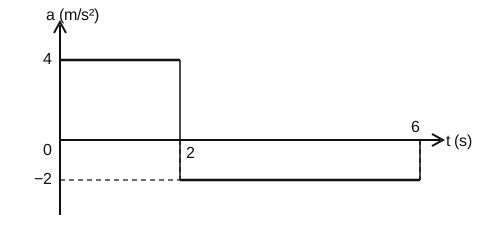
The velocity ($v$) – time ($t$) plot of the motion of a body is shown below. The acceleration ($a$) – time ($t$) graph that best suits this motion is :
Concept. Average speed $=$ total distance / total time.
Step 1. Time. For a total distance $2d$: $$t = \frac{d}{\vartheta} + \frac{d}{2\vartheta} = \frac{3d}{2\vartheta}$$
Step 2. Average speed. $$\frac{2d}{3d/(2\vartheta)} = \frac{4\vartheta}{3}$$
Answer. $\dfrac{4\vartheta}{3}$ (Option C).
Solution by Sreeraj P, M.Sc Physics
Q 11-02-007NEETNEET 2023Top questionMedium
A bullet from a gun is fired on a rectangular wooden block with velocity $u$. When bullet travels $24$ cm through the block along its length horizontally, velocity of bullet becomes $\dfrac{u}{3}$. Then it further penetrates into the block in the same direction before coming to rest exactly at the other end of the block. The total length of the block is :
A horizontal bridge is built across a river. A student standing on the bridge throws a small ball vertically upwards with a velocity $4\ \text{m s}^{-1}$. The ball strikes the water surface after $4$ s. The height of bridge above water surface is (Take $g = 10\ \text{m s}^{-2}$) :
Step 2. Interpret. The water is $64$ m below the bridge.
Answer. $64$ m (Option C).
Solution by Sreeraj P, M.Sc Physics
Q 11-02-009NEETNEET 2021Top questionMedium
A small block slides down on a smooth inclined plane, starting from rest at time $t = 0$. Let $S_n$ be the distance travelled by the block in the interval $t = n - 1$ to $t = n$. Then, the ratio $\dfrac{S_n}{S_{n+1}}$ is :
A ball is thrown vertically downward with a velocity of $20$ m/s from the top of a tower. It hits the ground after some time with a velocity of $80$ m/s. The height of the tower is : ($g = 10\ \text{m/s}^2$)
A particle starts moving from rest under uniform acceleration. It travels a distance $x$ in the first two seconds and a distance $y$ in the next two seconds. If $y = nx$, then $n =$
An object, moving with a speed of $6.25$ m/s, is decelerated at a rate given by $\dfrac{dv}{dt} = -2.5\sqrt{v}$, where $v$ is the instantaneous speed. The time taken by the object, to come to rest, would be
Concept. The deceleration depends on the speed, $\dfrac{dv}{dt}=-2.5\sqrt v$, so it is not constant. Separate the variables (all $v$ on one side, $t$ on the other) and integrate from the initial speed to zero.
Step 1. Separate. $$\frac{dv}{\sqrt v}=-2.5\,dt$$
Step 2. Integrate from $v=6.25$ m/s at $t=0$ to $v=0$ at time $t$. $$\int_{6.25}^{0}v^{-1/2}\,dv=-2.5\int_0^t dt\ \Rightarrow\ \Big[2\sqrt v\Big]_{6.25}^{0}=-2.5\,t$$
Answer. $2$ s (Option B). In general, $\dfrac{dv}{dt}=-k\sqrt v$ stops the body in $t=\dfrac{2\sqrt{u}}{k}$.
Solution by Sreeraj P, M.Sc Physics
Q 11-02-015JEE MainAIEEE 2008Medium
A body is at rest at $x = 0$. At $t = 0$, it starts moving in the positive $x$-direction with a constant acceleration. At the same instant another body passes through $x = 0$ moving in the positive $x$-direction with a constant speed. The position of the first body is given by $x_1(t)$ after time $t$ and that of the second body by $x_2(t)$ after the same time interval. Which of the following graphs correctly describes $(x_1 - x_2)$ as a function of time $t$?
Step 2. Shape. An upward-opening parabola through the origin: negative at first (the second body is ahead), minimum at $t = \dfrac{v}{a}$, zero again at $t = \dfrac{2v}{a}$, then positive.
Step 3. Choose. Only graph (2) dips below the axis and then rises.
A police party is moving in a jeep at a constant speed $v$. They saw a thief at a distance $x$ on a motorcycle which is at rest. The moment the police saw the thief, the thief started at constant acceleration $\alpha$. Which of the following relations is true if the police is able to catch the thief?
Step 2. Real root. The discriminant must be non-negative: $$4v^2 - 8\alpha x \geq 0 \;\Rightarrow\; v^2 \geq 2\alpha x$$ Among the options, the police catch the thief when $v^2 > 2\alpha x$ (at equality they just reach him).
A body is thrown vertically up to reach its maximum height in $t$ seconds. The total time from the time of projection to reach a point at half of its maximum height while returning (in seconds) is
A body is thrown vertically upward from a point 'A' $125$ m above the ground. It goes up to a maximum height of $250$ m above the ground and passes through 'A' on its downward journey. The velocity of the body when it is at a height of $70$ m above the ground is ($g = 10\ \text{m/s}^2$)
A cyclist covers the first one-third of a straight road at $12$ km/h and the remaining two-thirds at $18$ km/h. His average speed for the whole road is
A student walks $3$ km along a straight road from home to a library at $6$ km/h. Finding it closed, she immediately walks back home at $9$ km/h and then rests. Over the first $60$ minutes after leaving home, her average velocity and average speed (in km/h) are respectively
Concept. Average velocity $=$ displacement / time; average speed $=$ distance / time, both over the whole stated interval.
Step 1. Timeline. To the library: $\dfrac36 = 0.5$ h. Back: $\dfrac39 = \dfrac13$ h. She is home after $50$ min and rests for $10$ min.
Step 2. Average velocity. Displacement $= 0$, so $0$.
Step 3. Average speed. Distance $6$ km in $1$ h: $6$ km/h.
Answer. $0,\ 6$ (Option B).
Solution by Sreeraj P, M.Sc Physics
Q 11-02-022NEETJEE MainTop questionEasy
A car moving at $54$ km/h can be stopped by its brakes in a distance of $15$ m. With the same braking retardation, the minimum stopping distance when it moves at $72$ km/h is
A body moving with uniform acceleration covers $12$ m in the $3^{\text{rd}}$ second and $20$ m in the $5^{\text{th}}$ second of its motion. Its initial velocity and acceleration are respectively
A particle moving in a straight line with uniform retardation covers $22$ m and $18$ m in two successive seconds. How much further will it travel before coming to rest?
Step 2. Speed at the start. $22 = u - \dfrac12(4)(1) \Rightarrow u = 24$ m/s.
Step 3. Total stopping distance. $\dfrac{24^2}{2 \times 4} = 72$ m.
Step 4. Further distance. $72 - (22 + 18) = 32$ m.
Answer. $32$ m (Option A).
Solution by Sreeraj P, M.Sc Physics
Q 11-02-025JEE MainHard
Car A starts from rest with uniform acceleration $a_1$. Three seconds later, car B starts from rest from the same point with uniform acceleration $a_2$. If the displacement of A in its $6^{\text{th}}$ second equals the displacement of B in the same interval of time, then $a_1 : a_2$ is
Concept. From rest, distance in the $n$th second is $\dfrac{a}{2}(2n - 1)$. A's $6^{\text{th}}$ second ($t = 5$ to $6$ s) is B's $3^{\text{rd}}$ second.
A police jeep moving at a constant $20$ m/s spots a thief on a scooter at rest $64$ m ahead. At that instant the thief starts with a constant acceleration of $2\ \text{m/s}^2$ in the same direction. After how much time will the jeep first reach the thief?
A girl running at her top speed of $5$ m/s is $10$ m behind the door of a bus when the bus starts from rest with a constant acceleration of $1\ \text{m/s}^2$ away from her. How long does she take to reach the door?
Two stones are thrown vertically upward from the same point with the same speed of $30$ m/s, the second one $2$ s after the first. At what height above the point of projection do they collide? ($g = 10\ \text{m/s}^2$)
A ball projected vertically upward passes a point A with speed $\dfrac{u}{2}$ and a point B, $9$ m higher, with speed $\dfrac{u}{4}$, where $u$ is its speed of projection. The maximum height reached by the ball above the point of projection is
Concept. Apply $v^2 = u^2 - 2gh$ between A and B to find $u^2$ in terms of $g$; then $H = \dfrac{u^2}{2g}$.
Step 1. Between A and B. $$\left(\frac{u}{2}\right)^2 - \left(\frac{u}{4}\right)^2 = 2g(9) \;\Rightarrow\; \frac{3u^2}{16} = 18g \;\Rightarrow\; u^2 = 96g$$
Step 2. Maximum height. $H = \dfrac{96g}{2g} = 48$ m.
Answer. $48$ m (Option C).
Solution by Sreeraj P, M.Sc Physics
Q 11-02-031NEETJEE MainMedium
A ball is dropped from the roof of a building. It takes $0.2$ s to fall past a window $2.2$ m tall. How far above the top of the window is the roof? ($g = 10\ \text{m/s}^2$)
A ball is thrown vertically upward from the foot of a tower with a speed of $30$ m/s. It passes the top of the tower on its way up and comes back past the top $2$ s later. The height of the tower is ($g = 10\ \text{m/s}^2$)
Water drops fall from a tap at regular intervals onto the floor $4.5$ m below. The first drop strikes the floor just as the fourth drop begins to fall. At that instant, the height of the second drop above the floor is ($g = 10\ \text{m/s}^2$)
Concept. With interval $\tau$, the first drop has fallen for $3\tau$ and the second for $2\tau$; distance fallen $\propto t^2$.
Step 1. First drop. $4.5 = \dfrac12g(3\tau)^2$.
Step 2. Second drop. $$\frac12g(2\tau)^2 = \frac49 \times 4.5 = 2\ \text{m below the tap}$$
Step 3. Height above the floor. $4.5 - 2 = 2.5$ m.
Answer. $2.5$ m (Option B).
Solution by Sreeraj P, M.Sc Physics
Q 11-02-034NEETJEE MainMedium
A juggler throws balls vertically upward, one every $0.5$ s, all with the same speed. Each ball reaches its highest point just as the next ball is thrown. The maximum height reached by each ball is ($g = 10\ \text{m/s}^2$)
A rocket is launched vertically upward from rest with a constant acceleration of $5\ \text{m/s}^2$. After $20$ s its fuel runs out and it continues as a free body. The maximum height it reaches is ($g = 10\ \text{m/s}^2$)
A skydiver falls freely from rest for $3$ s. Then her parachute opens and she decelerates uniformly at $2\ \text{m/s}^2$, reaching the ground with a speed of $4$ m/s. From what height did she start? ($g = 10\ \text{m/s}^2$)
The velocity of a particle moving along a straight line varies with its displacement as $v = 6\sqrt{x}$ (SI units). The acceleration of the particle is
Step 2. Acceleration. $$a = 6\sqrt x \cdot \frac{3}{\sqrt x} = 18\ \text{m/s}^2$$ The $\sqrt x$ cancels, so $a$ is constant (consistent with $v^2 = 36x = 2(18)x$).
Answer. $18$ m/s$^2$, constant (Option C).
Solution by Sreeraj P, M.Sc Physics
Q 11-02-039NEETJEE MainHard
A train starts from rest at one station and accelerates at $1\ \text{m/s}^2$ until it reaches $20$ m/s. It runs at this speed and then decelerates at $2\ \text{m/s}^2$ to stop at the next station, $2$ km away. The total time of the journey is
Step 3. Uniform part. $2000 - 300 = 1700$ m at $20$ m/s: $t_2 = 85$ s.
Step 4. Total. $20 + 85 + 10 = 115$ s.
Answer. $115$ s (Option D).
Solution by Sreeraj P, M.Sc Physics
Q 11-02-040NEETJEE MainMedium
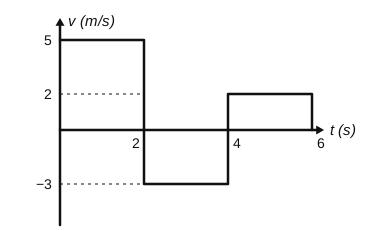
The velocity-time graph of a particle moving along a straight line is shown in the figure. The displacement and the distance travelled by the particle in $6$ s are respectively
Concept. Displacement $=$ signed area under the $v$–$t$ graph; distance $=$ sum of the magnitudes.
Step 1. Areas. $0$–$2$ s: $+10$ m. $2$–$4$ s: $-6$ m. $4$–$6$ s: $+4$ m.
Step 2. Displacement. $10 - 6 + 4 = 8$ m.
Step 3. Distance. $10 + 6 + 4 = 20$ m.
Answer. $8$ m, $20$ m (Option A).
Solution by Sreeraj P, M.Sc Physics
Q 11-02-041NEETJEE MainEasy
An elevator starts from rest and its speed increases uniformly to $4$ m/s in $3$ s. It moves at this speed until $t = 9$ s and then slows down uniformly to stop at $t = 12$ s. The height through which it rises is
A car starts from rest at $t = 0$ with an acceleration that varies as $a = (6 - 2t)\ \text{m/s}^2$ for $0 \le t \le 3$ s, after which the acceleration becomes zero. Find the maximum speed of the car in m/s.
Step 2. Maximum. $a \geq 0$ up to $t = 3$ s and zero afterwards: $$v_{\max} = 6(3) - 9 = 9\ \text{m/s}$$
Answer. $9$.
Solution by Sreeraj P, M.Sc Physics
Q 11-02-043JEE MainMedium
A ball is dropped from the top of a building $60$ m tall. At the same instant, another ball is thrown vertically upward from the ground directly below with a speed of $20$ m/s. Find the height above the ground, in metres, at which they meet. ($g = 10\ \text{m/s}^2$)
Concept. Both balls have the same acceleration, so relative to each other they move at a constant $20$ m/s.
Step 1. Meeting time. $t = \dfrac{60}{20} = 3$ s.
Step 2. Height. The dropped ball has fallen $\dfrac12(10)(9) = 45$ m, so they meet at $60 - 45 = 15$ m.
Answer. $15$.
Solution by Sreeraj P, M.Sc Physics
Q 11-02-044JEE MainJEE Main 2026 (8 Apr, Shift 2)Medium
A gas balloon is going up with a constant velocity of $10\ \text{m/s}$. When this balloon reached a height of $75$ m, a stone is dropped from it and balloon keeps moving up with the same velocity. The height of the balloon when the stone hits the ground is ______ m. (Take $g = 10\ \text{m/s}^2$)
Concept. A stone released from a moving balloon starts with the balloon's velocity ($10$ m/s upward), not from rest. After release only gravity acts on it, so $s=ut-\tfrac12gt^2$ applies with that $u$. Meanwhile the balloon keeps rising at constant speed.
Step 1. Equation for the stone. Take upward as positive, origin at the release point. The ground is at $s=-75$ m: $$-75=10t-\tfrac12(10)t^2=10t-5t^2$$
Step 2. Solve the quadratic. $$5t^2-10t-75=0\ \Rightarrow\ t^2-2t-15=0\ \Rightarrow\ (t-5)(t+3)=0\ \Rightarrow\ t=5\ \text{s}$$ (The negative root has no meaning here.)
Step 3. Height of the balloon then. It rises $10\times5=50$ m more: $$H=75+50=125\ \text{m}$$
Answer. $125$ m (Option D). Taking the stone as dropped from rest gives $t=\sqrt{15}$ s and a wrong height.
Solution by Sreeraj P, M.Sc Physics
Q 11-02-045JEE MainJEE Main 2026 (8 Apr, Shift 2)Medium
Two masses of $3.4$ kg and $2.5$ kg are accelerated from an initial speed of $5\ \text{m/s}$ and $12\ \text{m/s}$, respectively. The distances traversed by the masses in the $5^{\text{th}}$ second are $104$ m and $129$ m, respectively. The ratio of their momenta after $10$ s is $\dfrac{x}{8}$. The value of $x$ is ______.
Concept. Distance in the $n$th second: $s_n=u+\dfrac a2(2n-1)$. Each mass gives its own acceleration; then $v=u+at$ gives the speed after 10 s and $p=mv$.
Q 11-02-046JEE MainJEE Main 2026 (5 Apr, Shift 1)Easy
From $18$ m height above the ground a ball is dropped from rest. The height above the ground at which the magnitude of velocity equal to the magnitude of acceleration (in the same set of units) due to gravity is ______ m. (Take $g = 10\ \text{m/s}^2$ and neglect the air resistance)
Q 11-02-047JEE MainJEE Main 2026 (5 Apr, Shift 2)Easy
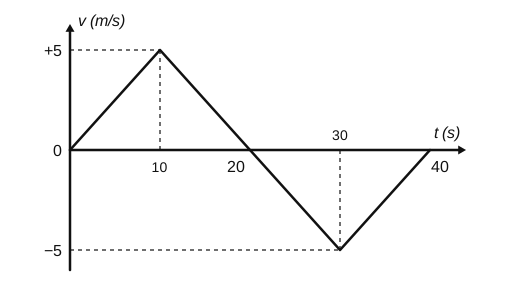
The velocity ($v$) versus time ($t$) plot of a particle is shown in the figure, for a time interval of $40$ s. The total distance travelled by the particle and the average velocity during this period are, respectively ______.
Concept. On a $v$–$t$ graph the signed area is the displacement; the sum of the areas taken as positive is the distance. Average velocity $=$ displacement $\div$ time.
Step 1. Areas. From 0 to 20 s: triangle above the axis, $\tfrac12\times20\times5=50$ m. From 20 to 40 s: triangle below, $-50$ m.
Step 2. Distance and displacement. Distance $=50+50=100$ m; displacement $=50-50=0$.
Step 3. Average velocity. $0/40=0$.
Answer. $100$ m and zero (Option C).
Solution by Sreeraj P, M.Sc Physics
Q 11-02-048JEE MainJEE Main 2026 (28 Jan, Shift 2)Medium
A particle starts moving from time $t = 0$ and its coordinate is given as $x(t) = 4t^3 - 3t$
A. The particle returns to its original position (origin) 0.866 units later
B. The particle is 1 unit away from origin at its turning point
C. Acceleration of the particle is non-negative
D. The particle is 0.5 units away from origin at its turning point
E. Particle never turns back as acceleration is non-negative
Choose the correct answer from the options given below :
Concept. Differentiate $x(t)$ to get $v$ and $a$. A turning point is where $v=0$; the return to the origin is where $x=0$ again.
Step 1. Velocity and acceleration. $$v=12t^2-3,\qquad a=24t$$
Step 2. Return to the origin. $4t^3-3t=0\Rightarrow t^2=\tfrac34\Rightarrow t=\dfrac{\sqrt3}{2}=0.866$. A is true.
Step 3. Turning point. $v=0$ at $t=\tfrac12$: $x=4\left(\tfrac18\right)-\tfrac32=-1$. It is 1 unit from the origin: B true, D false.
Step 4. Acceleration. $a=24t\ge0$ for $t\ge0$: C true. But the particle does turn back (at $t=\tfrac12$), so E is false.
Answer. A, B, C only (Option B).
Solution by Sreeraj P, M.Sc Physics
Q 11-02-049JEE MainJEE Main 2026 (28 Jan, Shift 1)Medium
Water drops fall from a tap on the floor, 5 m below, at regular intervals of time, the first drop strikes the floor when the sixth drop begins to fall. The height at which the fourth drop will be from ground, at the instant when the first drop strikes the ground is ______ m.
Concept. Every drop falls from rest with acceleration $g$, so the distance fallen is $\tfrac12gt^2$. The drops leave at equal intervals, so at any instant the drops differ in fall time by whole multiples of that interval. Count the gaps carefully.
Step 1. Fall time for $5$ m. $$5=\tfrac12(10)T^2\ \Rightarrow\ T^2=1\ \Rightarrow\ T=1\ \text{s}$$
Step 2. The interval between drops. When drop $1$ lands, drop $6$ is just leaving. Between drop $1$ and drop $6$ there are $5$ gaps, and together they span the $1$ s fall time: $$\tau=\frac{1}{5}=0.2\ \text{s}$$
Step 3. Fall time of drop $4$ at that instant. Drop $4$ left $2$ intervals before drop $6$: $$t_4=2\times0.2=0.4\ \text{s}$$
Step 4. Its height above the ground. It has fallen $$\tfrac12(10)(0.4)^2=5\times0.16=0.8\ \text{m}\qquad\Rightarrow\qquad h=5-0.8=4.2\ \text{m}$$
Answer. $4.2$ m (Option C). The question asks for the height *above the ground*, not the distance fallen; $0.8$ m is the trap.
Solution by Sreeraj P, M.Sc Physics
Q 11-02-050JEE MainJEE Main 2026 (24 Jan, Shift 2)Medium
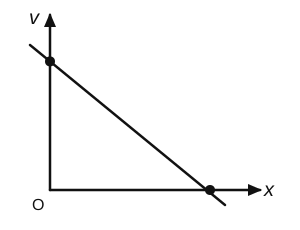
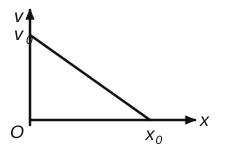
The velocity $(v)$ - Distance $(x)$ graph is shown in figure. Which graph represents acceleration(a) versus distance ( $x$ ) variation of this system?
Step 2. Shape. $a$ is linear in $x$: negative at $x=0$ (value $-kv_0$), with positive slope $k^2$, crossing zero where $v=0$.
Step 3. Choose. The graph that starts below the axis and rises in a straight line.
Answer. Option D.
Solution by Sreeraj P, M.Sc Physics
Q 11-02-051JEE MainJEE Main 2025 (23 Jan, Shift 1)Medium
The motion of an airplane is represented by the velocity-time graph shown below. The distance covered by the airplane in the first $30.5$ seconds is ______ km.
Q 11-02-052JEE MainJEE Main 2025 (28 Jan, Shift 2)Easy
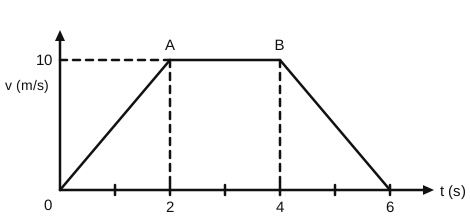
The velocity-time graph of an object moving along a straight line is shown in the figure. What is the distance covered by the object between $t = 0$ and $t = 4\ \text{s}$?
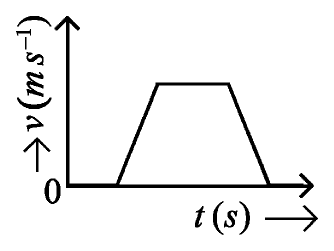
Concept. On a velocity–time graph, the area between the graph and the time axis is the displacement. Here the velocity stays positive from $0$ to $4$ s, so this area is also the distance.
Step 1. Read the graph. The velocity rises uniformly from $0$ at $t=0$ to $10$ m/s at $t=2$ s (point A), then stays at $10$ m/s up to $t=4$ s (point B).
Step 2. Area from $0$ to $2$ s (triangle). $$\tfrac12\times2\times10=10\ \text{m}$$
Step 3. Area from $2$ to $4$ s (rectangle). $$2\times10=20\ \text{m}$$
Step 4. Add. $$s=10+20=30\ \text{m}$$
Answer. $30$ m (Option A). The part after $4$ s (the fall to zero at $6$ s) is not included.
Solution by Sreeraj P, M.Sc Physics
Q 11-02-053JEE MainJEE Main 2025 (29 Jan, Shift 2)Medium
Two cars P and Q are moving on a road in the same direction. The acceleration of car P increases linearly with time whereas car Q moves with a constant acceleration. Both cars cross each other at time $t = 0$, for the first time. The maximum possible number of crossing(s) (including the crossing at $t = 0$) is ______.
Concept. Two bodies cross when their relative displacement is zero. Count the possible zeros of that function.
Step 1. Relative acceleration. P's acceleration grows linearly with time and Q's is constant, so $a_{PQ}=\alpha+\beta t$.
Step 2. Relative displacement. Integrating twice from the crossing at $t=0$ (where $x_{PQ}=0$): $$x_{PQ}=u t+\frac{\alpha t^2}{2}+\frac{\beta t^3}{6}$$ a cubic with $t=0$ as one root.
Step 3. Count. A cubic has at most 3 real roots, so at most 3 crossings, including $t=0$.
Answer. $3$.
Solution by Sreeraj P, M.Sc Physics
Q 11-02-054JEE MainJEE Main 2024 (1 Feb, Shift 1)Easy
A particle is moving in one dimension (along the $x$ axis) under the action of a variable force. Its initial position was $16\ \text{m}$ right of the origin. The variation of its position $x$ with time $t$ is given as $x = -3t^3 + 18t^2 + 16t$, where $x$ is in m and $t$ is in s. The velocity of the particle when its acceleration becomes zero is ______ $\text{m s}^{-1}$.
Q 11-02-055JEE MainJEE Main 2024 (1 Feb, Shift 2)Easy
Train A is moving along two parallel rail tracks towards north with $72\ \text{km h}^{-1}$ and train B is moving towards south with speed $108\ \text{km h}^{-1}$. The velocity of train B with respect to A and the velocity of the ground with respect to B are (in $\text{m s}^{-1}$)
Step 2. B with respect to A. $v_{BA}=-30-20=-50$ m/s.
Step 3. Ground with respect to B. $v_{GB}=0-(-30)=+30$ m/s.
Answer. $-50$ and $30$ (Option C).
Solution by Sreeraj P, M.Sc Physics
Q 11-02-056JEE MainJEE Main 2024 (1 Feb, Shift 2)Easy
A particle initially at rest starts moving from the reference point $x = 0$ along the $x$-axis, with velocity $v$ that varies as $v = 4\sqrt{x}\ \text{m s}^{-1}$. The acceleration of the particle is ______ $\text{m s}^{-2}$.
Concept. For constant acceleration the distance covered in the $n^{\text{th}}$ second is $s_n=u+\dfrac a2(2n-1)$. Subtracting two such expressions removes the unknown $u$, leaving only $a$.
Step 1. Write both distances. $$s_n=u+\frac a2(2n-1),\qquad s_{n+2}=u+\frac a2\big(2(n+2)-1\big)=u+\frac a2(2n+3)$$
Step 3. Put in the numbers. $$115.0-102.5=2a\ \Rightarrow\ a=\frac{12.5}{2}=6.25\ \text{m/s}^2$$
Answer. $6.25$ m/s$^2$ (Option A). Seconds one apart differ by $a$; two apart by $2a$.
Solution by Sreeraj P, M.Sc Physics
Q 11-02-058JEE MainJEE Main 2024 (4 Apr, Shift 2)Easy
A bus moving along a straight highway with a speed of $72\ \text{km/h}$ is brought to a halt within $4\ \text{s}$ after applying the brakes. The distance travelled by the bus during this time (assume the retardation is uniform) is ______ m.
Q 11-02-059JEE MainJEE Main 2024 (5 Apr, Shift 1)Medium
A body moves on a frictionless plane starting from rest. If $S_n$ is the distance moved between $t = n - 1$ and $t = n$, and $S_{n-1}$ is the distance moved between $t = n - 2$ and $t = n - 1$, then the ratio $\dfrac{S_{n-1}}{S_n}$ is $\left(1 - \dfrac{2}{x}\right)$ for $n = 10$. The value of $x$ is ______.
Concept. On a frictionless plane any applied force is constant here, so the body moves with constant acceleration from rest. Then the distance in the $n^{\text{th}}$ second is $S_n=\dfrac a2(2n-1)$, and distances in successive seconds are in the ratio of odd numbers.
Step 1. Distances in two successive seconds. With $u=0$: $$S_n=\frac a2(2n-1),\qquad S_{n-1}=\frac a2\big(2(n-1)-1\big)=\frac a2(2n-3)$$
Step 2. Take the ratio. The factor $\dfrac a2$ cancels: $$\frac{S_{n-1}}{S_n}=\frac{2n-3}{2n-1}$$
Step 3. Put $n=10$ and match the given form. $$\frac{S_9}{S_{10}}=\frac{17}{19}=\frac{19-2}{19}=1-\frac{2}{19}$$ Comparing with $1-\dfrac{2}{x}$ gives $x=19$.
Answer. $x=19$. In general $\dfrac{2n-3}{2n-1}=1-\dfrac{2}{2n-1}$, so $x=2n-1$.
Solution by Sreeraj P, M.Sc Physics
Q 11-02-060JEE MainJEE Main 2024 (6 Apr, Shift 1)Easy
A train starting from rest first accelerates uniformly up to a speed of $80\ \text{km/h}$ for time $t$, then it moves with a constant speed for time $3t$. The average speed of the train for this duration of journey will be (in km/h)
Concept. Average speed is total distance over total time. During the uniform acceleration from rest the average speed is half the final speed, so that part's distance is $\tfrac12vt$; during the cruise the distance is simply speed times time.
Step 1. Distance while accelerating. The speed rises uniformly from $0$ to $80$ km/h in time $t$, so its average is $40$ km/h (the area of the triangle under the $v$–$t$ graph): $$s_1=\frac{0+80}{2}\,t=40t$$
Step 2. Distance while cruising. Constant $80$ km/h for time $3t$: $$s_2=80\times3t=240t$$
Step 3. Average speed over the whole time $4t$. $$\bar v=\frac{40t+240t}{t+3t}=\frac{280t}{4t}=70\ \text{km/h}$$
Answer. $70$ km/h (Option D). The units of $t$ cancel, so no conversion to m/s is needed.
Solution by Sreeraj P, M.Sc Physics
Q 11-02-061JEE MainJEE Main 2024 (6 Apr, Shift 2)Medium
A body projected vertically upwards with a certain speed from the top of a tower reaches the ground in $t_1$. If it is projected vertically downwards from the same point with the same speed, it reaches the ground in $t_2$. The time required to reach the ground if it is dropped from the top of the tower is
Concept. All three throws start at the same point with acceleration $g$, so each obeys $h=ut+\tfrac12gt^2$ with the proper sign of $u$. Writing the up-throw and down-throw equations and eliminating $u$ gives $h$ in terms of $t_1$ and $t_2$; the drop then follows from $h=\tfrac12gt^2$.
Step 1. Two equations. Take downward as positive, tower height $h$, speed $u$: $$\text{thrown up: } h=-ut_1+\tfrac12gt_1^2,\qquad \text{thrown down: } h=ut_2+\tfrac12gt_2^2$$
Step 2. Eliminate $u$. Multiply the first by $t_2$ and the second by $t_1$, then add: $$h(t_1+t_2)=\tfrac12gt_1^2t_2+\tfrac12gt_2^2t_1=\tfrac12gt_1t_2(t_1+t_2)\ \Rightarrow\ h=\tfrac12gt_1t_2$$
Step 3. Time when dropped from rest. $$h=\tfrac12gt^2\ \Rightarrow\ \tfrac12gt^2=\tfrac12gt_1t_2\ \Rightarrow\ t=\sqrt{t_1t_2}$$
Answer. $\sqrt{t_1t_2}$ (Option A). Check: the drop time lies between $t_2$ and $t_1$, as it should.
Solution by Sreeraj P, M.Sc Physics
Q 11-02-062JEE MainJEE Main 2024 (6 Apr, Shift 2)Medium
A particle moves in a straight line so that its displacement $x$ at any time $t$ is given by $x^2 = 1 + t^2$. Its acceleration at any time $t$ is $x^{-n}$, where $n = $ ______.
Concept. Differentiate the implicit relation twice with respect to $t$.
Step 1. First derivative. $x^2=1+t^2\Rightarrow2xv=2t\Rightarrow v=\dfrac tx$.
Step 2. Second derivative. $$a=\frac{d}{dt}\left(\frac tx\right)=\frac{x-tv}{x^2}=\frac{x-t^2/x}{x^2}=\frac{x^2-t^2}{x^3}=\frac{1}{x^3}$$
Step 3. Compare. $a=x^{-3}$, so $n=3$.
Answer. $3$.
Solution by Sreeraj P, M.Sc Physics
Q 11-02-063JEE MainJEE Main 2024 (27 Jan, Shift 2)Medium
A bullet is fired into a fixed target and loses one third of its velocity after travelling $4\ \text{cm}$. It penetrates further $D\times10^{-3}\ \text{m}$ before coming to rest. The value of $D$ is:
Concept. Inside the target the bullet has constant retardation, so $v^2=u^2-2as$. Distance is proportional to the drop in $v^2$, so we compare how much of $v^2$ is lost in each stage.
Step 1. First stage (speed $v$ to $\tfrac23v$ in $4$ cm). Losing one third of the velocity leaves $\tfrac23v$: $$v^2-\left(\tfrac23v\right)^2=2a(0.04)\ \Rightarrow\ \frac{5v^2}{9}=2a(0.04)$$
Step 2. Second stage (from $\tfrac23v$ to rest in distance $x$). $$\left(\tfrac23v\right)^2-0=2ax\ \Rightarrow\ \frac{4v^2}{9}=2ax$$
Step 3. Divide the two equations. $a$ and $v$ cancel: $$\frac{x}{0.04}=\frac{4/9}{5/9}=\frac45\ \Rightarrow\ x=\frac45\times0.04=0.032\ \text{m}$$
Step 4. Match the form. $0.032\ \text{m}=32\times10^{-3}$ m, so $D=32$.
Answer. $D=32$ (Option A). Losing a third of the speed uses up $\tfrac59$ of $v^2$, which is why the remaining distance is less than the first $4$ cm.
Solution by Sreeraj P, M.Sc Physics
Q 11-02-064JEE MainJEE Main 2024 (27 Jan, Shift 2)Medium
A body falling under gravity covers two points A and B separated by $80\ \text{m}$ in $2\ \text{s}$. The distance of upper point A from the starting point is ______ m. (Use $g = 10\ \text{m s}^{-2}$)
Concept. The body falls from rest with constant acceleration $g$. The data for the stretch $A\to B$ give the speed at $A$ through $s=ut+\tfrac12gt^2$. Since the body started from rest, the speed at $A$ then gives the depth of $A$ through $u^2=2gh$.
Step 1. Speed at $A$. Take downward as positive. From $A$ to $B$: $s=80$ m, $t=2$ s: $$80=u(2)+\tfrac12(10)(2)^2=2u+20\ \Rightarrow\ u=30\ \text{m s}^{-1}$$
Step 2. Depth of $A$ below the start. From rest to speed $30$ m s$^{-1}$: $$u^2=2gh_A\ \Rightarrow\ h_A=\frac{30^2}{2\times10}=\frac{900}{20}=45\ \text{m}$$
Answer. $45$ m. Check: the body reaches $A$ after $3$ s and $B$ after $5$ s; $\tfrac12(10)(25)-\tfrac12(10)(9)=125-45=80$ m.
Solution by Sreeraj P, M.Sc Physics
Q 11-02-065JEE MainJEE Main 2024 (29 Jan, Shift 1)Medium
A body starts moving from rest with constant acceleration and covers displacement $S_1$ in first $(p-1)$ seconds and $S_2$ in first $p$ seconds. The displacement $S_1 + S_2$ will be made in time:
Concept. From rest with constant acceleration, $S=\tfrac12at^2$, so displacement is proportional to $t^2$. To find the time for $S_1+S_2$, add the $t^2$ values, not the times.
Step 1. Write $S_1$ and $S_2$. $$S_1=\tfrac12a(p-1)^2,\qquad S_2=\tfrac12ap^2$$
Step 2. Let $t$ be the time to cover $S_1+S_2$ from rest. $$\tfrac12at^2=\tfrac12a(p-1)^2+\tfrac12ap^2\ \Rightarrow\ t^2=(p-1)^2+p^2$$
Answer. Option B. Option D is $t^2$, not $t$; the trap is forgetting the square root.
Solution by Sreeraj P, M.Sc Physics
Q 11-02-066JEE MainJEE Main 2024 (29 Jan, Shift 2)Easy
A particle is moving in a straight line. The variation of position $x$ as a function of time $t$ is given as $x = (t^3 - 6t^2 + 20t + 15)\ \text{m}$. The velocity of the body when its acceleration becomes zero is:
Q 11-02-067JEE MainJEE Main 2024 (9 Apr, Shift 1)Medium
A particle moving in a straight line covers half the distance with speed $6\ \text{m/s}$. The other half is covered in two equal time intervals with speeds $9\ \text{m/s}$ and $15\ \text{m/s}$ respectively. The average speed of the particle during the motion is:
Concept. Average speed is total distance over total time. The trip has two parts: the first half of the distance at one speed, and the second half split into two equal *times*. Equal times give an arithmetic mean; then the two equal-distance halves combine through their times.
Step 1. Time for the first half. Let the total distance be $2s$. The first half is covered at $6$ m/s: $$t_1=\frac{s}{6}$$
Step 2. Time for the second half. Let each of the two equal intervals be $t$. The distances in them add to $s$: $$9t+15t=s\ \Rightarrow\ t=\frac{s}{24}\qquad\Rightarrow\qquad t_2=2t=\frac{s}{12}$$ (Equivalently, the average speed over the second half is $\dfrac{9+15}{2}=12$ m/s, so $t_2=\dfrac{s}{12}$.)
Step 3. Average speed for the whole trip. $$\bar v=\frac{2s}{\dfrac{s}{6}+\dfrac{s}{12}}=\frac{2s}{\dfrac{2s+s}{12}}=\frac{2s\times12}{3s}=8\ \text{m/s}$$
Answer. $8$ m/s (Option B). Shortcut: equal-distance mean of $6$ and $12$ is $\dfrac{2\times6\times12}{6+12}=8$.
Solution by Sreeraj P, M.Sc Physics
Q 11-02-068JEE MainJEE Main 2024 (9 Apr, Shift 2)Easy
Two cars are travelling towards each other at a speed of $20\ \text{m s}^{-1}$ each. When the cars are $300\ \text{m}$ apart, both the drivers apply brakes and the cars retard at the rate of $2\ \text{m s}^{-2}$. The distance between them when they come to rest is:
Concept. Each car brakes with constant retardation, so it stops after a distance $s=\dfrac{u^2}{2a}$ (from $v^2=u^2-2as$ with $v=0$). Both cars close the gap from opposite sides, so subtract both stopping distances from the initial separation.
Step 1. Stopping distance of one car. $$s=\frac{u^2}{2a}=\frac{20^2}{2\times2}=\frac{400}{4}=100\ \text{m}$$
Step 2. Gap left. Both cars cover $100$ m towards each other: $$300-100-100=100\ \text{m}$$
Answer. $100$ m (Option B). Since $200\ \text{m}<300$ m, they stop before meeting, so the formula applies without any collision.
Solution by Sreeraj P, M.Sc Physics
Q 11-02-069JEE MainJEE Main 2024 (30 Jan, Shift 1)Medium
The displacement and the increase in the velocity of a moving particle in the time interval of $t$ to $(t+1)\ \text{s}$ are $125\ \text{m}$ and $50\ \text{m s}^{-1}$, respectively. The distance travelled by the particle in the $(t+2)^{\text{th}}$ second is ______ m.
Concept. With constant acceleration, the change of velocity in a time interval is $a\,\Delta t$. Knowing the change in $1$ s gives $a$ directly. The displacement in that second then gives the starting velocity, and $s=u\,t+\tfrac12at^2$ works for any later one-second interval.
Step 1. Acceleration. The velocity increases by $50$ m s$^{-1}$ in $1$ s: $$a=\frac{50}{1}=50\ \text{m s}^{-2}$$
Step 2. Velocity at time $t$. In the interval $t$ to $t+1$ the displacement is $125$ m: $$125=v_t(1)+\tfrac12(50)(1)^2\ \Rightarrow\ v_t=125-25=100\ \text{m s}^{-1}$$
Step 3. Identify the required second. The $(t+2)^{\text{th}}$ second runs from $t+1$ to $t+2$. At its start the velocity is $$v_{t+1}=v_t+a(1)=100+50=150\ \text{m s}^{-1}$$
Step 4. Distance in that second. $$s=150(1)+\tfrac12(50)(1)^2=150+25=175\ \text{m}$$
Answer. $175$ m. Check: successive seconds differ by $a=50$ m, so $125\to175$.
Solution by Sreeraj P, M.Sc Physics
Q 11-02-070JEE MainJEE Main 2024 (31 Jan, Shift 1)Medium
The relation between time $t$ and distance $x$ is $t = \alpha x^2 + \beta x$, where $\alpha$ and $\beta$ are constants. The relation between acceleration $a$ and velocity $v$ is:
Concept. Time is given as a function of position. Differentiating gives $\dfrac{dt}{dx}=\dfrac1v$. Acceleration then follows from $a=v\dfrac{dv}{dx}$, which needs $v$ as a function of $x$ only.
Answer. $a=-2\alpha v^3$ (Option A). The particle is retarding, and the retardation grows as the cube of the speed.
Solution by Sreeraj P, M.Sc Physics
Q 11-02-071JEE MainJEE Main 2024 (31 Jan, Shift 1)Medium
A body starts falling freely from height $H$ and hits an inclined plane in its path at height $h$. As a result of this perfectly elastic impact, the direction of the velocity of the body becomes horizontal. The value of $\dfrac Hh$ for which the body will take the maximum time to reach the ground is ______.
Concept. The fall has two stages: a free fall through $H-h$, then (after the elastic impact turns the velocity horizontal) a horizontal launch from height $h$, which takes the same time as a drop from $h$.
Step 1. Total time. $$T(h)=\sqrt{\frac{2(H-h)}{g}}+\sqrt{\frac{2h}{g}}$$
Q 11-02-072JEE MainJEE Main 2023 (29 Jan, Shift 1)Medium
A tennis ball is dropped on to the floor from a height of $9.8\ \text{m}$. It rebounds to a height $5.0\ \text{m}$. Ball comes in contact with the floor for $0.2\ \text{s}$. The average acceleration during contact is ______ $\text{m s}^{-2}$. [Given $g = 10\ \text{m s}^{-2}$]
Concept. Average acceleration is $\dfrac{\Delta\vec v}{\Delta t}$, a vector change. The ball hits the floor moving down and leaves moving up, so the velocity reverses and the change in velocity is the *sum* of the two speeds. Each speed comes from free fall: $v=\sqrt{2gh}$.
Step 1. Speed just before impact. Dropped from $9.8$ m: $$v_1=\sqrt{2gh_1}=\sqrt{2\times10\times9.8}=\sqrt{196}=14\ \text{m s}^{-1}\ \text{(downward)}$$
Step 2. Speed just after impact. It rises to $5.0$ m, so it left the floor with $$v_2=\sqrt{2gh_2}=\sqrt{2\times10\times5}=10\ \text{m s}^{-1}\ \text{(upward)}$$
Step 3. Change in velocity. Take upward as positive: $$\Delta v=(+10)-(-14)=24\ \text{m s}^{-1}$$
Step 4. Average acceleration over $0.2$ s. $$a_{\text{avg}}=\frac{24}{0.2}=120\ \text{m s}^{-2}\ \text{(upward)}$$
Answer. $120$ m s$^{-2}$. Subtracting the speeds ($14-10$) would give $20$ m s$^{-2}$, which ignores the reversal of direction.
Solution by Sreeraj P, M.Sc Physics
Q 11-02-073JEE MainJEE Main 2023 (30 Jan, Shift 1)Medium
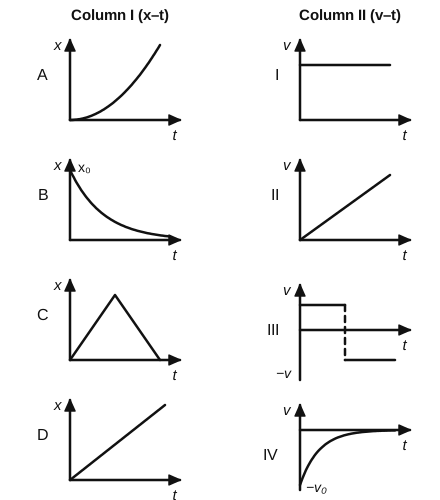
Match Column I with Column II.
Column I shows position–time ($x$–$t$) graphs A, B, C, D and Column II shows velocity–time ($v$–$t$) graphs I, II, III, IV, as in the figure.
Choose the correct answer from the options given below:
Concept. Velocity is the slope of the $x$–$t$ graph. So for each $x$–$t$ graph ask how its slope changes with time, and match that with the $v$–$t$ graph.
Step 1. Graph A. A parabola starting flat at the origin and curving upward: the slope starts at zero and grows uniformly. So $v$ rises linearly from zero: graph II.
Step 2. Graph B. It starts at $x_0$ and falls, steeply at first, then flattening out. The slope is large and negative at first and approaches zero. So $v$ starts at $-v_0$ and rises towards zero: graph IV.
Step 3. Graph C. A straight rise followed by a straight fall: constant positive slope, then constant negative slope. So $v=+v$ then $-v$: graph III.
Step 4. Graph D. A single straight line through the origin: constant slope, so constant velocity: graph I.
Answer. A-II, B-IV, C-III, D-I (Option A).
Solution by Sreeraj P, M.Sc Physics
Q 11-02-074JEE MainJEE Main 2023 (30 Jan, Shift 1)Medium
A horse rider covers half the distance with $5\ \text{m s}^{-1}$ speed. The remaining part of the distance was travelled with speed $10\ \text{m s}^{-1}$ for half the time and with speed $15\ \text{m s}^{-1}$ for other half of the time. The mean speed of the rider averaged over the whole time of motion is $\dfrac{x}{7}\ \text{m s}^{-1}$. The value of $x$ is ______.
Concept. Mean speed over the whole trip $=$ total distance $\div$ total time. The second half is covered in two *equal times*, so its average is the arithmetic mean; the two halves are *equal distances*, so they combine with the harmonic-mean rule.
Step 1. Average speed on the second half. Equal times at $10$ and $15$ m s$^{-1}$: $$v_2=\frac{10+15}{2}=12.5\ \text{m s}^{-1}$$
Step 2. Combine the two halves (equal distances). $$\bar v=\frac{2v_1v_2}{v_1+v_2}=\frac{2\times5\times12.5}{5+12.5}=\frac{125}{17.5}=\frac{50}{7}\ \text{m s}^{-1}$$
Answer. $x=50$.
Solution by Sreeraj P, M.Sc Physics
Q 11-02-075JEE MainJEE Main 2023 (30 Jan, Shift 2)Easy
A vehicle travels $4\ \text{km}$ with speed of $3\ \text{km h}^{-1}$ and another $4\ \text{km}$ with speed of $5\ \text{km h}^{-1}$, then its average speed is
Q 11-02-076JEE MainJEE Main 2023 (24 Jan, Shift 2)Easy
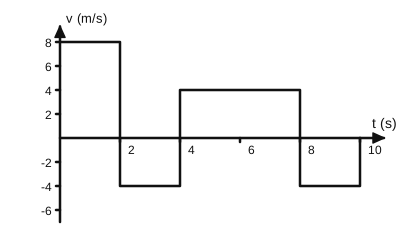
The velocity–time graph of a body moving in a straight line is shown in figure. The ratio of displacement and distance travelled by the body in time $0$ to $10$ s is
Concept. Area under a $v$–$t$ graph gives displacement when areas below the axis count as negative. Distance counts every area as positive. So find each piece's area with its sign, then add with and without signs.
Step 1. Read the graph. From the figure:
$0$–$2$ s: $v=+8$ m/s
$2$–$4$ s: $v=-4$ m/s
$4$–$8$ s: $v=+4$ m/s
$8$–$10$ s: $v=-4$ m/s
Step 2. Area of each piece. $$8\times2=+16,\qquad -4\times2=-8,\qquad 4\times4=+16,\qquad -4\times2=-8\ \ (\text{in m})$$
Step 3. Displacement and distance. $$\text{displacement}=16-8+16-8=16\ \text{m},\qquad \text{distance}=16+8+16+8=48\ \text{m}$$
Step 4. Ratio. $$\frac{16}{48}=\frac13$$
Answer. $1:3$ (Option C).
Solution by Sreeraj P, M.Sc Physics
Q 11-02-077JEE MainJEE Main 2023 (25 Jan, Shift 1)Easy
A car travels a distance of $x$ with speed $v_1$ and then same distance $x$ with speed $v_2$ in the same direction. The average speed of the car is
Concept. Average speed is total distance divided by total time. The car spends more time at the lower speed, so the answer is not the simple mean of $v_1$ and $v_2$; we must add the times of the two parts.
Step 1. Time for each part. Each part has length $x$, so $$t_1=\frac{x}{v_1},\qquad t_2=\frac{x}{v_2}$$
Step 2. Total distance over total time. $$\bar v=\frac{2x}{\dfrac{x}{v_1}+\dfrac{x}{v_2}}=\frac{2x}{x\left(\dfrac{v_1+v_2}{v_1v_2}\right)}=\frac{2v_1v_2}{v_1+v_2}$$
Answer. $\dfrac{2v_1v_2}{v_1+v_2}$ (Option D). This harmonic mean is always less than $\dfrac{v_1+v_2}{2}$; option C is a time, not a speed, so it fails a units check.
Solution by Sreeraj P, M.Sc Physics
Q 11-02-078JEE MainJEE Main 2023 (25 Jan, Shift 2)Easy
The distance travelled by a particle is related to time $t$ as $x=4t^2$. The velocity of the particle at $t=5$ s is
Q 11-02-080JEE MainJEE Main 2023 (13 Apr, Shift 2)Easy
A passenger sitting in a train A moving at $90\ \text{km h}^{-1}$ observes another train B moving in the opposite direction for $8$ s. If the velocity of the train B is $54\ \text{km h}^{-1}$, then length of train B is
Concept. In the passenger's frame, train B moves past at the relative speed, which is the sum of the speeds for opposite directions. The passenger is a point, so only B's length passes.
Step 1. Relative speed. $90+54=144$ km/h $=144\times\dfrac5{18}=40$ m/s.
Step 2. Length of B. $40\times8=320$ m.
Answer. $320$ m (Option B).
Solution by Sreeraj P, M.Sc Physics
Q 11-02-081JEE MainJEE Main 2023 (15 Apr, Shift 1)Easy
The position of a particle related to time is given by $x=(5t^2-4t+5)$ m. The magnitude of velocity of the particle at $t=2$ s will be
Q 11-02-082JEE MainJEE Main 2023 (10 Apr, Shift 2)Easy
A person travels $x$ distance with velocity $v_1$ and then $x$ distance with velocity $v_2$ in the same direction. The average velocity of the person is $v$, then the relation between $v$, $v_1$ and $v_2$ will be
Step 2. Totals. Distance $= 250$ m; displacement $= 150$ m.
Step 3. Ratio. $\dfrac{250}{150} = \dfrac53$.
Answer. $\dfrac53$ (Option C).
Solution by Sreeraj P, M.Sc Physics
Q 11-02-084JEE MainJEE Main 2023 (12 Apr, Shift 1)Easy
A ball is thrown vertically upward with an initial velocity of $150\ \text{m s}^{-1}$. The ratio of velocity after $3$ s and $5$ s is $\dfrac{x+1}{x}$. The value of $x$ is ______. (take $g=10\ \text{m s}^{-2}$)
Q 11-02-085JEE MainJEE Main 2023 (13 Apr, Shift 1)Medium
Two trains $A$ and $B$ of length $l$ and $4l$ are travelling into a tunnel of length $L$ in parallel tracks from opposite directions with velocities $108\ \text{km h}^{-1}$ and $72\ \text{km h}^{-1}$, respectively. If train $A$ takes $35$ s less time than train $B$ to cross the tunnel then, length $L$ of tunnel is (Given $L=60l$)
Concept. A train has "crossed" a tunnel when its rear leaves the far end. From the moment its front enters, its front must travel the tunnel length plus the train's own length. Each train moves at constant speed, so time $=$ distance $\div$ speed.
Step 1. Convert the speeds. Multiply km/h by $\tfrac{5}{18}$: $$v_A=108\times\frac{5}{18}=30\ \text{m s}^{-1},\qquad v_B=72\times\frac{5}{18}=20\ \text{m s}^{-1}$$
Step 2. Distances to cross. With $L=60l$: $$d_A=L+l=61l,\qquad d_B=L+4l=64l$$
Step 3. Use the time difference. Train $A$ takes $35$ s less: $$\frac{64l}{20}-\frac{61l}{30}=35\ \Rightarrow\ \frac{192l-122l}{60}=35\ \Rightarrow\ \frac{70l}{60}=35\ \Rightarrow\ l=30\ \text{m}$$
Answer. $1800$ m (Option C). The trains move on parallel tracks and each crosses the tunnel on its own, so the opposite directions do not matter here; there is no relative motion to use.
Solution by Sreeraj P, M.Sc Physics
Q 11-02-086JEE MainJEE Main 2023 (6 Apr, Shift 2)Easy
A particle starts with an initial velocity of $10.0\ \text{m s}^{-1}$ along $x$-direction and accelerates uniformly at the rate of $2.0\ \text{m s}^{-2}$. The time taken by the particle to reach the velocity of $60.0\ \text{m s}^{-1}$ is ______.
Answer: (D) Statement I is incorrect but Statement II is true
Concept. Areas under motion graphs: under $v$–$t$ is displacement, under $a$–$t$ is the change in velocity.
Step 1. Statement I. The area under $v$–$t$ (with sign) is the displacement. It equals the distance only if the body never turns back. As a general statement it is incorrect.
Step 2. Statement II. $\displaystyle\int a\,dt=\Delta v$. Correct.
Answer. Statement I is incorrect but Statement II is true (Option D).
Solution by Sreeraj P, M.Sc Physics
Q 11-02-088JEE MainJEE Main 2023 (10 Apr, Shift 1)Easy
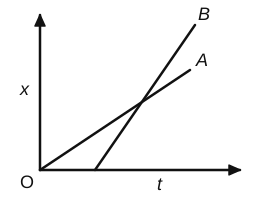
The position-time graphs for two students $A$ and $B$ returning from the school to their homes are shown in figure.
(A) $A$ lives closer to the school
(B) $B$ lives closer to the school
(C) $A$ takes lesser time to reach home
(D) $A$ travels faster than $B$
(E) $B$ travels faster than $A$
Choose the correct answer from the options given below.
Concept. On an $x$–$t$ graph the slope is the velocity, the final $x$ is where the student lives (measured from the school), and the end of each line gives the time of arrival.
Step 1. Distance from school. Line A ends at a smaller $x$: A lives closer. (A) true, (B) false.
Step 2. Speed. Line B is steeper, so B travels faster. (E) true, (D) false.
Step 3. Time. B starts later and reaches home at about the same moment, so B takes less time, not A. (C) false.
Answer. A and E only (Option D).
Solution by Sreeraj P, M.Sc Physics
Q 11-02-089JEE MainJEE Main 2023 (1 Feb, Shift 1)Easy
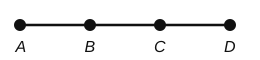
An object moves with speed $v_1$, $v_2$ and $v_3$ along a line segment $AB$, $BC$ and $CD$ respectively as shown in figure, where $AB=BC$ and $AD=3AB$. Then average speed of the object will be
Concept. Average speed is total distance over total time. In the figure $A$, $B$, $C$, $D$ lie on one line with $AB=BC$ and $AD=3AB$, so $CD=AB$ as well: three equal distances covered at three different speeds.
Step 1. Find the segment lengths. Let $AB=d$. Then $BC=d$ and $CD=AD-AB-BC=3d-2d=d$.
Step 2. Time on each segment. $$t_1=\frac{d}{v_1},\qquad t_2=\frac{d}{v_2},\qquad t_3=\frac{d}{v_3}$$
Step 3. Divide total distance by total time. $$\bar v=\frac{3d}{\dfrac{d}{v_1}+\dfrac{d}{v_2}+\dfrac{d}{v_3}}=\frac{3}{\dfrac{v_2v_3+v_1v_3+v_1v_2}{v_1v_2v_3}}=\frac{3v_1v_2v_3}{v_1v_2+v_2v_3+v_3v_1}$$
Answer. Option C. Quick check: if $v_1=v_2=v_3=v$ the formula gives $\dfrac{3v^3}{3v^2}=v$, as it must.
Solution by Sreeraj P, M.Sc Physics
Q 11-02-090JEE MainJEE Main 2023 (1 Feb, Shift 2)Easy
For a train engine moving with speed of $20\ \text{m s}^{-1}$, the driver must apply brakes at a distance of $500$ m before the station for the train to come to rest at the station. If the brakes were applied at half of this distance, the train engine would cross the station with speed $\sqrt x\ \text{m s}^{-1}$. The value of $x$ is ______. (Assuming same retardation is produced by brakes)
Step 2. Braking over $250$ m. $$v^2=400-2(0.4)(250)=400-200=200\ \Rightarrow\ v=\sqrt{200}\ \text{m s}^{-1}$$
Answer. $x=200$. (In general, braking over half the distance leaves $v=u/\sqrt2$.)
Solution by Sreeraj P, M.Sc Physics
Q 11-02-091JEE MainJEE Main 2022 (24 Jun, Shift 1)Medium
From the top of a tower, a ball is thrown vertically upward which reaches the ground in $6\ \text{s}$. A second ball thrown vertically downward from the same position with the same speed reaches the ground in $1.5\ \text{s}$. A third ball released from rest from the same location will reach the ground in ______ s.
Concept. For a tower of height $h$ with a ball thrown up and one thrown down at the same speed, the drop time is the geometric mean: $t=\sqrt{t_1t_2}$.
Step 1. Why. Down positive: $h=-ut_1+\tfrac12gt_1^2$ and $h=ut_2+\tfrac12gt_2^2$. Multiply the first by $t_2$, the second by $t_1$, and add: $h(t_1+t_2)=\tfrac12gt_1t_2(t_1+t_2)$, so $h=\tfrac12gt_1t_2$. A dropped ball: $h=\tfrac12gt^2$, so $t^2=t_1t_2$.
Step 2. Substitute. $t=\sqrt{6\times1.5}=\sqrt9=3$ s.
Answer. $3$.
Solution by Sreeraj P, M.Sc Physics
Q 11-02-092JEE MainJEE Main 2022 (25 Jun, Shift 2)Medium
Two buses $P$ and $Q$ start from a point at the same time and move in a straight line and their positions are represented by $x_P(t) = \alpha t + \beta t^2$ and $x_Q(t) = ft - t^2$. At what time do both the buses have the same velocity?
Concept. At the top of a vertical throw the velocity is momentarily zero, but gravity still acts.
Step 1. Check each quantity.
Momentum $mv$: $v=0$, so momentum is zero.
Potential energy: largest at the top, not zero.
Acceleration: still $g$ downward.
Force: still $mg$ downward.
Answer. Momentum (Option A).
Solution by Sreeraj P, M.Sc Physics
Q 11-02-094JEE MainJEE Main 2022 (26 Jun, Shift 1)Easy
A ball of mass $0.5\ \text{kg}$ is dropped from the height of $10\ \text{m}$. The height at which the magnitude of velocity becomes equal to the magnitude of acceleration due to gravity is ______ m. [Use $g = 10\ \text{m s}^{-2}$]
Concept. Find the distance fallen when $v = g = 10$ m/s: $s = \dfrac{v^2}{2g}$.
Step 1. Distance fallen. $\dfrac{100}{20} = 5$ m.
Step 2. Height. $10 - 5 = 5$ m.
Answer. $5$.
Solution by Sreeraj P, M.Sc Physics
Q 11-02-095JEE MainJEE Main 2022 (26 Jun, Shift 2)Easy
A ball is projected vertically upward with an initial velocity of $50\ \text{m s}^{-1}$ at $t = 0\ \text{s}$. At $t = 2\ \text{s}$, another ball is projected vertically upward with the same velocity. At $t$ = ______ s, the second ball will meet the first ball. ($g = 10\ \text{m s}^{-2}$)
Step 3. Check. $y_1=300-180=120$ m, $y_2=200-80=120$ m. (Shortcut: they meet at $\dfrac ug+\dfrac\tau2=5+1=6$ s.)
Answer. $6$.
Solution by Sreeraj P, M.Sc Physics
Q 11-02-096JEE MainJEE Main 2022 (25 Jul, Shift 1)Easy
A car is moving with a speed of $150\ \text{km h}^{-1}$ and after applying the brake it will move $27\ \text{m}$ before it stops. If the same car is moving with a speed of one third the reported speed then it will stop after travelling ______ m distance.
Q 11-02-097JEE MainJEE Main 2022 (25 Jul, Shift 2)Easy
A particle is moving in a straight line such that its velocity is increasing at $5\ \text{m s}^{-1}$ per metre. The acceleration of the particle is ______ $\text{m s}^{-2}$ at a point where its velocity is $20\ \text{m s}^{-1}$.
Concept. "Increasing at $5$ m s$^{-1}$ per metre" is a rate with respect to distance: $\dfrac{dv}{dx}=5\ \text{s}^{-1}$. Acceleration is a rate with respect to time. The chain rule connects them: $a=\dfrac{dv}{dt}=\dfrac{dv}{dx}\cdot\dfrac{dx}{dt}=v\dfrac{dv}{dx}$.
Step 1. Write the given rate. $$\frac{dv}{dx}=5\ \text{s}^{-1}$$
Step 2. Convert to acceleration at $v=20$ m s$^{-1}$. $$a=v\frac{dv}{dx}=20\times5=100\ \text{m s}^{-2}$$
Answer. $100$ m s$^{-2}$. Note that this acceleration grows as the particle speeds up; it is not constant.
Solution by Sreeraj P, M.Sc Physics
Q 11-02-098JEE MainJEE Main 2022 (27 Jun, Shift 2)Easy
When a ball is dropped into a lake from a height $4.9$ m above the water level, it hits the water with a velocity $v$ and then sinks to the bottom with the constant velocity $v$. It reaches the bottom of the lake $4.0$ s after it is dropped. The approximate depth of the lake is
Concept. Two stages: free fall through $4.9$ m, then uniform motion in the water at the speed gained.
Step 1. Free fall. $t_1=\sqrt{\dfrac{2\times4.9}{9.8}}=1$ s, and $v=gt_1=9.8$ m/s.
Step 2. Sinking. Time left $=4.0-1=3$ s, at constant $9.8$ m/s: $$d=9.8\times3=29.4\ \text{m}$$
Answer. $29.4$ m (Option D).
Solution by Sreeraj P, M.Sc Physics
Q 11-02-099JEE MainJEE Main 2022 (27 Jul, Shift 1)Medium
A bullet is shot vertically downwards with an initial velocity of $100\ \text{m s}^{-1}$ from a certain height. Within $10$ s, the bullet reaches the ground and instantaneously comes to rest due to the perfectly inelastic collision. The velocity-time curve for total time $t = 20$ s will be : (Take $g = 10\ \text{m s}^{-2}$)
Concept. Take upward as positive. The bullet moves down with $u=-100$ m/s and $a=-10$ m s$^{-2}$, so $v$ becomes more negative linearly; on hitting the ground it stops at once.
Step 1. Velocity just before impact ($t=10$ s). $$v=-100-10\times10=-200\ \text{m s}^{-1}$$
Step 2. After impact. Perfectly inelastic: $v$ jumps to $0$ and stays $0$ until $t=20$ s.
Step 3. Choose. A straight line from $-100$ to $-200$ m/s over 10 s, a vertical jump to zero, then zero.
Answer. Option A.
Solution by Sreeraj P, M.Sc Physics
Q 11-02-100JEE MainJEE Main 2022 (27 Jul, Shift 2)Medium
The velocity of the bullet becomes one third after it penetrates $4$ cm in a wooden block. Assuming that bullet is facing a constant resistance during its motion in the block. The bullet stops completely after travelling at $(4 + x)$ cm inside the block. The value of $x$ is
Concept. Constant resistance means constant retardation, so $v^2$ falls linearly with depth: equal drops in $v^2$ need equal distances.
Step 1. Drop in $v^2$ over the first $4$ cm. $$u^2-\left(\frac u3\right)^2=\frac89u^2$$
Step 2. Remaining drop to stop. $\left(\dfrac u3\right)^2-0=\dfrac19u^2$, which is $\dfrac18$ of the first drop.
Step 3. Further distance. $$x=\frac18\times4=0.5\ \text{cm}$$
Answer. $0.5$ (Option C).
Solution by Sreeraj P, M.Sc Physics
Q 11-02-101JEE MainJEE Main 2022 (28 Jul, Shift 1)Easy
A NCC parade is going at a uniform speed of $9\ \text{km h}^{-1}$ under a mango tree on which a monkey is sitting at a height of $19.6$ m. At any particular instant, the monkey drops a mango. A cadet will receive the mango whose distance from the tree at time of drop is :
Concept. The mango falls from rest (the monkey is at rest). While it falls, the parade moves on at constant speed; the cadet who catches it must be that far from the tree when it is dropped.
Step 1. Fall time. $t=\sqrt{\dfrac{2h}{g}}=\sqrt{\dfrac{2\times19.6}{9.8}}=2$ s.
Q 11-02-102JEE MainJEE Main 2021 (27 Jul, Shift 1)Medium
A ball is thrown up with a certain velocity so that it reaches a height $h$. Find the ratio of the two different times of the ball reaching $\dfrac{h}{3}$ in both the directions.
Concept. The ball has constant acceleration $g$ downward, so its height obeys $y=ut-\tfrac12gt^2$. A given height below the top is reached twice, going up and coming down; these are the two roots of a quadratic in $t$. The maximum height fixes $u$ through $u^2=2gh$.
Step 1. Initial speed. Maximum height $h$: $$u^2=2gh$$
Step 3. Solve. $$t=\frac{2u\pm\sqrt{4u^2-4g\cdot\frac{2h}{3}}}{2g}=\frac{u\pm\sqrt{u^2-\frac{2gh}{3}}}{g}$$ Using $2gh=u^2$, the square root is $\sqrt{u^2-\frac{u^2}{3}}=u\sqrt{\tfrac23}$, so $$t=\frac ug\left(1\pm\sqrt{\tfrac23}\right)$$
Step 4. Ratio of the times. $$\frac{t_1}{t_2}=\frac{1-\sqrt{2/3}}{1+\sqrt{2/3}}=\frac{\sqrt3-\sqrt2}{\sqrt3+\sqrt2}$$ (multiplying top and bottom by $\sqrt3$).
Answer. Option C.
Solution by Sreeraj P, M.Sc Physics
Q 11-02-103JEE MainJEE Main 2021 (31 Aug, Shift 2)Easy
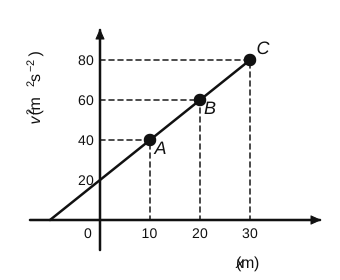
A particle is moving with constant acceleration $a$. Following graph shows $v^2$ versus $x$ (displacement) plot. The acceleration of the particle is ______ $\text{m s}^{-2}$.
Concept. For constant acceleration $v^2=u^2+2ax$. On a $v^2$–$x$ graph this is a straight line whose slope is $2a$, so the acceleration is half the slope.
Step 1. Read two points on the line. From the figure: $A(10,40)$ and $C(30,80)$ (with $x$ in m and $v^2$ in m$^2$ s$^{-2}$). Point $B(20,60)$ lies on the same line.
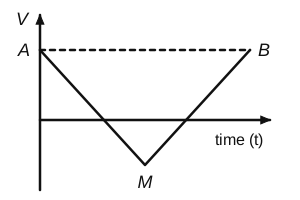
Concept. Acceleration is the slope of the $v$–$t$ graph.
Step 1. A to M. $v$ falls linearly: constant negative $a$.
Step 2. M to B. $v$ rises linearly: constant positive $a$.
Step 3. Choose. A negative constant jumping to a positive constant at M: graph (1).
Answer. Graph (1) (Option A).
Solution by Sreeraj P, M.Sc Physics
Q 11-02-105JEE MainJEE Main 2021 (24 Feb, Shift 2)Medium
A particle is projected with velocity $v_0$ along $x$-axis. A damping force is acting on the particle which is proportional to the square of the distance from the origin i.e. $ma = -\alpha x^2$. The distance at which the particle stops:
Concept. The force depends on position, $ma=-\alpha x^2$, so the acceleration is not constant. Write $a=v\dfrac{dv}{dx}$ so that $v$ and $x$ can be separated; this is the work–energy theorem in differential form.
Step 1. Rewrite the equation of motion. $$mv\frac{dv}{dx}=-\alpha x^2\ \Rightarrow\ mv\,dv=-\alpha x^2\,dx$$
Step 2. Integrate from $(x=0,\ v=v_0)$ to the stopping point $(x,\ v=0)$. $$\int_{v_0}^{0}mv\,dv=-\int_0^x\alpha x^2\,dx\ \Rightarrow\ -\frac{mv_0^2}{2}=-\frac{\alpha x^3}{3}$$
Step 3. Solve for $x$. $$x^3=\frac{3mv_0^2}{2\alpha}\ \Rightarrow\ x=\left(\frac{3mv_0^2}{2\alpha}\right)^{1/3}$$
Answer. Option B. Check: the initial kinetic energy $\tfrac12mv_0^2$ equals the work done against the force, $\int_0^x\alpha x^2dx=\tfrac{\alpha x^3}{3}$. Options without $m$ cannot be right, because $\alpha$ is a force constant.
Solution by Sreeraj P, M.Sc Physics
Q 11-02-106JEE MainJEE Main 2021 (25 Feb, Shift 1)Easy
An engine of a train, moving with uniform acceleration, passes the signal-post with velocity $u$ and the last compartment with velocity $v$. The velocity with which middle point of the train passes the signal post is:
Concept. Look at the motion from the train: the signal post moves past the train with the same uniform acceleration, from the engine (speed $u$) to the last compartment (speed $v$), over the train's length $L$. Use $v^2=u^2+2as$ for the whole length and for half of it.
Step 1. Whole length. From the engine to the last compartment: $$v^2=u^2+2aL\ \Rightarrow\ 2aL=v^2-u^2$$
Step 2. Half the length. Let $v_m$ be the speed when the middle of the train passes the post: $$v_m^2=u^2+2a\cdot\frac L2=u^2+\frac{v^2-u^2}{2}$$
Step 2. Acceleration. $$a=-\frac{v_0}{x_0}\cdot v_0\left(1-\frac x{x_0}\right)=-\frac{v_0^2}{x_0}+\frac{v_0^2}{x_0^2}x$$ A straight line from $-\dfrac{v_0^2}{x_0}$ at $x=0$ rising to $0$ at $x=x_0$.
Answer. Option C. (The acceleration is not constant, even though $v$–$x$ is a straight line.)
Solution by Sreeraj P, M.Sc Physics
Q 11-02-108JEE MainJEE Main 2021 (20 Jul, Shift 2)Easy
A boy reaches the airport and finds that the escalator is not working. He walks up the stationary escalator in time $t_1$. If he remains stationary on a moving escalator then the escalator takes him up in time $t_2$. The time taken by him to walk up on the moving escalator will be:
Concept. When the boy walks on the moving escalator, his velocity relative to the ground is his walking speed plus the escalator's speed (both upward). Express each speed through the escalator length $L$ and the given times, then add.
Step 1. The two speeds. $$v_{\text{boy}}=\frac{L}{t_1},\qquad v_{\text{esc}}=\frac{L}{t_2}$$
Answer. $\dfrac{t_1t_2}{t_1+t_2}$ (Option C). The answer must be shorter than both $t_1$ and $t_2$; only this option is.
Solution by Sreeraj P, M.Sc Physics
Q 11-02-109JEE MainJEE Main 2021 (26 Feb, Shift 2)Easy
A scooter accelerates from rest for time $t_1$ at constant rate $a_1$ and then retards at constant rate $a_2$ for time $t_2$ and comes to rest. The correct value of $\frac{t_1}{t_2}$ will be:
Answer. $\dfrac{a_2}{a_1}$ (Option A). The harder brake takes the shorter time.
Solution by Sreeraj P, M.Sc Physics
Q 11-02-110JEE MainJEE Main 2021 (25 Jul, Shift 2)Medium
The relation between time $t$ and distance $x$ for a moving body is given as $t = mx^2 + nx$, where $m$ and $n$ are constants. The retardation of the motion is: (When $v$ stands for velocity)
Concept. Differentiate $t = mx^2 + nx$ with respect to $t$ twice.
Step 1. First derivative. $1 = (2mx + n)v$, so $\dfrac{1}{v} = 2mx + n$.
Step 2. Second derivative. $$-\frac{1}{v^2}\frac{dv}{dt} = 2mv \;\Rightarrow\; a = -2mv^3$$ The retardation is $2mv^3$.
Answer. $2mv^3$ (Option A).
Solution by Sreeraj P, M.Sc Physics
Q 11-02-111JEE MainJEE Main 2021 (25 Jul, Shift 2)Easy
A balloon was moving upwards with a uniform velocity of $10$ m s$^{-1}$. An object of finite mass is dropped from the balloon when it was at a height of $75$ m from the ground level. The height of the balloon from the ground when object strikes the ground was around: (takes the value of $g$ as $10$ m s$^{-2}$)
Concept. The object leaves the balloon with the balloon's velocity, $10$ m/s upward, and then moves only under gravity. Find its flight time, then how far the balloon rises in that time.
Step 1. Flight time (up positive, origin at the release point). $$-75=10t-5t^2\ \Rightarrow\ t^2-2t-15=0\ \Rightarrow\ (t-5)(t+3)=0\ \Rightarrow\ t=5\ \text{s}$$
Q 11-02-112JEE MainJEE Main 2021 (25 Jul, Shift 2)Easy
The instantaneous velocity of a particle moving in a straight line is given as $v = \alpha t + \beta t^2$, where $\alpha$ and $\beta$ are constants. The distance travelled by the particle between $1$ s and $2$ s is:
Concept. Distance $=\displaystyle\int|v|\,dt$. For positive $\alpha$ and $\beta$, $v=\alpha t+\beta t^2$ is positive between 1 s and 2 s, so the distance equals the displacement.
Q 11-02-113JEE MainJEE Main 2021 (26 Aug, Shift 1)Medium
Two spherical balls having equal masses with radius of $5$ cm each are thrown upwards along the same vertical direction at an interval of $3$ s with the same initial velocity of $35$ m s$^{-1}$, then these balls collide at a height of ______ m. (take $g = 10$ m s$^{-2}$)
Concept. Two balls thrown up from the same point with the same speed, $\tau$ apart, meet at $t=\dfrac ug+\dfrac\tau2$ after the first throw. Then find the height.
Answer. $50$. (The radius of the balls is ignored.)
Solution by Sreeraj P, M.Sc Physics
Q 11-02-114JEE MainJEE Main 2021 (27 Aug, Shift 1)Easy
If the velocity of a body related to displacement $x$ is given by $v = \sqrt{5000 + 24x}$ m s$^{-1}$, then the acceleration of the body is ______ m s$^{-2}$.
Q 11-02-115JEE MainJEE Main 2021 (27 Aug, Shift 2)Easy
Water drops are falling from a nozzle of a shower onto the floor from a height of $9.8$ m. The drops fall at a regular interval of time. When the first drop strikes the floor, at that instant, the third drop begins to fall. Locate the position of second drop from the floor when the first drop strikes the floor.
Concept. The drops leave at equal intervals $\tau$. When drop 1 lands and drop 3 just leaves, two intervals have passed: the fall time $T=2\tau$. Drop 2 has then been falling for $\tau=T/2$.
Step 1. Fall time. $T=\sqrt{\dfrac{2h}{g}}=\sqrt{\dfrac{2\times9.8}{9.8}}=\sqrt2$ s, so $\tau=\dfrac{\sqrt2}{2}$ s.
Step 2. Distance fallen by drop 2. $$s=\tfrac12g\tau^2=\tfrac12(9.8)\left(\tfrac12\right)=2.45\ \text{m}$$ (In time $T/2$ a dropped body falls a quarter of the height.)
Step 3. Height above the floor. $9.8-2.45=7.35$ m.
Answer. $7.35$ m (Option D).
Solution by Sreeraj P, M.Sc Physics
Q 11-02-116JEE MainJEE Main 2020 (8 Jan, Shift 2)Medium
A ball is dropped from the top of a $100$ m high tower on a planet. In the last $\dfrac{1}{2}$ s before hitting the ground, it covers a distance of $19$ m. Acceleration due to gravity (in m s$^{-2}$) near the surface on that planet is ______.
Concept. The ball falls from rest with constant acceleration $g$ (unknown), so the distance fallen in time $t$ is $\tfrac12gt^2$. The full $100$ m takes the whole time $T$; the first $100-19=81$ m takes $T-\tfrac12$. Dividing the two equations removes $g$.
Step 1. Two fall equations. $$\tfrac12gT^2=100,\qquad \tfrac12g\left(T-\tfrac12\right)^2=81$$
Step 2. Divide and take square roots. $$\frac{T^2}{\left(T-\tfrac12\right)^2}=\frac{100}{81}\ \Rightarrow\ \frac{T}{T-\tfrac12}=\frac{10}{9}$$
Step 3. Solve for $T$. $$9T=10T-5\ \Rightarrow\ T=5\ \text{s}$$
Answer. $8$ m s$^{-2}$. Check: in $4.5$ s the ball falls $\tfrac12(8)(20.25)=81$ m, leaving $19$ m for the last half second.
Solution by Sreeraj P, M.Sc Physics
Q 11-02-117JEE MainJEE Main 2020 (9 Jan, Shift 1)Medium
The distance $x$ covered by a particle in one dimensional motion varies with time $t$ as $x^2 = at^2 + 2bt + c$. If the acceleration of the particle depends on $x$ as $x^{-n}$, where $n$ is an integer, the value of $n$ is ______.
Concept. Position is given implicitly by $x^2=at^2+2bt+c$. Differentiate both sides with respect to $t$ (implicit differentiation) to get $v$, then again to get the acceleration, and simplify using the original equation.
Step 1. First derivative. $$2x\frac{dx}{dt}=2at+2b\ \Rightarrow\ v=\frac{at+b}{x}$$
Step 2. Second derivative (quotient rule). Call the acceleration $A$ to avoid confusion with the constant $a$: $$A=\frac{dv}{dt}=\frac{a\,x-(at+b)\,v}{x^2}$$ Put $v=\dfrac{at+b}{x}$: $$A=\frac{a x-\dfrac{(at+b)^2}{x}}{x^2}=\frac{ax^2-(at+b)^2}{x^3}$$
Step 3. Simplify the numerator. Use $x^2=at^2+2bt+c$: $$a(at^2+2bt+c)-(a^2t^2+2abt+b^2)=ac-b^2$$ This is a constant.
Step 4. Read off $n$. $$A=\frac{ac-b^2}{x^3}\propto x^{-3}\ \Rightarrow\ n=3$$
Answer. $n=3$.
Solution by Sreeraj P, M.Sc Physics
Q 11-02-118JEE MainJEE Main 2020 (5 Sep, Shift 2)Easy
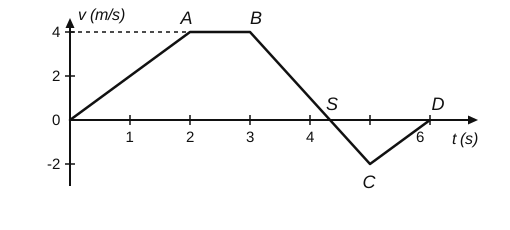
The velocity ($v$) and time ($t$) graph of a body in straight line motion is shown in the figure. The point $S$ is at $4.333$ s. The total distance covered by the body in $6$ s is:
Concept. Distance is the total area between the $v$–$t$ graph and the time axis, with every piece taken as positive. The graph crosses the axis at $S$, so split the area there.
Step 1. Read the corner points. From the figure: $(0,0)$, $A(2,4)$, $B(3,4)$, $C(5,-2)$, $D(6,0)$. On $BC$ the velocity falls by $6$ m/s in $2$ s, so it is zero at $t=3+\tfrac43=4.333$ s; this is $S$.
Step 2. Areas above the axis.
$0$ to $2$ s (triangle): $\tfrac12\times2\times4=4$ m
$2$ to $3$ s (rectangle): $1\times4=4$ m
$3$ to $4.333$ s (triangle): $\tfrac12\times\tfrac43\times4=\tfrac83$ m
Step 3. Areas below the axis (taken positive).
$4.333$ to $5$ s (triangle): $\tfrac12\times\tfrac23\times2=\tfrac23$ m
$5$ to $6$ s (triangle): $\tfrac12\times1\times2=1$ m
Answer. $\dfrac{37}{3}$ m (Option A). The displacement would be $\tfrac{32}{3}-\tfrac53=9$ m; the question asks for distance.
Solution by Sreeraj P, M.Sc Physics
Q 11-02-119JEE MainJEE Main 2020 (4 Sep, Shift 1)Medium
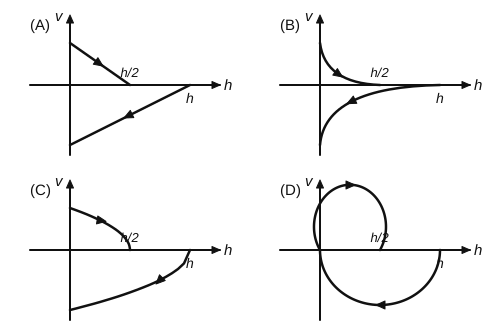
A tennis ball is released from a height $h$ and after freely falling on a wooden floor it rebounds and reaches height $\dfrac h2$. The velocity versus height of the ball during its motion may be represented graphically by: (graphs are drawn schematically and are not to scale)
Concept. For free fall and the rise after the bounce, $v^2=2g(h_{\text{top}}-h)$: $v$ against $h$ is a parabola opening along the $h$-axis, with $v=0$ at the top of each stage.
Step 1. The fall. From height $h$ down to the floor, $v$ is downward (negative) and $|v|$ grows as $\sqrt{2g(h-y)}$: a parabolic arc from $(h,0)$ to the $v$-axis below the origin.
Step 2. The rebound. Just after the bounce $v$ is upward (positive) and smaller; it falls to $0$ at $h/2$: a parabolic arc from the $v$-axis above the origin to $(h/2,0)$.
Step 3. Choose. Straight lines (A), curves hugging the axes (B) and arcs reaching negative heights (D) are wrong; (C) has the two parabolic arcs.
Answer. Graph (C) (Option C).
Solution by Sreeraj P, M.Sc Physics
Q 11-02-120JEE MainJEE Main 2020 (5 Sep, Shift 1)Medium
A helicopter rises from rest on the ground vertically upwards with a constant acceleration $g$. A food packet is dropped from the helicopter when it is at a height $h$. The time taken by the packet to reach the ground is close to [$g$ is the acceleration due to gravity]:
Concept. At the moment of release the packet has the helicopter's velocity, which is upward. After release only gravity acts, so its acceleration becomes $g$ downward. Use the helicopter's motion to find that release velocity, then a quadratic for the packet.
Step 1. Velocity at height $h$. The helicopter rises from rest with acceleration $g$: $$u^2=0+2gh\ \Rightarrow\ u=\sqrt{2gh}\ \text{(upward)}$$
Step 2. Equation for the packet. Take upward as positive; the ground is at $-h$ from the release point: $$-h=ut-\tfrac12gt^2\ \Rightarrow\ gt^2-2\sqrt{2gh}\,t-2h=0$$
Answer. $t\approx3.4\sqrt{\dfrac hg}$ (Option C). Treating the packet as dropped from rest would give $\sqrt{2h/g}\approx1.4\sqrt{h/g}$, which ignores its upward start.
Solution by Sreeraj P, M.Sc Physics
Q 11-02-121JEE MainJEE Main 2019 (9 Jan, Shift 2)Medium
In a car race on straight road, car $A$ takes a time $t$ less than car $B$ at the finish and passes finishing point with a speed $v$ more than that of car $B$. Both the cars start from rest and travel with constant acceleration $a_1$ and $a_2$ respectively. Then $v$ is equal to:
Concept. Both cars start from rest with constant acceleration over the same track length $d$. From $d=\tfrac12at^2$ and $v^2=2ad$, each car's finishing time and speed can be written in terms of $d$. The ratio $\dfrac{v}{t}$ then removes $d$.
Step 1. Finishing time and speed of a car with acceleration $a$. $$t=\sqrt{\frac{2d}{a}},\qquad v=\sqrt{2ad}$$
Step 2. Speed difference. $A$ (acceleration $a_1$) is faster: $$v=v_A-v_B=\sqrt{2d}\left(\sqrt{a_1}-\sqrt{a_2}\right)$$
Step 3. Time difference. $A$ finishes earlier: $$t=t_B-t_A=\sqrt{2d}\left(\frac{1}{\sqrt{a_2}}-\frac{1}{\sqrt{a_1}}\right)=\sqrt{2d}\,\frac{\sqrt{a_1}-\sqrt{a_2}}{\sqrt{a_1a_2}}$$
Step 4. Divide. The factors $\sqrt{2d}$ and $\left(\sqrt{a_1}-\sqrt{a_2}\right)$ cancel: $$\frac{v}{t}=\sqrt{a_1a_2}\ \Rightarrow\ v=\sqrt{a_1a_2}\,t$$
Answer. Option C. A useful result to remember: speed lead $=$ (geometric mean of the accelerations) $\times$ time lead.
Solution by Sreeraj P, M.Sc Physics
Q 11-02-122JEE MainJEE Main 2019 (10 Jan, Shift 2)Easy
A particle starts from the origin at time $t = 0$ and moves along the positive $x$-axis. The graph of velocity with respect to time is shown in figure. What is the position of the particle at time $t = 5\ \text{s}$?
Concept. Starting at the origin, the position at $t=5$ s equals the area under the $v$–$t$ graph from 0 to 5 s (the velocity is never negative).
Step 1. Read the pieces.
$0$–$2$ s: $v$ rises from 0 to 2 m/s: $\tfrac12\times2\times2=2$ m.
$2$–$4$ s: $v=2$ m/s: $2\times2=4$ m.
$4$–$5$ s: $v=3$ m/s: $3\times1=3$ m.
Step 2. Add. $x=2+4+3=9$ m.
Answer. $9$ m (Option B).
Solution by Sreeraj P, M.Sc Physics
Q 11-02-123JEE MainJEE Main 2019 (10 Apr, Shift 1)Hard
A ball is thrown upward with an initial velocity $V_0$ from the surface of the earth. The motion of the ball is affected by a drag force equal to $m\gamma v^2$ (where $m$ is mass of the ball, $v$ is its instantaneous velocity and $\gamma$ is a constant). Time taken by the ball to rise to its zenith is:
Concept. While the ball rises, both its weight and the drag act downward, so $\dfrac{dv}{dt}=-(g+\gamma v^2)$. The acceleration depends on $v$, so separate the variables and integrate from $V_0$ to $0$ (the zenith). The integral $\int\dfrac{dv}{g+\gamma v^2}$ is an arctan.
Step 1. Equation of motion on the way up. Taking upward as positive: $$m\frac{dv}{dt}=-mg-m\gamma v^2\ \Rightarrow\ \frac{dv}{dt}=-(g+\gamma v^2)$$
Step 2. Separate and set the limits. $$t=-\int_{V_0}^{0}\frac{dv}{g+\gamma v^2}=\int_0^{V_0}\frac{dv}{g+\gamma v^2}$$
Step 3. Integrate. Write $g+\gamma v^2=\gamma\left(\dfrac g\gamma+v^2\right)$ and use $\displaystyle\int\frac{dv}{k^2+v^2}=\frac1k\tan^{-1}\frac vk$ with $k=\sqrt{\dfrac g\gamma}$: $$t=\frac1\gamma\cdot\sqrt{\frac\gamma g}\,\tan^{-1}\!\left(\sqrt{\frac\gamma g}\,V_0\right)=\frac{1}{\sqrt{\gamma g}}\tan^{-1}\!\left(\sqrt{\frac\gamma g}\,V_0\right)$$
Answer. Option B. Check: for small $\gamma$, $\tan^{-1}y\approx y$ gives $t\approx\dfrac{V_0}{g}$, the drag-free result.
Solution by Sreeraj P, M.Sc Physics
Q 11-02-124JEE MainJEE Main 2019 (8 Apr, Shift 2)Easy
A particle starts from origin O from rest and moves with a uniform acceleration along the positive $x$-axis. Identify all figures that correctly represent the motion qualitatively. ($a$ = acceleration, $v$ = velocity, $x$ = displacement, $t$ = time)
Concept. Uniform acceleration from rest: $a$ is constant, $v=at$ is a straight line through the origin, and $x=\tfrac12at^2$ is a parabola curving upward.
Step 1. Check each graph.
(A) $a$–$t$ horizontal: correct.
(B) $v$–$t$ straight line from the origin: correct.
(C) $x$–$t$ flattening out: that means slowing down. Incorrect.
(D) $x$–$t$ curving upward: correct.
Answer. (A), (B), (D) (Option A).
Solution by Sreeraj P, M.Sc Physics
Q 11-02-125JEE MainJEE Main 2019 (9 Apr, Shift 2)Easy
The position of a particle as a function of time $t$, is given by $x(t) = at + bt^2 - ct^3$ where $a$, $b$ and $c$ are constants. When the particle attains zero acceleration, then its velocity will be
Concept. The position is a cubic in $t$, so the acceleration is not constant and the constant-acceleration equations cannot be used. Differentiate: $v=\dfrac{dx}{dt}$, $a=\dfrac{dv}{dt}$. Set $a=0$ to find the instant, then put it in $v$.
Step 1. Velocity. $$v=\frac{dx}{dt}=a+2bt-3ct^2$$
Step 2. Acceleration and the instant it is zero. $$\frac{dv}{dt}=2b-6ct=0\ \Rightarrow\ t=\frac{b}{3c}$$
Step 3. Velocity at that instant. $$v=a+2b\left(\frac{b}{3c}\right)-3c\left(\frac{b}{3c}\right)^2=a+\frac{2b^2}{3c}-\frac{b^2}{3c}=a+\frac{b^2}{3c}$$
Answer. $a+\dfrac{b^2}{3c}$ (Option A). Zero acceleration is where the velocity is maximum, so this is the particle's greatest velocity.
Solution by Sreeraj P, M.Sc Physics
Q 11-02-126JEE MainJEE Main 2019 (12 Jan, Shift 1)Easy
A passenger train of length $60$ m travels at a speed of $80$ km/hr. Another freight train of length $120$ m travels at a speed of $30$ km/hr. The ratio of times taken by the passenger train to completely cross the freight train when: (i) they are moving in the same direction, and (ii) in the opposite directions is:
Concept. Work in the frame of the freight train. The passenger train has "completely crossed" it when it has moved, relative to the freight train, a distance equal to the sum of the two lengths. The relative speed is the difference of speeds (same direction) or the sum (opposite directions).
Step 1. Relative distance. In both cases: $$d=60+120=180\ \text{m}$$
Step 3. Ratio of times. With the same distance, time is inversely proportional to relative speed: $$\frac{t_1}{t_2}=\frac{d/50}{d/110}=\frac{110}{50}=\frac{11}{5}$$
Answer. $\dfrac{11}{5}$ (Option C). Since only the ratio is asked, no unit conversion is needed.
Solution by Sreeraj P, M.Sc Physics
Q 11-02-127JEE MainJEE Main 2019 (12 Apr, Shift 2)Medium
A particle is moving with speed $v = b\sqrt x$ along positive $x$-axis. Calculate the speed of the particle at time $t = \tau$ (assume that the particle is at origin at $t = 0$)
Concept. The speed is given as a function of position, $v=b\sqrt x$. Write $v=\dfrac{dx}{dt}$, separate the variables and integrate to get $x(t)$; then put it back into $v$.
Step 2. Integrate from the origin at $t=0$ to $x$ at $t=\tau$. $$\int_0^x x^{-1/2}\,dx=\int_0^\tau b\,dt\ \Rightarrow\ 2\sqrt x=b\tau\ \Rightarrow\ \sqrt x=\frac{b\tau}{2}$$
Step 3. Speed at $t=\tau$. $$v=b\sqrt x=b\cdot\frac{b\tau}{2}=\frac{b^2\tau}{2}$$
Answer. $\dfrac{b^2\tau}{2}$ (Option C). Shortcut: $v^2=b^2x$ has the form $v^2=2ax$, so the acceleration is constant, $a=\tfrac{b^2}{2}$, and from rest $v=a\tau$.
Solution by Sreeraj P, M.Sc Physics
Q 11-02-128JEE MainJEE Main 2018 (15 Apr, Shift 1)Medium
The velocity time graphs of a car and a scooter are shown in the figure. (i) The difference between the distance travelled by the car and the scooter in 15 s and (ii) the time at which the car will catch up with the scooter are, respectively.
Answer: (A) $112.5\ \text{m}$ and $22.5\ \text{s}$
Concept. Areas under $v$–$t$ graphs are distances. Both vehicles start together from the same point, so the car catches up when the areas under the two graphs become equal. After the car's speed exceeds the scooter's, it closes the gap at the difference of speeds.
Step 1. Read the graphs. The car accelerates uniformly from rest to $45$ m s$^{-1}$ in $15$ s, then moves at $45$ m s$^{-1}$. The scooter moves at a constant $30$ m s$^{-1}$.
Step 2. Distances in the first $15$ s. $$s_{\text{car}}=\tfrac12\times15\times45=337.5\ \text{m},\qquad s_{\text{scooter}}=30\times15=450\ \text{m}$$
Step 4. Time to catch up (part ii). After $15$ s the car gains at $45-30=15$ m s$^{-1}$: $$\Delta t=\frac{112.5}{15}=7.5\ \text{s}\ \Rightarrow\ t=15+7.5=22.5\ \text{s}$$
Answer. $112.5$ m and $22.5$ s (Option A). Check: at $22.5$ s the car has $337.5+45\times7.5=675$ m and the scooter $30\times22.5=675$ m.
Solution by Sreeraj P, M.Sc Physics
Q 11-02-129JEE MainJEE Main 2018 (15 Apr, Shift 1)Easy
An automobile, traveling at $40\ \text{km h}^{-1}$, can be stopped at a distance of $40\ \text{m}$ by applying brakes. If the same automobile is traveling at $80\ \text{km h}^{-1}$, the minimum stopping distance in metres is (Assume no skidding):
Concept. Thrown up: $v=u-gt$ (up positive), a straight line of constant negative slope $-g$ that starts at $+u$ and crosses the time axis at the top, continuing below it on the way down.
Step 1. Reject the others.
A: a V above the axis is the *speed*, not the velocity.
B: velocity rising at first would need an upward acceleration.
C: the second line runs back to $t=0$, so time would go backwards.
Step 2. Choose. D: the single straight line from $+u$ falling through zero to negative values.
Answer. Option D.
Solution by Sreeraj P, M.Sc Physics
Q 11-02-131JEE MainJEE Main 2017 (8 Apr)Medium
Which graph corresponds to an object moving with a constant negative acceleration and a positive velocity?
Concept. With constant acceleration $-a$ and positive velocity, $v^2 = u^2 - 2ax$.
Step 1. Shape of $v$ against $x$. $v$ falls with $x$, and $\dfrac{dv}{dx} = -\dfrac{a}{v}$ gets steeper as $v$ shrinks, becoming vertical at $v = 0$, $x = \dfrac{u^2}{2a}$.
Step 2. Choose. A concave-down curve falling steeply to the axis: graph (3).
Answer. Graph (3) (Option C).
Solution by Sreeraj P, M.Sc Physics
Q 11-02-132JEE MainJEE Main 2017 (9 Apr)Easy
A car is standing $200$ m behind a bus, which is also at rest. The two start moving at the same instant but with different forward accelerations. The bus has acceleration $2\ \text{m s}^{-2}$ and the car has acceleration $4\ \text{m s}^{-2}$. The car will catch up with the bus after time:
Concept. In the frame of the bus, the car starts from rest $200$ m behind and moves with the relative acceleration $a_{\text{car}}-a_{\text{bus}}$. This relative acceleration is constant, so $s=\tfrac12at^2$ applies to the relative motion.
Step 1. Relative acceleration. Both accelerations are forward: $$a_{\text{rel}}=4-2=2\ \text{m s}^{-2}$$
Step 2. Relative distance to close. Both start from rest, so the relative initial velocity is zero and the car must gain $200$ m: $$200=\tfrac12(2)t^2=t^2$$
Answer. $10\sqrt2$ s (Option D). Check in the ground frame: car $\tfrac12(4)(200)=400$ m, bus $\tfrac12(2)(200)=200$ m, which differ by $200$ m.
Solution by Sreeraj P, M.Sc Physics
Q 11-02-133JEE MainJEE Main 2017 (9 Apr)Medium
The machine as shown has $2$ rods of length $1$ m connected by a pivot at the top. The end of one rod is connected to the floor by a stationary pivot and the end of the other rod has a roller that rolls along the floor in a slot. As the roller goes back and forth, a $2$ kg weight moves up and down. If the roller is moving towards right at a constant speed, the weight moves up with a:
Concept. Constraint kinematics: write the geometric relation between the height $h$ of the weight and the distance $x$ between the rod ends, then differentiate with respect to time.
Step 1. Geometry. Each rod is $1$ m and the top is above the midpoint of the base: $$h^2+\left(\frac x2\right)^2=1$$
Step 2. Differentiate. $$2h\dot h+\frac x2\dot x=0\ \Rightarrow\ \dot h=-\frac{x}{4h}\dot x$$ The roller moves towards the fixed pivot, so $x$ decreases ($\dot x\lt0$) and $\dot h>0$: the weight rises.
Step 3. How the speed changes. At constant $|\dot x|$, the speed $|\dot h|=\dfrac{x}{4h}|\dot x|$. As the weight rises, $x$ falls and $h$ grows, so $\dfrac{x}{4h}$ falls: the weight slows down.
Step 4. Check option A. At $h=0.4$ m, $x=2\sqrt{1-0.16}=1.83$ m and $\dfrac{x}{4h}=1.15$, not $\tfrac34$.
Answer. Decreasing speed (Option C).
Solution by Sreeraj P, M.Sc Physics
Q 11-02-134JEE MainJEE Main 2018 (8 Apr)Medium
All the graphs below are intended to represent the same motion. One of them does it incorrectly. Pick it up.
Concept. All four graphs describe a body thrown up and coming back down. Check each against $v=u-gt$, $v^2=u^2-2gy$, $y=ut-\tfrac12gt^2$ and the distance travelled.
Step 1. Check each.
A: velocity–time is a falling straight line. Correct.
B: velocity against position is a sideways parabola ($v^2=u^2-2gy$), both signs of $v$ at each height. Correct.
C: distance–time. Distance starts growing at speed $u$ (steep at $t=0$), slows to zero slope at the top, then grows faster again. The drawn curve starts flat and ends flat, the opposite. Incorrect.
D: position–time is a downward parabola. Correct.
Answer. Option C is drawn incorrectly.
Solution by Sreeraj P, M.Sc Physics
Q 11-02-135NEETNEET 2022Top questionEasy
The ratio of the distances travelled by a freely falling body in the $1^{\text{st}}$, $2^{\text{nd}}$, $3^{\text{rd}}$ and $4^{\text{th}}$ second
The displacement-time graphs of two moving particles make angles of $30°$ and $45°$ with the $x$-axis as shown in the figure. The ratio of their respective velocity is
Q 11-02-137JEE MainJEE Main 2025 (2 Apr, Shift 1)Easy
A person travelling on a straight line moves with a uniform velocity $v_1$ for a distance $x$ and with a uniform velocity $v_2$ for the next $\dfrac32 x$ distance. The average velocity in this motion is $\dfrac{50}{7}\ \text{m/s}$. If $v_1$ is $5\ \text{m/s}$ then $v_2$ = ______ m/s.
Concept. Average velocity in one-way straight motion $=$ total distance $\div$ total time. Write the time of each part as distance $\div$ speed.
Step 1. Total distance and time. Distance $x+\tfrac32x=\tfrac52x$; time $\dfrac{x}{v_1}+\dfrac{3x}{2v_2}$.
Step 2. Equate to the given average. $$\frac{\tfrac52x}{\dfrac x5+\dfrac{3x}{2v_2}}=\frac{50}{7}\ \Rightarrow\ \frac15+\frac{3}{2v_2}=\frac{5}{2}\times\frac{7}{50}=0.35$$
Q 11-02-138JEE MainJEE Main 2025 (2 Apr, Shift 2)Easy
A sportsman runs around a circular track of radius $r$ such that he traverses the path ABAB, where A and B are the ends of a diameter. The distance travelled and displacement, respectively, are:
Concept. Distance is the length of the path actually covered, so it keeps adding up along the track. Displacement is the straight-line vector from the starting point to the final point, so it depends only on where the motion starts and ends.
Step 1. Break the path into pieces. A and B are the ends of a diameter, so going from one to the other along the track is half a lap. The path ABAB has three such pieces: A to B, B to A, A to B.
Step 2. Distance. Each half lap is half the circumference: $$\text{half lap}=\frac{2\pi r}{2}=\pi r\qquad\Rightarrow\qquad \text{distance}=3\times\pi r=3\pi r$$
Step 3. Displacement. He starts at A and finishes at B. The straight line from A to B is the diameter: $$|\text{displacement}|=AB=2r$$
Answer. $3\pi r,\ 2r$ (Option D). The full lap from A back to A adds $2\pi r$ to the distance but nothing to the displacement.
Solution by Sreeraj P, M.Sc Physics
Q 11-02-139JEE MainJEE Main 2025 (3 Apr, Shift 1)Medium
Which of the following curves possibly represent one-dimensional motion of a particle?
(A) Phase versus time: a straight line with positive slope.
(B) Velocity versus displacement: a circle centred at the origin.
(C) Velocity versus time: a circle centred at the origin.
(D) Total distance versus time: a curve that starts at the origin and never decreases.
(The graphs are shown in the figure.) Choose the correct answer from the options given below:
Concept. A graph can describe a real motion only if every quantity has one value at each instant and distance never decreases.
Step 1. Check each.
(A) Phase growing linearly with time ($\omega t+\phi$): possible.
(B) Velocity against displacement as a circle: simple harmonic motion with suitable units, $v^2+x^2\omega^2$ const. Possible.
(C) Velocity against time as a circle: two velocities at the same time, and time going backwards on part of it. Impossible.
(D) Total distance never decreasing: possible.
Answer. A, B and D only (Option A).
Solution by Sreeraj P, M.Sc Physics
Q 11-02-140JEE MainJEE Main 2025 (3 Apr, Shift 2)Easy
A particle moves along the $x$-axis and has its displacement $x$ varying with time $t$ according to the equation $x = c_0(t^2 - 2) + c(t - 2)^2$, where $c_0$ and $c$ are constants of appropriate dimensions. Then, which of the following statements is correct?
Concept. On an $x$–$t$ graph, average velocity over an interval is $\dfrac{\Delta x}{\Delta t}$ (the slope of the chord), and instantaneous velocity is the slope of the graph at that instant. The graph is made of straight segments, so the slope is constant on each one.
Step 1. Read the corner points. From the figure: $O(0,0)$, $A(1,-5)$, $B(2,0)$, $C(3,5)$, $D(5,5)$, $E(6,10)$, $F(7,0)$, $G(8,-5)$, $H(9,0)$.
Step 2. Check each statement.
(A) $0$ to $3$ s: $\dfrac{5-0}{3}=\dfrac53$ m/s, not $10$ m/s. False.
(B) $3$ to $5$ s: $x=5$ m at both ends, so $\dfrac{0}{2}=0$. True.
(C) $t=2$ s lies on the straight segment $A$ to $C$, slope $\dfrac{5-(-5)}{3-1}=5$ m/s. True.
(D) $5$ to $7$ s average: $\dfrac{0-5}{2}=-2.5$ m/s. At $6.5$ s the segment $E$ to $F$ has slope $\dfrac{0-10}{1}=-10$ m/s. Not equal. False.
(E) $0$ to $9$ s: $x=0$ at both ends, so the average velocity is $0$. True.
Answer. (B), (C), (E) only (Option D). For (D), the chord from $5$ s to $7$ s averages a rising and a falling segment, so it cannot equal the slope of either.
Solution by Sreeraj P, M.Sc Physics
Q 11-02-142JEE MainMedium
A particle starts from rest at $t = 0$ and moves along a straight line. Its acceleration varies with time as shown in the graph. The maximum speed of the particle and the distance it covers in the first $6$ s are, respectively,
Concept. The area under an $a$–$t$ graph is the change in velocity. Use constant-acceleration equations on each part.
Step 1. From 0 to 2 s. $a = 4$ m/s² from rest: $$v(2) = 4 \times 2 = 8\ \text{m/s},\qquad x_1 = \tfrac12(4)(2)^2 = 8\ \text{m}$$
Step 2. From 2 to 6 s. $a = -2$ m/s²: $$v(6) = 8 - 2 \times 4 = 0$$ The speed falls to zero only at $t = 6$ s, so the particle never turns back and the maximum speed is $8$ m/s (at $t = 2$ s). $$x_2 = 8(4) - \tfrac12(2)(4)^2 = 16\ \text{m}$$
Step 3. Distance. $8 + 16 = 24$ m.
Answer. $8$ m/s and $24$ m (Option C).
Solution by Sreeraj P, M.Sc Physics
Q 11-02-143JEE MainMedium
A ball is thrown vertically upward with a speed of $20$ m/s from the top of a tower $25$ m high and finally lands at the foot of the tower. Take $g = 10\ \text{m/s}^2$ and neglect air resistance.
A. The maximum height of the ball above the ground is $45$ m.
B. The ball reaches the ground $5$ s after it is thrown.
C. The average speed of the ball over the whole flight is $13$ m/s.
D. The magnitude of the average velocity of the ball over the whole flight is $9$ m/s.
Choose the correct answer from the options given below:
Concept. Take upward as positive with the origin at the top of the tower. Average speed uses the total path length; average velocity uses the net displacement.
Step 1. Maximum height. Rise above the tower: $\dfrac{u^2}{2g} = \dfrac{400}{20} = 20$ m, so $25 + 20 = 45$ m above the ground. A is correct.
Step 2. Time of flight. Displacement $-25$ m: $$-25 = 20t - 5t^2 \;\Rightarrow\; t^2 - 4t - 5 = 0 \;\Rightarrow\; t = 5\ \text{s}$$ B is correct.
Step 3. Average speed. Path $= 20$ m up $+ 45$ m down $= 65$ m: $$\frac{65}{5} = 13\ \text{m/s}$$ C is correct.
Step 4. Average velocity. Net displacement $25$ m downward: $$\frac{25}{5} = 5\ \text{m/s}$$ not $9$ m/s, so D is wrong.


 Solution by Sreeraj P, M.Sc Physics