

Q 11-02-107JEE MainJEE Main 2021 (18 Mar, Shift 2)Medium
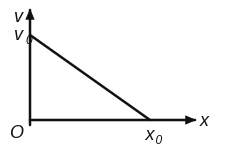
The velocity-displacement graph of a particle is shown in the figure.
The acceleration-displacement graph of the same particle is represented by:
Answer: (C) see figure
Concept. As in any $v$–$x$ question, $a=v\dfrac{dv}{dx}$. Here $v=v_0\left(1-\dfrac{x}{x_0}\right)$ from $x=0$ to $x_0$.
Step 1. Slope. $\dfrac{dv}{dx}=-\dfrac{v_0}{x_0}$ (constant).
Step 2. Acceleration.
$$a=-\frac{v_0}{x_0}\cdot v_0\left(1-\frac x{x_0}\right)=-\frac{v_0^2}{x_0}+\frac{v_0^2}{x_0^2}x$$
A straight line from $-\dfrac{v_0^2}{x_0}$ at $x=0$ rising to $0$ at $x=x_0$.
Answer. Option C. (The acceleration is not constant, even though $v$–$x$ is a straight line.)
 Solution by Sreeraj P, M.Sc Physics


