

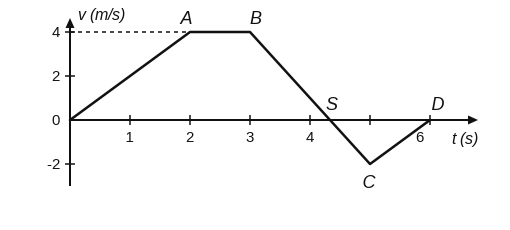
The velocity ($v$) and time ($t$) graph of a body in straight line motion is shown in the figure. The point $S$ is at $4.333$ s. The total distance covered by the body in $6$ s is:
Answer: (A) $\dfrac{37}{3}$ m
Concept. Distance is the total area between the $v$–$t$ graph and the time axis, with every piece taken as positive. The graph crosses the axis at $S$, so split the area there.
Step 1. Read the corner points. From the figure: $(0,0)$, $A(2,4)$, $B(3,4)$, $C(5,-2)$, $D(6,0)$. On $BC$ the velocity falls by $6$ m/s in $2$ s, so it is zero at $t=3+\tfrac43=4.333$ s; this is $S$.
Step 2. Areas above the axis.
- $0$ to $2$ s (triangle): $\tfrac12\times2\times4=4$ m
- $2$ to $3$ s (rectangle): $1\times4=4$ m
- $3$ to $4.333$ s (triangle): $\tfrac12\times\tfrac43\times4=\tfrac83$ m
Step 3. Areas below the axis (taken positive).
- $4.333$ to $5$ s (triangle): $\tfrac12\times\tfrac23\times2=\tfrac23$ m
- $5$ to $6$ s (triangle): $\tfrac12\times1\times2=1$ m
Step 4. Add.
$$s=4+4+\frac83+\frac23+1=9+\frac{10}{3}=\frac{37}{3}\ \text{m}$$
Answer. $\dfrac{37}{3}$ m (Option A). The displacement would be $\tfrac{32}{3}-\tfrac53=9$ m; the question asks for distance.
 Solution by Sreeraj P, M.Sc Physics


