

A tennis ball is released from a height $h$ and after freely falling on a wooden floor it rebounds and reaches height $\dfrac h2$. The velocity versus height of the ball during its motion may be represented graphically by: (graphs are drawn schematically and are not to scale)
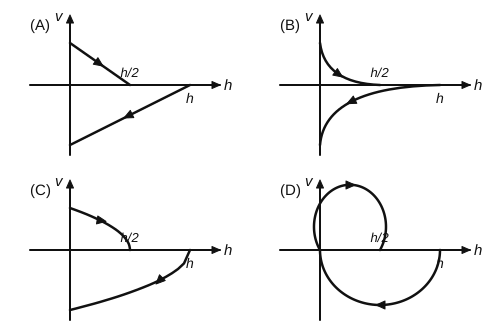
Answer: (C) Graph (C)
Take upward as positive. Falling from rest at height $h$: $v = -\sqrt{2g(h - y)}$, a parabola in the $v$–$h$ plane from $(h, 0)$ down to $(0, -\sqrt{2gh})$.
At the floor the velocity reverses suddenly to $+\sqrt{gh}$, and on the way up $v = +\sqrt{2g(h/2 - y)}$, a parabola from $(0, \sqrt{gh})$ to $(h/2, 0)$.
Both parts are parabolic arcs (not straight lines), the height never becomes negative, and the motion goes from $h$ to the floor and then up to $h/2$: graph (C).
 Solution by Sreeraj P, M.Sc Physics