

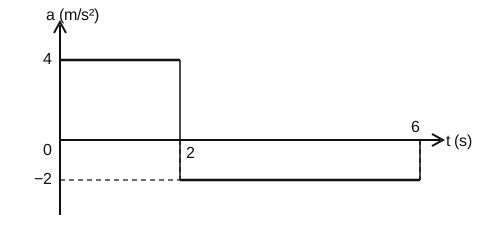
A particle starts from rest at $t = 0$ and moves along a straight line. Its acceleration varies with time as shown in the graph. The maximum speed of the particle and the distance it covers in the first $6$ s are, respectively,
Answer: (C) $8$ m/s and $24$ m
Concept. The area under an $a$–$t$ graph is the change in velocity. Use constant-acceleration equations on each part.
Step 1. From 0 to 2 s. $a = 4$ m/s² from rest:
$$v(2) = 4 \times 2 = 8\ \text{m/s},\qquad x_1 = \tfrac12(4)(2)^2 = 8\ \text{m}$$
Step 2. From 2 to 6 s. $a = -2$ m/s²:
$$v(6) = 8 - 2 \times 4 = 0$$
The speed falls to zero only at $t = 6$ s, so the particle never turns back and the maximum speed is $8$ m/s (at $t = 2$ s).
$$x_2 = 8(4) - \tfrac12(2)(4)^2 = 16\ \text{m}$$
Step 3. Distance. $8 + 16 = 24$ m.
Answer. $8$ m/s and $24$ m (Option C).
 Solution by Sreeraj P, M.Sc Physics