

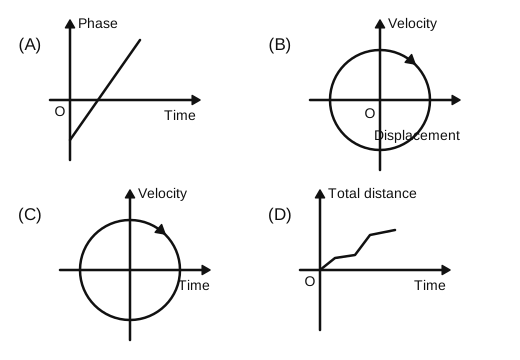
Which of the following curves possibly represent one-dimensional motion of a particle?
(A) Phase versus time: a straight line with positive slope.
(B) Velocity versus displacement: a circle centred at the origin.
(C) Velocity versus time: a circle centred at the origin.
(D) Total distance versus time: a curve that starts at the origin and never decreases.
(The graphs are shown in the figure.) Choose the correct answer from the options given below:
Answer: (A) A, B and D only
- (A) Phase $\phi = \omega t + \phi_0$ grows linearly with time, as for a particle in SHM, $x = A\sin\phi$. Possible ✔
- (B) In SHM, $v^2 = \omega^2(A^2 - x^2)$; with suitable units on the axes this is a circle in the $v$–$x$ plane. Possible ✔
- (C) A circle in the $v$–$t$ plane gives two velocities at the same instant and needs negative time. Not possible ✘
- (D) Total distance can only increase or stay the same, which the curve does. Possible ✔
Answer: A, B and D only.
 Solution by Sreeraj P, M.Sc Physics