

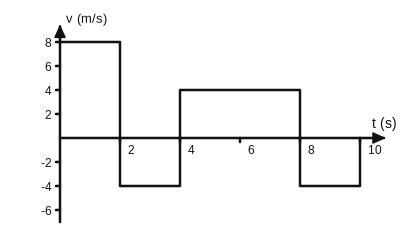
The velocity–time graph of a body moving in a straight line is shown in figure. The ratio of displacement and distance travelled by the body in time $0$ to $10$ s is
Answer: (C) $1:3$
Concept. Area under a $v$–$t$ graph gives displacement when areas below the axis count as negative. Distance counts every area as positive. So find each piece's area with its sign, then add with and without signs.
Step 1. Read the graph. From the figure:
- $0$–$2$ s: $v=+8$ m/s
- $2$–$4$ s: $v=-4$ m/s
- $4$–$8$ s: $v=+4$ m/s
- $8$–$10$ s: $v=-4$ m/s
Step 2. Area of each piece.
$$8\times2=+16,\qquad -4\times2=-8,\qquad 4\times4=+16,\qquad -4\times2=-8\ \ (\text{in m})$$
Step 3. Displacement and distance.
$$\text{displacement}=16-8+16-8=16\ \text{m},\qquad \text{distance}=16+8+16+8=48\ \text{m}$$
Step 4. Ratio.
$$\frac{16}{48}=\frac13$$
Answer. $1:3$ (Option C).
 Solution by Sreeraj P, M.Sc Physics


