

PiTheory

PiTheory JEE Physics Practice & Revision Pack · Class 11 · Chapter 2 · JEE Main

Motion in a Straight Line

Chapter-wise practice and revision for JEE Main: concise notes on the key kinematics formulas and graph rules, concept figures, and 40 selected previous-year JEE Main questions covering the major concepts and question patterns, each with a step-by-step solution.

40 selected questions6 topics7 concept figuresPreview · first 3 of 40 questions

How to study this chapter

  1. Look at the topic's figures, then read its notes (5 to 10 minutes). They give the major equations and methods the questions use.
  2. Solve the topic's questions with a timer: 2 minutes for Easy, 3 to 4 for Medium and Hard.
  3. Check the solution. Read the Point to note line even if you were right: it is the idea you will reuse.
  4. Mark each question Got it or Revise. Come back to the Revise list after two days.

Where the marks come from

Main idea of each of the 99 previous-year JEE questions in the PiTheory bank

Free fall22
Graphs21
Variable a20
Constant a17
Speed, velocity14
Relative5
01

Topic 1 · Q1–Q6

Distance, displacement, speed and velocity

14 of the 99 JEE PYQs in the bank test this as their main idea

Look first

ABdistance = length of the pathdisplacement = A → B|displacement| ≤ distance
Distance follows the path; displacement joins the start to the end.

Quick notes

  • Distance is the length of the path (scalar, never decreases). Displacement is the change in position (vector). $|\text{displacement}|\le\text{distance}$, equal only for one-way straight-line motion.
  • Average speed $=\dfrac{\text{total distance}}{\text{total time}}$; average velocity $=\dfrac{\text{displacement}}{\text{time}}$. A round trip has zero average velocity but non-zero average speed.
  • Instantaneous: $v=\dfrac{dx}{dt}$ (slope of $x$–$t$). Instantaneous speed $=|v|$, but average speed is not $|\text{average velocity}|$ in general.
$$\text{equal distances: }\ \bar v=\frac{2v_1v_2}{v_1+v_2}\qquad\text{equal times: }\ \bar v=\frac{v_1+v_2}{2}$$

Equal distances give the harmonic mean (it leans toward the slower speed); equal times give the arithmetic mean. Three equal distances: $\dfrac{3v_1v_2v_3}{v_1v_2+v_2v_3+v_3v_1}$. Distances $x$ and $kx$: $\bar v=\dfrac{(1+k)v_1v_2}{v_2+kv_1}$.

  • Mixed case: half the distance at $v_1$, the other half in two equal times at $v_2$ and $v_3$. The second half has average $\dfrac{v_2+v_3}{2}$; then use the equal-distance formula.
  • Accelerate then cruise: work with distances: $\tfrac12vt$ while accelerating from rest, $v\,T$ while cruising.
  • A train crossing a pole covers its own length; crossing a bridge or tunnel covers (bridge $+$ train) length.
  • Circle: half a lap has distance $\pi r$ and displacement $2r$; a full lap has displacement zero.
Traps. Never average speeds directly unless the times are equal. Convert km/h to m/s by multiplying by $\tfrac{5}{18}$ ($72\to20$, $108\to30$, $54\to15$, $90\to25$).

Practice: first 3 of 6 questions

Q1JEE Main 2025 (2 Apr, Shift 2)Easy

A sportsman runs around a circular track of radius $r$ such that he traverses the path ABAB, where A and B are the ends of a diameter. The distance travelled and displacement, respectively, are:
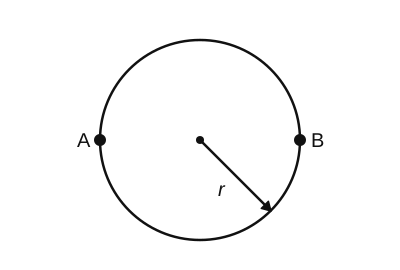
Circular track of radius r with points A and B at the ends of a horizontal diameter
  1. A$2r,\ 3\pi r$
  2. B$3\pi r,\ \pi r$
  3. C$\pi r,\ 3r$
  4. D$3\pi r,\ 2r$
Answer and solution

Answer: Option D: $3\pi r,\ 2r$

Concept. Distance is the length of the path actually covered, so it keeps adding up along the track. Displacement is the straight-line vector from the starting point to the final point, so it depends only on where the motion starts and ends.

Step 1. Break the path into pieces. A and B are the ends of a diameter, so going from one to the other along the track is half a lap. The path ABAB has three such pieces: A to B, B to A, A to B.

Step 2. Distance. Each half lap is half the circumference: $$\text{half lap}=\frac{2\pi r}{2}=\pi r\qquad\Rightarrow\qquad \text{distance}=3\times\pi r=3\pi r$$

Step 3. Displacement. He starts at A and finishes at B. The straight line from A to B is the diameter: $$|\text{displacement}|=AB=2r$$

Answer. $3\pi r,\ 2r$ (Option D). The full lap from A back to A adds $2\pi r$ to the distance but nothing to the displacement.

Point to note. Distance adds every half lap ($\pi r$); displacement only compares start and end.
Q2JEE Main 2023 (25 Jan, Shift 1)Easy

A car travels a distance of $x$ with speed $v_1$ and then same distance $x$ with speed $v_2$ in the same direction. The average speed of the car is

  1. A$\dfrac{v_1v_2}{2(v_1+v_2)}$
  2. B$\dfrac{v_1+v_2}{2}$
  3. C$\dfrac{2x}{v_1+v_2}$
  4. D$\dfrac{2v_1v_2}{v_1+v_2}$
Answer and solution

Answer: Option D: $\dfrac{2v_1v_2}{v_1+v_2}$

Concept. Average speed is total distance divided by total time. The car spends more time at the lower speed, so the answer is not the simple mean of $v_1$ and $v_2$; we must add the times of the two parts.

Step 1. Time for each part. Each part has length $x$, so $$t_1=\frac{x}{v_1},\qquad t_2=\frac{x}{v_2}$$

Step 2. Total distance over total time. $$\bar v=\frac{2x}{\dfrac{x}{v_1}+\dfrac{x}{v_2}}=\frac{2x}{x\left(\dfrac{v_1+v_2}{v_1v_2}\right)}=\frac{2v_1v_2}{v_1+v_2}$$

Answer. $\dfrac{2v_1v_2}{v_1+v_2}$ (Option D). This harmonic mean is always less than $\dfrac{v_1+v_2}{2}$; option C is a time, not a speed, so it fails a units check.

Point to note. Equal distances give the harmonic mean $\dfrac{2v_1v_2}{v_1+v_2}$, always below the arithmetic mean.

Q3JEE Main 2023 (1 Feb, Shift 1)Easy

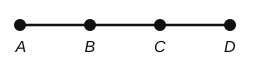
An object moves with speed $v_1$, $v_2$ and $v_3$ along a line segment $AB$, $BC$ and $CD$ respectively as shown in figure, where $AB=BC$ and $AD=3AB$. Then average speed of the object will be

Points A, B, C, D equally spaced on a straight line
  1. A$\dfrac{v_1+v_2+v_3}{3}$
  2. B$\dfrac{v_1v_2v_3}{3(v_1v_2+v_2v_3+v_3v_1)}$
  3. C$\dfrac{3v_1v_2v_3}{v_1v_2+v_2v_3+v_3v_1}$
  4. D$\dfrac{v_1+v_2+v_3}{3v_1v_2v_3}$
Answer and solution

Answer: Option C: $\dfrac{3v_1v_2v_3}{v_1v_2+v_2v_3+v_3v_1}$

Concept. Average speed is total distance over total time. In the figure $A$, $B$, $C$, $D$ lie on one line with $AB=BC$ and $AD=3AB$, so $CD=AB$ as well: three equal distances covered at three different speeds.

Step 1. Find the segment lengths. Let $AB=d$. Then $BC=d$ and $CD=AD-AB-BC=3d-2d=d$.

Step 2. Time on each segment. $$t_1=\frac{d}{v_1},\qquad t_2=\frac{d}{v_2},\qquad t_3=\frac{d}{v_3}$$

Step 3. Divide total distance by total time. $$\bar v=\frac{3d}{\dfrac{d}{v_1}+\dfrac{d}{v_2}+\dfrac{d}{v_3}}=\frac{3}{\dfrac{v_2v_3+v_1v_3+v_1v_2}{v_1v_2v_3}}=\frac{3v_1v_2v_3}{v_1v_2+v_2v_3+v_3v_1}$$

Answer. Option C. Quick check: if $v_1=v_2=v_3=v$ the formula gives $\dfrac{3v^3}{3v^2}=v$, as it must.

Point to note. Three equal distances: total distance over the sum of the three times.

37 more questions and 5 more topics in the full chapter

  1. 2Equations of motion with constant acceleration8 questions with solutions
  2. 3Motion under gravity8 questions with solutions
  3. 4Motion graphs7 questions with solutions
  4. 5Variable acceleration using calculus8 questions with solutions
  5. 6Relative velocity in one dimension3 questions with solutions
  6. ✓Last-day checklist

The complete Motion in a Straight Line chapter is in the Class 11 Pack and the Complete Pack, as a PDF on WhatsApp. Want to see a whole chapter first? Laws of Motion and Current Electricity are free in full.

Class 11 Pack

All 14 Class 11 chapters: kinematics to waves.

₹399₹299
  • 14 chapters, all included
  • 651 selected JEE Main questions (up to 50 per chapter)
  • Concept notes, equations and methods
  • Step-by-step solutions, answer keys, difficulty levels, checklists
Best value

Complete Pack

Class 11 + Class 12: all 28 chapters in one organised package.

₹799₹449
  • 28 chapters, all included
  • 1,346 selected JEE Main questions (up to 50 per chapter)
  • Concept notes, equations and methods
  • Step-by-step solutions, answer keys, difficulty levels, checklists
  • Save ₹149 on buying both class packs
  1. Tap Buy on WhatsAppYour message opens with the pack you chose. Send it.
  2. Get the payment detailsSreeraj Sir replies with the UPI details on WhatsApp.
  3. Pay and share the screenshotAny UPI app works: GPay, PhonePe, Paytm.
  4. Receive your PDFYour personal copy, with your name on it, comes on WhatsApp.