

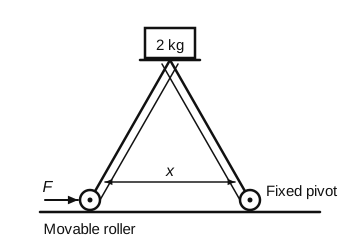
The machine as shown has $2$ rods of length $1$ m connected by a pivot at the top. The end of one rod is connected to the floor by a stationary pivot and the end of the other rod has a roller that rolls along the floor in a slot. As the roller goes back and forth, a $2$ kg weight moves up and down. If the roller is moving towards right at a constant speed, the weight moves up with a:
Answer: (C) Decreasing speed
Let the roller be a distance $x$ from the fixed pivot. The two rods and the floor form an isosceles triangle, so the height of the top is
$$y = \sqrt{1 - \frac{x^2}{4}}$$
Differentiating, with the roller moving towards the pivot ($\dfrac{dx}{dt} = -v$):
$$\frac{dy}{dt} = -\frac{x}{4y}\frac{dx}{dt} = \frac{x}{4y}v$$
As the roller moves right, $x$ decreases and $y$ increases, so $\dfrac{x}{4y}$ keeps decreasing: the weight rises with **decreasing speed**.
(Check of option 1: at $y = 0.4$ m, $x = 2\sqrt{0.84} \approx 1.83$ m, giving $\dfrac{dy}{dt} \approx 1.15v$, not $\frac34v$.)
 Solution by Sreeraj P, M.Sc Physics