A $0.5\ \text{m}$ rod moves at $4\ \text{m/s}$ perpendicular to its length and to a uniform magnetic field of $0.2\ \text{T}$. Find the emf induced across its ends, in volts.
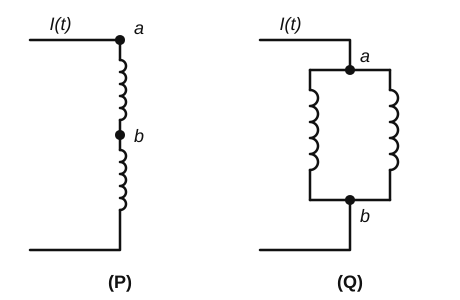
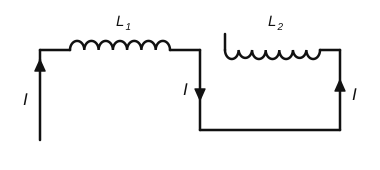
Two identical inductors are connected in two different configurations P and Q, where a time varying current $I(t)$ is flowing, as shown in the figure. The induced emf between points $a$ and $b$ for configuration P is $E_P$ and that for configuration Q is $E_Q$. The ratio $E_P/E_Q$ is :
Concept. The emf across an inductor is $L\dfrac{dI}{dt}$, where $I$ is the current through that inductor.
Step 1. Configuration P. $a$ and $b$ are across one inductor carrying the full current: $E_P = L\dfrac{dI}{dt}$.
Step 2. Configuration Q. The two inductors are in parallel between $a$ and $b$, each carrying $\dfrac{I}{2}$: $E_Q = \dfrac{L}{2}\dfrac{dI}{dt}$.
Step 3. Ratio. $\dfrac{E_P}{E_Q} = 2$.
Answer. $2$ (Option D).
Solution by Sreeraj P, M.Sc Physics
Q 12-06-003NEETNEET 2026Top questionEasy
Consider a long solenoid of length $l$ and radius $r$. If $n$ is the number of turns per unit length and $\mu_0$ is the permeability of free space, the inductance of the solenoid is :
A conducting loop of finite resistance lies on the $x$ - $y$ plane. There is a constant magnetic field in the $z$ direction. The area of the loop varies with time $t$, as $A = A_0(1 + \sin t)$ in appropriate units. The figure that correctly indicates the qualitative behaviour of the power $P$ dissipated in the loop as a function of time is :
Step 3. Shape. Maximum at $t = 0$, zero at $t = \dfrac{\pi}{2}$, maximum again at $t = \pi$, never negative: graph (2).
Answer. Graph (2) (Option B).
Solution by Sreeraj P, M.Sc Physics
Q 12-06-005NEETNEET 2025Top questionMedium
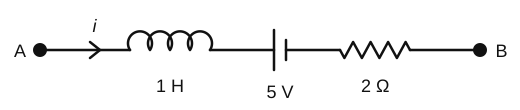
AB is a part of an electrical circuit (see figure). The potential difference $V_A - V_B$, at the instant when current $i = 2$ A and is increasing at a rate of $1$ amp / second is:
Step 2. Battery. The current enters at the positive plate and leaves at the negative one: a drop of $5$ V.
Step 3. Resistor. $iR = 2 \times 2 = 4$ V.
Step 4. Total. $V_A - V_B = 1 + 5 + 4 = 10$ V.
Answer. $10$ volt (Option D).
Solution by Sreeraj P, M.Sc Physics
Q 12-06-006NEETNEET 2024Top questionHard
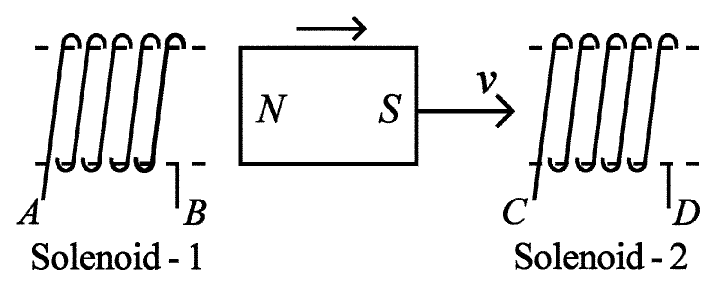
In the above diagram, a strong bar magnet is moving towards solenoid-2 from solenoid-1. The direction of induced current in solenoid-1 and that in solenoid-2, respectively, are through the directions:
Concept. Lenz's law: the induced current opposes the relative motion; then the winding sets the current direction for each pole.
Step 1. Solenoid-1. The N pole moves away, so solenoid-1 attracts it: its face towards the magnet becomes S. For this winding, the right face is S when current flows $A \to B$.
Step 2. Solenoid-2. The S pole approaches, so solenoid-2 repels it: its face towards the magnet (left face) becomes S, i.e. its right face is N. That needs current $D \to C$.
Answer. $AB$ and $DC$ (Option C).
Solution by Sreeraj P, M.Sc Physics
Q 12-06-007NEETNEET 2024Top questionMedium
A sheet is placed on a horizontal surface in front of a strong magnetic pole. A force is needed to :
A. hold the sheet there if it is magnetic. B. hold the sheet there if it is non-magnetic. C. move the sheet away from the pole with uniform velocity if it is conducting. D. move the sheet away from the pole with uniform velocity if it is both, non-conducting and non-polar.
Choose the correct statement(s) from the options given below:
Concept. A force is needed only if there is a magnetic force (on a magnetic sheet) or eddy-current drag (on a conducting sheet moving in a non-uniform field).
Step 1. Check the statements.
A: a magnetic sheet is attracted, so it must be held ✓.
B: a non-magnetic sheet feels no force ✗.
C: a conducting sheet moved away has eddy currents opposing the motion (Lenz) ✓.
D: a non-conducting, non-magnetic sheet feels nothing ✗.
Answer. A and C only (Option D).
Solution by Sreeraj P, M.Sc Physics
Q 12-06-008NEETNEET 2023Top questionEasy
The magnetic energy stored in an inductor of inductance $4\ \mu$H carrying a current of $2$ A is :
Two conducting circular loops of radii $R_1$ and $R_2$ are placed in the same plane with their centres coinciding. If $R_1 >> R_2$, the mutual inductance M between them will be directly proportional to :
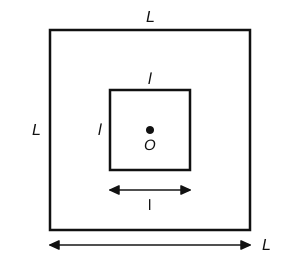
A small square loop of wire of side $l$ is placed inside a large square loop of side $L$ ($L \gg l$). If the loops are coplanar and their centres coincide, the mutual inductance of the system is directly proportional to
A coil of $100$ turns and area $0.02\ \text{m}^2$ lies perpendicular to a magnetic field that falls uniformly from $0.5$ T to zero in $0.1$ s. The average induced emf is
A coil of resistance $5\ \Omega$ has $50$ turns. The flux through each turn changes from $2$ mWb to $12$ mWb. The charge that flows through the coil is
An aeroplane with a wingspan of $40$ m flies horizontally at $250$ m/s at a place where the vertical component of the Earth's magnetic field is $5 \times 10^{-5}$ T. The emf induced between its wing tips is
A conducting rod of length $0.5$ m slides at $2$ m/s on two parallel rails joined by a $1\ \Omega$ resistor, in a field of $1$ T perpendicular to the plane. The force needed to keep the rod moving at constant speed is (neglect other resistances)
Concept. At constant speed the applied force balances the magnetic drag $BIl$, with $I = \dfrac{Blv}{R}$.
Step 1. Emf and current. $\varepsilon = 1 \times 0.5 \times 2 = 1$ V; $I = 1$ A.
Step 2. Force. $F = BIl = 1 \times 1 \times 0.5 = 0.5$ N.
Answer. $0.5$ N (Option B).
Solution by Sreeraj P, M.Sc Physics
Q 12-06-017NEETJEE MainEasy
A bar magnet is dropped with its north pole down through a horizontal copper ring. As it approaches the ring, viewed from above, the induced current in the ring is
Concept. $\varepsilon = NBA\omega\sin\omega t$, largest when the flux is zero but changing fastest.
Step 1. Orientation. Zero flux means the field lies in the plane of the coil, i.e. the plane is parallel to the field.
Answer. Parallel to the field (Option D).
Solution by Sreeraj P, M.Sc Physics
Q 12-06-027NEETJEE MainMedium
A square loop of side $10$ cm and resistance $0.5\ \Omega$ is pulled out of a region of uniform field $0.5$ T at a steady $2$ m/s, with one side parallel to the field boundary. The current induced while it is leaving the field is
A long solenoid has $1000$ turns per metre and cross-section $10\ \text{cm}^2$. A $50$-turn coil is wound tightly round its middle. Find their mutual inductance, in microhenry, to the nearest whole number. ($\mu_0 = 4\pi \times 10^{-7}$ T m/A)
Q 12-06-030JEE MainJEE Main 2026 (8 Apr, Shift 2)Medium
A $30$ cm long solenoid has $10$ turns per cm and area of $5\ \text{cm}^2$. The current through the solenoid coil varies from $2$ A to $4$ A in $3.14$ s. The e.m.f. induced in the coil is $\alpha \times 10^{-5}$ V. The value $\alpha$ is ______.
Step 1. Inductance. $4\pi\times10^{-7}\times10^6\times5\times10^{-4}\times0.3=1.885\times10^{-4}$ H.
Step 2. Emf. $1.885\times10^{-4}\times\dfrac{2}{3.14}=1.2\times10^{-4}$ V.
Answer. $12\times10^{-5}$ V (Option B).
Solution by Sreeraj P, M.Sc Physics
Q 12-06-031JEE MainJEE Main 2026 (6 Apr, Shift 1)Medium
A small cube of side $1$ mm is placed at the centre of a circular loop of radius $10$ cm carrying a current of $2$ A. The magnetic energy stored inside the cube is $\alpha \times 10^{-14}$ J. The value of $\alpha$ is ______. ($\mu_0 = 4\pi \times 10^{-7}$ Tm/A, $\pi = 3.14$)
Concept. The field at the centre of the loop, $\dfrac{\mu_0I}{2R}$, is uniform over the tiny cube. Energy $=u\times$volume with $u=\dfrac{B^2}{2\mu_0}$.
Step 1. Field. $B=\dfrac{4\pi\times10^{-7}\times2}{2\times0.1}=1.256\times10^{-5}$ T.
Step 2. Energy density. $u=\dfrac{(1.256\times10^{-5})^2}{2\times4\pi\times10^{-7}}=6.28\times10^{-5}$ J/m$^3$.
Step 3. Energy. $6.28\times10^{-5}\times10^{-9}=6.28\times10^{-14}$ J.
Answer. Option A.
Solution by Sreeraj P, M.Sc Physics
Q 12-06-032JEE MainJEE Main 2026 (6 Apr, Shift 1)Medium
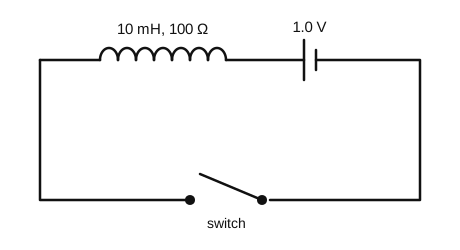
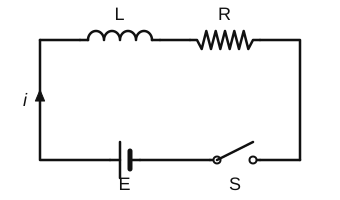
An inductor of inductance $10$ mH having resistance of $100\ \Omega$ is connected to battery of E.M.F. $1.0$ V through a switch as shown in the figure below. After switch is closed, the ratio of instantaneous voltages across the inductor when the current passing through it is $2$ mA and $4$ mA is ______.
Concept. In the growing LR circuit the voltage across the ideal inductance is $V_L=E-iR$.
Step 1. At 2 mA. $1-0.002\times100=0.8$ V.
Step 2. At 4 mA. $1-0.4=0.6$ V.
Step 3. Ratio. $\dfrac{0.8}{0.6}=\dfrac43$.
Answer. Option A.
Solution by Sreeraj P, M.Sc Physics
Q 12-06-033JEE MainJEE Main 2026 (6 Apr, Shift 2)Easy
A square loop of side $2$ cm is placed in a time varying magnetic field with magnitude as $B = 0.4\sin(300t)$ Tesla. The normal to the plane of loop makes an angle of $60^\circ$ with the field. The maximum induced emf produced in the loop is ______ mV.
Concept. $\phi=BA\cos60^\circ$ with $B=B_0\sin\omega t$, so the peak emf is $B_0\omega A\cos60^\circ$.
Step 1. Apply. $0.4\times300\times4\times10^{-4}\times0.5=0.024$ V.
Answer. $24$ mV (Option D).
Solution by Sreeraj P, M.Sc Physics
Q 12-06-034JEE MainJEE Main 2026 (5 Apr, Shift 1)Medium
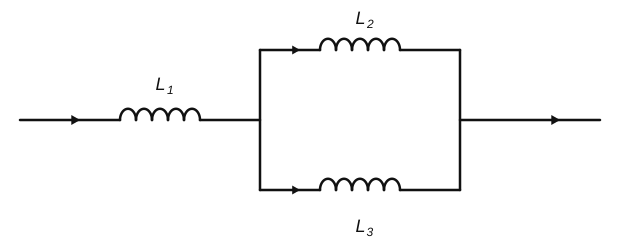
In the given circuit below inductance values of $L_1, L_2$ and $L_3$ are same. The magnetic energy stored in the entire circuit is $(U_t)$ and that stored in the $L_2$ inductor is $(U_l)$. $U_t/U_l$ is ______.
Q 12-06-035JEE MainJEE Main 2026 (5 Apr, Shift 2)Hard
A metal rod of length $L$ rotates about one end at origin with a uniform angular velocity $\omega$. The magnetic field radially falls off as $B(r) = B_0e^{-\lambda r}$; $\lambda$ being a positive constant. The emf induced (neglecting the centripetal force on electrons in the rod) is :
Q 12-06-036JEE MainJEE Main 2026 (5 Apr, Shift 2)Medium
A circular loop of radius $20$ cm and resistance $2\ \Omega$ is placed in a time varying magnetic field $\vec{B} = (2t^2 + 2t + 3)$ T. At $t = 0$, for the plane of the loop being perpendicular to the magnetic field and, the induced current in the loop at $t = 3$ s is $\dfrac{\alpha}{50}$ A. The value of $\alpha$ is ______. (Take $\pi = 22/7$)
Concept. Area fixed, field changing: $\varepsilon=A\dfrac{dB}{dt}$.
Step 1. Rate. $\dfrac{dB}{dt}=4t+2=14$ T/s at $t=3$.
Step 2. Emf. $\dfrac{22}{7}\times0.04\times14=1.76$ V.
Step 3. Current. $\dfrac{1.76}{2}=0.88=\dfrac{44}{50}$ A.
Answer. $\alpha=44$.
Solution by Sreeraj P, M.Sc Physics
Q 12-06-037JEE MainJEE Main 2026 (2 Apr, Shift 1)Hard
When a coil is placed in a time dependent magnetic field the power dissipated in it is $P$. The number of turns, area of the coil and radius of the coil wire are $N$, $A$ and $r$ respectively. For a second coil number of turns, area of the coil and radius of the coil wire are $2N$, $2A$ and $3r$ respectively. When the first coil is replaced with second coil the power dissipated in it is $\sqrt2\,\alpha P$. The value of $\alpha$ is ______.
Concept. $P=\dfrac{\varepsilon^2}{R}$ with $\varepsilon\propto NA$ and $R=\dfrac{\rho\,(N\times\text{perimeter})}{\pi r^2}\propto\dfrac{N\sqrt A}{r^2}$.
Q 12-06-038JEE MainJEE Main 2026 (2 Apr, Shift 2)Medium
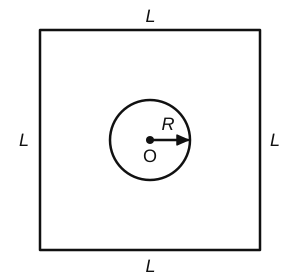
A circular current loop of radius $R$ is placed inside square loop of side length $L\ (L\gg R)$ such that they are co-planar and their centers coincide. The permeability of free space is $\mu_0$. The mutual inductance between circular loop and square loop is ______.
Concept. Pass $I$ through the large square; its field at the centre, $\dfrac{2\sqrt2\mu_0I}{\pi L}$, is nearly uniform over the small circle. $M=\dfrac{\Phi}{I}$.
Q 12-06-039JEE MainJEE Main 2025 (22 Jan, Shift 2)Easy
A rectangular metallic loop is moving out of a uniform magnetic field region to a field free region with a constant speed. When the loop is partially inside the magnetic field, the plot of magnitude of induced emf $(\varepsilon)$ with time $(t)$ is given by
Concept. $L=\mu_0\mu_r\dfrac{N^2A}{l}$; the self-induced emf $-L\dfrac{dI}{dt}$ opposes changes of current.
Step 1. A. Depends on geometry: true. B. It does depend on $\mu$: false.
Step 2. C. Opposes any change of current: true. D. Inductance resists changes of current as mass resists changes of velocity: true. E. Work against the self-induced emf builds the stored energy $\frac12LI^2$: true.
Answer. A, C, D, E only (Option C).
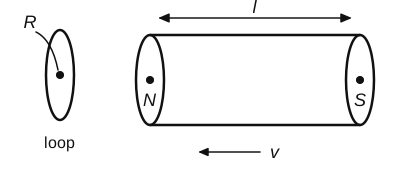
Solution by Sreeraj P, M.Sc Physics
Q 12-06-041JEE MainJEE Main 2025 (23 Jan, Shift 1)Medium
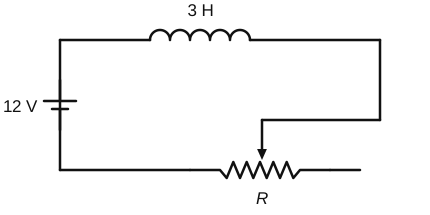
In the given circuit, the sliding contact is pulled outwards such that the electric current in the circuit changes at the rate of $8\ \text{A/s}$. At an instant when $R$ is $12\ \Omega$, the value of the current in the circuit will be ______ A.
Concept. Kirchhoff's loop law with an inductor: $E-L\dfrac{dI}{dt}=IR$. Pulling the contact out raises $R$, so the current falls: $\dfrac{dI}{dt}=-8$ A/s.
Q 12-06-042JEE MainJEE Main 2025 (28 Jan, Shift 2)Easy
A uniform magnetic field of $0.4\ \text{T}$ acts perpendicular to a circular copper disc $20\ \text{cm}$ in radius. The disc has a uniform angular velocity of $10\pi\ \text{rad s}^{-1}$ about an axis through its centre and perpendicular to the disc. What is the potential difference developed between the axis of the disc and the rim? ($\pi = 3.14$)
Concept. A rod or disc rotating about one end: $\varepsilon=\tfrac12B\omega r^2$.
Step 1. Apply. $0.5\times0.4\times31.4\times0.04=0.2512$ V.
Answer. Option C.
Solution by Sreeraj P, M.Sc Physics
Q 12-06-043JEE MainJEE Main 2025 (28 Jan, Shift 2)Medium
A conducting bar moves on two conducting rails as shown in the figure. A constant magnetic field $B$ exists into the page. The bar starts to move from the vertex at time $t = 0$ with a constant velocity. If the induced EMF is $E \propto t^n$, then the value of $n$ is ______.
Q 12-06-044JEE MainJEE Main 2025 (29 Jan, Shift 1)Easy
A coil of area $A$ and $N$ turns is rotating with angular velocity $\omega$ in a uniform magnetic field $\vec B$ about an axis perpendicular to $\vec B$. Magnetic flux $\varphi$ and induced emf $\varepsilon$ across it, at an instant when $\vec B$ is parallel to the plane of the coil, are
Concept. With $\theta = \omega t$ the angle between $\vec B$ and the coil's normal: $\varphi = NAB\cos\omega t$, $\varepsilon = NAB\omega\sin\omega t$.
Step 1. $\vec B$ in the plane of the coil. The normal is perpendicular to $\vec B$ ($\theta = 90°$).
Q 12-06-045JEE MainJEE Main 2025 (29 Jan, Shift 1)Easy
Consider $I_1$ and $I_2$ are the currents flowing simultaneously in two nearby coils 1 and 2, respectively. If $L_1$ = self inductance of coil 1 and $M_{12}$ = mutual inductance of coil 1 with respect to coil 2, then the value of induced emf in coil 1 will be
Concept. The flux through coil 1 has two parts: its own, $L_1I_1$, and that from coil 2, $M_{12}I_2$. Faraday's law gives $\varepsilon_1=-\dfrac{d}{dt}(L_1I_1+M_{12}I_2)$.
Q 12-06-046JEE MainJEE Main 2024 (1 Feb, Shift 1)Hard
A rectangular loop of sides $12\ \text{cm}$ and $5\ \text{cm}$, with its sides parallel to the $x$-axis and $y$-axis respectively, moves with a velocity of $5\ \text{cm s}^{-1}$ in the positive $x$ direction, in a space containing a variable magnetic field in the positive $z$ direction. The field has a gradient of $10^{-3}\ \text{T cm}^{-1}$ along the negative $x$ direction and it is decreasing with time at the rate of $10^{-3}\ \text{T s}^{-1}$. If the resistance of the loop is $6\ \text{m}\Omega$, the power dissipated by the loop as heat is ______ $\times10^{-9}\ \text{W}$.
Concept. The loop sees the field change for two reasons: the field itself changes in time, and the loop moves into a region of different field. $\dfrac{dB}{dt}\Big|_{loop}=\dfrac{\partial B}{\partial t}+v\dfrac{\partial B}{\partial x}$ (the field is linear in $x$, so the average over the loop changes at this rate).
Step 1. Gradient. $B$ increases towards $-x$: $\dfrac{\partial B}{\partial x}=-10^{-3}$ T/cm $=-0.1$ T/m; moving at $0.05$ m/s gives $-5\times10^{-3}$ T/s.
Step 2. Total rate. $-5\times10^{-3}-10^{-3}=-6\times10^{-3}$ T/s.
Step 3. EMF and power. $\varepsilon=(0.12\times0.05)\times6\times10^{-3}=3.6\times10^{-5}$ V; $P=\dfrac{\varepsilon^2}{R}=\dfrac{1.296\times10^{-9}}{6\times10^{-3}}=2.16\times10^{-7}$ W.
Answer. $216$.
Solution by Sreeraj P, M.Sc Physics
Q 12-06-047JEE MainJEE Main 2024 (1 Feb, Shift 2)Easy
A coil of 200 turns and area $0.20\ \text{m}^2$ is rotated at half a revolution per second and is placed in a uniform magnetic field of $0.01\ \text{T}$ perpendicular to the axis of rotation of the coil. The maximum voltage generated in the coil is $\dfrac{2\pi}{\beta}$ volt. The value of $\beta$ is ______.
Concept. A rotating coil gives $\varepsilon=NBA\omega\sin\omega t$; peak $NBA\omega$.
Step 1. $\omega$. Half a revolution per second: $\pi$ rad/s.
Step 2. Peak. $200\times0.01\times0.2\times\pi=0.4\pi=\dfrac{2\pi}{5}$ V.
Answer. $\beta=5$.
Solution by Sreeraj P, M.Sc Physics
Q 12-06-048JEE MainJEE Main 2024 (4 Apr, Shift 2)Easy
A rod of length $60\ \text{cm}$ rotates with a uniform angular velocity of $20\ \text{rad s}^{-1}$ about its perpendicular bisector, in a uniform magnetic field of $0.5\ \text{T}$. The direction of the magnetic field is parallel to the axis of rotation. The potential difference between the two ends of the rod is ______ V.
Concept. Rotating about its midpoint, each half gives $\tfrac12B\omega(l/2)^2$ from the centre outwards, so both ends are at the same potential.
Answer. $0$ V.
Solution by Sreeraj P, M.Sc Physics
Q 12-06-049JEE MainJEE Main 2024 (5 Apr, Shift 1)Medium
Two conducting circular loops A and B of radii $a$ and $b$ respectively ($b \gg a$) are placed in the same plane with their centres coinciding. The mutual inductance between them is
Concept. Mutual inductance: pass current in the big loop, find the flux through the small one. The big loop's field at its centre is $\dfrac{\mu_0I}{2b}$, nearly uniform over the small loop.
Step 1. Flux. $\dfrac{\mu_0I}{2b}\pi a^2$.
Step 2. $M$. $\dfrac{\mu_0\pi a^2}{2b}$.
Answer. Option D.
Solution by Sreeraj P, M.Sc Physics
Q 12-06-050JEE MainJEE Main 2024 (5 Apr, Shift 2)Easy
The current in an inductor is given by $I = (3t + 8)$, where $t$ is in seconds. The magnitude of the induced emf produced in the inductor is $12\ \text{mV}$. The self-inductance of the inductor is ______ mH.
Q 12-06-051JEE MainJEE Main 2024 (6 Apr, Shift 2)Easy
In a coil, the current changes from $-2\ \text{A}$ to $+2\ \text{A}$ in $0.2\ \text{s}$ and induces an emf of $0.1\ \text{V}$. The self-inductance of the coil is
Q 12-06-052JEE MainJEE Main 2024 (27 Jan, Shift 1)Easy
A rectangular loop of length $2.5\ \text{m}$ and width $2\ \text{m}$ is placed at $60^\circ$ to a magnetic field of $4\ \text{T}$. The loop is removed from the field in $10\ \text{s}$. The average emf induced in the loop during this time is:
Concept. Average emf $=\dfrac{\Delta\Phi}{\Delta t}$. Taking the $60^\circ$ as the angle between the field and the loop's normal, $\Phi=BA\cos60^\circ$, and removing the loop takes the flux to zero.
Step 2. Average emf. $\varepsilon=-\dfrac{\Delta\Phi}{\Delta t}=-\dfrac{0-10}{10}=+1$ V.
Answer. $+1$ V (Option C).
Solution by Sreeraj P, M.Sc Physics
Q 12-06-053JEE MainJEE Main 2024 (27 Jan, Shift 1)Easy
Two coils have mutual inductance $0.002\ \text{H}$. The current changes in the first coil according to the relation $i = i_0\sin\omega t$, where $i_0 = 5\ \text{A}$ and $\omega = 50\pi\ \text{rad s}^{-1}$. The maximum value of emf in the second coil is $\dfrac{\pi}{\alpha}\ \text{V}$. The value of $\alpha$ is ______.
Concept. Mutual emf $\varepsilon=M\dfrac{di_1}{dt}$; maximum $Mi_0\omega$.
Step 1. Apply. $0.002\times5\times50\pi=0.5\pi=\dfrac{\pi}{2}$ V.
Answer. $\alpha=2$.
Solution by Sreeraj P, M.Sc Physics
Q 12-06-054JEE MainJEE Main 2024 (29 Jan, Shift 1)Medium
A square loop of side $10\ \text{cm}$ and resistance $0.7\ \Omega$ is placed vertically in the east-west plane. A uniform magnetic field of $0.20\ \text{T}$ is set up across the plane in the north-east direction. The magnetic field is decreased to zero in $1\ \text{s}$ at a steady rate. Then, the magnitude of induced emf is $\sqrt x\times10^{-3}\ \text{V}$. The value of $x$ is ______.
Concept. Only the component of $\vec B$ along the loop's normal links flux. A loop in the east–west plane has its normal north–south; a north-east field makes $45^\circ$ with it.
Step 2. Emf. Falls to zero in $1$ s: $\sqrt2\times10^{-3}$ V.
Answer. $x=2$.
Solution by Sreeraj P, M.Sc Physics
Q 12-06-055JEE MainJEE Main 2024 (29 Jan, Shift 2)Easy
A horizontal straight wire $5\ \text{m}$ long extending from east to west is falling freely at right angle to the horizontal component of earth's magnetic field $0.60\times10^{-4}\ \text{Wb m}^{-2}$. The instantaneous value of emf induced in the wire when its velocity is $10\ \text{m s}^{-1}$ is ______ $\times10^{-3}\ \text{V}$.
Q 12-06-056JEE MainJEE Main 2024 (8 Apr, Shift 1)Medium
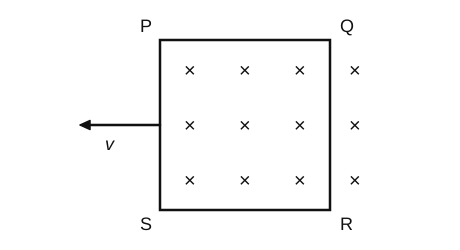
A square loop PQRS having 10 turns, area $3.6\times10^{-3}\ \text{m}^2$ and resistance $100\ \Omega$ is slowly and uniformly being pulled out of a uniform magnetic field of magnitude $B = 0.5\ \text{T}$ as shown. Work done in pulling the loop out of the field in $1.0\ \text{s}$ is ______ $\times10^{-6}\ \text{J}$.
Q 12-06-057JEE MainJEE Main 2024 (9 Apr, Shift 2)Easy
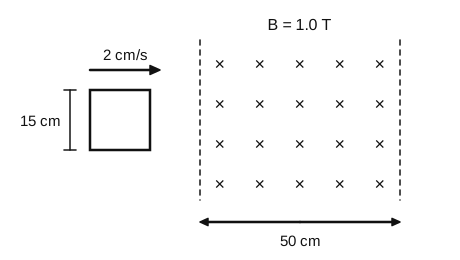
A square loop of side $15\ \text{cm}$ is being moved towards the right at a constant speed of $2\ \text{cm/s}$ as shown in the figure. The front edge enters the $50\ \text{cm}$ wide magnetic field at $t = 0$. The value of induced emf in the loop at $t = 10\ \text{s}$ will be:
Concept. An emf appears only while the flux through the loop is changing, i.e. while one edge is in the field and the other is not.
Step 1. Position at 10 s. The front edge is $2\times10=20$ cm into the 50 cm region, and the loop is 15 cm long: the whole loop is inside.
Step 2. EMF. The flux is constant: $\varepsilon=0$.
Answer. Option B.
Solution by Sreeraj P, M.Sc Physics
Q 12-06-058JEE MainJEE Main 2024 (30 Jan, Shift 1)Medium
A ceiling fan having 3 blades of length $80\ \text{cm}$ each is rotating with an angular velocity of $1200\ \text{rpm}$. The magnetic field of earth in that region is $0.5\ \text{G}$ and the angle of dip is $30^\circ$. The emf induced across the blades is $N\pi\times10^{-5}\ \text{V}$. The value of $N$ is ______.
Concept. Fan blades rotate in a horizontal plane, so they cut the vertical component $B_V=B\sin\delta$. The blades are in parallel, so the emf is that of one blade.
Step 2. Emf. $\tfrac12\times2.5\times10^{-5}\times40\pi\times0.64=32\pi\times10^{-5}$ V.
Answer. $N=32$.
Solution by Sreeraj P, M.Sc Physics
Q 12-06-059JEE MainJEE Main 2024 (31 Jan, Shift 1)Medium
A coil is placed perpendicular to a magnetic field of $5000\ \text{T}$. When the field is changed to $3000\ \text{T}$ in $2\ \text{s}$, an induced emf of $22\ \text{V}$ is produced in the coil. If the diameter of the coil is $0.02\ \text{m}$, then the number of turns in the coil is:
Step 2. Turns. $$22 = N \times \pi \times 10^{-4} \times 1000 \;\Rightarrow\; N = \frac{22}{0.1\pi} = 70$$
Answer. $70$ (Option B).
Solution by Sreeraj P, M.Sc Physics
Q 12-06-060JEE MainJEE Main 2024 (31 Jan, Shift 1)Medium
A small square loop of wire of side $l$ is placed inside a large square loop of wire of side $L$ $(L = l^2)$. The loops are coplanar and their centres coincide. The value of the mutual inductance of the system is $\sqrt x\times10^{-7}\ \text{H}$, where $x = $ ______.
Q 12-06-061JEE MainJEE Main 2024 (31 Jan, Shift 2)Easy
The magnetic flux $\phi$ (in weber) linked with a closed circuit of resistance $8\ \Omega$ varies with time (in seconds) as $\phi = 5t^2 - 36t + 1$. The induced current in the circuit at $t = 2\ \text{s}$ is ______ A.
Concept. Faraday's law: $\varepsilon=-\dfrac{d\phi}{dt}$; current $I=\dfrac{|\varepsilon|}{R}$.
Step 1. Rate. $\dfrac{d\phi}{dt}=10t-36=-16$ Wb/s at $t=2$.
Step 2. Current. $\dfrac{16}{8}=2$ A.
Answer. $2$.
Solution by Sreeraj P, M.Sc Physics
Q 12-06-062JEE MainJEE Main 2023 (29 Jan, Shift 1)Medium
Find the mutual inductance in the arrangement, when a small circular loop of wire of radius $R$ is placed inside a large square loop of wire of side $L\ (L\gg R)$. The loops are coplanar and their centres coincide.
Concept. Pass current $I$ through the square; its centre field is uniform over the small circle, and $M = \dfrac{\phi}{I}$.
Step 1. Field at the centre. Four sides at distance $\dfrac{L}{2}$, ends at $45°$: $$B = 4 \times \frac{\mu_0I}{4\pi(L/2)}(2\sin45°) = \frac{2\sqrt2\mu_0I}{\pi L}$$
Q 12-06-063JEE MainJEE Main 2023 (29 Jan, Shift 1)Easy
A certain elastic conducting material is stretched into a circular loop. It is placed with its plane perpendicular to a uniform magnetic field $B=0.8\ \text{T}$. When released the radius of the loop starts shrinking at a constant rate of $2\ \text{cm s}^{-1}$. The induced emf in the loop at an instant when the radius of the loop is $10\ \text{cm}$ will be ______ mV.
Concept. Field fixed, area changing: $\varepsilon=B\dfrac{dA}{dt}=B\cdot2\pi r\dfrac{dr}{dt}$.
Step 1. Apply. $0.8\times2\pi\times0.1\times0.02=0.01$ V.
Answer. $10$ mV.
Solution by Sreeraj P, M.Sc Physics
Q 12-06-064JEE MainJEE Main 2023 (29 Jan, Shift 2)Medium
A square loop of area $25\ \text{cm}^2$ has a resistance of $10\ \Omega$. The loop is placed in uniform magnetic field of magnitude $40.0\ \text{T}$. The plane of loop is perpendicular to the magnetic field. The work done in pulling the loop out of the magnetic field slowly and uniformly in $1.0\ \text{s}$, will be
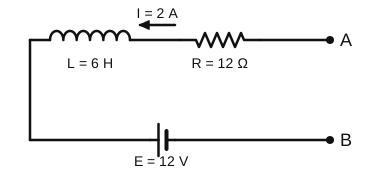
Concept. Walk from A to B along the branch, adding the potential drops: across the resistor $IR$ (in the current's direction), across the inductor $L\dfrac{dI}{dt}$, and across the cell its emf with the right sign.
Step 1. Resistor and inductor. The current flows from A into R and L: drop $2\times12+6\times(-1)=24-6=18$ V.
Step 2. Cell. The corner beyond L is at the cell's positive plate, so going on to B drops another 12 V.
Step 3. Total. $V_A-V_B=18+12=30$ V.
Answer. $30$.
Solution by Sreeraj P, M.Sc Physics
Q 12-06-066JEE MainJEE Main 2023 (30 Jan, Shift 2)Easy
In an ac generator, a rectangular coil of $100$ turns each having area $14\times10^{-2}\ \text{m}^2$ is rotated at $360\ \text{rev min}^{-1}$ about an axis perpendicular to a uniform magnetic field of magnitude $3.0\ \text{T}$. The maximum value of the emf produced will be ______ V. [Take $\pi=\frac{22}{7}$]
Step 2. Peak. $100\times3\times0.14\times12\times\dfrac{22}{7}=1584$ V.
Answer. $1584$.
Solution by Sreeraj P, M.Sc Physics
Q 12-06-067JEE MainJEE Main 2023 (31 Jan, Shift 1)Medium
Spherical insulating ball and a spherical metallic ball of same size and mass are dropped from the same height. Choose the correct statement out of the following (assume negligible air friction):
Answer: (B) Insulating ball will reach the earth's surface earlier than the metal ball
Concept. A metal ball falling through the Earth's (non-uniform) field has small eddy currents induced in it, which oppose its motion; an insulating ball carries no currents.
Step 1. Compare. The metal ball is slowed slightly; the insulating ball falls freely and lands first.
Answer. Option B.
Solution by Sreeraj P, M.Sc Physics
Q 12-06-068JEE MainJEE Main 2023 (24 Jan, Shift 1)Easy
A conducting loop of radius $\dfrac{10}{\sqrt\pi}\ \text{cm}$ is placed perpendicular to a uniform magnetic field of $0.5\ \text{T}$. The magnetic field is decreased to zero in $0.5\ \text{s}$ at a steady rate. The induced emf in the circular loop at $0.25\ \text{s}$ is
Step 2. EMF. $\varepsilon=A\dfrac{\Delta B}{\Delta t}=0.01\times\dfrac{0.5}{0.5}=0.01$ V.
Answer. $10$ mV (Option B).
Solution by Sreeraj P, M.Sc Physics
Q 12-06-069JEE MainJEE Main 2023 (24 Jan, Shift 2)Easy
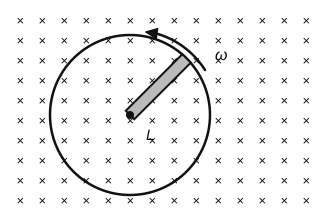
A metallic rod of length $L$ is rotated with an angular speed of $\omega$ normal to a uniform magnetic field $B$ about an axis passing through one end of rod as shown in figure. The induced emf will be
Q 12-06-070JEE MainJEE Main 2023 (24 Jan, Shift 2)Medium
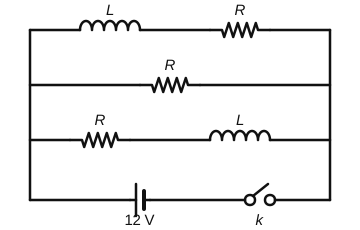
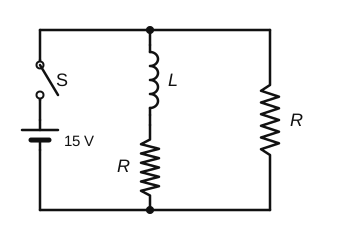
Three identical resistors with resistance $R=12\ \Omega$ and two identical inductors with self inductance $L=5\ \text{mH}$ are connected to an ideal battery with emf of $12\ \text{V}$ as shown in figure. The current through the battery long after the switch has been closed will be ______ A.
Concept. In the steady state, inductors act as plain wires.
Step 1. Equivalent resistance. The three $12\ \Omega$ branches are in parallel: $4\ \Omega$.
Step 2. Current. $\dfrac{12}{4} = 3$ A.
Answer. $3$.
Solution by Sreeraj P, M.Sc Physics
Q 12-06-071JEE MainJEE Main 2023 (25 Jan, Shift 2)Easy
A wire of length $1\ \text{m}$ moving with velocity $8\ \text{m s}^{-1}$ at right angles to a magnetic field of $2\ \text{T}$. The magnitude of induced emf between the ends of wire will be ______.
Concept. A rod moving across a field: $\varepsilon=Blv$.
Step 1. Apply. $2\times1\times8=16$ V.
Answer. Option D.
Solution by Sreeraj P, M.Sc Physics
Q 12-06-072JEE MainJEE Main 2023 (13 Apr, Shift 2)Medium
An insulated copper wire of $100$ turns is wrapped around a wooden cylindrical core of the cross-sectional area $24\ \text{cm}^2$. The two ends of the wire are connected to a resistor. The total resistance in the circuit is $12\ \Omega$. If an externally applied uniform magnetic field in the core along its axis changes from $1.5\ \text{T}$ in one direction to $1.5\ \text{T}$ in the opposite direction, the charge flowing through a point in the circuit during the change of magnetic field will be ______ mC.
Step 2. Charge. $\dfrac{100\times7.2\times10^{-3}}{12}=0.06$ C.
Answer. $60$ mC.
Solution by Sreeraj P, M.Sc Physics
Q 12-06-073JEE MainJEE Main 2023 (15 Apr, Shift 1)Easy
A $12\ \text{V}$ battery connected to a coil of resistance $6\ \Omega$ through a switch, drives a constant current in the circuit. The switch is opened in $1\ \text{ms}$. The emf induced across the coil is $20\ \text{V}$. The inductance of the coil is
Q 12-06-074JEE MainJEE Main 2023 (15 Apr, Shift 1)Easy
A $20\ \text{cm}$ long metallic rod is rotated with $210$ rpm about an axis normal to the rod passing through its one end. The other end of the rod is in contact with a circular metallic ring. A constant and uniform magnetic field $0.2\ \text{T}$ parallel to the axis exists everywhere. The emf developed between the centre and the ring is ______ mV. (Take $\pi=\frac{22}{7}$)
Concept. The falling magnet induces eddy currents in the copper tube that oppose its motion (Lenz). The drag grows with speed until it balances gravity.
Answer. It falls at almost constant (terminal) speed (Option C).
Solution by Sreeraj P, M.Sc Physics
Q 12-06-076JEE MainJEE Main 2023 (10 Apr, Shift 2)Medium
A square loop of side $2.0\ \text{cm}$ is placed inside a long solenoid that has $50$ turns per centimetre and carries a sinusoidally varying current of amplitude $2.5\ \text{A}$ and angular frequency $700\ \text{rad s}^{-1}$. The central axes of the loop and solenoid coincide. The amplitude of the emf induced in the loop is $x\times10^{-4}\ \text{V}$. The value of $x$ is ______. (Take $\pi=\frac{22}{7}$)
Concept. Inside a long solenoid $B=\mu_0nI$, uniform over the loop. With $I=I_0\sin\omega t$, $\varepsilon=\mu_0nA\dfrac{dI}{dt}$, amplitude $\mu_0nAI_0\omega$.
Step 2. Amplitude. $4\pi\times10^{-7}\times5000\times4\times10^{-4}\times2.5\times700=4.4\times10^{-3}$ V.
Answer. $x=44$.
Solution by Sreeraj P, M.Sc Physics
Q 12-06-077JEE MainJEE Main 2023 (11 Apr, Shift 1)Easy
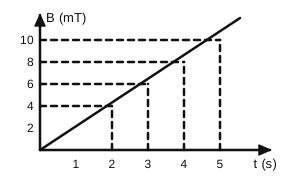
The magnetic field $B$ crossing normally a square metallic plate of area $4\ \text{m}^2$ is changing with time as shown in figure. The magnitude of induced emf in the plate during $t=2$ s to $t=4$ s is ______ mV.
Concept. $\varepsilon=A\dfrac{dB}{dt}$, and $\dfrac{dB}{dt}$ is the slope of the $B$–$t$ graph.
Step 1. Slope. The line rises $2$ mT every second: $2\times10^{-3}$ T/s throughout, including $2$ s to $4$ s.
Step 2. EMF. $\varepsilon=4\times2\times10^{-3}=8\times10^{-3}$ V.
Answer. $8$ mV.
Solution by Sreeraj P, M.Sc Physics
Q 12-06-078JEE MainJEE Main 2023 (11 Apr, Shift 2)Easy
Given below are two statements: one is labelled as Assertion A and the other is labelled as Reason R.
Assertion A: A bar magnet dropped through a metallic cylindrical pipe takes more time to come down compared to a non-magnetic bar with same geometry and mass.
Reason R: For the magnetic bar, eddy currents are produced in the metallic pipe which oppose the motion of the magnetic bar.
In the light of the above statements, choose the correct answer from the options given below.
Answer: (B) Both A and R are true and R is the correct explanation of A
Concept. A falling magnet changes the flux through rings of the metal pipe, so eddy currents flow in the pipe; by Lenz's law they oppose the magnet's motion.
Step 1. Reason. True.
Step 2. Assertion. The opposing force slows the magnet, so it takes longer than a non-magnetic bar, which induces no currents: true, and explained by R.
Answer. Option B.
Solution by Sreeraj P, M.Sc Physics
Q 12-06-079JEE MainJEE Main 2023 (11 Apr, Shift 2)Medium
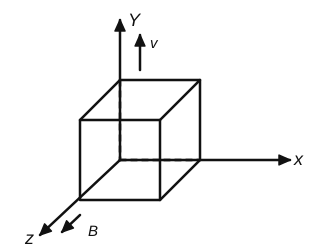
A metallic cube of side $15\ \text{cm}$ moving along $y$-axis at a uniform velocity of $2\ \text{m s}^{-1}$. In a region of uniform magnetic field of magnitude $0.5\ \text{T}$ directed along $z$-axis. In equilibrium the potential difference between the faces of higher and lower potential developed because of the motion through the field will be ______ mV.
Concept. The magnetic force $q\vec v \times \vec B$ separates charge until the electric field balances it; the potential difference is $Bvl$ across the faces perpendicular to $\vec v \times \vec B$.
Step 1. Direction. $\hat j \times \hat k = \hat i$: the faces perpendicular to $x$, $0.15$ m apart.
Q 12-06-080JEE MainJEE Main 2023 (11 Apr, Shift 2)Easy
A coil has an inductance of $2\ \text{H}$ and resistance of $4\ \Omega$. A $10\ \text{V}$ is applied across the coil. The energy stored in the magnetic field after the current has built up to its equilibrium value will be ______ $\times10^{-2}$ J.
Concept. At steady state the inductor is a plain wire: $I=\dfrac VR$; energy $\tfrac12LI^2$.
Step 1. Current. $2.5$ A.
Step 2. Energy. $\tfrac12\times2\times6.25=6.25$ J.
Answer. $625$.
Solution by Sreeraj P, M.Sc Physics
Q 12-06-081JEE MainJEE Main 2023 (12 Apr, Shift 1)Easy
A conducting circular loop is placed in a uniform magnetic field of $0.4\ \text{T}$ with its plane perpendicular to the field. Somehow, the radius of the loop starts expanding at a constant rate of $1\ \text{mm s}^{-1}$. The magnitude of induced emf in the loop at an instant when the radius of the loop is $2\ \text{cm}$ will be ______ $\mu$V.
Q 12-06-082JEE MainJEE Main 2023 (13 Apr, Shift 1)Medium
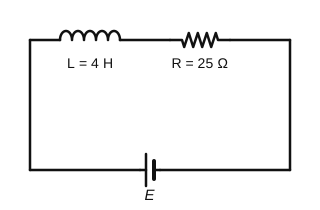
In the given figure, an inductor and resistor are connected in series with a battery of emf $E$ volt. $\dfrac{E^a}{2b}\ \text{J s}^{-1}$ represents the maximum rate at which the energy is stored in the magnetic field (inductor). The numerical value of $\dfrac ba$ will be ______.
Concept. An emf needs a change of flux $BA\cos\theta$: a change of $B$, of $A$ or of $\theta$.
Step 1. A and B. Translating a coil in a uniform field (at any speed) leaves the flux unchanged: no emf.
Step 2. C. Rotating changes $\theta$: emf.
Step 3. D. Changing the area: emf.
Answer. C and D only (Option C).
Solution by Sreeraj P, M.Sc Physics
Q 12-06-084JEE MainJEE Main 2023 (6 Apr, Shift 2)Medium
Two concentric circular coils with radii $1\ \text{cm}$ and $1000\ \text{cm}$ and number of turns $10$ and $200$ respectively are placed coaxially with centers coinciding. The mutual inductance of this arrangement will be ______ $\times10^{-8}$ H. (Take $\pi^2=10$)
Q 12-06-086JEE MainJEE Main 2023 (10 Apr, Shift 1)Easy
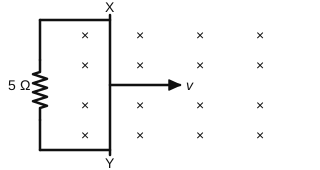
A $1$ m long metal rod $XY$ completes the circuit as shown in figure. The plane of the circuit is perpendicular to the magnetic field of flux density $0.15$ T. If the resistance of the circuit is $5\ \Omega$, the force needed to move the rod in direction, as indicated, with a constant speed of $4\ \text{m s}^{-1}$ will be ______ $\times10^{-3}$ N.
Concept. At constant speed the applied force balances the magnetic force on the rod: $F=BIl$ with $I=\dfrac{Blv}{R}$, so $F=\dfrac{B^2l^2v}{R}$.
Step 1. Force. $F=\dfrac{(0.15)^2\times1^2\times4}{5}=0.018$ N.
Answer. $18$.
Solution by Sreeraj P, M.Sc Physics
Q 12-06-088JEE MainJEE Main 2023 (1 Feb, Shift 2)Medium
A square shaped coil of area $70\ \text{cm}^2$ having $600$ turns rotates in a magnetic field of $0.4\ \text{Wb m}^{-2}$, about an axis which is parallel to one of the sides of the coil and perpendicular to the direction of field. If the coil completes $500$ revolutions in a minute, the instantaneous emf when the plane of the coil is inclined at $60^\circ$ with the field, will be ______ V. (Take $\pi=\frac{22}{7}$)
Concept. $\varepsilon=NBA\omega\sin\theta$, with $\theta$ between the normal and $\vec B$. Plane at $60^\circ$ to the field means the normal is at $30^\circ$.
Step 2. Emf. $600\times0.4\times7\times10^{-3}\times52.4\times\tfrac12=44$ V.
Answer. $44$.
Solution by Sreeraj P, M.Sc Physics
Q 12-06-089JEE MainJEE Main 2022 (24 Jun, Shift 2)Easy
A circular coil of $1000$ turns each with area $1\ \text{m}^2$ is rotated about its vertical diameter at the rate of one revolution per second in a uniform horizontal magnetic field of $0.07\ \text{T}$. The maximum voltage generated will be ______ V.
Q 12-06-090JEE MainJEE Main 2022 (25 Jun, Shift 1)Easy
The current in a coil of self inductance $L = 2.0\ \text{H}$ is increasing according to the law $i = 2\sin t^2$. Find the amount of energy spent (in J) during the period when the current changes from $0$ to $2\ \text{A}$.
Q 12-06-091JEE MainJEE Main 2022 (26 Jun, Shift 1)Easy
The magnetic flux through a coil perpendicular to its plane is varying according to the relation $\phi = (5t^3 + 4t^2 + 2t - 5)$ weber. If the resistance of the coil is $5\ \text{ohm}$, then the induced current through the coil at $t = 2\ \text{s}$ will be
Concept. Same: differentiate the flux, divide by $R$.
Step 1. Rate. $15t^2+8t+2=60+16+2=78$ at $t=2$.
Step 2. Current. $\dfrac{78}{5}=15.6$ A.
Answer. Option A.
Solution by Sreeraj P, M.Sc Physics
Q 12-06-092JEE MainJEE Main 2022 (26 Jun, Shift 1)Easy
A $10\ \Omega$, $20\ \text{mH}$ coil carrying constant current is connected to a battery of $20\ \text{V}$ through a switch. Now after the switch is opened, the current becomes zero in $100\ \mu\text{s}$. The average emf induced in the coil is ______ V.
Concept. $\varepsilon=M\dfrac{dI}{dt}$, so $[M]=\dfrac{[V]}{[A\,T^{-1}]}$ with $[V]=ML^2T^{-3}A^{-1}$.
Step 1. Dimensions. $[M]=\dfrac{ML^2T^{-3}A^{-1}}{AT^{-1}}=ML^2T^{-2}A^{-2}$ (the same as self-inductance).
Answer. Option B.
Solution by Sreeraj P, M.Sc Physics
Q 12-06-094JEE MainJEE Main 2022 (26 Jun, Shift 2)Medium
Two coils of self inductance $L_1$ and $L_2$ are connected in series combination having mutual inductance of the coils as $M$. The equivalent self inductance of the combination will be
Concept. In series the same current flows through both coils. If the current circulates in opposite senses in them, their mutual fluxes oppose the self fluxes: $L=L_1+L_2-2M$.
Step 1. Sense. The current goes left to right through $L_1$ and right to left through $L_2$: opposing.
Answer. $L_1+L_2-2M$ (Option B).
Solution by Sreeraj P, M.Sc Physics
Q 12-06-095JEE MainJEE Main 2022 (26 Jun, Shift 2)Medium
A metallic conductor of length $1\ \text{m}$ rotates in a vertical plane parallel to the east-west direction about one of its ends with angular velocity $5\ \text{rad s}^{-1}$. If the horizontal component of earth's magnetic field is $0.2\times10^{-4}\ \text{T}$, then the emf induced between the two ends of the conductor is
Concept. A rod rotating about one end gives $\varepsilon=\frac12B\omega L^2$, where $B$ is the field component along the axis of rotation. The rod turns in a vertical east–west plane, so the axis is horizontal and north–south: the component that counts is $B_H$.
Step 1. EMF. $\varepsilon=\dfrac12\times0.2\times10^{-4}\times5\times1^2=5\times10^{-5}$ V.
Answer. $50\ \mu$V (Option B).
Solution by Sreeraj P, M.Sc Physics
Q 12-06-096JEE MainJEE Main 2022 (25 Jul, Shift 1)Medium
A small square loop of wire of side $l$ is placed inside a large square loop of wire of side $L$ $(L\gg l)$. Both loops are coplanar and their centres coincide at point $O$ as shown in figure. The mutual inductance of the system is
Q 12-06-097JEE MainJEE Main 2022 (25 Jul, Shift 2)Easy
Magnetic flux (in weber) in a closed circuit of resistance $20\ \Omega$ varies with time $t$ (s) as $\phi = 8t^2 - 9t + 5$. The magnitude of the induced current at $t = 0.25\ \text{s}$ will be ______ mA.
Concept. $|\varepsilon| = \left|\dfrac{d\phi}{dt}\right|$ and $I = \dfrac{\varepsilon}{R}$.
Step 1. Emf. $\dfrac{d\phi}{dt} = 16t - 9 = 4 - 9 = -5$, so $|\varepsilon| = 5$ V.
Step 2. Current. $\dfrac{5}{20} = 0.25$ A $= 250$ mA.
Answer. $250$.
Solution by Sreeraj P, M.Sc Physics
Q 12-06-098JEE MainJEE Main 2022 (26 Jul, Shift 2)Medium
In a coil of resistance $8\ \Omega$, the magnetic flux due to an external magnetic field varies with time as $\phi = \dfrac23(9 - t^2)$. The value of total heat produced in the coil, till the flux becomes zero, will be ______ J.
Concept. Heat $=\displaystyle\int\frac{\varepsilon^2}{R}dt$ with $\varepsilon=\left|\dfrac{d\phi}{dt}\right|$.
Step 1. Emf. $\varepsilon=\dfrac43t$; the flux is zero at $t=3$ s.
Step 2. Heat. $\displaystyle\int_0^3\frac{16t^2/9}{8}dt=\frac29\times\frac{27}{3}=2$ J.
Answer. $2$.
Solution by Sreeraj P, M.Sc Physics
Q 12-06-099JEE MainJEE Main 2022 (27 Jun, Shift 2)Medium
A metallic rod of length $20$ cm is placed in North-South direction and is moved at a constant speed of $20\ \text{m s}^{-1}$ towards East. The horizontal component of the Earth's magnetic field at that place is $4\times10^{-3}$ T and the angle of dip is $45^\circ$. The emf induced in the rod is ______ mV.
Concept. A horizontal rod moving horizontally cuts the vertical component of the earth's field: $B_V=B_H\tan\delta$.
Step 1. Field. $B_V=4\times10^{-3}$ T.
Step 2. Emf. $4\times10^{-3}\times0.2\times20=0.016$ V.
Answer. $16$ mV.
Solution by Sreeraj P, M.Sc Physics
Q 12-06-100JEE MainJEE Main 2022 (27 Jul, Shift 2)Easy
A conducting circular loop is placed in $X$-$Y$ plane in presence of magnetic field $\vec B = (3t^3\hat j + 3t^2\hat k)$ in SI unit. If the radius of the loop is $1$ m, the induced emf in the loop, at time, $t = 2$ s is $n\pi$ V. The value of $n$ is ______ .
Concept. A loop in the $xy$ plane has normal $\hat k$: only $B_z$ contributes.
Step 1. Flux. $\phi=3t^2\times\pi$.
Step 2. Emf. $6\pi t=12\pi$ V at $t=2$.
Answer. $n=12$.
Solution by Sreeraj P, M.Sc Physics
Q 12-06-101JEE MainJEE Main 2021 (27 Jul, Shift 1)Medium
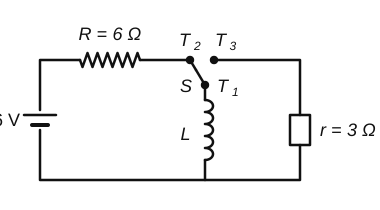
Consider an electrical circuit containing a two way switch $S$. Initially $S$ is open and then $T_1$ is connected to $T_2$. As the current in $R = 6\ \Omega$ attains a maximum value of steady-state level, $T_1$ is disconnected from $T_2$ and immediately connected to $T_3$. Potential drop across $r = 3\ \Omega$ resistor immediately after $T_1$ is connected to $T_3$ is ______ V. (Round off to the nearest integer)
Concept. The current through an inductor cannot change instantly. With $T_1$–$T_2$ the steady current through L is $\dfrac{6}{6}=1$ A. Just after switching to $T_3$, that 1 A flows through $r$.
Step 1. Drop across $r$. $V=1\times3=3$ V.
Answer. $3$.
Solution by Sreeraj P, M.Sc Physics
Q 12-06-102JEE MainJEE Main 2021 (27 Jul, Shift 2)Easy
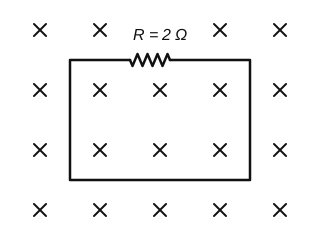
In the given figure the magnetic flux through the loop increases according to the relation $\phi_B(t) = 10t^2 + 20t$, where $\phi_B$ is in milliwebers and $t$ is in seconds. The magnitude of current through $R = 2\ \Omega$ resistor at $t = 5$ s is ______ mA.
Q 12-06-103JEE MainJEE Main 2021 (31 Aug, Shift 1)Medium
A small square loop of side $a$ and one turn is placed inside a larger square loop of side $b$ and one turn $(b \gg a)$. The two loops are coplanar with their centres coinciding. If a current $I$ is passed in the square loop of side $b$, then the coefficient of mutual inductance between the two loops is:
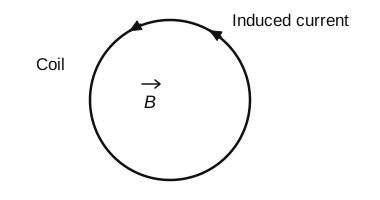
Concept. Lenz's law: the induced current makes its own field so as to oppose the change in flux.
Step 1. Induced field. The current is anticlockwise in the plane of the page, so its field at the coil points out of the page.
Step 2. Cause. An induced field along the outward direction opposes a decrease of an outward field (or an increase of an inward one). A field parallel to the plane gives no flux and no current.
Answer. Outward and decreasing (Option C).
Solution by Sreeraj P, M.Sc Physics
Q 12-06-105JEE MainJEE Main 2021 (24 Feb, Shift 2)Easy
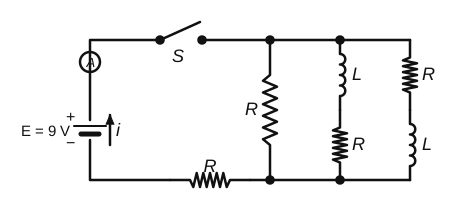
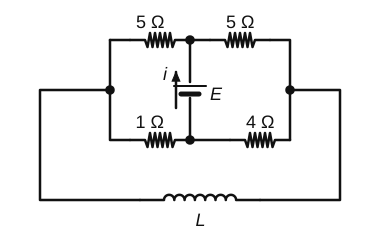
The figure shows a circuit that contains four identical resistors with resistance $R = 2.0\ \Omega$, two identical inductors with inductance $L = 2.0$ mH and an ideal battery with E.M.F. $E = 9$ V. The current $i$ just after the switch $S$ is closed will be:
Concept. At $t=0$ the inductor is a break; at $t=\infty$ it is a plain wire.
Step 1. $t=0$. From the top junction the current goes either 5 Ω + 1 Ω (left) or 5 Ω + 4 Ω (right) to the bottom junction: $6\parallel9=3.6\ \Omega$, $i=\dfrac{E}{3.6}=\dfrac{5E}{18}$.
Step 2. $t=\infty$. L joins the left and right ends: the two 5 Ω are in parallel (2.5 Ω), then 1 Ω and 4 Ω in parallel (0.8 Ω): $3.3\ \Omega$, $i=\dfrac{10E}{33}$.
Answer. Option B.
Solution by Sreeraj P, M.Sc Physics
Q 12-06-107JEE MainJEE Main 2021 (25 Feb, Shift 1)Easy
A coil of inductance 2 H having negligible resistance is connected to a source of supply whose voltage is given by $V = 3t$ volt (where $t$ is in second). If the voltage is applied when $t = 0$, then the energy stored in the coil after 4 s in J is ______.
Concept. No resistance: $V=L\dfrac{di}{dt}$, so $i=\dfrac1L\int V\,dt$.
Step 1. Current. $i=\dfrac{3t^2}{2\times2}=12$ A at $t=4$.
Step 2. Energy. $\tfrac12\times2\times144=144$ J.
Answer. $144$.
Solution by Sreeraj P, M.Sc Physics
Q 12-06-108JEE MainJEE Main 2021 (18 Mar, Shift 2)Easy
The time taken for the magnetic energy to reach 25% of its maximum value, when a solenoid of resistance $R$, inductance $L$ is connected to a battery, is:
Q 12-06-109JEE MainJEE Main 2021 (20 Jul, Shift 1)Medium
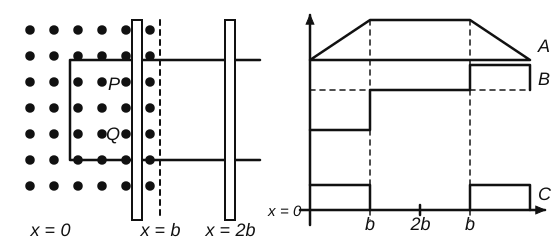
The arm $PQ$ of a rectangular conductor is moving from $x = 0$ to $x = 2b$ outwards and then inwards from $x = 2b$ to $x = 0$ as shown in the figure. A uniform magnetic field perpendicular to the plane is acting from $x = 0$ to $x = b$. Identify the graph showing the variation of different quantities with distance:
Concept. As PQ moves out from $x=0$ to $b$ the enclosed field area grows linearly; beyond $b$ it stays constant; on the way back it shrinks over the same stretch.
Step 1. Flux. Rises linearly from 0 to $b$, flat from $b$ to $2b$, and falls back on the return: graph A.
Step 2. EMF. $-\dfrac{d\Phi}{dt}$: a constant value while the flux rises, zero while it is flat, the opposite sign while it falls: graph B.
Step 3. Power. $\dfrac{\varepsilon^2}{R}$: positive in both stretches, zero between: graph C.
Answer. A—Flux, B—EMF, C—Power (Option C).
Solution by Sreeraj P, M.Sc Physics
Q 12-06-110JEE MainJEE Main 2021 (26 Feb, Shift 2)Medium
An aeroplane, with its wings spread $10$ m, is flying at a speed of $180$ km h$^{-1}$ in a horizontal direction. The total intensity of earth's field at that part is $2.5\times10^{-4}$ Wb m$^{-2}$ and the angle of dip is $60^\circ$. The emf induced between the tips of the plane wings will be
Step 2. Emf. $2.165\times10^{-4}\times10\times50=0.108$ V.
Answer. Option A.
Solution by Sreeraj P, M.Sc Physics
Q 12-06-111JEE MainJEE Main 2021 (26 Aug, Shift 1)Easy
An inductor coil stores $64$ J of magnetic field energy and dissipates energy at the rate of $640$ W when a current of $8$ A is passed through it. If this coil is joined across an ideal battery, find the time constant of the circuit (in s).
Step 1. Values. $R=\dfrac{640}{64}=10\ \Omega$; $L=\dfrac{2\times64}{64}=2$ H.
Step 2. Time constant. $0.2$ s.
Answer. Option B.
Solution by Sreeraj P, M.Sc Physics
Q 12-06-112JEE MainJEE Main 2021 (26 Aug, Shift 2)Easy
A circular coil of radius $8.0$ cm and $20$ turns is rotated about its vertical diameter with an angular speed of $50$ rad s$^{-1}$ in a uniform horizontal magnetic field of $3.0\times10^{-2}$ T. The maximum emf induced in the coil will be ______ $\times10^{-2}$ volt (rounded off to the nearest integer).
Q 12-06-113JEE MainJEE Main 2021 (27 Aug, Shift 1)Medium
A bar magnet is passing through a conducting loop of radius $R$ with velocity $v$. The radius of the bar magnet is such that it just passes through the loop. The induced e.m.f. in the loop can be represented by the approximate curve:
Concept. An emf appears only while the flux through the loop changes; Lenz's law fixes its sign.
Step 1. N end passing. The flux changes rapidly: a sharp emf pulse.
Step 2. Middle of the magnet inside. The flux is nearly constant: emf almost zero.
Step 3. S end passing. After a time $\dfrac{l}{v}$ the flux changes the opposite way: a sharp pulse of opposite sign.
Step 4. Choose. Two opposite pulses separated by $\dfrac{l}{v}$, the first negative (with the figure's sign convention): graph (3).
Answer. Graph (3) (Option C).
Solution by Sreeraj P, M.Sc Physics
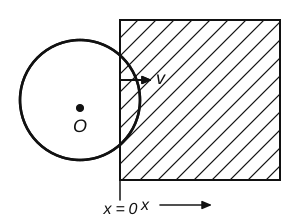
Q 12-06-114JEE MainJEE Main 2021 (27 Aug, Shift 2)Medium
A constant magnetic field of $1$ T is applied in the $x > 0$ region. A metallic circular ring of radius $1$ m is moving with a constant velocity of $1$ m s$^{-1}$ along the $x$-axis. At $t = 0$ s, the centre $O$ of the ring is at $x = -1$ m. What will be the value of the induced emf in the ring at $t = 1$ s? (Assume the velocity of the ring does not change.)
Concept. Only the part of the ring inside the field matters; its effective length is the chord along the field boundary, perpendicular to $\vec v$.
Step 1. Position at $t=1$ s. The centre has moved 1 m to $x=0$: the boundary passes through the centre, so the chord is a diameter, $2R=2$ m.
Step 2. EMF. $\varepsilon=B(2R)v=1\times2\times1=2$ V.
Answer. Option B.
Solution by Sreeraj P, M.Sc Physics
Q 12-06-115JEE MainJEE Main 2020 (8 Jan, Shift 2)Medium
A battery of emf $\varepsilon$ is connected in series with an inductor $L$, a resistance $R$ and a switch S. The switch is closed at $t = 0$. The total charge that flows from the battery, between $t = 0$ and $t = t_c$ ($t_c$ is the time constant of the circuit) is:
Q 12-06-116JEE MainJEE Main 2020 (9 Jan, Shift 1)Easy
In a fluorescent lamp choke (a small transformer) $100$ V of reverse voltage is produced when the choke current changes uniformly from $0.25$ A to $0$ in a duration of $0.025$ ms. The self-inductance of the choke (in mH) is estimated to be ______.
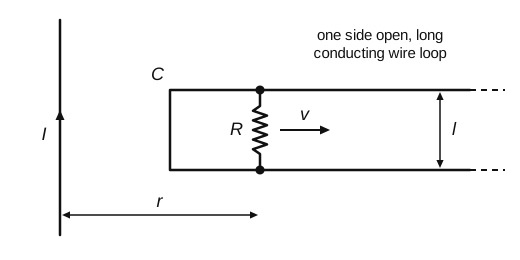
Q 12-06-117JEE MainJEE Main 2020 (5 Sep, Shift 2)Easy
An infinitely long straight wire carrying current $I$, a one side opened rectangular loop and a conductor C with a sliding connector are located in the same plane, as shown in the figure. The connector has length $l$ and resistance $R$. It slides to the right with a velocity $v$. The resistance of the conductor and the self inductance of the loop are negligible. The induced current in the loop, as a function of separation $r$ between the connector and the straight wire, is:
Concept. The connector at distance $r$ from the wire moves through the wire's field $B=\dfrac{\mu_0I}{2\pi r}$: $\varepsilon=Bvl$, current $\dfrac{\varepsilon}{R}$.
Q 12-06-118JEE MainJEE Main 2020 (7 Jan, Shift 1)Medium
A long solenoid of radius $R$ carries a time ($t$) dependent current $I(t) = I_0t(1 - t)$. A ring of radius $2R$ is placed coaxially near its middle. During the time interval $0 \le t \le 1$, the induced current ($I_R$) and the induced EMF ($V_R$) in the ring change as:
Answer: (D) At $t = 0.5$ direction of $I_R$ reverses and $V_R$ is zero
Concept. The ring links the solenoid's flux $\propto I$, so $\varepsilon\propto\dfrac{dI}{dt}=I_0(1-2t)$.
Step 1. Sign change. Zero at $t=0.5$, and it changes sign there, so the induced current reverses.
Answer. Option D.
Solution by Sreeraj P, M.Sc Physics
Q 12-06-119JEE MainJEE Main 2020 (7 Jan, Shift 1)Medium
A loop ABCDEFA of straight edges has six corner points $A(0, 0, 0)$, $B(5, 0, 0)$, $C(5, 5, 0)$, $D(0, 5, 0)$, $E(0, 5, 5)$ and $F(0, 0, 5)$. The magnetic field in this region is $\vec B = (3\hat i + 4\hat k)$ T. The quantity of flux through the loop ABCDEFA (in Wb) is ______.
Concept. A non-planar loop can be split into plane loops by adding a pair of opposite currents along a shared edge. The flux is $\vec B\cdot\vec A$ summed over the plane parts, each area vector set by the sense of traversal (right-hand rule).
Step 1. ABCDA (in the $xy$ plane): A→B→C→D runs anticlockwise seen from $+z$: $\vec A_1=25\hat k$ m$^2$.
Step 2. ADEFA (in the $yz$ plane): A$(0,0)$→D$(5,0)$→E$(5,5)$→F$(0,5)$ in $(y,z)$ is anticlockwise, so its normal is $\hat y\times\hat z=\hat i$: $\vec A_2=25\hat i$ m$^2$.
Q 12-06-120JEE MainJEE Main 2020 (7 Jan, Shift 2)Medium
A planar loop of wire rotates in a uniform magnetic field. Initially, at $t = 0$, the plane of the loop is perpendicular to the magnetic field. If it rotates with a period of $10$ s about an axis in its plane, then the magnitude of the induced emf will be maximum and minimum, respectively, at:
Concept. Starting with the plane perpendicular to $\vec B$, $\phi=BA\cos\omega t$ and $\varepsilon\propto\sin\omega t$: maximum at $\tfrac T4$, zero at $\tfrac T2$.
Answer. $2.5$ s and $5.0$ s (Option B).
Solution by Sreeraj P, M.Sc Physics
Q 12-06-121JEE MainJEE Main 2020 (8 Jan, Shift 1)Medium
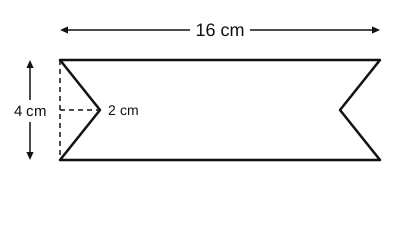
At time $t = 0$, a magnetic field of $1000$ gauss is passing perpendicularly through the area defined by the closed loop shown in the figure. If the magnetic field reduces linearly to $500$ gauss in the next $5$ s, then the induced EMF in the loop is:
Q 12-06-122JEE MainJEE Main 2020 (2 Sep, Shift 1)Medium
A circular coil of radius $10\ \text{cm}$ is placed in a uniform magnetic field of $3.0 \times 10^{-5}\ \text{T}$ with its plane perpendicular to the field initially. It is rotated at constant angular speed about an axis along the diameter of coil and perpendicular to magnetic field so that it undergoes half of rotation in $0.2\ \text{s}$. The maximum value of EMF induced (in $\mu\text{V}$) in the coil will be close to the integer ______.
Concept. Half a turn in $0.2$ s gives $\omega=5\pi$ rad/s; peak $BA\omega$.
Step 1. Apply. $3\times10^{-5}\times\pi\times0.01\times5\pi=1.48\times10^{-5}$ V.
Answer. About $15\ \mu$V.
Solution by Sreeraj P, M.Sc Physics
Q 12-06-123JEE MainJEE Main 2020 (3 Sep, Shift 1)Medium
An elliptical loop having resistance $R$, of semi major axis $a$, and semi minor axis $b$ is placed in a uniform magnetic field $B$. The loop lies in the $xy$-plane with its major axis along the $x$-axis, and the field is along the $z$-axis. If the loop is rotated about the $x$-axis with angular frequency $\omega$, the average power loss in the loop due to Joule heating is:
Concept. Rotating loop: $\varepsilon=BA\omega\sin\omega t$ with $A=\pi ab$; average of $\sin^2$ is $\tfrac12$.
Step 1. Average power. $\dfrac{(B\pi ab\omega)^2}{2R}$.
Answer. Option A.
Solution by Sreeraj P, M.Sc Physics
Q 12-06-124JEE MainJEE Main 2020 (3 Sep, Shift 2)Medium
A uniform magnetic field $B$ exists in a direction perpendicular to the plane of a square loop made of a metal wire. The wire has a diameter of $4\ \text{mm}$ and a total length of $30\ \text{cm}$. The magnetic field changes with time at a steady rate $dB/dt = 0.032\ \text{T s}^{-1}$. The induced current in the loop is close to (Resistivity of the metal wire is $1.23\times10^{-8}\ \Omega\,\text{m}$)
Concept. $I=\dfrac{\varepsilon}{R}$ with $\varepsilon=A\dfrac{dB}{dt}$ and $R=\dfrac{\rho l}{\pi r^2}$ from the wire data.
Step 1. Area. A 30 cm wire makes a square of side 7.5 cm: $A=5.625\times10^{-3}$ m$^2$; $\varepsilon=5.625\times10^{-3}\times0.032=1.8\times10^{-4}$ V.
Step 3. Current. $I=\dfrac{1.8\times10^{-4}}{2.94\times10^{-4}}\approx0.61$ A.
Answer. Option B.
Solution by Sreeraj P, M.Sc Physics
Q 12-06-125JEE MainJEE Main 2020 (4 Sep, Shift 1)Medium
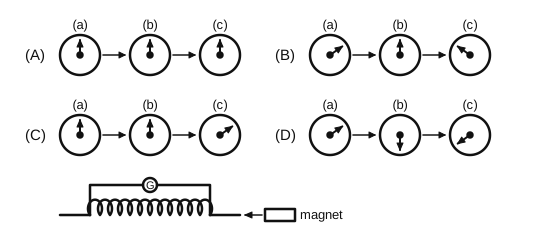
A small bar magnet is moved through a coil at constant speed from one end to the other. Which of the following series of observations will be seen on the galvanometer $G$ attached across the coil? The three positions are: (a) the magnet's entry, (b) magnet is completely inside and (c) magnet's exit.
Concept. As the magnet enters, the flux through the coil increases; while it is wholly inside a long coil the flux hardly changes; as it leaves, the flux decreases. The induced current reverses between entry and exit.
Step 1. Sequence. Deflection one way, then no deflection, then deflection the other way.
Answer. Dials (B) (Option B).
Solution by Sreeraj P, M.Sc Physics
Q 12-06-126JEE MainJEE Main 2020 (4 Sep, Shift 2)Medium
A series $L$–$R$ circuit is connected to a battery of emf $V$. If the circuit is switched on at $t = 0$, then the time at which the energy stored in the inductor reaches $\left(\dfrac1n\right)$ times of its maximum value, is:
Q 12-06-127JEE MainJEE Main 2020 (5 Sep, Shift 1)Medium
Two concentric circular coils, $C_1$ and $C_2$, are placed in the $XY$ plane. $C_1$ has $500$ turns, and a radius of $1\ \text{cm}$. $C_2$ has $200$ turns and radius of $20\ \text{cm}$. $C_2$ carries a time dependent current $I(t) = (5t^{2} - 2t + 3)$ A where $t$ is in s. The emf induced in $C_1$ (in mV) at the instant $t = 1\ \text{s}$ is $\dfrac4x$. The value of $x$ is ______.
Concept. Same method with turns: $M=\dfrac{\mu_0N_1N_2\pi r^2}{2R}$; $\varepsilon=M\dfrac{dI}{dt}$.
Step 1. $M$. $\dfrac{4\pi\times10^{-7}\times10^5\times\pi\times10^{-4}}{0.4}=10^{-4}$ H.
Step 2. Rate. $\dfrac{dI}{dt}=10t-2=8$ A/s.
Step 3. Emf. $8\times10^{-4}$ V $=\dfrac45$ mV.
Answer. $x=5$.
Solution by Sreeraj P, M.Sc Physics
Q 12-06-128JEE MainJEE Main 2019 (10 Jan, Shift 1)Easy
A solid metal cube of edge length $2\ \text{cm}$ is moving in the positive $y$-direction, at a constant speed of $6\ \text{m s}^{-1}$. There is a uniform magnetic field of $0.1\ \text{T}$ in the positive $z$-direction. The potential difference between the two faces of the cube, perpendicular to the $x$-axis, is
Concept. Electrons in the moving cube shift until $eE=evB$; the voltage across a length $d$ is $vBd$.
Step 1. Apply. $6\times0.1\times0.02=0.012$ V.
Answer. $12$ mV (Option A).
Solution by Sreeraj P, M.Sc Physics
Q 12-06-129JEE MainJEE Main 2019 (10 Jan, Shift 2)Easy
The self induced emf of a coil is $25$ volts. When the current in it is changed at uniform rate from $10\ \text{A}$ to $25\ \text{A}$ in $1\ \text{s}$, the change in the energy of the inductance is:
Concept. $L=\dfrac{\varepsilon}{dI/dt}$; energy change $\tfrac12L(I_2^2-I_1^2)$.
Step 1. Inductance. $\dfrac{25}{15}=\dfrac53$ H.
Step 2. Change. $\tfrac12\times\dfrac53\times(625-100)=437.5$ J.
Answer. Option C.
Solution by Sreeraj P, M.Sc Physics
Q 12-06-130JEE MainJEE Main 2019 (10 Apr, Shift 2)Easy
A coil of self inductance $10\ \text{mH}$ and resistance of $0.1\ \Omega$ is connected through a switch to a battery of internal resistance $0.9\ \Omega$. After the switch is closed, the time taken for the current to attain $80\%$ of the saturation value is: [$\ln5 = 1.6$]
Concept. $\tau=\dfrac{L}{R_{\text{total}}}$, including the battery's internal resistance.
Step 1. Time constant. $\dfrac{0.01}{1}=0.01$ s.
Step 2. 80%. $e^{-t/\tau}=0.2\Rightarrow t=\tau\ln5=0.016$ s.
Answer. Option D.
Solution by Sreeraj P, M.Sc Physics
Q 12-06-131JEE MainJEE Main 2019 (9 Jan, Shift 1)Easy
A conducting circular loop made of a thin wire has area $3.5\times10^{-2}\ \text{m}^2$ and resistance $10\ \Omega$. It is placed perpendicular to a time-dependent magnetic field $B(t) = (0.4\ \text{T})\sin(50\pi t)$. The field is uniform in space. Then the net charge flowing through the loop during $t = 0$ s and $t = 10$ ms is close to
Step 1. Flux change. At $t=10$ ms, $\sin(0.5\pi)=1$: $\Delta\phi=0.4\times3.5\times10^{-2}=0.014$ Wb.
Step 2. Charge. $\dfrac{0.014}{10}=1.4$ mC.
Answer. Option A.
Solution by Sreeraj P, M.Sc Physics
Q 12-06-132JEE MainJEE Main 2019 (8 Apr, Shift 1)Hard
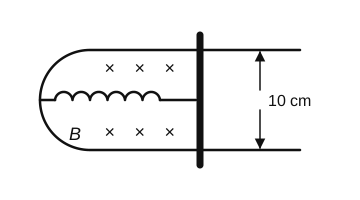
A thin strip $10\ \text{cm}$ long is on a U shaped wire of negligible resistance and it is connected to a spring of spring constant $0.5\ \text{N m}^{-1}$ (see figure). The assembly is kept in a uniform magnetic field of $0.1\ \text{T}$. If the strip is pulled from its equilibrium position and released, the number of oscillations it performs before its amplitude decreases by a factor of $e$ is $N$. If the mass of the strip is $50$ grams, its resistance $10\ \Omega$ and air drag negligible, $N$ will be close to
Concept. The moving strip carries a current $\dfrac{Blv}{R}$ and feels a drag $\dfrac{B^2l^2}{R}v=bv$. Damped SHM: the amplitude falls as $e^{-bt/2m}$, so it drops by $e$ in $t=\dfrac{2m}{b}$.
Q 12-06-134JEE MainJEE Main 2019 (9 Apr, Shift 1)Easy
The total number of turns and cross-section area in a solenoid is fixed. However, its length $L$ is varied by adjusting the separation between windings. The inductance of solenoid will be proportional to
Concept. $L=\dfrac{\mu_0N^2A}{l}$: with $N$ and $A$ fixed, $L\propto\dfrac1l$.
Answer. Option C.
Solution by Sreeraj P, M.Sc Physics
Q 12-06-135JEE MainJEE Main 2019 (9 Apr, Shift 2)Easy
Two coils P and Q are separated by some distance. When a current of $3\ \text{A}$ flows through coil P, a magnetic flux of $10^{-3}\ \text{Wb}$ passes through Q. No current is passed through Q. When no current passes through P and a current of $2\ \text{A}$ passes through Q, the flux through P is
Q 12-06-136JEE MainJEE Main 2019 (9 Apr, Shift 2)Hard
A very long solenoid of radius $R$ is carrying current $I(t) = kte^{-\alpha t}$ ($k > 0$), as a function of time ($t \ge 0$). Counterclockwise current is taken to be positive. A circular conducting coil of radius $2R$ is placed in the equatorial plane of the solenoid and concentric with the solenoid. The current induced in the outer coil is correctly depicted, as a function of time, by
Concept. The solenoid's field is confined inside it, so the flux through the outer coil is $\propto I(t)$ and the induced current is $\propto -\dfrac{dI}{dt}$.
Step 2. Behaviour. $-k$ at $t = 0$ (clockwise, non-zero), zero at $t = \dfrac{1}{\alpha}$, positive afterwards with a maximum at $t = \dfrac{2}{\alpha}$, then decaying: graph (2).
Answer. Graph (2) (Option B).
Solution by Sreeraj P, M.Sc Physics
Q 12-06-137JEE MainJEE Main 2019 (11 Jan, Shift 1)Easy
There are two long co-axial solenoids of same length $l$. The inner and outer coils have radii $r_1$ and $r_2$ and number of turns per unit length $n_1$ and $n_2$, respectively. The ratio of mutual inductance to the self-inductance of the inner coil is:
Q 12-06-138JEE MainJEE Main 2019 (11 Jan, Shift 1)Easy
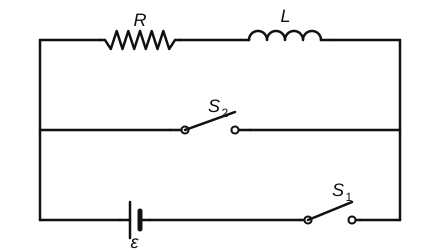
In the circuit shown, the switch $S_1$ is closed at time $t = 0$ and the switch $S_2$ is kept open. At some later time $(t_0)$, the switch $S_1$ is opened and $S_2$ is closed. The behaviour of the current $I$ as a function of time $t$ is given by:
Concept. With $S_1$ closed the current grows as $I_0(1-e^{-t/\tau})$. At $t_0$ the cell is cut out and $S_2$ closes the loop through L and R: the current cannot jump, so it decays smoothly, $I(t_0)e^{-(t-t_0)/\tau}$.
Step 1. Shape. A rising exponential up to $t_0$, then a falling exponential from the same value: graph (A).
Answer. Option A.
Solution by Sreeraj P, M.Sc Physics
Q 12-06-139JEE MainJEE Main 2019 (11 Jan, Shift 2)Medium
A copper wire is wound on a wooden frame, whose shape is that of an equilateral triangle. If the linear dimension of each side of the frame is increased by a factor of $3$, keeping the number of turns of the coil per unit length of the frame the same, then the self inductance of the coil:
Concept. For a coil wound along a frame with a fixed number of turns per unit length $n$ and a fixed winding cross-section $A$, $L=\mu_0n^2A\,l$, where $l$ is the total wound length.
Step 1. Scaling. Each side ×3, so the frame's length (perimeter) ×3, with $n$ and $A$ unchanged.
Step 2. Result. $L$ increases by a factor of 3.
Answer. Option C.
Solution by Sreeraj P, M.Sc Physics
Q 12-06-140JEE MainJEE Main 2019 (12 Jan, Shift 1)Easy
In the figure shown, a circuit contains two identical resistors with resistance $R = 5\ \Omega$ and an inductance with $L = 2$ mH. An ideal battery of $15$ V is connected in the circuit. What will be the current through the battery long after the switch is closed?
Concept. In the steady state the inductor acts as a plain wire.
Step 1. Equivalent resistance. The two $5\ \Omega$ branches are in parallel: $2.5\ \Omega$.
Step 2. Current. $\dfrac{15}{2.5} = 6$ A.
Answer. $6$ A (Option B).
Solution by Sreeraj P, M.Sc Physics
Q 12-06-141JEE MainJEE Main 2019 (12 Jan, Shift 2)Medium
A $10$ m long horizontal wire extends from North East to South West. It is falling with a speed of $5.0\ \text{m s}^{-1}$, at right angles to the horizontal component of the earth's magnetic field of $0.3\times10^{-4}\ \text{Wb m}^{-2}$. The value of the induced emf in the wire is:
Concept. $\varepsilon=Blv$ uses only the length perpendicular to both $\vec v$ and $\vec B$. A NE–SW wire makes $45^\circ$ with $B_H$ (north).
Step 1. Apply. $0.3\times10^{-4}\times5\times10\times\sin45^\circ=1.06\times10^{-3}$ V.
Answer. Option B.
Solution by Sreeraj P, M.Sc Physics
Q 12-06-142JEE MainJEE Main 2019 (12 Apr, Shift 1)Hard
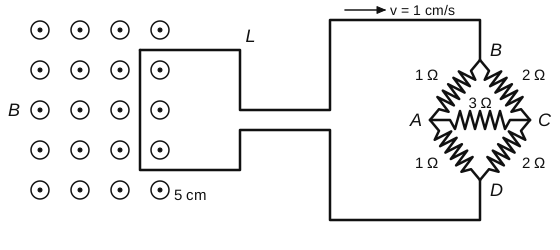
The figure shows a square loop L of side $5$ cm which is connected to a network of resistances. The whole setup is moving towards the right with a constant speed of $1\ \text{cm s}^{-1}$. At some instant, a part of L is in a uniform magnetic field of $1$ T perpendicular to the plane of the loop. If the resistance of L is $1.7\ \Omega$, the current in the loop at that instant will be close to:
Concept. Only the side of L inside the field cuts the field lines: $\varepsilon=Blv$. The external network is a bridge; reduce it, add the loop's own resistance, then $I=\dfrac{\varepsilon}{R_{total}}$.
Step 1. EMF. $\varepsilon=1\times0.05\times0.01=5\times10^{-4}$ V.
Step 2. Network between B and D. Path B–A–D: $1+1=2\ \Omega$; path B–C–D: $2+2=4\ \Omega$. A and C both sit at half the potential, so the 3 Ω resistor carries nothing: $R_{BD}=\dfrac{2\times4}{6}=\dfrac43\ \Omega$.
Step 3. Current. $I=\dfrac{5\times10^{-4}}{1.7+1.33}=1.65\times10^{-4}$ A $\approx170\ \mu$A.
Answer. Option D.
Solution by Sreeraj P, M.Sc Physics
Q 12-06-143JEE MainJEE Main 2019 (12 Apr, Shift 2)Medium
Consider the LR circuit shown in the figure. If the switch S is closed at $t = 0$ then the amount of charge that passes through the battery between $t = 0$ and $t = \dfrac LR$ is:
Q 12-06-144JEE MainJEE Main 2018 (15 Apr, Shift 2)Medium
A copper rod of mass $m$ slides under gravity on two smooth parallel rails, with separation $l$ and set at an angle of $\theta$ with the horizontal. At the bottom, rails are joined by a resistance $R$. There is a uniform magnetic field $B$ normal to the plane of the rails. The terminal speed of the copper rod is:
Q 12-06-145JEE MainJEE Main 2018 (15 Apr, Shift 2)Medium
At the centre of a fixed large circular coil of radius $R$, a much smaller circular coil of radius $r$ is placed. The two coils are concentric and are in the same plane. The larger coil carries a current $I$. The smaller coil is set to rotate with a constant angular velocity $\omega$ about an axis along their common diameter. Calculate the emf induced in the smaller coil after a time $t$ of its start of rotation.
Q 12-06-146JEE MainJEE Main 2018 (16 Apr, Shift 1)Easy
A coil of cross-sectional area $A$ having $n$ turns is placed in a uniform magnetic field $B$. When it is rotated with an angular velocity $\omega$, the maximum e.m.f. induced in the coil will be:
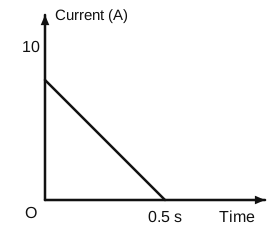
In a coil of resistance $100\ \Omega$, a current is induced by changing the magnetic flux through it as shown in the figure. The magnitude of change in flux through the coil is:
A small circular loop of wire of radius $a$ is located at the centre of a much larger circular wire loop of radius $b$. The two loops are in the same plane. The outer loop of radius $b$ carries an alternating current $I = I_0\cos(\omega t)$. The emf induced in the smaller inner loop is nearly:
Concept. $M=\dfrac{\mu_0\pi a^2}{2b}$ and $\varepsilon=-M\dfrac{dI}{dt}=MI_0\omega\sin\omega t$.
Answer. Option D.
Solution by Sreeraj P, M.Sc Physics
Q 12-06-149NEETNEET 2022Top questionEasy
A square loop of side $1$ m and resistance $1\ \Omega$ is placed in a magnetic field of $0.5$ T. If the plane of loop is perpendicular to the direction of magnetic field, the magnetic flux through the loop is
A big circular coil of $1000$ turns and average radius $10$ m is rotating about its horizontal diameter at $2\ \text{rad s}^{-1}$. If the vertical component of earth's magnetic field at that place is $2 \times 10^{-5}$ T and electrical resistance of the coil is $12.56\ \Omega$, then the maximum induced current in the coil will be
Q 12-06-152JEE MainJEE Main 2025 (4 Apr, Shift 1)Medium
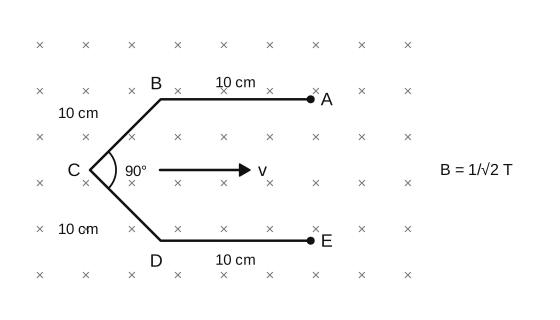
A conductor wire ABCDE with each arm $10\ \text{cm}$ in length is placed in a magnetic field of $\dfrac{1}{\sqrt2}\ \text{T}$, perpendicular to its plane. Arms BC and CD make a $90^\circ$ angle at C, with AB and DE parallel to the direction of motion, as shown in the figure. When the conductor is pulled towards the right with a constant velocity of $10\ \text{cm/s}$, the induced emf between points A and E is ______ mV.
Concept. The emf of a wire moving in a uniform field is $Bv\ell$, where $\ell$ is the length of the straight line joining its ends, measured perpendicular to $\vec v$. Parts along $\vec v$ contribute nothing.
Step 1. Effective length. AB and DE are along $\vec v$. BC and CD (10 cm each, at $90^\circ$) span a perpendicular distance $2\times10\sin45^\circ=10\sqrt2$ cm.
Step 2. EMF. $\varepsilon=\dfrac1{\sqrt2}\times0.1\times0.1\sqrt2=0.01$ V.


 Solution by Sreeraj P, M.Sc Physics