

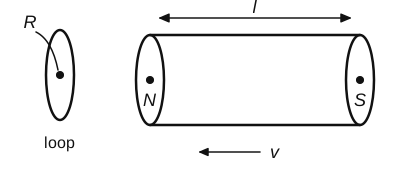
A bar magnet is passing through a conducting loop of radius $R$ with velocity $v$. The radius of the bar magnet is such that it just passes through the loop. The induced e.m.f. in the loop can be represented by the approximate curve:
Answer: (C) see figure
The magnet moves towards the loop with its N end first. As the N end passes through the loop, the flux through the loop changes rapidly: a sharp emf pulse.
While the long middle part of the magnet is inside the loop, the flux is nearly constant, so the emf is almost zero.
As the S end passes through, after a time $\dfrac{l}{v}$, the flux changes in the opposite sense (it was increasing, now it decreases), so a second sharp pulse of opposite sign appears.
Only the curve with two opposite pulses separated by $\dfrac{l}{v}$ and the first pulse negative (with the sign convention of the figure) is correct.
 Solution by Sreeraj P, M.Sc Physics