

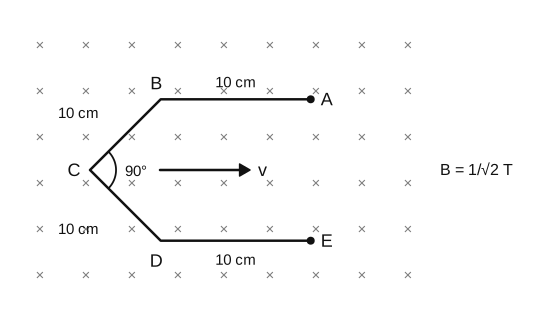
A conductor wire ABCDE with each arm $10\ \text{cm}$ in length is placed in a magnetic field of $\dfrac{1}{\sqrt2}\ \text{T}$, perpendicular to its plane. Arms BC and CD make a $90^\circ$ angle at C, with AB and DE parallel to the direction of motion, as shown in the figure. When the conductor is pulled towards the right with a constant velocity of $10\ \text{cm/s}$, the induced emf between points A and E is ______ mV.
Numerical value type. Enter your answer.
Answer: 10
In a uniform field, the emf across a moving wire depends only on the straight-line separation of its ends measured perpendicular to the velocity.
AB and DE are along the velocity and add nothing. BC and CD are each $10\ \text{cm}$ at $45^\circ$ to the velocity, so the perpendicular separation of A and E is
$$l_\perp = 2\times10\sin45^\circ = 10\sqrt2\ \text{cm}$$
$$\varepsilon = Bvl_\perp = \frac1{\sqrt2}\times0.1\times0.1\sqrt2 = 0.01\ \text{V} = 10\ \text{mV}$$
 Solution by Sreeraj P, M.Sc Physics