

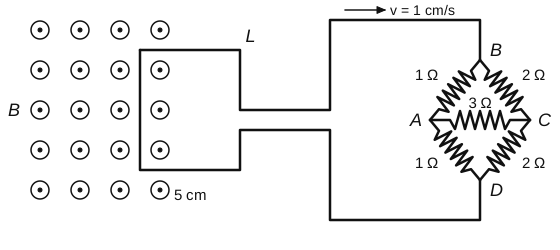
The figure shows a square loop L of side $5$ cm which is connected to a network of resistances. The whole setup is moving towards the right with a constant speed of $1\ \text{cm s}^{-1}$. At some instant, a part of L is in a uniform magnetic field of $1$ T perpendicular to the plane of the loop. If the resistance of L is $1.7\ \Omega$, the current in the loop at that instant will be close to:
Answer: (D) $170\ \mu$A
Only the side of L inside the field cuts field lines:
$$\varepsilon = Blv = 1\times0.05\times0.01 = 5\times10^{-4}\ \text{V}$$
The network is connected at B and D. By symmetry A and C are both at the midpoint potential (B–A–D has $1 : 1$ and B–C–D has $2 : 2$), so the $3\ \Omega$ resistor carries no current:
$$R_{BD} = (1 + 1)\parallel(2 + 2) = \frac43\ \Omega$$
$$I = \frac{5\times10^{-4}}{1.7 + 1.33} \approx 1.65\times10^{-4}\ \text{A} \approx 170\ \mu\text{A}$$
 Solution by Sreeraj P, M.Sc Physics