A planet has the same average density as Earth but twice its radius. If the escape speed from Earth is $11.2\ \text{km/s}$, the escape speed from the planet is
Two planets $P_1$ and $P_2$ with equal mass have radii $R_1$ and $R_2$, respectively, where $R_2 = \dfrac{R_1}{2}$. The escape speeds of $P_1$ and $P_2$ are $v_1$ and $v_2$, respectively. Then $\dfrac{v_2}{v_1}$ is :
The radius of Martian orbit around the Sun is about $4$ times the radius of the orbit of Mercury. The Martian year is $687$ Earth days. Then which of the following is the length of $1$ year on Mercury ?
Step 1. Scale. $T_{\text{Mercury}} = 687 \times \left(\dfrac14\right)^{3/2} = \dfrac{687}{8} \approx 86$ days; the closest option is $88$.
Answer. $88$ earth days (Option A).
Solution by Sreeraj P, M.Sc Physics
Q 11-07-005NEETNEET 2025Top questionEasy
A body weighs $48$ N on the surface of the earth. The gravitational force experienced by the body due to the earth at a height equal to one-third the radius of the earth from its surface is :
Step 1. Substitute. $48 \times \left(\dfrac{3}{4}\right)^2 = 27$ N.
Answer. $27$ N (Option B).
Solution by Sreeraj P, M.Sc Physics
Q 11-07-006NEETNEET 2024Top questionEasy
The mass of a planet is $\dfrac{1}{10}$th that of the earth and its diameter is half that of the earth. The acceleration due to gravity on that planet is :
The minimum energy required to launch a satellite of mass $m$ from the surface of earth of mass $M$ and radius $R$ in a circular orbit at an altitude of $2R$ from the surface of the earth is:
Two bodies of mass $m$ and $9m$ are placed at a distance $R$. The gravitational potential on the line joining the bodies where the gravitational field equals zero, will be ($G$ = gravitational constant) :
A satellite is orbiting just above the surface of the earth with period $T$. If $d$ is the density of the earth and $G$ is the universal constant of gravitation, the quantity $\dfrac{3\pi}{Gd}$ represents :
The escape velocity from the Earth's surface is $v$. The escape velocity from the surface of another planet having a radius, four times that of Earth and same mass density is :
Concept. At fixed density $v_e = R\sqrt{\dfrac{8\pi G\rho}{3}} \propto R$.
Step 1. Scale. Four times the radius: $4v$.
Answer. $4v$ (Option A).
Solution by Sreeraj P, M.Sc Physics
Q 11-07-011NEETNEET 2021Top questionMedium
A particle of mass 'm' is projected with a velocity $v = kV_e$ ($k < 1$) from the surface of the earth. ($V_e$ = escape velocity) The maximum height above the surface reached by the particle is :
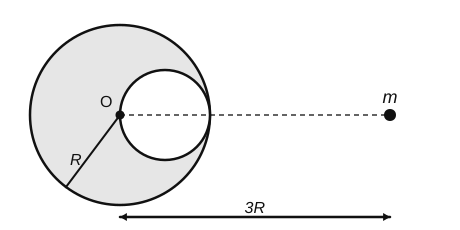
The gravitational force acting on a particle, due to a solid sphere of uniform density and radius $R$, at a distance of $3R$ from the centre of the sphere is $F_1$. A spherical hole of radius $\dfrac{R}{2}$ is now made in the sphere as shown in the figure. The sphere with the hole now exerts a force $F_2$ on the same particle. The ratio $\dfrac{F_1}{F_2}$ is
Two bodies of masses $m$ and $4m$ are placed at a distance $r$. The gravitational potential at a point on the line joining them where the gravitational field is zero is
Concept. First find the neutral point, where the two fields cancel. Then add the potentials there. Potential is a scalar, and both contributions are negative, so they add up; they do not cancel.
Step 1. Neutral point. Let it be at $x$ from $m$: $$\frac{Gm}{x^2}=\frac{G(4m)}{(r-x)^2}\ \Rightarrow\ r-x=2x\ \Rightarrow\ x=\frac r3$$
The gravitational field in a region is given by $\vec{E} = (5\hat{i} + 12\hat{j})$ N/kg. If a particle of mass $2$ kg is moved from the origin to the point $(12\ \text{m}, 5\ \text{m})$ in this region, the change in the gravitational potential energy is
A body is projected vertically upwards from the surface of the earth with a velocity equal to half of the escape velocity of the earth. If $R$ is the radius of the earth, the maximum height attained by the body from the surface of the earth is
A launching vehicle carrying an artificial satellite of mass $m$ is set for launch on the surface of the earth of mass $M$ and radius $R$. If the satellite is intended to move in a circular orbit of radius $7R$, the minimum energy required to be spent by the launching vehicle on the satellite is
Concept. $T = 2\pi\sqrt{\dfrac{r^3}{GM}}$ with $r = R + h$.
Step 1. Dependence. On the Earth's mass, the orbit radius, and so the height (not the satellite's mass).
Answer. All the above (Option D).
Solution by Sreeraj P, M.Sc Physics
Q 11-07-019NEETEAMCET 2007 (Medical)Medium
A body of mass $m$ is raised from the surface of the earth to a height $nR$ ($R$ is the radius of the earth). The magnitude of the change in the gravitational potential energy of the body is ($g$ = acceleration due to gravity on the surface of the earth)
In planetary motion, the areal velocity of the position vector of a planet depends on the angular velocity ($\omega$) and the distance of the planet from the sun ($r$). If so, the correct relation for the areal velocity is
An artificial satellite of mass $m$ is revolving around in a circular orbit of radius $r$. If the mass of the earth is $M$, the angular momentum of the satellite with respect to the centre of the earth is
If the earth were to rotate on its own axis such that the weight of a person at the equator becomes half the weight at the poles, then its time period of rotation is ($g$ = acceleration due to gravity near the poles and $R$ is the radius of the earth; ignore equatorial bulge)
The acceleration due to gravity at a depth of $1600$ km below the Earth's surface is ($g = 9.8\ \text{m/s}^2$ at the surface, radius of Earth $= 6400$ km)
At what height above the Earth's surface is the acceleration due to gravity equal to its value at a depth of $\dfrac{R}{2}$, where $R$ is the radius of the Earth?
A satellite orbits the Earth at a height equal to the Earth's radius $R$. If $g$ is the acceleration due to gravity at the surface, its orbital speed is
A satellite of mass $m$ is moved from a circular orbit of radius $2R$ to one of radius $4R$ around the Earth (mass $M$, radius $R$). The work required is
A planet moves in an elliptical orbit around the Sun. Its distances from the Sun at perihelion and aphelion are $r_1$ and $r_2$. The ratio of its speeds at perihelion and aphelion is
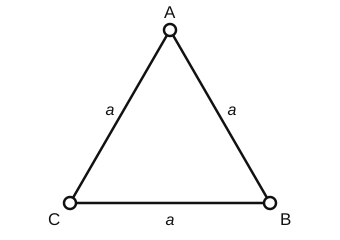
Three particles, each of mass $m$, are placed at the vertices of an equilateral triangle of side $a$. The gravitational potential energy of the system is
Concept. Inside a uniform solid sphere $E = \dfrac{GMr}{R^3}$.
Step 1. At $\dfrac R2$. $E = \dfrac{GM}{2R^2}$.
Answer. $\dfrac{GM}{2R^2}$ (Option B).
Solution by Sreeraj P, M.Sc Physics
Q 11-07-035NEETJEE MainEasy
Inside a uniform thin spherical shell of mass $M$ and radius $R$, the gravitational field and potential at a point halfway between the centre and the shell are respectively
Concept. Inside a shell the field is zero, so the potential equals its surface value.
Step 1. Values. $E = 0$, $V = -\dfrac{GM}{R}$.
Answer. $0$ and $-\dfrac{GM}{R}$ (Option C).
Solution by Sreeraj P, M.Sc Physics
Q 11-07-036NEETJEE MainMedium
The height of a geostationary satellite above the Earth's surface is about $36000$ km. Taking the Earth's radius as $6400$ km, the orbital speed of such a satellite is about
Answer: (A) both the astronaut and the spacecraft are in free fall with the same acceleration
Concept. Weightlessness is the absence of a normal force, not of gravity.
Step 1. Reason. Astronaut and spacecraft fall freely with the same acceleration, so the floor pushes on nothing.
Answer. Both the astronaut and the spacecraft are in free fall with the same acceleration (Option A).
Solution by Sreeraj P, M.Sc Physics
Q 11-07-038JEE MainMedium
With what minimum speed, in km/s, must a body be projected from the surface of a planet of mass $6 \times 10^{24}$ kg and radius $6.67 \times 10^6$ m to escape its gravity? ($G = 6.67 \times 10^{-11}\ \text{N m}^2\text{kg}^{-2}$; give the answer to the nearest whole number)
Q 11-07-040JEE MainJEE Main 2026 (5 Apr, Shift 1)Medium
When one moves from a point $16$ km below the earth's surface to a point $16$ km above the earth's surface. The change in g is approximately $\alpha\%$. The value of $\alpha$ is ______.
Concept. For small heights and depths: going up $h$ reduces $g$ by the fraction $\dfrac{2h}{R}$; going down $d$ reduces it by $\dfrac dR$. So $g$ is largest at the surface and falls on both sides, faster going up.
Step 1. At $16$ km depth. $g_1=g\left(1-\dfrac{16}{6400}\right)=g(1-0.0025)$.
Step 2. At $16$ km height. $g_2=g\left(1-\dfrac{2\times16}{6400}\right)=g(1-0.005)$.
Step 3. Change. $g_1-g_2=0.0025\,g$, which is $0.25\%$ of $g$.
Answer. $\alpha=0.25$ (Option B).
Solution by Sreeraj P, M.Sc Physics
Q 11-07-041JEE MainJEE Main 2026 (5 Apr, Shift 2)Easy
A body of mass $m$ is taken from the surface of earth to a height equal to twice the radius of earth ($R_e$). The increase in potential energy will be ______.
($g$ is acceleration due to gravity at the surface of earth)
Q 11-07-042JEE MainJEE Main 2026 (4 Apr, Shift 2)Easy
The height in terms of radius of the earth $(R)$, at which the acceleration due to gravity becomes $\dfrac{g}{9}$, where $g$ is acceleration due to gravity on earth's surface, is ______.
Concept. Above the surface, $g$ falls with the square of the distance from the centre: $g_h=\dfrac{g}{(1+h/R)^2}$. This formula is exact; the shortcut $g(1-2h/R)$ only works for $h\ll R$.
Step 1. Set up. $\dfrac{g}{(1+h/R)^2}=\dfrac g9\Rightarrow\left(1+\dfrac hR\right)^2=9$.
Step 2. Solve. $1+\dfrac hR=3\Rightarrow h=2R$.
Answer. $2R$ (Option C). Distance from the centre is $3R$; $g$ falls by $3^2$.
Solution by Sreeraj P, M.Sc Physics
Q 11-07-043JEE MainJEE Main 2026 (2 Apr, Shift 1)Easy
A planet $(P_1)$ is moving around the star of mass $2M$ in the orbit of radius $R$. Another planet $(P_2)$ is moving around another star of mass $4M$ in a orbit of radius $2R$. Ratio of time periods of revolution of $P_2$ and $P_1$ is ______.
Q 11-07-044JEE MainJEE Main 2026 (2 Apr, Shift 2)Easy
If a body of mass $1$ kg falls on the earth from infinity, it attains velocity $(v)$ and kinetic energy $(k)$ on reaching the surface of earth. The values of $v$ and $k$ respectively are ______.
(Take radius of earth to be $6400$ km and $g=9.8\ \text{m/s}^2$)
Step 2. KE. $K=mgR=9.8\times6.4\times10^6=6.27\times10^7$ J.
Answer. Option A.
Solution by Sreeraj P, M.Sc Physics
Q 11-07-045JEE MainJEE Main 2026 (24 Jan, Shift 1)Medium
Three masses $200\ \text{kg}, 300\ \text{kg}$ and 400 kg are placed at the vertices of an equilateral triangle with sides 20 m . They are rearranged on the vertices of a bigger triangle of side 25 m and with the same centre. The work done in this process ______ J. (Gravitational constant $\text{G} = 6.7\times10^{-11}\ \text{N m}^2/\text{kg}^2$ )
Q 11-07-046JEE MainJEE Main 2025 (22 Jan, Shift 1)Medium
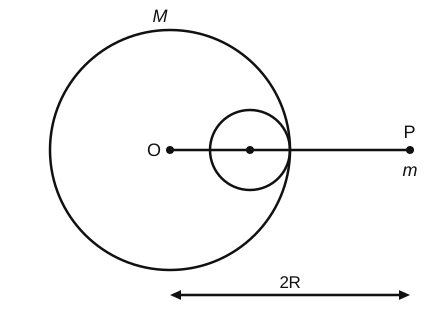
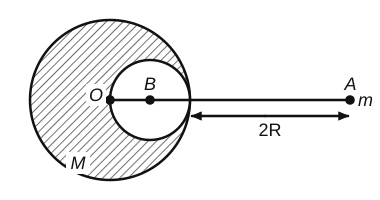
A small point of mass $m$ is placed at a distance $2R$ from the centre $O$ of a big uniform solid sphere of mass $M$ and radius $R$. The gravitational force on $m$ due to $M$ is $F_1$. A spherical part of radius $R/3$ is removed from the big sphere as shown in the figure and the gravitational force on $m$ due to the remaining part of $M$ is found to be $F_2$. The value of ratio $F_1 : F_2$ is
Concept. Superposition: (full sphere) $-$ (removed sphere). The removed sphere has mass $M\left(\tfrac13\right)^3=\tfrac M{27}$; from the figure it touches the surface on the side of $P$, so its centre is $\tfrac{2R}{3}$ from $O$, i.e. $2R-\tfrac{2R}3=\tfrac{4R}{3}$ from $P$.
Q 11-07-047JEE MainJEE Main 2025 (22 Jan, Shift 2)Medium
Given below are two statements. One is labelled as Assertion (A) and the other is labelled as Reason (R).
Assertion (A): A simple pendulum is taken to a planet of mass and radius 4 times and 2 times, respectively, than the Earth. The time period of the pendulum remains same on earth and the planet.
Reason (R): The mass of the pendulum remains unchanged at Earth and the other planet.
In the light of the above statements, choose the correct answer from the options given below:
Answer: (D) Both (A) and (R) are true but (R) is NOT the correct explanation of (A)
Concept. $T=2\pi\sqrt{l/g}$ depends on $g$, not on the bob's mass. On the planet $g'=\dfrac{G(4M)}{(2R)^2}=g$.
Step 1. Assertion. $g'=g$, so the period is the same. True.
Step 2. Reason. The mass is unchanged (true), but the period does not depend on mass at all, so it does not explain A.
Answer. Both true but R is not the correct explanation of A (Option D).
Solution by Sreeraj P, M.Sc Physics
Q 11-07-048JEE MainJEE Main 2025 (23 Jan, Shift 2)Easy
If a satellite orbiting the Earth is 9 times closer to the Earth than the Moon, what is the time period of rotation of the satellite? Given rotational time period of Moon $= 27$ days and gravitational attraction between the satellite and the Moon is neglected.
Concept. Kepler's third law about the same central body: $T\propto r^{3/2}$.
Step 1. Scale. $r$ to $\tfrac19$: $T\times\left(\tfrac19\right)^{3/2}=\tfrac1{27}$.
Step 2. Period. $\dfrac{27}{27}=1$ day.
Answer. Option B.
Solution by Sreeraj P, M.Sc Physics
Q 11-07-049JEE MainJEE Main 2025 (23 Jan, Shift 2)Medium
A satellite of mass $\dfrac{M}{2}$ is revolving around the Earth in a circular orbit at a height of $\dfrac{R}{3}$ from the Earth's surface. The angular momentum of the satellite is $M\sqrt{\dfrac{GMR}{x}}$. The value of $x$ is ______, where $M$ and $R$ are the mass and radius of the Earth, respectively. ($G$ is the gravitational constant)
Q 11-07-050JEE MainJEE Main 2025 (24 Jan, Shift 1)Easy
A satellite is launched into a circular orbit of radius $R$ around the earth. A second satellite is launched into an orbit of radius $1.03R$. The time period of revolution of the second satellite is larger than the first one approximately by
Q 11-07-051JEE MainJEE Main 2025 (24 Jan, Shift 2)Easy
Acceleration due to gravity on the surface of earth is $g$. If the diameter of earth is reduced to one third of its original value and mass remains unchanged, then the acceleration due to gravity on the surface of the earth is ______ $g$.
Q 11-07-052JEE MainJEE Main 2025 (28 Jan, Shift 2)Easy
Earth has mass 8 times and radius 2 times that of a planet. If the escape velocity from the earth is $11.2\ \text{km/s}$, the escape velocity in km/s from the planet will be
Answer: (A) Both (A) and (R) are true and (R) is the correct explanation of (A)
Concept. $T = 2\pi\sqrt{\dfrac lg}$; $g$ is smaller at height.
Step 1. Reason. $T$ falls as $g$ rises → true.
Step 2. Assertion. Lower $g$ on the mountain, longer $T$ → true, following from R.
Answer. Both (A) and (R) are true and (R) is the correct explanation of (A) (Option A).
Solution by Sreeraj P, M.Sc Physics
Q 11-07-054JEE MainJEE Main 2025 (29 Jan, Shift 2)Hard
Three equal masses $m$ are kept at the vertices $(A, B, C)$ of an equilateral triangle of side $a$ in free space. At $t = 0$, they are given initial velocities $\vec V_A = V_0\,\widehat{AC}$, $\vec V_B = V_0\,\widehat{BA}$ and $\vec V_C = V_0\,\widehat{CB}$, where $\widehat{AC}$, $\widehat{CB}$ and $\widehat{BA}$ are unit vectors along the edges of the triangle. If the three masses interact gravitationally, then the magnitude of the net angular momentum of the system at the point of collision is
Concept. Gravity between the masses is internal, so the total angular momentum about the centroid is conserved, also at the collision. Compute it at $t=0$.
Step 1. Each mass. Each moves at $V_0$ along a side of the triangle; the perpendicular distance from the centroid to a side is the inradius $\dfrac{a}{2\sqrt3}$. So each has $L=mV_0\dfrac{a}{2\sqrt3}$.
Step 2. Same sense. $A\to C$, $C\to B$, $B\to A$ all go round the triangle the same way, so the three add.
Q 11-07-055JEE MainJEE Main 2025 (29 Jan, Shift 2)Easy
Two planets, A and B, are orbiting a common star in circular orbits of radii $R_A$ and $R_B$, respectively, with $R_B = 2R_A$. The planet B is $4\sqrt2$ times more massive than planet A. The ratio $\left(\dfrac{L_B}{L_A}\right)$ of the angular momentum $(L_B)$ of planet B to that of planet A $(L_A)$ is closest to integer ______.
Q 11-07-056JEE MainJEE Main 2024 (1 Feb, Shift 1)Easy
If $R$ is the radius of the earth and the acceleration due to gravity on the surface of the earth is $g = \pi^2\ \text{m s}^{-2}$, then the length of the seconds pendulum at a height $h = 2R$ from the surface of the earth will be
Q 11-07-057JEE MainJEE Main 2024 (1 Feb, Shift 2)Medium
A light planet is revolving around a massive star in a circular orbit of radius $R$ with a period of revolution $T$. If the force of attraction between the planet and the star is proportional to $R^{-3/2}$, then choose the correct option.
Concept. For a circular orbit the attraction supplies the centripetal force: $m\omega^2R\propto R^{-3/2}$.
Step 1. Solve. $\omega^2\propto R^{-5/2}$, and $T=\dfrac{2\pi}{\omega}$, so $T^2\propto R^{5/2}$.
Answer. Option A.
Solution by Sreeraj P, M.Sc Physics
Q 11-07-058JEE MainJEE Main 2024 (4 Apr, Shift 1)Medium
A metal wire of uniform mass density having length $L$ and mass $M$ is bent to form a semicircular arc and a particle of mass $m$ is placed at the centre of the arc. The gravitational force on the particle by the wire is
Concept. By symmetry the pull of a semicircular wire on a mass at its centre points along the axis of symmetry: $F=\displaystyle\int\frac{Gm\,dm}{R^2}\cos\theta=\frac{2Gm\lambda}{R}$.
Q 11-07-059JEE MainJEE Main 2024 (4 Apr, Shift 2)Easy
A $90\ \text{kg}$ body placed at a distance $2R$ from the surface of the earth experiences a gravitational pull of ($R$ = radius of earth, $g = 10\ \text{m s}^{-2}$)
Q 11-07-061JEE MainJEE Main 2024 (5 Apr, Shift 1)Easy
A simple pendulum doing small oscillations at a place $R$ height above the earth's surface has a time period of $T_1 = 4\ \text{s}$. $T_2$ would be its time period if it is brought to a point which is at a height $2R$ from the earth's surface. Choose the correct relation [$R$ = radius of earth].
Concept. In a circular orbit of radius $a$: $K=\dfrac{GMm}{2a}$, $U=-\dfrac{GMm}{a}$, $E=-\dfrac{GMm}{2a}$. Escape energy per unit mass at a planet's surface: $\dfrac{Gm}{r}$.
Step 1. Match. A–II, B–I, C–IV, D–III.
Answer. Option B.
Solution by Sreeraj P, M.Sc Physics
Q 11-07-063JEE MainJEE Main 2024 (5 Apr, Shift 2)Medium
A satellite revolving around a planet in a stationary orbit has a time period of 6 hours. The mass of the planet is one-fourth the mass of the earth. The radius of the orbit around the planet is (Given: radius of the geostationary orbit for earth is $4.2\times10^4\ \text{km}$)
Q 11-07-064JEE MainJEE Main 2024 (6 Apr, Shift 1)Easy
To project a body of mass $m$ from the earth's surface to infinity, the required kinetic energy is (assume the radius of earth is $R_E$ and $g$ = acceleration due to gravity on the surface of earth)
Concept. To reach infinity the KE must cancel the (negative) PE at the surface: $K=\dfrac{GMm}{R}=mgR$.
Answer. $mgR_E$ (Option C).
Solution by Sreeraj P, M.Sc Physics
Q 11-07-065JEE MainJEE Main 2024 (6 Apr, Shift 2)Easy
Assuming the earth to be a sphere of uniform mass density, a body weighs $300\ \text{N}$ on the surface of the earth. How much would it weigh at a depth of $R/4$ below the surface of the earth?
Concept. Inside a uniform earth, only the mass inside radius $(R-d)$ pulls, and $g$ falls linearly to zero at the centre: $g_d=g\left(1-\dfrac dR\right)$.
Step 1. Factor. With $d=\dfrac R4$: $1-\dfrac14=\dfrac34$.
Step 2. Weight. $300\times\dfrac34=225$ N.
Answer. $225$ N (Option D).
Solution by Sreeraj P, M.Sc Physics
Q 11-07-066JEE MainJEE Main 2024 (27 Jan, Shift 1)Easy
The acceleration due to gravity on the surface of earth is $g$. If the diameter of earth reduces to half of its original value and mass remains constant, then acceleration due to gravity on the surface of earth would be:
Answer: (B) Both (A) and (R) are correct and (R) is the correct explanation of (A)
Concept. Angular speed $\omega=\dfrac{2\pi}{T}$: the shorter the period, the larger $\omega$.
Step 1. Compare. The moon's period ($\approx27$ days) is much shorter than the earth's ($1$ year), so its angular speed is larger, and the Reason is exactly why.
Answer. Both correct and R is the correct explanation of A (Option B).
Solution by Sreeraj P, M.Sc Physics
Q 11-07-068JEE MainJEE Main 2024 (29 Jan, Shift 1)Medium
At what distance above and below the surface of the earth a body will have same weight? (Take radius of earth as $R$)
Concept. Equal weights at height $h$ and depth $h$: $g\left(1-\dfrac hR\right)=g\left(\dfrac{R}{R+h}\right)^2$. Solve exactly (the small-$h$ rules do not apply here).
Step 1. Put $x=h/R$. $(1-x)(1+x)^2=1\Rightarrow1+x-x^2-x^3=1\Rightarrow x(1-x-x^2)=0$.
Q 11-07-069JEE MainJEE Main 2024 (29 Jan, Shift 2)Easy
A planet takes 200 days to complete one revolution around the Sun. If the distance of the planet from the Sun is reduced to one fourth of the original distance, how many days will it take to complete one revolution?
Q 11-07-070JEE MainJEE Main 2024 (8 Apr, Shift 1)Hard
Two planets $A$ and $B$ having masses $m_1$ and $m_2$ move around the sun in circular orbits of radii $r_1$ and $r_2$ respectively. If angular momentum of $A$ is $L$ and that of $B$ is $3L$, the ratio of time periods $\left(\dfrac{T_A}{T_B}\right)$ is:
Q 11-07-071JEE MainJEE Main 2024 (8 Apr, Shift 2)Easy
Two satellites $A$ and $B$ go round a planet in circular orbits having radii $4R$ and $R$ respectively. If the speed of $A$ is $3v$, the speed of $B$ will be:
Q 11-07-072JEE MainJEE Main 2024 (9 Apr, Shift 1)Medium
An astronaut takes a ball of mass $m$ from earth to space. He throws the ball into a circular orbit about earth at an altitude of $318.5\ \text{km}$. From earth's surface to the orbit, the change in total mechanical energy of the ball is $x\dfrac{GM_em}{21R_e}$. The value of $x$ is (take $R_e = 6370\ \text{km}$):
Q 11-07-073JEE MainJEE Main 2024 (9 Apr, Shift 2)Medium
A satellite of $10^3\ \text{kg}$ mass is revolving in a circular orbit of radius $2R$. If $\dfrac{10^4R}{6}\ \text{J}$ energy is supplied to the satellite, it would revolve in a new circular orbit of radius (use $g = 10\ \text{m/s}^2$, $R$ = radius of earth):
Concept. Total energy in a circular orbit is $E=-\dfrac{GMm}{2r}=-\dfrac{mgR^2}{2r}$. Energy supplied raises $E$ (makes it less negative), which means a bigger orbit.
Step 1. Initial energy ($r=2R$): $E_1=-\dfrac{mgR^2}{4R}=-\dfrac{mgR}{4}$.
Step 2. Energy supplied. $mg=10^3\times10=10^4$ N, so $\dfrac{10^4R}{6}=\dfrac{mgR}{6}$.
Step 3. New energy. $$E_2=-\frac{mgR}{4}+\frac{mgR}{6}=-\frac{mgR}{12}$$
Step 4. New radius. $-\dfrac{mgR^2}{2r'}=-\dfrac{mgR}{12}\Rightarrow r'=6R$.
Answer. Option D.
Solution by Sreeraj P, M.Sc Physics
Q 11-07-074JEE MainJEE Main 2024 (30 Jan, Shift 1)Medium
The gravitational potential at a point above the surface of earth is $-5.12\times10^7\ \text{J kg}^{-1}$ and the acceleration due to gravity at that point is $6.4\ \text{m s}^{-2}$. Assume the mean radius of earth to be $6400\ \text{km}$. The height of this point above the earth's surface is:
Concept. At distance $r$: $|V| = \dfrac{GM}{r}$ and $g = \dfrac{GM}{r^2}$, so $r = \dfrac{|V|}{g}$.
Step 1. Distance. $\dfrac{5.12 \times 10^7}{6.4} = 8 \times 10^6$ m $= 8000$ km.
Step 2. Height. $8000 - 6400 = 1600$ km.
Answer. $1600$ km (Option A).
Solution by Sreeraj P, M.Sc Physics
Q 11-07-075JEE MainJEE Main 2024 (30 Jan, Shift 2)Easy
The escape velocity of a body from earth is $11.2\ \text{km s}^{-1}$. If the radius of a planet is one-third the radius of earth and its mass is one-sixth that of earth, the escape velocity from the planet is:
Step 2. Value. $\dfrac{11.2}{\sqrt2}\approx7.9$ km s$^{-1}$.
Answer. Option D.
Solution by Sreeraj P, M.Sc Physics
Q 11-07-076JEE MainJEE Main 2024 (31 Jan, Shift 1)Medium
Four identical particles of mass $m$ are kept at the four corners of a square. If the gravitational force exerted on one of the masses by the other masses is $\left(\dfrac{2\sqrt2 + 1}{32}\right)\dfrac{Gm^2}{L^2}$, the length of the sides of the square is
Concept. Superposition: add the pulls of the other three masses on one corner. Two act along the sides (perpendicular), one along the diagonal; by symmetry the net force is along the diagonal.
Step 1. Forces on one corner (side $a$). Two sides: $\dfrac{Gm^2}{a^2}$ each, at $90^\circ$, resultant $\sqrt2\dfrac{Gm^2}{a^2}$ along the diagonal. Diagonal mass: $\dfrac{Gm^2}{2a^2}$.
Q 11-07-077JEE MainJEE Main 2024 (31 Jan, Shift 2)Easy
The mass of the moon is $\dfrac1{144}$ times the mass of a planet and its diameter $\dfrac1{16}$ times the diameter of the planet. If the escape velocity on the planet is $v$, the escape velocity on the moon will be:
Q 11-07-078JEE MainJEE Main 2023 (29 Jan, Shift 1)Easy
Two particles of equal mass $m$ move in a circle of radius $r$ under the action of their mutual gravitational attraction. The speed of each particle will be
Concept. Two equal masses circling under mutual attraction go round their centre of mass, each on radius $r$, $2r$ apart. Gravity supplies the centripetal force.
Q 11-07-079JEE MainJEE Main 2023 (29 Jan, Shift 2)Easy
The time period of a satellite of earth is $24$ hours. If the separation between the earth and the satellite is decreased to one fourth of the previous value, then its new time period will become
Q 11-07-080JEE MainJEE Main 2023 (30 Jan, Shift 1)Medium
If the gravitational field in the space is given as $-\dfrac{K}{r^2}$. Taking the reference point to be at $r=2\ \text{cm}$ with gravitational potential $V=10\ \text{J kg}^{-1}$, find the gravitational potential at $r=3\ \text{cm}$ in SI unit. (Given that $K=6\ \text{J cm kg}^{-1}$)
Concept. Potential and field are linked by $E=-\dfrac{dV}{dr}$, so $V(r)-V(r_0)=-\int_{r_0}^rE\,dr$. Keep the units consistent: $K$ is given with cm, so work in cm.
Step 2. Numbers ($r_0=2$ cm, $r=3$ cm, $K=6$): $$V(3)-10=6\left(\frac12-\frac13\right)=1\ \Rightarrow\ V(3)=11\ \text{J kg}^{-1}$$
Answer. Option B.
Solution by Sreeraj P, M.Sc Physics
Q 11-07-081JEE MainJEE Main 2023 (30 Jan, Shift 2)Easy
An object is allowed to fall from a height $R$ above the earth, where $R$ is the radius of earth. Its velocity when it strikes the earth's surface, ignoring air resistance, will be
Concept. Energy: $\tfrac12v^2=GM\left(\dfrac1R-\dfrac1{2R}\right)=\dfrac{GM}{2R}$, with $GM=gR^2$.
Step 1. Solve. $v^2=\dfrac{GM}{R}=gR$.
Answer. $\sqrt{gR}$ (Option B).
Solution by Sreeraj P, M.Sc Physics
Q 11-07-082JEE MainJEE Main 2023 (31 Jan, Shift 1)Medium
At a certain depth $d$ below surface of earth, value of acceleration due to gravity becomes four times that of its value at a height $3R$ above earth surface, where $R$ is radius of earth (Take $R=6400\ \text{km}$). The depth $d$ is equal to
Q 11-07-083JEE MainJEE Main 2023 (31 Jan, Shift 2)Easy
A body of weight $W$ is projected vertically upwards from earth's surface to reach a height above the earth which is equal to nine times the radius of earth. The weight of the body at that height will be
Concept. $W\propto\dfrac1{r^2}$ outside the earth.
Step 1. Distance. Height $9R$: $r=10R$, so $W'=\dfrac{W}{100}$.
Answer. Option B.
Solution by Sreeraj P, M.Sc Physics
Q 11-07-084JEE MainJEE Main 2023 (24 Jan, Shift 1)Easy
The weight of a body at the surface of earth is $18\ \text{N}$. The weight of the body at an altitude of $3200\ \text{km}$ above the earth's surface is (given, radius of earth $R_e=6400\ \text{km}$)
Concept. A pendulum clock keeps time through $T=2\pi\sqrt{l/g}$; smaller $g$ means a longer period, so the clock loses time.
Step 1. Reason. $g$ is smaller at the top of Mount Everest. True.
Step 2. Assertion. A larger period makes the clock slow, not fast. False.
Answer. A is not correct but R is correct (Option D).
Solution by Sreeraj P, M.Sc Physics
Q 11-07-087JEE MainJEE Main 2023 (24 Jan, Shift 2)Easy
If the distance of the earth from Sun is $1.5\times10^6\ \text{km}$, then the distance of an imaginary planet from Sun, if its period of revolution is $2.83$ years, is
Step 1. Scale. $2.83 \approx 2^{3/2}$, so $r = 1.5 \times 10^6 \times 2 = 3 \times 10^6$ km.
Answer. $3 \times 10^6$ km (Option C).
Solution by Sreeraj P, M.Sc Physics
Q 11-07-088JEE MainJEE Main 2023 (25 Jan, Shift 1)Medium
Assume that the earth is a solid sphere of uniform density and a tunnel is dug along its diameter throughout the earth. It is found that when a particle is released in this tunnel, it executes a simple harmonic motion. The mass of the particle is $100\ \text{g}$. The time period of the motion of the particle will be (approximately) (take $g=10\ \text{m s}^{-2}$, radius of earth $=6400\ \text{km}$)
Concept. Inside a uniform earth the pull at distance $r$ from the centre is $mg\dfrac rR$, always towards the centre. A force proportional to displacement and opposite to it means simple harmonic motion with $\omega^2=\dfrac gR$.
Step 1. Equation of motion. $ma=-\dfrac{mg}{R}r$, so $\omega=\sqrt{\dfrac gR}$.
Step 3. Convert. $5027$ s $\approx83.8$ min, i.e. about $1$ hour $24$ minutes.
Answer. Option B. The particle's mass does not matter.
Solution by Sreeraj P, M.Sc Physics
Q 11-07-089JEE MainJEE Main 2023 (25 Jan, Shift 1)Easy
$T$ is the time period of simple pendulum on the earth's surface. Its time period becomes $xT$ when taken to a height $R$ (equal to earth's radius) above the earth's surface. Then, the value of $x$ will be
Q 11-07-090JEE MainJEE Main 2023 (25 Jan, Shift 2)Easy
A body of mass $m$ is taken from earth surface to the height $h$ equal to twice the radius of earth ($R_e$), the increase in potential energy will be ($g$ = acceleration due to gravity on the surface of earth)
Concept. The sun's pull on a planet is $\dfrac{GMm}{r^2}$, towards the sun; $T^2\propto a^3$.
Step 1. Check. A true; B false (proportional to the product of the masses); C false (centripetal force points towards the sun); D true.
Answer. A and D only (Option A).
Solution by Sreeraj P, M.Sc Physics
Q 11-07-092JEE MainJEE Main 2023 (13 Apr, Shift 2)Easy
Two planets A and B of radii $R$ and $1.5R$ have densities $\rho$ and $\dfrac\rho2$ respectively. The ratio of acceleration due to gravity at the surface of B to A is
Concept. Writing $M=\tfrac43\pi R^3\rho$ in $g=\dfrac{GM}{R^2}$ gives $g=\tfrac43\pi G\rho R$. So $g\propto\rho R$: use this whenever density is given instead of mass.
Answer: (B) Statement I is correct but Statement II is incorrect
Concept. $v_e=\sqrt{2GM/R}$ depends on the ratio $M/R$.
Step 1. Statement I. Larger $M/R$ gives a larger $v_e$. Correct.
Step 2. Statement II. $v_e$ depends on $R$. Incorrect.
Answer. Option B.
Solution by Sreeraj P, M.Sc Physics
Q 11-07-094JEE MainJEE Main 2023 (15 Apr, Shift 1)Easy
A body is released from a height equal to the radius ($R$) of the earth. The velocity of the body when it strikes the surface of the earth will be (given $g$ = acceleration due to gravity on the earth)
Q 11-07-095JEE MainJEE Main 2023 (15 Apr, Shift 1)Easy
Two identical particles each of mass $m$ go round a circle of radius $a$ under the action of their mutual gravitational attraction. The angular speed of each particle will be
Concept. Two equal masses attracting each other go round their common centre of mass, which is the centre of the circle. The gravitational pull of one on the other supplies the centripetal force. Be careful: the separation is the diameter $2a$, not $a$.
Step 1. Force between them. $F=\dfrac{Gm^2}{(2a)^2}=\dfrac{Gm^2}{4a^2}$.
Answer: (D) Statement I is true but statement II is false
Concept. $g' = g - \omega^2R\cos^2\lambda$.
Step 1. Statement I. Rotation does change $g$ → true.
Step 2. Statement II. The effect is largest at the equator and zero at the poles → false.
Answer. Statement I is true but statement II is false (Option D).
Solution by Sreeraj P, M.Sc Physics
Q 11-07-097JEE MainJEE Main 2023 (10 Apr, Shift 2)Medium
The time period of a satellite, revolving above earth's surface at a height equal to $R$ will be (Given $g=\pi^2\ \text{m s}^{-2}$, $R$ = radius of earth)
Step 2. Put $g=\pi^2$. $T=2\pi\cdot\dfrac{\sqrt{8R}}{\pi}=2\sqrt{8R}=\sqrt{32R}$.
Answer. Option C.
Solution by Sreeraj P, M.Sc Physics
Q 11-07-098JEE MainJEE Main 2023 (11 Apr, Shift 1)Easy
The radii of two planets $A$ and $B$ are $R$ and $4R$ and their densities are $\rho$ and $\dfrac\rho3$ respectively. The ratio of acceleration due to gravity at their surfaces $g_A:g_B$ will be
Q 11-07-099JEE MainJEE Main 2023 (11 Apr, Shift 2)Medium
A space ship of mass $2\times10^4\ \text{kg}$ is launched into a circular orbit close to the earth surface. The additional velocity to be imparted to the space ship in the orbit to overcome the gravitational pull will be (if $g=10\ \text{m s}^{-2}$ and radius of earth $=6400\ \text{km}$)
Concept. For a uniform solid sphere, the potential inside is $V(r)=-\dfrac{GM}{2R^3}(3R^2-r^2)$. At the surface it is $-\dfrac{GM}{R}$; at the centre $-\dfrac{3GM}{2R}$.
Step 1. Compare. Surface $V=-\dfrac{GM}{R}$; centre $-\dfrac32\cdot\dfrac{GM}{R}$.
Step 2. Ratio. $V_{\text{centre}}=\dfrac32V$.
Answer. Option D. The centre has the lowest (most negative) potential.
Solution by Sreeraj P, M.Sc Physics
Q 11-07-101JEE MainJEE Main 2023 (12 Apr, Shift 1)Easy
Two satellites $A$ and $B$ move round the earth in the same orbit. The mass of $A$ is twice the mass of $B$. The quantity which is same for the two satellites will be
Concept. $v = \sqrt{\dfrac{GM}{r}}$ does not involve the satellite's mass; the energies do.
Step 1. Same orbit. Same speed.
Answer. Speed (Option A).
Solution by Sreeraj P, M.Sc Physics
Q 11-07-102JEE MainJEE Main 2023 (12 Apr, Shift 1)Easy
The ratio of escape velocity of a planet to the escape velocity of earth will be (Given: Mass of the planet is $16$ times mass of earth and radius of the planet is $4$ times the radius of earth)
Q 11-07-103JEE MainJEE Main 2023 (13 Apr, Shift 1)Easy
A planet having mass $9M_e$ and radius $4R_e$, where $M_e$ and $R_e$ are mass and radius of earth respectively, has escape velocity in $\text{km s}^{-1}$ given by (Given escape velocity on earth $V_e=11.2\times10^3\ \text{m s}^{-1}$)
Q 11-07-104JEE MainJEE Main 2023 (6 Apr, Shift 1)Medium
A planet has double the mass of the earth. Its average density is equal to that of the earth. An object weighing $W$ on earth will weigh on that planet
Answer: (C) Both A and R are correct and R is the correct explanation of A
Concept. A planet keeps an atmosphere only if gas molecules (rms speeds of a few hundred m/s, some faster) cannot reach the escape speed. The moon's escape speed ($2.4$ km/s) is small, so molecules leak away; the earth's ($11.2$ km/s) holds them.
Answer. Both true and R is the correct explanation of A (Option C).
Solution by Sreeraj P, M.Sc Physics
Q 11-07-106JEE MainJEE Main 2023 (6 Apr, Shift 2)Easy
The weight of a body on the surface of the earth is $100\ \text{N}$. The gravitational force on it when taken at a height, from the surface of earth, equal to one-fourth the radius of the earth is
Answer: (C) The linear speed of a planet revolving around the sun remains constant
Concept. A circular orbit has constant speed; any orbit has constant total energy; an elliptical orbit has a varying speed (fastest when nearest the sun); the earth's acceleration towards a falling body is tiny ($F/M_e$).
Step 1. Check. A, B and D are correct. C (constant linear speed in an ellipse) is incorrect.
Answer. Option C.
Solution by Sreeraj P, M.Sc Physics
Q 11-07-108JEE MainJEE Main 2023 (8 Apr, Shift 1)Easy
Given below are two statements:
Statement I: If $E$ be the total energy of a satellite moving around the earth, then its potential energy will be $\dfrac E2$.
Statement II: The kinetic energy of a satellite revolving in an orbit is equal to the half the magnitude of total energy $E$.
In the light of the above statements, choose the most appropriate answer from the options given below.
Concept. Inside a uniform earth only the inner sphere attracts: $g_d=g\left(1-\dfrac dR\right)$.
Step 1. Half the radius down. $g_d=\dfrac g2$, weight $200$ N.
Answer. Option A.
Solution by Sreeraj P, M.Sc Physics
Q 11-07-110JEE MainJEE Main 2023 (8 Apr, Shift 2)Medium
The orbital angular momentum of a satellite is $L$, when it is revolving in a circular orbit at height $h$ from earth surface. If the distance of satellite from the earth centre is increased by eight times to its initial value, then the new angular momentum will be
Concept. $g_h=g(1+h/R)^{-2}\approx g\left(1-\dfrac{2h}{R}\right)$ for $h\ll R$ (binomial approximation).
Answer. Option C.
Solution by Sreeraj P, M.Sc Physics
Q 11-07-112JEE MainJEE Main 2023 (10 Apr, Shift 1)Easy
Two satellites of masses $m$ and $3m$ revolve around the earth in circular orbits of radii $r$ and $3r$ respectively. The ratio of orbital speeds of the satellites respectively is
Concept. $v_o=\sqrt{\dfrac{GM}{r}}$: independent of the satellite's mass.
Step 1. Ratio. $\sqrt{\dfrac{3r}{r}}=\sqrt3$.
Answer. $\sqrt3:1$ (Option A).
Solution by Sreeraj P, M.Sc Physics
Q 11-07-113JEE MainJEE Main 2023 (10 Apr, Shift 1)Easy
Assuming the earth to be a sphere of uniform mass density, the weight of a body at a depth $d=\dfrac R2$ from the surface of earth, if its weight on the surface of earth is $200$ N, will be (Given $R$ = radius of earth)
Q 11-07-114JEE MainJEE Main 2023 (1 Feb, Shift 1)Medium
If earth has a mass nine times and radius twice that of a planet $P$, then $\dfrac{v_e}{3}\sqrt x\ \text{m s}^{-1}$ will be the minimum velocity required by a rocket to pull out of gravitational force of $P$, where $v_e$ is escape velocity on earth. The value of $x$ is
Answer: (C) Statement I is true but Statement II is false
Concept. $g$ varies with latitude and altitude; below the surface $g = g_0\left(1 - \dfrac dR\right)$.
Step 1. Check. I true; II false ($g$ decreases with depth).
Answer. Statement I is true but Statement II is false (Option C).
Solution by Sreeraj P, M.Sc Physics
Q 11-07-116JEE MainJEE Main 2023 (1 Feb, Shift 2)Easy
The escape velocities of two planets $A$ and $B$ are in the ratio $1:2$. If the ratio of their radii respectively is $1:3$, then the ratio of acceleration due to gravity of planet $A$ to the acceleration due to gravity of planet $B$ will be
Q 11-07-117JEE MainJEE Main 2022 (24 Jun, Shift 1)Easy
The approximate height from the surface of earth at which the weight of the body becomes $\dfrac{1}{3}$ of its weight on the surface of earth is: [Radius of earth $R = 6400\ \text{km}$ and $\sqrt3 = 1.732$]
Q 11-07-119JEE MainJEE Main 2022 (25 Jun, Shift 1)Easy
The height of any point $P$ above the surface of earth is equal to diameter of earth. The value of acceleration due to gravity at point $P$ will be: (Given $g$ = acceleration due to gravity at the surface of earth)
Q 11-07-120JEE MainJEE Main 2022 (25 Jun, Shift 2)Easy
Two satellites $S_1$ and $S_2$ are revolving in circular orbits around a planet with radius $R_1 = 3200\ \text{km}$ and $R_2 = 800\ \text{km}$ respectively. The ratio of the speed of satellite $S_1$ to the speed of satellite $S_2$ in their respective orbits would be $\dfrac1x$ where $x$ = ______.
Q 11-07-121JEE MainJEE Main 2022 (26 Jun, Shift 1)Easy
The variation of acceleration due to gravity $(g)$ with distance $(r)$ from the center of the earth is correctly represented by (Given $R$ = radius of earth)
Concept. For a uniform earth: inside, $g=\dfrac{GM}{R^3}r$ (straight line from zero); outside, $g=\dfrac{GM}{r^2}$ (falling curve). The peak is at the surface.
Step 1. Choose. The graph rising linearly from the origin to $r=R$ and then falling as $1/r^2$.
Answer. Option A.
Solution by Sreeraj P, M.Sc Physics
Q 11-07-122JEE MainJEE Main 2022 (26 Jun, Shift 2)Easy
Given below are two statements: One is labelled as Assertion A and the other is labelled as Reason R.
Assertion A: If we move from poles to equator, the direction of acceleration due to gravity of earth always points towards the center of earth without any variation in its magnitude.
Reason R: At equator, the direction of acceleration due to gravity is towards the center of earth.
In the light of above statements, choose the correct answer from the options given below.
Answer: (D) Assertion is false but reason is true.
Concept. Effective $g' = g - \omega^2R\cos^2\lambda$.
Step 1. Assertion. Magnitude changes with latitude and the direction is slightly off-centre in between → false.
Step 2. Reason. At the equator the centrifugal term is directly opposite gravity, so $g'$ points to the centre → true.
Answer. Assertion is false but reason is true (Option D).
Solution by Sreeraj P, M.Sc Physics
Q 11-07-123JEE MainJEE Main 2022 (25 Jul, Shift 1)Medium
Three identical particles $A$, $B$ and $C$ of mass $100\ \text{kg}$ each are placed in a straight line with $AB = BC = 13\ \text{m}$. The gravitational force on a fourth particle $P$ of the same mass is $F$, when placed at a distance $13\ \text{m}$ from the particle $B$ on the perpendicular bisector of the line $AC$. The value of $F$ will be approximately
Q 11-07-124JEE MainJEE Main 2022 (25 Jul, Shift 2)Medium
The length of a seconds pendulum at a height $h = 2R$ from earth surface will be: (Given: $R$ = radius of earth and acceleration due to gravity at the surface of earth $g = \pi^2\ \text{m s}^{-2}$)
Q 11-07-125JEE MainJEE Main 2022 (25 Jul, Shift 2)Easy
An object is taken to a height above the surface of earth at a distance $\dfrac54R$ from the centre of the earth, where the radius of earth $R = 6400\ \text{km}$. The percentage decrease in the weight of the object will be
Q 11-07-126JEE MainJEE Main 2022 (26 Jul, Shift 1)Easy
The percentage decrease in the weight of a rocket, when taken to a height of $32\ \text{km}$ above the surface of earth, will be (Radius of earth $= 6400\ \text{km}$)
Q 11-07-127JEE MainJEE Main 2022 (26 Jul, Shift 2)Medium
A body is projected vertically upwards from the surface of earth with a velocity equal to one third of escape velocity. The maximum height attained by the body will be (Take radius of earth $= 6400\ \text{km}$ and $g = 10\ \text{m s}^{-2}$)
Answer: (A) Statement I and Statement II both are true.
Concept. Newton's law is universal. At the earth's centre the pulls of all parts of the earth cancel ($g=0$), so the weight is zero.
Step 1. Statement I. True.
Step 2. Statement II. $g_d=g\left(1-\dfrac dR\right)=0$ at $d=R$. True.
Answer. Both true (Option A).
Solution by Sreeraj P, M.Sc Physics
Q 11-07-129JEE MainJEE Main 2022 (27 Jun, Shift 2)Medium
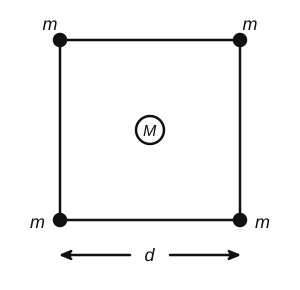
Four spheres each of mass $m$ form a square of side $d$ (as shown in figure). A fifth sphere of mass $M$ is situated at the centre of square. The total gravitational potential energy of the system is
Q 11-07-130JEE MainJEE Main 2022 (27 Jul, Shift 1)Easy
Two satellites $A$ and $B$ having masses in the ratio $4 : 3$ are revolving in circular orbits of radii $3r$ and $4r$ respectively around the earth. The ratio of total mechanical energy of $A$ to $B$ is
Q 11-07-131JEE MainJEE Main 2022 (27 Jul, Shift 2)Medium
A body of mass $m$ is projected with velocity $\lambda v_e$ in vertically upward direction from the surface of the earth into space. It is given that $v_e$ is escape velocity and $\lambda < 1$. If air resistance is considered to be negligible, then the maximum height from the centre of earth, to which the body can go, will be ($R$ : radius of earth)
Q 11-07-133JEE MainJEE Main 2021 (27 Jul, Shift 1)Hard
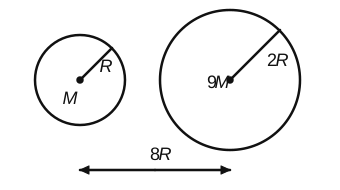
Suppose two planets (spherical in shape) of radii $R$ and $2R$, but mass $M$ and $9M$ respectively have a centre to centre separation $8R$ as shown in the figure. A satellite of mass $m$ is projected from the surface of the planet of mass $M$ directly towards the centre of the second planet. The minimum speed $v$ required for the satellite to reach the surface of the second planet is $\sqrt{\dfrac a7\dfrac{GM}{R}}$, then the value of $a$ is ______.
[Given: The two planets are fixed in their position]
Concept. The satellite only has to reach the neutral point; beyond it the larger planet pulls it in. Energy from the launch surface to the neutral point, with the potentials of both planets.
Step 1. Neutral point (distance $x$ from the small planet). $\dfrac{M}{x^2}=\dfrac{9M}{(8R-x)^2}\Rightarrow8R-x=3x\Rightarrow x=2R$.
Step 2. Potentials. Surface of $M$: $-\dfrac{GM}{R}-\dfrac{9GM}{7R}=-\dfrac{16GM}{7R}$. Neutral point: $-\dfrac{GM}{2R}-\dfrac{9GM}{6R}=-\dfrac{2GM}{R}$.
Q 11-07-134JEE MainJEE Main 2021 (27 Jul, Shift 2)Easy
Two identical particles of mass $1$ kg each go round a circle of radius $R$, under the action of their mutual gravitational attraction. The angular speed of each particle is:
Q 11-07-135JEE MainJEE Main 2021 (27 Jul, Shift 2)Easy
The planet Mars has two moons, if one of them has a period $7$ hours, $30$ minutes and an orbital radius of $9.0\times10^3$ km. Find the mass of Mars. $\left\{\text{Given } \dfrac{4\pi^2}{G} = 6\times10^{11}\ \text{N}^{-1}\text{m}^{-2}\text{kg}^2\right\}$
Q 11-07-136JEE MainJEE Main 2021 (31 Aug, Shift 1)Medium
The masses and radii of the earth and moon are $(M_1, R_1)$ and $(M_2, R_2)$ respectively. Their centres are at a distance $r$ apart. Find the minimum escape velocity for a particle of mass $m$ to be projected from the middle of these two masses:
Concept. To escape from a point, the kinetic energy must make the total energy zero: $\tfrac12mv^2+mV=0$. At the mid-point the potentials of both bodies add.
Step 1. Potential at the mid-point (each centre is $\dfrac r2$ away): $$V=-\frac{GM_1}{r/2}-\frac{GM_2}{r/2}=-\frac{2G(M_1+M_2)}{r}$$
Q 11-07-137JEE MainJEE Main 2021 (31 Aug, Shift 2)Medium
If $R_E$ be the radius of Earth, then the ratio between the acceleration due to gravity at a depth $r$ below and a height $r$ above the earth surface is: (Given: $r < R_E$)
Q 11-07-138JEE MainJEE Main 2021 (24 Feb, Shift 1)Easy
Consider two satellites $S_1$ and $S_2$ with periods of revolution 1 hr and 8 hr respectively revolving around a planet in circular orbits. The ratio of angular velocity of satellite $S_1$ to the angular velocity of satellite $S_2$ is:
Q 11-07-139JEE MainJEE Main 2021 (24 Feb, Shift 1)Medium
Four identical particles of equal masses 1 kg made to move along the circumference of a circle of radius 1 m under the action of their own mutual gravitational attraction. The speed of each particle will be:
Concept. Each particle is pulled by the other three. The pulls' components along the radius add up to the centripetal force; the tangential components cancel by symmetry.
Step 1. Geometry. Four particles on a circle of radius $1$ m form a square of side $\sqrt2$ m and diagonal $2$ m.
Step 2. Pull of the two neighbours. Each is $\dfrac{G(1)(1)}{(\sqrt2)^2}=\dfrac G2$, at $45^\circ$ to the radius. Their radial parts add: $$2\cdot\frac G2\cos45^\circ=\frac{G}{\sqrt2}$$
Step 3. Pull of the opposite particle, straight along the radius: $\dfrac{G}{2^2}=\dfrac G4$.
Concept. In a binary system both stars orbit the common centre of mass with the same period. Write the centripetal equation for one star using its own orbit radius; the result depends only on the total mass and the separation.
Step 1. Orbit radii. The centre of mass divides $d$ inversely to the masses: the star of mass $m$ is at $r_1=\dfrac{2m}{3m}d=\dfrac{2d}{3}$ from it.
Step 2. Centripetal equation for mass $m$. $$\frac{G(m)(2m)}{d^2}=m\omega^2\cdot\frac{2d}{3}\ \Rightarrow\ \omega^2=\frac{3Gm}{d^3}$$
Answer. Option A. In general $T=2\pi\sqrt{\dfrac{d^3}{G(m_1+m_2)}}$.
Solution by Sreeraj P, M.Sc Physics
Q 11-07-141JEE MainJEE Main 2021 (24 Feb, Shift 2)Medium
A body weighs 49 N on a spring balance at the north pole. What will be its weight recorded on the same weighing machine, if it is shifted to the equator?
[Use $g = \dfrac{GM}{R^2} = 9.8\ \text{m s}^{-2}$ and radius of earth, $R = 6400$ km.]
Step 3. Weight. $5(9.8 - 0.0338) \approx 48.83$ N.
Answer. $48.83$ N (Option B).
Solution by Sreeraj P, M.Sc Physics
Q 11-07-142JEE MainJEE Main 2021 (25 Feb, Shift 1)Medium
A solid sphere of radius $R$ gravitationally attracts a particle placed at $3R$ from its centre with a force $F_1$. Now a spherical cavity of radius $\left(\dfrac{R}{2}\right)$ is made in the sphere (as shown in figure) and the force becomes $F_2$. The value of $F_1 : F_2$ is:
Concept. Superposition: the sphere with a cavity = full sphere minus the small sphere that was removed. A uniform sphere attracts an outside particle as if all its mass were at its centre.
Step 1. Full sphere. $F_1=\dfrac{GMm}{(3R)^2}=\dfrac{GMm}{9R^2}$.
Step 2. The removed sphere. Radius halves, so its volume and mass are $\dfrac18$: mass $\dfrac M8$. From the figure its centre is $\dfrac R2$ from $O$, on the particle's side, so it is $3R-\dfrac R2=\dfrac{5R}{2}$ from the particle: $$F_{\text{cav}}=\frac{G(M/8)m}{(5R/2)^2}=\frac{GMm}{50R^2}$$
Step 3. Subtract (both forces point the same way): $$F_2=GMm\left(\frac{1}{9R^2}-\frac{1}{50R^2}\right)=\frac{41\,GMm}{450R^2}$$
Q 11-07-143JEE MainJEE Main 2021 (25 Feb, Shift 1)Medium
Two satellites $A$ and $B$ of masses 200 kg and 400 kg are revolving round the earth at height of 600 km and 1600 km respectively. If $T_A$ and $T_B$ are the time periods of $A$ and $B$ respectively then the value of $T_B - T_A$:
[Given: radius of earth = 6400 km, mass of earth = $6\times10^{24}$ kg]
Concept. Equal escape speeds mean equal $\dfrac MR$, not equal $MR$.
Step 1. Assertion. Unequal masses with equal $M/R$ give the same $v_e$. Correct.
Step 2. Reason. $M_1R_1=M_2R_2$ is the wrong condition. Not correct.
Answer. A is correct but R is not correct (Option D).
Solution by Sreeraj P, M.Sc Physics
Q 11-07-145JEE MainJEE Main 2021 (18 Mar, Shift 2)Easy
If the angular velocity of earth's spin is increased such that the bodies at the equator start floating, the duration of the day would be approximately:
(Take: $g = 10\ \text{m s}^{-2}$, the radius of earth, $R = 6400\times10^3$ m, Take $\pi = 3.14$)
Step 2. Length of the day. $$T=\frac{2\pi}{\omega}=\frac{6.28}{1.25\times10^{-3}}=5024\ \text{s}\approx84\ \text{min}$$
Answer. About $84$ minutes (Option D). This equals the period of a satellite skimming the surface.
Solution by Sreeraj P, M.Sc Physics
Q 11-07-146JEE MainJEE Main 2021 (18 Mar, Shift 2)Medium
A particle of mass $m$ moves in a circular orbit under the central potential field, $U(r) = \dfrac{-C}{r}$, where $C$ is a positive constant. The correct radius-velocity graph of the particle's motion is:
Step 2. Shape. $r$ falls steeply and keeps falling as $v$ increases, never reaching zero: a decreasing curve concave up.
Answer. Option A.
Solution by Sreeraj P, M.Sc Physics
Q 11-07-147JEE MainJEE Main 2021 (18 Mar, Shift 2)Easy
The angular momentum of a planet of mass $M$ moving around the sun in an elliptical orbit is $\vec L$. The magnitude of the areal velocity of the planet is:
Concept. In a small time $dt$ the radius vector sweeps a thin triangle of area $dA=\tfrac12r^2\,d\theta$. So the areal velocity is $\dfrac{dA}{dt}=\tfrac12r^2\omega=\dfrac{L}{2M}$, since $L=Mr^2\omega$.
Answer. Option D. Gravity is a central force, so $L$ is constant; that is why the areal velocity is constant (Kepler's second law).
Solution by Sreeraj P, M.Sc Physics
Q 11-07-148JEE MainJEE Main 2021 (20 Jul, Shift 1)Medium
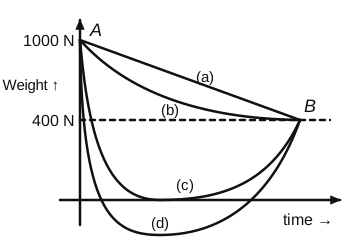
A person whose mass is 100 kg travels from Earth to Mars in a spaceship. Neglect all other objects in sky and take acceleration due to gravity on the surface of the Earth and Mars as $10\ \text{m s}^{-2}$ and $4\ \text{m s}^{-2}$, respectively. Identify from the below figures, the curve that fits best for the weight of the passenger as a function of time.
Concept. On the way, the earth's pull falls and the pull of Mars grows. At the neutral point they cancel and the weight is zero; then it rises to the weight on Mars ($100\times4=400$ N).
Step 1. Shape. From $1000$ N down to $0$ (touching the time axis, never below: weight is a magnitude), then up to $400$ N.
Step 2. Choose. Curve (c).
Answer. Option A.
Solution by Sreeraj P, M.Sc Physics
Q 11-07-149JEE MainJEE Main 2021 (20 Jul, Shift 2)Easy
A satellite is launched into a circular orbit of radius $R$ around earth, while a second satellite is launched into a circular orbit of radius $1.02R$. The percentage difference in the time periods of the two satellites is:
Concept. $T\propto r^{3/2}$, so for small changes $\dfrac{\Delta T}{T}=\dfrac32\dfrac{\Delta r}{r}$.
Step 1. Substitute. $\dfrac32\times2\%=3\%$.
Answer. $3.0$ (Option D).
Solution by Sreeraj P, M.Sc Physics
Q 11-07-150JEE MainJEE Main 2021 (20 Jul, Shift 2)Easy
Consider a binary star system of star $A$ and star $B$ with masses $m_A$ and $m_B$ revolving in a circular orbit of radii $r_A$ and $r_B$, respectively. If $T_A$ and $T_B$ are the time period of star $A$ and star $B$, respectively, then:
Concept. Both stars revolve about the common centre of mass, always on opposite sides.
Step 1. Consequence. Same angular velocity, so $T_A = T_B$.
Answer. $T_A = T_B$ (Option B).
Solution by Sreeraj P, M.Sc Physics
Q 11-07-151JEE MainJEE Main 2021 (22 Jul, Shift 1)Hard
A body is projected vertically upwards from the surface of earth with a velocity sufficient enough to carry it to infinity. The time taken by it to reach height $h$ is ______ s.
Concept. Launched with exactly the escape speed, the body's total energy is zero at every $r$: $\tfrac12v^2=\dfrac{GM}{r}$. Then $\dfrac{dr}{dt}=\sqrt{\dfrac{2GM}{r}}$; separate and integrate.
Step 1. Separate. $\sqrt r\,dr=\sqrt{2GM}\,dt$.
Step 2. Integrate from $R_e$ to $R_e+h$. $$\frac23\left[(R_e+h)^{3/2}-R_e^{3/2}\right]=\sqrt{2gR_e^2}\,t$$
Concept. Kepler's second law: the line to the sun sweeps equal areas in equal times (areal velocity constant, because angular momentum is conserved under a central force). The speed is not constant: it is greatest at the nearest point.
Step 1. Check. A false (speed varies); B false (fastest when nearest); C and D false (areal velocity is constant, not proportional to speed); E true.
Answer. E only (Option C).
Solution by Sreeraj P, M.Sc Physics
Q 11-07-153JEE MainJEE Main 2021 (26 Feb, Shift 1)Medium
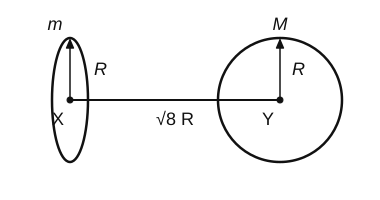
Find the gravitational force of attraction between the ring and sphere as shown in the diagram, where the plane of the ring is perpendicular to the line joining the centres. If $\sqrt{8}R$ is the distance between the centres of a ring (of mass $m$) and a sphere (mass $M$) where both have equal radius $R$
Concept. A uniform sphere acts as a point mass at its centre. The field of a ring on its axis at distance $x$ is $\dfrac{Gmx}{(R^2+x^2)^{3/2}}$; multiply by $M$.
Step 1. Substitute $x=\sqrt8R$. $R^2+x^2=9R^2$, so $(9R^2)^{3/2}=27R^3$.
Q 11-07-154JEE MainJEE Main 2021 (26 Feb, Shift 1)Medium
Assume that a tunnel is dug along a chord of the earth, at a perpendicular distance $\frac{R}{2}$ from the earth's centre, where $R$ is the radius of the earth. The wall of the tunnel is frictionless. If a particle is released in this tunnel, it will execute a simple harmonic motion with a time period:
Concept. In a tunnel along a chord, only the component of gravity along the tunnel moves the particle. That component is proportional to the distance from the tunnel's mid-point, so the motion is again simple harmonic with the same $\omega^2=\dfrac gR$.
Step 1. Force along the tunnel. At distance $r$ from the centre the pull is $\dfrac{mg}{R}r$. If $x$ is the distance from the tunnel's mid-point, the component along the tunnel is $\dfrac{mg}{R}r\cdot\dfrac xr=\dfrac{mg}{R}x$.
Step 2. Period. $a=-\dfrac gRx$, so $T=2\pi\sqrt{\dfrac Rg}$, independent of where the chord is.
Answer. Option B.
Solution by Sreeraj P, M.Sc Physics
Q 11-07-155JEE MainJEE Main 2021 (26 Feb, Shift 2)Medium
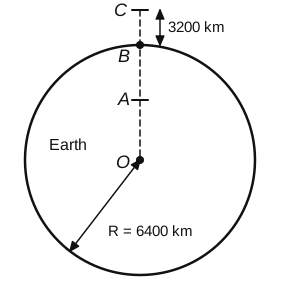
In the reported figure of earth, the value of acceleration due to gravity is same at point $A$ and $C$ but it is smaller than that of its value at point $B$ (surface of the earth). The value of $OA : AB$ will be $x : 5$. The value of $x$ is
Concept. Inside: $g\propto r$; outside: $g\propto1/r^2$. From the figure, $C$ is $3200$ km $=R/2$ above the surface.
Step 1. $g$ at $C$. $g\left(\dfrac{R}{1.5R}\right)^2=\dfrac49g$.
Step 2. Point $A$ inside with the same $g$. $g\dfrac{OA}{R}=\dfrac49g\Rightarrow OA=\dfrac49R$, so $AB=\dfrac59R$.
Step 3. Ratio. $OA:AB=4:5$, so $x=4$.
Answer. $4$.
Solution by Sreeraj P, M.Sc Physics
Q 11-07-156JEE MainJEE Main 2021 (25 Jul, Shift 2)Easy
Consider a planet in some solar system that has a mass double the mass of earth and density equal to the average density of the earth. If the weight of an object on earth is $W$, the weight of the same object on that planet will be:
Concept. Inside a uniform shell every part's pull cancels: $E=0$ everywhere inside, so $V$ is constant there and equal to the surface value $-\dfrac{GM}{R}$ (not zero).
Q 11-07-159JEE MainJEE Main 2021 (27 Aug, Shift 2)Easy
A mass of $50$ kg is placed at the center of a uniform spherical shell of mass $100$ kg and radius $50$ m. If the gravitational potential at a point, $25$ m from the center is $V$ kg m$^{-1}$. The value of $V$ is:
Concept. Potentials of separate bodies simply add. Inside a hollow shell the potential is constant and equal to its surface value, $-\dfrac{GM}{R}$.
Step 1. Shell's contribution (point is inside the shell): $$V_1=-\frac{G(100)}{50}=-2G$$
Step 2. Point mass at $25$ m: $$V_2=-\frac{G(50)}{25}=-2G$$
Step 3. Total. $V=-4G$.
Answer. Option C.
Solution by Sreeraj P, M.Sc Physics
Q 11-07-160JEE MainJEE Main 2020 (8 Jan, Shift 2)Medium
An asteroid is moving directly towards the centre of the earth. When at a distance of $10R$ ($R$ is the radius of the earth) from the centre of the earth, it has a speed of $12$ km s$^{-1}$. Neglecting the effect of earth's atmosphere, what will be the speed of the asteroid when it hits the surface of the earth (escape velocity from the earth is $11.2$ km s$^{-1}$)? Give your answer to the nearest integer in km s$^{-1}$ ______.
Concept. Only gravity acts, so mechanical energy is conserved: $\tfrac12v^2-\dfrac{GM}{r}$ (per unit mass) stays the same. Express $\dfrac{GM}{R}$ through the escape speed: $v_e^2=\dfrac{2GM}{R}$.
Step 1. Energy equation per unit mass, from $10R$ to $R$: $$\frac12v^2=\frac12u^2+\frac{GM}{R}\left(1-\frac1{10}\right)=\frac12u^2+\frac{9}{10}\cdot\frac{v_e^2}{2}$$
Q 11-07-161JEE MainJEE Main 2020 (9 Jan, Shift 1)Medium
A body A of mass $m$ is moving in a circular orbit of radius $R$ about a planet. Another body B of mass $\dfrac{m}{2}$ collides with A with a velocity which is half $\left(\dfrac{\vec{v}}{2}\right)$ the instantaneous velocity $\vec{v}$ of A. The collision is completely inelastic. Then, the combined body:
Answer: (D) starts moving in an elliptical orbit around the planet
Concept. Momentum is conserved in the sticking. If the new speed is not the circular-orbit speed $\sqrt{GM/R}$ (and is below the escape speed $\sqrt2v$), the body moves on an ellipse.
Step 1. New speed. $mv+\dfrac m2\cdot\dfrac v2=\dfrac{3m}{2}V\Rightarrow V=\dfrac{5v}{6}$, still tangential.
Step 2. Compare. $V\lt v$ (not circular) and $V\lt\sqrt2v$ (no escape): an ellipse.
Answer. Option D.
Solution by Sreeraj P, M.Sc Physics
Q 11-07-162JEE MainJEE Main 2020 (9 Jan, Shift 2)Easy
Planet $A$ has mass $M$ and radius $R$. Planet $B$ has half the mass and half the radius of Planet $A$. If the escape velocities from the Planets $A$ and $B$ are $v_A$ and $v_B$, respectively, then $\dfrac{v_A}{v_B} = \dfrac{n}{4}$. The value of $n$ is:
Concept. $v_e = \sqrt{\dfrac{2GM}{R}}$ depends only on $\dfrac MR$.
Step 1. Compare. $\dfrac MR$ is the same, so $\dfrac{v_A}{v_B} = 1 = \dfrac n4 \Rightarrow n = 4$.
Answer. $4$ (Option A).
Solution by Sreeraj P, M.Sc Physics
Q 11-07-163JEE MainJEE Main 2020 (5 Sep, Shift 2)Medium
The acceleration due to gravity on the earth's surface at the poles is $g$ and the angular velocity of the earth about the axis passing through the poles is $\omega$. An object is weighed at the equator and at a height $h$ above the poles using a spring balance. If the weights are found to be the same, then $h$ is: ($h \ll R$, where $R$ is the radius of the earth)
Concept. At the equator the spin reduces $g$ to $g-\omega^2R$. Above the pole there is no spin effect, but height reduces $g$ to $g\left(1-\dfrac{2h}{R}\right)$ (small $h$). Equal readings mean equal effective $g$.
Q 11-07-164JEE MainJEE Main 2020 (6 Sep, Shift 1)Easy
A satellite is in an elliptical orbit around a planet $P$. It is observed that the velocity of the satellite when it is farthest from the planet is $6$ times less than that when it is closest to the planet. The ratio of distances between the satellite and the planet at the closest and farthest points is:
Q 11-07-165JEE MainJEE Main 2020 (6 Sep, Shift 2)Hard
Two planets have masses $M$ and $16M$ and their radii are $a$ and $2a$, respectively. The separation between the centres of the planets is $10a$. A body of mass $m$ is fired from the surface of the larger planet towards the smaller planet along the line joining their centres. For the body to be able to reach the surface of the smaller planet, the minimum firing speed needed is:
Concept. Between the planets there is a neutral point where the two pulls cancel. Fired from the big planet, the body slows down until that point; after it, the small planet pulls it in. So the minimum speed is the one that just reaches the neutral point. Use energy conservation with the potentials of both planets.
Step 1. Neutral point. At distance $x$ from the $16M$ planet: $$\frac{16M}{x^2}=\frac{M}{(10a-x)^2}\ \Rightarrow\ 4(10a-x)=x\ \Rightarrow\ x=8a$$
Step 2. Potential at the launch point (surface of the big planet: $2a$ from it, $8a$ from the small one): $$V_1=-\frac{G(16M)}{2a}-\frac{GM}{8a}=-\frac{65GM}{8a}$$
Step 3. Potential at the neutral point ($8a$ and $2a$): $$V_2=-\frac{G(16M)}{8a}-\frac{GM}{2a}=-\frac{20GM}{8a}$$
Step 4. Energy. $\tfrac12v^2=V_2-V_1=\dfrac{45GM}{8a}$, so $$v=\sqrt{\frac{45GM}{4a}}=\frac32\sqrt{\frac{5GM}{a}}$$
Answer. Option D.
Solution by Sreeraj P, M.Sc Physics
Q 11-07-166JEE MainJEE Main 2020 (7 Jan, Shift 1)Hard
A satellite of mass $M$ is launched vertically upwards with an initial speed $u$ from the surface of the earth. After it reaches height $R$ ($R$ = radius of the earth), it ejects a rocket of mass $\dfrac{M}{10}$ so that subsequently the satellite moves in a circular orbit. The kinetic energy of the rocket is ($G$ is the gravitational constant; $M_e$ is the mass of the earth):
Q 11-07-167JEE MainJEE Main 2020 (7 Jan, Shift 2)Medium
A box weighs $196$ N on a spring balance at the north pole. Its weight recorded on the same balance if it is shifted to the equator is close to (Take $g = 10\ \text{m s}^{-2}$ at the north pole and the radius of the earth $= 6400$ km):
Concept. A spring balance reads the normal force. At the pole the earth's spin has no effect, so it reads $mg$. At the equator part of gravity supplies the centripetal force $m\omega^2R$ for the daily rotation, so it reads $m(g-\omega^2R)$.
Step 1. Mass. $m=\dfrac{196}{10}=19.6$ kg.
Step 2. Earth's angular speed. $\omega=\dfrac{2\pi}{24\times3600}=7.27\times10^{-5}$ rad s$^{-1}$.
Step 4. Reading at the equator. $196-0.66=195.34\approx195.32$ N.
Answer. Option D.
Solution by Sreeraj P, M.Sc Physics
Q 11-07-168JEE MainJEE Main 2020 (8 Jan, Shift 1)Easy
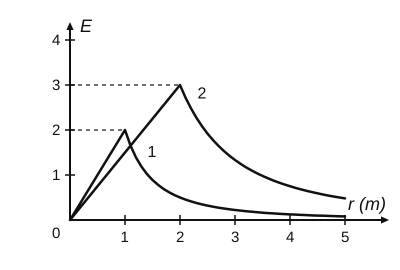
Consider two solid spheres of radii $R_1 = 1$ m, $R_2 = 2$ m and masses $M_1$ and $M_2$, respectively. The gravitational fields due to spheres (1) and (2) are shown. The value of $\dfrac{M_1}{M_2}$ is:
Q 11-07-169JEE MainJEE Main 2020 (2 Sep, Shift 1)Medium
The mass density of a spherical galaxy varies as $\dfrac{K}{r}$ over a large distance $r$ from its center. In that region, a small star is in a circular orbit of radius $R$. Then the period of revolution, $T$ depends on $R$ as:
Concept. The star is pulled only by the galaxy's mass inside its orbit. Find that mass from the density, then use the centripetal condition.
Step 1. Mass inside radius $R$. $$M(R)=\int_0^R4\pi r^2\frac Kr\,dr=2\pi KR^2$$
Step 2. Force on the star. $F=\dfrac{GM(R)m}{R^2}=2\pi GKm$, the same at every radius.
Step 3. Speed and period. $\dfrac{mv^2}{R}=2\pi GKm\Rightarrow v^2\propto R$. Then $T=\dfrac{2\pi R}{v}\propto\dfrac{R}{\sqrt R}=\sqrt R$.
Answer. $T^2\propto R$ (Option A).
Solution by Sreeraj P, M.Sc Physics
Q 11-07-170JEE MainJEE Main 2020 (2 Sep, Shift 2)Medium
The height $h$ at which the weight of a body will be the same as that at the same depth $h$ from the surface of the earth is (Radius of the earth is $R$ and effect of the rotation of the earth is neglected)
Step 3. Non-zero root. $x^2+x-1=0\Rightarrow x=\dfrac{-1+\sqrt5}{2}$ (the positive root).
Answer. $h=\dfrac{\sqrt5R-R}{2}$ (Option C). With the approximate $g(1-2h/R)$ you would wrongly get only $h=0$.
Solution by Sreeraj P, M.Sc Physics
Q 11-07-171JEE MainJEE Main 2020 (3 Sep, Shift 1)Medium
A satellite is moving in a low nearly circular orbit around the earth. Its radius is roughly equal to that of the earth's radius $R_e$. By firing rockets attached to it, its speed is instantaneously increased in the direction of its motion so that it becomes $\sqrt{\dfrac32}$ times larger. Due to this the farthest distance from the centre of the earth that the satellite reaches is $R$. Value of $R$ is:
Concept. After the boost the satellite moves on an ellipse. At the farthest point its velocity is again perpendicular to the radius. Two conservation laws link the two points: angular momentum ($mvr$) and energy.
Step 1. Units. Let $R_e=1$ and $GM=1$. The circular speed is $1$, so the new speed is $v_1=\sqrt{3/2}$.
Step 2. Angular momentum (launch point and farthest point $r$): $v_2=\dfrac{v_1\cdot1}{r}$.
Step 4. Solve. Multiply by $4r^2$: $-r^2=3-4r$, so $r^2-4r+3=0$, giving $r=1$ (launch point) or $r=3$.
Answer. $R=3R_e$ (Option C).
Solution by Sreeraj P, M.Sc Physics
Q 11-07-172JEE MainJEE Main 2020 (3 Sep, Shift 2)Medium
The mass density of a planet of radius $R$ varies with the distance $r$ from its centre as $\rho(r) = \rho_0\left(1 - \dfrac{r^{2}}{R^{2}}\right)$. Then the gravitational field is maximum at:
Concept. By Gauss's law for gravity (shell theorem), the field at $r$ inside depends only on the mass enclosed: $E=\dfrac{GM(r)}{r^2}$. Find $M(r)$ by integrating the density over thin shells, then maximise $E$.
Q 11-07-173JEE MainJEE Main 2020 (4 Sep, Shift 1)Medium
On the $x$-axis and at a distance $x$ from the origin, the gravitational field due to a mass distribution is given by $\dfrac{Ax}{(x^{2}+a^{2})^{3/2}}$ in the $x$-direction. The magnitude of the gravitational potential on the $x$-axis at a distance $x$, taking its value to be zero at infinity, is:
Q 11-07-174JEE MainJEE Main 2020 (4 Sep, Shift 2)Easy
A body is moving in a low circular orbit about a planet of mass $M$ and radius $R$. The radius of the orbit can be taken to be $R$ itself. Then the ratio of the speed of this body in the orbit to the escape velocity from the planet is:
Concept. Orbital speed at radius $R$: $v_o=\sqrt{\dfrac{GM}{R}}$ (gravity provides the centripetal force). Escape speed from the same radius: $v_e=\sqrt{\dfrac{2GM}{R}}$ (kinetic energy cancels the negative potential energy).
Q 11-07-175JEE MainJEE Main 2020 (5 Sep, Shift 1)Medium
The value of the acceleration due to gravity is $g_1$ at a height $h = \dfrac R2$ ($R$ = radius of the earth) from the surface of the earth. It is again equal to $g_1$ at a depth $d$ below the surface of the earth. The ratio $\left(\dfrac dR\right)$ equals:
Concept. Equate $g$ at height $\dfrac R2$ with $g$ at depth $d$.
Step 1. Height. $g_1 = \dfrac{4g}{9}$.
Step 2. Depth. $1 - \dfrac dR = \dfrac49 \Rightarrow \dfrac dR = \dfrac59$.
Answer. $\dfrac59$ (Option B).
Solution by Sreeraj P, M.Sc Physics
Q 11-07-176JEE MainJEE Main 2019 (9 Jan, Shift 2)Medium
The energy required to take a satellite to a height $h$ above the Earth surface (radius of Earth $= 6.4\times10^3\ \text{km}$) is $E_1$, and the kinetic energy required for the satellite to be in a circular orbit at this height is $E_2$. The value of $h$ for which $E_1$ and $E_2$ are equal, is
Concept. $E_1$ is the work to lift the satellite from the surface to height $h$: the rise in potential energy. $E_2$ is the orbital kinetic energy at $r=R+h$: $\dfrac{GMm}{2(R+h)}$.
Step 2. Orbital kinetic energy. $E_2=\dfrac{GMm}{2(R+h)}$.
Step 3. Equate. $\dfrac hR=\dfrac12\Rightarrow h=\dfrac R2=3.2\times10^3$ km.
Answer. Option C.
Solution by Sreeraj P, M.Sc Physics
Q 11-07-177JEE MainJEE Main 2019 (10 Jan, Shift 1)Easy
A satellite is moving with a constant speed $v$ in circular orbit around the earth. An object of mass $m$ is ejected from the satellite such that it just escapes from the gravitational pull of the earth. At the time of ejection, the kinetic energy of the object is:
Concept. To just escape, total energy is zero; in orbit $v^2 = \dfrac{GM}{r}$.
Step 1. KE. $K = \dfrac{GMm}{r} = mv^2$.
Answer. $mv^2$ (Option B).
Solution by Sreeraj P, M.Sc Physics
Q 11-07-178JEE MainJEE Main 2019 (10 Jan, Shift 2)Medium
Two stars of masses $3\times10^{31}\ \text{kg}$ each, and at distance $2\times10^{11}\ \text{m}$ rotate in a plane about their common centre of mass O. A meteorite passes through O moving perpendicular to the stars' rotation plane. In order to escape from the gravitational field of this double star, the minimum speed that meteorite should have at O is (Take gravitational constant $G = 6.67\times10^{-11}\ \text{N m}^2\text{kg}^{-2}$)
Q 11-07-179JEE MainJEE Main 2019 (10 Apr, Shift 1)Easy
The value of acceleration due to gravity at Earth's surface is $9.8\ \text{m s}^{-2}$. The altitude above its surface at which the acceleration due to gravity decreases to $4.9\ \text{m s}^{-2}$, is close to: (Radius of earth $= 6.4\times10^6\ \text{m}$)
Q 11-07-180JEE MainJEE Main 2019 (10 Apr, Shift 2)Medium
A spaceship orbits around a planet at a height of $20\ \text{km}$ from its surface. Assuming that only the gravitational field of the planet acts on the spaceship, what will be the number of complete revolutions made by the spaceship in $24$ hours around the planet? [Given: mass of planet $= 8\times10^{22}\ \text{kg}$, radius of planet $= 2\times10^6\ \text{m}$, gravitational constant $G = 6.67\times10^{-11}\ \text{N m}^2/\text{kg}^2$]
Concept. Areal velocity $\dfrac{dA}{dt}=\tfrac12r^2\omega=\dfrac{L}{2m}$ (Kepler's second law).
Answer. $\dfrac{L}{2m}$ (Option C).
Solution by Sreeraj P, M.Sc Physics
Q 11-07-182JEE MainJEE Main 2019 (8 Apr, Shift 1)Medium
Four identical particles of mass $M$ are located at the corners of a square of side $a$. What should be their speed if each of them revolves under the influence of other's gravitational field in a circular orbit circumscribing the square?
Q 11-07-183JEE MainJEE Main 2019 (8 Apr, Shift 2)Easy
A rocket has to be launched from earth in such a way that it never returns. If $E$ is the minimum energy delivered by the rocket launcher, what should be the minimum energy that the launcher should have, if the same rocket is to be launched from the surface of the moon? Assume that the density of the earth and the moon are equal and that the earth's volume is 64 times the volume of the moon.
Concept. Minimum energy $= \dfrac{GMm}{R}$; at equal density $M \propto R^3$, so $E \propto R^2$.
Step 1. Radii. Volume ratio 64: $R_E = 4R_M$.
Step 2. Energy. $\dfrac{E}{16}$.
Answer. $\dfrac{E}{16}$ (Option D).
Solution by Sreeraj P, M.Sc Physics
Q 11-07-184JEE MainJEE Main 2019 (9 Apr, Shift 1)Easy
A solid sphere of mass $M$ and radius $a$ is surrounded by a uniform concentric spherical shell of thickness $2a$ and mass $2M$. The gravitational field at distance $3a$ from the centre will be
Q 11-07-185JEE MainJEE Main 2019 (9 Apr, Shift 2)Medium
A test particle is moving in a circular orbit in the gravitational field produced by a mass density $\rho(r) = \dfrac{K}{r^2}$. Identify the correct relation between the radius $R$ of the particle's orbit and its period $T$:
Q 11-07-186JEE MainJEE Main 2019 (11 Jan, Shift 1)Easy
A satellite is revolving in a circular orbit at a height $h$ from the earth's surface, such that $h \ll R$ where $R$ is the radius of the earth. Assuming that the effect of earth's atmosphere can be neglected, the minimum increase in the speed required so that the satellite could escape from the gravitational field of earth is
Q 11-07-187JEE MainJEE Main 2019 (11 Jan, Shift 2)Easy
The mass and the diameter of a planet are three times the respective values for the Earth. The period of oscillation of a simple pendulum on the Earth is $2$ s. The period of oscillation of the same pendulum on the planet would be:
Concept. A pendulum's period is $T=2\pi\sqrt{\dfrac lg}$, so $T\propto\dfrac{1}{\sqrt g}$. Find the planet's $g$ from $g\propto\dfrac{M}{R^2}$.
Step 1. Planet's $g$. Mass $\times3$, radius $\times3$: $g'=g\cdot\dfrac{3}{3^2}=\dfrac g3$.
Step 2. Period. $T'=T\sqrt{\dfrac{g}{g'}}=2\sqrt3$ s.
Answer. Option D.
Solution by Sreeraj P, M.Sc Physics
Q 11-07-188JEE MainJEE Main 2019 (12 Jan, Shift 1)Medium
A satellite of mass $M$ is in a circular orbit of radius $R$ about the centre of the earth. A meteorite of the same mass, falling towards the earth, collides with the satellite completely inelastically. The speeds of the satellite and the meteorite are the same, just before the collision. The subsequent motion of the combined body will be:
Concept. Sticking conserves momentum (as a vector). The satellite moves tangentially at $v$; the meteorite falls radially at $v$.
Step 1. New velocity. $Mv\hat t+Mv\hat r=2M\vec V\Rightarrow\vec V=\dfrac v2(\hat t+\hat r)$, speed $\dfrac{v}{\sqrt2}$, not tangential.
Step 2. Orbit. A velocity that is not the circular speed and has a radial part gives an elliptical orbit (it does not escape: $V\lt\sqrt2v$).
Answer. Option A.
Solution by Sreeraj P, M.Sc Physics
Q 11-07-189JEE MainJEE Main 2019 (12 Jan, Shift 1)Medium
A straight rod of length $L$ extends from $x = a$ to $x = L + a$. The gravitational force it exerts on a point mass $m$ at $x = 0$, if the mass per unit length of the rod is $A + Bx^2$, is given by:
Concept. For an extended body, split it into small pieces, find each piece's pull with Newton's law, and add (integrate). All pieces pull in the same direction here, so the magnitudes simply add.
Step 1. A small piece. Between $x$ and $x+dx$ the mass is $dm=(A+Bx^2)dx$, at distance $x$ from $m$: $$dF=\frac{Gm(A+Bx^2)}{x^2}dx=Gm\left(\frac{A}{x^2}+B\right)dx$$
Step 2. Integrate from $a$ to $a+L$. $$F=Gm\left[-\frac Ax+Bx\right]_a^{a+L}=Gm\left[A\left(\frac1a-\frac{1}{a+L}\right)+BL\right]$$
Answer. Option D.
Solution by Sreeraj P, M.Sc Physics
Q 11-07-190JEE MainJEE Main 2019 (12 Jan, Shift 2)Easy
Two satellites, A and B, have masses $m$ and $2m$ respectively. A is in a circular orbit of radius $R$ and B is in a circular orbit of radius $2R$ around the earth. The ratio of their kinetic energies, $\dfrac{K_A}{K_B}$, is:
Q 11-07-191JEE MainJEE Main 2019 (12 Apr, Shift 2)Easy
The ratio of the weights of a body on the Earth's surface to that on the surface of a planet is $9 : 4$. The mass of the planet is $\dfrac19$th of that of the Earth. If $R$ is the radius of the Earth, what is the radius of the planet? (Take the planets to have the same mass density)
Step 2. Solve. $R_p = \dfrac R2$ (the density remark is not needed).
Answer. $\dfrac R2$ (Option B).
Solution by Sreeraj P, M.Sc Physics
Q 11-07-192JEE MainJEE Main 2018 (15 Apr, Shift 1)Medium
A body of mass $m$ is moving in a circular orbit of radius $R$ about a planet of mass $M$. At some instant, it splits into two equal masses. The first mass moves in a circular orbit of radius $\dfrac{R}{2}$, and the other mass, in a circular orbit of radius $\dfrac{3R}{2}$. The difference between the final and the initial total energies is
Concept. A body in a circular orbit of radius $r$ has total energy $-\dfrac{GMm}{2r}$. Add the energies of the two pieces and compare.
Step 1. Initial energy. $E_i=-\dfrac{GMm}{2R}$.
Step 2. Final energy (two halves, radii $\dfrac R2$ and $\dfrac{3R}{2}$): $$E_f=-\frac{GM(m/2)}{2(R/2)}-\frac{GM(m/2)}{2(3R/2)}=-\frac{GMm}{2R}-\frac{GMm}{6R}$$
Step 3. Difference. $E_f-E_i=-\dfrac{GMm}{6R}$.
Answer. Option C.
Solution by Sreeraj P, M.Sc Physics
Q 11-07-193JEE MainJEE Main 2018 (15 Apr, Shift 1)Hard
Take the mean distance of the moon and the sun from the earth to be $0.4 \times 10^6\ \text{km}$ and $150 \times 10^6\ \text{km}$, respectively. Their masses are $8 \times 10^{22}\ \text{kg}$ and $2 \times 10^{30}\ \text{kg}$, respectively. The radius of the earth is $6400\ \text{km}$. Let $\Delta F_1$ be the difference in the forces exerted by the moon at the nearest and farthest points on the earth, and $\Delta F_2$ be the difference in the forces exerted by the sun at the nearest and farthest points on the earth. Then, the number closest to $\dfrac{\Delta F_1}{\Delta F_2}$ is,
Concept. The difference of a body's pull across the earth's diameter (the tidal effect) is $\Delta F\approx\left|\dfrac{dF}{dr}\right|2R_e=\dfrac{4GMmR_e}{d^3}\propto\dfrac{M}{d^3}$.
Q 11-07-194JEE MainJEE Main 2018 (16 Apr, Shift 1)Easy
The relative uncertainty in the period of a satellite orbiting around the earth is $10^{-2}$. If the relative uncertainty in the radius of the orbit is negligible, the relative uncertainty in the mass of the earth is:
Step 1. Shape. Linear rise to the peak at $R$, then a curved fall: graph (1).
Answer. Graph (1) (Option A).
Solution by Sreeraj P, M.Sc Physics
Q 11-07-197JEE MainJEE Main 2017 (8 Apr)Easy
If the Earth has no rotational motion, the weight of a person on the equator is $W$. Determine the speed with which the earth would have to rotate about its axis so that the person at the equator will weigh $\frac34W$. The radius of the Earth is $6400$ km and $g = 10\ \text{m s}^{-2}$.
The mass density of a spherical body is given by $\rho(r) = \dfrac kr$ for $r \le R$ and $\rho(r) = 0$ for $r > R$, where $r$ is the distance from the center. The correct graph that describes qualitatively the acceleration, $a$, of a test particle as a function of $r$ is:
A particle is moving with a uniform speed in a circular orbit of radius $R$ in a central force inversely proportional to the $n^{\text{th}}$ power of $R$. If the period of rotation of the particle is $T$, then:
Answer. Option D. For gravity ($n=2$) this gives $T\propto R^{3/2}$, Kepler's third law.
Solution by Sreeraj P, M.Sc Physics
Q 11-07-200NEETNEET 2022Top questionEasy
A body of mass $60$ g experiences a gravitational force of $3.0$ N, when placed at a particular point. The magnitude of the gravitational field intensity at that point is
Q 11-07-202JEE MainJEE Main 2025 (2 Apr, Shift 2)Easy
A satellite of mass $1000\ \text{kg}$ is launched to revolve around the earth in an orbit at a height of $270\ \text{km}$ from the earth's surface. The kinetic energy of the satellite in this orbit is ______ $\times10^{10}\ \text{J}$.
(Mass of earth $= 6\times10^{24}\ \text{kg}$, radius of earth $= 6.4\times10^6\ \text{m}$, gravitational constant $= 6.67\times10^{-11}\ \text{N m}^2\text{kg}^{-2}$)
Q 11-07-203JEE MainJEE Main 2025 (3 Apr, Shift 1)Medium
Three identical spheres of mass $m$ are placed at the vertices of an equilateral triangle of side $a$. When released, they interact only through gravitational force and collide after a time $T = 4$ seconds. If the sides of the triangle are increased to length $2a$ and the masses of the spheres are made $2m$, then they will collide after ______ seconds.
Q 11-07-204JEE MainJEE Main 2025 (4 Apr, Shift 1)Easy
Given below are two statements: one is labelled as Assertion A and the other is labelled as Reason R.
Assertion A: The kinetic energy needed to project a body of mass $m$ from the earth's surface to infinity is $\dfrac12mgR$, where $R$ is the radius of the earth.
Reason R: The maximum potential energy of a body is zero when it is projected to infinity from the earth's surface.
In the light of the above statements, choose the correct answer from the options given below:
Concept. $K_{\text{escape}}=\dfrac{GMm}{R}=mgR$. The PE rises from $-\dfrac{GMm}{R}$ to its largest value, zero, at infinity.
Step 1. Assertion. $\tfrac12mgR$ is wrong. False.
Step 2. Reason. The PE is greatest (zero) at infinity. True.
Answer. A is false but R is true (Option A).
Solution by Sreeraj P, M.Sc Physics
Q 11-07-205JEE MainJEE Main 2025 (4 Apr, Shift 2)Easy
An object is kept at rest at a distance of $3R$ above the earth's surface, where $R$ is the earth's radius. The minimum speed with which it must be projected so that it does not return to earth is: (Assume $M$ = mass of earth, $G$ = universal gravitational constant)
Q 11-07-206JEE MainJEE Main 2025 (7 Apr, Shift 2)Easy
Given below are two statements: one is labelled as Assertion (A) and the other is labelled as Reason (R).
Assertion (A): The radius vector from the Sun to a planet sweeps out equal areas in equal intervals of time, and thus the areal velocity of the planet is constant.
Reason (R): For a central force field the angular momentum is a constant.
In the light of the above statements, choose the most appropriate answer from the options given below:
Answer: (A) Both (A) and (R) are correct and (R) is the correct explanation of (A)
Concept. A central force exerts no torque, so $L$ is constant and $\dfrac{dA}{dt} = \dfrac{L}{2m}$.
Step 1. Verdict. Both correct; R explains A.
Answer. Both (A) and (R) are correct and (R) is the correct explanation of (A) (Option A).
Solution by Sreeraj P, M.Sc Physics
Q 11-07-207JEE MainMedium
Given below are two statements. One is labelled as Assertion (A) and the other is labelled as Reason (R).
Assertion (A): Neglecting air resistance and the rotation of the earth, the minimum speed with which a body must be projected from the earth's surface to escape is the same whether it is projected vertically upward or at $45^\circ$ to the vertical.
Reason (R): The gravitational force is conservative, so whether a body escapes depends only on its total mechanical energy at launch, not on the direction of its velocity.
In the light of the above statements, choose the correct answer from the options given below:
Answer: (A) Both (A) and (R) are true and (R) is the correct explanation of (A)
Concept. A body escapes if its total mechanical energy is at least zero. Kinetic energy depends on speed, not direction, so the condition fixes a speed only.
Step 1. Assertion. At launch $$\frac12mv^2 - \frac{GMm}{R} \ge 0 \;\Rightarrow\; v \ge \sqrt{\frac{2GM}{R}}$$ The direction does not appear, so the escape speed is the same at any angle (unless the path hits the earth, which does not happen for an upward launch). A is true.
Step 2. Reason. The work done by gravity depends only on the end points because the force is conservative. So energy conservation applies and only the launch energy matters. R is true, and it is exactly why A holds.
Answer. Both (A) and (R) are true and (R) is the correct explanation of (A) (Option A).
Solution by Sreeraj P, M.Sc Physics
Q 11-07-208JEE MainMedium
A satellite moves in a circular orbit of radius $r$ around the earth. Match List-I with List-II, which shows how each quantity depends on $r$.
Step 4. Total energy. $E = -\dfrac{GMm}{2r}$, so $|E| \propto r^{-1}$, D-IV.
Answer. A-I, B-II, C-III, D-IV (Option C).
Solution by Sreeraj P, M.Sc Physics
Q 11-07-209JEE MainMedium
The acceleration due to gravity at a height $\dfrac R2$ above the earth's surface is equal to that at a depth $d$ below the surface, where $R$ is the radius of the earth (assumed uniform). Then $d$ is
Step 2. Equate to depth. $$g\left(1 - \frac dR\right) = \frac{4g}{9} \;\Rightarrow\; \frac dR = \frac59$$
Answer. $\dfrac{5R}{9}$ (Option B). Using $g_h \approx g(1 - 2h/R)$ would wrongly give $d = R$; the approximation fails for $h = R/2$.
Solution by Sreeraj P, M.Sc Physics
Q 11-07-210JEE MainMedium
A satellite of mass $m$ is in a circular orbit of radius $2R$ around the earth, where $R$ is the radius of the earth and $g$ the acceleration due to gravity at its surface. The minimum energy required to shift it to a circular orbit of radius $3R$ is
Concept. The total energy of a satellite in a circular orbit of radius $r$ is $E = -\dfrac{GMm}{2r}$. The energy to be supplied is the increase in $E$. Use $GM = gR^2$.
A planet moves around the sun (mass $M$) in an elliptical orbit. Its maximum distance from the sun is three times its minimum distance $r_p$. The speed of the planet when it is closest to the sun is
Concept. At the nearest and farthest points the velocity is perpendicular to the radius. Use conservation of angular momentum and of mechanical energy between these two points.
Four particles, each of mass $m$, are placed at the corners of a square of side $a$. The minimum work needed to separate them so that they are infinitely far from each other is $(x + \sqrt2)\dfrac{Gm^2}{a}$. The value of $x$ is ______.


 Solution by Sreeraj P, M.Sc Physics