

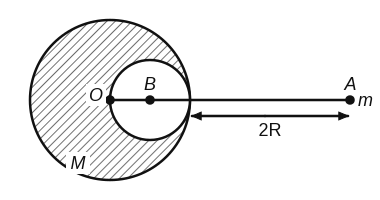
A solid sphere of radius $R$ gravitationally attracts a particle placed at $3R$ from its centre with a force $F_1$. Now a spherical cavity of radius $\left(\dfrac{R}{2}\right)$ is made in the sphere (as shown in figure) and the force becomes $F_2$. The value of $F_1 : F_2$ is:
Answer: (B) 50 : 41
Concept. Superposition: the sphere with a cavity = full sphere minus the small sphere that was removed. A uniform sphere attracts an outside particle as if all its mass were at its centre.
Step 1. Full sphere. $F_1=\dfrac{GMm}{(3R)^2}=\dfrac{GMm}{9R^2}$.
Step 2. The removed sphere. Radius halves, so its volume and mass are $\dfrac18$: mass $\dfrac M8$. From the figure its centre is $\dfrac R2$ from $O$, on the particle's side, so it is $3R-\dfrac R2=\dfrac{5R}{2}$ from the particle:
$$F_{\text{cav}}=\frac{G(M/8)m}{(5R/2)^2}=\frac{GMm}{50R^2}$$
Step 3. Subtract (both forces point the same way):
$$F_2=GMm\left(\frac{1}{9R^2}-\frac{1}{50R^2}\right)=\frac{41\,GMm}{450R^2}$$
Step 4. Ratio. $\dfrac{F_1}{F_2}=\dfrac{50/450}{41/450}=\dfrac{50}{41}$.
Answer. $50:41$ (Option B).
 Solution by Sreeraj P, M.Sc Physics


