A beam of light falls on a metal surface such that photo-electrons are generated. If power of the light source starts to decrease linearly with time $t$, then variation of the photocurrent $I$ and magnitude of the stopping potential $|V|$ with time is best represented by :
Concept. Photocurrent $\propto$ photons per second (power); stopping potential depends only on frequency: $e|V| = h\nu - \phi$.
Step 1. Current. The power falls linearly, so $I$ falls linearly.
Step 2. Stopping potential. Frequency unchanged, so $|V|$ stays constant: graph (1).
Answer. Graph (1) (Option A).
Solution by Sreeraj P, M.Sc Physics
Q 12-11-003NEETNEET 2026Top questionMedium
A ray of light with wavelength $\lambda$ is incident on three different photoelectric cells namely 1, 2 and 3. The threshold wavelength of these photoelectric cells are $\lambda_1$, $\lambda_2$, and $\lambda_3$, respectively and the magnitude of stopping potentials of these cells are $V_1$, $V_2$ and $V_3$, respectively. The relation between $\lambda$ and threshold wavelengths are $\lambda_1 < \lambda$, $\lambda_2 > \lambda$ and $\lambda_3 >> \lambda$. The correct option is :
Step 2. Cells 2 and 3. Both emit; a larger $\lambda_0$ gives a larger $V$, and $\lambda_3 > \lambda_2$, so $V_3 > V_2$.
Answer. $V_1 = 0,\ V_2 < V_3$ (Option A).
Solution by Sreeraj P, M.Sc Physics
Q 12-11-004NEETNEET 2026Top questionMedium
A photon and an electron, each of $20$ eV energy, move in free space. The ratio of linear momentum of electron $p_e$ to that of photon $p_{Ph}$, $\dfrac{p_e}{p_{Ph}}$ is :
(Take speed of light $= 3 \times 10^8\ \text{m s}^{-1}$, charge of electron $= -1.6 \times 10^{-19}$ C and mass of electron $= 9 \times 10^{-31}$ kg)
A photon and an electron (mass $m$) have the same energy $E$. The ratio ($\lambda_{\text{photon}}/\lambda_{\text{electron}}$) of their de Broglie wavelengths is: ($c$ is the speed of light)
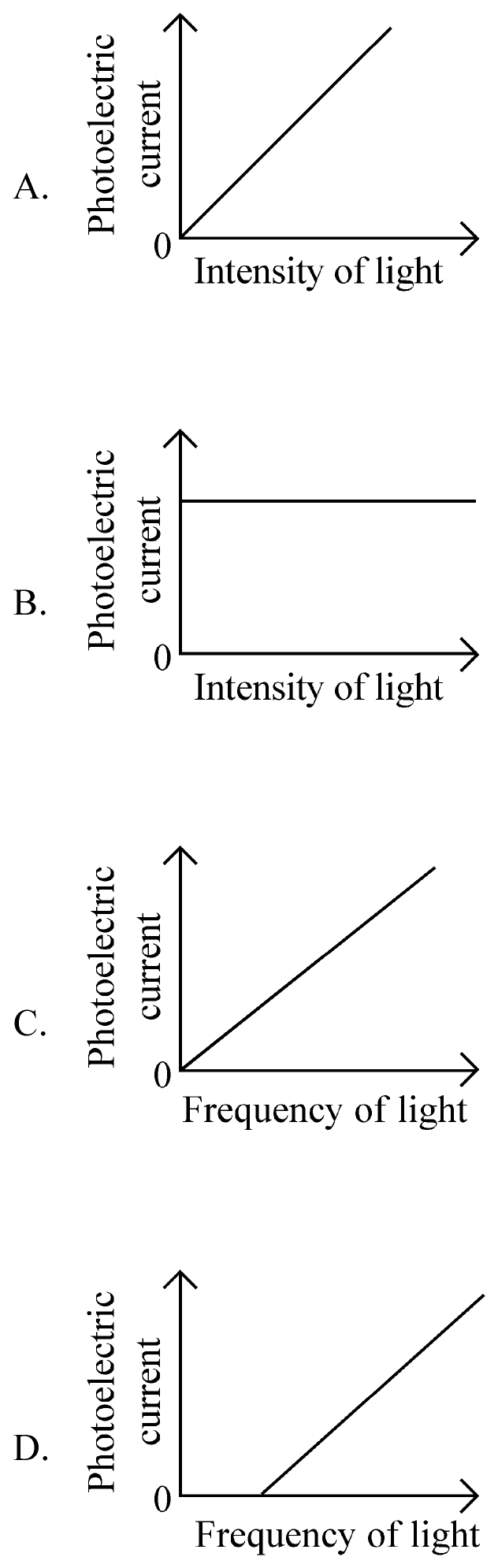
Concept. Photocurrent is proportional to the number of photons per second (intensity), not to frequency.
Step 1. A and B. Current against intensity is a line through the origin: A correct, B wrong.
Step 2. C and D. Above threshold the current does not rise linearly with frequency (D describes the stopping potential); C starts at zero frequency, also wrong.
Answer. A only (Option A).
Solution by Sreeraj P, M.Sc Physics
Q 12-11-007NEETNEET 2024Top questionEasy
If $c$ is the velocity of light in free space, the correct statements about photon among the following are :
A. The energy of a photon is $E = h\nu$. B. The velocity of a photon is $c$. C. The momentum of a photon, $p = \dfrac{h\nu}{c}$. D. In a photon-electron collision, both total energy and total momentum are conserved. E. Photon possesses positive charge.
Choose the correct answer from the options given below :
Step 1. Check. A ✓, B ✓, C ✓, D (Compton: energy and momentum conserved) ✓, E photons are neutral ✗.
Answer. A, B, C and D only (Option D).
Solution by Sreeraj P, M.Sc Physics
Q 12-11-008NEETNEET 2024Top questionEasy
The graph which shows the variation of $\left(\dfrac{1}{\lambda^2}\right)$ and its kinetic energy, $E$ is (where $\lambda$ is de Broglie wavelength of a free particle) :
The work functions of Caesium (Cs), Potassium (K) and Sodium (Na) are $2.14$ eV, $2.30$ eV and $2.75$ eV respectively. If incident electromagnetic radiation has an incident energy of $2.20$ eV, which of these photosensitive surfaces may emit photoelectrons?
Concept. Emission needs photon energy greater than the work function.
Step 1. Compare. $2.20 > 2.14$ (Cs) but $< 2.30$ (K) and $< 2.75$ (Na).
Answer. Cs only (Option A).
Solution by Sreeraj P, M.Sc Physics
Q 12-11-011NEETNEET 2021Top questionEasy
The number of photons per second on an average emitted by the source of monochromatic light of wavelength $600$ nm, when it delivers the power of $3.3 \times 10^{-3}$ watt will be : ($h = 6.6 \times 10^{-34}$ J s)
An electromagnetic wave of wavelength '$\lambda$' is incident on a photosensitive surface of negligible work function. If 'm' mass is of photoelectron emitted from the surface has de-Broglie wavelength $\lambda_d$, then :
Light of frequency $1.5$ times the threshold frequency is incident on a photosensitive material. What will be the photoelectric current if the frequency is halved and intensity is doubled ?
Concept. Below the threshold frequency there is no emission at any intensity.
Step 1. New frequency. $\dfrac{1.5\nu_0}{2} = 0.75\nu_0 < \nu_0$.
Step 2. Current. Zero.
Answer. Zero (Option D).
Solution by Sreeraj P, M.Sc Physics
Q 12-11-014NEETNEET 2020Top questionEasy
An electron is accelerated from rest through a potential difference of V volt. If the de Broglie wavelength of the electron is $1.227 \times 10^{-2}$ nm, the potential difference is :
Concept. For an electron through $V$ volts: $\lambda = \dfrac{1.227}{\sqrt V}$ nm.
Step 1. Solve. $\sqrt V = \dfrac{1.227}{1.227 \times 10^{-2}} = 100 \Rightarrow V = 10^4$ V.
Answer. $10^4$ V (Option D).
Solution by Sreeraj P, M.Sc Physics
Q 12-11-015JEE MainAIEEE 2011Medium
Statement I: A metallic surface is irradiated by a monochromatic light of frequency $\nu > \nu_0$ (the threshold frequency). The maximum kinetic energy and the stopping potential are $K_{max}$ and $V_0$ respectively. If the frequency incident on the surface is doubled, both $K_{max}$ and $V_0$ are also doubled.
Statement II: The maximum kinetic energy and the stopping potential of photoelectrons emitted from a surface are linearly dependent on the frequency of incident light.
Answer: (A) Statement I is true, Statement II is true; Statement II is a correct explanation of Statement I
Concept. Davisson and Germer observed electron diffraction from a nickel crystal.
Step 1. Check. Diffraction is a wave property, so both are true and II explains why the experiment shows wave nature.
Answer. Statement I is true, Statement II is true; Statement II is a correct explanation of Statement I (Option A).
Solution by Sreeraj P, M.Sc Physics
Q 12-11-017JEE MainAIEEE 2010Medium
Statement I: When ultraviolet light is incident on a photocell, its stopping potential is $V_0$ and the maximum kinetic energy of the photoelectrons is $K_{max}$. When the ultraviolet light is replaced by X-rays, both $V_0$ and $K_{max}$ increase.
Statement II: Photoelectrons are emitted with speeds ranging from zero to a maximum value because of the range of frequencies present in the incident light.
Answer: (C) Statement I is true, Statement II is false
Concept. $K_{max}=h\nu-\phi$ grows with frequency. Electrons leave with a range of speeds because those from deeper inside lose energy on the way out, even for one frequency.
Step 1. Statement I. X-rays have a higher frequency than UV, so $K_{max}$ and $V_0$ increase: true.
Step 2. Statement II. The spread of speeds is not due to a range of frequencies (it occurs with monochromatic light too): false.
The work functions of metals A and B are in the ratio $1 : 2$. If light of frequencies $f$ and $2f$ are incident on metal surfaces A and B respectively, the ratio of the maximum kinetic energies of the photoelectrons emitted is
The de Broglie wavelength of an electron having $80$ eV of energy is nearly ($1$ eV $= 1.6 \times 10^{-19}$ J, mass of electron $= 9 \times 10^{-31}$ kg, Planck's constant $= 6.6 \times 10^{-34}$ J s)
Electrons accelerated through a potential difference $V$ are diffracted from a crystal whose planes are $d = 1$ Å apart. A strong diffraction peak is observed when the electrons are incident at an angle $i = 30°$ from the normal to the crystal planes, with the condition $2d\cos i = n\lambda$ ($n = 1$). $V$ should be about ($h = 6.6 \times 10^{-34}$ J s, $m = 9.1 \times 10^{-31}$ kg, $e = 1.6 \times 10^{-19}$ C)
A proton and an alpha particle are accelerated through the same potential difference. The ratio of their de Broglie wavelengths $\lambda_p : \lambda_\alpha$ is
Step 1. Substitute. $6.6 \times 10^{-34}$ m, of order $10^{-33}$ m (far too small to detect).
Answer. $10^{-33}$ m (Option C).
Solution by Sreeraj P, M.Sc Physics
Q 12-11-032JEE MainMedium
Photons of energy $5$ eV fall on a metal surface and the fastest photoelectrons are stopped by a potential of $2$ V. Find the work function of the metal in eV.
Q 12-11-034JEE MainJEE Main 2026 (8 Apr, Shift 2)Easy
A monochromatic source of light operating at $15$ kW emits $2.5 \times 10^{22}$ photons/s. The region of an electromagnetic spectrum to which the emitted electromagnetic radiation belongs to ______. (Take $h = 6.6 \times 10^{-34}\ \text{J.s}$ and $c = 3 \times 10^8\ \text{m/s}$).
Concept. Energy per photon $=\dfrac{P}{n}$; then $\lambda=\dfrac{hc}{E}$ tells the band.
Step 1. Energy. $\dfrac{15\times10^3}{2.5\times10^{22}}=6\times10^{-19}$ J.
Step 2. Wavelength. $\dfrac{6.6\times10^{-34}\times3\times10^8}{6\times10^{-19}}=3.3\times10^{-7}$ m $=330$ nm, below the visible.
Answer. Ultraviolet (Option D).
Solution by Sreeraj P, M.Sc Physics
Q 12-11-035JEE MainJEE Main 2026 (8 Apr, Shift 2)Medium
$K_1$ and $K_2$ be the maximum kinetic energies of photoelectrons emitted from a surface of a given material for the light of wavelength $\lambda_1$ and $\lambda_2$, respectively. If $\lambda_1 = 2\lambda_2$ then the work function of material is given by :
Q 12-11-036JEE MainJEE Main 2026 (6 Apr, Shift 2)Easy
The de Broglie wavelength for an electron accelerated through the potential difference of $V_1$ volt is $\lambda_1$. When the potential difference is changed to $V_2$ volt, the associated de Broglie wavelength is increased by $50\%$. If $(V_1/V_2) = (9/\alpha)$, then the value of $\alpha$ is ______.
Q 12-11-037JEE MainJEE Main 2026 (5 Apr, Shift 1)Hard
An electron of mass $m$ is moving in an electric field $\vec{E} = -2E_0\hat{i}$ ($E_0 =$ constant $> 0$), with an initial velocity $\vec{V} = v_0\hat{i}$ ($v_0 =$ constant $> 0$). If $\lambda_0 = \dfrac{h}{4mv_0}$, its de Broglie wavelength at time $t$ is ______. ($e =$ charge of electron)
Q 12-11-038JEE MainJEE Main 2026 (5 Apr, Shift 1)Medium
Light source having wavelength $331$ nm is used to generate photo-electrons whose stopping potential is $0.2$ V. The work function of the used metal in the experiment is $\alpha \times 10^{-19}$ J. The value of $\alpha$ is ______. ($h = 6.62 \times 10^{-34}$ J s, $e = 1.6 \times 10^{-19}$ C and $c = 3 \times 10^8$ m/s)
Concept. $\phi=\dfrac{hc}{\lambda}-eV_0$, in joules.
Step 1. Photon energy. $\dfrac{6.62\times10^{-34}\times3\times10^8}{331\times10^{-9}}=6.0\times10^{-19}$ J.
Step 2. Electron energy. $1.6\times10^{-19}\times0.2=0.32\times10^{-19}$ J.
Step 3. Work function. $5.68\times10^{-19}$ J.
Answer. Option C.
Solution by Sreeraj P, M.Sc Physics
Q 12-11-039JEE MainJEE Main 2026 (5 Apr, Shift 2)Easy
An electron is travelling with a velocity $v$ in free space and when it enters a medium, its velocity is reduced by $20\%$. The de Broglie wavelength of electron in the medium is $\alpha\lambda_0$, where $\lambda_0$ is its de Broglie wavelength in free space. The value of $\alpha$ is ______.
Step 1. New speed. $0.8v$, so $\lambda=\dfrac{\lambda_0}{0.8}=1.25\lambda_0$.
Answer. Option C.
Solution by Sreeraj P, M.Sc Physics
Q 12-11-040JEE MainJEE Main 2026 (4 Apr, Shift 2)Easy
The de Broglie wavelength associated with an electron accelerated through a potential difference $V$ is $\lambda_e$ and the de Broglie wavelength associated with a proton accelerated through the same potential difference is $\lambda_p$. If their corresponding masses are $m_e$ and $m_p$, respectively, then the ratio of their de Broglie wavelengths $\left(\dfrac{\lambda_e}{\lambda_p}\right)$ is ______.
Q 12-11-041JEE MainJEE Main 2026 (2 Apr, Shift 1)Easy
For a certain metal, when monochromatic light of wavelength $\lambda$ is incident, the stopping potential for photoelectrons is $3V_0$. When the same metal is illuminated by light of wavelength $2\lambda$, then the stopping potential becomes $V_0$. The threshold wavelength for photoelectric emission for the given metal is $\alpha\lambda$. The value of $\alpha$ is ______.
Q 12-11-042JEE MainJEE Main 2026 (28 Jan, Shift 2)Easy
Number of photons of equal energy emitted per second by a 6 mW laser source operating at 663 nm is ______. (Given : $h = 6.63\times10^{-34}$ J.s and $c = 3\times10^8$ m/s)
Q 12-11-043JEE MainJEE Main 2026 (28 Jan, Shift 1)Easy
The ratio of de Broglie wavelength of a deutron with kinetic energy $E$ to that of an alpha particle with kinetic energy $2E$, is $n : 1$. The value of $n$ is ______ .
Q 12-11-044JEE MainJEE Main 2026 (24 Jan, Shift 2)Medium
When a light of a given wavelength falls on a metallic surface the stopping potential for photoelectrons is 3.2 V . If a second light having wavelength twice of first light is used, the stopping potential drops to 0.7 V . The wavelength of first light is ______ m .
Step 3. Wavelength. $\lambda=\dfrac{1243}{5}$ nm $\approx2.5\times10^{-7}$ m.
Answer. Option B.
Solution by Sreeraj P, M.Sc Physics
Q 12-11-045JEE MainJEE Main 2025 (22 Jan, Shift 1)Easy
The work functions of cesium (Cs) and lithium (Li) metals are $1.9\ \text{eV}$ and $2.5\ \text{eV}$, respectively. If light of wavelength $550\ \text{nm}$ is incident on these two metal surfaces, then photoelectric effect is possible for the case of
Step 2. Compare. $2.25>1.9$ (Cs emits); $2.25<2.5$ (Li does not).
Answer. Cs only (Option C).
Solution by Sreeraj P, M.Sc Physics
Q 12-11-046JEE MainJEE Main 2025 (22 Jan, Shift 2)Easy
A light source of wavelength $\lambda$ illuminates a metal surface and electrons are ejected with maximum kinetic energy of $2\ \text{eV}$. If the same surface is illuminated by a light source of wavelength $\lambda/2$, then the maximum kinetic energy of ejected electrons will be (the work function of the metal is $1\ \text{eV}$)
Concept. Halving $\lambda$ doubles the photon energy; the work function stays.
Step 1. First photon. $2+1=3$ eV.
Step 2. Second. $6-1=5$ eV.
Answer. Option D.
Solution by Sreeraj P, M.Sc Physics
Q 12-11-047JEE MainJEE Main 2025 (23 Jan, Shift 1)Easy
A sub-atomic particle of mass $10^{-30}\ \text{kg}$ is moving with a velocity $2.21\times10^6\ \text{m/s}$. Under the matter wave consideration, the particle will behave closely like ($h = 6.63\times10^{-34}\ \text{J s}$)
Concept. $\lambda=\dfrac{h}{mv}$, then compare with the spectrum.
Step 1. Wavelength. $\dfrac{6.63\times10^{-34}}{10^{-30}\times2.21\times10^6}=3\times10^{-10}$ m $=0.3$ nm.
Answer. X-rays (Option D).
Solution by Sreeraj P, M.Sc Physics
Q 12-11-048JEE MainJEE Main 2025 (23 Jan, Shift 2)Easy
In the photoelectric effect, an em-wave is incident on a metal surface and electrons are ejected from the surface. If the work function of the metal is $2.14\ \text{eV}$ and the stopping potential is $2\ \text{V}$, what is the wavelength of the em-wave? (Given $hc = 1242\ \text{eV nm}$, where $h$ is Planck's constant and $c$ is the speed of light in vacuum.)
Q 12-11-049JEE MainJEE Main 2025 (24 Jan, Shift 1)Medium
An electron of mass $m$ with an initial velocity $\vec v = v_0\hat i$ ($v_0 > 0$) enters an electric field $\vec E = -E_0\hat k$. If the initial de Broglie wavelength is $\lambda_0$, the value after time $t$ would be
Q 12-11-050JEE MainJEE Main 2025 (24 Jan, Shift 2)Medium
In photoelectric effect, the stopping potential $(V_0)$ vs frequency $(\nu)$ curve is plotted ($h$ is the Planck's constant and $\phi_0$ is the work function of the metal).
(A) $V_0$ vs $\nu$ is linear.
(B) The slope of the $V_0$ vs $\nu$ curve $= \dfrac{\phi_0}{h}$.
(C) $h$ is related to the slope of the $V_0$ vs $\nu$ line.
(D) The value of the electric charge of the electron is not required to determine $h$ using the $V_0$ vs $\nu$ curve.
(E) The work function can be estimated without knowing the value of $h$.
Choose the correct answer from the options given below:
Step 1. Check. A: linear, true. B: slope is $\dfrac he$, false. C: true. D: we get $\dfrac he$, so $e$ is needed for $h$: false. E: the intercept on the $V_0$ axis is $-\dfrac\phi e$, giving $\phi$ in eV without $h$: true.
Answer. (A), (C) and (E) only (Option B).
Solution by Sreeraj P, M.Sc Physics
Q 12-11-051JEE MainJEE Main 2025 (24 Jan, Shift 2)Easy
The energy $E$ and momentum $p$ of a moving body of mass $m$ are related by some equation. Given that $c$ represents the speed of light, identify the correct equation.
Concept. Every term in a valid equation has the same dimensions. $E^2$ has the dimensions of (energy)$^2$; $pc$ and $mc^2$ are energies.
Step 1. Check terms. $p^2c^2=(pc)^2$ and $m^2c^4=(mc^2)^2$ are both (energy)$^2$; $pc^2$ and $m^2c^2$ are not.
Step 2. Equation. $E^2=p^2c^2+m^2c^4$ (it gives $E=mc^2$ at rest and $E=pc$ for a photon).
Answer. Option D.
Solution by Sreeraj P, M.Sc Physics
Q 12-11-052JEE MainJEE Main 2025 (24 Jan, Shift 2)Easy
The ratio of the power of a light source $S_1$ to that of the light source $S_2$ is 2. $S_1$ is emitting $2\times10^{15}$ photons per second at $600\ \text{nm}$. If the wavelength of the source $S_2$ is $300\ \text{nm}$, then the number of photons per second emitted by $S_2$ is ______ $\times10^{14}$.
Q 12-11-053JEE MainJEE Main 2025 (28 Jan, Shift 1)Medium
A proton of mass $m_p$ has the same energy as that of a photon of wavelength $\lambda$. If the proton is moving at non-relativistic speed, then the ratio of its de Broglie wavelength to the wavelength of the photon is
Concept. In the Compton effect an X-ray photon collides with an electron like a particle, losing energy and momentum. Waves cannot explain this; reflection, refraction and diffraction are wave effects.
Answer. Compton effect (Option A).
Solution by Sreeraj P, M.Sc Physics
Q 12-11-055JEE MainJEE Main 2025 (29 Jan, Shift 1)Easy
If $\lambda$ and $K$ are the de Broglie wavelength and kinetic energy, respectively, of a particle with constant mass, the correct graphical representation for the particle will be
Concept. $\lambda=\dfrac{h}{\sqrt{2mK}}$, so $\dfrac1K=\dfrac{2m}{h^2}\lambda^2$: $\dfrac1K$ grows as $\lambda^2$.
Step 1. Graph. A parabola through the origin, curving upward.
Answer. Option B.
Solution by Sreeraj P, M.Sc Physics
Q 12-11-056JEE MainJEE Main 2025 (29 Jan, Shift 1)Medium
Given below are two statements: one is labelled as Assertion (A) and the other is labelled as Reason (R).
Assertion (A): Emission of electrons in the photoelectric effect can be suppressed by applying a sufficiently negative electric potential to the photoemissive substance.
Reason (R): A negative electric potential which stops the emission of electrons from the surface of a photoemissive substance varies linearly with the frequency of incident radiation.
In the light of the above statements, choose the most appropriate answer from the options given below:
Answer: (D) is $\left(\dfrac{1}{e}\right)$ times the maximum kinetic energy of the emitted photoelectrons
Concept. The stopping potential just stops the fastest electrons: $eV_0 = K_{\max} = \dfrac{hc}{\lambda} - \phi$.
Step 1. Check. Independent of intensity; decreases with wavelength; $V_0 = \dfrac{K_{\max}}{e}$.
Answer. Is $\left(\dfrac1e\right)$ times the maximum kinetic energy of the emitted photoelectrons (Option D).
Solution by Sreeraj P, M.Sc Physics
Q 12-11-058JEE MainJEE Main 2024 (1 Feb, Shift 1)Easy
The de Broglie wavelengths of a proton and an $\alpha$ particle are $\lambda$ and $2\lambda$ respectively. The ratio of the velocities of the proton and the $\alpha$ particle will be
Q 12-11-059JEE MainJEE Main 2024 (1 Feb, Shift 2)Easy
Monochromatic light of frequency $6\times10^{14}\ \text{Hz}$ is produced by a laser. The power emitted is $2\times10^{-3}\ \text{W}$. How many photons per second, on average, are emitted by the source? (Given $h = 6.63\times10^{-34}\ \text{J s}$)
Step 1. Photon energy. $6.63\times10^{-34}\times6\times10^{14}=3.98\times10^{-19}$ J.
Step 2. Rate. $\dfrac{2\times10^{-3}}{3.98\times10^{-19}}=5\times10^{15}$ per second.
Answer. Option C.
Solution by Sreeraj P, M.Sc Physics
Q 12-11-060JEE MainJEE Main 2024 (4 Apr, Shift 1)Easy
Which figure shows the correct variation of the applied potential difference ($V$) with photoelectric current ($i$) at two different intensities of light ($I_1 < I_2$) of the same wavelength?
Concept. Same wavelength means the same $K_{max}$, so the same stopping potential $-V_0$. Higher intensity means more electrons, so a larger saturation current.
Step 1. Graph. Both curves start at the same $-V_0$; the $I_2$ curve saturates higher.
Answer. Option B.
Solution by Sreeraj P, M.Sc Physics
Q 12-11-061JEE MainJEE Main 2024 (4 Apr, Shift 2)Easy
Given below are two statements: one is labelled as Assertion A and the other is labelled as Reason R.
Assertion A: The number of photons increases with increase in frequency of light.
Reason R: The maximum kinetic energy of emitted electrons increases with the frequency of incident radiation.
In the light of the above statements, choose the most appropriate answer from the options given below:
Answer: (C) **A** is not correct but **R** is correct.
Concept. At a given power $P$, the number of photons per second is $\dfrac{P}{h\nu}$, which falls as $\nu$ rises. $K_{max}=h\nu-\phi$ rises with $\nu$.
Step 1. Assertion. False (fewer photons at higher frequency for the same power).
Step 2. Reason. True.
Answer. A is not correct but R is correct (Option C).
Solution by Sreeraj P, M.Sc Physics
Q 12-11-062JEE MainJEE Main 2024 (5 Apr, Shift 1)Medium
Given below are two statements:
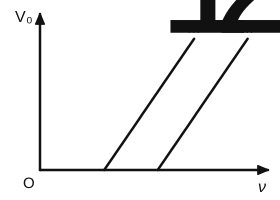
Statement I: The figure shows the variation of stopping potential with frequency $(\nu)$ for two photosensitive materials $M_1$ and $M_2$. The slope gives the value of $\dfrac{h}{e}$, where $h$ is Planck's constant and $e$ is the charge of an electron.
Statement II: $M_2$ will emit photoelectrons of greater kinetic energy for incident radiation of the same frequency.
In the light of the above statements, choose the most appropriate answer from the options given below.
Answer: (B) It increases with increase in intensity of the incident light.
Concept. $eV_0=K_{max}=h\nu-\phi$: the stopping potential depends on the frequency and the metal, not on the intensity.
Step 1. Check. A ($V_0=K_{max}/e$), C (depends on the metal) and D (depends on frequency) are true. B (rises with intensity) is false.
Answer. Option B.
Solution by Sreeraj P, M.Sc Physics
Q 12-11-064JEE MainJEE Main 2024 (6 Apr, Shift 1)Easy
In a photoelectric experiment, light of energy $2.48\ \text{eV}$ irradiates a photosensitive material. The stopping potential was measured to be $0.5\ \text{V}$. The work function of the photosensitive material is
Q 12-11-065JEE MainJEE Main 2024 (6 Apr, Shift 2)Easy
When UV light of wavelength $300\ \text{nm}$ is incident on a metal surface having work function $2.13\ \text{eV}$, electron emission takes place. The stopping potential is (Given $hc = 1240\ \text{eV nm}$)
Q 12-11-066JEE MainJEE Main 2024 (27 Jan, Shift 1)Medium
A convex lens of focal length $40\ \text{cm}$ forms an image of an extended source of light on a photoelectric cell. A current $I$ is produced. The lens is replaced by another convex lens having the same diameter but focal length $20\ \text{cm}$. The photoelectric current now is:
Concept. The photocurrent depends on the total light power reaching the cell. A lens of the same diameter collects the same light from the source; a shorter focal length only makes the image smaller and brighter.
Answer. $I$ (Option D).
Solution by Sreeraj P, M.Sc Physics
Q 12-11-067JEE MainJEE Main 2024 (27 Jan, Shift 2)Easy
The threshold frequency of a metal with work function $6.63\ \text{eV}$ is:
Q 12-11-068JEE MainJEE Main 2024 (29 Jan, Shift 1)Medium
The de-Broglie wavelength of an electron is the same as that of a photon. If velocity of electron is $25\%$ of the velocity of light, then the ratio of K.E. of electron and K.E. of photon will be:
Q 12-11-069JEE MainJEE Main 2024 (29 Jan, Shift 2)Easy
Two sources of light emit with a power of $200\ \text{W}$. The ratio of number of photons of visible light emitted by each source having wavelengths $300\ \text{nm}$ and $500\ \text{nm}$ respectively, will be:
Concept. Same power: $n=\dfrac{P\lambda}{hc}\propto\lambda$.
Step 1. Ratio. $\dfrac{300}{500}=\dfrac35$.
Answer. $3:5$ (Option D).
Solution by Sreeraj P, M.Sc Physics
Q 12-11-070JEE MainJEE Main 2024 (8 Apr, Shift 1)Easy
A proton and an electron are associated with the same de-Broglie wavelength. The ratio of their kinetic energies is: (Assume $h = 6.63\times10^{-34}\ \text{J s}$, $m_e = 9.0\times10^{-31}\ \text{kg}$ and $m_p = 1836$ times $m_e$)
Q 12-11-071JEE MainJEE Main 2024 (8 Apr, Shift 2)Easy
A proton and an electron have the same de Broglie wavelength. If $K_p$ and $K_e$ be the kinetic energies of proton and electron respectively, then choose the correct relation:
Q 12-11-073JEE MainJEE Main 2024 (9 Apr, Shift 2)Easy
UV light of $4.13\ \text{eV}$ is incident on a photosensitive metal surface having work function $3.13\ \text{eV}$. The maximum kinetic energy of ejected photoelectrons will be:
Q 12-11-074JEE MainJEE Main 2024 (30 Jan, Shift 1)Easy
The work function of a substance is $3.0\ \text{eV}$. The longest wavelength of light that can cause the emission of photoelectrons from this substance is approximately:
Concept. Longest wavelength (threshold): photon energy just equals $\phi$, $\lambda_0=\dfrac{hc}{\phi}$.
Step 1. Value. $\dfrac{1240}{3.0}=413$ nm.
Answer. About $414$ nm (Option B).
Solution by Sreeraj P, M.Sc Physics
Q 12-11-075JEE MainJEE Main 2024 (30 Jan, Shift 2)Easy
For the photoelectric effect, the maximum kinetic energy $E_k$ of the photoelectrons is plotted against the frequency $\nu$ of the incident photons. The graph is a straight line cutting the frequency axis at the threshold frequency. The slope of the graph gives
Concept. $K_{max}=h\nu-\phi$ is a straight line in $\nu$ with slope $h$ and $\nu$-intercept $\nu_0$.
Step 1. Slope. $h$, Planck's constant. (The $V_0$–$\nu$ graph would have slope $h/e$.)
Answer. Option D.
Solution by Sreeraj P, M.Sc Physics
Q 12-11-076JEE MainJEE Main 2024 (31 Jan, Shift 1)Medium
When a metal surface is illuminated by light of wavelength $\lambda$, the stopping potential is $8\ \text{V}$. When the same surface is illuminated by light of wavelength $3\lambda$, the stopping potential is $2\ \text{V}$. The threshold wavelength for this surface is:
Step 3. Threshold. $\phi=\dfrac E9$, so $\lambda_0=9\lambda$.
Answer. Option C.
Solution by Sreeraj P, M.Sc Physics
Q 12-11-077JEE MainJEE Main 2024 (31 Jan, Shift 2)Easy
In a photoelectric effect experiment, light of frequency $1.5$ times the threshold frequency is made to fall on the surface of a photosensitive material. Now if the frequency is halved and the intensity is doubled, the number of photoelectrons emitted will be:
Concept. Emission needs $\nu\ge\nu_0$, whatever the intensity.
Step 1. New frequency. $\dfrac{1.5\nu_0}{2}=0.75\nu_0<\nu_0$.
Answer. Zero (Option C).
Solution by Sreeraj P, M.Sc Physics
Q 12-11-078JEE MainJEE Main 2023 (29 Jan, Shift 1)Easy
The threshold wavelength for photoelectric emission from a material is $5500\ \text{Å}$. Photoelectrons will be emitted, when this material is illuminated with monochromatic radiation from a
A. $75\ \text{W}$ infra-red lamp
B. $10\ \text{W}$ infra-red lamp
C. $75\ \text{W}$ ultra-violet lamp
D. $10\ \text{W}$ ultra-violet lamp
Choose the correct answer from the options given below:
Concept. Emission depends on photon energy, i.e. on wavelength, not on the lamp's power. The threshold is $5500$ Å.
Step 1. Infrared. Wavelength longer than $5500$ Å: no emission at any power.
Step 2. Ultraviolet. Shorter than $5500$ Å: emission from both lamps (the brighter one gives more electrons).
Answer. C and D only (Option D).
Solution by Sreeraj P, M.Sc Physics
Q 12-11-079JEE MainJEE Main 2023 (29 Jan, Shift 2)Easy
The ratio of de-Broglie wavelength of an $\alpha$-particle and a proton accelerated from rest by the same potential is $\dfrac{1}{\sqrt m}$. The value of $m$ is
Q 12-11-080JEE MainJEE Main 2023 (30 Jan, Shift 2)Easy
An electron accelerated through a potential difference $V_1$ has a de-Broglie wavelength of $\lambda$. When the potential is changed to $V_2$, its de-Broglie wavelength increases by $50\%$. The value of $\left(\dfrac{V_1}{V_2}\right)$ is equal to
Answer: (D) Both A and R are correct and R is the correct explanation of A
Concept. Electron beams diffract from crystals and give interference patterns, which is wave behaviour. Davisson and Germer's experiment was the first direct verification.
Step 1. Assertion. Correct.
Step 2. Reason. Correct, and it is the experimental basis of the assertion.
Answer. Option D.
Solution by Sreeraj P, M.Sc Physics
Q 12-11-082JEE MainJEE Main 2023 (31 Jan, Shift 1)Medium
If a source of electromagnetic radiation having power $15\ \text{kW}$ produces $10^{16}$ photons per second, the radiation belongs to a part of spectrum is (Take Planck constant $h=6\times10^{-34}\ \text{J s}$)
Concept. $eV_0 = h\nu - \phi$; intensity sets the current, not $K_{\max}$.
Step 1. Check.
A: $V_0$ also depends on frequency ✗.
B: more intense light, more electrons ✓.
C: $K_{\max}$ is independent of intensity ✗.
D: needs the photon picture ✗.
Answer. B only (Option C).
Solution by Sreeraj P, M.Sc Physics
Q 12-11-086JEE MainJEE Main 2023 (25 Jan, Shift 1)Easy
Electron beam used in an electron microscope, when accelerated by a voltage of $20\ \text{kV}$ has a de-Broglie wavelength of $\lambda_0$. If the voltage is increased to $40\ \text{kV}$ then the de-Broglie wavelength associated with the electron beam would be
Answer: (D) Both Statement I and Statement II are correct
Concept. $eV_0=\dfrac{hc}{\lambda}-\phi$: neither side contains the power of the source.
Step 1. Statement I. $V_0$ does not depend on power: correct.
Step 2. Statement II. For a given metal $K_{max}$ depends on $\lambda$: correct.
Answer. Both correct (Option D).
Solution by Sreeraj P, M.Sc Physics
Q 12-11-088JEE MainJEE Main 2023 (13 Apr, Shift 2)Easy
Given below are two statements:
Statement I: Out of microwaves, infrared rays and ultraviolet rays, ultraviolet rays are the most effective for the emission of electrons from a metallic surface.
Statement II: Above the threshold frequency, the maximum kinetic energy of photoelectrons is inversely proportional to the frequency of the incident light.
In the light of above statements, choose the correct answer from the options given below.
Answer: (B) Statement I is true but Statement II is false
Concept. Emission needs $h\nu>\phi$; ultraviolet has the highest frequency of the three. $K_{max}=h\nu-\phi$ increases with $\nu$.
Step 1. Statement I. UV is the most effective: true.
Step 2. Statement II. $K_{max}$ is not inversely proportional to $\nu$ (it rises linearly): false.
Answer. Option B.
Solution by Sreeraj P, M.Sc Physics
Q 12-11-089JEE MainJEE Main 2023 (15 Apr, Shift 1)Easy
The de Broglie wavelength of an electron having kinetic energy $E$ is $\lambda$. If the kinetic energy of electron becomes $\dfrac E4$, then its de-Broglie wavelength will be
Step 1. New value. $K\to\dfrac K4$ gives $\lambda\to2\lambda$.
Answer. Option D.
Solution by Sreeraj P, M.Sc Physics
Q 12-11-090JEE MainJEE Main 2023 (10 Apr, Shift 2)Medium
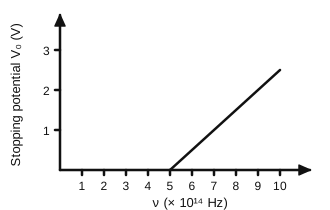
The variation of stopping potential $V_0$ as a function of the frequency ($\nu$) of the incident light for a metal is shown in figure. The work function of the surface is
Q 12-11-091JEE MainJEE Main 2023 (11 Apr, Shift 1)Medium
A metallic surface is illuminated with radiation of wavelength $\lambda$, the stopping potential is $V_0$. If the same surface is illuminated with radiation of wavelength $2\lambda$, the stopping potential becomes $\dfrac{V_0}4$. The threshold wavelength for this metallic surface will be
Q 12-11-093JEE MainJEE Main 2023 (12 Apr, Shift 1)Easy
A proton and an $\alpha$-particle are accelerated from rest by $2\ \text{V}$ and $4\ \text{V}$ potentials, respectively. The ratio of their de-Broglie wavelength is
Q 12-11-094JEE MainJEE Main 2023 (13 Apr, Shift 1)Easy
The difference between threshold wavelengths for two metal surfaces $A$ and $B$ having work function $\phi_A=9\ \text{eV}$ and $\phi_B=4.5\ \text{eV}$ in nm is (Given $hc=1242\ \text{eV nm}$)
Concept. $\lambda_0=\dfrac{hc}{\phi}$ for each metal.
Step 1. Values. $\dfrac{1242}{4.5}=276$ nm and $\dfrac{1242}{9}=138$ nm.
Step 2. Difference. $138$ nm.
Answer. Option D.
Solution by Sreeraj P, M.Sc Physics
Q 12-11-095JEE MainJEE Main 2023 (6 Apr, Shift 1)Medium
The kinetic energy of an electron, $\alpha$-particle and a proton are given as $4K$, $2K$ and $K$ respectively. The de-Broglie wavelength associated with electron ($\lambda_e$), $\alpha$-particle ($\lambda_\alpha$) and the proton ($\lambda_p$) are as follows:
Q 12-11-096JEE MainJEE Main 2023 (6 Apr, Shift 2)Easy
The work functions of Aluminium and Gold are $4.1\ \text{eV}$ and $5.1\ \text{eV}$ respectively. The ratio of the slope of the stopping potential versus frequency plot for Gold to that of Aluminium is
Concept. Intensity controls the number of electrons; frequency controls their maximum energy; there is a threshold frequency, not a threshold intensity.
Step 1. Statements. A true (current $\propto$ intensity). B false. C true. D false (threshold frequency). E false.
Answer. A and C only (Option C).
Solution by Sreeraj P, M.Sc Physics
Q 12-11-099JEE MainJEE Main 2023 (10 Apr, Shift 1)Easy
The de Broglie wavelength of a molecule in a gas at room temperature $300$ K is $\lambda_1$. If the temperature of the gas is increased to $600$ K, then the de Broglie wavelength of the same gas molecule becomes
Q 12-11-100JEE MainJEE Main 2023 (1 Feb, Shift 1)Easy
A proton moving with one tenth of velocity of light has a certain de Broglie wavelength of $\lambda$. An alpha particle having certain kinetic energy has the same de Broglie wavelength $\lambda$. The ratio of kinetic energy of proton and that of alpha particle is
Q 12-11-101JEE MainJEE Main 2023 (1 Feb, Shift 2)Easy
The threshold frequency of a metal is $f_0$. When the light of frequency $2f_0$ is incident on the metal plate, the maximum velocity of photoelectron is $v_1$. When the frequency of incident radiation is increased to $5f_0$, the maximum velocity of photoelectrons emitted is $v_2$. The ratio of $v_1$ to $v_2$ is
Q 12-11-102JEE MainJEE Main 2022 (24 Jun, Shift 1)Easy
When light of frequency twice the threshold frequency is incident on a metal plate, the maximum velocity of emitted electrons is $v_1$. When the frequency of incident radiation is increased to five times the threshold value, the maximum velocity of emitted electrons becomes $v_2$. If $v_2 = xv_1$, the value of $x$ will be ______.
Q 12-11-103JEE MainJEE Main 2022 (24 Jun, Shift 2)Easy
Light of two different frequencies whose photons have energies $3.8\ \text{eV}$ and $1.4\ \text{eV}$ respectively illuminate a metallic surface whose work function is $0.6\ \text{eV}$ successively. The ratio of maximum speeds of emitted electrons for the two frequencies respectively will be:
Answer: (A) Both Statement I and Statement II are true.
Concept. Davisson and Germer saw sharp diffraction peaks when electrons were scattered from a nickel crystal, at the angle Bragg's law predicts for $\lambda=h/p$. Only waves interfere and diffract.
Step 1. Statement I. True.
Step 2. Statement II. True.
Answer. Both true (Option A).
Solution by Sreeraj P, M.Sc Physics
Q 12-11-105JEE MainJEE Main 2022 (25 Jun, Shift 2)Medium
A proton, a neutron, an electron and an $\alpha$-particle have the same energy. If $\lambda_p$, $\lambda_n$, $\lambda_e$ and $\lambda_\alpha$ are the de Broglie wavelengths of proton, neutron, electron and $\alpha$-particle respectively, then choose the correct relation from the following
Q 12-11-106JEE MainJEE Main 2022 (26 Jun, Shift 1)Medium
An electron with speed $v$ and a photon with speed $c$ have the same de Broglie wavelength. If the kinetic energy and momentum of the electron are $E_e$ and $P_e$ and that of the photon are $E_{ph}$ and $P_{ph}$ respectively, which of the following is correct?
Q 12-11-107JEE MainJEE Main 2022 (26 Jun, Shift 2)Medium
A metal surface is illuminated by radiation of wavelength $4500\ \text{Å}$. The ejected photoelectron enters a constant magnetic field of $2\ \text{mT}$ making an angle of $90^\circ$ with the magnetic field. If it starts revolving in a circular path of radius $2\ \text{mm}$, the work function of the metal is approximately
Step 3. Work function. $\dfrac{12400}{4500}-1.41=2.76-1.41=1.35$ eV.
Answer. About $1.36$ eV (Option A).
Solution by Sreeraj P, M.Sc Physics
Q 12-11-108JEE MainJEE Main 2022 (26 Jun, Shift 2)Medium
The stopping potential for photoelectrons emitted from a surface illuminated by light of wavelength $6630\ \text{Å}$ is $0.42\ \text{V}$. If the threshold frequency is $x\times10^{13}\ \text{s}^{-1}$, where $x$ is (nearest integer): (Given, speed of light $= 3\times10^8\ \text{m s}^{-1}$, Planck's constant $= 6.63\times10^{-34}\ \text{J s}$)
Step 2. Work function. $1.875-0.42=1.455$ eV $=2.33\times10^{-19}$ J.
Step 3. Threshold frequency. $\dfrac{2.33\times10^{-19}}{6.63\times10^{-34}}=3.5\times10^{14}$ Hz $=35\times10^{13}$ Hz.
Answer. $35$.
Solution by Sreeraj P, M.Sc Physics
Q 12-11-109JEE MainJEE Main 2022 (25 Jul, Shift 1)Medium
A metal exposed to light of wavelength $800\ \text{nm}$ emits photoelectrons with a certain kinetic energy. The maximum kinetic energy of photo-electrons doubles when light of wavelength $500\ \text{nm}$ is used. The work function of the metal is (Take $hc = 1230\ \text{eV nm}$)
Q 12-11-111JEE MainJEE Main 2022 (26 Jul, Shift 1)Medium
A parallel beam of light of wavelength $900\ \text{nm}$ and intensity $100\ \text{W m}^{-2}$ is incident on a surface perpendicular to the beam. The number of photons crossing $1\ \text{cm}^2$ area perpendicular to the beam in one second is
Q 12-11-112JEE MainJEE Main 2022 (26 Jul, Shift 2)Easy
A nucleus of mass $M$ at rest splits into two parts having masses $\dfrac{M'}{3}$ and $\dfrac{2M'}{3}$ $(M' < M)$. The ratio of de Broglie wavelengths of the two parts will be
Concept. A nucleus at rest that splits gives the two parts equal and opposite momenta; $\lambda=\dfrac hp$.
Answer. $1:1$ (Option C).
Solution by Sreeraj P, M.Sc Physics
Q 12-11-113JEE MainJEE Main 2022 (27 Jun, Shift 1)Easy
An $\alpha$ particle and a carbon $12$ atom has same kinetic energy $K$. The ratio of their de-Broglie wavelengths $(\lambda_\alpha : \lambda_{C12})$ is
Q 12-11-114JEE MainJEE Main 2022 (27 Jul, Shift 1)Medium
An electron (mass $m$) with an initial velocity $\vec v = v_0\hat i$ $(v_0 > 0)$ is moving in an electric field $\vec E = -E_0\hat i$ $(E_0 > 0)$ where $E_0$ is constant. If at $t = 0$, de-Broglie wavelength is $\lambda_0 = \dfrac{h}{mv_0}$, then its de-Broglie wavelength after time $t$ is given by
Concept. $\tfrac12mv_{\max}^2=h\nu-\phi$: linear in $\nu$, independent of intensity.
Step 1. Check. A: true. B: moving the source away lowers intensity, so the saturation current falls: false. C: power changes intensity, not $K_{\max}$: false. D: instant emission is exactly what the photon picture explains: false. E: true; waves would give emission at any frequency if intense enough.
Answer. A and E only (Option B).
Solution by Sreeraj P, M.Sc Physics
Q 12-11-116JEE MainJEE Main 2022 (28 Jul, Shift 1)Easy
The equation $\lambda = \dfrac{1.227}{x}$ nm can be used to find the de-Broglie wavelength of an electron. In this equation $x$ stands for :
Where, $m$ = mass of electron, $P$ = momentum of electron, $K$ = Kinetic energy of electron, $V$ = Accelerating potential in volts for electron
Concept. An electron accelerated through $V$ volts has $\lambda=\dfrac{h}{\sqrt{2meV}}$. Putting in the constants gives $\dfrac{1.227}{\sqrt V}$ nm.
Step 1. Identify. $x=\sqrt V$.
Answer. Option D.
Solution by Sreeraj P, M.Sc Physics
Q 12-11-117JEE MainJEE Main 2021 (27 Jul, Shift 1)Easy
A particle of mass $9.1\times10^{-31}$ kg travels in a medium with a speed of $10^6\ \text{m s}^{-1}$ and a photon of radiation of linear momentum $10^{-27}\ \text{kg m s}^{-1}$ travels in a vacuum. The wavelength of the photon is ______ times the wavelength of the particle.
Q 12-11-118JEE MainJEE Main 2021 (31 Aug, Shift 1)Easy
A moving proton and electron have the same de-Broglie wavelength. If $K$ and $P$ denote the K.E. and momentum respectively, then choose the correct option:
Q 12-11-119JEE MainJEE Main 2021 (31 Aug, Shift 2)Medium
Consider two separate ideal gases of electrons and protons having same number of particles. The temperature of both the gases are same. The ratio of the uncertainty in determining the position of an electron to that of a proton is proportional to:
Concept. The momentum spread of a gas particle is of the order of its thermal momentum, $\Delta p\sim\sqrt{mkT}$; the uncertainty principle gives $\Delta x\sim\dfrac{h}{\Delta p}\propto\dfrac1{\sqrt{mT}}$.
Step 1. Same temperature. $\dfrac{\Delta x_e}{\Delta x_p}=\sqrt{\dfrac{m_p}{m_e}}$.
Answer. Option A.
Solution by Sreeraj P, M.Sc Physics
Q 12-11-120JEE MainJEE Main 2021 (24 Feb, Shift 1)Easy
Given below are two statements:
Statement I: Two photons having equal linear momenta have equal wavelengths.
Statement II: If the wavelength of the photon is decreased, then the momentum and energy of a photon will also decrease.
In the light of the above statements, choose the correct answer from the options given below.
Q 12-11-123JEE MainJEE Main 2021 (25 Feb, Shift 1)Easy
An $\alpha$ particle and a proton are accelerated from rest by a potential difference of 200 V. After this, their de Broglie wavelengths are $\lambda_\alpha$ and $\lambda_p$ respectively. The ratio $\dfrac{\lambda_p}{\lambda_\alpha}$ is:
Q 12-11-124JEE MainJEE Main 2021 (18 Mar, Shift 2)Easy
The speed of electrons in a scanning electron microscope is $1\times10^7\ \text{m s}^{-1}$. If the protons having the same speed are used instead of electrons, then the resolving power of scanning proton microscope will be changed by a factor of:
Concept. A microscope resolves details of the order of the wavelength used, so resolving power $\propto\dfrac1\lambda\propto p=mv$.
Step 1. Same speed. The factor is $\dfrac{m_p}{m_e}=1837$.
Answer. Increased $1837$ times (Option A).
Solution by Sreeraj P, M.Sc Physics
Q 12-11-125JEE MainJEE Main 2021 (20 Jul, Shift 1)Medium
The radiation corresponding to $3 \to 2$ transition of a hydrogen atom falls on a gold surface to generate photoelectrons. These electrons are passed through a magnetic field of $5\times10^{-4}$ T. Assume that the radius of the largest circular path followed by these electrons is 7 mm, the work function of the metal is:
Q 12-11-127JEE MainJEE Main 2021 (20 Jul, Shift 2)Medium
A certain metallic surface is illuminated by monochromatic radiation of wavelength $\lambda$. The stopping potential for photoelectric current for this radiation is $3V_0$. If the same surface is illuminated with a radiation of wavelength $2\lambda$, the stopping potential is $V_0$. The threshold wavelength of this surface for photoelectric effect is ______ $\lambda$.
Q 12-11-128JEE MainJEE Main 2021 (22 Jul, Shift 1)Easy
An electron of mass $m_e$ and a proton of mass $m_p$ are accelerated through the same potential difference. The ratio of the de-Broglie wavelength associated with the electron to that with the proton is
Answer: (B) Both A and R are true and R is the correct explanation of A
Concept. Resolving power improves as the wavelength falls. Electrons accelerated through kilovolts have $\lambda\sim0.01$ nm, far below visible wavelengths ($\sim500$ nm).
Step 1. Assertion and reason. Both true, and the short wavelength is the reason.
Answer. Option B.
Solution by Sreeraj P, M.Sc Physics
Q 12-11-130JEE MainJEE Main 2021 (26 Feb, Shift 2)Easy
Two streams of photons, possessing energies equal to twice and ten times the work function of metal are incident on the metal surface successively. The value of ratio of maximum velocities of the photoelectrons emitted in the two respective cases is $x : 3$. The value of $x$ is
Concept. $K_{\max} = E - \phi$ and $v \propto \sqrt K$.
Step 1. KEs. $K_1 = \phi$, $K_2 = 9\phi$.
Step 2. Ratio. $\dfrac{v_1}{v_2} = \dfrac13$, so $x = 1$.
Answer. $1$.
Solution by Sreeraj P, M.Sc Physics
Q 12-11-132JEE MainJEE Main 2021 (25 Jul, Shift 2)Medium
When radiation of wavelength $\lambda$ is incident on a metallic surface, the stopping potential of ejected photoelectrons is $4.8$ V. If the same surface is illuminated by radiation of double the previous wavelength, then the stopping potential becomes $1.6$ V. The threshold wavelength of the metal is:
Q 12-11-133JEE MainJEE Main 2021 (25 Jul, Shift 2)Medium
A light beam of wavelength $500$ nm is incident on a metal having work function of $1.25$ eV, placed in a magnetic field of intensity $B$. The electrons emitted perpendicular to the magnetic field $B$, with maximum kinetic energy are bent into a circular arc of radius $30$ cm. The value of $B$ is ______ $\times10^{-7}$ T. Given $hc = 20\times10^{-26}$ J m, the mass of the electron $= 9\times10^{-31}$ kg.
Q 12-11-134JEE MainJEE Main 2021 (26 Aug, Shift 1)Medium
In a photoelectric experiment, ultraviolet light of wavelength $280$ nm is used with lithium cathode having work function $\phi = 2.5$ eV. If the wavelength of incident light is switched to $400$ nm, find out the change in the stopping potential. ($h = 6.63\times10^{-34}$ J s, $c = 3\times10^8$ m s$^{-1}$)
Q 12-11-135JEE MainJEE Main 2021 (26 Aug, Shift 2)Easy
The de-Broglie wavelength of a particle having kinetic energy $E$ is $\lambda$. How much extra energy must be given to this particle so that the de-Broglie wavelength reduces to $75\%$ of the initial value?
Answer: (C) increases the number of photons incident and the K.E. of the ejected electrons remains unchanged.
Concept. At fixed frequency, intensity sets the photon count; each photon still carries $hf$.
Step 1. Effect. More photons per second; $K_{\max} = hf - \phi$ unchanged.
Answer. Increases the number of photons incident and the K.E. of the ejected electrons remains unchanged (Option C).
Solution by Sreeraj P, M.Sc Physics
Q 12-11-137JEE MainJEE Main 2021 (27 Aug, Shift 2)Medium
A monochromatic neon lamp with wavelength of $670.5$ nm illuminates a photo-sensitive material which has a stopping voltage of $0.48$ V. What will be the stopping voltage if the source light is changed with another source of wavelength of $474.6$ nm?
Concept. Find $\phi$ from the first source, then use it for the second; $hc \approx 1240$ eV nm.
Step 1. Work function. $\dfrac{1240}{670.5} = 1.85$ eV, so $\phi = 1.37$ eV.
Step 2. New stopping voltage. $\dfrac{1240}{474.6} = 2.61$ eV, so $V_s = 2.61 - 1.37 \approx 1.25$ V.
Answer. $1.25$ V (Option C).
Solution by Sreeraj P, M.Sc Physics
Q 12-11-138JEE MainJEE Main 2020 (8 Jan, Shift 2)Medium
An electron (mass $m$) with initial velocity $\vec{v} = v_0\hat{i} + v_0\hat{j}$ is in an electric field $\vec{E} = -E_0\hat{k}$. If $\lambda_0$ is initial de-Broglie wavelength of electron, its de-Broglie wavelength at time $t$ is given by:
Q 12-11-139JEE MainJEE Main 2020 (9 Jan, Shift 1)Medium
Radiation, with wavelength $6561$ Å falls on a metal surface to produce photoelectrons. The electrons are made to enter a uniform magnetic field of $3\times10^{-4}$ T. If the radius of the largest circular path followed by the electrons is $10$ mm, the work function of the metal is close to:
Step 4. Work function. $1.89 - 0.79 \approx 1.1$ eV.
Answer. $1.1$ eV (Option C).
Solution by Sreeraj P, M.Sc Physics
Q 12-11-140JEE MainJEE Main 2020 (9 Jan, Shift 1)Easy
A particle moving with kinetic energy $E$ has de Broglie wavelength $\lambda$. If energy $\Delta E$ is added to its energy, the wavelength becomes $\dfrac{\lambda}{2}$. Value of $\Delta E$, is:
Q 12-11-141JEE MainJEE Main 2020 (9 Jan, Shift 2)Easy
An electron of mass $m$ and magnitude of charge $e$ at rest, gets accelerated by a constant electric field $E$. The rate of change of de-Broglie wavelength of this electron at a time $t$ is (ignore relativistic effects)
Q 12-11-142JEE MainJEE Main 2020 (5 Sep, Shift 2)Easy
The surface of a metal is illuminated alternately with photons of energies $E_1 = 4$ eV and $E_2 = 2.5$ eV respectively. The ratio of the maximum speeds of the photoelectrons emitted in the two cases is $2$. The work function of the metal (in eV) is ______.
Concept. $\tfrac12mv_{max}^2=E-\phi$, so $\dfrac{v_1^2}{v_2^2}=\dfrac{E_1-\phi}{E_2-\phi}$.
Step 1. Equation. $4=\dfrac{4-\phi}{2.5-\phi}$, so $10-4\phi=4-\phi$.
Step 2. Work function. $\phi=2$ eV.
Answer. $2$.
Solution by Sreeraj P, M.Sc Physics
Q 12-11-143JEE MainJEE Main 2020 (6 Sep, Shift 1)Easy
An electron, a doubly ionized helium ion ($\text{He}^{++}$) and a proton are having the same kinetic energy. The relation between their respective de Broglie wavelengths $\lambda_e$, $\lambda_{\text{He}^{++}}$ and $\lambda_p$ is:
Q 12-11-144JEE MainJEE Main 2020 (6 Sep, Shift 2)Medium
Assuming the nitrogen molecule is moving with r.m.s. velocity at $400$ K, the de Broglie wavelength of the nitrogen molecule is close to: (Given: nitrogen molecule weight: $4.64\times10^{-26}$ kg, Boltzmann constant: $1.38\times10^{-23}\ \text{J K}^{-1}$, Planck constant: $6.63\times10^{-34}$ J s)
Concept. At the rms speed, $p=mv_{rms}=\sqrt{3mkT}$ and $\lambda=\dfrac hp$.
Step 1. Momentum. $p=\sqrt{3\times4.64\times10^{-26}\times1.38\times10^{-23}\times400}=2.77\times10^{-23}$ kg m s$^{-1}$.
Step 2. Wavelength. $\lambda=\dfrac{6.63\times10^{-34}}{2.77\times10^{-23}}=2.4\times10^{-11}$ m $=0.24$ Å.
Answer. Option A.
Solution by Sreeraj P, M.Sc Physics
Q 12-11-145JEE MainJEE Main 2020 (7 Jan, Shift 1)Easy
A beam of electromagnetic radiation of intensity $6.4\times10^{-5}\ \text{W/cm}^2$ is comprised of wavelength $\lambda = 310$ nm. It falls normally on a metal (work function $\varphi = 2$ eV) of surface area $1\ \text{cm}^2$. If one in $10^3$ photons ejects an electron, the total number of electrons ejected in $1$ s is $10^x$. ($hc = 1240$ eV nm, $1$ eV $= 1.6\times10^{-19}$ J), then $x$ is ______.
Q 12-11-146JEE MainJEE Main 2020 (7 Jan, Shift 2)Medium
An electron (of mass $m$) and a photon have the same energy $E$ in the range of a few eV. The ratio of the de Broglie wavelength associated with the electron and the wavelength of the photon is ($c$ = speed of light in vacuum):
Q 12-11-147JEE MainJEE Main 2020 (8 Jan, Shift 1)Medium
When a photon of energy $4.0$ eV strikes the surface of a metal A, the ejected photoelectrons have maximum kinetic energy $T_A$ eV and de Broglie wavelength $\lambda_A$. The maximum kinetic energy of photoelectrons liberated from another metal B by a photon of energy $4.50$ eV is $T_B = (T_A - 1.5)$ eV. If the de Broglie wavelength of these photoelectrons is $\lambda_B = 2\lambda_A$, then the work function of metal B is:
Concept. For electrons $\lambda=\dfrac{h}{\sqrt{2mT}}$, so $\lambda_B=2\lambda_A$ means $T_B=\dfrac{T_A}{4}$.
Step 1. Energies. $\dfrac{T_A}{4}=T_A-1.5$, so $T_A=2$ eV and $T_B=0.5$ eV.
Step 2. Work function of B. $4.5-0.5=4$ eV.
Answer. $4$ eV (Option A).
Solution by Sreeraj P, M.Sc Physics
Q 12-11-148JEE MainJEE Main 2020 (2 Sep, Shift 1)Medium
When radiation of wavelength $\lambda$ is used to illuminate a metallic surface, the stopping potential is $V$. When the same surface is illuminated with radiation of wavelength $3\lambda$, the stopping potential is $\dfrac{V}{4}$. If the threshold wavelength for the metallic surface is $n\lambda$ then value of $n$ will be ______.
Q 12-11-149JEE MainJEE Main 2020 (2 Sep, Shift 2)Medium
A particle is moving $5$ times as fast as an electron. The ratio of the de-Broglie wavelength of the particle to that of the electron is $1.878 \times 10^{-4}$. The mass of the particle is close to:
Step 2. Mass. $m_p=\dfrac{9.1\times10^{-31}}{5\times1.878\times10^{-4}}=9.7\times10^{-28}$ kg.
Answer. Option D.
Solution by Sreeraj P, M.Sc Physics
Q 12-11-150JEE MainJEE Main 2020 (3 Sep, Shift 1)Medium
When the wavelength of radiation falling on a metal is changed from $500\ \text{nm}$ to $200\ \text{nm}$, the maximum kinetic energy of the photoelectrons becomes three times larger. The work function of the metal is close to:
Q 12-11-151JEE MainJEE Main 2020 (3 Sep, Shift 2)Easy
Two sources of light emit X-rays of wavelength $1\ \text{nm}$ and visible light of wavelength $500\ \text{nm}$, respectively. Both the sources emit light of the same power $200\ \text{W}$. The ratio of the number density of photons of X-rays to the number density of photons of the visible light of the given wavelengths is:
Concept. Same power: photon number $\propto \lambda$.
Step 1. Ratio. $\dfrac{1}{500}$.
Answer. $\dfrac{1}{500}$ (Option A).
Solution by Sreeraj P, M.Sc Physics
Q 12-11-152JEE MainJEE Main 2020 (4 Sep, Shift 1)Medium
Particle $A$ of mass $m_A = \dfrac m2$ moving along the $x$-axis with velocity $v_0$ collides elastically with another particle $B$ at rest having mass $m_B = \dfrac m3$. If both the particles move along the $x$-axis after the collision, the change $\Delta\lambda$ in the wavelength of the particle $A$, in terms of its de-Broglie wavelength $(\lambda_0)$ before the collision is:
Step 2. Wavelength. $\lambda'=5\lambda_0$, so $\Delta\lambda=4\lambda_0$.
Answer. Option D.
Solution by Sreeraj P, M.Sc Physics
Q 12-11-153JEE MainJEE Main 2020 (4 Sep, Shift 1)Medium
The given figure shows a few data points in a photoelectric effect experiment for a certain metal, plotted as stopping potential against frequency. The minimum energy for ejection of electrons from its surface is: (Planck's constant $h = 6.62\times10^{-34}\ \text{J s}$)
Q 12-11-154JEE MainJEE Main 2020 (4 Sep, Shift 2)Easy
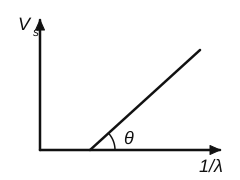
In a photoelectric effect experiment, the graph of stopping potential $V_s$ versus reciprocal of wavelength obtained is a straight line as shown in the figure. As the intensity of incident radiation is increased:
Concept. $V_s=\dfrac{hc}{e}\cdot\dfrac1\lambda-\dfrac\phi e$: the slope ($hc/e$) and intercept ($\phi$) do not involve intensity.
Step 1. Effect. A brighter beam gives more electrons but the same $V_s$ at each $\lambda$: the graph is unchanged.
Answer. Option D.
Solution by Sreeraj P, M.Sc Physics
Q 12-11-155JEE MainJEE Main 2020 (5 Sep, Shift 1)Medium
A beam of electrons of energy $E$ scatters from a target having atomic spacing of $1\ \text{Å}$. The first maximum intensity occurs at $\theta = 60^\circ$. Then $E$ (in eV) is ______. (Planck's constant $h = 6.64\times10^{-34}$ J s, $1\ \text{eV} = 1.6\times10^{-19}$ J, electron mass $m = 9.1\times10^{-31}$ kg)
Q 12-11-156JEE MainJEE Main 2019 (9 Jan, Shift 2)Medium
The magnetic field associated with a light wave is given, at the origin, by $B = B_0\left[\sin(3.14\times10^7)ct + \sin(6.28\times10^7)ct\right]$. If this light falls on a silver plate having a work function of $4.7\ \text{eV}$, what will be the maximum kinetic energy of the photoelectrons? $(c = 3\times10^8\ \text{m s}^{-1},\ h = 6.6\times10^{-34}\ \text{J s})$
Concept. The light contains two frequencies, $\omega=kc$ with $k=3.14\times10^7$ and $6.28\times10^7$ m$^{-1}$. The higher frequency gives the maximum kinetic energy.
Step 1. Higher frequency. $\omega=6.28\times10^7\times3\times10^8$, so $\nu=\dfrac{\omega}{2\pi}=3\times10^{15}$ Hz.
Q 12-11-157JEE MainJEE Main 2019 (10 Jan, Shift 1)Medium
In an electron microscope, the resolution that can be achieved is of the order of the wavelength of electrons used. To resolve a width of $7.5\times10^{-12}\ \text{m}$, the minimum electron energy required is close to:
Concept. Take $\lambda$ equal to the width to resolve; then $K=\dfrac{p^2}{2m}=\dfrac{h^2}{2m\lambda^2}$.
Step 1. Energy. $K=\dfrac{(6.63\times10^{-34})^2}{2\times9.1\times10^{-31}\times(7.5\times10^{-12})^2}=4.3\times10^{-15}$ J.
Step 2. In eV. $\dfrac{4.3\times10^{-15}}{1.6\times10^{-19}}=2.7\times10^4$ eV $\approx25$ keV.
Answer. Option B.
Solution by Sreeraj P, M.Sc Physics
Q 12-11-158JEE MainJEE Main 2019 (10 Jan, Shift 2)Medium
A metal plate of area $1\times10^{-4}\ \text{m}^2$ is illuminated by a radiation of intensity $16\ \text{mW/m}^2$. The work function of the metal is $5\ \text{eV}$. The energy of the incident photons is $10\ \text{eV}$ and only $10\%$ of it produces photo electrons. The number of emitted photo electrons per second and their maximum energy, respectively, will be: $[1\ \text{eV} = 1.6\times10^{-19}\ \text{J}]$
Concept. Photons per second $=\dfrac{IA}{E}$; electrons per second $=$ efficiency $\times$ photons; $K_{max}=E-\phi$.
Step 1. Power on the plate. $16\times10^{-3}\times10^{-4}=1.6\times10^{-6}$ W.
Step 2. Photons. $\dfrac{1.6\times10^{-6}}{10\times1.6\times10^{-19}}=10^{12}$ per second; $10\%$ gives $10^{11}$ electrons per second.
Step 3. Energy. $10-5=5$ eV.
Answer. $10^{11}$ and $5$ eV (Option C).
Solution by Sreeraj P, M.Sc Physics
Q 12-11-159JEE MainJEE Main 2019 (10 Apr, Shift 1)Easy
In a photoelectric effect experiment, the threshold wavelength of light is $380\ \text{nm}$. If the wavelength of incident light is $260\ \text{nm}$, the maximum kinetic energy of emitted electrons will be (Given $E\,(\text{in eV}) = \dfrac{1237}{\lambda\,(\text{in nm})}$)
Q 12-11-160JEE MainJEE Main 2019 (10 Apr, Shift 2)Easy
A $2\ \text{mW}$ laser operates at a wavelength of $500\ \text{nm}$. The number of photons that will be emitted per second is: [Given Planck's constant $h = 6.6\times10^{-34}\ \text{J s}$, speed of light $c = 3.0\times10^8\ \text{m/s}$]
Q 12-11-161JEE MainJEE Main 2019 (9 Jan, Shift 1)Medium
The surface of certain metal is first illuminated with light of wavelength $\lambda_1 = 350\ \text{nm}$ and then, by a light of wavelength $\lambda_2 = 540\ \text{nm}$. It is found that the maximum speed of the photoelectrons in the two cases differ by a factor of 2. The work function of the metal (in eV) is close to (Energy of photon $= \dfrac{1240}{\lambda\ \text{in nm}}\ \text{eV}$)
Q 12-11-162JEE MainJEE Main 2019 (8 Apr, Shift 1)Easy
Two particles move at right angle to each other. Their de Broglie wavelengths are $\lambda_1$ and $\lambda_2$ respectively. The particles suffer perfectly inelastic collision. The de Broglie wavelength $\lambda$ of the final particle, is given by
Concept. In a perfectly inelastic collision the joined particle carries the vector sum of the momenta. At right angles: $p^2=p_1^2+p_2^2$, with $p=\dfrac h\lambda$.
Q 12-11-164JEE MainJEE Main 2019 (9 Apr, Shift 1)Easy
The electric field of light wave is given as $\vec E = 10^{-3}\cos\left(\dfrac{2\pi x}{5\times10^{-7}} - 2\pi\times6\times10^{14}t\right)\hat x\ \dfrac{\text{N}}{\text{C}}$. This light falls on a metal plate of work function $2\ \text{eV}$. The stopping potential of the photo-electrons is (Given, $E\ (\text{in eV}) = \dfrac{12375}{\lambda\ (\text{in Å})}$)
Concept. Read the wavelength from the field: $k=\dfrac{2\pi}{\lambda}$ gives $\lambda=5\times10^{-7}$ m $=5000$ Å (and $c/\nu$ agrees). Then $eV_0=E-\phi$.
Step 2. Stopping potential. $V_0=2.475-2=0.475\approx0.48$ V.
Answer. Option D.
Solution by Sreeraj P, M.Sc Physics
Q 12-11-165JEE MainJEE Main 2019 (9 Apr, Shift 2)Easy
A particle P is formed due to a completely inelastic collision of particles x and y having de Broglie wavelengths $\lambda_x$ and $\lambda_y$ respectively. If x and y were moving in opposite directions, then the de Broglie wavelength of P is
Q 12-11-166JEE MainJEE Main 2019 (11 Jan, Shift 1)Medium
If the de Broglie wavelength of an electron is equal to $10^{-3}$ times the wavelength of a photon of frequency $6\times10^{14}$ Hz, then the speed of electron is equal to: (Speed of light $= 3\times10^8$ m/s, Planck's constant $= 6.63\times10^{-34}$ J s, mass of electron $= 9.1\times10^{-31}$ kg)
Q 12-11-167JEE MainJEE Main 2019 (11 Jan, Shift 2)Easy
In a photoelectric experiment, the wavelength of the light incident on a metal is changed from $300$ nm to $400$ nm. The decrease in the stopping potential is close to: $\left(\dfrac{hc}{e} = 1240\ \text{nm V}\right)$
Concept. Subtract Einstein's equation for the two wavelengths; $\phi$ cancels: $\Delta V_0=\dfrac{hc}{e}\left(\dfrac1{\lambda_1}-\dfrac1{\lambda_2}\right)$.
Step 1. Change. $1240\left(\dfrac1{300}-\dfrac1{400}\right)=\dfrac{1240}{1200}=1.03$ V.
Answer. About $1.0$ V (Option C).
Solution by Sreeraj P, M.Sc Physics
Q 12-11-168JEE MainJEE Main 2019 (12 Jan, Shift 1)Easy
A particle A of mass $m$ and charge $q$ is accelerated by a potential difference of $50$ V. Another particle B of mass $4m$ and charge $q$ is accelerated by a potential difference of $2500$ V. The ratio of de Broglie wavelengths $\dfrac{\lambda_A}{\lambda_B}$ is close to:
Q 12-11-170JEE MainJEE Main 2019 (12 Apr, Shift 1)Easy
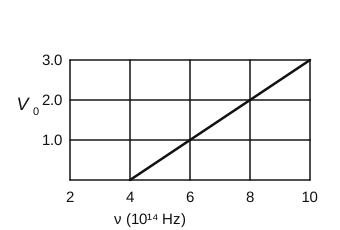
The stopping potential $V_0$ (in volt) as a function of frequency $(\nu)$ for a sodium emitter, is shown in the figure. The work function of sodium, from the data plotted in the figure, will be: (Given: Planck's constant $h = 6.63\times10^{-34}$ J s, electron charge $e = 1.6\times10^{-19}$ C)
Concept. The $V_0$–$\nu$ line meets the frequency axis at the threshold $\nu_0$, and $\phi=h\nu_0$.
Step 1. Threshold. $V_0=0$ at $\nu_0=4\times10^{14}$ Hz.
Step 2. Work function. $\phi=\dfrac{6.63\times10^{-34}\times4\times10^{14}}{1.6\times10^{-19}}=1.66$ eV.
Answer. Option D.
Solution by Sreeraj P, M.Sc Physics
Q 12-11-171JEE MainJEE Main 2018 (15 Apr, Shift 1)Hard
Two electrons are moving with non-relativistic speeds perpendicular to each other. If corresponding de Broglie wavelengths are $\lambda_1$ and $\lambda_2$, their de Broglie wavelength in the frame of reference attached to their centre of mass is:
Concept. For two equal masses, in the centre-of-mass frame each has momentum $\dfrac12|\vec p_1-\vec p_2|$. The momenta are perpendicular, so $|\vec p_1-\vec p_2|=\sqrt{p_1^2+p_2^2}$.
Step 1. Momentum in the CM frame. $p=\dfrac h2\sqrt{\dfrac1{\lambda_1^2}+\dfrac1{\lambda_2^2}}$.
Q 12-11-172JEE MainJEE Main 2018 (15 Apr, Shift 2)Easy
If the de Broglie wavelengths associated with a proton and an $\alpha$-particle are equal, then the ratio of velocities of the proton and the $\alpha$-particle will be:
Q 12-11-173JEE MainJEE Main 2018 (16 Apr, Shift 1)Easy
The de-Broglie wavelength $(\lambda_B)$ associated with the electron orbiting in the second excited state of hydrogen atom is related to that in the ground state $(\lambda_G)$ by:
Concept. In Bohr orbit $n$ the circumference holds $n$ wavelengths: $2\pi r_n=n\lambda$. With $r_n\propto n^2$, $\lambda\propto n$.
Step 1. States. Ground state $n=1$; second excited state $n=3$.
Step 2. Ratio. $\lambda_B=3\lambda_G$.
Answer. Option A.
Solution by Sreeraj P, M.Sc Physics
Q 12-11-174JEE MainJEE Main 2017 (2 Apr)Easy
An electron beam is accelerated by a potential difference $V$ to hit a metallic target to produce X-rays. It produces continuous as well as characteristic X-rays. If $\lambda_{\min}$ is the smallest possible wavelength of X-ray in the spectrum, the variation of $\log\lambda_{\min}$ with $\log V$ is correctly represented in:
Step 1. Logs. $\log\lambda_{\min} = \log\dfrac{hc}{e} - \log V$: a falling straight line of slope $-1$, graph (2).
Answer. Graph (2) (Option B).
Solution by Sreeraj P, M.Sc Physics
Q 12-11-175JEE MainJEE Main 2017 (2 Apr)Medium
A particle $A$ of mass $m$ and initial velocity $v$ collides with a particle $B$ of mass $\dfrac m2$ which is at rest. The collision is head on, and elastic. The ratio of the de-Broglie wavelengths $\lambda_A$ to $\lambda_B$ after the collision is:
The maximum velocity of the photoelectrons emitted from the surface is $v$ when light of frequency $n$ falls on a metal surface. If the incident frequency is increased to $3n$, the maximum velocity of the ejected photoelectrons will be:
Concept. $\tfrac12mv^2=hn-\phi$. With $3n$: $\tfrac12mv'^2=3hn-\phi=3(hn-\phi)+2\phi$.
Step 1. Compare. $\tfrac12mv'^2>3\times\tfrac12mv^2$, so $v'>\sqrt3v$.
Answer. More than $\sqrt3v$ (Option A).
Solution by Sreeraj P, M.Sc Physics
Q 12-11-177JEE MainJEE Main 2017 (9 Apr)Easy
A laser light of wavelength $660$ nm is used to weld Retina detachment. If a laser pulse of width $60$ ms and power $0.5$ kW is used, the approximate number of photons in the pulse are: (Take Planck's constant, $h = 6.62\times10^{-34}$ J s)
When two monochromatic lights of frequency, $\nu$ and $\dfrac{\nu}{2}$ are incident on a photoelectric metal, their stopping potential becomes $\dfrac{V_s}{2}$ and $V_s$ respectively. The threshold frequency for this metal is
(This threshold is above both incident frequencies, so the data are not physically consistent; solving the equations as given leads to $\dfrac32\nu$, the expected answer.)
Answer. $\dfrac32\nu$ (Option A).
Solution by Sreeraj P, M.Sc Physics
Q 12-11-179NEETNEET 2022Top questionEasy
The graph which shows the variation of the de Broglie wavelength ($\lambda$) of a particle and its associated momentum ($p$) is
Concept. $\lambda = \dfrac hp$, so $\lambda p = $ constant.
Step 1. Shape. A rectangular hyperbola: graph (1).
Answer. Graph (1) (Option A).
Solution by Sreeraj P, M.Sc Physics
Q 12-11-180JEE MainJEE Main 2025 (2 Apr, Shift 1)Medium
A monochromatic light is incident on a metallic plate having work function $\phi$. An electron, emitted normally to the plate from a point A with maximum kinetic energy, enters a constant magnetic field perpendicular to the initial velocity of the electron. The electron passes through a curve and hits back the plate at a point B. The distance between A and B is:
(Given: the magnitude of charge of an electron is $e$ and mass is $m$, $h$ is Planck's constant and $c$ is velocity of light. Take the magnetic field to exist throughout the path of the electron.)
Concept. The electron leaves normally, the field is perpendicular to its velocity, so it moves on a semicircle and lands a diameter $2r$ away; $r=\dfrac{mv}{eB}=\dfrac{\sqrt{2mK}}{eB}$.
Q 12-11-181JEE MainJEE Main 2025 (2 Apr, Shift 2)Easy
An electron with mass $m$ with an initial velocity ($t = 0$) $\vec v = v_0\hat i$ ($v_0 > 0$) enters a magnetic field $\vec B = B_0\hat j$. If the initial de-Broglie wavelength at $t = 0$ is $\lambda_0$ then its value after time $t$ would be:
Concept. A magnetic force is always perpendicular to the velocity, so it does no work: the speed, momentum magnitude and hence $\lambda$ stay constant.
Answer. $\lambda_0$ (Option D).
Solution by Sreeraj P, M.Sc Physics
Q 12-11-182JEE MainJEE Main 2025 (4 Apr, Shift 1)Easy
Given below are two statements: one is labelled as Assertion A and the other is labelled as Reason R.
Assertion A: In the photoelectric effect, on increasing the intensity of incident light the stopping potential increases.
Reason R: Increase in intensity of light increases the rate of photoelectrons emitted, provided the frequency of incident light is greater than the threshold frequency.
In the light of the above statements, choose the correct answer from the options given below:
Concept. Intensity sets the number of photons per second, so it changes the photocurrent, not $K_{max}$ or $V_0$.
Step 1. Assertion. False: $V_0$ does not change with intensity.
Step 2. Reason. True (above the threshold frequency).
Answer. A is false but R is true (Option B).
Solution by Sreeraj P, M.Sc Physics
Q 12-11-183JEE MainJEE Main 2025 (7 Apr, Shift 2)Medium
A photo-emissive substance is illuminated with radiation of wavelength $\lambda_i$ so that it releases electrons with de Broglie wavelength $\lambda_e$. The longest wavelength of radiation that can emit photoelectrons is $\lambda_0$. The expression for the de Broglie wavelength is: ($m$: mass of the electron, $h$: Planck's constant and $c$: speed of light)
Q 12-11-184JEE MainJEE Main 2025 (8 Apr, Shift 2)Hard
An electron is released from rest near an infinite non-conducting sheet of uniform charge density $-\sigma$. The rate of change of the de Broglie wavelength associated with the electron varies inversely as the $n^{\text{th}}$ power of time. The numerical value of $n$ is ______.


 Solution by Sreeraj P, M.Sc Physics