In Geiger-Marsden experiment, the number of scattered $\alpha$-particles $N(\theta)$ is plotted as a function of scattering angle $\theta$. Which of the following options represents the correct plot ?
Concept. Rutherford's scattering formula gives the number of $\alpha$-particles scattered at angle $\theta$: $$N(\theta) \propto \frac{1}{\sin^4(\theta/2)}$$
Step 1. Small angles. Most $\alpha$-particles pass almost undeflected, so $N(\theta)$ is very large near $\theta = 0$.
Step 2. Large angles. As $\theta$ grows, $\sin(\theta/2)$ grows and $N$ falls very steeply; only a few particles come back near $\theta = 180°$.
Step 3. Choose the graph. The correct plot falls steadily and sharply with $\theta$, which is graph (3).
Answer. Graph (3) (Option C).
Solution by Sreeraj P, M.Sc Physics
Q 12-12-002NEETNEET 2026Top questionMedium
Consider that an electron is revolving in an excited state of Hydrogen atom with velocity $\sqrt{25.6} \times 10^5\ \text{m s}^{-1}$. The radius of the orbit is $x \times 10^{-9}$ m. The value of $x$ is :
[Take the mass of electron to be $9 \times 10^{-31}$ kg, charge of electron $= -1.6 \times 10^{-19}$ C and $\dfrac{1}{4\pi\epsilon_0} = 9 \times 10^9\ \text{N m}^2\text{C}^{-2}$]
Concept. In a circular orbit the Coulomb attraction provides the centripetal force: $$\frac{mv^2}{r} = \frac{1}{4\pi\epsilon_0}\frac{e^2}{r^2} \;\Rightarrow\; r = \frac{1}{4\pi\epsilon_0}\frac{e^2}{mv^2}$$
Step 2. Compare. $r = 1 \times 10^{-9}$ m, so $x = 1$.
Answer. $1$ (Option D).
Solution by Sreeraj P, M.Sc Physics
Q 12-12-003NEETNEET 2025Top questionMedium
A particle of mass $m$ is moving around the origin with a constant force $F$ pulling it towards the origin. If Bohr model is used to describe its motion, the radius $r$ of the $n^{\text{th}}$ orbit and the particle's speed $v$ in the orbit depend on $n$ as
Concept. Bohr's condition means a whole number of de Broglie wavelengths fits around the orbit: $2\pi r_n = n\lambda$.
Step 1. Radius of the $n = 2$ orbit. $r_2 = n^2a_0 = 4 \times 0.052 = 0.208$ nm.
Step 2. Wavelength. $$\lambda = \frac{2\pi r_2}{2} = \pi \times 0.208 \approx 0.65\ \text{nm}$$ The closest option is $0.67$ nm.
Answer. $0.67$ nm (Option B).
Solution by Sreeraj P, M.Sc Physics
Q 12-12-005NEETNEET 2024Top questionMedium
Match List I with List II.
List I (Spectral Lines of Hydrogen for transitions from): A. $n_2 = 3$ to $n_1 = 2$ B. $n_2 = 4$ to $n_1 = 2$ C. $n_2 = 5$ to $n_1 = 2$ D. $n_2 = 6$ to $n_1 = 2$
List II (Wavelengths (nm)): I. $410.2$ II. $434.1$ III. $656.3$ IV. $486.1$
Choose the correct answer from the options given below :
Concept. All four are Balmer lines: $\dfrac{1}{\lambda} = R\left(\dfrac{1}{4} - \dfrac{1}{n_2^2}\right)$. A larger $n_2$ gives a larger energy gap and a shorter wavelength.
Step 1. Order the wavelengths. $\lambda_{3\to2} > \lambda_{4\to2} > \lambda_{5\to2} > \lambda_{6\to2}$.
Step 2. Match.
A ($3 \to 2$, H$_\alpha$): $656.3$ nm → III.
B ($4 \to 2$, H$_\beta$): $486.1$ nm → IV.
C ($5 \to 2$, H$_\gamma$): $434.1$ nm → II.
D ($6 \to 2$, H$_\delta$): $410.2$ nm → I.
Answer. A-III, B-IV, C-II, D-I (Option D).
Solution by Sreeraj P, M.Sc Physics
Q 12-12-006NEETNEET 2024Top questionMedium
Given below are two statements :
Statement I : Atoms are electrically neutral as they contain equal number of positive and negative charges.
Statement II : Atoms of each element are stable and emit their characteristic spectrum.
In the light of the above statements, choose the most appropriate answer from the options given below :
Answer: (A) Statement I is correct but Statement II is incorrect.
Concept. Judge each statement against the structure of the atom and how spectra arise.
Step 1. Statement I. An atom has as many electrons as protons, so it is electrically neutral → correct.
Step 2. Statement II. Atoms emit their characteristic spectrum only when excited (by heating or an electric discharge) and falling back to lower levels, not on their own. Also, radioactive atoms are not stable → incorrect.
Answer. Statement I is correct but Statement II is incorrect (Option A).
Solution by Sreeraj P, M.Sc Physics
Q 12-12-007NEETNEET 2023Top questionMedium
In hydrogen spectrum, the shortest wavelength in the Balmer series is $\lambda$. The shortest wavelength in the Bracket series is :
Concept. The shortest wavelength of a series is its series limit ($n_2 \to \infty$): $\dfrac{1}{\lambda_{\min}} = \dfrac{R}{n_1^2}$, so $\lambda_{\min} \propto n_1^2$.
Concept. Bohr's model treats a single electron in the field of a nucleus, so it holds only for one-electron (hydrogen-like) systems.
Step 1. Count electrons. H, deuterium and He$^+$ each have one electron. Ne$^+$ ($Z = 10$) still has $9$ electrons, so the model does not apply.
Answer. Singly ionised neon (Ne$^+$) (Option D).
Solution by Sreeraj P, M.Sc Physics
Q 12-12-010JEE MainAIEEE 2012Easy
A hydrogen atom is excited to the state with principal quantum number $n = 4$. The maximum number of photons that this single atom can emit as it returns to the ground state is
Concept. A single atom emits one photon per jump; the most photons come from stepping down one level at a time.
Step 1. Path. $4\to3\to2\to1$: three photons.
Answer. Option D.
Solution by Sreeraj P, M.Sc Physics
Q 12-12-011JEE MainAIEEE 2006Medium
An alpha nucleus of energy $\dfrac{1}{2}mv^2$ bombards a heavy nuclear target of charge $Ze$. Then the distance of closest approach for the alpha nucleus will be proportional to
The speed of the electron in the first Bohr orbit of hydrogen is about $2.2 \times 10^6$ m/s. Its speed in the third orbit of doubly ionised lithium ($Z = 3$) is
Concept. An $\alpha$-particle is deflected only when it passes close to something massive and charged.
Step 1. Interpret. Most $\alpha$-particles passed almost undeflected, so they met nothing in their way: most of the atom is empty space. (The rare large-angle deflections showed that the positive charge and mass sit in a tiny nucleus.)
Answer. Most of the atom is empty space (Option C).
Solution by Sreeraj P, M.Sc Physics
Q 12-12-023NEETJEE MainTop questionMedium
The energy of the electron in the ground state of hydrogen is $-13.6$ eV. The energy required to excite it from the ground state to the second excited state is
Find the energy, in eV, of the photon emitted when the electron in a hydrogen atom falls from $n = 4$ to $n = 2$. (Give the answer to two decimal places.)
Q 12-12-027JEE MainJEE Main 2026 (6 Apr, Shift 1)Medium
The ratio of momentum of the photons of the $1^{\text{st}}$ and $2^{\text{nd}}$ line of Balmer series of Hydrogen atoms is $\alpha/\beta$. The possible values of $\alpha$ and $\beta$ are:-
Q 12-12-028JEE MainJEE Main 2026 (5 Apr, Shift 1)Easy
In the hydrogen atom, the electron makes a transition from the higher orbit (i) to a lower orbit ($f$). The ratio of the radius of the orbits in given by $r_i : r_f = 16 : 4$. The wavelength of photon emitted due to this transition is ______ nm.
Concept. Large-angle scattering needs a nearly head-on approach (small impact parameter) to a tiny, heavy nucleus.
Step 1. Check. A: true, the nucleus is tiny. B: false; charges are $2e$ and $79e$. C: true. D: all particles had about the same energy, false. E: true.
Answer. A, C, E only (Option D).
Solution by Sreeraj P, M.Sc Physics
Q 12-12-030JEE MainJEE Main 2026 (2 Apr, Shift 1)Easy
Angular momentum of an electron in a hydrogen atom is $\dfrac{3h}{\pi}$, then the energy of the electron is ______ eV.
Concept. $L=\dfrac{nh}{2\pi}$ gives $n$; then $E_n=-\dfrac{13.6}{n^2}$ eV.
Step 1. Orbit. $\dfrac{3h}{\pi}=\dfrac{6h}{2\pi}$, so $n=6$.
Step 2. Energy. $-\dfrac{13.6}{36}=-0.38$ eV.
Answer. Option C.
Solution by Sreeraj P, M.Sc Physics
Q 12-12-031JEE MainJEE Main 2026 (2 Apr, Shift 2)Medium
Using Bohr's model, calculate the ratio of the magnetic fields generated due to the motion of the electrons in the $2^{\text{nd}}$ and $4^{\text{th}}$ orbits of hydrogen atom ______.
Q 12-12-032JEE MainJEE Main 2026 (24 Jan, Shift 1)Medium
Two electrons are moving in orbits of two hydrogen like atoms with speeds $3\times10^5\ \text{m/s}$ and $2.5\times10^5\ \text{m/s}$ respectively. If the radii of these orbits are nearly same then the possible order of energy states are ______ respectively.
Concept. $r\propto\dfrac{n^2}{Z}$ and $v\propto\dfrac Zn$. Equal radii mean $\dfrac{n_1^2}{Z_1}=\dfrac{n_2^2}{Z_2}=k$, so $Z=\dfrac{n^2}k$ and $v\propto\dfrac{Z}{n}=\dfrac nk$: the speeds are in the ratio of the $n$'s.
Step 1. Ratio of $n$. $\dfrac{n_1}{n_2}=\dfrac{3\times10^5}{2.5\times10^5}=\dfrac65$.
Step 2. Pick. $6$ and $5$.
Answer. Option D.
Solution by Sreeraj P, M.Sc Physics
Q 12-12-033JEE MainJEE Main 2025 (22 Jan, Shift 1)Easy
An electron in the ground state of the hydrogen atom has the orbital radius of $5.3\times10^{-11}\ \text{m}$ while that for the electron in third excited state is $8.48\times10^{-10}\ \text{m}$. The ratio of the de Broglie wavelengths of electron in the excited state to that in the ground state is
Q 12-12-034JEE MainJEE Main 2025 (22 Jan, Shift 2)Medium
An electron projected perpendicular to a uniform magnetic field $B$ moves in a circle. If Bohr's quantization is applicable, then the radius of the electronic orbit in the first excited state is
Concept. Combine the magnetic circle $r=\dfrac{mv}{eB}$ with $mvr=\dfrac{nh}{2\pi}$.
Step 1. Substitute. $mv=eBr$, so $eBr^2=\dfrac{nh}{2\pi}$, $r=\sqrt{\dfrac{nh}{2\pi eB}}$.
Step 2. First excited ($n=2$). $r=\sqrt{\dfrac{h}{\pi eB}}$.
Answer. Option A.
Solution by Sreeraj P, M.Sc Physics
Q 12-12-035JEE MainJEE Main 2025 (24 Jan, Shift 1)Easy
During the transition of an electron from state A to state C of a Bohr atom, the wavelength of emitted radiation is $2000\ \text{Å}$ and it becomes $6000\ \text{Å}$ when the electron jumps from state B to state C. Then the wavelength of the radiation emitted during the transition of electrons from state A to state B is
Q 12-12-039JEE MainJEE Main 2024 (1 Feb, Shift 2)Easy
A particular hydrogen-like ion emits radiation of frequency $3\times10^{15}\ \text{Hz}$ when it makes a transition from $n = 2$ to $n = 1$. The frequency of radiation emitted in the transition from $n = 3$ to $n = 1$ is $\dfrac{x}{9}\times10^{15}\ \text{Hz}$, when $x = $ ______.
Step 2. Frequency. $\nu_{3\to1}=3\times10^{15}\times\dfrac{32}{27}=\dfrac{32}{9}\times10^{15}$ Hz.
Answer. $x=32$.
Solution by Sreeraj P, M.Sc Physics
Q 12-12-040JEE MainJEE Main 2024 (4 Apr, Shift 1)Hard
A hydrogen atom changes its state from $n = 3$ to $n = 2$. Due to recoil, the percentage change in the wavelength of the emitted light is approximately $1\times10^{-n}$. The value of $n$ is ______. [Given $Rhc = 13.6\ \text{eV}$, $hc = 1242\ \text{eV nm}$, $h = 6.6\times10^{-34}\ \text{J s}$, mass of the hydrogen atom $= 1.6\times10^{-27}\ \text{kg}$]
Concept. The photon's momentum $p = \dfrac{E}{c}$ goes to the atom as recoil. The recoil energy $\dfrac{p^2}{2M} = \dfrac{E^2}{2Mc^2}$ is taken from the photon, so $\dfrac{\Delta\lambda}{\lambda} \approx \dfrac{\Delta E}{E} = \dfrac{E}{2Mc^2}$.
Q 12-12-042JEE MainJEE Main 2024 (5 Apr, Shift 1)Easy
An electron rotates in a circle around a nucleus having positive charge $Ze$. The correct relation between the total energy ($E$) of the electron and its potential energy ($U$) is
Concept. $L\propto n$ and $r\propto n^2$, so $L\propto\sqrt r$.
Answer. Option B.
Solution by Sreeraj P, M.Sc Physics
Q 12-12-044JEE MainJEE Main 2024 (5 Apr, Shift 2)Medium
The shortest wavelength of the spectral lines in the Lyman series of the hydrogen spectrum is $915\ \text{\AA}$. The longest wavelength of the spectral lines in the Balmer series will be ______ Å.
Q 12-12-046JEE MainJEE Main 2024 (6 Apr, Shift 1)Easy
The radius of a certain orbit of the hydrogen atom is $8.48\ \text{\AA}$. If the energy of the electron in this orbit is $E/x$, then $x = $ ______. (Given $a_0 = 0.529\ \text{\AA}$, $E$ = energy of electron in ground state)
Q 12-12-048JEE MainJEE Main 2024 (6 Apr, Shift 2)Easy
In the Franck-Hertz experiment, the first dip in the current-voltage graph for hydrogen is observed at $10.2\ \text{V}$. The wavelength of light emitted by the hydrogen atom when excited to the first excitation level is ______ nm. (Given $hc = 1245\ \text{eV nm}$, $e = 1.6\times10^{-19}\ \text{C}$)
Concept. The first dip at $10.2$ V means the first excitation energy is $10.2$ eV; the atom emits a photon of this energy on returning, $\lambda = \dfrac{hc}{E}$.
Q 12-12-051JEE MainJEE Main 2024 (29 Jan, Shift 1)Medium
When a hydrogen atom going from $n = 2$ to $n = 1$ emits a photon, its recoil speed is $\dfrac x5\ \text{m s}^{-1}$, where $x =$ ______. (Use: mass of hydrogen atom $= 1.6\times10^{-27}\ \text{kg}$, charge of electron $e = 1.6\times10^{-19}\ \text{C}$)
Q 12-12-052JEE MainJEE Main 2024 (29 Jan, Shift 2)Easy
Given below are two statements:
Statement I: Most of the mass of the atom and all its positive charge are concentrated in a tiny nucleus and the electrons revolve around it, is Rutherford's model.
Statement II: An atom is a spherical cloud of positive charges with electrons embedded in it, is a special case of Rutherford's model.
In the light of the above statements, choose the most appropriate from the options given below.
Answer: (C) Statement I is true but Statement II is false
Concept. Statement II describes Thomson's plum-pudding model, which Rutherford's experiment replaced; it is not a special case of it.
Answer. Statement I true, II false (Option C).
Solution by Sreeraj P, M.Sc Physics
Q 12-12-053JEE MainJEE Main 2024 (29 Jan, Shift 2)Medium
Hydrogen atom is bombarded with electrons accelerated through a potential difference of $V$, which causes excitation of hydrogen atoms. If the experiment is being performed at $T = 0\ \text{K}$, the minimum potential difference needed to observe any Balmer series lines in the emission spectra will be $\dfrac{\alpha}{10}\ \text{V}$, where $\alpha =$ ______. (Write the value to the nearest integer)
Concept. Balmer lines end on $n=2$, so the atom must first reach at least $n=3$. An electron accelerated through $V$ volts brings $eV$ of energy.
Step 1. Energy to $n=3$. $13.6\left(1-\dfrac19\right)=12.09$ eV.
Step 2. Voltage. $12.1$ V $=\dfrac{121}{10}$ V.
Answer. $\alpha=121$.
Solution by Sreeraj P, M.Sc Physics
Q 12-12-054JEE MainJEE Main 2024 (8 Apr, Shift 1)Medium
In an alpha particle scattering experiment, the distance of closest approach for the $\alpha$ particle is $4.5\times10^{-14}\ \text{m}$. If the target nucleus has atomic number 80, then the maximum velocity of the $\alpha$-particle is ______ $\times10^5\ \text{m/s}$ approximately. $\left(\dfrac{1}{4\pi\epsilon_0} = 9\times10^9\ \text{SI unit}, \text{mass of}\ \alpha\ \text{particle} = 6.72\times10^{-27}\ \text{kg}\right)$
Concept. In every Bohr orbit $K=-\dfrac U2$, so $\dfrac{K}{|U|}=\dfrac12$, whatever $n$.
Answer. Option C.
Solution by Sreeraj P, M.Sc Physics
Q 12-12-057JEE MainJEE Main 2024 (30 Jan, Shift 1)Easy
An electron of a hydrogen atom in an excited state has energy $E_n = -0.85\ \text{eV}$. The maximum number of allowed transitions to lower energy levels is ______.
Q 12-12-060JEE MainJEE Main 2023 (30 Jan, Shift 1)Easy
Speed of an electron in Bohr's $7^\text{th}$ orbit for Hydrogen atom is $3.6\times10^6\ \text{m s}^{-1}$. The corresponding speed of the electron in $3^\text{rd}$ orbit, in $\text{m s}^{-1}$, is
Q 12-12-061JEE MainJEE Main 2023 (31 Jan, Shift 1)Easy
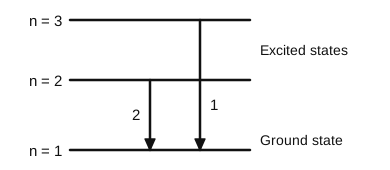
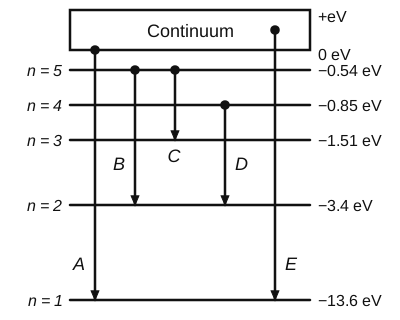
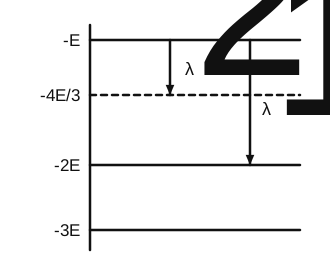
For hydrogen atom, $\lambda_1$ and $\lambda_2$ are the wavelengths corresponding to the transitions 1 and 2 respectively as shown in figure. The ratio of $\lambda_1$ and $\lambda_2$ is $\dfrac{x}{32}$. The value of $x$ is ______.
Q 12-12-063JEE MainJEE Main 2023 (31 Jan, Shift 2)Easy
If the binding energy of ground state electron in a hydrogen atom is $13.6\ \text{eV}$, then the energy required to remove the electron from the second excited state of $\text{Li}^{2+}$ will be $x\times10^{-1}\ \text{eV}$. The value of $x$ is ______.
Concept. Hydrogen-like ion: $E_n=-\dfrac{13.6Z^2}{n^2}$ eV. Second excited state means $n=3$.
Step 1. Li$^{2+}$. $\dfrac{13.6\times9}{9}=13.6$ eV $=136\times10^{-1}$ eV.
Answer. $136$.
Solution by Sreeraj P, M.Sc Physics
Q 12-12-065JEE MainJEE Main 2023 (25 Jan, Shift 1)Medium
The wavelength of the radiation emitted is $\lambda_0$ when an electron jumps from the second excited state to the first excited state of hydrogen atom. If the electron jumps from the third excited state to the second orbit of the hydrogen atom, the wavelength of the radiation emitted will be $\dfrac{20}{x}\lambda_0$. The value of $x$ is ______.
Q 12-12-066JEE MainJEE Main 2023 (25 Jan, Shift 2)Medium
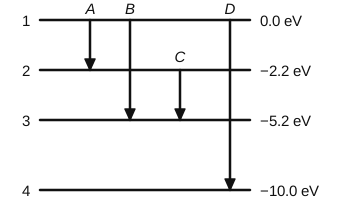
The energy levels of an atom are shown in figure. Which one of these transitions will result in the emission of a photon of wavelength $124.1\ \text{nm}$? Given $h=6.62\times10^{-34}\ \text{J s}$.
Q 12-12-067JEE MainJEE Main 2023 (13 Apr, Shift 2)Medium
An atom absorbs a photon of wavelength $500\ \text{nm}$ and emits another photon of wavelength $600\ \text{nm}$. The net energy absorbed by the atom in this process is $n\times10^{-4}\ \text{eV}$. The value of $n$ is ______. [Assume the atom to be stationary during the absorption and emission process] (Take $h=6.6\times10^{-34}\ \text{J s}$ and $c=3\times10^8\ \text{m s}^{-1}$)
Concept. Energy kept by the atom $=$ energy absorbed $-$ energy emitted $=hc\left(\dfrac1{\lambda_1}-\dfrac1{\lambda_2}\right)$.
Step 1. $hc$ in eV nm. $\dfrac{6.6\times10^{-34}\times3\times10^8}{1.6\times10^{-19}}=1237.5$ eV nm.
Step 2. Net energy. $1237.5\left(\dfrac1{500}-\dfrac1{600}\right)=\dfrac{1237.5}{3000}=0.4125$ eV $=4125\times10^{-4}$ eV.
Answer. $4125$.
Solution by Sreeraj P, M.Sc Physics
Q 12-12-068JEE MainJEE Main 2023 (15 Apr, Shift 1)Medium
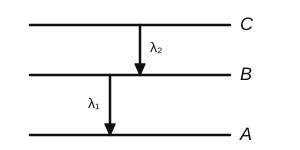
As per given figure $A$, $B$ and $C$ are the first, second and third excited energy levels of hydrogen atom respectively. If the ratio of the two wavelengths $\left(\text{i.e. }\dfrac{\lambda_1}{\lambda_2}\right)$ is $\dfrac7{4n}$, then the value of $n$ will be ______.
Concept. The first, second and third excited levels are $n = 2, 3, 4$. Use $\dfrac{1}{\lambda} \propto \dfrac{1}{n_1^2} - \dfrac{1}{n_2^2}$ for each transition.
Q 12-12-070JEE MainJEE Main 2023 (11 Apr, Shift 1)Medium
A monochromatic light is incident on a hydrogen sample in ground state. Hydrogen atoms absorb a fraction of light and subsequently emit radiation of six different wavelengths. The frequency of incident light is $x\times10^{15}\ \text{Hz}$. The value of $x$ is ______. (Given $h=4.25\times10^{-15}\ \text{eV s}$)
Concept. For a hydrogen-like ion $E_n = -13.6\dfrac{Z^2}{n^2}$ eV. Following the official key, "first state" is read as the first excited state, $n = 2$.
Step 1. Substitute. He$^+$: $Z = 2$, $n = 2$: $$E = -13.6 \times \frac{4}{4} = -13.6\ \text{eV}$$ (The ground state of He$^+$ would be $-54.4$ eV.)
Answer. $-13.6$ eV (Option C).
Solution by Sreeraj P, M.Sc Physics
Q 12-12-072JEE MainJEE Main 2023 (12 Apr, Shift 1)Medium
A $12.5\ \text{eV}$ electron beam is used to bombard gaseous hydrogen at room temperature. The number of spectral lines emitted will be
Concept. The electron beam can lift atoms only to levels within $12.5$ eV of the ground state.
Step 1. Levels. $E_3-E_1=12.09$ eV $<12.5$; $E_4-E_1=12.75$ eV $>12.5$. So up to $n=3$.
Step 2. Lines. $\dfrac{3\times2}{2}=3$.
Answer. Option D.
Solution by Sreeraj P, M.Sc Physics
Q 12-12-073JEE MainJEE Main 2023 (13 Apr, Shift 1)Easy
The radius of $2^\text{nd}$ orbit of $\text{He}^+$ of Bohr's model is $r_1$ and that of fourth orbit of $\text{Be}^{3+}$ is represented as $r_2$. Now the ratio $\dfrac{r_2}{r_1}$ is $x:1$. The value of $x$ is ______.
Step 1. Value. $\dfrac{25}{3}\times0.51=4.25$ Å $=425\times10^{-12}$ m.
Answer. $425$.
Solution by Sreeraj P, M.Sc Physics
Q 12-12-076JEE MainJEE Main 2023 (6 Apr, Shift 2)Medium
A small particle of mass $m$ moves in such a way that its potential energy $U=\dfrac12m\omega^2r^2$ where $\omega$ is constant and $r$ is the distance of the particle from origin. Assuming Bohr's quantization of momentum and circular orbit, the radius of $n^\text{th}$ orbit will be proportional to
Concept. The force from $U = \dfrac12m\omega^2r^2$ is $F = m\omega^2r$ towards the origin; combine it with Bohr's quantisation $mvr = \dfrac{nh}{2\pi}$.
Q 12-12-077JEE MainJEE Main 2023 (6 Apr, Shift 2)Medium
Experimentally it is found that $12.8\ \text{eV}$ energy is required to separate a hydrogen atom into a proton and an electron. So the orbital radius of the electron in a hydrogen atom is $\dfrac9x\times10^{-10}$ m. The value of $x$ is ______. ($1\ \text{eV}=1.6\times10^{-19}$ J, $\dfrac1{4\pi\epsilon_0}=9\times10^9\ \text{N m}^2\,\text{C}^{-2}$ and electronic charge $=1.6\times10^{-19}$ C)
Step 1. Radius. $r=\dfrac{9\times10^9\times(1.6\times10^{-19})^2}{2\times12.8\times1.6\times10^{-19}}=5.625\times10^{-11}$ m $=\dfrac{9}{16}\times10^{-10}$ m.
Answer. $x=16$.
Solution by Sreeraj P, M.Sc Physics
Q 12-12-078JEE MainJEE Main 2023 (8 Apr, Shift 2)Easy
The ratio of wavelength of spectral lines $\text{H}_\alpha$ and $\text{H}_\beta$ in the Balmer series is $\dfrac x{20}$. The value of $x$ is ______.
Q 12-12-079JEE MainJEE Main 2023 (10 Apr, Shift 1)Easy
The angular momentum for the electron in Bohr's orbit is $L$. If the electron is assumed to revolve in second orbit of hydrogen atom, then the change in angular momentum will be
Concept. Bohr's quantisation: $L = \dfrac{nh}{2\pi}$, so $L_n = nL_1$.
Step 1. Change. First orbit: $L$. Second orbit: $2L$. Change $= 2L - L = L$.
Answer. $L$ (Option C).
Solution by Sreeraj P, M.Sc Physics
Q 12-12-080JEE MainJEE Main 2023 (1 Feb, Shift 1)Medium
A light of energy $12.75$ eV is incident on a hydrogen atom in its ground state. The atom absorbs the radiation and reaches to one of its excited states. The angular momentum of the atom in the excited state is $\dfrac x\pi\times10^{-17}$ eV s. The value of $x$ is ______ (use $h=4.14\times10^{-15}$ eV s, $c=3\times10^8\ \text{m s}^{-1}$).
Concept. Find the final level from the energy, then $L=\dfrac{nh}{2\pi}$.
Step 1. Level. $-13.6+12.75=-0.85$ eV $=-\dfrac{13.6}{16}$, so $n=4$.
Step 2. Angular momentum. $\dfrac{4h}{2\pi}=\dfrac{2\times4.14\times10^{-15}}{\pi}=\dfrac{828}{\pi}\times10^{-17}$ eV s.
Answer. $828$.
Solution by Sreeraj P, M.Sc Physics
Q 12-12-081JEE MainJEE Main 2023 (1 Feb, Shift 2)Easy
An electron of a hydrogen like atom, having $Z=4$, jumps from $4^\text{th}$ energy state to $2^\text{nd}$ energy state. The energy released in this process will be (Given $Rch=13.6$ eV, where $R$ = Rydberg constant, $c$ = speed of light in vacuum, $h$ = Planck's constant)
Answer: (C) A classical atom based on Rutherford's model is doomed to collapse.
Concept. In Rutherford's model electrons orbit a tiny heavy nucleus. Classically an accelerating charge radiates, loses energy and spirals in, so the atom should collapse.
Step 1. Other options. Electrons in orbit are not in static equilibrium (A false); mass is concentrated, not continuous, in Rutherford's model (B false); in Thomson's model too the positive part carries most mass (D false).
Answer. Option C.
Solution by Sreeraj P, M.Sc Physics
Q 12-12-083JEE MainJEE Main 2022 (24 Jun, Shift 2)Easy
In Bohr's atomic model of hydrogen, let $K$, $P$ and $E$ be the kinetic energy, potential energy and total energy of the electron respectively. Choose the correct option when the electron undergoes transition to a higher level:
Q 12-12-086JEE MainJEE Main 2022 (25 Jul, Shift 2)Medium
A hydrogen atom comes from an excited state to the ground state by emitting a photon of wavelength $\lambda$. The value of principal quantum number $n$ of the excited state will be: ($R$: Rydberg constant)
Q 12-12-087JEE MainJEE Main 2022 (25 Jul, Shift 2)Medium
$\dfrac{x}{x+4}$ is the ratio of energies of photons produced due to transition of an electron of hydrogen atom from its (i) third permitted energy level to the second level and (ii) the highest permitted energy level to the second permitted level. The value of $x$ will be ______.
Q 12-12-088JEE MainJEE Main 2022 (26 Jul, Shift 1)Medium
In a hydrogen spectrum, $\lambda$ is the wavelength of the first transition line of the Lyman series. The wavelength difference will be $a\lambda$ between the wavelength of the 3rd transition line of the Paschen series and that of the 2nd transition line of the Balmer series, where $a$ = ______.
Q 12-12-089JEE MainJEE Main 2022 (27 Jun, Shift 1)Easy
A hydrogen atom in its ground state absorbs $10.2$ eV of energy. The angular momentum of electron of the hydrogen atom will increase by the value of (Given, Planck's constant $= 6.6\times10^{-34}$ Js).
Concept. $10.2$ eV takes the electron from $n=1$ to $n=2$; $L$ rises by $\dfrac{h}{2\pi}$.
Step 1. Change. $\dfrac{6.6\times10^{-34}}{2\pi}=1.05\times10^{-34}$ J s.
Answer. Option B.
Solution by Sreeraj P, M.Sc Physics
Q 12-12-090JEE MainJEE Main 2022 (27 Jun, Shift 1)Medium
A beam of monochromatic light is used to excite the electron in $\text{Li}^{++}$ from the first orbit to the third orbit. The wavelength of monochromatic light is found to be $x\times10^{-10}$ m. The value of $x$ is ______ .
Q 12-12-091JEE MainJEE Main 2022 (27 Jun, Shift 2)Easy
Given below are two statements
Statement I: In hydrogen atom, the frequency of radiation emitted when an electron jumps from lower energy orbit $(E_1)$ to higher energy orbit $(E_2)$, is given as $hf = E_1 - E_2$
Statement II: The jumping of electron from higher energy orbit $(E_2)$ to lower energy orbit $(E_1)$ is associated with frequency of radiation given as $f = \dfrac{(E_2 - E_1)}{h}$. This condition is Bohr's frequency condition.
In the light of the above statements, choose the correct answer from the options given below:
Answer: (D) Statement I is incorrect but Statement II is true.
Concept. Bohr's frequency condition: a jump from the higher level $E_2$ to the lower $E_1$ emits $hf=E_2-E_1$. Going up needs energy to be absorbed.
Step 1. Statement I. It gives $hf=E_1-E_2$, a negative value, for a jump upward: incorrect.
Step 2. Statement II. Correct: that is the frequency condition.
Answer. Option D.
Solution by Sreeraj P, M.Sc Physics
Q 12-12-092JEE MainJEE Main 2021 (27 Jul, Shift 1)Easy
In Bohr's atomic model, the electron is assumed to revolve in a circular orbit of radius $0.5$ Å. If the speed of electron is $2.2\times10^6\ \text{m s}^{-1}$, then the current associated with the electron will be ______ $\times10^{-2}$ mA. [Take $\pi$ as $\dfrac{22}{7}$]
Step 2. Current. $I=1.6\times10^{-19}\times7.0\times10^{15}=1.12\times10^{-3}$ A $=112\times10^{-2}$ mA.
Answer. $112$.
Solution by Sreeraj P, M.Sc Physics
Q 12-12-093JEE MainJEE Main 2021 (27 Jul, Shift 2)Medium
An electron and proton are separated by a large distance. The electron starts approaching the proton with energy $3$ eV. The proton captures the electron and forms a hydrogen atom in second excited state. The resulting photon is incident on a photosensitive metal of threshold wavelength $4000$ Å. What is the maximum kinetic energy of the emitted photoelectron?
Concept. The photon carries the electron's energy plus the binding energy of the level it falls into: second excited state, $n=3$, $-1.51$ eV.
Step 1. Photon. $3+1.51=4.51$ eV.
Step 2. Work function. $\dfrac{12400}{4000}=3.1$ eV.
Step 3. Photoelectron. $4.51-3.1=1.41$ eV.
Answer. Option B.
Solution by Sreeraj P, M.Sc Physics
Q 12-12-094JEE MainJEE Main 2021 (27 Jul, Shift 2)Medium
The $K_\alpha$ X-ray of molybdenum has wavelength $0.071$ nm. If the energy of a molybdenum atom with a $K$ electron knocked out is $27.5$ keV, the energy of this atom when an $L$ electron is knocked out will be ______ keV. (Round off to the nearest integer) $[h = 4.14\times10^{-15}\ \text{eV s},\ c = 3\times10^8\ \text{m s}^{-1}]$
Concept. $K_\alpha$ is emitted when the vacancy moves from the $K$ shell to the $L$ shell, so $E_{K_\alpha} = E_K - E_L$, where $E_K$ and $E_L$ are the energies of the atom with a $K$ or $L$ vacancy.
Step 2. Energy with an $L$ vacancy. $$E_L = E_K - E_{K_\alpha} = 27.5 - 17.5 = 10\ \text{keV}$$
Answer. $10$.
Solution by Sreeraj P, M.Sc Physics
Q 12-12-095JEE MainJEE Main 2021 (31 Aug, Shift 2)Easy
A free electron of $2.6$ eV energy collides with a $\text{H}^+$ ion. This results in the formation of a hydrogen atom in the first excited state and a photon is released. Find the frequency of the emitted photon. ($h = 6.6\times10^{-34}$ J s)
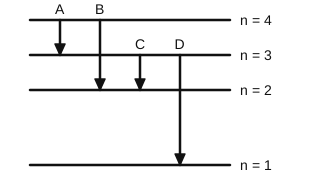
Answer: (C) The series limit of Lyman series, third member of Balmer series and second member of Paschen series.
Concept. A series is named by its lower level. Members are counted from the nearest upper level: for Balmer, $3\to2$ is the first, $4\to2$ the second, $5\to2$ the third.
Step 1. A. From the continuum ($n=\infty$) to $n=1$: Lyman series limit.
Step 2. B. $5\to2$: third member of the Balmer series.
Step 3. C. $5\to3$: second member of the Paschen series ($4\to3$ is the first).
Answer. Option C.
Solution by Sreeraj P, M.Sc Physics
Q 12-12-097JEE MainJEE Main 2021 (24 Feb, Shift 2)Easy
According to Bohr atom model, in which of the following transitions will the frequency be maximum?
Q 12-12-098JEE MainJEE Main 2021 (26 Feb, Shift 1)Medium
If $\lambda_1$ and $\lambda_2$ are the wavelengths of the third member of Lyman and first member of the Paschen series respectively, then the value of $\lambda_1 : \lambda_2$ is:
Q 12-12-100JEE MainJEE Main 2021 (26 Aug, Shift 1)Easy
A particular hydrogen like ion emits radiation of frequency $2.92\times10^{15}$ Hz when it makes transition from $n = 3$ to $n = 1$. The frequency in Hz of radiation emitted in transition from $n = 2$ to $n = 1$ will be:
Q 12-12-101JEE MainJEE Main 2021 (27 Aug, Shift 2)Easy
$X$ different wavelength may be observed in the spectrum from a hydrogen sample if the atoms are excited to states with principal quantum number $n = 6$? The value of $X$ is
Concept. A sample (many atoms) from level $n$ can give all $\dfrac{n(n-1)}{2}$ lines.
Step 1. $n=6$. $\dfrac{6\times5}{2}=15$.
Answer. $15$.
Solution by Sreeraj P, M.Sc Physics
Q 12-12-102JEE MainJEE Main 2020 (8 Jan, Shift 2)Easy
The first member of the Balmer series of hydrogen atom has a wavelength of $6561$ Å. The wavelength of the second member of the Balmer series (in nm) is ______.
Concept. Balmer lines: $\dfrac{1}{\lambda} = R\left(\dfrac{1}{2^2} - \dfrac{1}{n^2}\right)$. Take the ratio of the first ($n = 3$) and second ($n = 4$) members.
Q 12-12-103JEE MainJEE Main 2020 (9 Jan, Shift 2)Medium
The energy required to ionise a hydrogen like ion in its ground state is $9$ Rydbergs. What is the wavelength of the radiation emitted when the electron in this ion jumps from the second excited state to the ground state?
Q 12-12-104JEE MainJEE Main 2020 (7 Jan, Shift 1)Easy
The time period of revolution of an electron in its ground state orbit in a hydrogen atom is $1.6\times10^{-16}$ s. The frequency of revolution of the electron in its first excited state (in s$^{-1}$) is:
Step 1. Ground state. $f_1=\dfrac{1}{1.6\times10^{-16}}=6.25\times10^{15}$ Hz.
Step 2. $n=2$. $\dfrac{6.25\times10^{15}}{8}=7.8\times10^{14}$ Hz.
Answer. Option B.
Solution by Sreeraj P, M.Sc Physics
Q 12-12-105JEE MainJEE Main 2020 (8 Jan, Shift 1)Easy
The graph which depicts the results of the Rutherford gold foil experiment with $\alpha$-particles is: ($\theta$: scattering angle; $Y$: number of scattered $\alpha$-particles detected; plots are schematic and not to scale)
Concept. Rutherford's formula gives the number scattered at angle $\theta$ as $N\propto\dfrac{1}{\sin^4(\theta/2)}$: most $\alpha$ particles pass almost straight through; very few are turned through large angles.
Step 1. Shape. Very large at small $\theta$, falling steeply, and small but not zero towards $\pi$.
Answer. Option D.
Solution by Sreeraj P, M.Sc Physics
Q 12-12-106JEE MainJEE Main 2020 (2 Sep, Shift 2)Medium
In a hydrogen atom the electron makes a transition from $(n+1)^{\text{th}}$ level to the $n^{\text{th}}$ level. If $n \gg 1$, the frequency of radiation emitted is proportional to:
Concept. $\nu\propto\dfrac1{n^2}-\dfrac1{(n+1)^2}=\dfrac{2n+1}{n^2(n+1)^2}\approx\dfrac{2}{n^3}$ for large $n$.
Answer. $\dfrac1{n^3}$ (Option B).
Solution by Sreeraj P, M.Sc Physics
Q 12-12-108JEE MainJEE Main 2020 (5 Sep, Shift 1)Medium
A particle of mass $200\ \text{MeV}/c^{2}$ collides with a hydrogen atom at rest. Soon after the collision, the particle comes to rest, and the atom recoils and goes to its first excited state. The initial kinetic energy of the particle (in eV) is $\dfrac N4$. The value of $N$ is: (Given the mass of the hydrogen atom to be $1\ \text{GeV}/c^{2}$) ______
Concept. Momentum is conserved; the kinetic energy that disappears excites the atom ($10.2$ eV for $1\to2$).
Step 1. Momentum. $mu=Mv$ with $M=5m$, so $v=\dfrac u5$.
Step 2. Energy lost. $\tfrac12mu^2-\tfrac12(5m)\dfrac{u^2}{25}=\tfrac12mu^2\cdot\dfrac45=10.2$ eV.
Step 3. Initial KE. $\tfrac12mu^2=12.75$ eV $=\dfrac{51}4$ eV.
Answer. $N=51$.
Solution by Sreeraj P, M.Sc Physics
Q 12-12-109JEE MainJEE Main 2019 (10 Apr, Shift 2)Medium
In $\text{Li}^{++}$, an electron in the first Bohr orbit is excited to a level by a radiation of wavelength $\lambda$. When the ion gets de-excited to the ground state in all possible ways (including intermediate emissions), a total of six spectral lines are observed. What is the value of $\lambda$? (Given: $h = 6.63\times10^{-34}\ \text{J s}$; $c = 3\times10^8\ \text{m s}^{-1}$)
Q 12-12-110JEE MainJEE Main 2019 (8 Apr, Shift 1)Medium
Radiation coming from transitions $n = 2$ to $n = 1$ of hydrogen atoms fall on $\text{He}^+$ ions in $n = 1$ and $n = 2$ states. The possible transition of helium ions as they absorb energy from the radiation is
Concept. The H photon has $10.2$ eV. He$^+$ levels are $-\dfrac{54.4}{n^2}$; find a jump of exactly $10.2$ eV.
Step 1. Try $2\to4$. $54.4\left(\dfrac14-\dfrac1{16}\right)=10.2$ eV. (From $n=1$ the smallest jump is $40.8$ eV.)
Answer. Option B.
Solution by Sreeraj P, M.Sc Physics
Q 12-12-111JEE MainJEE Main 2019 (9 Apr, Shift 1)Easy
Taking the wavelength of first Balmer line in hydrogen spectrum ($n = 3$ to $n = 2$) as $660\ \text{nm}$, the wavelength of the $2^{\text{nd}}$ Balmer line ($n = 4$ to $n = 2$) will be
Concept. Ionisation energy from level $n$ $=\dfrac{13.6Z^2}{n^2}$ eV. First excited: $n=2$.
Step 1. He$^+$. $\dfrac{13.6\times4}{4}=13.6$ eV.
Answer. Option A.
Solution by Sreeraj P, M.Sc Physics
Q 12-12-113JEE MainJEE Main 2019 (11 Jan, Shift 1)Medium
A hydrogen atom, initially in the ground state, is excited by absorbing a photon of wavelength $980$ Å. The radius of the atom in the excited state, in terms of Bohr radius $a_0$, will be:
Concept. The photon must supply the gap to a level exactly: $13.6\left(1-\dfrac1{n^2}\right)$ eV. Then $r_n=n^2a_0$.
Step 1. Photon energy. $\dfrac{1240}{98}=12.65$ eV, nearest the $1\to4$ gap ($12.75$ eV).
Step 2. Radius. $r_4=16a_0$.
Answer. $16a_0$ (Option C).
Solution by Sreeraj P, M.Sc Physics
Q 12-12-114JEE MainJEE Main 2019 (11 Jan, Shift 2)Easy
In a hydrogen like atom, when an electron jumps from the M-shell to the L-shell, the wavelength of emitted radiation is $\lambda$. If an electron jumps from N-shell to the L-shell, the wavelength of emitted radiation will be:
Q 12-12-115JEE MainJEE Main 2019 (12 Jan, Shift 1)Medium
A particle of mass $m$ moves in a circular orbit in a central potential field $U(r) = \dfrac12kr^2$. If Bohr's quantization conditions are applied, radii of possible orbitals and energy levels vary with quantum number $n$ as:
Q 12-12-116JEE MainJEE Main 2019 (12 Jan, Shift 2)Easy
In a Frank-Hertz experiment, an electron of energy $5.6$ eV passes through mercury vapour and emerges with an energy $0.7$ eV. The minimum wavelength of photons emitted by mercury atoms is close to:
Concept. The energy the electron loses goes into exciting a mercury atom; the atom then emits a photon of that energy.
Step 1. Energy. $5.6-0.7=4.9$ eV.
Step 2. Wavelength. $\dfrac{1240}{4.9}=253$ nm, close to $250$ nm.
Answer. Option A.
Solution by Sreeraj P, M.Sc Physics
Q 12-12-117JEE MainJEE Main 2019 (12 Apr, Shift 1)Medium
An excited He$^+$ ion emits two photons in succession, with wavelengths $108.5$ nm and $30.4$ nm, in making a transition to the ground state. The quantum number $n$, corresponding to its initial excited state is (for a photon of wavelength $\lambda$, energy $E = \dfrac{1240\ \text{eV}}{\lambda\ (\text{in nm})}$)
Q 12-12-118JEE MainJEE Main 2019 (12 Apr, Shift 2)Easy
Consider an electron in a hydrogen atom, revolving in its second excited state (having radius $4.65$ Å). The de Broglie wavelength of this electron is:
Q 12-12-119JEE MainJEE Main 2019 (12 Apr, Shift 2)Easy
The electron in a hydrogen atom first jumps from the third excited state to the second excited state and subsequently to the first excited state. The ratio of the respective wavelengths $\dfrac{\lambda_1}{\lambda_2}$ of the photons emitted in this process is:
Q 12-12-120JEE MainJEE Main 2018 (15 Apr, Shift 1)Medium
The energy required to remove the electron from a singly ionized Helium atom is $2.2$ times the energy required to remove an electron from helium atom. The total energy required to ionize the Helium atom completely is close to
Concept. Ionising helium completely takes two steps: remove the first electron (energy $E_1$), then the electron of He$^+$, which needs $13.6\times2^2=54.4$ eV.
Step 1. First electron. $54.4=2.2E_1$, so $E_1=24.7$ eV.
Step 2. Total. $24.7+54.4=79.1$ eV.
Answer. About $79$ eV (Option C).
Solution by Sreeraj P, M.Sc Physics
Q 12-12-121JEE MainJEE Main 2018 (15 Apr, Shift 2)Medium
Muon $(\mu^{-1})$ is negatively charged $(|q| = |e|)$ with a mass $m_\mu = 200\,m_e$, where $m_e$ is the mass of the electron and $e$ is the electronic charge. If $\mu^{-1}$ is bound to a proton to form a hydrogen like atom, identify the correct statements.
(A) Radius of the muonic orbit is 200 times smaller than that of the electron.
(B) The speed of the $\mu^{-1}$ in the $n$th orbit is $\dfrac{1}{200}$ times that of the electron in the $n$th orbit.
(C) The ionization energy of muonic atom is 200 times more than that of an hydrogen atom.
(D) The momentum of the muon in the $n$th orbit is 200 times more than that of the electron.
According to Bohr's theory, the time averaged magnetic field at the centre (i.e., nucleus) of a hydrogen atom due to the motion of electrons in the $n^{\text{th}}$ orbit is proportional to: ($n$ = principal quantum number)
An electron from various excited states of hydrogen atom emit radiation to come to the ground state. Let $\lambda_n$, $\lambda_g$ be the de Broglie wavelength of the electron in the $n^{\text{th}}$ state and the ground state respectively. Let $\Lambda_n$ be the wavelength of the emitted photon in the transition from the $n^{\text{th}}$ state to the ground state. For large $n$ ($A$, $B$ are constants):
Answer: (B) $\Lambda_n \approx A + \dfrac{B}{\lambda_n^2}$
Concept. The electron's wavelength in orbit $n$ is $\lambda_n=\dfrac{2\pi r_n}{n}\propto n$, so $n=\dfrac{\lambda_n}{\lambda_g}$. The photon to the ground state has $\dfrac1{\Lambda_n}=R\left(1-\dfrac1{n^2}\right)$.
Step 1. Large $n$. $\Lambda_n=\dfrac1R\left(1-\dfrac1{n^2}\right)^{-1}\approx\dfrac1R\left(1+\dfrac1{n^2}\right)$.
Step 2. In terms of $\lambda_n$. $\Lambda_n\approx\dfrac1R+\dfrac{\lambda_g^2}{R}\cdot\dfrac{1}{\lambda_n^2}=A+\dfrac{B}{\lambda_n^2}$.
Answer. Option B.
Solution by Sreeraj P, M.Sc Physics
Q 12-12-126JEE MainJEE Main 2018 (8 Apr)Easy
If the series limit frequency of the Lyman series is $\nu_L$, then the series limit frequency of the Pfund series is:
Let $T_1$ and $T_2$ be the energy of an electron in the first and second excited states of hydrogen atoms, respectively. According to the Bohr's model of an atom, the ratio $T_1 : T_2$ is
Q 12-12-129JEE MainJEE Main 2025 (2 Apr, Shift 2)Easy
Assuming the validity of Bohr's atomic model for hydrogen-like ions, the radius of the $\text{Li}^{++}$ ion in its ground state is given by $\dfrac{1}{X}a_0$, where $X$ = ______. (Where $a_0$ is the first Bohr radius.)
Answer: (C) Both A and R are true and R is the correct explanation of A.
Concept. Bohr's model balances one electron against the nucleus. With two or more electrons, their mutual repulsion changes the energies, and the model has no term for it.
Step 1. Assertion. True: one-electron systems only.
Step 2. Reason. True, and it is the cause.
Answer. Option C.
Solution by Sreeraj P, M.Sc Physics
Q 12-12-131JEE MainJEE Main 2025 (3 Apr, Shift 2)Easy
An electron in the hydrogen atom, initially in the fourth excited state, makes a transition to the $n^{\text{th}}$ energy state by emitting a photon of energy $2.86\ \text{eV}$. The integer value of $n$ will be ______.
Q 12-12-132JEE MainJEE Main 2025 (4 Apr, Shift 1)Easy
Considering the Bohr model of hydrogen-like atoms, the ratio of the radius of the $5^{\text{th}}$ orbit of the electron in $\text{Li}^{2+}$ and $\text{He}^+$ is:
Q 12-12-133JEE MainJEE Main 2025 (4 Apr, Shift 2)Easy
Given below are two statements:
Statement (I): The dimensions of Planck's constant and angular momentum are the same.
Statement (II): In Bohr's model, electrons revolve around the nucleus only in those orbits for which the angular momentum is an integral multiple of Planck's constant.
In the light of the above statements, choose the most appropriate answer from the options given below:


 Solution by Sreeraj P, M.Sc Physics