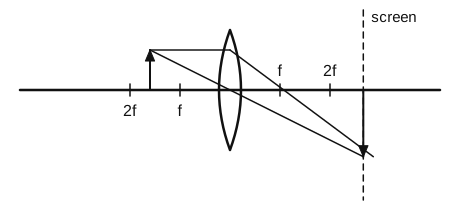
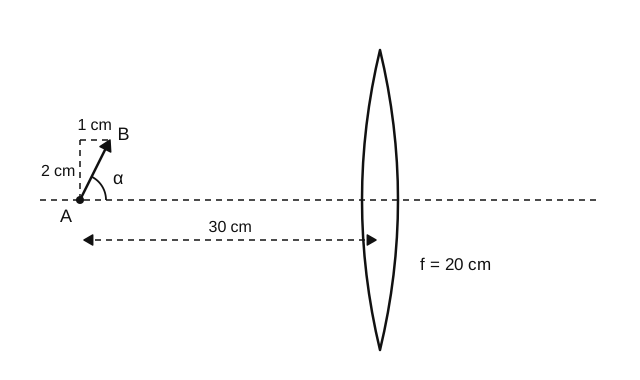
Answer: (A) $60\ \text{cm}$ behind the lens, real, magnified
Using $\frac1v - \frac1u = \frac1f$ with $u = -30\ \text{cm}$, $f = +20\ \text{cm}$: $$\frac1v = \frac1{20} - \frac1{30} = \frac1{60} \;\Rightarrow\; v = +60\ \text{cm}$$ Positive $v$ means a real image on the other side; $m = v/u = -2$, so it is inverted and twice the size.
Solution by Sreeraj P, M.Sc Physics
Q 12-09-002NEETNEET 2026Top questionEasy
Which of the following measurements require 'index correction' ?
Answer: (C) Measurement of focal length of lenses using optical bench
On an optical bench, the distance read between two uprights from the scale (using their index marks) is not exactly the true distance between the optical elements (for example, lens and needle tip). The difference is the index error, and every measured distance must be corrected for it.
This index correction is applied when measuring the focal length of lenses (or mirrors) on an optical bench.
Solution by Sreeraj P, M.Sc Physics
Q 12-09-003NEETNEET 2026Top questionMedium
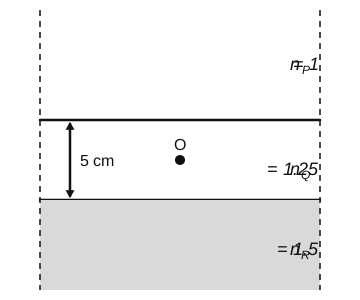
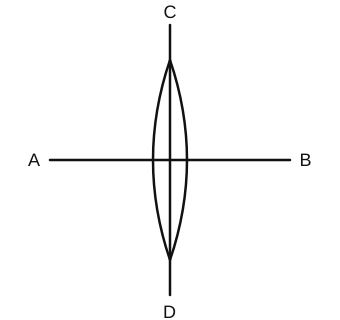
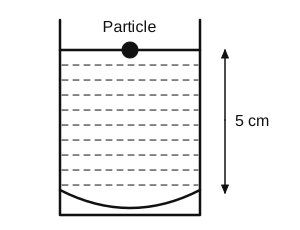
Consider three media P, Q and R with refractive indices $1$, $1.25$, and $1.5$, respectively. The medium Q having a thickness of $5$ cm is placed between extended media P and R as shown in the figure. An object O is placed at the center of medium Q. If viewed from medium P near the normal direction, the apparent depth of O is $h_1$. For similar observation from medium R, the apparent depth is $h_2$. The value of $|h_1 - h_2|$, in cm, is :
The object is at the centre of Q, so its real depth from either face is $2.5$ cm.
For near-normal viewing, apparent depth $= \text{real depth} \times \dfrac{n_{\text{observer}}}{n_{\text{object}}}$.
From P: $h_1 = 2.5 \times \dfrac{1}{1.25} = 2$ cm
From R: $h_2 = 2.5 \times \dfrac{1.5}{1.25} = 3$ cm
$$|h_1 - h_2| = 1\ \text{cm}$$
Solution by Sreeraj P, M.Sc Physics
Q 12-09-004NEETNEET 2026Top questionMedium
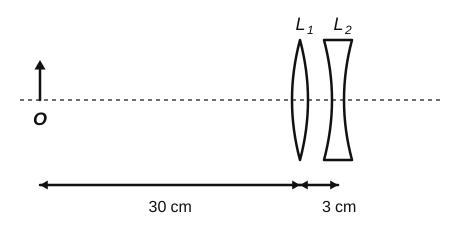
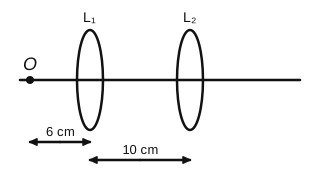
The lens combination as shown in the figure, consists of two lenses, $L_1$ and $L_2$, of the focal lengths $+10$ cm and $-10$ cm, respectively. The position of the image formed is :
The final image is $60$ cm to the left of the concave lens.
Solution by Sreeraj P, M.Sc Physics
Q 12-09-005NEETNEET 2025Top questionEasy
A microscope has an objective of focal length $2$ cm, eyepiece of focal length $4$ cm and the tube length of $40$ cm. If the distance of distinct vision of eye is $25$ cm, the magnification in the microscope is
For a compound microscope with the final image at infinity (normal adjustment): $$m = \frac{L}{f_o}\cdot\frac{D}{f_e} = \frac{40}{2} \times \frac{25}{4} = 20 \times 6.25 = 125$$
Solution by Sreeraj P, M.Sc Physics
Q 12-09-006NEETNEET 2025Top questionEasy
In a certain camera, a combination of four similar thin convex lenses are arranged axially in contact. Then the power of the combination and the total magnification in comparison to the power ($p$) and magnification ($m$) for each lens will be, respectively –
For thin lenses in contact, the powers add: $$P = p + p + p + p = 4p$$
For lenses used in succession, each forms an image that is the object for the next, so the magnifications multiply: $$M = m \times m \times m \times m = m^4$$
Solution by Sreeraj P, M.Sc Physics
Q 12-09-007NEETNEET 2024Top questionHard
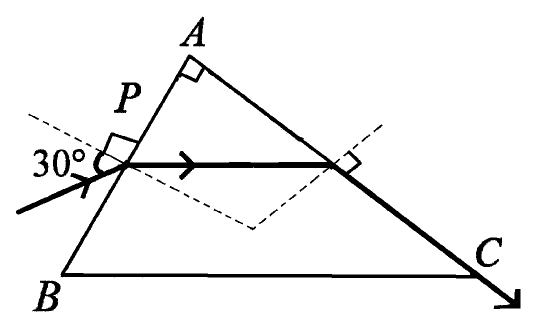
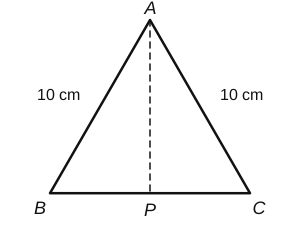
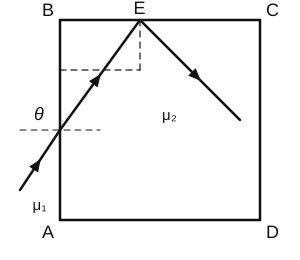
A light ray enters through a right angled prism at point $P$ with the angle of incidence $30°$ as shown in figure. It travels through the prism parallel to its base $BC$ and emerges along the face $AC$. The refractive index of the prism is:
The prism is right-angled at $A$, so $\angle B + \angle C = 90°$.
At face $AB$: the ray inside is parallel to $BC$, so it makes angle $B$ with face $AB$. The angle of refraction is $r_1 = 90° - B$. Snell's law: $$\sin 30° = \mu\sin(90° - B) = \mu\cos B \;\Rightarrow\; \mu\cos B = \frac{1}{2}$$
At face $AC$: the ray (parallel to $BC$) makes angle $C = 90° - B$ with face $AC$, so the angle of incidence is $B$. The ray emerges along the face, so $B$ is the critical angle: $$\mu\sin B = 1$$
A small telescope has an objective of focal length $140$ cm and an eye piece of focal length $5.0$ cm. The magnifying power of telescope for viewing a distant object is:
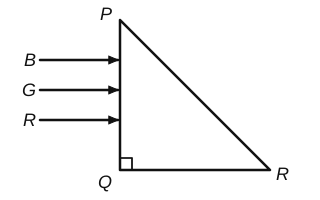
$$\sin C = \frac{1}{n} = \frac{10t_1}{t_2} \;\Rightarrow\; C = \sin^{-1}\left(\frac{10t_1}{t_2}\right)$$
Solution by Sreeraj P, M.Sc Physics
Q 12-09-010NEETNEET 2023Top questionEasy
Two thin lenses are of same focal lengths ($f$), but one is convex and the other one is concave. When they are placed in contact with each other, the equivalent focal length of the combination will be :
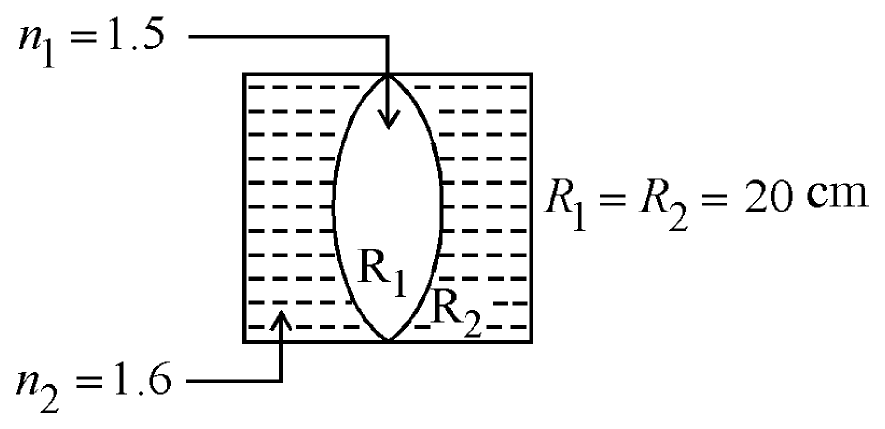
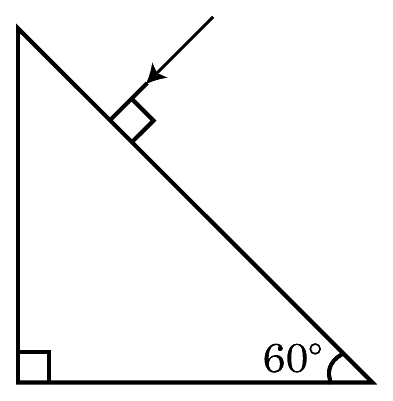
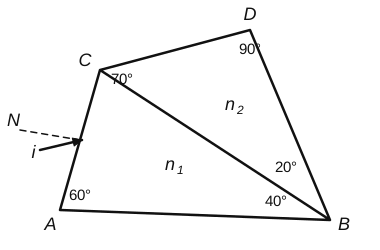
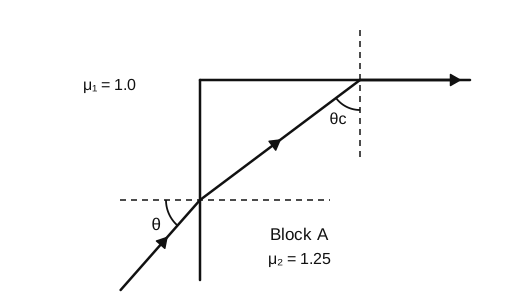
The combination is a biconvex lens of index $n_1 = 1.5$ with the rest of the block, of index $n_2 = 1.6$, forming two plano-concave lenses on either side. All three are thin and in contact.
The ray strikes the slanting face normally, so it enters without bending.
The slanting face makes $60°$ with the base, so the ray inside (perpendicular to that face) travels at $30°$ below the horizontal. It meets the vertical face at an angle of incidence of $30°$ (measured from the horizontal normal).
This is less than the critical angle ($\sin C = 1/\sqrt{3}$, $C \approx 35°$), so the ray emerges. Snell's law at the vertical face: $$\sqrt{3}\sin 30° = \sin e \;\Rightarrow\; \sin e = \frac{\sqrt{3}}{2} \;\Rightarrow\; e = 60°$$
Solution by Sreeraj P, M.Sc Physics
Q 12-09-013NEETNEET 2021Top questionEasy
A convex lens 'A' of focal length $20$ cm and a concave lens 'B' of focal length $5$ cm are kept along the same axis with a distance 'd' between them. If a parallel beam of light falling on 'A' leaves 'B' as a parallel beam, then the distance 'd' in cm will be :
Lens A brings the parallel beam towards its focus, $20$ cm beyond A. For B to send it out parallel, that point must be at B's (virtual) focus, $5$ cm beyond B.
$$d = 20 - 5 = 15\ \text{cm}$$
Solution by Sreeraj P, M.Sc Physics
Q 12-09-014NEETNEET 2021Top questionEasy
A lens of large focal length and large aperture is best suited as an objective of an astronomical telescope since :
A large aperture collects more light (brighter images of faint objects) and gives better resolving power (resolution $\propto D/\lambda$). Both improve the quality and visibility of the image, and a large focal length gives a high magnification ($f_o/f_e$).
All the statements are true.
Solution by Sreeraj P, M.Sc Physics
Q 12-09-015NEETNEET 2021Top questionHard
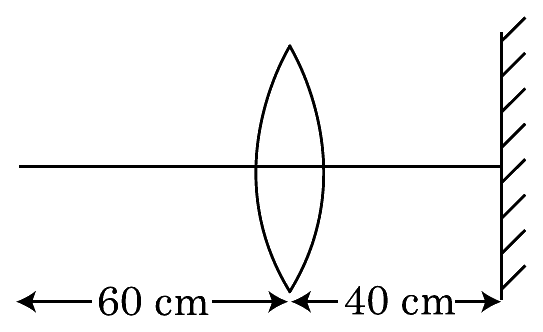
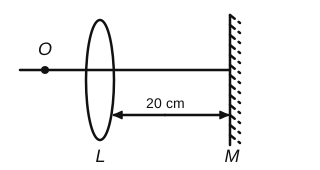
A point object is placed at a distance of $60$ cm from a convex lens of focal length $30$ cm. If a plane mirror were put perpendicular to the principal axis of the lens and at a distance of $40$ cm from it, the final image would be formed at a distance of :
The rays would converge $60$ cm beyond the lens, but the mirror is only $40$ cm away. The image point lies $20$ cm behind the mirror and acts as a virtual object for it.
A plane mirror forms the image as far in front as the object is behind: the reflected rays converge to a real image $20$ cm in front of the mirror, i.e. $20$ cm from the lens (between the lens and the mirror).
This is the intended answer: a real image $20$ cm from the lens.
Solution by Sreeraj P, M.Sc Physics
Q 12-09-016NEETNEET 2020Top questionMedium
A ray is incident at an angle of incidence $i$ on one surface of a small angle prism (with angle of prism A) and emerges normally from the opposite surface. If the refractive index of the material of the prism is $\mu$, then the angle of incidence is nearly equal to :
The ray emerges normally, so the angle of refraction at the second face is $r_2 = 0$. Since $r_1 + r_2 = A$, $r_1 = A$.
At the first face, for small angles, $\sin i \approx i$ and $\sin r_1 \approx r_1$: $$i = \mu r_1 = \mu A$$
Solution by Sreeraj P, M.Sc Physics
Q 12-09-017JEE MainAIEEE 2012Hard
An object $2.4$ m in front of a lens forms a sharp image on a film $12$ cm behind the lens. A glass plate $1$ cm thick, of refractive index $1.50$, is interposed between the lens and the film with its plane faces parallel to the film. At what distance (from the lens) should the object be shifted to be in sharp focus on the film?
Focal length: $\dfrac{1}{f} = \dfrac{1}{12} + \dfrac{1}{240} = \dfrac{21}{240}$, so $f = \dfrac{240}{21}$ cm.
The plate shifts the image away from the lens by $t\left(1 - \dfrac{1}{\mu}\right) = \dfrac{1}{3}$ cm. For the final image to land on the film, the lens alone must form it at $v = 12 - \dfrac{1}{3} = \dfrac{35}{3}$ cm: $$\frac{1}{u} = \frac{1}{v} - \frac{1}{f} = \frac{3}{35} - \frac{21}{240} = -\frac{1}{560} \;\Rightarrow\; u = -560\ \text{cm}$$
The object must be $5.6$ m from the lens.
Solution by Sreeraj P, M.Sc Physics
Q 12-09-018JEE MainIIT JEE 2013Medium
A ray of light in the direction $-\left(\hat{i} + \sqrt{3}\hat{j}\right)$ is incident on a plane mirror. After reflection it travels along the direction $\dfrac{1}{2}\left(\hat{i} - \sqrt{3}\hat{j}\right)$. The angle of incidence is
Concept. On reflection the component of the ray along the mirror is unchanged and the normal component reverses, so the difference (reflected $-$ incident) points along the normal.
Step 2. Normal. $\hat b-\hat a=\dfrac{\hat i-\sqrt3\hat j}{2}+\dfrac{\hat i+\sqrt3\hat j}{2}=\hat i$, so the normal is along $\hat i$.
Step 3. Angle of incidence. It is the angle between the reversed incident ray $-\hat a$ and the normal: $\cos i=(-\hat a)\cdot\hat i=\dfrac12$, so $i=60^\circ$.
Answer. $60^\circ$ (Option C).
Solution by Sreeraj P, M.Sc Physics
Q 12-09-019NEETJEE MainEasy
An object is placed $30$ cm in front of a concave mirror of focal length $20$ cm. The image is formed at
A point source of light is placed $4$ m below the surface of water ($\mu = \dfrac{4}{3}$). The radius of the circle on the surface through which light emerges is
At the edge of the circle, light meets the surface at the critical angle: $\sin C = \dfrac{3}{4}$, $\tan C = \dfrac{3}{\sqrt{7}}$. $$r = h\tan C = \frac{12}{\sqrt{7}} \approx 4.5\ \text{m}$$
Solution by Sreeraj P, M.Sc Physics
Q 12-09-023NEETJEE MainEasy
A glass slab $6$ cm thick ($\mu = 1.5$) is placed over a mark on paper. When viewed from above, the mark appears to be raised by
$\dfrac{1}{v} = \dfrac{1}{10} - \dfrac{1}{15} = \dfrac{1}{30}$, so $v = 30$ cm and $m = \dfrac{v}{u} = \dfrac{30}{-15} = -2$ (real, inverted, twice the size).
Solution by Sreeraj P, M.Sc Physics
Q 12-09-031NEETJEE MainMedium
The distance between an object and a screen is $90$ cm. A convex lens placed between them gives a sharp image on the screen for two positions of the lens, $30$ cm apart. The focal length of the lens is
Hypermetropia: the lens must image an object at $u = -25$ cm at $v = -50$ cm. $$\frac{1}{f} = \frac{1}{v} - \frac{1}{u} = -\frac{1}{50} + \frac{1}{25} = \frac{1}{50} \Rightarrow P = +2\ \text{D}$$
Solution by Sreeraj P, M.Sc Physics
Q 12-09-034NEETJEE MainEasy
A simple microscope has a convex lens of focal length $5$ cm. Its maximum magnifying power, for a near point of $25$ cm, is
Answer: (B) scattering of light, which is stronger for shorter wavelengths
Rayleigh scattering varies as $\dfrac{1}{\lambda^4}$, so blue light is scattered much more than red and reaches us from all parts of the sky.
Solution by Sreeraj P, M.Sc Physics
Q 12-09-036JEE MainMedium
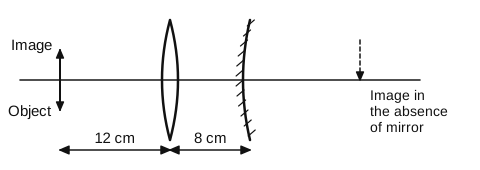
A convex lens of focal length $20$ cm and a concave mirror of focal length $10$ cm are placed coaxially $50$ cm apart. An object is placed $30$ cm in front of the lens (on the side away from the mirror). Find the distance, in cm, of the image formed by the mirror from the mirror.
Lens: $\dfrac{1}{v} = \dfrac{1}{20} - \dfrac{1}{30} = \dfrac{1}{60}$, so $v = 60$ cm: $10$ cm beyond the mirror, which acts as a virtual object for it.
Mirror (distances from the mirror, towards the lens positive for real): the converging rays would meet $10$ cm behind it, $u = +10$, $f = -10$: $$\frac{1}{v} = \frac{1}{f} - \frac{1}{u} = -\frac{1}{10} - \frac{1}{10} = -\frac{1}{5} \;\Rightarrow\; v = -5\ \text{cm}$$
The image is real, $5$ cm in front of the mirror.
Solution by Sreeraj P, M.Sc Physics
Q 12-09-037JEE MainEasy
Find the focal length, in cm, of a plano-convex lens of refractive index $1.5$ whose curved surface has a radius of $15$ cm.
$\dfrac{1}{f} = (1.5 - 1)\dfrac{1}{15} = \dfrac{1}{30}$, so $f = 30$ cm.
Solution by Sreeraj P, M.Sc Physics
Q 12-09-038JEE MainJEE Main 2026 (8 Apr, Shift 2)Hard
A thin biconvex lens is prepared from the glass ($\mu = 1.5$) both curved surfaces of which have equal radii of $20$ cm each. Left side surface of the lens is silvered from outside to make it reflecting. To have the position of image and object at the same place, the object should be placed, from the lens at a distance of ______ cm.
Focal length of the lens: $\dfrac{1}{f_L} = (1.5 - 1)\left(\dfrac{1}{20} + \dfrac{1}{20}\right) = \dfrac{1}{20}$, so $f_L = 20$ cm.
The silvered surface is a concave mirror of radius $20$ cm, so $f_m = 10$ cm.
Light passes through the lens, reflects, and passes through the lens again, so the system acts as a mirror of power $$P = \frac{2}{f_L} + \frac{1}{f_m} = \frac{2}{20} + \frac{1}{10} = \frac{1}{5}\ \text{cm}^{-1}$$
That is a concave mirror of focal length $F = 5$ cm. Image and object coincide when the object is at its centre of curvature: $2F = 10$ cm.
Solution by Sreeraj P, M.Sc Physics
Q 12-09-039JEE MainJEE Main 2026 (8 Apr, Shift 2)Hard
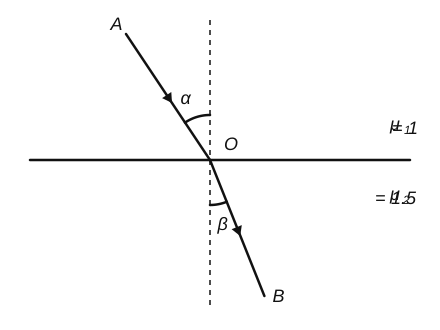
Light ray incident along a vector $\overrightarrow{AO}$ ($\overrightarrow{AO} = 2\hat{i} - 3\hat{j}$) emerges out along vector $\overrightarrow{OB}$ ($\overrightarrow{OB} = C\hat{i} - 4\hat{j}$) as shown in the figure below. The value of $C$ is ______.
Concept. The boundary is horizontal, so the normal is along $\hat j$ and the sine of each angle with the normal is $\dfrac{|x\text{-component}|}{\text{length}}$. Then apply Snell's law.
Q 12-09-040JEE MainJEE Main 2026 (6 Apr, Shift 1)Hard
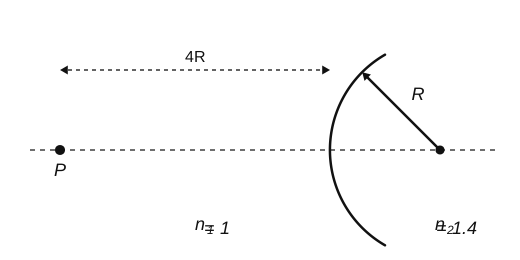
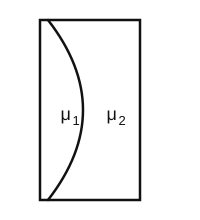
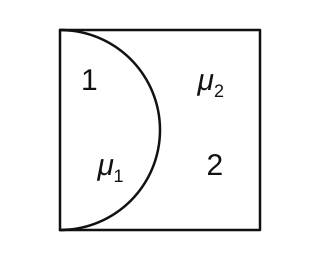
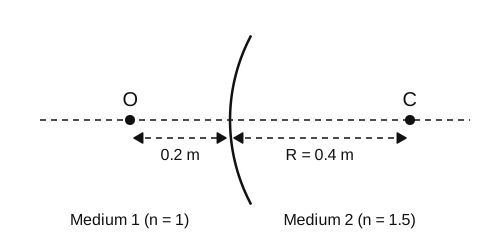
A spherical interface lens of radius $R$ separates two media of refractive indices $1$ and $1.4$ respectively as shown in the figure below. A point source is placed at a distance of $4R$ in front of spherical interface. The magnitude of the magnification of point source image is ______.
Refraction at a spherical surface: $\dfrac{n_2}{v} - \dfrac{n_1}{u} = \dfrac{n_2 - n_1}{R}$ with $u = -4R$ and $R$ positive (centre in the second medium): $$\frac{1.4}{v} + \frac{1}{4R} = \frac{0.4}{R} \;\Rightarrow\; \frac{1.4}{v} = \frac{0.15}{R} \;\Rightarrow\; v = \frac{28R}{3}$$
Q 12-09-042JEE MainJEE Main 2026 (6 Apr, Shift 2)Easy
A concave mirror of focal length $10$ cm forms an image which is double the size of object when the object is placed at two different positions. The distance between the two positions of the object is ______ cm.
Concept. For a mirror $m=-\dfrac vu=\dfrac{f}{f-u}$. A double-size image is either real ($m=-2$) or virtual ($m=+2$): two object positions.
Step 1. Real image. $\dfrac{-10}{-10-u}=-2\Rightarrow-10=20+2u\Rightarrow u=-15$ cm.
Step 2. Virtual image. $\dfrac{-10}{-10-u}=2\Rightarrow-10=-20-2u\Rightarrow u=-5$ cm.
Step 3. Separation. $15-5=10$ cm (in general $2|f|/m$).
Answer. $10$.
Solution by Sreeraj P, M.Sc Physics
Q 12-09-043JEE MainJEE Main 2026 (5 Apr, Shift 1)Medium
A ray of light passing through an equilateral prism is having velocity $2.12 \times 10^8$ m/s in the prism material, then the minimum angle of deviation is ______ degrees.
Q 12-09-044JEE MainJEE Main 2026 (5 Apr, Shift 1)Medium
A compound microscope is designed with two symmetric biconvex lenses. The objective lens is cut vertically, creating two identical plano-convex lenses. One of them is used in place of original objective lens. To retain same magnification keeping the object distance unchanged, the tube length has to be
Concept. Cutting a symmetric biconvex lens perpendicular to its axis gives two plano-convex lenses, each of focal length $2f_o$. The objective's magnification is $m_o\approx\dfrac{L}{f_o}$.
Step 1. New objective. $f_o'=2f_o$.
Step 2. Same magnification. $\dfrac{L'}{2f_o}=\dfrac{L}{f_o}$, so $L'=2L$.
Answer. Increased two times (Option A).
Solution by Sreeraj P, M.Sc Physics
Q 12-09-045JEE MainJEE Main 2026 (5 Apr, Shift 2)Easy
A thin convex lens and a thin concave lens are kept in contact and are co-axial. Which of the following statements is correct for this combination of two lenses ?
Answer: (A) behaves as concave lens if $|f_{\text{convex}}| > |f_{\text{concave}}|$
Concept. Thin lenses in contact: $P=P_1+P_2=\dfrac1{|f_{convex}|}-\dfrac1{|f_{concave}|}$.
Step 1. Sign of the total. If $|f_{convex}|>|f_{concave}|$, the concave lens has the larger power, so $P\lt0$: the pair acts as a concave lens.
Step 2. Other options. B and C are the reverse of this; D is false because the sum of powers does not depend on order.
Answer. Option A.
Solution by Sreeraj P, M.Sc Physics
Q 12-09-046JEE MainJEE Main 2026 (5 Apr, Shift 2)Medium
An object $AB$ is placed $15$ cm on the left of a convex lens $P$ of focal length $10$ cm. Another convex lens $Q$ is now placed $15$ cm right of lens $P$. If the focal length of lens $Q$ is $15$ cm, the final image is ______.
Answer: (B) real, formed at $7.5$ cm right of lens $Q$, with a size same as that of $AB$
Concept. Separated lenses: the image formed by P is the object for Q (here a virtual object, since the light converges towards a point beyond Q). Total magnification $m=m_1m_2$.
Step 1. Lens P. $u=-15$, $f=10$: $\dfrac1v=\dfrac1{10}-\dfrac1{15}=\dfrac1{30}$, $v=30$ cm; $m_1=\dfrac{30}{-15}=-2$.
Step 2. Lens Q. This image is $30-15=15$ cm beyond Q: $u=+15$, $f=15$: $\dfrac1v=\dfrac1{15}+\dfrac1{15}$, $v=7.5$ cm; $m_2=\dfrac{7.5}{15}=\dfrac12$.
Step 3. Final image. Real, $7.5$ cm right of Q, $m=-1$: same size (inverted).
Answer. Option B.
Solution by Sreeraj P, M.Sc Physics
Q 12-09-047JEE MainJEE Main 2026 (4 Apr, Shift 2)Easy
A convex lens is made from glass material having refractive index of $1.4$ with same radius of curvature on both sides. The ratio of its focal length and radius of curvature is ______.
Q 12-09-048JEE MainJEE Main 2026 (4 Apr, Shift 1)Medium
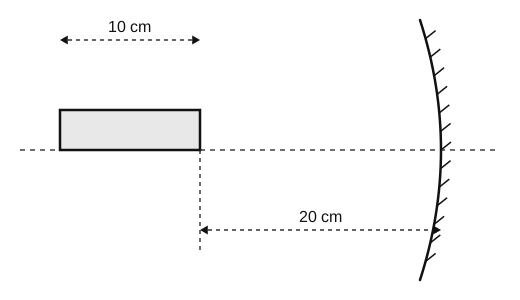
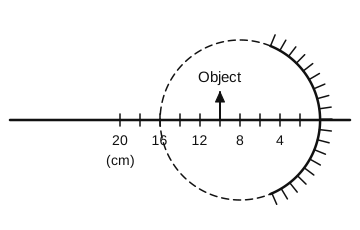
A rod of length $10$ cm lies along the principle axis of a concave mirror of focal length $10$ cm as shown in figure. The length of the image is ______ cm.
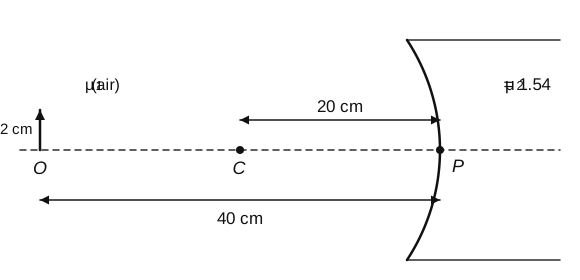
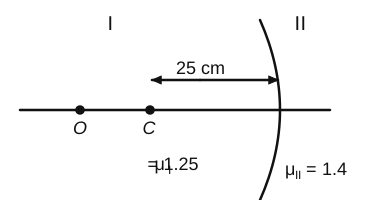
Concept. One refracting surface: $\dfrac{\mu_2}{v}-\dfrac{\mu_1}{u}=\dfrac{\mu_2-\mu_1}{R}$, $m=\dfrac{\mu_1v}{\mu_2u}$. The centre C lies on the object side, so $R=-20$ cm.
Step 1. Image. $\dfrac{1.54}{v}=\dfrac{0.54}{-20}+\dfrac1{-40}=-0.027-0.025=-0.052$, so $v=-29.6$ cm (virtual).
Q 12-09-051JEE MainJEE Main 2026 (2 Apr, Shift 2)Medium
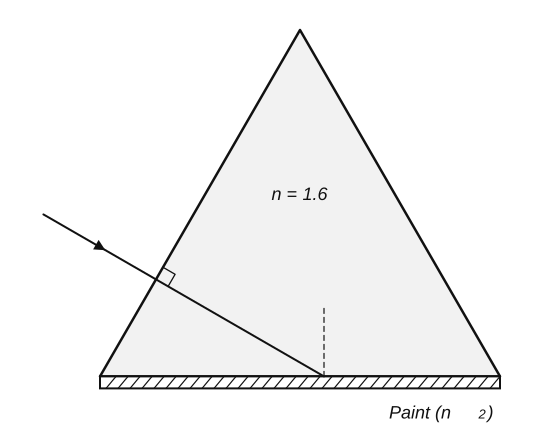
One side of an equilateral prism is painted by a transparent material of refractive index $n_2$. The refractive index of prism is $1.6$. The minimum value of $n_2$ required for total internal reflection from painted face is ______.
The ray enters one face normally, so it goes straight into the prism. In an equilateral prism it then meets the painted face at an angle of incidence of $60^\circ$.
Total internal reflection at the glass–paint boundary needs $i\ge C$, where $\sin C=\dfrac{n_2}{1.6}$:
The limiting (critical) value of $n_2$ is $\dfrac{4\sqrt3}{5}$; TIR occurs for any paint with $n_2$ up to this value.
Solution by Sreeraj P, M.Sc Physics
Q 12-09-052JEE MainJEE Main 2026 (2 Apr, Shift 2)Easy
If sunlight is focused on a paper using convex lens, it starts burning the paper in shortest time when the lens is kept at $30$ cm above the paper. If the radius of curvature of the lens is $60$ cm then the refractive index of the lens material is $\dfrac{\alpha}{10}$. The value of $\alpha$ is ______.
Q 12-09-053JEE MainJEE Main 2026 (28 Jan, Shift 2)Medium
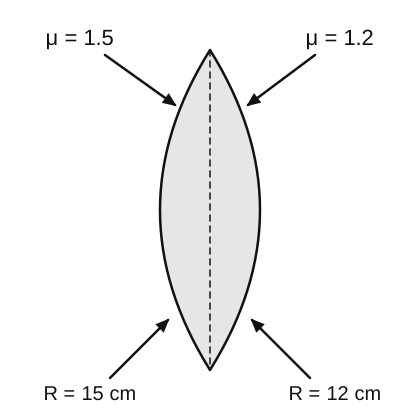
A biconvex lens is formed by using two thin planoconvex lenses, as shown in the figure. The refractive index and radius of curved surfaces are also mentioned in figure. When an object is placed on the left side of lens at a distance of 30 cm from the biconvex lens, the magnification of the image will be :
Concept. With $\delta_m=A$: $\mu=\dfrac{\sin A}{\sin(A/2)}=2\cos\dfrac A2$. The angle of incidence $i=\dfrac{A+\delta_m}{2}=A$ cannot exceed $90^\circ$.
Step 1. Range of $A$. $0<A\le90^\circ$, so $45^\circ\ge\dfrac A2>0$.
Step 2. Range of $\mu$. $2\cos\dfrac A2$ runs from $\sqrt2$ to $2$.
Answer. $\sqrt2<n<2$ (Option B).
Solution by Sreeraj P, M.Sc Physics
Q 12-09-055JEE MainJEE Main 2026 (28 Jan, Shift 1)Medium
The magnitudes of power of a biconvex lens (refractive index 1.5) and that of a plano-concave lens (refractive index $= 1.7$) are same. If the curvature of planoconcave lens exactly matches with the curvature of back surface of the biconvex lens, then ratio of radius of curvature of front and back surface of the biconvex lens is ______
Concept. Write each power with the lens maker's formula. Matching the curvature means the plano-concave lens has the same radius $R_2$ as the back of the biconvex lens.
Q 12-09-056JEE MainJEE Main 2026 (28 Jan, Shift 1)Easy
A convex lens of refractive index 1.5 and focal length $f = 18$ cm is immersed in water. The difference in focal lengths of the given lens when it is in water and in air is $\alpha\times\text{f}$. The value of $\alpha$ is ______ .
Concept. A real image from a mirror is inverted, so $m=-\dfrac vu=-3$ gives $v=3u$, and both lie in front of the mirror.
Step 1. Distances. $|v|-|u|=2|u|=40$ cm, so $u=-20$ cm and $v=-60$ cm.
Step 2. Mirror formula. $\dfrac1f=\dfrac1v+\dfrac1u=-\dfrac1{60}-\dfrac1{20}=-\dfrac4{60}$, so $f=-15$ cm.
Answer. Option D.
Solution by Sreeraj P, M.Sc Physics
Q 12-09-058JEE MainJEE Main 2026 (24 Jan, Shift 2)Medium
Five persons $P_1, P_2, P_3, P_4$ and $P_5$ recorded object distance $(u)$ and image distance (v) using same convex lens having power +5 D as $(25, 96), (30, 62), (35, 37), (45, 35)$ and $(50, 32)$ respectively. Identify correct statement
Q 12-09-059JEE MainJEE Main 2026 (24 Jan, Shift 1)Medium
The exit surface of a prism with refractive index $n$ is coated with a material having refractive index $\dfrac n2$. When this prism is set for minimum angle of deviation, it exactly meets the condition of critical angle. The prism angle is ______ .
Concept. At minimum deviation the ray meets the exit face at $r=\dfrac A2$. It just reaches the critical angle for the glass–coating boundary: $\sin C=\dfrac{n/2}{n}=\dfrac12$.
Step 1. Condition. $\dfrac A2=30^\circ$.
Answer. $A=60^\circ$ (Option A).
Solution by Sreeraj P, M.Sc Physics
Q 12-09-060JEE MainJEE Main 2026 (24 Jan, Shift 1)Easy
In a microscope of tube length 10 cm two convex lenses are arranged with focal length of 2 cm and 5 cm . Total magnification obtained with this system for normal adjustment is $(5)^k$. The value of $k$ is ______ .
Q 12-09-061JEE MainJEE Main 2025 (22 Jan, Shift 1)Medium
Given is a thin convex lens of glass (refractive index $\mu$) and each side having radius of curvature $R$. One side is polished for complete reflection. At what distance from the lens, an object be placed on the optic axis so that the image gets formed on the object itself?
Concept. A lens silvered on one side acts as a mirror with power $P=2P_{\text{lens}}+P_{\text{mirror}}$ (light crosses the lens twice). An image falls on the object when the object is at the centre of curvature, $2F$.
Step 2. Total. $P=\dfrac{4(\mu-1)+2}{R}=\dfrac{2(2\mu-1)}{R}$, so $F=\dfrac{R}{2(2\mu-1)}$.
Step 3. Object. $2F=\dfrac{R}{2\mu-1}$.
Answer. Option D.
Solution by Sreeraj P, M.Sc Physics
Q 12-09-062JEE MainJEE Main 2025 (22 Jan, Shift 1)Hard
In the diagram given below, there are three lenses formed. Considering negligible thickness of each of them as compared to $|R_1|$ and $|R_2|$, i.e., the radii of curvature for upper and lower surfaces of the glass lens, the power of the combination is
Concept. The water above, the glass and the water below form three thin lenses in contact; add their powers. Light goes downward; both curved surfaces have their centres above, on the incident side.
Q 12-09-063JEE MainJEE Main 2025 (22 Jan, Shift 1)Hard
The driver sitting inside a parked car is watching vehicles approaching from behind with the help of his side view mirror, which is a convex mirror with radius of curvature $R = 2\ \text{m}$. Another car approaches him from behind with a uniform speed of $90\ \text{km/h}$. When the car is at a distance of $24\ \text{m}$ from him, the magnitude of the acceleration of the image of the car in the side view mirror is $a$. The value of $100a$ is ______ $\text{m/s}^2$.
Step 2. Acceleration. With $\dfrac{d^2u}{dt^2}=0$: $\dfrac{d^2v}{dt^2}=\dfrac{2f^2}{(u-f)^3}\left(\dfrac{du}{dt}\right)^2$.
Step 3. Numbers. $f=1$ m, $u=-24$ m, $u-f=-25$, speed $25$ m/s: $|a|=\dfrac{2\times1\times625}{15625}=0.08$ m/s$^2$.
Answer. $100a=8$.
Solution by Sreeraj P, M.Sc Physics
Q 12-09-064JEE MainJEE Main 2025 (22 Jan, Shift 2)Easy
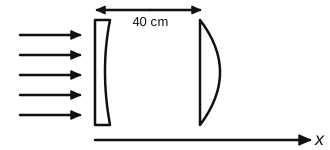
A symmetric thin biconvex lens is cut into four equal parts by two planes $AB$ and $CD$ as shown in the figure. If the power of the original lens is $4\ \text{D}$, then the power of a part of the divided lens is
Concept. A cut along the axis (AB) only reduces the aperture: each half keeps both curved faces and the full power. A cut perpendicular to the axis (CD) through the middle leaves one curved face on each piece: a plano-convex lens with half the power.
Step 1. Each quarter. It has one curved face (from CD) and a smaller aperture (from AB): power $\dfrac P2$.
Step 2. Value. $\dfrac42=2$ D.
Answer. $2$ D (Option C).
Solution by Sreeraj P, M.Sc Physics
Q 12-09-065JEE MainJEE Main 2025 (23 Jan, Shift 1)Medium
A spherical surface of radius of curvature $R$ separates air from glass (refractive index $= 1.5$). The centre of curvature is in the glass medium. A point object $O$ placed in air on the optic axis of the surface forms its real image at $I$ inside glass. The line $OI$ intersects the spherical surface at $P$ and $PO = PI$. The distance $PO$ equals
Q 12-09-066JEE MainJEE Main 2025 (23 Jan, Shift 1)Hard
Given a thin convex lens (refractive index $\mu_2$), kept in a liquid (refractive index $\mu_1$, $\mu_1 < \mu_2$) having radii of curvature $|R_1|$ and $|R_2|$. Its second surface is silver polished. Where should an object be placed on the optic axis so that a real and inverted image is formed at the same place?
Concept. The image falls on the object when the light, after the first refraction, meets the silvered surface normally, so it retraces its path. Rays inside the glass must therefore be directed along radii of the second surface, i.e. appear to come from its centre $C_2$, which is $|R_2|$ in front of the lens.
Step 1. First refraction. Object at $u=-x$ in the liquid; image required at $v=-|R_2|$: $\dfrac{\mu_2}{-|R_2|}-\dfrac{\mu_1}{-x}=\dfrac{\mu_2-\mu_1}{|R_1|}$.
Q 12-09-067JEE MainJEE Main 2025 (23 Jan, Shift 1)Easy
What is the lateral shift of a ray refracted through a parallel-sided glass slab of thickness $h$ in terms of the angle of incidence $i$ and angle of refraction $r$, if the glass slab is placed in air medium?
Concept. Inside the slab the ray travels a length $l=\dfrac{h}{\cos r}$. The emergent ray is parallel to the incident ray; the lateral shift is the perpendicular distance between them.
Step 1. Path inside. $l=\dfrac{h}{\cos r}$.
Step 2. Shift. The path inside makes angle $(i-r)$ with the incident direction, so $d=l\sin(i-r)=\dfrac{h\sin(i-r)}{\cos r}$.
Answer. Option B.
Solution by Sreeraj P, M.Sc Physics
Q 12-09-068JEE MainJEE Main 2025 (23 Jan, Shift 2)Easy
A concave mirror of focal length $f$ in air is dipped in a liquid of refractive index $\mu$. Its focal length in the liquid will be
Concept. A mirror's focal length $f=\dfrac R2$ comes from the law of reflection alone. Reflection does not depend on the medium, so $f$ does not change.
Answer. $f$ (Option B).
Solution by Sreeraj P, M.Sc Physics
Q 12-09-069JEE MainJEE Main 2025 (23 Jan, Shift 2)Easy
The refractive index of the material of a glass prism is $\sqrt3$. The angle of minimum deviation is equal to the angle of the prism. What is the angle of the prism?
Concept. If $\delta_m=A$: $n=\dfrac{\sin A}{\sin\frac A2}=2\cos\dfrac A2$.
Step 1. Solve. $2\cos\dfrac A2=\sqrt3$, so $\dfrac A2=30^\circ$.
Answer. $A=60^\circ$ (Option A).
Solution by Sreeraj P, M.Sc Physics
Q 12-09-070JEE MainJEE Main 2025 (24 Jan, Shift 1)Easy
What is the relative decrease in focal length of a lens for an increase in optical power by $0.1\ \text{D}$ from $2.5\ \text{D}$? ('D' stands for dioptre)
Concept. $f=\dfrac1P$, so $\dfrac{\Delta f}{f}=-\dfrac{\Delta P}{P}$: a rise in power gives the same fractional fall in focal length.
Step 1. Fraction. $\dfrac{0.1}{2.5}=0.04$. (Exactly: $f$ falls from $0.400$ m to $0.385$ m, a $0.038$ fraction.)
Answer. $0.04$ (Option B).
Solution by Sreeraj P, M.Sc Physics
Q 12-09-071JEE MainJEE Main 2025 (24 Jan, Shift 1)Medium
A thin plano-convex lens made of glass of refractive index $1.5$ is immersed in a liquid of refractive index $1.2$. When the plane side of the lens is silver coated for complete reflection, the lens immersed in the liquid behaves like a concave mirror of focal length $0.2\ \text{m}$. The radius of curvature of the curved surface of the lens is
Concept. Light passes the lens, reflects at the silvered plane face and passes the lens again: $\dfrac1F=\dfrac2{f_l}+\dfrac1{f_m}$, with the lens focal length taken in the liquid and $\dfrac1{f_m}=0$ for a plane mirror.
Step 1. Lens in the liquid. $\dfrac1{f_l}=\left(\dfrac{1.5}{1.2}-1\right)\dfrac1R=\dfrac{0.25}R$.
Step 2. Silvered lens. $\dfrac1F=\dfrac{0.5}{R}$, so $F=2R=0.2$ m.
Step 3. Radius. $R=0.10$ m.
Answer. Option D.
Solution by Sreeraj P, M.Sc Physics
Q 12-09-072JEE MainJEE Main 2025 (24 Jan, Shift 1)Medium
A plano-convex lens having radius of curvature of first surface $2\ \text{cm}$ exhibits focal length of $f_1$ in air. Another plano-convex lens with first surface radius of curvature $3\ \text{cm}$ has focal length of $f_2$ when it is immersed in a liquid of refractive index $1.2$. If both the lenses are made of the same glass of refractive index $1.5$, the ratio of $f_1$ and $f_2$ will be
Concept. In a liquid the lens maker's formula uses the relative index $\dfrac{n}{n_l}$. Plano-convex: $\dfrac1f=\left(\dfrac{n}{n_l}-1\right)\dfrac1R$.
Step 1. First lens, in air. $f_1=\dfrac{2}{0.5}=4$ cm.
Step 2. Second lens, in liquid. $\dfrac1{f_2}=\left(\dfrac{1.5}{1.2}-1\right)\dfrac13=\dfrac{0.25}3$, so $f_2=12$ cm.
Step 3. Ratio. $f_1:f_2=4:12=1:3$.
Answer. Option B.
Solution by Sreeraj P, M.Sc Physics
Q 12-09-073JEE MainJEE Main 2025 (24 Jan, Shift 2)Easy
A photograph of a landscape is captured by a drone camera at a height of $18\ \text{km}$. The size of the camera film is $2\ \text{cm}\times2\ \text{cm}$ and the area of the landscape photographed is $400\ \text{km}^2$. The focal length of the lens in the drone camera is
Concept. For a distant object the image is at the focal plane, so the linear magnification is $\dfrac{\text{image size}}{\text{object size}}=\dfrac{f}{u}$.
Step 1. Sizes. Landscape $400$ km$^2$: side $20$ km. Film side $2$ cm.
Step 3. Focal length. $f=mu=10^{-6}\times18\text{ km}=1.8$ cm.
Answer. Option A.
Solution by Sreeraj P, M.Sc Physics
Q 12-09-074JEE MainJEE Main 2025 (28 Jan, Shift 1)Easy
A thin prism $P_1$ with angle $4^\circ$ made of glass having refractive index $1.54$ is combined with another thin prism $P_2$ made of glass having refractive index $1.72$ to get dispersion without deviation. The angle of the prism $P_2$ in degrees is
Q 12-09-075JEE MainJEE Main 2025 (28 Jan, Shift 1)Medium
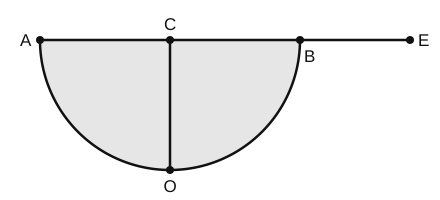
A hemispherical vessel is completely filled with a liquid of refractive index $\mu$. A small coin is kept at the lowest point $(O)$ of the vessel as shown in the figure. The minimum value of the refractive index of the liquid so that a person can see the coin from point $E$ (at the level of the vessel) is
Concept. The observer at E, level with the rim, can see the coin only if a ray from O leaves at the rim B and grazes along the surface. That needs refraction at $90^\circ$, i.e. incidence at the critical angle.
Step 1. Angle at B. O is the lowest point and B the rim, so CO and CB are radii at right angles; OB makes $45^\circ$ with the vertical normal at B.
Step 2. Grazing emergence. $\mu\sin45^\circ=1\times\sin90^\circ$, so $\mu=\sqrt2$. A smaller $\mu$ bends the ray less and it cannot reach E.
Answer. $\sqrt2$ (Option D).
Solution by Sreeraj P, M.Sc Physics
Q 12-09-076JEE MainJEE Main 2025 (28 Jan, Shift 2)Easy
A concave mirror produces an image of an object such that the distance between the object and the image is $20\ \text{cm}$. If the magnification of the image is $-3$, then the magnitude of the radius of curvature of the mirror is
Q 12-09-077JEE MainJEE Main 2025 (28 Jan, Shift 2)Hard
In a long glass tube, a mixture of two liquids A and B with refractive indices $1.3$ and $1.4$ respectively forms a convex refractive meniscus towards A. If an object placed at $13\ \text{cm}$ from the vertex of the meniscus in A forms an image with a magnification of $-2$, then the radius of curvature of the meniscus is
Concept. Light goes from A ($1.3$) into B ($1.4$); the meniscus bulges towards A, so its centre is in B and $R>0$. Get $v$ from the magnification, then $R$ from the surface formula.
Step 1. Image distance. $m=\dfrac{n_1v}{n_2u}=\dfrac{1.3v}{1.4(-13)}=-2$, so $v=28$ cm.
Step 3. Radius. $R=\dfrac{0.1}{0.15}=\dfrac23$ cm.
Answer. Option D.
Solution by Sreeraj P, M.Sc Physics
Q 12-09-078JEE MainJEE Main 2025 (29 Jan, Shift 1)Medium
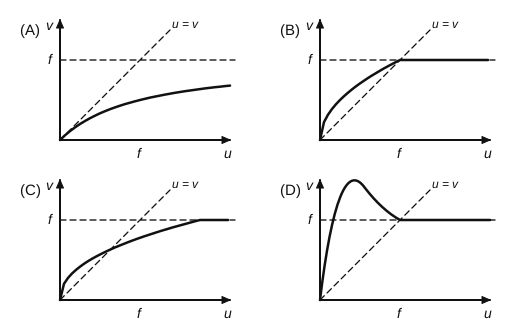
Let $u$ and $v$ be the distances of the object and the image from a lens of focal length $f$. The correct graphical representation of $u$ and $v$ for a convex lens when $|u| > f$ is
Concept. Convex lens, real object ($u\lt0$) with $|u|>f$: $v=\dfrac{uf}{u+f}$ is positive (real image).
Step 1. Limits. As $u\to-f$, $v\to+\infty$; as $u\to-\infty$, $v\to f$.
Step 2. Shape. Plotted with $u$ increasing to the left, $v$ stays positive, rises steeply near $u=-f$ and levels off at $f$ far away.
Answer. Option C.
Solution by Sreeraj P, M.Sc Physics
Q 12-09-079JEE MainJEE Main 2025 (29 Jan, Shift 1)Medium
Two light beams fall on a transparent material block at points 1 and 2 at angles $\theta_1$ and $\theta_2$ (measured from the surface), respectively, as shown in the figure. After refraction, the beams intersect at point 3, which is exactly on the interface at the other end of the block. Given: the distance between 1 and 2, $d = 4\sqrt3\ \text{cm}$ and $\theta_1 = \theta_2 = \cos^{-1}\left(\dfrac{n_2}{2n_1}\right)$, where the refractive index of the block $n_2$ is greater than the refractive index of the outside medium $n_1$. The thickness of the block is ______ cm.
Concept. The beams are measured from the surface, so the angle of incidence is $90^\circ-\theta$ and $\sin i=\cos\theta$. By symmetry they meet below the midpoint of 1 and 2.
Step 1. Refraction. $n_1\cos\theta=n_2\sin r$ with $\cos\theta=\dfrac{n_2}{2n_1}$, so $\sin r=\dfrac12$ and $r=30^\circ$.
Step 2. Geometry. Each beam travels $\dfrac d2=2\sqrt3$ cm sideways while crossing the thickness $t$: $\tan30^\circ=\dfrac{2\sqrt3}{t}$.
Step 3. Thickness. $t=2\sqrt3\times\sqrt3=6$ cm.
Answer. $6$.
Solution by Sreeraj P, M.Sc Physics
Q 12-09-080JEE MainJEE Main 2025 (29 Jan, Shift 2)Easy
Two identical symmetric double convex lenses of focal length $f$ are cut into two equal parts, $L_1, L_2$ by the $AB$ plane and $L_3, L_4$ by the $XY$ plane, as shown in the figure respectively. The ratio of focal lengths of lenses $L_1$ and $L_3$ is
Cut along $AB$ (the principal axis): each half keeps both curved surfaces, so $L_1$ still has focal length $f$ (only its aperture is smaller).
Cut along $XY$ (the plane of the lens): each half is a plano-convex lens with half the power, so $L_3$ has focal length $2f$.
$f_1 : f_3 = f : 2f = 1 : 2$
Solution by Sreeraj P, M.Sc Physics
Q 12-09-081JEE MainJEE Main 2025 (29 Jan, Shift 2)Easy
A convex lens made of glass (refractive index $= 1.5$) has focal length $24\ \text{cm}$ in air. When it is totally immersed in water (refractive index $= 1.33$), its focal length changes to
By the lens maker's formula, $\dfrac{1}{f} \propto (\mu_{rel} - 1)$: $$\frac{f_w}{f_a} = \frac{1.5 - 1}{\frac{1.5}{1.33} - 1} = \frac{0.5}{0.125} = 4$$ (taking $1.33 \approx 4/3$, so $\mu_{rel} = 9/8$).
$f_w = 4\times24 = 96\ \text{cm}$
Solution by Sreeraj P, M.Sc Physics
Q 12-09-082JEE MainJEE Main 2025 (29 Jan, Shift 2)Hard
Two concave refracting surfaces of equal radii of curvature $R$ and refractive index $1.5$ face each other in air, as shown in the figure. A point object O is placed midway between P and B. The separation between the images of O formed by each refracting surface is
Concept. Each surface forms its own image of O, from light that travels towards that surface. Take positive along the light's direction for each, with the pole of that surface as origin. Both surfaces are concave towards the air gap, so the centre is on the incident side: $R=-R$.
Step 1. Distances. $AB=2R$; O is midway between P and B, so $AO=1.5R$ and $BO=0.5R$.
Step 2. Surface A. $u=-1.5R$: $\dfrac{1.5}{v}=\dfrac{0.5}{-R}+\dfrac{1}{-1.5R}=-\dfrac{1.167}R$, so $v=-1.286R$: $1.286R$ from A, on the air side.
Step 3. Surface B. $u=-0.5R$: $\dfrac{1.5}{v}=-\dfrac{0.5}R-\dfrac2R=-\dfrac{2.5}R$, $v=-0.6R$: $0.6R$ from B, i.e. $1.4R$ from A.
Step 4. Separation. $1.4R-1.286R=0.114R$.
Answer. Option D.
Solution by Sreeraj P, M.Sc Physics
Q 12-09-083JEE MainJEE Main 2024 (1 Feb, Shift 1)Easy
The distance between an object and its 3 times magnified virtual image as produced by a convex lens is $20\ \text{cm}$. The focal length of the lens used is ______ cm.
Q 12-09-084JEE MainJEE Main 2024 (4 Apr, Shift 1)Easy
The effective power of a combination of 5 identical convex lenses which are kept in contact along the principal axis is $25\ \text{D}$. The focal length of each of the convex lenses is
Step 1. Each lens. $\dfrac{25}{5}=5$ D, so $f=20$ cm.
Answer. Option A.
Solution by Sreeraj P, M.Sc Physics
Q 12-09-085JEE MainJEE Main 2024 (4 Apr, Shift 2)Medium
A light ray is incident on a glass slab of thickness $4\sqrt3\ \text{cm}$ and refractive index $\sqrt2$. The angle of incidence is equal to the critical angle for the glass slab with air. The lateral displacement of the ray after passing through the glass slab is ______ cm. (Given $\sin15^\circ = 0.25$)
Answer: (C) Both Statement I and Statement II are true
Concept. In a dispersive medium $n$ depends on wavelength; it is largest for violet and smallest for red.
Step 1. Statement I. Red has the smallest $n$, so it bends least: true.
Step 2. Statement II. True, and it is the reason for Statement I.
Answer. Both true (Option C).
Solution by Sreeraj P, M.Sc Physics
Q 12-09-087JEE MainJEE Main 2024 (6 Apr, Shift 1)Medium
The refractive index of a prism is $\mu = \sqrt3$ and the ratio of the angle of minimum deviation to the angle of the prism is one. The value of the angle of the prism is ______ degrees.
Q 12-09-088JEE MainJEE Main 2024 (6 Apr, Shift 2)Hard
In finding the refractive index of a glass slab, the following observations were made through a travelling microscope: 50 vernier scale divisions $= 49$ MSD; 20 divisions on the main scale in each cm.
For a mark on paper: MSR $= 8.45\ \text{cm}$, VC $= 26$.
For the mark on paper seen through the slab: MSR $= 7.12\ \text{cm}$, VC $= 41$.
For a powder particle on the top surface of the glass slab: MSR $= 4.05\ \text{cm}$, VC $= 1$.
(MSR = main scale reading, VC = vernier coincidence.) The refractive index of the glass slab is
Concept. For a slab, $n=\dfrac{\text{real thickness}}{\text{apparent thickness}}$. The microscope readings at the mark, the mark seen through the slab, and the top surface give both thicknesses.
Step 1. Least count. 1 MSD $=\dfrac1{20}$ cm $=0.05$ cm; 1 VSD $=\dfrac{49}{50}$ MSD, so LC $=\dfrac1{50}$ MSD $=0.001$ cm.
Step 2. Readings. Mark: $8.45+0.026=8.476$ cm. Through the slab: $7.12+0.041=7.161$ cm. Top surface: $4.05+0.001=4.051$ cm.
Step 3. Thicknesses. Real: $8.476-4.051=4.425$ cm. Apparent: $7.161-4.051=3.110$ cm.
Step 4. Index. $n=\dfrac{4.425}{3.110}=1.42$.
Answer. $1.42$ (Option C).
Solution by Sreeraj P, M.Sc Physics
Q 12-09-089JEE MainJEE Main 2024 (6 Apr, Shift 2)Easy
For a thin convex lens, the radii of curvature are $15\ \text{cm}$ and $30\ \text{cm}$ respectively. The focal length of the lens is $20\ \text{cm}$. The refractive index of the material is
Concept. Lens maker's formula: $\dfrac1f=(\mu-1)\left(\dfrac1{R_1}-\dfrac1{R_2}\right)$; for a biconvex lens the bracket is $\dfrac1{|R_1|}+\dfrac1{|R_2|}$.
Q 12-09-090JEE MainJEE Main 2024 (27 Jan, Shift 1)Medium
If the refractive index of the material of a prism is $\cot\left(\dfrac{A}{2}\right)$, where $A$ is the angle of prism, then the angle of minimum deviation will be:
Q 12-09-091JEE MainJEE Main 2024 (27 Jan, Shift 1)Easy
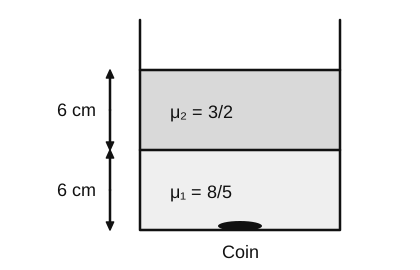
Two immiscible liquids of refractive indices $\dfrac85$ and $\dfrac32$ respectively are put in a beaker as shown in the figure. The height of each column is $6\ \text{cm}$. A coin is placed at the bottom of the beaker. For near normal vision, the apparent depth of the coin is $\dfrac{\alpha}{4}\ \text{cm}$. The value of $\alpha$ is ______.
$f = +15\ \text{cm}$. A convex mirror forms a virtual erect image, so $m = -\dfrac vu = \dfrac12 \Rightarrow v = -\dfrac u2$. $$\frac1v + \frac1u = \frac1f \;\Rightarrow\; -\frac2u + \frac1u = \frac1{15} \;\Rightarrow\; u = -15\ \text{cm}$$
Solution by Sreeraj P, M.Sc Physics
Q 12-09-093JEE MainJEE Main 2024 (29 Jan, Shift 1)Easy
A biconvex lens of refractive index $1.5$ has a focal length of $20\ \text{cm}$ in air. Its focal length when immersed in a liquid of refractive index $1.6$ will be:
Concept. In a liquid, use the relative index $\dfrac{\mu_g}{\mu_l}$ in the lens maker's formula. If it is less than 1 the convex lens diverges.
Step 1. In air. $\dfrac1{20}=0.5\times K$ where $K=\dfrac1{R_1}-\dfrac1{R_2}$, so $K=\dfrac1{10}$.
Step 2. In liquid. $\dfrac1{f_l}=\left(\dfrac{1.5}{1.6}-1\right)\dfrac1{10}=-\dfrac{1}{160}$.
Answer. $-160$ cm (Option B).
Solution by Sreeraj P, M.Sc Physics
Q 12-09-094JEE MainJEE Main 2024 (29 Jan, Shift 2)Medium
If the distance between an object and its two times magnified virtual image produced by a curved mirror is $15\ \text{cm}$, the focal length of the mirror must be:
Light goes from the denser (first) medium to the rarer (second): $$\sin C = \frac{\mu_2}{\mu_1} = \sin45^\circ = \frac{1}{\sqrt2} \;\Rightarrow\; \mu_1 : \mu_2 = \sqrt2 : 1$$
Solution by Sreeraj P, M.Sc Physics
Q 12-09-096JEE MainJEE Main 2024 (8 Apr, Shift 2)Medium
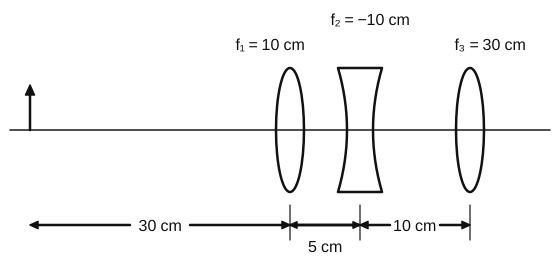
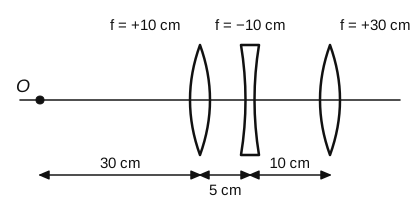
The position of the image formed by the combination of lenses is:
Concept. Image through each lens in turn; each image is the object for the next lens.
Step 1. First lens. $u=-30$, $f=10$: $v=15$ cm, i.e. $10$ cm beyond the concave lens.
Step 2. Concave lens. Virtual object: $u=+10$, $f=-10$: $\dfrac1v=-\dfrac1{10}+\dfrac1{10}=0$, so the rays leave parallel.
Step 3. Third lens. Parallel rays focus at $f=30$ cm.
Answer. $30$ cm right of the third lens (Option D).
Solution by Sreeraj P, M.Sc Physics
Q 12-09-097JEE MainJEE Main 2024 (9 Apr, Shift 1)Easy
Given below are two statements:
Statement (I): When an object is placed at the centre of curvature of a concave lens, image is formed at the centre of curvature of the lens on the other side.
Statement (II): Concave lens always forms a virtual and erect image.
In the light of the above statements, choose the correct answer from the options given below:
Answer: (D) Statement I is false but Statement II is true
Concept. A concave lens diverges light from any real object, so the image is always virtual, erect and on the object's side.
Step 1. Statement I. With $u=-2f$ (taking the centre of curvature at $2f$): $\dfrac1v=-\dfrac1f-\dfrac1{2f}$, $v=-\dfrac{2f}3$, on the same side, not at $2f$ on the other side. False.
Step 2. Statement II. True for every real object.
Answer. Statement I false, Statement II true (Option D).
Solution by Sreeraj P, M.Sc Physics
Q 12-09-098JEE MainJEE Main 2024 (9 Apr, Shift 2)Easy
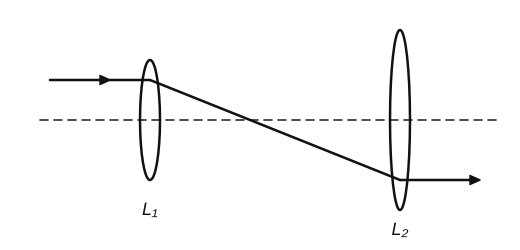
The following figure represents two biconvex lenses $L_1$ and $L_2$ having focal lengths $10\ \text{cm}$ and $15\ \text{cm}$ respectively. The distance between $L_1$ and $L_2$ is:
Concept. A parallel ray focuses at $F$ of $L_1$; to leave $L_2$ parallel it must pass through $F$ of $L_2$. So the two foci coincide.
Step 1. Separation. $d=f_1+f_2=10+15=25$ cm.
Answer. $25$ cm (Option C).
Solution by Sreeraj P, M.Sc Physics
Q 12-09-099JEE MainJEE Main 2024 (30 Jan, Shift 1)Easy
The distance between an object and its two times magnified real image as produced by a convex lens is $45\ \text{cm}$. The focal length of the lens used is ______ cm.
Q 12-09-100JEE MainJEE Main 2024 (30 Jan, Shift 2)Medium
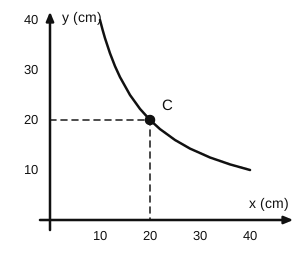
In an experiment to measure the focal length $(f)$ of a convex lens, the magnitudes of the object distance $(x)$ and the image distance $(y)$ are measured with reference to the focal point of the lens. The $y$–$x$ plot is shown in the figure. The focal length of the lens is ______ cm.
Q 12-09-102JEE MainJEE Main 2024 (31 Jan, Shift 2)Medium
Light from a point source in air falls on a convex curved surface of radius $20\ \text{cm}$ and refractive index $1.5$. If the source is located at $100\ \text{cm}$ from the convex surface, the image will be formed at ______ cm from the object.
Concept. Single surface, air to glass, convex towards the source: $R=+20$ cm, $u=-100$ cm.
Step 1. Surface formula. $\dfrac{1.5}{v}=\dfrac{0.5}{20}+\dfrac1{-100}=0.025-0.01=0.015$, so $v=100$ cm inside the glass.
Step 2. From the object. The object is $100$ cm in front and the image $100$ cm behind the surface: $200$ cm apart.
Answer. $200$.
Solution by Sreeraj P, M.Sc Physics
Q 12-09-103JEE MainJEE Main 2023 (30 Jan, Shift 1)Medium
A person has been using spectacles of power $-1.0$ diopter for distant vision and a separate reading glass of power $2.0$ diopters. What is the least distance of distinct vision for this person?
Concept. The reading glass brings an object at $25$ cm to a virtual image at the person's near point.
Step 1. Lens formula. $f=50$ cm, $u=-25$ cm: $\dfrac1v=\dfrac1{50}-\dfrac1{25}$, so $v=-50$ cm.
Answer. $50$ cm (Option D).
Solution by Sreeraj P, M.Sc Physics
Q 12-09-104JEE MainJEE Main 2023 (30 Jan, Shift 1)Hard
In an experiment for estimating the value of focal length of converging mirror, image of an object placed at $40\ \text{cm}$ from the pole of the mirror is formed at distance $120\ \text{cm}$ from the pole of the mirror. These distances are measured with a modified scale in which there are $20$ small divisions in $1\ \text{cm}$. The value of error in measurement of focal length of the mirror is $\dfrac1K\ \text{cm}$. The value of $K$ is ______.
$\dfrac1f=\dfrac1u+\dfrac1v=\dfrac1{40}+\dfrac1{120}\Rightarrow f=30\ \text{cm}$. The least count is $\Delta u=\Delta v=\dfrac1{20}=0.05\ \text{cm}$.
Differentiating: $\dfrac{\Delta f}{f^2}=\dfrac{\Delta u}{u^2}+\dfrac{\Delta v}{v^2}$ $$\Delta f=900\times0.05\left(\frac1{1600}+\frac1{14400}\right)=45\times\frac{10}{14400}=\frac1{32}\ \text{cm}$$ So $K=32$.
Solution by Sreeraj P, M.Sc Physics
Q 12-09-105JEE MainJEE Main 2023 (30 Jan, Shift 2)Easy
A thin prism $P_1$ with an angle $6^\circ$ and made of glass of refractive index $1.54$ is combined with another prism $P_2$ made from glass of refractive index $1.72$ to produce dispersion without average deviation. The angle of prism $P_2$ is
No net deviation: $(\mu_1-1)A_1=(\mu_2-1)A_2$. $$A_2=\frac{0.54\times6^\circ}{0.72}=4.5^\circ$$
Solution by Sreeraj P, M.Sc Physics
Q 12-09-106JEE MainJEE Main 2023 (31 Jan, Shift 2)Medium
A microscope is focused on an object at the bottom of a bucket. If liquid with refractive index $\dfrac53$ is poured inside the bucket, then microscope has to be raised by $30\ \text{cm}$ to focus the object again. The height of the liquid in the bucket is
Concept. A liquid layer of height $h$ lifts the image of the bottom by $h\left(1-\dfrac1\mu\right)$; the microscope must rise by this amount.
Step 1. Equation. $h\left(1-\dfrac35\right)=30$.
Step 2. Height. $h=75$ cm.
Answer. Option A.
Solution by Sreeraj P, M.Sc Physics
Q 12-09-107JEE MainJEE Main 2023 (24 Jan, Shift 1)Medium
As shown in the figure, a combination of a thin plano-concave lens and a thin plano-convex lens is used to image an object placed at infinity. The radius of curvature of both the lenses is $30\ \text{cm}$ and refraction index of the material for both the lenses is $1.75$. Both the lenses are placed at distance of $40\ \text{cm}$ from each other. Due to the combination, the image of the object is formed at distance $x=$ ______ cm, from concave lens.
Concept. Find each focal length with the lens maker's formula, then image the distant object through both lenses in turn.
Step 1. Focal lengths. Plano-concave: $f_1=-\dfrac{30}{0.75}=-40$ cm. Plano-convex: $f_2=+40$ cm.
Step 2. First lens. Parallel light gives a virtual image at the focus, $40$ cm before the concave lens.
Step 3. Second lens. That point is $40+40=80$ cm before the convex lens: $\dfrac1v=\dfrac1{40}-\dfrac1{80}$, $v=80$ cm.
Step 4. From the concave lens. $x=40+80=120$ cm.
Answer. $120$.
Solution by Sreeraj P, M.Sc Physics
Q 12-09-108JEE MainJEE Main 2023 (24 Jan, Shift 2)Easy
When a beam of white light is allowed to pass through convex lens parallel to principal axis, the different colours of light converge at different points on the principal axis after refraction. This is called
Concept. The refractive index of glass depends on wavelength, so a lens has a different focal length for each colour: violet focuses nearest the lens, red farthest.
Step 1. Name. This colour-dependent focusing is chromatic aberration. (Spherical aberration is the spread of foci for rays at different heights, for one colour.)
Answer. Chromatic aberration (Option B).
Solution by Sreeraj P, M.Sc Physics
Q 12-09-109JEE MainJEE Main 2023 (24 Jan, Shift 2)Medium
A convex lens of refractive index $1.5$ and focal length $18\ \text{cm}$ in air is immersed in water. The change in focal length of the lens will be ______ cm. (Given refractive index of water $=\frac43$)
Step 2. Change. $f_w=72$ cm; change $=72-18=54$ cm.
Answer. $54$.
Solution by Sreeraj P, M.Sc Physics
Q 12-09-110JEE MainJEE Main 2023 (25 Jan, Shift 1)Medium
A ray of light is incident from air on a glass plate having thickness $\sqrt3\ \text{cm}$ and refractive index $\sqrt2$. The angle of incidence of a ray is equal to the critical angle for glass–air interface. The lateral displacement of the ray when it passes through the plate is ______ $\times10^{-2}\ \text{cm}$. (given $\sin15^\circ=0.26$)
Concept. A plane mirror forms a virtual image (rays only appear to come from behind it), erect, of the same size, as far behind as the object is in front, and laterally inverted.
Step 1. Check each statement. A (real): false. B (erect): true. C (smaller): false, it is the same size. D (laterally inverted): true.
Answer. B and D only (Option A).
Solution by Sreeraj P, M.Sc Physics
Q 12-09-112JEE MainJEE Main 2023 (25 Jan, Shift 2)Medium
An object is placed on the principal axis of convex lens of focal length $10\ \text{cm}$ as shown. A plane mirror is placed on the other side of lens at a distance of $20\ \text{cm}$. The image produced by the plane mirror is $5\ \text{cm}$ inside the mirror. The distance of the object from the lens is ______ cm.
Concept. The plane mirror's image is as far behind it as its object is in front. So the lens image (the mirror's object) lies $5$ cm in front of the mirror.
Step 1. Lens image. $20-5=15$ cm from the lens.
Step 2. Lens formula. $\dfrac1{15}-\dfrac1u=\dfrac1{10}$, so $\dfrac1u=-\dfrac1{30}$, $u=-30$ cm.
Answer. $30$.
Solution by Sreeraj P, M.Sc Physics
Q 12-09-113JEE MainJEE Main 2023 (13 Apr, Shift 2)Easy
A bi-convex lens of focal length $10\ \text{cm}$ is cut in two identical parts along a plane perpendicular to the principal axis. The power of each lens after cut is ______ D.
Each half is plano-convex with one curved surface, so its focal length doubles to $20\ \text{cm}$.
$P=\dfrac{1}{0.2}=5\ \text{D}$.
Solution by Sreeraj P, M.Sc Physics
Q 12-09-114JEE MainJEE Main 2023 (15 Apr, Shift 1)Easy
The refractive index of a transparent liquid filled in an equilateral hollow prism is $\sqrt2$. The angle of minimum deviation for the liquid will be ______ $^\circ$.
Q 12-09-115JEE MainJEE Main 2023 (10 Apr, Shift 2)Medium
A point object $O$ is placed in front of two thin symmetrical coaxial convex lenses $L_1$ and $L_2$ with focal length $24\ \text{cm}$ and $9\ \text{cm}$ respectively. The distance between two lenses is $10\ \text{cm}$ and the object is placed $6\ \text{cm}$ away from lens $L_1$ as shown in the figure. The distance between the object and the image formed by the system of two lenses is ______ cm.
$L_1$: $\dfrac1v=\dfrac1{24}-\dfrac16=-\dfrac18\Rightarrow v=-8\ \text{cm}$ (virtual, $8\ \text{cm}$ before $L_1$).
For $L_2$ this image is $18\ \text{cm}$ away: $\dfrac1v=\dfrac19-\dfrac1{18}=\dfrac1{18}\Rightarrow v=18\ \text{cm}$ beyond $L_2$.
Object to image: $6+10+18=34\ \text{cm}$.
Solution by Sreeraj P, M.Sc Physics
Q 12-09-116JEE MainJEE Main 2023 (11 Apr, Shift 1)Easy
The critical angle for a denser–rarer interface is $45^\circ$. The speed of light in rarer medium is $3\times10^8\ \text{m s}^{-1}$. The speed of light in the denser medium is
Q 12-09-117JEE MainJEE Main 2023 (11 Apr, Shift 1)Medium
The radius of curvature of each surface of a convex lens having refractive index $1.8$ is $20\ \text{cm}$. The lens is now immersed in a liquid of refractive index $1.5$. The ratio of power of lens in air to its power in the liquid will be $x:1$. The value of $x$ is ______.
Q 12-09-119JEE MainJEE Main 2023 (11 Apr, Shift 2)Medium
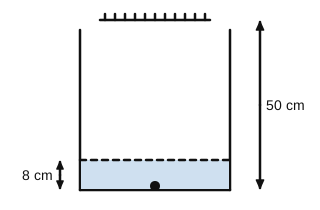
As shown in the figure, a plane mirror is fixed at a height of $50\ \text{cm}$ from the bottom of tank containing water $\left(\mu=\frac43\right)$. The height of water in the tank is $8\ \text{cm}$. A small bulb is placed at the bottom of the water tank. The distance of image of the bulb formed by mirror from the bottom of the tank is ______ cm.
Concept. The mirror receives light that has left the water, so it "sees" the bulb at its apparent depth. Then the plane mirror forms an image as far behind it as this apparent bulb is in front.
Step 1. Apparent bulb. Apparent depth $\dfrac{8}{4/3}=6$ cm below the surface, i.e. $2$ cm above the bottom.
Step 2. Mirror image. The apparent bulb is $50-2=48$ cm below the mirror, so the image is $48$ cm above it.
Step 3. From the bottom. $50+48=98$ cm.
Answer. $98$.
Solution by Sreeraj P, M.Sc Physics
Q 12-09-120JEE MainJEE Main 2023 (12 Apr, Shift 1)Medium
An ice cube has a bubble inside. When viewed from one side the apparent distance of the bubble is $12\ \text{cm}$. When viewed from the opposite side, the apparent distance of the bubble is observed as $4\ \text{cm}$. If the side of the ice cube is $24\ \text{cm}$, the refractive index of the ice cube is
Q 12-09-121JEE MainJEE Main 2023 (12 Apr, Shift 1)Easy
Two convex lenses of focal length $20\ \text{cm}$ each are placed coaxially with a separation of $60\ \text{cm}$ between them. The image of the distant object formed by the combination is at ______ cm from the first lens.
Concept. Separated lenses: the image formed by the first lens is the object for the second.
Step 1. First lens. Distant object, image at $20$ cm, which is $40$ cm in front of the second lens.
Step 2. Second lens. $\dfrac1v=\dfrac1{20}-\dfrac1{40}=\dfrac1{40}$, so $v=40$ cm beyond it.
Step 3. From the first lens. $60+40=100$ cm.
Answer. $100$.
Solution by Sreeraj P, M.Sc Physics
Q 12-09-122JEE MainJEE Main 2023 (13 Apr, Shift 1)Medium
A vessel of depth $d$ is half filled with oil of refractive index $n_1$ and the other half is filled with water of refractive index $n_2$. The apparent depth of this vessel when viewed from above will be
Q 12-09-123JEE MainJEE Main 2023 (13 Apr, Shift 1)Medium
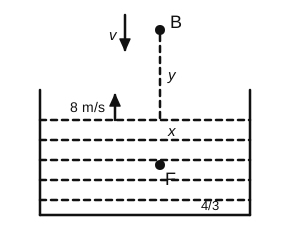
A fish rising vertically upward with a uniform velocity of $8\ \text{m s}^{-1}$ observes that a bird is diving vertically downward towards the fish with the velocity of $12\ \text{m s}^{-1}$. If the refractive index of water is $\dfrac43$, then the actual velocity of the diving bird to pick the fish will be ______ $\text{m s}^{-1}$.
Concept. The fish sees the bird at $n$ times its true height above the water. Differentiate the apparent separation with time.
Step 1. Apparent separation. With the fish at depth $x$ and the bird at height $y$: $s=x+ny$.
Step 2. Rates. The fish rises, so $\dfrac{dx}{dt}=-8$ m s$^{-1}$; the separation shrinks at $12$ m s$^{-1}$: $-12=-8+\dfrac43\dfrac{dy}{dt}$.
Step 3. Bird's speed. $\dfrac{dy}{dt}=-3$ m s$^{-1}$: it dives at $3$ m s$^{-1}$.
Answer. $3$.
Solution by Sreeraj P, M.Sc Physics
Q 12-09-124JEE MainJEE Main 2023 (6 Apr, Shift 1)Easy
A monochromatic light wave with wavelength $\lambda_1$ and frequency $\nu_1$ in air enters another medium. If the angle of incidence and angle of refraction at the interface are $45^\circ$ and $30^\circ$ respectively, then the wavelength $\lambda_2$ and frequency $\nu_2$ of the refracted wave are
Q 12-09-125JEE MainJEE Main 2023 (6 Apr, Shift 1)Hard
A pole is vertically submerged in swimming pool, such that it gives a length of shadow $2.15\ \text{m}$ within water when sunlight is incident at an angle of $30^\circ$ with the surface of water. If swimming pool is filled to a height of $1.5\ \text{m}$, then the height of the pole above the water surface in centimetres is ______. ($n_w=\frac43$)
Concept. The shadow on the bottom ends where the ray grazing the top of the pole reaches the floor. Above the water the sunlight makes $30^\circ$ with the surface; in the water it bends towards the normal.
Step 1. Refraction. Angle of incidence $60^\circ$: $\sin r=\dfrac{\sin60^\circ}{4/3}=\dfrac{3\sqrt3}{8}=0.650$, so $\tan r=\dfrac{0.650}{0.760}=0.855$.
Step 2. Shadow length. The part of the pole of height $h$ above water shifts the ray by $h\cot30^\circ=\sqrt3h$ along the surface; the water adds $1.5\tan r=1.28$ m. So $\sqrt3h+1.28=2.15$.
Step 3. Height above water. $h=\dfrac{0.87}{1.732}=0.50$ m.
Answer. $50$ cm.
Solution by Sreeraj P, M.Sc Physics
Q 12-09-126JEE MainJEE Main 2023 (6 Apr, Shift 2)Hard
A $2$ metre long scale with least count of $0.2\ \text{cm}$ is used to measure the locations of objects on an optical bench. While measuring the focal length of a convex lens, the object pin and the convex lens are placed at $80\ \text{cm}$ mark and $1\ \text{m}$ mark, respectively. The image of the object pin on the other side of lens coincides with image pin that is kept at $180\ \text{cm}$ mark. The % error in the estimation of focal length is
Concept. $f=\dfrac{uv}{u+v}$ and $\dfrac{\Delta f}{f^2}=\dfrac{\Delta u}{u^2}+\dfrac{\Delta v}{v^2}$. Each distance is the difference of two scale readings, so its error is $2\times0.2=0.4$ cm.
Step 1. Distances. $u=100-80=20$ cm, $v=180-100=80$ cm; $f=\dfrac{1600}{100}=16$ cm.
Step 2. Error. $\Delta f=256\left(\dfrac{0.4}{400}+\dfrac{0.4}{6400}\right)=256(0.001+0.0000625)=0.272$ cm.
Answer: (C) move the eyepiece outside the telescopic tube
Concept. The secondary mirror sends the light back through a hole in the primary, so the eyepiece sits outside the tube.
Answer. Option C.
Solution by Sreeraj P, M.Sc Physics
Q 12-09-128JEE MainJEE Main 2023 (8 Apr, Shift 1)Medium
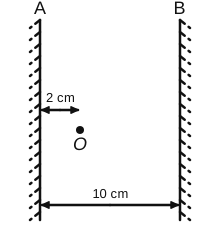
Two vertical parallel mirrors $A$ and $B$ are separated by $10$ cm. A point object $O$ is placed at a distance of $2$ cm from mirror $A$. The distance of the second nearest image behind mirror $A$ from the mirror $A$ is ______ cm.
Concept. With two parallel mirrors, each image in one mirror acts as an object for the other. Images behind A come from a last reflection at A.
Step 1. First image behind A. The object is $2$ cm in front of A, so its image $I_1$ is $2$ cm behind A.
Step 2. Image in B. O is $10-2=8$ cm from B, so its image $I_2$ is $8$ cm behind B, which is $10+8=18$ cm from A.
Step 3. Second image behind A. $I_2$ is $18$ cm in front of A, so its image in A is $18$ cm behind A. (The next one, the image of $I_1$ in B and then in A, is farther: $22$ cm.)
Answer. $18$ cm.
Solution by Sreeraj P, M.Sc Physics
Q 12-09-129JEE MainJEE Main 2023 (8 Apr, Shift 2)Medium
Two transparent media having refractive indices $1.0$ and $1.5$ are separated by a spherical refracting surface of radius of curvature $30$ cm. The centre of curvature of surface is towards denser medium and a point object is placed on the principal axis in rarer medium at a distance of $15$ cm from the pole of the surface. The distance of image from the pole of the surface is ______ cm.
$\dfrac{\mu_2}{v}-\dfrac{\mu_1}{u}=\dfrac{\mu_2-\mu_1}{R}$ with $u=-15$, $R=+30$: $$\frac{1.5}{v}+\frac1{15}=\frac{0.5}{30}\ \Rightarrow\ \frac{1.5}{v}=-\frac{1}{20}\ \Rightarrow\ v=-30\ \text{cm}$$ A virtual image $30$ cm from the pole, on the object's side.
Solution by Sreeraj P, M.Sc Physics
Q 12-09-130JEE MainJEE Main 2023 (10 Apr, Shift 1)Easy
An object is placed at a distance of $12$ cm in front of a plane mirror. The virtual and erect image is formed by the mirror. Now the mirror is moved by $4$ cm towards the stationary object. The distance by which the position of image would be shifted, will be
Concept. A plane mirror's image is as far behind the mirror as the object is in front. Moving the mirror by $x$ towards a fixed object moves the image by $2x$ in the same direction.
Step 1. Before. Object $12$ cm from the mirror; image $12$ cm behind it, so $24$ cm from the object.
Step 2. After. Object $8$ cm from the mirror; image $8$ cm behind it, so $16$ cm from the object.
Step 3. Shift. The image moved $24-16=8$ cm towards the object, i.e. towards the mirror ($=2\times4$ cm).
Answer. $8$ cm towards the mirror (Option B).
Solution by Sreeraj P, M.Sc Physics
Q 12-09-131JEE MainJEE Main 2023 (1 Feb, Shift 1)Medium
A thin cylindrical rod of length $10$ cm is placed horizontally on the principal axis of a concave mirror of focal length $20$ cm. The rod is placed in such a way that mid point of the rod is at $40$ cm from the pole of mirror. The length of the image formed by the mirror will be $\dfrac x3$ cm. The value of $x$ is ______.
Concept. For a rod along the axis, find the image of each end separately; the image length is the difference.
Step 1. Ends. The rod runs from $35$ cm to $45$ cm; $f=-20$ cm.
Step 2. Near end ($u=-35$). $v=\dfrac{uf}{u-f}=\dfrac{(-35)(-20)}{-15}=-46.67$ cm.
Step 3. Far end ($u=-45$). $v=\dfrac{(-45)(-20)}{-25}=-36$ cm.
Step 4. Length. $46.67-36=10.67=\dfrac{32}{3}$ cm.
Answer. $x=32$.
Solution by Sreeraj P, M.Sc Physics
Q 12-09-132JEE MainJEE Main 2023 (1 Feb, Shift 2)Medium
Two objects $A$ and $B$ are placed at $15$ cm and $25$ cm from the pole in front of a concave mirror having radius of curvature $40$ cm. The distance between images formed by the mirror is
Concept. Image each object with the mirror formula, $f=-\dfrac R2=-20$ cm, then find where the two images lie.
Step 1. A at $u=-15$ cm (inside $F$). $\dfrac1v=-\dfrac1{20}+\dfrac1{15}=\dfrac1{60}$, so $v=+60$ cm: virtual, $60$ cm behind the mirror.
Step 2. B at $u=-25$ cm. $\dfrac1v=-\dfrac1{20}+\dfrac1{25}=-\dfrac1{100}$, so $v=-100$ cm: real, $100$ cm in front.
Step 3. Separation. The images are on opposite sides of the mirror: $60+100=160$ cm.
Answer. $160$ cm (Option C).
Solution by Sreeraj P, M.Sc Physics
Q 12-09-133JEE MainJEE Main 2022 (24 Jun, Shift 1)Medium
Two identical thin biconvex lenses of focal length $15\ \text{cm}$ and refractive index $1.5$ are in contact with each other. The space between the lenses is filled with a liquid of refractive index $1.25$. The focal length of the combination is ______ cm.
Step 3. Total. $\dfrac2{15}-\dfrac1{30}=\dfrac1{10}$, so $F=10$ cm.
Answer. $10$.
Solution by Sreeraj P, M.Sc Physics
Q 12-09-134JEE MainJEE Main 2022 (24 Jun, Shift 2)Medium
A ray of light is incident at an angle of incidence $60^\circ$ on a glass slab of refractive index $\sqrt3$. After refraction, the light ray emerges out from the other parallel face and the lateral shift between incident ray and emergent ray is $4\sqrt3\ \text{cm}$. The thickness of the glass slab is ______ cm.
$\sin r = \dfrac{\sin60^\circ}{\sqrt3} = \dfrac12\Rightarrow r = 30^\circ$. $$d = \frac{t\sin(i-r)}{\cos r} = \frac{t\sin30^\circ}{\cos30^\circ} = \frac{t}{\sqrt3}$$ $$\frac{t}{\sqrt3} = 4\sqrt3\ \Rightarrow\ t = 12\ \text{cm}$$
Solution by Sreeraj P, M.Sc Physics
Q 12-09-135JEE MainJEE Main 2022 (25 Jun, Shift 1)Medium
A light wave travelling linearly in a medium of dielectric constant $4$ is incident on the horizontal interface separating the medium from air. The angle of incidence for which the total intensity of the incident wave will be reflected back into the same medium will be: (Given: relative permeability of medium $\mu_r = 1$)
Step 3. Choice. Only $60^\circ$ is larger than $30^\circ$.
Answer. $60^\circ$ (Option D).
Solution by Sreeraj P, M.Sc Physics
Q 12-09-136JEE MainJEE Main 2022 (25 Jun, Shift 1)Medium
The difference of speed of light in the two media $A$ and $B$, $(v_A - v_B)$, is $2.6\times10^7\ \text{m s}^{-1}$. If the refractive index of medium $B$ is $1.47$, then the ratio of refractive index of medium $B$ to medium $A$ is: (Given: speed of light in vacuum $c = 3\times10^8\ \text{m s}^{-1}$)
Concept. When a particle is much smaller than the wavelength, it re-radiates the wave in all directions: scattering (Rayleigh, intensity $\propto\dfrac1{\lambda^4}$). Diffraction needs obstacles comparable to $\lambda$.
Step 1. Sizes. $\lambda=\dfrac{3\times10^8}{3\times10^9}=0.1$ m; the particle is $1$ mm, $\dfrac{\lambda}{100}$.
Answer. Scattering (Option B).
Solution by Sreeraj P, M.Sc Physics
Q 12-09-138JEE MainJEE Main 2022 (26 Jun, Shift 1)Medium
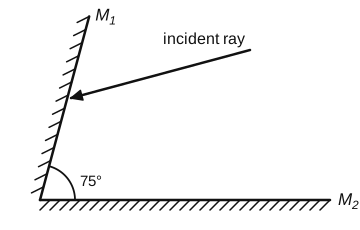
A light ray is incident, at an incident angle $\theta_1$, on the system of two plane mirrors $M_1$ and $M_2$ having an inclination angle $75^\circ$ between them (as shown in figure). After reflecting from mirror $M_1$ it gets reflected back by the mirror $M_2$ with an angle of reflection $30^\circ$. The total deviation of the ray will be ______ degree.
Concept. A reflection at glancing angle $g$ (angle between the ray and the mirror) turns the ray by $2g$. For two mirrors at angle $\theta$, the glancing angles and $\theta$ are the angles of one triangle.
Step 1. Glancing angles. At $M_2$ the angle of reflection is $30^\circ$, so $g_2=60^\circ$. In the triangle made by the two mirrors and the ray between them, $g_1+g_2+75^\circ=180^\circ$, so $g_1=45^\circ$.
Step 2. Total deviation. $\delta=2g_1+2g_2=90^\circ+120^\circ=210^\circ$. This is $360^\circ-2\theta$ for any incidence.
Answer. $210$.
Solution by Sreeraj P, M.Sc Physics
Q 12-09-139JEE MainJEE Main 2022 (26 Jun, Shift 2)Medium
A small bulb is placed at the bottom of a tank containing water to a depth of $\sqrt7\ \text{m}$. The refractive index of water is $\dfrac43$. The area of the surface of water through which light from the bulb can emerge out is $x\pi\ \text{m}^2$. The value of $x$ is ______.
Answer: (A) In primary rainbow, observer sees red colour on the top and violet on the bottom
Concept. In a primary rainbow, light refracts into a drop, reflects once inside (not total internal reflection) and refracts out. Red leaves at about $42^\circ$ and violet at about $40^\circ$ to the antisolar direction.
Step 1. Order. Red reaches the eye from higher drops: red on top, violet at the bottom.
Step 2. Others. Two internal reflections make the secondary bow, which is fainter.
Answer. Option A.
Solution by Sreeraj P, M.Sc Physics
Q 12-09-141JEE MainJEE Main 2022 (25 Jul, Shift 1)Medium
The times taken by light to travel through two different materials $A$ and $B$ of refractive indices $\mu_A$ and $\mu_B$ of the same thickness are $t_1$ and $t_2$ respectively. If $t_2 - t_1 = 5\times10^{-10}\ \text{s}$ and the ratio of $\mu_A$ to $\mu_B$ is $1 : 2$, then the thickness of material, in metre, is: (Given $v_A$ and $v_B$ are velocities of light in $A$ and $B$ materials respectively)
Concept. Time through thickness $d$ is $t=\dfrac dv$, and $v\propto\dfrac1\mu$.
Step 1. Speeds. $\mu_B=2\mu_A$, so $v_B=\dfrac{v_A}{2}$.
Step 2. Time difference. $t_2-t_1=\dfrac{d}{v_B}-\dfrac{d}{v_A}=\dfrac{2d}{v_A}-\dfrac{d}{v_A}=\dfrac{d}{v_A}=5\times10^{-10}$ s.
Step 3. Thickness. $d=5\times10^{-10}\,v_A$.
Answer. Option A.
Solution by Sreeraj P, M.Sc Physics
Q 12-09-142JEE MainJEE Main 2022 (25 Jul, Shift 2)Medium
For an object placed at a distance $2.4\ \text{m}$ from a lens, a sharp focused image is observed on a screen placed at a distance $12\ \text{cm}$ from the lens. A glass plate of refractive index $1.5$ and thickness $1\ \text{cm}$ is introduced between the lens and the screen such that the glass plate plane faces parallel to the screen. By what distance should the object be shifted so that a sharp focused image is observed again on the screen?
Concept. A glass plate of thickness $t$ shifts the image away from the lens by $t\left(1-\dfrac1\mu\right)$. To keep the final image on the screen, the lens itself must form its image that much closer.
Step 2. Shift by the plate. $1\times\left(1-\dfrac1{1.5}\right)=\dfrac13$ cm, so the lens must image at $12-\dfrac13=\dfrac{35}{3}$ cm.
Step 3. New object distance. $\dfrac1u=\dfrac{3}{35}-\dfrac{21}{240}=-\dfrac{1}{560}$, so the object is $5.6$ m away.
Step 4. Shift. $5.6-2.4=3.2$ m (further from the lens).
Answer. Option B.
Solution by Sreeraj P, M.Sc Physics
Q 12-09-143JEE MainJEE Main 2022 (25 Jul, Shift 2)Medium
A convex lens of focal length $20\ \text{cm}$ is placed in front of a convex mirror with principal axis coinciding with each other. The distance between the lens and mirror is $10\ \text{cm}$. A point object is placed on the principal axis at a distance of $60\ \text{cm}$ from the convex lens. The image formed by the combination coincides with the object itself. The focal length of the convex mirror is ______ cm.
Concept. The image coincides with the object if light retraces its path, which happens when the lens's image falls on the convex mirror's centre of curvature.
Step 1. Lens image. $\dfrac1v=\dfrac1{20}-\dfrac1{60}\Rightarrow v=30$ cm, i.e. $20$ cm behind the mirror.
Step 2. Mirror. $R=20$ cm, so $f=10$ cm.
Answer. $10$.
Solution by Sreeraj P, M.Sc Physics
Q 12-09-144JEE MainJEE Main 2022 (26 Jul, Shift 1)Medium
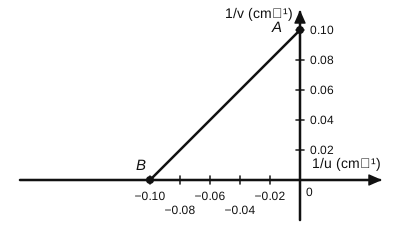
The graph between $\dfrac1u$ and $\dfrac1v$ for a thin convex lens in order to determine its focal length is plotted as shown in the figure. The refractive index of the lens is $1.5$ and both its surfaces have the same radius of curvature $R$. The value of $R$ will be ______ cm. (Where $u$ = object distance, $v$ = image distance)
Concept. $\dfrac1v-\dfrac1u=\dfrac1f$ is a straight line in $\dfrac1u$, $\dfrac1v$ with intercepts $-\dfrac1f$ and $+\dfrac1f$. Then the lens maker's formula gives $R$.
Step 1. Focal length. Intercept $\dfrac1v=0.10$ cm$^{-1}$, so $f=10$ cm.
Step 2. Radius. Equiconvex: $\dfrac1f=(1.5-1)\dfrac2R=\dfrac1R$, so $R=f=10$ cm.
Answer. $10$.
Solution by Sreeraj P, M.Sc Physics
Q 12-09-145JEE MainJEE Main 2022 (26 Jul, Shift 2)Medium
Light travels in two media $M_1$ and $M_2$ with speeds $1.5\times10^8\ \text{m s}^{-1}$ and $2.0\times10^8\ \text{m s}^{-1}$ respectively. The critical angle between them is
Step 2. Convert. $\cos C=\dfrac{\sqrt7}{4}$, so $\tan C=\dfrac3{\sqrt7}$.
Answer. Option A.
Solution by Sreeraj P, M.Sc Physics
Q 12-09-146JEE MainJEE Main 2022 (26 Jul, Shift 2)Medium
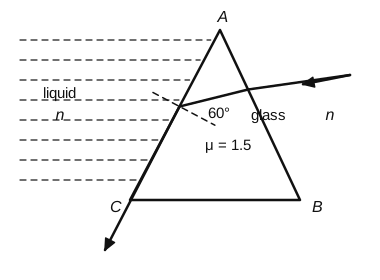
In the given figure, the face $AC$ of the equilateral prism is immersed in a liquid of refractive index $n$. For incident angle $60^\circ$ at the side $AC$, the refracted light beam just grazes along face $AC$. The refractive index of the liquid $n = \dfrac{\sqrt x}{4}$. The value of $x$ is ______. (Given refractive index of glass $= 1.5$)
Concept. The ray inside the glass meets face AC at $60^\circ$ and emerges grazing: $60^\circ$ is the critical angle for glass–liquid, $n_g\sin60^\circ=n\sin90^\circ$.
Q 12-09-147JEE MainJEE Main 2022 (27 Jun, Shift 1)Medium
Consider a light ray travelling in air is incident into a medium of refractive index $\sqrt{2n}$. The incident angle is twice that of refracting angle. Then, the angle of incidence will be
Step 2. Angle of incidence. $i=2r=2\cos^{-1}\sqrt{\dfrac n2}$.
Answer. Option D.
Solution by Sreeraj P, M.Sc Physics
Q 12-09-148JEE MainJEE Main 2022 (27 Jun, Shift 2)Medium
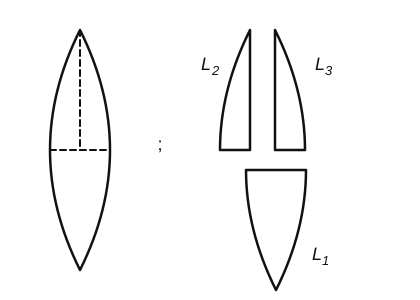
A convex lens has power $P$. It is cut into two halves along its principal axis. Further one piece (out of the two halves) is cut into two halves perpendicular to the principal axis (as shown in figures). Choose the incorrect option for the reported pieces.
Cutting along the principal axis does not change the curvatures, so $L_1$ keeps power $P$.
Cutting perpendicular to the axis splits the half into two plano-convex pieces. By the lens maker's formula each has one curved surface instead of two, so each has power $\dfrac P2$.
So $L_2 = L_3 = \dfrac P2$ and $L_1 = P$. The incorrect option is "Power of $L_1 = \dfrac P2$".
Solution by Sreeraj P, M.Sc Physics
Q 12-09-149JEE MainJEE Main 2022 (27 Jul, Shift 2)Medium
A thin prism of angle $6^\circ$ and refractive index for yellow light $(n_Y)$ $1.5$ is combined with another prism of angle $5^\circ$ and $n_Y = 1.55$, placed inverted with respect to the first. The combination produces no dispersion. The net average deviation $(\delta)$ produced by the combination is $\left(\dfrac1x\right)^\circ$. The value of $x$ is ______ .
Q 12-09-150JEE MainJEE Main 2022 (28 Jul, Shift 1)Easy
In normal adjustment, for a refracting telescope, the distance between objective and eye piece is $30$ cm. The focal length of the objective, when the angular magnification of the telescope is $2$, will be:
Concept. Telescope in normal adjustment: $L=f_o+f_e$ and $M=\dfrac{f_o}{f_e}$.
Step 1. Solve. $f_o=2f_e$, $3f_e=30$: $f_e=10$ cm, $f_o=20$ cm.
Answer. Option A.
Solution by Sreeraj P, M.Sc Physics
Q 12-09-151JEE MainJEE Main 2021 (27 Jul, Shift 1)Medium
A prism of refractive index $n_1$ and another prism of refractive index $n_2$ are stuck together (as shown in the figure). $n_1$ and $n_2$ depend on $\lambda$, the wavelength of light, according to the relation $n_1 = 1.2 + \dfrac{10.8\times10^{-14}}{\lambda^2}$ and $n_2 = 1.45 + \dfrac{1.8\times10^{-14}}{\lambda^2}$.
The wavelength for which rays incident at any angle on the interface $BC$ pass through without bending at that interface will be ______ nm.
Concept. $\delta=i+e-A$. The deviation falls as $i$ rises, reaches a minimum when $i=e$, then rises again; except at the minimum, two values of $i$ give the same $\delta$.
Step 1. Shape. A curve dipping to one minimum, not symmetric (it rises more slowly beyond the minimum).
Answer. Option B.
Solution by Sreeraj P, M.Sc Physics
Q 12-09-153JEE MainJEE Main 2021 (31 Aug, Shift 1)Easy
An object is placed at the focus of a concave lens having focal length $f$. What is the magnification and distance of the image from the optical centre of the lens?
Q 12-09-155JEE MainJEE Main 2021 (31 Aug, Shift 2)Medium
Cross-section view of a prism is the equilateral triangle $ABC$ shown in the figure. The minimum deviation is observed using this prism when the angle of incidence is equal to the prism angle. The time taken by light to travel from $P$ (midpoint of $BC$) to $A$ is ______ $\times10^{-10}$ s. (Given, speed of light in vacuum $= 3\times10^8\ \text{m s}^{-1}$ and $\cos30^\circ = \dfrac{\sqrt3}{2}$)
Concept. For a spherical mirror $f=\dfrac R2$. In the Cartesian convention (distances positive along the incident light), the focus and centre of a convex mirror lie behind it, so both are positive.
Q 12-09-157JEE MainJEE Main 2021 (25 Feb, Shift 1)Easy
The same size images are formed by a convex lens when the object is placed at 20 cm or at 10 cm from the lens. The focal length of convex lens is ______ cm.
Concept. For a lens $m=\dfrac{f}{f+u}$. Equal sizes at two object distances means one image is real ($m=-k$) and the other virtual ($m=+k$).
Step 1. Equal and opposite. $\dfrac{f}{f-20}=-\dfrac{f}{f-10}$, so $f-10=20-f$.
Step 2. Focal length. $f=15$ cm (the mean of the two distances when $|m|$ is the same).
Answer. $15$.
Solution by Sreeraj P, M.Sc Physics
Q 12-09-158JEE MainJEE Main 2021 (18 Mar, Shift 2)Medium
Three rays of light, namely red $(R)$, green $(G)$ and blue $(B)$ are incident on the face $PQ$ of a right angled prism $PQR$ as shown in figure.
The refractive indices of the material of the prism for red, green and blue wavelength are 1.27, 1.42 and 1.49 respectively. The colour of the ray(s) emerging out of the face $PR$ is:
Concept. The rays enter PQ normally and go straight to PR, meeting it at $45^\circ$ (isosceles right prism). A colour escapes only if $45^\circ$ is below its critical angle, i.e. $n\lt\dfrac1{\sin45^\circ}=\sqrt2=1.414$.
Step 1. Compare. Red $1.27\lt1.414$: escapes. Green $1.42$ and blue $1.49$ exceed $1.414$: totally reflected.
Answer. Red only (Option B).
Solution by Sreeraj P, M.Sc Physics
Q 12-09-159JEE MainJEE Main 2021 (20 Jul, Shift 1)Medium
Region I and II are separated by a spherical surface of radius 25 cm. An object is kept in region I at a distance of 40 cm from the surface. The distance of the image from the surface is:
Step 2. Solve. $\dfrac{1.4}{v}=-0.006-0.03125=-0.03725$, so $v=-37.58$ cm (virtual, in region I).
Answer. $37.58$ cm (Option D).
Solution by Sreeraj P, M.Sc Physics
Q 12-09-160JEE MainJEE Main 2021 (20 Jul, Shift 1)Hard
An object viewed from a near point distance of 25 cm, using a microscopic lens with magnification 6, gives an unresolved image. A resolved image is observed at infinite distance with a total magnification double the earlier using an eyepiece along with the given lens and a tube of length 0.6 m, if the focal length of the eyepiece is equal to ______ cm.
Concept. The single lens as a simple microscope with the image at the near point has $m=1+\dfrac Df$; this gives its focal length. As an objective with the final image at infinity, $m=\dfrac L{f_o}\cdot\dfrac D{f_e}$.
Step 1. Objective. $1+\dfrac{25}{f}=6$, so $f_o=5$ cm.
Step 2. Compound microscope. $12=\dfrac{60}{5}\times\dfrac{25}{f_e}$, so $f_e=25$ cm.
Answer. $25$.
Solution by Sreeraj P, M.Sc Physics
Q 12-09-161JEE MainJEE Main 2021 (22 Jul, Shift 1)Medium
A ray of light passes from a denser medium to a rarer medium at an angle of incidence $i$. The reflected and refracted rays make an angle of $90^\circ$ with each other. The angle of reflection and refraction are respectively $r$ and $r'$. The critical angle is given by,
Step 2. Critical angle. $\sin C=\dfrac{n_r}{n_d}=\tan r$, so $C=\sin^{-1}(\tan r)$.
Answer. Option D.
Solution by Sreeraj P, M.Sc Physics
Q 12-09-162JEE MainJEE Main 2021 (22 Jul, Shift 1)Easy
A ray of light passing through a prism $(\mu = \sqrt3)$ suffers minimum deviation. It is found that the angle of incidence is double the angle of refraction within the prism. Then, the angle of prism is ______ (in degrees).
Q 12-09-163JEE MainJEE Main 2021 (26 Feb, Shift 1)Easy
A short straight object of height $100$ cm lies before the central axis of a spherical mirror whose focal length has absolute value $|f| = 40$ cm. The image of object produced by the mirror is of height $25$ cm and has the same orientation of the object. One may conclude from the information:
Answer: (D) Image is virtual, opposite side of convex mirror.
Concept. An erect image of a real object is virtual. An erect image smaller than the object comes only from a convex mirror (a concave mirror's virtual images are magnified).
Step 1. Magnification. $m=+\dfrac{25}{100}=+\dfrac14$: erect and diminished.
Step 2. Mirror and side. So the mirror is convex, and the virtual image lies behind it, on the side opposite to the object.
Answer: (D) Both $A$ and $R$ are true and $R$ is the correct explanation of $A$
Concept. With the eye close to a simple microscope, the image subtends the same angle at the eye as the object does at its new position. The gain comes from bringing the object much closer than $25$ cm, where unaided it would look blurred.
Step 1. Assertion. Angular sizes of object and image at the eye are equal: true.
Step 2. Reason. True, and it explains how magnification arises despite A.
Answer. Both true and R explains A (Option D).
Solution by Sreeraj P, M.Sc Physics
Q 12-09-165JEE MainJEE Main 2021 (26 Feb, Shift 2)Medium
The incident ray, reflected ray and the outward drawn normal are denoted by the unit vectors $\vec{a}$, $\vec{b}$ and $\vec{c}$ respectively. Then choose the correct relation for these vectors.
Concept. Split the incident ray into a part along the normal and a part along the mirror. Reflection keeps the part along the mirror and reverses the part along the normal.
Step 1. Normal part. The component of $\vec a$ along the unit normal $\vec c$ is $(\vec a\cdot\vec c)\vec c$.
Step 2. Reverse it. $\vec b=\vec a-(\vec a\cdot\vec c)\vec c-(\vec a\cdot\vec c)\vec c=\vec a-2(\vec a\cdot\vec c)\vec c$. The result does not depend on whether $\vec c$ points out or in, since it appears twice.
Q 12-09-166JEE MainJEE Main 2021 (26 Feb, Shift 2)Medium
A point source of light $S$, placed at a distance $60$ cm in front of the centre of a plane mirror of width $50$ cm, hangs vertically on a wall. A man walks in front of the mirror along a line parallel to the mirror at a distance $1.2$ m from it (see in the figure). The distance between the extreme points where he can see the image of the light source in the mirror is ______ cm
Concept. The reflected rays seem to come from the image $S'$, $60$ cm behind the mirror. The man sees $S'$ only along lines from $S'$ that pass through the mirror, so the edges of the region are the lines from $S'$ through the two edges of the mirror.
Step 1. Similar triangles. From $S'$ the mirror ($50$ cm wide) is $60$ cm away and the man's line is $60+120=180$ cm away.
Step 2. Width. $w=50\times\dfrac{180}{60}=150$ cm.
Answer. $150$.
Solution by Sreeraj P, M.Sc Physics
Q 12-09-167JEE MainJEE Main 2021 (25 Jul, Shift 2)Medium
A prism of refractive index $\mu$ and angle of prism $A$ is placed in the position of minimum angle of deviation. If minimum angle of deviation is also $A$, then in terms of refractive index,
Q 12-09-168JEE MainJEE Main 2021 (25 Jul, Shift 2)Medium
A ray of light entering from air into a denser medium of refractive index $\frac{4}{3}$, as shown in figure. The light ray suffers total internal reflection at the adjacent surface as shown. The maximum value of angle $\theta$ should be equal to:
Concept. The ray enters the top face at $\theta$, refracts at $\theta'$, and meets the vertical face at $\theta''=90^\circ-\theta'$. TIR there needs $\sin\theta''\ge\dfrac1n$; this caps $\theta'$, and so $\theta$.
Step 1. TIR condition. $\cos\theta'\ge\dfrac34$, so $\sin\theta'\le\sqrt{1-\dfrac9{16}}=\dfrac{\sqrt7}4$.
Q 12-09-169JEE MainJEE Main 2021 (26 Aug, Shift 1)Medium
Car $B$ overtakes another car $A$ at a relative speed of $40$ m s$^{-1}$. How fast will the image of car $B$ appear to move in the mirror of focal length $10$ cm fitted in car $A$, when the car $B$ is $1.9$ m away from the car $A$?
Q 12-09-170JEE MainJEE Main 2021 (26 Aug, Shift 2)Medium
An object is placed at a distance of $12$ cm from a convex lens. A convex mirror of focal length $15$ cm is placed on another side of the lens at $8$ cm as shown in the figure. The image of the object coincides with the object. When the convex mirror is removed, a real and inverted image is formed at a position. The distance of the image from the object will be ______ cm
Concept. The image falls on the object when the lens image lies at the centre of curvature of the convex mirror (behind it), so the rays meet the mirror normally. That lens image is exactly what forms when the mirror is removed.
Step 1. Lens image. $C$ of the mirror is $2\times15=30$ cm behind it, so $8+30=38$ cm from the lens.
Step 2. Distance from the object. $12+38=50$ cm.
Answer. $50$.
Solution by Sreeraj P, M.Sc Physics
Q 12-09-171JEE MainJEE Main 2021 (27 Aug, Shift 1)Medium
An object is placed beyond the centre of curvature $C$ of the given concave mirror. If the distance of the object is $d_1$ from $C$ and the distance of the image formed is $d_2$ from $C$, the radius of curvature of this mirror is:
First lens ($f = +10$ cm, $u = -30$ cm): $\dfrac{1}{v} = \dfrac{1}{10} - \dfrac{1}{30} \Rightarrow v = 15$ cm.
Second lens ($f = -10$ cm), $5$ cm further: the first image is $10$ cm beyond it, a virtual object with $u = +10$ cm. $$\frac{1}{v} = -\frac{1}{10} + \frac{1}{10} = 0 \Rightarrow v = \infty$$ The light leaves as a parallel beam.
Third lens ($f = +30$ cm): a parallel beam is focused $30$ cm beyond it.
Distance from $O$: $30 + 5 + 10 + 30 = 75$ cm.
Solution by Sreeraj P, M.Sc Physics
Q 12-09-173JEE MainJEE Main 2021 (27 Aug, Shift 2)Medium
Curved surfaces of a plano-convex lens of refractive index $\mu_1$ and a plano-concave lens of refractive index $\mu_2$ have equal radius of curvature as shown in figure. Find the ratio of radius of curvature to the focal length of the combined lenses
Step 2. Combination. $\dfrac1F=\dfrac{\mu_1-\mu_2}{R}$, so $\dfrac RF=\mu_1-\mu_2$.
Answer. Option D.
Solution by Sreeraj P, M.Sc Physics
Q 12-09-174JEE MainJEE Main 2020 (8 Jan, Shift 2)Medium
An object is gradually moving away from the focal point of a concave mirror along the axis of the mirror. The graphical representation of the magnitude of linear magnification $(m)$ versus distance of the object from the mirror $(x)$ is correctly given by (graphs are drawn schematically and are not to scale)
Concept. For a concave mirror with the object at distance $x>f$ (magnitudes), $|m|=\dfrac{f}{x-f}$.
Step 1. Shape. Just beyond $F$, $|m|\to\infty$; it falls steadily as $x$ grows.
Step 2. Check points. At $x=2f$, $|m|=1$; as $x\to\infty$, $|m|\to0$.
Step 3. Graph. A curve falling from very large values near $f$, through $1$ at $2f$, towards zero.
Answer. Option C.
Solution by Sreeraj P, M.Sc Physics
Q 12-09-175JEE MainJEE Main 2020 (9 Jan, Shift 1)Easy
A vessel of depth $2h$ is half filled with a liquid of refractive index $2\sqrt{2}$ and the upper half with another liquid of refractive index $\sqrt{2}$. The liquids are immiscible. The apparent depth of the inner surface of the bottom of the vessel will be
Viewed from above (near-normal), each layer appears shortened by its own refractive index: $$d_{\text{app}} = \frac{h}{\sqrt{2}} + \frac{h}{2\sqrt{2}} = \frac{3h}{2\sqrt{2}} = \frac{3\sqrt{2}\,h}{4}$$
Solution by Sreeraj P, M.Sc Physics
Q 12-09-176JEE MainJEE Main 2020 (9 Jan, Shift 2)Medium
There is a small source of light at some depth below the surface of water (refractive index $= \dfrac{4}{3}$) in a tank of large cross sectional surface area. Neglecting any reflection from the bottom and absorption by water, percentage of light that emerges out of surface is (nearly):
[Use the fact that surface area of a spherical cap of height $h$ and radius of curvature $r$ is $2\pi rh$]
Concept. Only rays inside the cone of half-angle $C$ escape. The fraction of a sphere inside the cone is the cap area $2\pi r^2(1-\cos C)$ divided by $4\pi r^2$.
Q 12-09-177JEE MainJEE Main 2020 (5 Sep, Shift 2)Easy
A prism of angle $A = 1^\circ$ has $\mu = 1.5$. A good estimate for the minimum angle of deviation (in degrees) is close to $\dfrac{N}{10}$. The value of $N$ is ______.
Q 12-09-178JEE MainJEE Main 2020 (6 Sep, Shift 1)Medium
A point like object is placed at a distance of $1$ m in front of a convex lens of focal length $0.5$ m. A plane mirror is placed at a distance of $2$ m behind the lens. The position and nature of the image formed by the system is:
Concept. Follow the light: lens, then plane mirror, then back through the lens.
Step 1. Lens. $\dfrac1v=\dfrac1{0.5}-\dfrac11=1$, image $1$ m behind the lens, which is $1$ m in front of the mirror.
Step 2. Mirror. That image acts as an object for the mirror, giving an image $1$ m behind it, $3$ m from the lens.
Step 3. Back through the lens. $u=3$ m: $\dfrac1v=2-\dfrac13=\dfrac53$, $v=0.6$ m on the original side, a real image.
Step 4. From the mirror. $2+0.6=2.6$ m.
Answer. Option A.
Solution by Sreeraj P, M.Sc Physics
Q 12-09-179JEE MainJEE Main 2020 (6 Sep, Shift 2)Easy
A double convex lens has power $P$ and the same radius of curvature $r$ for both surfaces. The radius of curvature of a surface of a plano-convex lens made of the same material with power $1.5P$ is:
Q 12-09-180JEE MainJEE Main 2020 (7 Jan, Shift 1)Medium
If we need a magnification of $375$ from a compound microscope of tube length $150$ mm and an objective of focal length $5$ mm, the focal length of the eye-piece should be close to:
Concept. Final image at the near point: $M=\dfrac{L}{f_o}\left(1+\dfrac{D}{f_e}\right)$.
Step 1. Objective. $\dfrac{150}{5}=30$.
Step 2. Eyepiece. $1+\dfrac{250}{f_e}=\dfrac{375}{30}=12.5\Rightarrow f_e=\dfrac{250}{11.5}=21.7$ mm.
Answer. About $22$ mm (Option A).
Solution by Sreeraj P, M.Sc Physics
Q 12-09-181JEE MainJEE Main 2020 (7 Jan, Shift 2)Medium
A thin lens made of glass (refractive index $= 1.5$) of focal length $f = 16$ cm is immersed in a liquid of refractive index $1.42$. If its focal length in the liquid is $f_l$, then the ratio $f_l/f$ is closest to the integer:
In normal adjustment: $f_o + f_e = 60$ cm and $\dfrac{f_o}{f_e} = 5$.
So $6f_e = 60 \Rightarrow f_e = 10$ cm.
Solution by Sreeraj P, M.Sc Physics
Q 12-09-183JEE MainJEE Main 2020 (8 Jan, Shift 1)Easy
A point object in air is in front of the curved surface of a plano-convex lens. The radius of curvature of the curved surface is $30$ cm and the refractive index of the lens material is $1.5$. Then the focal length of the lens (in cm) is ______.
Concept. A thin lens has one focal length, whichever face meets the light first. Plano-convex: $\dfrac1f=(n-1)\dfrac1R$.
Step 1. Focal length. $f=\dfrac{R}{n-1}=\dfrac{30}{0.5}=60$ cm.
Answer. $60$.
Solution by Sreeraj P, M.Sc Physics
Q 12-09-184JEE MainJEE Main 2020 (2 Sep, Shift 1)Medium
A spherical mirror is obtained as shown in the figure from a hollow glass sphere. If an object is positioned in front of the mirror, what will be the nature and magnification of the image of the object? (Figure drawn as schematic and not to scale)
Concept. The silvered arc is part of a sphere of diameter $16$ cm, used from inside, so it is a concave mirror with $R=8$ cm and $f=-4$ cm. Read the object distance from the scale.
Step 1. Distances. The pole is at the $0$ mark and the centre at the $8$ mark; the object at the $10$ mark is $10$ cm from the pole, beyond $C$: $u=-10$ cm.
Step 2. Mirror formula. $\dfrac1v=\dfrac1f-\dfrac1u=-\dfrac14+\dfrac1{10}=-\dfrac3{20}$, so $v=-\dfrac{20}3$ cm.
Step 3. Nature. $m=-\dfrac vu=-\dfrac23$: real, inverted and not magnified.
Answer. Inverted, real and unmagnified (Option D).
Solution by Sreeraj P, M.Sc Physics
Q 12-09-185JEE MainJEE Main 2020 (2 Sep, Shift 2)Medium
A light ray enters a solid glass sphere of refractive index $\mu = \sqrt3$ at an angle of incidence $60^\circ$. The ray is both reflected and refracted at the farther surface of the sphere. The angle (in degrees) between the reflected and refracted rays at this surface is ______.
Concept. In a sphere, the ray meets the far surface at the same angle at which it was refracted in (the two radii make an isosceles triangle), so it comes out at the original angle.
Step 2. Far surface. Incidence $30^\circ$; reflected ray at $30^\circ$, refracted ray at $60^\circ$ on the other side of the normal.
Step 3. Angle between them. $180^\circ-30^\circ-60^\circ=90^\circ$.
Answer. $90$.
Solution by Sreeraj P, M.Sc Physics
Q 12-09-186JEE MainJEE Main 2020 (3 Sep, Shift 1)Medium
An observer can see through a small hole on the side of a jar (radius $15\ \text{cm}$) at a point at height of $15\ \text{cm}$ from the bottom (see figure). The hole is at a height of $45\ \text{cm}$. When the jar is filled with a liquid up to a height of $30\ \text{cm}$ the same observer can see the edge at the bottom of the jar. If the refractive index of the liquid is $\dfrac{N}{100}$, where $N$ is an integer, the value of $N$ is ______.
Concept. With the jar empty, the line of sight from the hole to the point $15$ cm up on the far wall fixes the angle in air. With liquid, the same line meets the surface and must bend to reach the bottom edge.
Step 1. Angle in air. The line drops $45-15=30$ cm across $30$ cm: $45^\circ$ to the vertical. It meets the liquid surface (height $30$ cm) after $15$ cm across.
Step 2. Angle in the liquid. From there to the bottom edge: $15$ cm across, $30$ cm down: $\tan r=\dfrac12$, $\sin r=\dfrac1{\sqrt5}$.
Q 12-09-187JEE MainJEE Main 2020 (3 Sep, Shift 2)Medium
When an object is kept at a distance of $30\ \text{cm}$ from a concave mirror, the image is formed at a distance of $10\ \text{cm}$ from the mirror. If the object is moved with a speed of $9\ \text{cm s}^{-1}$, the speed (in $\text{cm s}^{-1}$) with which image moves at that instant is ______.
Concept. Differentiating the mirror formula: $\dfrac{dv}{dt}=-\dfrac{v^2}{u^2}\dfrac{du}{dt}$, so image speed $=m^2\times$ object speed (along the axis).
Q 12-09-188JEE MainJEE Main 2020 (4 Sep, Shift 1)Medium
In a compound microscope, the magnified virtual image is formed at a distance of $25\ \text{cm}$ from the eye-piece. The focal length of its objective lens is $1\ \text{cm}$. If the magnification is $100$ and the tube length of the microscope is $20\ \text{cm}$, then the focal length of the eye-piece lens (in cm) is ______.
For the final image at the near point: $M = \dfrac{L}{f_o}\left(1 + \dfrac{D}{f_e}\right)$. $$100 = \frac{20}{1}\left(1 + \frac{25}{f_e}\right) \Rightarrow \frac{25}{f_e} = 4 \Rightarrow f_e = 6.25\ \text{cm}$$
Solution by Sreeraj P, M.Sc Physics
Q 12-09-189JEE MainJEE Main 2020 (4 Sep, Shift 2)Medium
The distance between an object and a screen is $100\ \text{cm}$. A lens can produce real image of the object on the screen for two different positions between the screen and the object. The distance between these two positions is $40\ \text{cm}$. If the power of the lens is close to $\left(\dfrac{N}{100}\right)$ D where $N$ is an integer, the value of $N$ is ______.
Concept. Displacement method: with object–screen distance $D$ and lens positions $d$ apart, $f=\dfrac{D^2-d^2}{4D}$.
Step 1. Focal length. $f=\dfrac{100^2-40^2}{400}=21$ cm.
Step 2. Power. $P=\dfrac{100}{21}=4.76$ D.
Answer. $N=476$.
Solution by Sreeraj P, M.Sc Physics
Q 12-09-190JEE MainJEE Main 2020 (5 Sep, Shift 1)Medium
For a concave lens of focal length $f$, the relation between object and image distance $u$ and $v$, respectively, from its pole can best be represented by ($u = v$ is the reference line):
Concept. For a concave lens and a real object, in magnitudes $v=\dfrac{uf}{u+f}$: always less than $u$ and less than $f$.
Step 1. Small $u$. $v\approx u$, so the curve starts along the line $u=v$.
Step 2. Large $u$. $v\to f$ from below.
Step 3. Graph. Tangent to $u=v$ at the origin, below it, levelling off at $f$.
Answer. Graph (A) (Option A).
Solution by Sreeraj P, M.Sc Physics
Q 12-09-191JEE MainJEE Main 2020 (5 Sep, Shift 1)Medium
A compound microscope consists of an objective lens of focal length $1\ \text{cm}$ and an eye piece of focal length $5\ \text{cm}$ with a separation of $10\ \text{cm}$. The distance between an object and the objective lens, at which the strain on the eye is minimum is $\dfrac{n}{40}$ cm. The value of $n$ is ______.
Concept. Least strain: final image at infinity, so the objective's image is at the eyepiece's focus.
Step 1. Objective image. $10-5=5$ cm from the objective.
Step 2. Object. $\dfrac15-\dfrac1u=1\Rightarrow\dfrac1u=-\dfrac45$, $u=-1.25$ cm $=\dfrac{50}{40}$ cm.
Answer. $n=50$.
Solution by Sreeraj P, M.Sc Physics
Q 12-09-192JEE MainJEE Main 2019 (9 Jan, Shift 2)Medium
Two plane mirrors are inclined to each other such that a ray of light incident on the first mirror $(M_1)$ and parallel to the second mirror $(M_2)$ is finally reflected from the second mirror $(M_2)$ and parallel to the first mirror $(M_1)$. The angle between the two mirrors will be:
Concept. At each mirror the ray leaves at the same glancing angle at which it arrives. Use the triangle formed by the two mirrors and the ray between them.
Step 1. First reflection. A ray parallel to $M_2$ meets $M_1$ at a glancing angle equal to the angle $\theta$ between the mirrors, and leaves $M_1$ at $\theta$.
Step 2. Second mirror. In the triangle (vertex angle $\theta$, angle $\theta$ at $M_1$), the glancing angle at $M_2$ is $180^\circ-2\theta$.
Step 3. Final ray parallel to $M_1$. It must leave $M_2$ at glancing angle $\theta$: $180^\circ-2\theta=\theta$, so $\theta=60^\circ$.
Answer. $60^\circ$ (Option A).
Solution by Sreeraj P, M.Sc Physics
Q 12-09-193JEE MainJEE Main 2019 (10 Jan, Shift 1)Medium
A plano-convex lens of refractive index $\mu_1$ and focal length $f_1$ is kept in contact with another plano-concave lens of refractive index $\mu_2$ and focal length $f_2$. If the radius of curvature of their spherical faces is $R$ each and $f_1 = 2f_2$, then $\mu_1$ and $\mu_2$ are related as:
Concept. Use magnitudes of the focal lengths: plano-convex $f_1=\dfrac{R}{\mu_1-1}$, plano-concave $|f_2|=\dfrac{R}{\mu_2-1}$.
Step 1. Given relation. $f_1=2f_2$: $\dfrac{R}{\mu_1-1}=\dfrac{2R}{\mu_2-1}$.
Step 2. Simplify. $\mu_2-1=2\mu_1-2$, so $2\mu_1-\mu_2=1$.
Answer. Option D.
Solution by Sreeraj P, M.Sc Physics
Q 12-09-194JEE MainJEE Main 2019 (10 Jan, Shift 2)Easy
The eye can be regarded as a single refracting surface. The radius of curvature of this surface is equal to that of the cornea ($7.8\ \text{mm}$). This surface separates two media of refractive indices $1$ and $1.34$. Calculate the distance from the refracting surface at which a parallel beam of light will come to focus.
Step 2. Focus. $v=\dfrac{1.34\times0.78}{0.34}=3.07$ cm.
Answer. $3.07$ cm (Option D).
Solution by Sreeraj P, M.Sc Physics
Q 12-09-195JEE MainJEE Main 2019 (10 Apr, Shift 1)Medium
A ray of light $AO$ in vacuum is incident on a glass slab at angle $60^\circ$ and refracted at angle $30^\circ$ along $OB$ (both angles measured from the normal at $O$). The point $A$ is at a height $a$ above the surface of the slab and $B$ is at a depth $b$ below it. The optical path length of the light ray from $A$ to $B$ is:
Concept. Optical path $=\sum n\,l$: each geometric length is multiplied by the refractive index of its medium.
Step 1. In vacuum. $AO=\dfrac{a}{\cos60^\circ}=2a$, optical path $2a$.
Step 2. In glass. $n=\dfrac{\sin60^\circ}{\sin30^\circ}=\sqrt3$; $OB=\dfrac{b}{\cos30^\circ}=\dfrac{2b}{\sqrt3}$, optical path $\sqrt3\times\dfrac{2b}{\sqrt3}=2b$.
Step 3. Total. $2a+2b$.
Answer. Option B.
Solution by Sreeraj P, M.Sc Physics
Q 12-09-196JEE MainJEE Main 2019 (10 Apr, Shift 1)Medium
One plano-convex and one plano-concave lens of the same radius of curvature $R$ but of different materials are joined side by side as shown in the figure. If the refractive index of the material of 1 is $\mu_1$ and that of 2 is $\mu_2$, then the focal length of the combination is:
By the lens maker's formula with one plane face: $$\frac1{f_1} = \frac{\mu_1-1}{R},\qquad \frac1{f_2} = -\frac{\mu_2-1}{R}$$ For lenses in contact: $$\frac1f = \frac{\mu_1-1}{R} - \frac{\mu_2-1}{R} = \frac{\mu_1-\mu_2}{R} \;\Rightarrow\; f = \frac{R}{\mu_1-\mu_2}$$
Solution by Sreeraj P, M.Sc Physics
Q 12-09-197JEE MainJEE Main 2019 (10 Apr, Shift 2)Medium
The graph shows how the magnification $m$ produced by a thin lens varies with image distance $v$. The focal length of the lens used is
Concept. Eliminate $u$: $m=\dfrac vu=v\left(\dfrac1v-\dfrac1f\right)=1-\dfrac vf$. So $m$ against $v$ is a straight line of slope magnitude $\dfrac1f$.
Step 1. Slope. $m$ changes by $c$ while $v$ changes by $b$: $\dfrac1f=\dfrac cb$.
Step 2. Focal length. $f=\dfrac bc$.
Answer. Option A.
Solution by Sreeraj P, M.Sc Physics
Q 12-09-198JEE MainJEE Main 2019 (9 Jan, Shift 1)Medium
A convex lens is put $10\ \text{cm}$ from a light source and it makes a sharp image on a screen, kept $10\ \text{cm}$ from the lens. Now a glass block (refractive index $1.5$) of $1.5\ \text{cm}$ thickness is placed in between the light source and the lens. To get the sharp image again, the screen is shifted by a distance $d$. Then $d$ is
Concept. A slab between the source and the lens moves the source's image (the object for the lens) towards the lens by $t\left(1-\dfrac1n\right)$. Then re-image with the lens.
Step 1. Focal length. $u=-10$ cm, $v=10$ cm: $\dfrac1f=\dfrac1{10}+\dfrac1{10}$, $f=5$ cm.
Step 2. Shift by the block. $1.5\left(1-\dfrac1{1.5}\right)=0.5$ cm, so the new $u=-9.5$ cm.
Step 3. New image. $\dfrac1v=\dfrac15-\dfrac1{9.5}=\dfrac{4.5}{47.5}$, $v=10.56$ cm: the screen moves $0.55$ cm away from the lens.
Answer. Option B.
Solution by Sreeraj P, M.Sc Physics
Q 12-09-199JEE MainJEE Main 2019 (8 Apr, Shift 1)Medium
An optical fibre is $l = 2\ \text{m}$ long and has a diameter of $d = 20\ \mu\text{m}$. If a ray of light is incident on one end of the fibre at angle $\theta_1 = 40^\circ$ (with the axis of the fibre), the number of reflections it makes before emerging from the other end is close to (refractive index of fibre is $1.31$, $\sin40^\circ = 0.64$ and $\sin^{-1}0.49 = 30^\circ$)
Concept. Inside the fibre the ray makes angle $r$ with the axis; between reflections it moves $\dfrac{d}{\tan r}$ along the axis. Count how many such lengths fit in $l$.
Step 1. Refraction at the end. $\sin40^\circ=1.31\sin r$: $\sin r=\dfrac{0.64}{1.31}=0.49$, $r=30^\circ$.
Step 2. Axial step. $\dfrac{d}{\tan30^\circ}=20\sqrt3\ \mu\text{m}=3.46\times10^{-5}$ m.
Step 3. Number of reflections. $N=\dfrac{2}{3.46\times10^{-5}}\approx5.8\times10^4$, closest to $57000$.
Answer. Option B.
Solution by Sreeraj P, M.Sc Physics
Q 12-09-202JEE MainJEE Main 2019 (9 Apr, Shift 1)Easy
A concave mirror for face viewing has a focal length of $0.4\ \text{m}$. The distance at which you hold the mirror from your face in order to see your image upright with a magnification of 5 is
Step 2. Object distance. $u=-\dfrac{4\times0.4}{5}=-0.32$ m.
Answer. $0.32$ m (Option C).
Solution by Sreeraj P, M.Sc Physics
Q 12-09-203JEE MainJEE Main 2019 (9 Apr, Shift 2)Easy
A convex lens of focal length $20\ \text{cm}$ produces images of the same magnification 2 when an object is kept at two distances $x_1$ and $x_2$ ($x_1 > x_2$) from the lens. The ratio of $x_1$ and $x_2$ is
Concept. $m=\dfrac{f}{f+u}$ with $f=20$ cm. Magnification 2 occurs for a real image ($m=-2$) and a virtual one ($m=+2$).
Step 1. Real image. $\dfrac{20}{20+u}=-2\Rightarrow u=-30$ cm.
Step 2. Virtual image. $\dfrac{20}{20+u}=2\Rightarrow u=-10$ cm.
Step 3. Ratio. $x_1:x_2=30:10=3:1$.
Answer. Option D.
Solution by Sreeraj P, M.Sc Physics
Q 12-09-204JEE MainJEE Main 2019 (9 Apr, Shift 2)Hard
A thin convex lens L (refractive index $= 1.5$) is placed on a plane mirror M. When a pin is placed at A, such that $OA = 18\ \text{cm}$, its real inverted image is formed at A itself, as shown in figure. When liquid of refractive index $\mu_l$ is put between the lens and the mirror, the pin has to be moved to A$'$, such that $OA' = 27\ \text{cm}$, to get its inverted real image at A$'$ itself. The value of $\mu_l$ will be
Concept. The image of a pin coincides with it when the rays leave the lens system parallel, hit the plane mirror normally and retrace. So the pin is at the focus of the lens (with the liquid layer, if any).
Step 1. Lens alone. $f=18$ cm; equiconvex with $n=1.5$: $f=R$, so $R=18$ cm.
Step 2. Liquid layer. It forms a plano-concave lens of radius $18$ cm: power $-\dfrac{\mu_l-1}{18}$.
Step 3. Combination. $\dfrac1{27}=\dfrac1{18}-\dfrac{\mu_l-1}{18}$, so $\dfrac{\mu_l-1}{18}=\dfrac1{54}$ and $\mu_l=\dfrac43$.
Answer. Option A.
Solution by Sreeraj P, M.Sc Physics
Q 12-09-205JEE MainJEE Main 2019 (11 Jan, Shift 1)Medium
An object is at a distance of $20$ m from a convex lens of focal length $0.3$ m. The lens forms an image of the object. If the object moves away from the lens at a speed of $5$ m/s, the speed and direction of the image will be
Step 3. Direction. As the object recedes, the image moves towards the focus, i.e. towards the lens.
Answer. Option D.
Solution by Sreeraj P, M.Sc Physics
Q 12-09-206JEE MainJEE Main 2019 (11 Jan, Shift 1)Easy
The variation of refractive index of a crown glass thin prism with wavelength of the incident light is shown. Which of the following graphs is the correct one, if $D_m$ is the angle of minimum deviation?
Concept. For a thin prism $D_m=(n-1)A$, so $D_m$ follows the shape of the $n$–$\lambda$ curve.
Step 1. Shape. $n$ falls with $\lambda$, steeply at short wavelengths and then flattening, so $D_m$ does the same.
Answer. Option A.
Solution by Sreeraj P, M.Sc Physics
Q 12-09-207JEE MainJEE Main 2019 (11 Jan, Shift 2)Easy
A monochromatic light is incident at a certain angle on an equilateral triangular prism and suffers minimum deviation. If the refractive index of the material of the prism is $\sqrt3$, then the angle of incidence is:
Concept. At minimum deviation $r=\dfrac A2$ and $\sin i=\mu\sin r$.
Step 1. Angle. $\sin i=\sqrt3\sin30^\circ=\dfrac{\sqrt3}{2}$, so $i=60^\circ$.
Answer. Option C.
Solution by Sreeraj P, M.Sc Physics
Q 12-09-208JEE MainJEE Main 2019 (12 Jan, Shift 1)Medium
A point source of light, S is placed at a distance $L$ in front of the centre of plane mirror of width $d$ which is hanging vertically on a wall. A man walks in front of the mirror along a line parallel to the mirror, at a distance $2L$ as shown below. The distance over which the man can see the image of the light source in the mirror is:
The image S′ is at distance $L$ behind the mirror. The man sees it when the line from S′ to his eye passes through the mirror.
Rays from S′ through the two edges of the mirror (separated by $d$, at distance $L$ from S′) reach the man's line at distance $L + 2L = 3L$ from S′. By similar triangles the width there is $$d\times\frac{3L}{L} = 3d$$
Solution by Sreeraj P, M.Sc Physics
Q 12-09-210JEE MainJEE Main 2019 (12 Jan, Shift 2)Medium
A plano-convex lens (focal length $f_2$, refractive index $\mu_2$, radius of curvature $R$) fits exactly into a plano-concave lens (focal length $f_1$, refractive index $\mu_1$, radius of curvature $R$). Their plane surfaces are parallel to each other. Then, the focal length of the combination will be:
Lens maker's formula for each lens (one plane face): $$\frac{1}{f_2} = \frac{\mu_2 - 1}{R},\qquad \frac1{f_1} = -\frac{\mu_1 - 1}{R}$$
For lenses in contact: $$\frac1F = \frac{\mu_2 - 1}{R} - \frac{\mu_1 - 1}{R} = \frac{\mu_2 - \mu_1}{R} \Rightarrow F = \frac{R}{\mu_2 - \mu_1}$$
Solution by Sreeraj P, M.Sc Physics
Q 12-09-211JEE MainJEE Main 2019 (12 Jan, Shift 2)Medium
Formation of real image using a biconvex lens is shown below. If the whole set up is immersed in water without disturbing the object and the screen positions, what will one observe on the screen?
Concept. In water the relative index of glass falls from $1.5$ to about $\dfrac{1.5}{1.33}=1.13$, so the focal length grows about four times: $f_w=f\dfrac{0.5}{0.13}\approx3.9f$.
Step 1. Object position. The object is between $f$ and $2f$ of the lens in air, so it is now inside the new focal length ($2f\lt3.9f$).
Step 2. Image. An object inside the focus of a convex lens gives a virtual image on its own side; no real image reaches the screen.
Answer. The image disappears (Option A).
Solution by Sreeraj P, M.Sc Physics
Q 12-09-212JEE MainJEE Main 2019 (12 Apr, Shift 1)Medium
A concave mirror has radius of curvature of $40$ cm. It is at the bottom of a glass that has water filled up to $5$ cm (see figure). If a small particle is floating on the surface of water, its image as seen, from directly above the glass, is at a distance $d$ from the surface of water. The value of $d$ is close to: (Refractive index of water $= 1.33$)
Concept. First image the particle in the concave mirror (everything is in water), then view that image from above: its light reaches the surface through water, so use apparent depth.
Step 1. Mirror. $f=-20$ cm, $u=-5$ cm: $\dfrac1v=-\dfrac1{20}+\dfrac15=\dfrac3{20}$, $v=+6.67$ cm: a virtual image $6.67$ cm below the mirror.
Step 2. Depth of this image. It is $5+6.67=11.67$ cm below the water surface (the light from it travels through water to the surface).
Step 3. Seen from above. $d=\dfrac{11.67}{1.33}=8.8$ cm.
Answer. $8.8$ cm (Option B).
Solution by Sreeraj P, M.Sc Physics
Q 12-09-213JEE MainJEE Main 2019 (12 Apr, Shift 1)Easy
The value of numerical aperture of the objective lens of a microscope is $1.25$. If light of wavelength $5000$ Å is used, the minimum separation between two points, to be seen as distinct, will be:
Limit of resolution of a microscope: $$d_{\min} = \frac{1.22\lambda}{2\,\text{NA}} = \frac{1.22\times0.5\ \mu\text{m}}{2\times1.25} \approx 0.24\ \mu\text{m}$$
Solution by Sreeraj P, M.Sc Physics
Q 12-09-214JEE MainJEE Main 2019 (12 Apr, Shift 2)Hard
A transparent cube of side $d$, made of a material of refractive index $\mu_2$, is immersed in a liquid of refractive index $\mu_1$ $(\mu_1 < \mu_2)$. A ray is incident on the face AB at an angle $\theta$ (shown in the figure). Total internal reflection takes place at the point E on the face BC. Then, $\theta$ must satisfy
Concept. Same as a block in air, but the outside medium is the liquid $\mu_1$, both at entry and at the face where TIR is needed.
Step 1. Entry at AB. $\mu_1\sin\theta=\mu_2\sin r$.
Step 2. TIR at E. The angle there is $90^\circ-r$: $\mu_2\cos r>\mu_1$, so $\sin r<\sqrt{1-\dfrac{\mu_1^2}{\mu_2^2}}$.
Step 3. Condition on $\theta$. $\sin\theta=\dfrac{\mu_2}{\mu_1}\sin r<\dfrac{\mu_2}{\mu_1}\sqrt{1-\dfrac{\mu_1^2}{\mu_2^2}}=\sqrt{\dfrac{\mu_2^2}{\mu_1^2}-1}$.
Answer. Option A.
Solution by Sreeraj P, M.Sc Physics
Q 12-09-215JEE MainJEE Main 2018 (15 Apr, Shift 1)Hard
A plano-convex lens becomes an optical system of $28\ \text{cm}$ focal length when its plane surface is silvered and illuminated from left to right (light falls on the curved surface first). If the same lens is instead silvered on the curved surface and illuminated from the other side (light falls on the plane surface first), it acts as an optical system of focal length $10\ \text{cm}$. The refractive index of the material of the lens is:
Q 12-09-216JEE MainJEE Main 2018 (15 Apr, Shift 1)Hard
A particle is oscillating on the $x$-axis with an amplitude $2\ \text{cm}$ about the point $x_0 = 10\ \text{cm}$ with a certain frequency. A concave mirror of focal length $5\ \text{cm}$ is placed at the origin, facing the particle.
Identify the correct statements.
(i) The image executes periodic motion.
(ii) The image executes non-periodic motion.
(iii) The turning points of the image are asymmetric with respect to the image of the point at $x = 10\ \text{cm}$.
(iv) The distance between the turning points of the oscillation of the image is $\dfrac{100}{21}\ \text{cm}$.
Concept. Image each turning point of the particle with the mirror formula ($f=-5$ cm). The image moves with the same period, but the mirror formula is not linear, so its motion is not symmetric.
Step 1. Centre $x=10$ cm. $\dfrac1v=-\dfrac15+\dfrac1{10}=-\dfrac1{10}$, so the image is at $10$ cm.
Step 2. Turning points $x=8$ and $12$ cm. $\dfrac1v=-\dfrac15+\dfrac18=-\dfrac3{40}\Rightarrow v=-\dfrac{40}3$ cm; $\dfrac1v=-\dfrac15+\dfrac1{12}=-\dfrac7{60}\Rightarrow v=-\dfrac{60}7$ cm.
Step 3. Statements. The image repeats its motion each period: periodic, so (i) true and (ii) false. Its turning points are $3.33$ cm and $1.43$ cm from $10$ cm: asymmetric, (iii) true. Separation $\dfrac{40}3-\dfrac{60}7=\dfrac{100}{21}$ cm: (iv) true.
Answer. (i), (iii), (iv) (Option B).
Solution by Sreeraj P, M.Sc Physics
Q 12-09-217JEE MainJEE Main 2018 (15 Apr, Shift 2)Hard
A convergent doublet of separated lenses, corrected for spherical aberration, has resultant focal length of $10\ \text{cm}$. The separation between the two lenses is $2\ \text{cm}$. The focal lengths of the component lenses
For two separated lenses to have minimum spherical aberration, the separation equals the difference of their focal lengths: $d = f_1 - f_2 = 2\ \text{cm}$. All four options satisfy this, so use the combined focal length: $$\frac1F = \frac1{f_1} + \frac1{f_2} - \frac{d}{f_1f_2} = \frac{f_1 + f_2 - d}{f_1f_2}$$
(The other pairs give $F = 6$, $7$ and $9\ \text{cm}$.)
Solution by Sreeraj P, M.Sc Physics
Q 12-09-218JEE MainJEE Main 2018 (16 Apr, Shift 1)Medium
A ray of light is incident at an angle of $60^\circ$ on one face of a prism of angle $30^\circ$. The emergent ray of light makes an angle of $30^\circ$ with incident ray. The angle made by the emergent ray with second face of prism will be:
Step 2. Meaning. The ray leaves along the normal, i.e. at $90^\circ$ to the second face.
Answer. Option B.
Solution by Sreeraj P, M.Sc Physics
Q 12-09-219JEE MainJEE Main 2017 (2 Apr)Medium
A diverging lens with magnitude of focal length $25$ cm is placed at a distance of $15$ cm from a converging lens of magnitude of focal length $20$ cm. A beam of parallel light falls on the diverging lens. The final image formed is:
Answer: (B) Real and at a distance of $40$ cm from convergent lens
Concept. The diverging lens forms a virtual image of the parallel beam at its focus; that image is the object for the converging lens.
Step 1. First image. $25$ cm in front of the diverging lens, i.e. $25+15=40$ cm from the converging lens.
Step 2. Second lens. $u=-40$, $f=20$: $\dfrac1v=\dfrac1{20}-\dfrac1{40}\Rightarrow v=+40$ cm, real.
Answer. Option B.
Solution by Sreeraj P, M.Sc Physics
Q 12-09-220JEE MainJEE Main 2017 (8 Apr)Medium
Let the refractive index of a denser medium with respect to rarer medium be $n_{12}$ and its critical angle be $\theta_C$. At an angle of incidence $A$ when light is travelling from denser medium to rarer medium, a part of the light is reflected and the rest is refracted and the angle between reflected and refracted rays is $90^\circ$. Angle $A$ is given by:
Reflected and refracted rays perpendicular means $A + r = 90^\circ$. Snell's law from the denser side: $$n_{12}\sin A = \sin r = \cos A \;\Rightarrow\; \tan A = \frac{1}{n_{12}}$$ For the critical angle, $\sin\theta_C = \dfrac{1}{n_{12}}$. Hence $$A = \tan^{-1}(\sin\theta_C)$$
Solution by Sreeraj P, M.Sc Physics
Q 12-09-221JEE MainJEE Main 2017 (9 Apr)Medium
In an experiment a convex lens of focal length $15$ cm is placed coaxially on an optical bench in front of a convex mirror at a distance of $5$ cm from it. It is found that an object and its image coincide, if the object is placed at a distance of $20$ cm from the lens. The focal length of the convex mirror is:
The image coincides with the object only if the rays leaving the lens strike the mirror normally and retrace their path. So the lens must form its image at the centre of curvature of the convex mirror (behind it).
Lens: $u = -20$ cm, $f = 15$ cm: $$\frac1v = \frac1{15} - \frac1{20} = \frac1{60} \;\Rightarrow\; v = 60\ \text{cm}$$ This point is $60 - 5 = 55$ cm behind the mirror, so $R = 55$ cm and $$f = \frac R2 = 27.5\ \text{cm}$$
Solution by Sreeraj P, M.Sc Physics
Q 12-09-222NEETNEET 2022Top questionEasy
A biconvex lens has radii of curvature, $20$ cm each. If the refractive index of the material of the lens is $1.5$, the power of the lens is
Lens maker's formula with $R_1 = +20$ cm, $R_2 = -20$ cm: $$\frac{1}{f} = (\mu - 1)\left(\frac{1}{R_1} - \frac{1}{R_2}\right) = 0.5 \times \frac{2}{20} = \frac{1}{20}\ \text{cm}^{-1}$$
$f = 20$ cm $= 0.2$ m, so $P = \dfrac{1}{0.2} = +5$ D.
Solution by Sreeraj P, M.Sc Physics
Q 12-09-223NEETNEET 2022Top questionEasy
Two transparent media $A$ and $B$ are separated by a plane boundary. The speed of light in those media are $1.5 \times 10^8$ m/s and $2.0 \times 10^8$ m/s, respectively. The critical angle for a ray of light for these two media is
Light is slower in $A$, so $A$ is the denser medium; total internal reflection happens for light going from $A$ to $B$. $$\sin C = \frac{\mu_B}{\mu_A} = \frac{v_A}{v_B} = \frac{1.5 \times 10^8}{2.0 \times 10^8} = 0.75$$
$C = \sin^{-1}(0.750)$.
Solution by Sreeraj P, M.Sc Physics
Q 12-09-224JEE MainJEE Main 2025 (2 Apr, Shift 1)Hard
A slanted object AB is placed on one side of a convex lens as shown in the diagram. The image is formed on the opposite side. The angle made by the image with the principal axis is:
Concept. Image both ends of the slanted object separately; the image line joins the two image points.
Step 1. End A ($u=-30$ cm, on the axis). $\dfrac1v=\dfrac1{20}-\dfrac1{30}=\dfrac1{60}$: image at $60$ cm, on the axis.
Step 2. End B ($u=-29$ cm, $2$ cm high). $v=\dfrac{29\times20}{9}=64.4$ cm; $m=\dfrac{64.4}{-29}=-2.22$, so it is $4.44$ cm below the axis.
Step 3. Slope. From $(60,0)$ to $(64.4,-4.44)$: $4.44$ down for $4.44$ along. The image makes $-45^\circ$ with the axis.
Answer. $-45^\circ$ (Option B).
Solution by Sreeraj P, M.Sc Physics
Q 12-09-225JEE MainJEE Main 2025 (2 Apr, Shift 1)Easy
A spherical surface separates two media of refractive indices $1$ and $1.5$ as shown in the figure. The object O is $0.2\ \text{m}$ from the surface in medium 1 and the centre of curvature C is in medium 2, with $R = 0.4\ \text{m}$. The distance of the image of the object O is:
Answer: (B) $0.4\ \text{m}$ left to the spherical surface
Light goes from medium 1 ($\mu_1 = 1$) to medium 2 ($\mu_2 = 1.5$). With the surface as origin and light travelling to the right: $u = -0.2\ \text{m}$, $R = +0.4\ \text{m}$ (C is on the right). $$\frac{\mu_2}{v} - \frac{\mu_1}{u} = \frac{\mu_2 - \mu_1}{R}$$ $$\frac{1.5}{v} + \frac{1}{0.2} = \frac{0.5}{0.4} \Rightarrow \frac{1.5}{v} = 1.25 - 5 = -3.75 \Rightarrow v = -0.4\ \text{m}$$
The image is virtual, $0.4\ \text{m}$ to the left of the surface.
Solution by Sreeraj P, M.Sc Physics
Q 12-09-226JEE MainJEE Main 2025 (2 Apr, Shift 2)Easy
Two identical objects are placed in front of a convex mirror and a concave mirror having same radii of curvature of $12\ \text{cm}$, at the same distance of $18\ \text{cm}$ from the respective mirrors. The ratio of sizes of the images formed by the convex mirror and by the concave mirror is:
Step 3. Ratio of sizes. $\dfrac{1/4}{1/2}=\dfrac12$.
Answer. Option A.
Solution by Sreeraj P, M.Sc Physics
Q 12-09-227JEE MainJEE Main 2025 (2 Apr, Shift 2)Medium
A bi-convex lens has radius of curvature of both surfaces the same, $\dfrac16\ \text{cm}$. If this lens is to be replaced by another convex lens of the same material having different radii of curvature on both sides ($R_1 \ne R_2$), without any change in lens power, then a possible combination of $R_1$ and $R_2$ is:
Answer: (B) $\dfrac15\ \text{cm}$ and $\dfrac17\ \text{cm}$
By the lens maker's formula, for a biconvex lens $P = (\mu - 1)\left(\dfrac1{R_1} + \dfrac1{R_2}\right)$ with both radii taken as magnitudes. The power is unchanged if $$\frac1{R_1} + \frac1{R_2} = \frac{2}{R} = 2\times6 = 12\ \text{cm}^{-1}$$
Check the options: $3 + 3 = 6$; $5 + 7 = 12$ ✔; $3 + 7 = 10$; $6 + 9 = 15$. Option (1) also has equal radii, which is not allowed anyway.
So $R_1 = \frac15\ \text{cm}$, $R_2 = \frac17\ \text{cm}$.
Solution by Sreeraj P, M.Sc Physics
Q 12-09-228JEE MainJEE Main 2025 (2 Apr, Shift 2)Easy
A ray of light suffers minimum deviation when incident on a prism having angle of the prism equal to $60^\circ$. The refractive index of the prism material is $\sqrt2$. The angle of incidence (in degrees) is ______.
At minimum deviation the ray passes symmetrically, so $r = A/2 = 30^\circ$.
Snell's law at the first face: $$\sin i = \mu\sin r = \sqrt2\times\frac12 = \frac{1}{\sqrt2} \Rightarrow i = 45^\circ$$
Solution by Sreeraj P, M.Sc Physics
Q 12-09-229JEE MainJEE Main 2025 (3 Apr, Shift 1)Easy
The radii of curvature for a thin convex lens are $10\ \text{cm}$ and $15\ \text{cm}$ respectively. The focal length of the lens is $12\ \text{cm}$. The refractive index of the lens material is:
Concept. At minimum deviation the path is symmetric.
Step 1. Check. A: true (ray inside parallel to base, symmetric prism). B: false; $\delta_m$ increases with $A$. C: true, $i=e$. D: true; on the $\delta$–$i$ curve every other $\delta$ occurs for two values of $i$ ($i$ and $e$ swapped). E: false; $r=\dfrac A2$.
Answer. A, C and D only (Option A).
Solution by Sreeraj P, M.Sc Physics
Q 12-09-231JEE MainJEE Main 2025 (3 Apr, Shift 2)Easy
A monochromatic light of frequency $5\times10^{14}\ \text{Hz}$ travelling through air is incident on a medium of refractive index $2$. The wavelength of the refracted light will be:
Concept. The frequency stays the same in the medium; the speed and wavelength drop by the factor $n$.
Step 1. In air. $\lambda_0=\dfrac cf=\dfrac{3\times10^8}{5\times10^{14}}=600$ nm.
Step 2. In the medium. $\lambda=\dfrac{\lambda_0}{n}=300$ nm.
Answer. $300$ nm (Option A).
Solution by Sreeraj P, M.Sc Physics
Q 12-09-232JEE MainJEE Main 2025 (3 Apr, Shift 2)Medium
Light from a point source in air falls on a convex spherical glass surface (refractive index $\mu = 1.5$ and radius of curvature $50\ \text{cm}$). The image is formed at a distance of $200\ \text{cm}$ from the glass surface inside the glass. The magnitude of the distance of the light source from the glass surface is ______ m.
Light travels from air into glass; take $u = -x$, $v = +200\ \text{cm}$, $R = +50\ \text{cm}$ (centre of curvature inside the glass). $$\frac{\mu_2}{v} - \frac{\mu_1}{u} = \frac{\mu_2 - \mu_1}{R} \Rightarrow \frac{1.5}{200} + \frac1x = \frac{0.5}{50}$$ $$\frac1x = 0.01 - 0.0075 = 0.0025 \Rightarrow x = 400\ \text{cm} = 4\ \text{m}$$
Solution by Sreeraj P, M.Sc Physics
Q 12-09-233JEE MainJEE Main 2025 (4 Apr, Shift 1)Medium
When an object is placed $40\ \text{cm}$ away from a spherical mirror, an image of magnification $\dfrac12$ is produced. To obtain an image with magnification of $\dfrac13$, the object is to be moved:
Concept. A positive magnification less than 1 (erect, diminished) comes only from a convex mirror. Use $m=\dfrac{f}{f-u}$ to find $f$, then the new $u$.
Step 1. Focal length. $\dfrac{f}{f+40}=\dfrac12\Rightarrow f=40$ cm.
Step 2. New position. $\dfrac{40}{40-u}=\dfrac13\Rightarrow40-u=120\Rightarrow u=-80$ cm.
Step 3. Shift. From $40$ cm to $80$ cm: moved $40$ cm away from the mirror.
Answer. $40$ cm away from the mirror (Option A).
Solution by Sreeraj P, M.Sc Physics
Q 12-09-234JEE MainJEE Main 2025 (4 Apr, Shift 1)Medium
The distance between an object and its image (magnified by $-\dfrac13$) is $30\ \text{cm}$. The focal length of the mirror used is $\left(\dfrac x4\right)\ \text{cm}$, where the magnitude of the value of $x$ is ______.
Concept. $m=-\dfrac13$: real, inverted, diminished, so $v=\dfrac u3$ on the same side.
Step 1. Distances. $|u|-\dfrac{|u|}{3}=30\Rightarrow u=-45$ cm, $v=-15$ cm.
Step 2. Focal length. $\dfrac1f=-\dfrac1{15}-\dfrac1{45}=-\dfrac4{45}$, so $f=-\dfrac{45}{4}$ cm.
Answer. $|x|=45$.
Solution by Sreeraj P, M.Sc Physics
Q 12-09-235JEE MainJEE Main 2025 (4 Apr, Shift 2)Medium
A finite size object is placed normal to the principal axis at a distance of $30\ \text{cm}$ from a convex mirror of focal length $30\ \text{cm}$. A plane mirror is now placed in such a way that the images produced by both the mirrors coincide with each other. The distance between the two mirrors is:
Concept. Find the convex mirror's image, then place the plane mirror midway between the object and that image.
Step 1. Convex mirror. $u=-30$, $f=+30$: $\dfrac1v=\dfrac1{30}+\dfrac1{30}$, $v=15$ cm behind the mirror, so $45$ cm from the object.
Step 2. Plane mirror. Its image is as far behind as the object is in front, so it stands $22.5$ cm from the object.
Step 3. Between the mirrors. $30-22.5=7.5$ cm.
Answer. $7.5$ cm (Option B).
Solution by Sreeraj P, M.Sc Physics
Q 12-09-236JEE MainJEE Main 2025 (7 Apr, Shift 1)Easy
A lens having refractive index $1.6$ has focal length of $12\ \text{cm}$ when it is in air. Find the focal length of the lens when it is placed in water. (Take refractive index of water as $1.28$)
By the lens maker's formula, $\dfrac1f = \left(\dfrac{\mu_L}{\mu_m} - 1\right)K$, where $K = \dfrac1{R_1} - \dfrac1{R_2}$ depends only on the shape. $$\frac{f_w}{f_a} = \frac{\mu_L - 1}{\mu_L/\mu_w - 1} = \frac{0.6}{1.6/1.28 - 1} = \frac{0.6}{0.25} = 2.4$$ $$f_w = 2.4\times12 = 28.8\ \text{cm} = 288\ \text{mm}$$
Solution by Sreeraj P, M.Sc Physics
Q 12-09-237JEE MainJEE Main 2025 (7 Apr, Shift 1)Easy
Two thin convex lenses of focal lengths $30\ \text{cm}$ and $10\ \text{cm}$ are placed coaxially, $10\ \text{cm}$ apart. The power of this combination is:
Concept. Two lenses separated by $d$: $P=P_1+P_2-dP_1P_2$ (focal lengths in metres).
Step 1. Powers. $P_1=\dfrac1{0.3}=\dfrac{10}3$ D, $P_2=10$ D.
Step 2. Combination. $P=\dfrac{10}3+10-0.1\times\dfrac{10}3\times10=10$ D.
Answer. $10$ D (Option D).
Solution by Sreeraj P, M.Sc Physics
Q 12-09-238JEE MainJEE Main 2025 (7 Apr, Shift 1)Medium
A container contains a liquid with refractive index $1.2$ up to a height of $60\ \text{cm}$, and another liquid having refractive index $1.6$ is added to height $H$ above the first liquid. If viewed from above, the apparent shift in the position of the bottom of the container is $40\ \text{cm}$. The value of $H$ is ______ cm. (Consider the liquids to be immiscible.)
Q 12-09-239JEE MainJEE Main 2025 (7 Apr, Shift 2)Medium
A mirror is used to produce an image with magnification of $\dfrac14$. If the distance between the object and its image is $40\ \text{cm}$, then the focal length of the mirror is:
An erect, diminished image ($m = +\tfrac14$) is formed by a convex mirror, with the image behind the mirror: $|v| = \dfrac{|u|}{4}$ and $|u| + |v| = 40$.
Concept. Refractive index measures optical density (how much light slows), which is not the same as mass density.
Step 1. Assertion. Glass ($n\approx1.5$) has a higher index than air ($n\approx1$): true.
Step 2. Reason. There is no proportionality between mass density and refractive index; for example turpentine is less dense than water but has a higher index. False.
Answer. A is correct but R is not correct (Option C).
Solution by Sreeraj P, M.Sc Physics
Q 12-09-241JEE MainJEE Main 2025 (7 Apr, Shift 2)Medium
A transparent block A having refractive index $\mu = 1.25$ is surrounded by another medium of refractive index $\mu = 1.0$ as shown in the figure. A light ray is incident on the flat (vertical) face of the block with incident angle $\theta$. What is the maximum value of $\theta$ for which the light suffers total internal reflection at the top surface of the block?
Let the refraction angle at the side face be $r$. The two faces are perpendicular, so the ray meets the top face at an angle of incidence $90^\circ - r$.
TIR at the top needs $90^\circ - r \ge \theta_c$, where $\sin\theta_c = \dfrac{1}{1.25} = 0.8$, so $\cos\theta_c = 0.6$. The limit is $r = 90^\circ - \theta_c$, i.e. $\sin r = \cos\theta_c = 0.6$.
Snell's law at the side face: $$\sin\theta = 1.25\sin r = 1.25\times0.6 = 0.75$$
So $\theta_{\max} = \sin^{-1}(3/4)$; larger $\theta$ makes $r$ larger and the ray escapes through the top.
Solution by Sreeraj P, M.Sc Physics
Q 12-09-242JEE MainJEE Main 2025 (8 Apr, Shift 2)Hard
A concave–convex lens of refractive index $1.5$ has radii of curvature of its surfaces $30\ \text{cm}$ (concave surface) and $20\ \text{cm}$ (convex surface). The concave surface is upwards and is filled with a liquid of refractive index $1.3$. The focal length of the liquid–glass combination will be:
Treat the system as two thin lenses in contact, with light travelling downwards. Both surfaces of the glass have their centres of curvature above the lens.
Q 12-09-243JEE MainJEE Main 2025 (8 Apr, Shift 2)Easy
A convex lens of focal length $30\ \text{cm}$ is placed in contact with a concave lens of focal length $20\ \text{cm}$. An object is placed at $20\ \text{cm}$ to the left of this lens system. The distance of the image from the lens in cm is:


 Solution by Sreeraj P, M.Sc Physics