

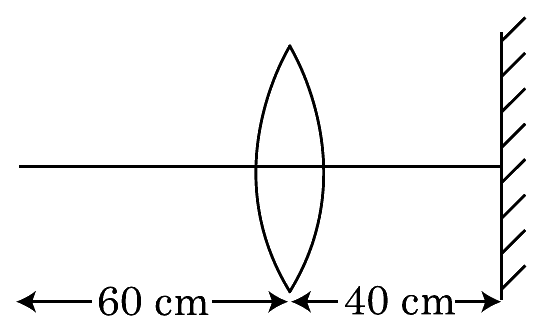
A point object is placed at a distance of $60$ cm from a convex lens of focal length $30$ cm. If a plane mirror were put perpendicular to the principal axis of the lens and at a distance of $40$ cm from it, the final image would be formed at a distance of :
Answer: (B) $20$ cm from the lens, it would be a real image.
Lens: $u = -60$ cm, $f = +30$ cm:
$$\frac{1}{v} = \frac{1}{30} - \frac{1}{60} = \frac{1}{60} \;\Rightarrow\; v = 60\ \text{cm}$$
The rays would converge $60$ cm beyond the lens, but the mirror is only $40$ cm away. The image point lies $20$ cm behind the mirror and acts as a virtual object for it.
A plane mirror forms the image as far in front as the object is behind: the reflected rays converge to a real image $20$ cm in front of the mirror, i.e. $20$ cm from the lens (between the lens and the mirror).
This is the intended answer: a real image $20$ cm from the lens.
 Solution by Sreeraj P, M.Sc Physics