

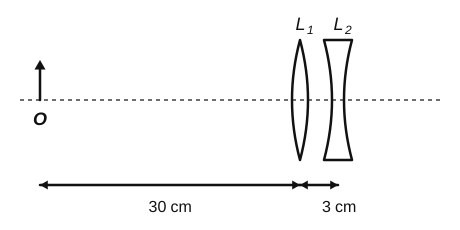
The lens combination as shown in the figure, consists of two lenses, $L_1$ and $L_2$, of the focal lengths $+10$ cm and $-10$ cm, respectively. The position of the image formed is :
Answer: (B) $60$ cm to the left of the concave lens
Lens $L_1$ ($f = +10$ cm, $u = -30$ cm):
$$\frac{1}{v_1} = \frac{1}{f} + \frac{1}{u} = \frac{1}{10} - \frac{1}{30} = \frac{1}{15} \;\Rightarrow\; v_1 = +15\ \text{cm}$$
This image is $15$ cm to the right of $L_1$, i.e. $15 - 3 = 12$ cm to the right of $L_2$. It acts as a virtual object for $L_2$: $u_2 = +12$ cm.
Lens $L_2$ ($f = -10$ cm):
$$\frac{1}{v_2} = -\frac{1}{10} + \frac{1}{12} = -\frac{1}{60} \;\Rightarrow\; v_2 = -60\ \text{cm}$$
The final image is $60$ cm to the left of the concave lens.
 Solution by Sreeraj P, M.Sc Physics