

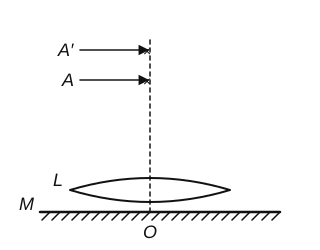
A thin convex lens L (refractive index $= 1.5$) is placed on a plane mirror M. When a pin is placed at A, such that $OA = 18\ \text{cm}$, its real inverted image is formed at A itself, as shown in figure. When liquid of refractive index $\mu_l$ is put between the lens and the mirror, the pin has to be moved to A$'$, such that $OA' = 27\ \text{cm}$, to get its inverted real image at A$'$ itself. The value of $\mu_l$ will be
Answer: (A) $\dfrac43$
The image coincides with the pin when rays return along their own path, i.e. when the pin is at the focus of the lens system. So $f_{lens} = 18\ \text{cm}$.
For the (equiconvex) glass lens: $\dfrac1{18} = (1.5 - 1)\dfrac{2}{R} \Rightarrow R = 18\ \text{cm}$.
The liquid fills the gap as a plano-concave lens of radius $R$: $\dfrac{1}{f_l} = -\dfrac{\mu_l - 1}{18}$. In contact with the glass lens, the new focal length is $27\ \text{cm}$:
$$\frac1{27} = \frac1{18} - \frac{\mu_l - 1}{18} \Rightarrow \mu_l - 1 = 18\left(\frac1{18} - \frac1{27}\right) = \frac13$$
$$\mu_l = \frac43$$
 Solution by Sreeraj P, M.Sc Physics