

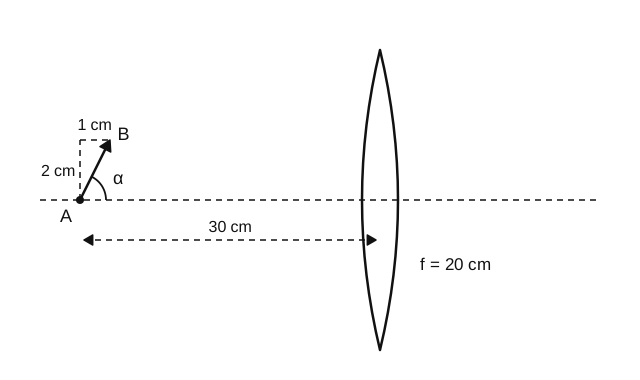
A slanted object AB is placed on one side of a convex lens as shown in the diagram. The image is formed on the opposite side. The angle made by the image with the principal axis is:
Answer: (B) $-45^\circ$
**Image of A** ($u = -30\ \text{cm}$, $f = 20\ \text{cm}$):
$$\frac1v = \frac1f + \frac1u = \frac1{20} - \frac1{30} = \frac1{60} \Rightarrow v_A = 60\ \text{cm}$$
**Image of B**: B is $1\ \text{cm}$ closer to the lens and $2\ \text{cm}$ above the axis, so $u = -29\ \text{cm}$:
$$\frac1v = \frac1{20} - \frac1{29} = \frac{9}{580} \Rightarrow v_B = \frac{580}{9}\ \text{cm} \approx 64.4\ \text{cm}$$
$$m_B = \frac{v}{u} = \frac{580/9}{-29} = -\frac{20}{9},\qquad h' = -\frac{20}{9}\times 2 = -\frac{40}{9}\ \text{cm}$$
So A' is on the axis at $60\ \text{cm}$ and B' is $\frac{40}{9}\ \text{cm}$ further along the axis and $\frac{40}{9}\ \text{cm}$ below it. The slope of A'B' is
$$\tan\theta = \frac{-40/9}{40/9} = -1 \Rightarrow \theta = -45^\circ$$
(Equivalently, longitudinal magnification $m^2 = 4$ stretches the $1\ \text{cm}$ along the axis to $4\ \text{cm}$, and transverse magnification $2$ turns the $2\ \text{cm}$ height into $4\ \text{cm}$ below the axis.)
 Solution by Sreeraj P, M.Sc Physics