

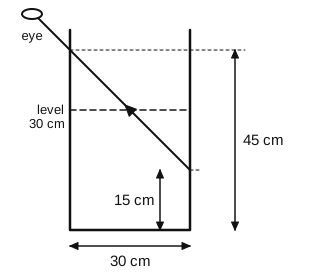
An observer can see through a small hole on the side of a jar (radius $15\ \text{cm}$) at a point at height of $15\ \text{cm}$ from the bottom (see figure). The hole is at a height of $45\ \text{cm}$. When the jar is filled with a liquid up to a height of $30\ \text{cm}$ the same observer can see the edge at the bottom of the jar. If the refractive index of the liquid is $\dfrac{N}{100}$, where $N$ is an integer, the value of $N$ is ______.
Numerical value type. Enter your answer.
Answer: 158
Width of the jar $= 30$ cm. Empty jar: the line of sight drops $45 - 15 = 30$ cm over $30$ cm, so it makes $45^\circ$ with the vertical.
Filled to $30$ cm: the ray in air drops $15$ cm and so moves $15$ cm across, meeting the surface at the middle of the jar. In the liquid it must cover the remaining $15$ cm across over a depth of $30$ cm to reach the bottom edge: $\tan r = \dfrac{15}{30}$, so $\sin r = \dfrac{1}{\sqrt5}$.
$$\mu = \frac{\sin45^\circ}{\sin r} = \frac{1/\sqrt2}{1/\sqrt5} = \sqrt{2.5} \approx 1.58 \Rightarrow N = 158$$
 Solution by Sreeraj P, M.Sc Physics