

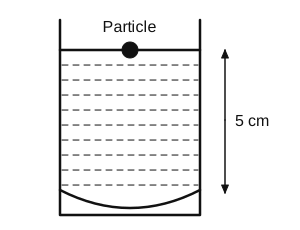
A concave mirror has radius of curvature of $40$ cm. It is at the bottom of a glass that has water filled up to $5$ cm (see figure). If a small particle is floating on the surface of water, its image as seen, from directly above the glass, is at a distance $d$ from the surface of water. The value of $d$ is close to: (Refractive index of water $= 1.33$)
Answer: (B) $8.8$ cm
Mirror: $f = -20$ cm, object $u = -5$ cm (the mirror formula does not depend on the medium):
$$\frac1v = \frac1f - \frac1u = -\frac1{20} + \frac15 = \frac3{20} \Rightarrow v = +6.67\ \text{cm}$$
a virtual image $6.67$ cm below the mirror, i.e. $5 + 6.67 = 11.67$ cm below the water surface.
Seen from above through the water:
$$d = \frac{11.67}{1.33} \approx 8.8\ \text{cm}$$
 Solution by Sreeraj P, M.Sc Physics