

As shown in the figure, a combination of a thin plano-concave lens and a thin plano-convex lens is used to image an object placed at infinity. The radius of curvature of both the lenses is $30\ \text{cm}$ and refraction index of the material for both the lenses is $1.75$. Both the lenses are placed at distance of $40\ \text{cm}$ from each other. Due to the combination, the image of the object is formed at distance $x=$ ______ cm, from concave lens.
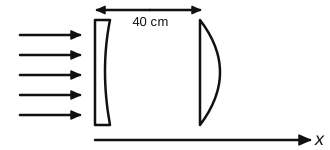
Numerical value type. Enter your answer.
Answer: 120
Focal lengths: $|f|=\dfrac{R}{\mu-1}=\dfrac{30}{0.75}=40\ \text{cm}$, so $f_1=-40\ \text{cm}$ (concave) and $f_2=+40\ \text{cm}$ (convex).
The concave lens forms a virtual image of the distant object $40\ \text{cm}$ in front of it, i.e. $80\ \text{cm}$ in front of the convex lens.
Convex lens: $\dfrac1v-\dfrac1{-80}=\dfrac1{40}\Rightarrow v=80\ \text{cm}$ beyond the convex lens.
Distance from the concave lens $=40+80=120\ \text{cm}$.
 Solution by Sreeraj P, M.Sc Physics