

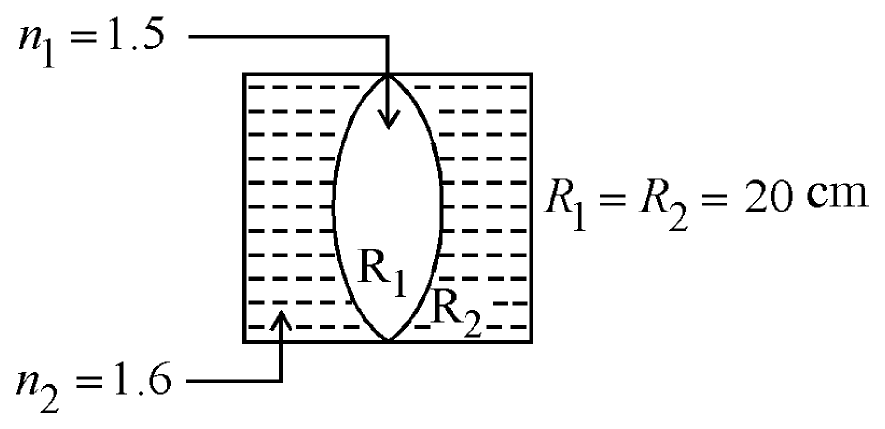
In the figure shown here, what is the equivalent focal length of the combination of lenses (Assume that all layers are thin)?
Answer: (C) $-100$ cm
The combination is a biconvex lens of index $n_1 = 1.5$ with the rest of the block, of index $n_2 = 1.6$, forming two plano-concave lenses on either side. All three are thin and in contact.
Biconvex lens ($n = 1.5$, $R_1 = R_2 = 20$ cm):
$$\frac{1}{f_1} = (1.5 - 1)\left(\frac{1}{20} + \frac{1}{20}\right) = \frac{1}{20}$$
Each plano-concave lens ($n = 1.6$, one curved surface of radius $20$ cm):
$$\frac{1}{f_2} = (1.6 - 1)\left(-\frac{1}{20}\right) = -\frac{3}{100}$$
$$\frac{1}{F} = \frac{1}{20} - \frac{3}{100} - \frac{3}{100} = \frac{5 - 6}{100} = -\frac{1}{100} \;\Rightarrow\; F = -100\ \text{cm}$$
 Solution by Sreeraj P, M.Sc Physics