Take masses of $^{238}\text{U}$, $^{234}\text{Th}$ and $^{4}\text{He}$ as $238.050$ u, $234.043$ u and $4.003$ u, respectively. The Q value for the reaction, in keV, is :
The half life of a radioactive substance is $20$ minutes. In how much time, the activity of substance drops to $\left(\dfrac{1}{16}\right)^{th}$ of its initial value?
Concept. Activity halves every half-life: $\dfrac{A}{A_0} = \left(\dfrac12\right)^{t/T_{1/2}}$.
Step 1. Number of half-lives. $\dfrac{1}{16} = \left(\dfrac12\right)^4$, so $4$ half-lives.
Step 2. Time. $t = 4 \times 20 = 80$ minutes.
Answer. $80$ minutes (Option D).
Solution by Sreeraj P, M.Sc Physics
Q 12-13-004NEETNEET 2021Top questionEasy
A nucleus with mass number $240$ breaks into two fragments each of mass number $120$, the binding energy per nucleon of unfragmented nuclei is $7.6$ MeV while that of fragments is $8.5$ MeV. The total gain in the Binding Energy in the process is :
Let $F_{pp}$, $F_{pn}$ and $F_{nn}$ denote the magnitudes of the nuclear force by a proton on a proton, by a proton on a neutron and by a neutron on a neutron respectively, when the separation is less than one fermi. Then
Step 1. Apply. At the same short separation the nuclear force is the same for proton–proton, proton–neutron and neutron–neutron pairs. (The electrostatic repulsion between protons is a separate force.)
Answer. $F_{pp} = F_{pn} = F_{nn}$ (Option B).
Solution by Sreeraj P, M.Sc Physics
Q 12-13-010JEE MainAIEEE 2011Medium
The half life of a radioactive substance is $20$ minutes. The approximate time interval $(t_2 - t_1)$ between the time $t_2$ when $\dfrac{2}{3}$ of it has decayed and time $t_1$ when $\dfrac{1}{3}$ of it had decayed is
Step 2. Balance. Mass number: $8 = 8 + A \Rightarrow A = 0$. Charge: $4 = 4 + Z \Rightarrow Z = 0$.
Step 3. Identify. No mass number and no charge: a gamma photon.
Answer. Gamma photons (Option C).
Solution by Sreeraj P, M.Sc Physics
Q 12-13-012JEE MainAIEEE 2010Medium
A nucleus of mass $M + \Delta m$ is at rest and decays into two daughter nuclei of equal mass $\dfrac{M}{2}$ each. The speed of light is $c$. The binding energy per nucleon for the parent nucleus is $E_1$ and that for the daughter nuclei is $E_2$. Then
Concept. The decay happens on its own, so energy is released ($\Delta m>0$). Energy is released when nucleons move into more tightly bound nuclei.
Step 1. Compare. The daughters have the larger binding energy per nucleon: $E_2>E_1$.
Answer. Option C.
Solution by Sreeraj P, M.Sc Physics
Q 12-13-013JEE MainAIEEE 2010Medium
A nucleus of mass $M + \Delta m$ is at rest and decays into two daughter nuclei of equal mass $\dfrac{M}{2}$ each. The speed of light is $c$. The speed of each daughter nucleus is
Concept. The binding energy per nucleon curve rises steeply for light nuclei, peaks, then falls slowly for heavy nuclei.
Step 1. Peak. The maximum, about $8.8$ MeV per nucleon, is near iron, $A \approx 56$. (That is why fusion of light nuclei and fission of heavy ones both release energy.)
Answer. $56$ (Option D).
Solution by Sreeraj P, M.Sc Physics
Q 12-13-018NEETJEE MainMedium
The activity of a radioactive sample falls to $\dfrac{1}{8}$ of its initial value in $24$ hours. Its half-life is
Answer: (A) a neutron changing into a proton inside the nucleus
Concept. In $\beta^-$ decay, $n \to p + e^- + \bar\nu$ inside the nucleus.
Step 1. Origin of the electron. There are no electrons inside a nucleus; the electron is created when a neutron turns into a proton. So $Z$ rises by $1$ and $A$ is unchanged.
Answer. A neutron changing into a proton inside the nucleus (Option A).
Solution by Sreeraj P, M.Sc Physics
Q 12-13-023NEETJEE MainMedium
$^{238}_{92}$U decays to $^{206}_{82}$Pb through a series of alpha and beta-minus decays. The numbers of alpha and beta particles emitted are
Concept. Slow (thermal) neutrons are much more likely to cause fission of U-235 than fast ones.
Step 1. Role of the moderator. Heavy water or graphite slows fast neutrons down by collisions. (Control rods of cadmium or boron absorb excess neutrons; the coolant removes heat.)
Each fission of U-235 releases about $200$ MeV. Find the number of fissions per second needed to produce $1$ W of power, in units of $10^{10}$. ($1$ MeV $= 1.6 \times 10^{-13}$ J; give one decimal place)
Q 12-13-028JEE MainJEE Main 2026 (8 Apr, Shift 2)Medium
Two radioactive substances A and B of mass numbers $200$ and $212$ respectively, shows spontaneous $\alpha$-decay with same $Q$ value of $1$ MeV. The ratio of energies of $\alpha$-rays produced by A and B is ______.
Q 12-13-029JEE MainJEE Main 2026 (6 Apr, Shift 1)Hard
The energy released when $\dfrac{7}{17.13}$ kg of $^7_3\text{Li}$ is converted into $^4_2\text{He}$ by proton bombardment is $\alpha \times 10^{32}$ eV. The value of $\alpha$ is ______. (Nearest integer) (Mass of $^7_3\text{Li} = 7.0183$ u, mass of $^4_2\text{He} = 4.004$ u, mass of proton $= 1.008$ u and $1\text{u} = 931\ \text{MeV/c}^2$ and Avogadro number $= 6.0 \times 10^{23}$)
Q 12-13-030JEE MainJEE Main 2026 (6 Apr, Shift 2)Medium
The energy released if hydrogen atoms are combined to form $^4_2\text{He}$ is ______ MeV. (Take binding energies per nucleon of $^2_1\text{H}$ and $^4_2\text{He}$ as $1.1$ MeV and $7.2$ MeV, respectively)
Step 1. Defect. $6(1.00727)+6(1.00866)-12=0.09558$ u.
Step 2. In MeV. $0.09558\times931.5=89.03$ MeV/$c^2$.
Answer. Option B.
Solution by Sreeraj P, M.Sc Physics
Q 12-13-032JEE MainJEE Main 2026 (4 Apr, Shift 1)Medium
Two nuclei of mass number $3$ combine with another nucleus of mass number $4$ to yield a nucleus of mass number $10$. If the binding energy per nucleon for the mass numbers $3, 4$ and $10$ are $5.6$ MeV, $7.4$ MeV and $6.1$ MeV, respectively, then in the process, $\Delta Mc^2 =$ ______ MeV.
Concept. Compare total binding energies before and after. If the products are less bound, energy must be supplied and the mass increases by $\Delta M = \dfrac{\Delta E}{c^2}$.
Q 12-13-035JEE MainJEE Main 2026 (28 Jan, Shift 1)Medium
An atom ${}^{8}_{3}X$ is bombarded by shower of fundamental particles and in 10 s this atom absorbed 10 electrons, 10 protons and 9 neutrons. The percentage growth in the surface area of the nucleons is recorded by :
If $\text{X}_3, \text{X}_4, \text{X}_5$ denote the stability of ${}_2\text{He}^3$, ${}_2\text{He}^4$ and ${}_2\text{He}^5$, respectively, then the correct order is :
Concept. Energy released when a neutron is added means the new nucleus is more tightly bound; energy that must be supplied means it is less tightly bound.
Step 1. He-3 to He-4. $20$ MeV released: $B_4=B_3+20$ MeV, so He-4 is far more stable.
Step 2. He-4 to He-5. $0.9$ MeV must be supplied: $B_5=B_4-0.9=B_3+19.1$ MeV, so He-5 is less stable than He-4 but more than He-3 (He-3's own binding energy is only about $7.7$ MeV, so this holds per nucleon too).
Step 3. Order. $X_4>X_5>X_3$.
Answer. Option A.
Solution by Sreeraj P, M.Sc Physics
Q 12-13-037JEE MainJEE Main 2026 (24 Jan, Shift 1)Easy
Given below are two statements :
Statement I : For all elements, greater the mass of the nucleus, greater is the binding energy per nucleon.
Statement II : For all elements, nuclei with less binding energy per nucleon transforms to nuclei with greater binding energy per nucleon.
In the light of the above statements, choose the correct answer from the options given below
Answer: (A) Statement I is false but Statement II is true
Concept. $BE/A$ rises to a peak near iron ($A\approx56$) and then falls. Nuclei move towards higher $BE/A$ (fission of heavy, fusion of light).
Step 1. Statement I. False beyond iron.
Step 2. Statement II. True.
Answer. Option A.
Solution by Sreeraj P, M.Sc Physics
Q 12-13-038JEE MainJEE Main 2025 (23 Jan, Shift 1)Easy
A radioactive nucleus $n_2$ has 3 times the decay constant as compared to the decay constant of another radioactive nucleus $n_1$. If the initial number of both nuclei are the same, what is the ratio of the number of nuclei of $n_2$ to the number of nuclei of $n_1$ after one half-life of $n_1$?
Concept. $N=N_0e^{-\lambda t}$; after one half-life of $n_1$, $e^{-\lambda_1t}=\dfrac12$ and $e^{-3\lambda_1t}=\dfrac18$.
Step 1. Ratio. $\dfrac{1/8}{1/2}=\dfrac14$.
Answer. Option D.
Solution by Sreeraj P, M.Sc Physics
Q 12-13-039JEE MainJEE Main 2025 (23 Jan, Shift 2)Easy
Given below are two statements. One is labelled as Assertion (A) and the other is labelled as Reason (R).
Assertion (A): The binding energy per nucleon is found to be practically independent of the atomic number $A$, for nuclei with mass numbers between 30 and 170.
Reason (R): Nuclear force is long range.
In the light of the above statements, choose the correct answer from the options given below:
Concept. In $\beta^-$ decay a neutron becomes a proton; charge and lepton number are conserved, so an electron and an antineutrino are emitted.
Step 1. Charge. $0\to+1-1+0$: the electron, not the positron.
Step 2. Lepton number. $e^-$ ($+1$) needs $\bar\nu$ ($-1$) to keep the total at $0$.
Answer. $n\to p+e^-+\bar\nu$ (Option D).
Solution by Sreeraj P, M.Sc Physics
Q 12-13-041JEE MainJEE Main 2024 (1 Feb, Shift 1)Easy
The radius of a nucleus of mass number 64 is $4.8$ fermi. Then the mass number of another nucleus having radius of $4$ fermi is $\dfrac{1000}{x}$, where $x$ is ______.
Concept. Check each statement against Bohr's model and the properties of nuclear forces.
Step 1. Check the statements.
(A) Bohr: $L = n\dfrac{h}{2\pi}$, an integral multiple of $\dfrac{h}{2\pi}$; this is the intended statement → taken as true.
(B) Nuclear forces are short range and do not follow $1/r^2$ → true.
(C) Nuclear forces depend on the spins of the nucleons → true.
(D) Nuclear forces are charge independent but non-central → false.
(E) A smaller packing fraction means a more stable nucleus → true.
Answer. (A), (B), (C), (E) only (Option C).
Solution by Sreeraj P, M.Sc Physics
Q 12-13-043JEE MainJEE Main 2024 (4 Apr, Shift 1)Easy
Which of the following nuclear fragments corresponding to nuclear fission between a neutron $\left({}^1_0\text{n}\right)$ and the uranium isotope $\left({}^{235}_{92}\text{U}\right)$ is correct?
Concept. Mass number and charge are conserved: $235+1=236$ nucleons, $92$ protons.
Step 1. Check B. $144+89+3=236$, $56+36=92$. A gives $237$ nucleons, C gives $237$, D gives $255$.
Answer. Option B.
Solution by Sreeraj P, M.Sc Physics
Q 12-13-044JEE MainJEE Main 2024 (4 Apr, Shift 2)Medium
The disintegration energy $Q$ for the nuclear fission of ${}^{235}\text{U} \rightarrow {}^{140}\text{Ce} + {}^{94}\text{Zr} + n$ is ______ MeV. Given atomic masses of ${}^{235}\text{U}: 235.0439\,u$; ${}^{140}\text{Ce}: 139.9054\,u$; ${}^{94}\text{Zr}: 93.9063\,u$; $n: 1.0086\,u$. Value of $c^2 = 931\ \text{MeV/u}$.
Concept. $Q=(\text{mass before}-\text{mass after})c^2$ for the reaction as written.
Step 1. Products. $139.9054+93.9063+1.0086=234.8203$ u.
Step 2. Defect. $235.0439-234.8203=0.2236$ u.
Step 3. Energy. $0.2236\times931=208$ MeV.
Answer. $208$.
Solution by Sreeraj P, M.Sc Physics
Q 12-13-045JEE MainJEE Main 2024 (5 Apr, Shift 1)Easy
If three helium nuclei combine to form a carbon nucleus, then the energy released in this reaction is ______ $\times10^{-2}\ \text{MeV}$. (Given $1\,u = 931\ \text{MeV}/c^2$, atomic mass of helium $= 4.002603\,u$)
Q 12-13-046JEE MainJEE Main 2024 (27 Jan, Shift 1)Easy
In a nuclear fission process, a high mass nuclide ($A \approx 236$) with binding energy $7.6\ \text{MeV/nucleon}$ dissociated into two middle mass nuclides ($A \approx 118$), having binding energy of $8.6\ \text{MeV/nucleon}$. The energy released in the process would be ______ MeV.
Concept. Energy released $=A\times$ gain in $BE$ per nucleon (nucleon number unchanged).
Step 1. Value. $236\times(8.6-7.6)=236$ MeV.
Answer. $236$.
Solution by Sreeraj P, M.Sc Physics
Q 12-13-047JEE MainJEE Main 2024 (27 Jan, Shift 2)Medium
The atomic mass of $^{12}_{6}\text{C}$ is $12.000000\ \text{u}$ and that of $^{13}_{6}\text{C}$ is $13.003354\ \text{u}$. The required energy to remove a neutron from $^{13}_{6}\text{C}$, if mass of neutron is $1.008665\ \text{u}$, will be:
Concept. Energy to pull one neutron out: mass of the parts minus mass of the whole, $(M_{^{12}C}+m_n-M_{^{13}C})c^2$.
Step 1. Difference. $12+1.008665-13.003354=0.005311$ u.
Step 2. Energy. $0.005311\times931.5=4.95$ MeV.
Answer. Option C.
Solution by Sreeraj P, M.Sc Physics
Q 12-13-048JEE MainJEE Main 2024 (29 Jan, Shift 1)Medium
The explosive in a Hydrogen bomb is a mixture of $^2_1\text{H}$, $^3_1\text{H}$ and $^6_3\text{Li}$ in some condensed form. The chain reaction is given by $$^6_3\text{Li} + {}^1_0n \to {}^4_2\text{He} + {}^3_1\text{H};\qquad {}^2_1\text{H} + {}^3_1\text{H} \to {}^4_2\text{He} + {}^1_0n$$ During the explosion the energy released is approximately:
Concept. Add the two reactions: the neutron and the tritium cancel, leaving $^6\text{Li}+{}^2\text{H}\to2\,{}^4\text{He}$. Then $Q=\Delta m\,c^2$.
Step 1. Masses. Before: $6.01690+2.01471=8.03161$ u. After: $2\times4.00388=8.00776$ u.
Step 2. Energy. $Q=0.02385\times931.5=22.2$ MeV.
Answer. Option D.
Solution by Sreeraj P, M.Sc Physics
Q 12-13-049JEE MainJEE Main 2024 (8 Apr, Shift 1)Easy
Binding energy of a certain nucleus is $18\times10^8\ \text{J}$. How much is the difference between the total mass of all the nucleons and the nuclear mass of the given nucleus?
Step 1. Value. $\dfrac{18\times10^8}{9\times10^{16}}=2\times10^{-8}$ kg $=20\ \mu$g.
Answer. Option B.
Solution by Sreeraj P, M.Sc Physics
Q 12-13-050JEE MainJEE Main 2024 (8 Apr, Shift 2)Easy
If $M_o$ is the mass of isotope $^{12}_5\text{B}$, and $M_p$ and $M_n$ are the masses of proton and neutron, then the nuclear binding energy of the isotope is:
Q 12-13-053JEE MainJEE Main 2024 (9 Apr, Shift 1)Hard
A star has $100\%$ helium composition. It starts to convert three $^4\text{He}$ into one $^{12}\text{C}$ via the triple alpha process as $^4\text{He} + {}^4\text{He} + {}^4\text{He} \to {}^{12}\text{C} + Q$. The mass of the star is $2.0\times10^{32}\ \text{kg}$ and it generates energy at the rate of $5.808\times10^{30}\ \text{W}$. The rate of converting these $^4\text{He}$ to $^{12}\text{C}$ is $n\times10^{42}\ \text{s}^{-1}$, where $n$ is ______. [Take, mass of $^4\text{He} = 4.0026\ \text{u}$, mass of $^{12}\text{C} = 12\ \text{u}$]
Concept. Energy per triple-alpha reaction from the mass difference; reactions per second $=$ power $\div$ energy per reaction; each reaction uses three helium nuclei.
Step 1. $Q$. $(3\times4.0026-12)\times931.5=7.27$ MeV $=1.163\times10^{-12}$ J.
Step 2. Reactions per second. $\dfrac{5.808\times10^{30}}{1.163\times10^{-12}}=5.0\times10^{42}$ s$^{-1}$.
Answer: (D) in opposite directions with speed in the ratio of $1:2$ respectively.
Concept. The nucleus was at rest, so the two fragments have equal and opposite momenta: $m_1v_1=m_2v_2$.
Step 1. Speeds. $\dfrac{v_1}{v_2}=\dfrac{m_2}{m_1}=\dfrac12$, in opposite directions.
Answer. Option D.
Solution by Sreeraj P, M.Sc Physics
Q 12-13-055JEE MainJEE Main 2024 (9 Apr, Shift 2)Hard
The energy released in the fusion of $2\ \text{kg}$ of hydrogen deep in the sun is $E_H$ and the energy released in the fission of $2\ \text{kg}$ of $^{235}\text{U}$ is $E_U$. The ratio $\dfrac{E_H}{E_U}$ is approximately: (Consider the fusion reaction as $4\,{}^1_1\text{H} + 2e^- \to {}^4_2\text{He} + 2\nu + 6\gamma + 26.7\ \text{MeV}$, energy released in the fission reaction of $^{235}\text{U}$ is $200\ \text{MeV}$ per fission nucleus and $N_A = 6.023\times10^{23}$)
Step 3. Ratio. $$\frac{E_H}{E_U} \approx \frac{13350}{1702} \approx 7.8$$ The closest option is $7.62$.
Answer. $7.62$ (Option A).
Solution by Sreeraj P, M.Sc Physics
Q 12-13-056JEE MainJEE Main 2024 (30 Jan, Shift 2)Medium
In a nuclear fission reaction of an isotope of mass $M$, three similar daughter nuclei of the same mass are formed. The speed of a daughter nucleus in terms of the mass defect $\Delta M$ will be:
Concept. The energy released $\Delta Mc^2$ becomes the kinetic energy of the three daughter nuclei, each of mass $\approx \dfrac{M}{3}$ moving with the same speed $v$.
Q 12-13-057JEE MainJEE Main 2024 (31 Jan, Shift 1)Medium
The mass defect in a particular reaction is $0.4\ \text{g}$. The amount of energy liberated is $n\times10^7\ \text{kW h}$, where $n = $ ______. (speed of light $= 3\times10^8\ \text{m s}^{-1}$)
Q 12-13-059JEE MainJEE Main 2024 (31 Jan, Shift 2)Easy
A nucleus has mass number $A_1$ and volume $V_1$. Another nucleus has mass number $A_2$ and volume $V_2$. If the relation between the mass numbers is $A_2 = 4A_1$, then $\dfrac{V_2}{V_1} = $ ______.
Q 12-13-060JEE MainJEE Main 2023 (29 Jan, Shift 1)Easy
If a radioactive element having half-life of $30\ \text{min}$ is undergoing beta decay, the fraction of radioactive element that remains undecayed after $90\ \text{min}$ will be
Q 12-13-061JEE MainJEE Main 2023 (29 Jan, Shift 1)Easy
A radioactive element $^{242}_{92}\text{X}$ emits two $\alpha$-particles, one electron and two positrons. The product nucleus is represented by $^{234}_{P}\text{Y}$. The value of $P$ is ______.
Concept. Count charge: $\alpha$ removes $2$, an emitted electron adds $1$, a positron removes $1$.
Step 1. Charge. $92-4+1-2=87$.
Answer. $P=87$.
Solution by Sreeraj P, M.Sc Physics
Q 12-13-062JEE MainJEE Main 2023 (29 Jan, Shift 2)Medium
Substance $A$ has atomic mass number $16$ and half life of $1$ day. Another substance $B$ has atomic mass number $32$ and half life of $\frac12$ day. If both $A$ and $B$ simultaneously start undergoing radioactivity at the same time with initial mass $320\ \text{g}$ each, how many total atoms of $A$ and $B$ combined would be left after $2$ days?
Q 12-13-063JEE MainJEE Main 2023 (30 Jan, Shift 2)Easy
Given below are two statements: one is labelled as Assertion A and the other is labelled as Reason R.
Assertion A: The nuclear density of nuclides $^{10}_{5}\text{B}$, $^{6}_{3}\text{Li}$, $^{56}_{26}\text{Fe}$, $^{20}_{10}\text{Ne}$ and $^{209}_{83}\text{Bi}$ can be arranged as $\rho^N_{Bi}>\rho^N_{Fe}>\rho^N_{Ne}>\rho^N_{B}>\rho^N_{Li}$.
Reason R: The radius $R$ of nucleus is related to its mass number $A$ as $R=R_0A^{1/3}$, where $R_0$ is a constant.
In the light of the above statements, choose the correct answer from the options given below:
Concept. With $R = R_0A^{1/3}$, nuclear volume $\propto A$, so the density $\dfrac{Am}{\frac43\pi R_0^3A}$ is the same for all nuclei.
Step 1. Reason. $R = R_0A^{1/3}$ is the standard result → true.
Step 2. Assertion. It orders the densities, but all nuclear densities are equal → false.
Answer. A is false but R is true (Option B).
Solution by Sreeraj P, M.Sc Physics
Q 12-13-064JEE MainJEE Main 2023 (30 Jan, Shift 2)Medium
A radioactive nucleus decays by two different processes. The half life of the first process is $5$ minutes and that of the second process is $30$ s. The effective half-life of the nucleus is calculated to be $\dfrac{\alpha}{11}$ s. The value of $\alpha$ is ______.
Answer: (D) neutron has larger rest mass than proton
Concept. A free particle can decay only into lighter products. The neutron ($939.6$ MeV) is heavier than the proton ($938.3$ MeV), so $n\to p+e^-+\bar\nu$ releases energy; the reverse would need energy.
Answer. The neutron has the larger rest mass (Option D).
Solution by Sreeraj P, M.Sc Physics
Q 12-13-066JEE MainJEE Main 2023 (24 Jan, Shift 1)Easy
Consider the following radioactive decay process: $$^{218}_{84}A\xrightarrow{\alpha}A_1\xrightarrow{\beta^-}A_2\xrightarrow{\gamma}A_3\xrightarrow{\alpha}A_4\xrightarrow{\beta^+}A_5\xrightarrow{\gamma}A_6$$ The mass number and the atomic number of $A_6$ are given by
Q 12-13-067JEE MainJEE Main 2023 (24 Jan, Shift 1)Medium
Assume that protons and neutrons have equal masses. Mass of a nucleon is $1.6\times10^{-27}\ \text{kg}$ and radius of nucleus is $1.5\times10^{-15}A^{1/3}\ \text{m}$. The approximate ratio of the nuclear density and water density is $n\times10^{13}$. The value of $n$ is ______.
Step 2. Ratio to water. $\dfrac{1.13\times10^{17}}{10^3}=11\times10^{13}$.
Answer. $n=11$.
Solution by Sreeraj P, M.Sc Physics
Q 12-13-068JEE MainJEE Main 2023 (24 Jan, Shift 2)Easy
The energy released per fission of nucleus of $^{240}\text{X}$ is $200\ \text{MeV}$. The energy released if all the atoms in $120\ \text{g}$ of pure $^{240}\text{X}$ undergo fission is ______ $\times10^{25}\ \text{MeV}$. (Given $N_A=6\times10^{23}$)
Concept. Nuclear density $=\dfrac{Am}{\frac43\pi R_0^3A}=\dfrac{3m}{4\pi R_0^3}$, the same for every nucleus.
Answer. $1:1$ (Option C).
Solution by Sreeraj P, M.Sc Physics
Q 12-13-070JEE MainJEE Main 2023 (25 Jan, Shift 2)Medium
A nucleus disintegrates into two smaller parts, which have their velocities in the ratio $3:2$. The ratio of their nuclear sizes will be $\left(\dfrac x3\right)^{1/3}$. The value of $x$ is ______.
Answer: (B) Both A and R are true and R is the correct explanation of A
Concept. The nuclear force acts only between neighbouring nucleons (a few fm). Each nucleon binds with a fixed number of neighbours, however large the nucleus, so the binding energy per nucleon saturates.
Step 1. Assertion. True: $B/A$ is nearly constant for $A\approx30$–$170$.
Step 2. Reason. True, and the short range is exactly why.
Answer. Option B.
Solution by Sreeraj P, M.Sc Physics
Q 12-13-072JEE MainJEE Main 2023 (15 Apr, Shift 1)Easy
The half-life of a radioactive nucleus is $5$ years. The fraction of the original sample that would decay in $15$ years is
Concept. If $\dfrac78$ has disintegrated, $\dfrac18$ remains.
Step 1. Half-lives. $\dfrac18 = \left(\dfrac12\right)^3$: three half-lives.
Step 2. Time. $3T$.
Answer. $3T$ (Option B).
Solution by Sreeraj P, M.Sc Physics
Q 12-13-074JEE MainJEE Main 2023 (11 Apr, Shift 1)Easy
Two radioactive elements $A$ and $B$ initially have same number of atoms. The half life of $A$ is same as the average life of $B$. If $\lambda_A$ and $\lambda_B$ are decay constants of $A$ and $B$ respectively, then choose the correct relation from the given options.
Concept. $T=\dfrac{\ln2}{\lambda}$ and $\tau=\dfrac1\lambda$.
Step 1. Equate. $\dfrac{\ln2}{\lambda_A}=\dfrac1{\lambda_B}$, so $\lambda_A=\lambda_B\ln2$.
Answer. Option C.
Solution by Sreeraj P, M.Sc Physics
Q 12-13-075JEE MainJEE Main 2023 (11 Apr, Shift 2)Easy
A nucleus disintegrates into two nuclear parts, in such a way that ratio of their nuclear sizes is $1:2^{1/3}$. Their respective speeds have a ratio of $n:1$. The value of $n$ is ______.
Q 12-13-076JEE MainJEE Main 2023 (12 Apr, Shift 1)Medium
A common example of alpha decay is $$^{238}_{92}\text{U}\to{}^{234}_{90}\text{Th}+{}^4_2\text{He}+Q$$ Given: $^{238}_{92}\text{U}=238.05060$ u, $^{234}_{90}\text{Th}=234.04360$ u, $^4_2\text{He}=4.00260$ u and $1\ \text{u}=931.5\ \text{MeV}/c^2$.
The energy released ($Q$) during the alpha decay of $^{238}_{92}\text{U}$ is ______ MeV.
Q 12-13-077JEE MainJEE Main 2023 (13 Apr, Shift 1)Easy
$^{238}_{92}A\to{}^{234}_{90}B+{}^4_2D+Q$
In the given nuclear reaction, the approximate amount of energy released will be [Given, mass of $^{238}_{92}A=238.05079\times931.5\ \text{MeV}\,c^{-2}$, mass of $^{234}_{90}B=234.04363\times931.5\ \text{MeV}\,c^{-2}$, mass of $^4_2D=4.00260\times931.5\ \text{MeV}\,c^{-2}$]
Concept. Liquid-drop model: volume term $+a_vA$ (each inner nucleon has a fixed number of neighbours); surface term $-a_sA^{2/3}$ (surface nucleons have fewer neighbours, a loss proportional to the surface area); Coulomb term $-a_c\dfrac{Z(Z-1)}{A^{1/3}}$.
Step 1. Statements. A false ($-a_1A^{2/3}$ is the total surface term, not per nucleon). B false (the Coulomb term goes as $A^{-1/3}$). C true. D true. E false (surface nucleons have fewer than 12 neighbours; that is why there is a surface term).
Answer. C, D only (Option B).
Solution by Sreeraj P, M.Sc Physics
Q 12-13-079JEE MainJEE Main 2023 (8 Apr, Shift 1)Easy
A nucleus with mass number $242$ and binding energy per nucleon as $7.6$ MeV breaks into two fragments each with mass number $121$. If each fragment nucleus has binding energy per nucleon as $8.1$ MeV, the total gain in binding energy is ______ MeV.
Q 12-13-080JEE MainJEE Main 2023 (8 Apr, Shift 2)Easy
A radioactive material is reduced to $\dfrac18$ of its original amount in $3$ days. If $8\times10^{-3}$ kg of the material is left after $5$ days the initial amount of the material is
Step 2. Initial. $8\times10^{-3}\times32=0.256$ kg $=256$ g.
Answer. Option D.
Solution by Sreeraj P, M.Sc Physics
Q 12-13-081JEE MainJEE Main 2023 (10 Apr, Shift 1)Easy
The decay constant for a radioactive nuclide is $1.5\times10^{-5}\ \text{s}^{-1}$. Atomic weight of the substance is $60\ \text{g mol}^{-1}$, $N_A=6\times10^{23}$. The activity of $1.0\ \mu$g of the substance is ______ $\times10^{10}$ Bq.
Step 1. Defect. $2(1.0073)+2(1.0087)-4.0015=0.0305$ u.
Step 2. Energy. $0.0305\times931=28.4$ MeV.
Answer. Option B.
Solution by Sreeraj P, M.Sc Physics
Q 12-13-083JEE MainJEE Main 2023 (1 Feb, Shift 2)Easy
Nucleus $A$ having $Z=17$ and equal number of protons and neutrons has $1.2$ MeV binding energy per nucleon. Another nucleus $B$ of $Z=12$ has total $26$ nucleons and $1.8$ MeV binding energy per nucleon. The difference of binding energy of $B$ and $A$ will be ______ MeV.
Concept. Total binding energy $=A\times(B/A)$, with $A=Z+N$.
Step 1. Nucleus A. $A=17+17=34$: $34\times1.2=40.8$ MeV.
Step 2. Nucleus B. $26\times1.8=46.8$ MeV.
Step 3. Difference. $46.8-40.8=6$ MeV.
Answer. $6$.
Solution by Sreeraj P, M.Sc Physics
Q 12-13-084JEE MainJEE Main 2022 (24 Jun, Shift 1)Easy
Nucleus $A$ has mass number $220$ and its binding energy per nucleon is $5.6\ \text{MeV}$. It splits into two fragments $B$ and $C$ of mass numbers $105$ and $115$. The binding energy of nucleons in $B$ and $C$ is $6.4\ \text{MeV}$ per nucleon. The energy $Q$ released per fission will be:
Q 12-13-085JEE MainJEE Main 2022 (24 Jun, Shift 2)Medium
A sample contains $10^{-2}\ \text{kg}$ each of two substances $A$ and $B$ with half lives $4\ \text{s}$ and $8\ \text{s}$ respectively. The ratio of their atomic weights is $1 : 2$. The ratio of the amounts of $A$ and $B$ after $16\ \text{s}$ is $\dfrac{x}{100}$. The value of $x$ is ______.
Q 12-13-086JEE MainJEE Main 2022 (25 Jun, Shift 2)Easy
Which of the following figures represents the variation of $\ln\left(\dfrac{R}{R_0}\right)$ with $\ln A$? (where $R$ = radius of a nucleus and $A$ = its mass number)
Answer: (D) 8 alpha particles and 6 beta particles
Concept. Only alpha changes $A$ (by $4$). Then beta decays fix the charge.
Step 1. Alphas. $\dfrac{238-206}{4}=8$, lowering $Z$ by $16$ to $76$.
Step 2. Betas. Each $\beta^-$ raises $Z$ by $1$: $82-76=6$.
Answer. $8\alpha$, $6\beta$ (Option D).
Solution by Sreeraj P, M.Sc Physics
Q 12-13-088JEE MainJEE Main 2022 (26 Jun, Shift 2)Medium
A radioactive nucleus can decay by two different processes. The half-life for the first process is $3.0$ hours while it is $4.5$ hours for the second process. The effective half-life of the nucleus will be
Q 12-13-089JEE MainJEE Main 2022 (26 Jul, Shift 1)Easy
The disintegration rate of a certain radioactive sample at any instant is $4250$ disintegrations per minute. $10$ minutes later, the rate becomes $2250$ disintegrations per minute. The approximate decay constant is (Take $\log_e1.88 = 0.63$)
Concept. $R = R_0A^{1/3}$, so both the volume and the mass are proportional to $A$; nuclear density is independent of $A$.
Step 1. Ratio. $1 : 1$.
Answer. $1 : 1$ (Option C).
Solution by Sreeraj P, M.Sc Physics
Q 12-13-091JEE MainJEE Main 2022 (26 Jul, Shift 2)Easy
Two lighter nuclei combine to form a comparatively heavier nucleus by the relation given below: ${}^2_1X + {}^2_1X = {}^4_2Y$. The binding energies per nucleon of ${}^2_1X$ and ${}^4_2Y$ are $1.1\ \text{MeV}$ and $7.6\ \text{MeV}$ respectively. The energy released in this process is ______ MeV.
Concept. If $\dfrac78$ disintegrates, $\dfrac18 = \left(\dfrac12\right)^3$ remains: three half-lives.
Step 1. Time. $3 \times 60 = 180$ days.
Answer. $180$ days (Option C).
Solution by Sreeraj P, M.Sc Physics
Q 12-13-095JEE MainJEE Main 2022 (28 Jul, Shift 1)Easy
A freshly prepared radioactive source of half life $2$ hours $30$ minutes emits radiation which is $64$ times the permissible safe level. The minimum time, after which it would be possible to work safely with source, will be ______ hours.
Q 12-13-096JEE MainJEE Main 2021 (27 Jul, Shift 1)Easy
If $f$ denotes the ratio of the number of nuclei decayed $(N_d)$ to the number of nuclei at $t = 0$ $(N_0)$, then for a collection of radioactive nuclei, the rate of change of $f$ with respect to time is given as: [$\lambda$ is the radioactive decay constant]
Q 12-13-097JEE MainJEE Main 2021 (27 Jul, Shift 1)Medium
A radioactive sample has an average life of $30$ ms and is decaying. A capacitor of capacitance $200\ \mu\text{F}$ is first charged and later connected with resistor $R$. If the ratio of the charge on the capacitor to the activity of the radioactive sample is fixed with respect to time then the value of $R$ should be ______ $\Omega$.
Concept. Check each statement against standard results.
Step 1. Statements. A true (line spectra are characteristic). B true (stationary orbits). C false (nuclear density is the same for all sizes). D false (a free neutron decays; a free proton does not). E true.
Answer. A, B and E only (Option B).
Solution by Sreeraj P, M.Sc Physics
Q 12-13-099JEE MainJEE Main 2021 (31 Aug, Shift 1)Easy
A sample of a radioactive nucleus $A$ disintegrates to another radioactive nucleus $B$, which in turn disintegrates to some other stable nucleus $C$. Plot of a graph showing the variation of number of atoms of nucleus $B$ versus time is: (Assume that at $t = 0$, there are no $B$ atoms in the sample)
Concept. $\dfrac{dN_B}{dt} = \lambda_AN_A - \lambda_BN_B$: B is produced by A's decay and lost by its own.
Step 1. Early times. $N_B = 0$ at first and A feeds it, so $N_B$ rises from zero.
Step 2. Late times. As A runs out, B's own decay dominates, and $N_B$ falls smoothly to zero (C is stable).
Step 3. Choose. A smooth rise from zero to a maximum, then a decay: graph (3).
Answer. Graph (3) (Option C).
Solution by Sreeraj P, M.Sc Physics
Q 12-13-100JEE MainJEE Main 2021 (25 Feb, Shift 1)Easy
Two radioactive substances $X$ and $Y$ originally have $N_1$ and $N_2$ nuclei respectively. Half life of $X$ is half of the half life of $Y$. After three half lives of $Y$, number of nuclei of both are equal. The ratio $\dfrac{N_1}{N_2}$ will be equal to:
Concept. A free proton is lighter than a neutron, so it cannot decay. Inside a nucleus the binding energies of the parent and daughter nuclei can supply the difference, giving $\beta^+$ decay $p\to n+e^++\nu$.
Answer. Possible only inside the nucleus (Option B).
Solution by Sreeraj P, M.Sc Physics
Q 12-13-102JEE MainJEE Main 2021 (20 Jul, Shift 1)Medium
A radioactive material decays by simultaneous emissions of two particles with half lives of 1400 years and 700 years, respectively. What will be the time after the which one third of the material remains? (Take $\ln3 = 1.1$)
Step 2. Time. $t=\dfrac{1.1\times1400}{3\times0.693}=740$ years.
Answer. Option D.
Solution by Sreeraj P, M.Sc Physics
Q 12-13-103JEE MainJEE Main 2021 (20 Jul, Shift 1)Medium
A nucleus of mass $M$ emits $\gamma$-ray photon of frequency $\nu$. The loss of internal energy by the nucleus is: [Take $c$ as the speed of electromagnetic wave]
Concept. The nucleus recoils with the photon's momentum $\dfrac{h\nu}{c}$, so it must also supply the recoil kinetic energy $\dfrac{p^2}{2M}$.
Step 1. Total loss. $h\nu+\dfrac{(h\nu)^2}{2Mc^2}=h\nu\left[1+\dfrac{h\nu}{2Mc^2}\right]$.
Answer. Option D.
Solution by Sreeraj P, M.Sc Physics
Q 12-13-104JEE MainJEE Main 2021 (20 Jul, Shift 2)Medium
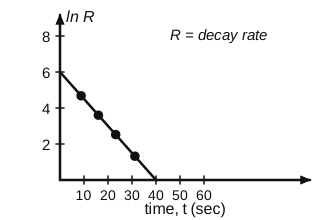
For a certain radioactive process, the graph between $\ln R$ and $t$ (sec) is obtained as shown in the figure. Then the value of half life for the unknown radioactive material is approximately:
Concept. $\ln R=\ln R_0-\lambda t$: the slope of the line is $-\lambda$, and $T=\dfrac{\ln2}{\lambda}$.
Step 1. Slope. $\ln R$ falls from $6$ to $0$ in $40$ s: $\lambda=0.15$ s$^{-1}$.
Step 2. Half-life. $T=\dfrac{0.693}{0.15}=4.62$ s.
Answer. Option D.
Solution by Sreeraj P, M.Sc Physics
Q 12-13-105JEE MainJEE Main 2021 (20 Jul, Shift 2)Easy
A radioactive substance decays to $\left(\frac{1}{16}\right)^{\text{th}}$ of its initial activity in 80 days. The half life of the radioactive substance expressed in days is ______.
Step 1. Half-lives. $\dfrac{1}{16} = \left(\dfrac12\right)^4$: four half-lives in $80$ days.
Step 2. Half-life. $\dfrac{80}{4} = 20$ days.
Answer. $20$.
Solution by Sreeraj P, M.Sc Physics
Q 12-13-106JEE MainJEE Main 2021 (22 Jul, Shift 1)Easy
A nucleus with mass number 184 initially at rest emits an $\alpha$-particle. If the $Q$ value of the reaction is 5.5 MeV, calculate the kinetic energy of the $\alpha$-particle.
Q 12-13-107JEE MainJEE Main 2021 (26 Feb, Shift 2)Easy
A radioactive sample is undergoing $\alpha$ decay. At any time $t_1$, its activity is $A$ and another time $t_2$, the activity is $\frac{A}{5}$. What is the average life time for the sample?
Q 12-13-109JEE MainJEE Main 2021 (25 Jul, Shift 2)Easy
The nuclear activity of a radioactive element becomes $\left(\frac{1}{8}\right)^{\text{th}}$ of its initial value in $30$ years. The half-life of radioactive element is ______ years.
Step 1. Half-lives. $\dfrac18 = \left(\dfrac12\right)^3$: three half-lives in $30$ years.
Step 2. Half-life. $\dfrac{30}{3} = 10$ years.
Answer. $10$.
Solution by Sreeraj P, M.Sc Physics
Q 12-13-110JEE MainJEE Main 2021 (26 Aug, Shift 2)Hard
At time $t = 0$, a material is composed of two radioactive atoms $A$ and $B$, where $N_A(0) = 2N_B(0)$. The decay constant of both kind of radioactive atoms is $\lambda$. However, $A$ disintegrates to $B$ and $B$ disintegrates to $C$. Which of the following figures represents the evolution of $\frac{N_B(t)}{N_B(0)}$ with respect to time $t$?
Concept. With equal decay constants, $N_B(t)=\left[N_B(0)+\lambda tN_A(0)\right]e^{-\lambda t}$. Here $N_A(0)=2N_B(0)$.
Step 1. Ratio. $\dfrac{N_B}{N_B(0)}=(1+2\lambda t)e^{-\lambda t}$: starts at 1.
Step 2. Maximum. $\dfrac{d}{dt}$ gives $\lambda e^{-\lambda t}(1-2\lambda t)=0$ at $t=\dfrac1{2\lambda}$, value $2e^{-1/2}=1.21$; then it falls to 0.
Answer. Option C.
Solution by Sreeraj P, M.Sc Physics
Q 12-13-111JEE MainJEE Main 2021 (27 Aug, Shift 1)Easy
There are $10^{10}$ radioactive nuclei in a given radioactive element. Its half-life time is $1$ min. How many nuclei will remain after $30$ s? $(\sqrt{2} = 1.414)$
Q 12-13-112JEE MainJEE Main 2020 (5 Sep, Shift 2)Easy
A radioactive nucleus decays by two different processes. The half-life for the first process is $10$ s and that for the second is $100$ s. The effective half-life of the nucleus is close to:
Step 2. Effective half-life. $T = \dfrac{100}{11} \approx 9$ s.
Answer. $9$ s (Option A).
Solution by Sreeraj P, M.Sc Physics
Q 12-13-113JEE MainJEE Main 2020 (6 Sep, Shift 1)Hard
You are given that the mass of ${}^7_3\text{Li} = 7.0160$ u, mass of ${}^4_2\text{He} = 4.0026$ u and mass of ${}^1_1\text{H} = 1.0079$ u. When $20$ g of ${}^7_3\text{Li}$ is converted into ${}^4_2\text{He}$ by proton capture, the energy liberated (in kWh) is: [Mass of nucleon $= 1$ GeV/$c^2$]
Q 12-13-114JEE MainJEE Main 2020 (6 Sep, Shift 2)Medium
Given the masses of various atomic particles $m_p = 1.0072$ u, $m_n = 1.0087$ u, $m_e = 0.000548$ u, $m_{\bar\nu} = 0$, $m_d = 2.0141$ u, where $p \equiv$ proton, $n \equiv$ neutron, $e \equiv$ electron, $\bar\nu \equiv$ antineutrino and $d \equiv$ deuteron. Which of the following processes is allowed by momentum and energy conservation?
Concept. A process must conserve charge, momentum and energy (a spontaneous one cannot gain mass), and lepton number.
Step 1. Check. A: two neutrons cannot make a deuterium atom (charge). B: a free proton is lighter than $n+e^+$, so it cannot decay; also a $\beta^+$ comes with $\nu$, not $\bar\nu$. D: a pair at rest cannot give one photon (its momentum would not be zero). C: $m_n+m_p=2.0159$ u $>m_d=2.0141$ u; the extra $2.2$ MeV goes to the photon.
Answer. Option C.
Solution by Sreeraj P, M.Sc Physics
Q 12-13-115JEE MainJEE Main 2020 (7 Jan, Shift 2)Medium
The activity of a radioactive sample falls from $700\ \text{s}^{-1}$ to $500\ \text{s}^{-1}$ in $30$ minutes. Its half life is close to:
Concept. $\lambda=\dfrac{1}{t}\ln\dfrac{A_0}{A}$, then $T=\dfrac{\ln2}{\lambda}$.
Step 1. Decay constant. $\dfrac{\ln1.4}{30}=\dfrac{0.336}{30}$ per min.
Step 2. Half-life. $\dfrac{0.693\times30}{0.336}=62$ min.
Answer. Option B.
Solution by Sreeraj P, M.Sc Physics
Q 12-13-116JEE MainJEE Main 2020 (2 Sep, Shift 1)Medium
In a reactor, $2\ \text{kg}$ of ${}_{92}\text{U}^{235}$ fuel is fully used up in $30$ days. The energy released per fission is $200\ \text{MeV}$. Given that the Avogadro number, $N = 6.023 \times 10^{26}$ per kilo mole and $1\ \text{eV} = 1.6 \times 10^{-19}\ \text{J}$. The power output of the reactor is close to:
Step 2. Energy. $5.13\times10^{24}\times200\times1.6\times10^{-13}=1.64\times10^{14}$ J.
Step 3. Power. $\dfrac{1.64\times10^{14}}{30\times86400}=6.3\times10^7$ W.
Answer. About $60$ MW (Option B).
Solution by Sreeraj P, M.Sc Physics
Q 12-13-117JEE MainJEE Main 2020 (3 Sep, Shift 1)Easy
In a radioactive material, a fraction of active material remaining after the time $t$ is $\dfrac{9}{16}$. The fraction that was remaining after the time $\dfrac t2$ is:
Concept. $N=N_0e^{-\lambda t}$, so the fraction at $\dfrac t2$ is the square root of the fraction at $t$.
Step 1. Value. $\sqrt{\dfrac9{16}}=\dfrac34$.
Answer. Option C.
Solution by Sreeraj P, M.Sc Physics
Q 12-13-118JEE MainJEE Main 2020 (3 Sep, Shift 2)Medium
The radius $R$ of a nucleus of mass number $A$ can be estimated by the formula $R = (1.3\times10^{-15})A^{1/3}\ \text{m}$. It follows that the mass density of a nucleus is of the order of: $(M_{prot} \cong M_{neut} \simeq 1.67\times10^{-27}\ \text{kg})$
Q 12-13-119JEE MainJEE Main 2020 (4 Sep, Shift 2)Medium
Find the binding energy per nucleon for ${}^{120}_{50}\text{Sn}$. Mass of proton $m_p = 1.00783\ \text{u}$, mass of neutron $m_n = 1.00867\ \text{u}$ and mass of tin nucleus $m_{Sn} = 119.902199\ \text{u}$. (take $1\ \text{u} = 931\ \text{MeV}$)
Step 1. Defect. $50(1.00783)+70(1.00867)-119.902199=1.0962$ u.
Step 2. Per nucleon. $\dfrac{1.0962\times931}{120}=8.5$ MeV.
Answer. Option D.
Solution by Sreeraj P, M.Sc Physics
Q 12-13-120JEE MainJEE Main 2020 (5 Sep, Shift 1)Medium
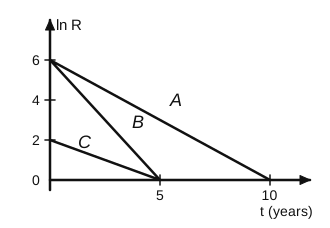
Activities of three radioactive substances $A$, $B$ and $C$ are represented by the curves $A$, $B$ and $C$, in the figure. Then their half-lives $T_{1/2}(A) : T_{1/2}(B) : T_{1/2}(C)$ are in the ratio:
Q 12-13-121JEE MainJEE Main 2019 (9 Jan, Shift 2)Medium
At a given instant, say $t = 0$, two radioactive substances $A$ and $B$ have equal activities. The ratio $\dfrac{R_B}{R_A}$ of their activities after time $t$ itself decays with time $t$ as $e^{-3t}$. If the half-life of $A$ is $\ln2$, the half-life of $B$ is:
Concept. $R=\lambda N$. Equal activities at $t=0$ give $\dfrac{R_B}{R_A}=e^{-(\lambda_B-\lambda_A)t}$.
Step 1. Compare. $\lambda_B-\lambda_A=3$.
Step 2. Decay constants. $T_A=\ln2$ gives $\lambda_A=1$, so $\lambda_B=4$.
Step 3. Half-life of B. $\dfrac{\ln2}{4}$.
Answer. Option C.
Solution by Sreeraj P, M.Sc Physics
Q 12-13-122JEE MainJEE Main 2019 (10 Jan, Shift 1)Easy
Using a nuclear counter the count rate of emitted particles from a radioactive source is measured. At $t = 0$ it was $1600$ counts per second and at $t = 8$ seconds it was $100$ counts per second. The count rate observed, as counts per second, at $t = 6$ seconds is close to:
Concept. $1600\to100$ is a factor of $16=2^4$ in $8$ s, so $T=2$ s.
Step 1. At $6$ s. Three half-lives: $\dfrac{1600}{8}=200$.
Answer. Option B.
Solution by Sreeraj P, M.Sc Physics
Q 12-13-123JEE MainJEE Main 2019 (10 Jan, Shift 2)Medium
Consider the nuclear fission $\text{Ne}^{20} \rightarrow 2\,\text{He}^4 + \text{C}^{12}$. Given that the binding energy per nucleon of $\text{Ne}^{20}$, $\text{He}^4$ and $\text{C}^{12}$ are $8.03\ \text{MeV}$, $7.07\ \text{MeV}$ and $7.86\ \text{MeV}$ respectively, identify the correct statement:
Q 12-13-124JEE MainJEE Main 2019 (10 Apr, Shift 1)Easy
Two radioactive materials $A$ and $B$ have decay constants $10\lambda$ and $\lambda$, respectively. If initially they have the same number of nuclei, then the ratio of the number of nuclei of $A$ to that of $B$ will be $1/e$ after a time:
Concept. With equal initial numbers, $\dfrac{N_A}{N_B} = e^{-(\lambda_A - \lambda_B)t}$.
Step 1. Set equal to $e^{-1}$. $$e^{-9\lambda t} = e^{-1} \;\Rightarrow\; t = \frac{1}{9\lambda}$$
Answer. $\dfrac{1}{9\lambda}$ (Option B).
Solution by Sreeraj P, M.Sc Physics
Q 12-13-125JEE MainJEE Main 2019 (10 Apr, Shift 2)Easy
Two radioactive substances $A$ and $B$ have decay constants $5\lambda$ and $\lambda$ respectively. At $t = 0$, a sample has the same number of the two nuclei. The time taken for the ratio of the number of nuclei to become $\left(\dfrac1e\right)^2$ will be
Concept. With equal starting numbers, $\dfrac{N_A}{N_B}=e^{-(\lambda_A-\lambda_B)t}$.
Step 1. Equation. $e^{-4\lambda t}=e^{-2}$.
Step 2. Time. $t=\dfrac1{2\lambda}$.
Answer. Option B.
Solution by Sreeraj P, M.Sc Physics
Q 12-13-126JEE MainJEE Main 2019 (9 Jan, Shift 1)Easy
A sample of radioactive material $A$, that has an activity of $10\ \text{mCi}$ ($1\ \text{Ci} = 3.7\times10^{10}$ decays/s), has twice the number of nuclei as another sample of a different radioactive material $B$ which has an activity of $20\ \text{mCi}$. The correct choices for half-lives of $A$ and $B$ would then be, respectively
Concept. $R = R_0A^{1/3}$, so volume $\propto A$ and mass $\propto A$: nuclear density is the same for all nuclei.
Step 1. Ratio. About $1$.
Answer. $1$ (Option A).
Solution by Sreeraj P, M.Sc Physics
Q 12-13-128JEE MainJEE Main 2019 (12 Jan, Shift 2)Easy
In a radioactive decay chain, the initial nucleus is ${}^{232}_{90}\text{Th}$. At the end, there are $6$ $\alpha$-particles and $4$ $\beta$-particles which are emitted. If the end nucleus is ${}^{A}_{Z}\text{X}$, $A$ and $Z$ are given by:
Q 12-13-129JEE MainJEE Main 2019 (12 Apr, Shift 2)Easy
Half lives of two radioactive nuclei A and B are $10$ minutes and $20$ minutes, respectively. If, initially a sample has equal number of nuclei, then after $60$ minutes, the ratio of decayed numbers of nuclei A and B will be:
Concept. Decayed number $=N_0\left[1-\left(\tfrac12\right)^{t/T}\right]$.
Step 1. A. $60$ min $=6$ half-lives: decayed $\dfrac{63}{64}N_0$.
Step 2. B. $3$ half-lives: decayed $\dfrac78N_0$.
Step 3. Ratio. $\dfrac{63/64}{7/8}=\dfrac98$.
Answer. $9:8$ (Option D).
Solution by Sreeraj P, M.Sc Physics
Q 12-13-130JEE MainJEE Main 2018 (15 Apr, Shift 1)Medium
A solution containing active cobalt $^{60}_{27}\text{Co}$ having an activity of $0.8\ \mu\text{Ci}$ and decay constant $\lambda$ is injected in an animal's body. When $1\ \text{cm}^3$ blood is drawn from the animal's body after $10\ \text{h}$ of injection, the activity was found to be $300\ \text{dpm}$ (decays per minute), then the total volume of blood in the animal's body is close to $\left[1\ \text{Ci} = 3.7\times10^{10}\ \text{dps (decays per second) and at } t = 10\ \text{h the value of } e^{-\lambda t} = 0.84\right]$
Step 2. Volume. $\dfrac{1.49\times10^6}{300}=4970$ cm$^3\approx5$ L.
Answer. Option C.
Solution by Sreeraj P, M.Sc Physics
Q 12-13-131JEE MainJEE Main 2018 (15 Apr, Shift 2)Easy
An unstable heavy nucleus at rest breaks into two nuclei which move away with velocities in the ratio of $8 : 27$. The ratio of the radii of the nuclei (assumed to be spherical) is:
Q 12-13-132JEE MainJEE Main 2018 (16 Apr, Shift 1)Medium
Both the nucleus and the atom of some element are in their respective first excited states. They get de-excited by emitting photons of wavelengths $\lambda_N$, $\lambda_A$ respectively. The ratio $\dfrac{\lambda_N}{\lambda_A}$ is closest to:
Concept. Nuclear energy levels are about a MeV apart; atomic levels about an eV apart. $\lambda=\dfrac{hc}{\Delta E}$, so the wavelengths are in the inverse ratio of the energies.
Q 12-13-133JEE MainJEE Main 2018 (16 Apr, Shift 1)Medium
At some instant, a radioactive sample $S_1$ having an activity $5\ \mu\text{Ci}$ has twice the number of nuclei as another sample $S_2$ which has an activity of $10\ \mu\text{Ci}$. The half lives of $S_1$ and $S_2$ are:
A radioactive nucleus $A$ with a half-life $T$ decays into a nucleus $B$. At $t = 0$, there is no nucleus $B$. At some time $t$, the ratio of the number of $B$ to that of $A$ is $0.3$. Then, $t$ is given by (take $\log x$ to mean $\log_e x$):
Two deuterons undergo nuclear fusion to form a Helium nucleus. The energy released in this process is (given binding energy per nucleon for deuteron $= 1.1$ MeV and for helium $= 7.0$ MeV):
Imagine that a reactor converts all the given mass into energy and that it operates at a power level of $10^9$ watt. The mass of the fuel consumed per hour in the reactor will be: (velocity of light, $c$ is $3\times10^8\ \text{m s}^{-1}$)
Q 12-13-139JEE MainJEE Main 2025 (2 Apr, Shift 2)Easy
Energy released when two deuterons ($_1\text{H}^2$) fuse to form a helium nucleus ($_2\text{He}^4$) is: (Given: binding energy per nucleon of $_1\text{H}^2 = 1.1\ \text{MeV}$ and binding energy per nucleon of $_2\text{He}^4 = 7.0\ \text{MeV}$)
Concept. Heavy nucleus splitting is fission; light nuclei combining is fusion; a molecule change is chemical. Sign of $Q$: D–D fusion releases energy; turning $^1$H + $^3$H into two deuterons lowers binding energy, so $Q<0$.
Answer. A-III, B-I, C-II, D-IV (Option B).
Solution by Sreeraj P, M.Sc Physics
Q 12-13-141JEE MainJEE Main 2025 (4 Apr, Shift 2)Easy
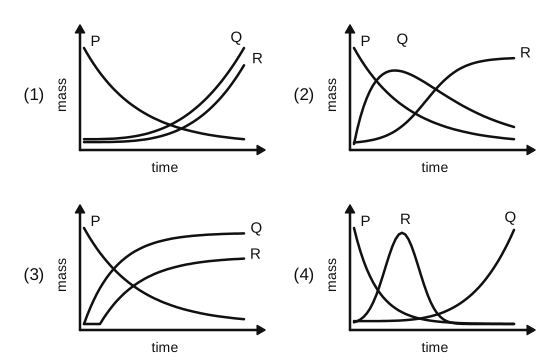
A radioactive material P first decays into Q and then Q decays to non-radioactive material R. Which of the graphs shown in the figure represents the time-dependent mass of P, Q and R?
Concept. In $P\to Q\to R$: $P$ falls exponentially from its starting value; $Q$ starts at zero, rises while $P$ feeds it faster than it decays, peaks and then falls to zero; $R$ starts at zero and rises towards the starting mass.
Step 1. Pick. Graph (2) shows these three shapes.
Answer. Option B.
Solution by Sreeraj P, M.Sc Physics
Q 12-13-142JEE MainJEE Main 2025 (7 Apr, Shift 2)Easy
Given below are two statements: one is labelled as Assertion (A) and the other is labelled as Reason (R).
Assertion (A): The density of the copper (${}^{64}_{29}\text{Cu}$) nucleus is greater than that of the carbon (${}^{12}_{6}\text{C}$) nucleus.
Reason (R): The nucleus of mass number A has a radius proportional to $A^{1/3}$.
In the light of the above statements, choose the most appropriate answer from the options given below:


 Solution by Sreeraj P, M.Sc Physics