Answer: (B) varying velocity and varying acceleration.
Concept. In uniform circular motion the speed is constant but directions keep changing.
Step 1. Velocity. Constant magnitude, changing direction → varies.
Step 2. Acceleration. Constant magnitude $\dfrac{v^2}{r}$, always towards the centre, so its direction changes → varies.
Answer. Varying velocity and varying acceleration (Option B).
Solution by Sreeraj P, M.Sc Physics
Q 11-03-003NEETNEET 2023Top questionEasy
A bullet is fired from a gun at the speed of $280\ \text{m s}^{-1}$ in the direction $30°$ above the horizontal. The maximum height attained by the bullet is ($g = 9.8\ \text{m s}^{-2}$, $\sin 30° = 0.5$) :
A particle moving in a circle of radius R with a uniform speed takes a time T to complete one revolution.
If this particle were projected with the same speed at an angle '$\theta$' to the horizontal, the maximum height attained by it equals $4$R. The angle of projection, $\theta$, is then given by :
A car starts from rest and accelerates at $5\ \text{m/s}^2$. At $t = 4$ s, a ball is dropped out of a window by a person sitting in the car. What is the velocity and acceleration of the ball at $t = 6$ s ? (Take $g = 10\ \text{m/s}^2$)
Answer: (D) $\vec{r}\cdot\vec{\tau} = 0$ and $\vec{F}\cdot\vec{\tau} = 0$
Concept. Torque about the origin is $\vec\tau=\vec r\times\vec F$. A cross product is always perpendicular to both of its factors, and perpendicular vectors have zero dot product.
Step 1. Direction of $\vec\tau$. By definition of the cross product, $\vec\tau$ is perpendicular to the plane containing $\vec r$ and $\vec F$.
Step 2. Dot products. Since $\vec\tau\perp\vec r$ and $\vec\tau\perp\vec F$: $$\vec r\cdot\vec\tau=\vec r\cdot(\vec r\times\vec F)=0,\qquad \vec F\cdot\vec\tau=\vec F\cdot(\vec r\times\vec F)=0$$ (Each is a triple product with a repeated vector, which is zero.)
Answer. Option D: both dot products are zero.
Solution by Sreeraj P, M.Sc Physics
Q 11-03-007NEETJEE MainEAMCET 2007 (Medical)Easy
Given two vectors $\vec{A} = \hat{i} - 2\hat{j} - 3\hat{k}$ and $\vec{B} = 4\hat{i} - 2\hat{j} + 6\hat{k}$. The angle made by $(\vec{A} + \vec{B})$ with the $x$-axis is
Velocity and acceleration vectors of a charged particle moving perpendicular to the direction of a magnetic field at a given instant of time are $\vec{v} = 2\hat{i} + c\hat{j}$ and $\vec{a} = 3\hat{i} + 4\hat{j}$ respectively. Then the value of $c$ is
Three forces $\vec{A} = (\hat{i} + \hat{j} + \hat{k})$, $\vec{B} = (2\hat{i} - \hat{j} + 3\hat{k})$ and $\vec{C}$ act on a body to keep it in equilibrium. Then $\vec{C}$ is
A man is walking due east at the rate of $2$ kmph. The rain appears to him to come down vertically at the rate of $2$ kmph. The actual velocity and direction of rainfall with the vertical respectively are
A particle is projected with a velocity $v$ such that its range on the horizontal plane is twice the greatest height attained by it. The range of the projectile is (where $g$ is the acceleration due to gravity)
Concept. Maximum range is at $45°$: $R_{\max} = \dfrac{u^2}{g}$.
Step 1. Substitute. $\dfrac{400}{10} = 40$ m.
Answer. $40$ m (Option D).
Solution by Sreeraj P, M.Sc Physics
Q 11-03-013NEETAIPMT 2011Top questionEasy
A body is moving with velocity $30\ \text{m s}^{-1}$ towards east. After $10$ s its velocity becomes $40\ \text{m s}^{-1}$ towards north. The average acceleration of the body is
Concept. With constant acceleration, $\vec v=\vec u+\vec at$ holds as a vector equation, so each component changes independently. The speed is the magnitude of the final velocity vector.
Step 1. Velocity after $10$ s. $$\vec v=(3\hat i+4\hat j)+(0.4\hat i+0.3\hat j)(10)=(3+4)\hat i+(4+3)\hat j=7\hat i+7\hat j$$
Answer. $7\sqrt2$ units (Option A). Trap: the speed is not $7+7=14$; add the components as a vector.
Solution by Sreeraj P, M.Sc Physics
Q 11-03-015JEE MainIIT JEE 1996Hard
Two guns situated on the top of a hill of height $10$ m fire one shot each with the same speed $5\sqrt{3}$ m/s at some interval of time. One gun fires horizontally and the other fires upwards at an angle of $60°$ with the horizontal. The shots collide in air at a point P. Taking the origin at the foot of the hill right below the muzzles, the time interval between the firings and the coordinates of P are ($g = 10\ \text{m/s}^2$)
Concept. Two shots collide when they are at the same point at the same instant, so both their $x$ and $y$ coordinates must match. Because they are fired at different times, give each its own flight time ($t_1$ for the horizontal shot, $t_2$ for the inclined shot) and solve the two equations.
Step 1. Components of the inclined shot. With $u=5\sqrt3$ m s$^{-1}$ at $60^\circ$: $$u\cos60^\circ=\frac{5\sqrt3}{2}\ \text{m s}^{-1},\qquad u\sin60^\circ=5\sqrt3\cdot\frac{\sqrt3}{2}=7.5\ \text{m s}^{-1}$$
Step 2. Match the $x$-coordinates. Both start at $x=0$: $$5\sqrt3\,t_1=\frac{5\sqrt3}{2}\,t_2\ \Rightarrow\ t_2=2t_1$$
Step 3. Match the $y$-coordinates. Both start at $y=10$ m: $$10-5t_1^2=10+7.5t_2-5t_2^2$$ Substitute $t_2=2t_1$: $$-5t_1^2=15t_1-20t_1^2\ \Rightarrow\ 15t_1^2=15t_1\ \Rightarrow\ t_1=1\ \text{s},\ t_2=2\ \text{s}$$
Step 4. Time interval and point P. The inclined shot is in the air $1$ s longer, so it is fired first and the interval is $1$ s. $$x_P=5\sqrt3(1)=5\sqrt3\ \text{m},\qquad y_P=10-5(1)^2=5\ \text{m}$$
Answer. $1$ s, $(5\sqrt3\ \text{m},\ 5\ \text{m})$ (Option A). Check with the inclined shot: $y=10+7.5(2)-5(4)=5$ m.
Solution by Sreeraj P, M.Sc Physics
Q 11-03-016NEETJEE MainEasy
The greatest and least resultants of two forces acting at a point are $17$ N and $7$ N. The magnitude of their resultant when they act at right angles is
Concept. Greatest resultant $A + B$, least $A - B$.
Step 1. Forces. $A + B = 17$, $A - B = 7$: $A = 12$ N, $B = 5$ N.
Step 2. At right angles. $\sqrt{144 + 25} = 13$ N.
Answer. $13$ N (Option A).
Solution by Sreeraj P, M.Sc Physics
Q 11-03-017NEETJEE MainMedium
The resultant of two forces $\vec{A}$ and $\vec{B}$ is perpendicular to $\vec{A}$, and its magnitude is half the magnitude of $\vec{B}$. The angle between $\vec{A}$ and $\vec{B}$ is
The vectors $\vec{A} = a\hat{i} + 2\hat{j} - \hat{k}$ and $\vec{B} = 2a\hat{i} - a\hat{j} + 4\hat{k}$ are perpendicular to each other. The positive value of $a$ is
The diagonals of a parallelogram are $\vec{d}_1 = 3\hat{i} + \hat{j} - 2\hat{k}$ and $\vec{d}_2 = \hat{i} - 3\hat{j} + 4\hat{k}$. The area of the parallelogram is
Step 2. Area. $|\vec d_1 \times \vec d_2| = \sqrt{300} = 10\sqrt3$, so area $= 5\sqrt3$.
Answer. $5\sqrt3$ (Option C).
Solution by Sreeraj P, M.Sc Physics
Q 11-03-023NEETJEE MainEasy
A force $\vec{F} = (2\hat{i} + 3\hat{j} - \hat{k})$ N moves a particle from the point $(1, 2, 0)$ m to the point $(4, -1, 3)$ m. The work done by the force is
Concept. Work by a constant force: $W = \vec F \cdot \vec s$.
Step 1. Displacement. $\vec s = 3\hat i - 3\hat j + 3\hat k$.
Step 2. Work. $6 - 9 - 3 = -6$ J.
Answer. $-6$ J (Option D).
Solution by Sreeraj P, M.Sc Physics
Q 11-03-024NEETJEE MainMedium
The position of a particle is $\vec{r} = (3t^2\,\hat{i} + 4t\,\hat{j})$ m, with $t$ in seconds. The angle between its velocity and its acceleration at $t = 1$ s is
A particle starts from the origin at $t = 0$ with a velocity of $4\hat{j}$ m/s and moves in the $xy$-plane with a constant acceleration of $(6\hat{i} + 2\hat{j})\ \text{m/s}^2$. Its $y$-coordinate at the instant its $x$-coordinate is $12$ m is
Step 2. Tilt. The rain comes from the front, so tilt forward: $$\tan\theta = \frac86 = \frac43$$
Answer. Tilted forward at $\tan^{-1}\left(\dfrac43\right)$ with the vertical (Option D).
Solution by Sreeraj P, M.Sc Physics
Q 11-03-028JEE MainTop questionHard
Ship A is $20$ km due north of ship B. A sails due west at $15$ km/h and B sails due north at $20$ km/h. The distance of closest approach between the ships is
Concept. Work in A's frame: B moves in a straight line with $\vec v_{BA}$; closest approach is the perpendicular distance from A to that line.
Step 1. Relative velocity. $\vec v_{BA} = 20\hat N + 15\hat E$, magnitude $25$ km/h; it makes angle $\phi$ with north, $\sin\phi = \dfrac35$.
Step 2. Closest distance. B starts $20$ km south of A: $$d_{\min} = 20\sin\phi = 12\ \text{km}$$
Answer. $12$ km (Option A).
Solution by Sreeraj P, M.Sc Physics
Q 11-03-029NEETJEE MainMedium
A river $120$ m wide flows at $3$ m/s. A boat can move at $5$ m/s in still water. How much longer does it take to cross along the shortest path than in the shortest possible time?
A boat whose speed in still water is $5$ m/s must reach the point directly opposite on the other bank of a river flowing at $3$ m/s. The angle between the boat's heading and the direction of the river flow must be
Two balls are projected from the same point with the same speed of $40$ m/s at complementary angles of projection. The sum of their maximum heights is ($g = 10\ \text{m/s}^2$)
A ball is projected at $20$ m/s at $60°$ above the horizontal. After what time will its velocity be perpendicular to its initial velocity? ($g = 10\ \text{m/s}^2$)
Step 2. Substitute. $t = \dfrac{20}{10 \times \sqrt3/2} = \dfrac{4}{\sqrt3}$ s (after the top at $\sqrt3$ s, as it must be).
Answer. $\dfrac{4}{\sqrt3}$ s (Option C).
Solution by Sreeraj P, M.Sc Physics
Q 11-03-035NEETJEE MainMedium
A stone is projected at $30\sqrt{2}$ m/s at $45°$ to the horizontal. Its average velocity from the point of projection to the highest point is ($g = 10\ \text{m/s}^2$)
Concept. Average velocity $= \dfrac{\text{displacement}}{\text{time}}$.
Step 1. Components. $u_x = u_y = 30$ m/s; time to the top $3$ s.
Step 2. Displacement. $x = 90$ m, $H = 45$ m: $\sqrt{90^2 + 45^2} = 45\sqrt5$ m.
Step 3. Average velocity. $\dfrac{45\sqrt5}{3} = 15\sqrt5$ m/s.
Answer. $15\sqrt5$ m/s (Option D).
Solution by Sreeraj P, M.Sc Physics
Q 11-03-036NEETJEE MainEasy
A ball is thrown horizontally at $20$ m/s from the top of a tower $45$ m high. The angle its velocity makes with the horizontal when it hits the ground is ($g = 10\ \text{m/s}^2$)
Two stones are thrown horizontally in opposite directions from the top of an $80$ m tall tower, with speeds $15$ m/s and $25$ m/s. The distance between the points where they land is ($g = 10\ \text{m/s}^2$)
Concept. Both stones fall for the same time and move apart horizontally.
Step 1. Time. $t = \sqrt{\dfrac{160}{10}} = 4$ s.
Step 2. Separation. $(15 + 25) \times 4 = 160$ m.
Answer. $160$ m (Option B).
Solution by Sreeraj P, M.Sc Physics
Q 11-03-038NEETJEE MainEasy
An aeroplane flying horizontally at $360$ km/h at a height of $500$ m wants to drop a food packet on a target on the ground. How far horizontally before the target should the packet be released? ($g = 10\ \text{m/s}^2$)
Concept. The packet keeps the plane's horizontal velocity while it falls.
Step 1. Speed. $360$ km/h $= 100$ m/s.
Step 2. Time of fall. $t = \sqrt{\dfrac{1000}{10}} = 10$ s.
Step 3. Distance. $100 \times 10 = 1000$ m.
Answer. $1000$ m (Option C).
Solution by Sreeraj P, M.Sc Physics
Q 11-03-039NEETJEE MainTop questionMedium
A particle moves on a circle of radius $2$ m. At a certain instant its speed is $4$ m/s and its speed is increasing at $6\ \text{m/s}^2$. The magnitude of its acceleration at that instant is
A disc starts from rest and rotates with a uniform angular acceleration of $2\ \text{rad/s}^2$. The number of revolutions it makes in the first $10$ s is nearly
A ball is projected with a speed of $25$ m/s at an angle of $53°$ above the horizontal. Find its horizontal range in metres. (Take $\sin 53° = 0.8$, $\cos 53° = 0.6$ and $g = 10\ \text{m/s}^2$.)
Step 2. Time of flight. $T = \dfrac{2 \times 20}{10} = 4$ s.
Step 3. Range. $15 \times 4 = 60$ m.
Answer. $60$.
Solution by Sreeraj P, M.Sc Physics
Q 11-03-043JEE MainMedium
The position of a particle moving in a vertical plane is $\vec{r} = \left[2t\,\hat{i} + (5t - t^2)\,\hat{j}\right]$ m, where $\hat{j}$ is vertically upward and $t$ is in seconds. Find the maximum height ($y$-coordinate) reached by the particle, in metres.
Concept. At maximum height $v_y = \dfrac{dy}{dt} = 0$.
Step 1. Time. $5 - 2t = 0 \Rightarrow t = 2.5$ s.
Step 2. Height. $y = 12.5 - 6.25 = 6.25$ m.
Answer. $6.25$.
Solution by Sreeraj P, M.Sc Physics
Q 11-03-044JEE MainJEE Main 2026 (8 Apr, Shift 2)Easy
Two identical bodies, projected with the same speed at two different angles cover the same horizontal range $R$. If the time of flight of these bodies are $5$ s and $10$ s, respectively, then the value of $R$ is ______ m. (Take $g = 10\ \text{m/s}^2$)
Concept. At the same speed, $R=\dfrac{u^2\sin2\theta}{g}$ takes the same value for $\theta$ and $90^\circ-\theta$. The two flight times are then $\dfrac{2u\sin\theta}{g}$ and $\dfrac{2u\cos\theta}{g}$, and their product is directly related to $R$.
Step 1. Write the two flight times. $$T_1=\frac{2u\sin\theta}{g},\qquad T_2=\frac{2u\sin(90^\circ-\theta)}{g}=\frac{2u\cos\theta}{g}$$
Q 11-03-045JEE MainJEE Main 2026 (4 Apr, Shift 2)Medium
Two cars $A$ and $B$ are moving in the same direction along a straight line with speeds $100\ \text{km/h}$ and $80\ \text{km/h}$, respectively such that car $A$ is moving ahead of car $B$. A person in car $B$ throws a stone with a speed $v$ so that it hits the car $A$ with a speed of $5\ \text{m/s}$. The value of $v$ is ______ km/h.
Concept. The stone's velocity relative to car A decides how hard it hits A. The stone leaves car B with B's velocity plus $v$ (relative to B), all along the road.
Step 1. Stone's ground speed. $80+v$ km/h.
Step 2. Relative to A. $(80+v)-100=v-20$ km/h, which must be $5$ m/s $=18$ km/h.
Step 3. Solve. $v=38$ km/h.
Answer. $38$ (Option C).
Solution by Sreeraj P, M.Sc Physics
Q 11-03-046JEE MainJEE Main 2026 (4 Apr, Shift 2)Easy
If $x$ and $y$ coordinates of a projectile as a function of time $(t)$ are given as $24t$ and $43.6t - 4.9t^2$, respectively, then the angle (in degrees) made by the projectile with horizontal when $t = 2$ s is ______.
Q 11-03-047JEE MainJEE Main 2026 (4 Apr, Shift 2)Easy
A gun mounted on the ground fires bullets in all directions with same speed. The farthest distance the bullets could reach is $6.4$ m. The speed of the bullets from the gun is ______ m/s. (take $g = 10\ \text{m/s}^2$)
Concept. The farthest a gun can reach on level ground is the maximum range $R_{\max}=\dfrac{u^2}{g}$ (at $45^\circ$).
Step 1. Solve for $u$. $$u^2=gR_{\max}=10\times6.4=64\ \Rightarrow\ u=8\ \text{m/s}$$
Answer. $8$.
Solution by Sreeraj P, M.Sc Physics
Q 11-03-048JEE MainJEE Main 2026 (4 Apr, Shift 1)Easy
The two projectiles are projected with the same initial velocities at the $15^\circ$ and $30^\circ$ with respect to the horizontal. The ratio of their ranges is $1 : x$. The value of $x$ is
Q 11-03-049JEE MainJEE Main 2026 (2 Apr, Shift 1)Medium
The velocity of a particle is given as $\vec v=-x\hat i+2y\hat j-z\hat k$ m/s. The magnitude of acceleration at point $(1,2,4)$ is ______ $\text{m/s}^2$.
Concept. Here velocity is given as a function of position, not time. By the chain rule, $a_x=\dfrac{dv_x}{dt}=\dfrac{\partial v_x}{\partial x}v_x+\dfrac{\partial v_x}{\partial y}v_y+\dfrac{\partial v_x}{\partial z}v_z$. Each component depends only on its own coordinate, so only one term survives: $a_x=v_x\dfrac{dv_x}{dx}$, and likewise for $y$ and $z$.
Answer. $9$ m s$^{-2}$ (Option B). Trap: the acceleration is not zero just because there is no $t$ in the formula; the particle moves to places where the velocity is different.
Solution by Sreeraj P, M.Sc Physics
Q 11-03-050JEE MainJEE Main 2026 (24 Jan, Shift 1)Easy
A boy throws a ball into air at $45^\circ$ from the horizontal to land it on a roof of a building of height $H$. If the ball attains maximum height in 2 s and lands on the building in 3 s after launch, then value of $H$ is ______ m.
Concept. The vertical motion alone decides heights and times. Time to the top $t=\dfrac{u_y}{g}$ gives $u_y$; then $y=u_yt-\tfrac12gt^2$ at the landing time.
Step 2. Height after 3 s. $$H=20\times3-\tfrac12(10)(9)=60-45=15\ \text{m}$$
Answer. $15$ m (Option D). (The $45^\circ$ is not needed.)
Solution by Sreeraj P, M.Sc Physics
Q 11-03-051JEE MainJEE Main 2025 (22 Jan, Shift 1)Easy
A particle is projected at an angle of $30^\circ$ from horizontal at a speed of $60\ \text{m/s}$. The height traversed by the particle in the first second is $h_0$ and height traversed in the last second, before it reaches the maximum height, is $h_1$. The ratio $h_0 : h_1$ is ______. [Take $g = 10\ \text{m/s}^2$]
Concept. Only the vertical motion matters: $u_y=60\sin30^\circ=30$ m/s. The last second before the top is the mirror image of the first second of a fall from rest: $\tfrac12g(1)^2$.
Step 1. First second. $h_0=30(1)-\tfrac12(10)(1)=25$ m.
Step 2. Last second before the top. $h_1=\tfrac12g=5$ m.
Step 3. Ratio. $h_0:h_1=25:5=5$.
Answer. $5$.
Solution by Sreeraj P, M.Sc Physics
Q 11-03-052JEE MainJEE Main 2025 (22 Jan, Shift 2)Easy
A ball of mass $100\ \text{g}$ is projected with velocity $20\ \text{m/s}$ at $60^\circ$ with horizontal. The decrease in kinetic energy of the ball during the motion from point of projection to highest point is
Concept. At the highest point only the vertical component of velocity is lost.
Step 1. Loss in KE. $$\Delta K = \frac12(0.1)\left(20 \times \frac{\sqrt3}{2}\right)^2 = \frac12(0.1)(300) = 15\ \text{J}$$
Answer. $15$ J (Option B).
Solution by Sreeraj P, M.Sc Physics
Q 11-03-053JEE MainJEE Main 2025 (23 Jan, Shift 1)Medium
Two particles are located at equal distance from origin. The position vectors of those are represented by $\vec A = 2\hat i + 3n\hat j + 2\hat k$ and $\vec B = 2\hat i - 2\hat j + 4p\hat k$, respectively. If both the vectors are at right angle to each other, the value of $n^{-1}$ is ______.
Q 11-03-054JEE MainJEE Main 2025 (23 Jan, Shift 2)Easy
A ball having kinetic energy $KE$ is projected at an angle of $60^\circ$ from the horizontal. What will be the kinetic energy of the ball at the highest point of its flight?
Concept. At the highest point only the horizontal velocity $u\cos\theta$ is left. Kinetic energy goes as speed squared, so $\text{KE}_{\text{top}}=\text{KE}\cos^2\theta$.
Step 1. Speed at the top. $$v_{\text{top}}=u\cos60^\circ=\frac u2$$
Step 2. Kinetic energy at the top. $$\text{KE}_{\text{top}}=\frac12m\left(\frac u2\right)^2=\frac14\cdot\frac12mu^2=\frac{\text{KE}}{4}$$
Answer. $\dfrac{KE}{4}$ (Option D). The other $\tfrac34$ of the energy has become potential energy.
Solution by Sreeraj P, M.Sc Physics
Q 11-03-055JEE MainJEE Main 2025 (24 Jan, Shift 2)Easy
The position vector of a moving body at any instant of time is given as $\vec r = (5t^2\hat i - 5t\hat j)\ \text{m}$. The magnitude and direction of velocity at $t = 2\ \text{s}$ is
Step 3. Direction. The vector points mainly along $+x$ and slightly down. Its angle with the $-y$ axis has $\tan=\dfrac{|v_x|}{|v_y|}=\dfrac{20}{5}=4$. (With the $+x$ axis the tangent would be $\tfrac14$.)
Answer. $5\sqrt{17}$ m/s at $\tan^{-1}4$ with the $-Y$ axis (Option D).
Solution by Sreeraj P, M.Sc Physics
Q 11-03-056JEE MainJEE Main 2025 (29 Jan, Shift 1)Easy
Two projectiles are fired with the same initial speed from the same point on the ground at angles of $(45^\circ - \alpha)$ and $(45^\circ + \alpha)$, respectively, with the horizontal direction. The ratio of their maximum heights attained is
Concept. At fixed speed, $H=\dfrac{u^2\sin^2\theta}{2g}\propto\sin^2\theta$. Writing $\sin^2\theta=\dfrac{1-\cos2\theta}{2}$ turns the angles $45^\circ\pm\alpha$ into $90^\circ\pm2\alpha$, whose cosines are simple.
Step 1. Set up the ratio. $$\frac{H_1}{H_2}=\frac{\sin^2(45^\circ-\alpha)}{\sin^2(45^\circ+\alpha)}=\frac{1-\cos(90^\circ-2\alpha)}{1-\cos(90^\circ+2\alpha)}$$
Step 2. Simplify the cosines. $\cos(90^\circ-2\alpha)=\sin2\alpha$ and $\cos(90^\circ+2\alpha)=-\sin2\alpha$: $$\frac{H_1}{H_2}=\frac{1-\sin2\alpha}{1+\sin2\alpha}$$
Answer. Option B. Check: the first projectile is at the smaller angle, so its height must be smaller, and the ratio is indeed less than 1.
Solution by Sreeraj P, M.Sc Physics
Q 11-03-057JEE MainJEE Main 2025 (29 Jan, Shift 1)Medium
The maximum speed of a boat in still water is $27\ \text{km/h}$. Now this boat is moving downstream in a river flowing at $9\ \text{km/h}$. A man in the boat throws a ball vertically upwards with a speed of $10\ \text{m/s}$. The range of the ball as observed by an observer at rest on the river bank is ______ cm. (Take $g = 10\ \text{m/s}^2$)
Concept. The ball shares the boat's horizontal velocity. Seen from the bank it is a projectile with that horizontal speed and the thrown vertical speed.
Step 1. Boat's ground speed. Downstream at full speed: $27+9=36$ km/h $=10$ m/s.
Step 2. Time in air. $T=\dfrac{2u}{g}=\dfrac{2\times10}{10}=2$ s.
Step 3. Range. $10\times2=20$ m $=2000$ cm.
Answer. $2000$.
Solution by Sreeraj P, M.Sc Physics
Q 11-03-058JEE MainJEE Main 2024 (1 Feb, Shift 1)Medium
A particle moving in a circle of radius $R$ with uniform speed takes time $T$ to complete one revolution. If this particle is projected with the same speed at an angle $\theta$ to the horizontal, the maximum height attained by it is equal to $4R$. The angle of projection $\theta$ is then given by
Step 2. Path. The initial velocity $4\hat i + 3\hat j$ is not along $\vec a$; eliminating $t = \dfrac{x - 2}{4}$ makes $y$ quadratic in $x$.
Answer. Uniformly accelerated having motion along a parabolic path (Option A).
Solution by Sreeraj P, M.Sc Physics
Q 11-03-060JEE MainJEE Main 2024 (4 Apr, Shift 1)Medium
Two forces $\vec F_1$ and $\vec F_2$ are acting on a body. One force has magnitude thrice that of the other force and the resultant of the two forces is equal to the force of larger magnitude. The angle between $\vec F_1$ and $\vec F_2$ is $\cos^{-1}\left(\dfrac1n\right)$. The value of $|n|$ is ______.
Concept. Use the resultant formula $R^2=F_1^2+F_2^2+2F_1F_2\cos\theta$. The condition "resultant equals the larger force" makes the larger force's square cancel from both sides.
Step 1. Name the forces. Let the smaller force be $F$ and the larger $3F$. The resultant is $3F$.
Step 2. Apply the resultant formula. $$(3F)^2=F^2+(3F)^2+2(F)(3F)\cos\theta$$
Step 3. Simplify. The $9F^2$ terms cancel: $$0=F^2+6F^2\cos\theta\ \Rightarrow\ \cos\theta=-\frac16$$
Step 4. Compare with the given form. $\cos\theta=\dfrac1n$ gives $n=-6$.
Answer. $|n|=6$. The angle is obtuse: a resultant can only equal the larger force if the smaller force partly opposes it.
Solution by Sreeraj P, M.Sc Physics
Q 11-03-061JEE MainJEE Main 2024 (4 Apr, Shift 2)Easy
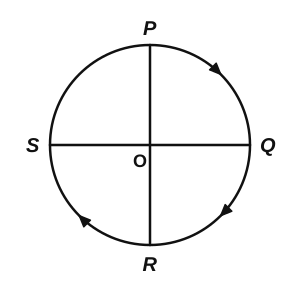
A cyclist starts from the point $P$ of a circular ground of radius $2\ \text{km}$ and travels along its circumference to the point $S$ as shown. The displacement of the cyclist is
Concept. Displacement depends only on the start and end points: here a chord of the circle.
Step 1. Positions. $P$ is at the top and $S$ at the left end of the horizontal diameter; going $P\to Q\to R\to S$ is three-quarters of a turn, but $P$ and $S$ are $90^\circ$ apart at the centre.
Q 11-03-063JEE MainJEE Main 2024 (5 Apr, Shift 2)Easy
A man carrying a monkey on his shoulder does cycling smoothly on a circular track of radius $9\ \text{m}$ and completes 120 revolutions in 3 minutes. The magnitude of the centripetal acceleration of the monkey is (in $\text{m/s}^2$)
Concept. The monkey moves on the same circle at the same rate as the man, so its centripetal acceleration is $a=\omega^2r$. First convert revolutions in a given time to angular speed: $\omega=2\pi f$.
Step 1. Frequency. $120$ revolutions in $3$ min $=180$ s: $$f=\frac{120}{180}=\frac23\ \text{s}^{-1}$$
Concept. $H=\dfrac{u^2\sin^2\theta}{2g}\propto u^2$ at a fixed angle.
Step 1. Halve $u$. $H$ becomes $\tfrac14$ of $64$ m.
Answer. $16$.
Solution by Sreeraj P, M.Sc Physics
Q 11-03-065JEE MainJEE Main 2024 (6 Apr, Shift 1)Medium
For three vectors $\vec A = (-x\hat i - 6\hat j - 2\hat k)$, $\vec B = (-\hat i + 4\hat j + 3\hat k)$ and $\vec C = (-8\hat i - \hat j + 3\hat k)$, if $\vec A\cdot(\vec B\times\vec C) = 0$, then the value of $x$ is ______.
Concept. $\vec A\cdot(\vec B\times\vec C)$ is the volume of the box built on the three vectors, and it equals the $3\times3$ determinant of their components. Setting it to zero (the vectors are coplanar) gives an equation for $x$.
Step 1. Write the determinant. $$\vec A\cdot(\vec B\times\vec C)=\begin{vmatrix}-x&-6&-2\\-1&4&3\\-8&-1&3\end{vmatrix}$$
Step 2. Expand along the first row.
$-x\left[(4)(3)-(3)(-1)\right]=-x(12+3)=-15x$
$-(-6)\left[(-1)(3)-(3)(-8)\right]=6(-3+24)=126$
$(-2)\left[(-1)(-1)-(4)(-8)\right]=-2(1+32)=-66$
Step 3. Set the sum to zero. $$-15x+126-66=0\ \Rightarrow\ 15x=60\ \Rightarrow\ x=4$$
Answer. $x=4$. Remember the alternating signs $+,-,+$ along the first row.
Solution by Sreeraj P, M.Sc Physics
Q 11-03-066JEE MainJEE Main 2024 (27 Jan, Shift 1)Easy
Position of an ant ($S$ in metres) moving in the Y–Z plane is given by $\vec S = 2t^2\,\hat j + 5\,\hat k$ (where $t$ is in second). The magnitude and direction of velocity of the ant at $t = 1\ \text{s}$ will be:
Step 2. At $t=1$ s. $\vec v=4\hat j$: $4\ \text{m s}^{-1}$ along $y$.
Answer. Option D.
Solution by Sreeraj P, M.Sc Physics
Q 11-03-067JEE MainJEE Main 2024 (27 Jan, Shift 1)Medium
A particle starts from origin at $t = 0$ with a velocity $5\hat i\ \text{m s}^{-1}$ and moves in the $x$–$y$ plane under action of a force which produces a constant acceleration of $(3\hat i + 2\hat j)\ \text{m s}^{-2}$. If the $x$-coordinate of the particle at that instant is $84\ \text{m}$, then the speed of the particle at this time is $\sqrt\alpha\ \text{m s}^{-1}$. The value of $\alpha$ is ______.
Concept. Treat the $x$- and $y$-motions separately with the same time. The $x$-coordinate is given, so solve the $x$-equation for $t$; then find both velocity components at that time and combine them for the speed.
Step 1. Time from the $x$-motion. $u_x=5$ m s$^{-1}$, $a_x=3$ m s$^{-2}$: $$84=5t+\tfrac12(3)t^2\ \Rightarrow\ 3t^2+10t-168=0$$
Step 2. Solve the quadratic (keep the positive root): $$t=\frac{-10+\sqrt{100+4(3)(168)}}{2(3)}=\frac{-10+\sqrt{2116}}{6}=\frac{-10+46}{6}=6\ \text{s}$$
Step 3. Velocity components at $t=6$ s. $$v_x=5+3(6)=23\ \text{m s}^{-1},\qquad v_y=0+2(6)=12\ \text{m s}^{-1}$$
Step 4. Speed. $$v^2=23^2+12^2=529+144=673$$
Answer. $\alpha=673$.
Solution by Sreeraj P, M.Sc Physics
Q 11-03-068JEE MainJEE Main 2024 (29 Jan, Shift 1)Hard
A ball rolls off the top of a stairway with horizontal velocity $u$. The steps are $0.1\ \text{m}$ high and $0.1\ \text{m}$ wide. The minimum velocity $u$ with which the ball just hits the step 5 of the stairway will be $\sqrt x\ \text{m s}^{-1}$, where $x =$ ______ [use $g = 10\ \text{m s}^{-2}$].
Concept. The ball moves as a horizontal projectile: $x=ut$, $y=\tfrac12gt^2$ (measured down). It lands on step 5 only if it passes just over the outer edge (corner) of step 4. The least speed is the one whose path goes exactly through that corner.
Step 1. Locate the corner of step 4. Each step is $0.1$ m high and $0.1$ m wide. Starting at the top edge, the corner of step 4 is $4\times0.1=0.4$ m ahead and $0.4$ m below.
Step 2. Time to fall $0.4$ m. $$0.4=\tfrac12(10)t^2\ \Rightarrow\ t^2=0.08\ \text{s}^2$$
Step 3. Horizontal condition. In that time the ball must travel $0.4$ m forward: $$u=\frac{0.4}{t}\ \Rightarrow\ u^2=\frac{0.16}{0.08}=2\ \text{m}^2\text{s}^{-2}$$
Step 4. Check it does not land earlier. On the path $y=\dfrac{gx^2}{2u^2}=\dfrac{5x^2}{2}$, at the corner of step $n$ ($x=y=0.1n$) the ball's height drop is $0.025n^2$, less than $0.1n$ for $n<4$. So it clears steps 1 to 3 and just grazes the corner of step 4.
Answer. $u=\sqrt2$ m s$^{-1}$, so $x=2$.
Solution by Sreeraj P, M.Sc Physics
Q 11-03-069JEE MainJEE Main 2024 (29 Jan, Shift 2)Hard
A particle is moving in a circle of radius $50\ \text{cm}$ in such a way that at any instant the normal and tangential components of its acceleration are equal. If its speed at $t = 0$ is $4\ \text{m s}^{-1}$, the time taken to complete the first revolution will be $\dfrac1\alpha\left[1 - e^{-2\pi}\right]\ \text{s}$, where $\alpha =$ ______.
Step 3. One revolution. $s=2\pi R$: $$1-\frac{v_0t}{R}=e^{-2\pi}\ \Rightarrow\ t=\frac{R}{v_0}\left(1-e^{-2\pi}\right)=\frac{0.5}{4}\left(1-e^{-2\pi}\right)=\frac18\left(1-e^{-2\pi}\right)$$
Answer. $\alpha=8$.
Solution by Sreeraj P, M.Sc Physics
Q 11-03-070JEE MainJEE Main 2024 (8 Apr, Shift 1)Easy
A clock has $75\ \text{cm}$ and $60\ \text{cm}$ long second hand and minute hand respectively. In 30 minutes duration, the tip of the second hand will travel $x$ distance more than the tip of the minute hand. The value of $x$ in metre is nearly (Take $\pi = 3.14$):
Concept. The distance travelled by a tip is (number of revolutions) $\times2\pi r$. In 30 minutes the second hand makes 30 revolutions and the minute hand half a revolution.
Step 1. Second hand. $30\times2\pi\times0.75=45\pi=141.3$ m.
Step 2. Minute hand. $\tfrac12\times2\pi\times0.60=0.6\pi=1.884$ m.
Step 3. Difference. $141.3-1.884\approx139.4$ m.
Answer. $139.4$ (Option C).
Solution by Sreeraj P, M.Sc Physics
Q 11-03-071JEE MainJEE Main 2024 (8 Apr, Shift 1)Easy
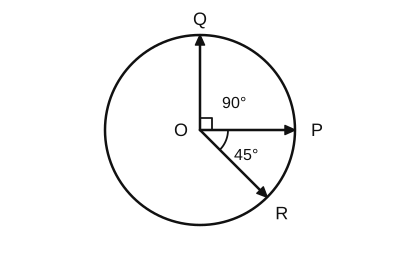
Three vectors $\overrightarrow{OP}$, $\overrightarrow{OQ}$ and $\overrightarrow{OR}$, each of magnitude $A$, are acting as shown in the figure. The resultant of the three vectors is $A\sqrt x$. The value of $x$ is ______.
Concept. Resolve each vector along $x$ (along $\overrightarrow{OP}$) and $y$ (along $\overrightarrow{OQ}$), add the components, then $R=\sqrt{R_x^2+R_y^2}$.
Step 1. Set $R=H$. $4\cot\theta=1\Rightarrow\tan\theta=4$.
Answer. $\tan^{-1}(4)$ (Option A), about $76^\circ$.
Solution by Sreeraj P, M.Sc Physics
Q 11-03-073JEE MainJEE Main 2024 (8 Apr, Shift 2)Easy
A body of mass $M$ thrown horizontally with velocity $v$ from the top of a tower of height $H$ touches the ground at a distance of $100\ \text{m}$ from the foot of the tower. A body of mass $2M$ thrown at a velocity $\dfrac v2$ from the top of a tower of height $4H$ will touch the ground at a distance of ______ m.
Concept. A body thrown horizontally from height $H$ takes $t=\sqrt{\dfrac{2H}{g}}$ to fall (free fall from rest vertically) and meanwhile moves horizontally at constant speed $v$. So $R=v\sqrt{\dfrac{2H}{g}}$, which does not depend on mass.
Step 1. First body. $$R_1=v\sqrt{\frac{2H}{g}}=100\ \text{m}$$
Step 2. Second body (speed $\dfrac v2$, height $4H$; mass irrelevant): $$R_2=\frac v2\sqrt{\frac{2(4H)}{g}}=\frac v2\cdot2\sqrt{\frac{2H}{g}}=v\sqrt{\frac{2H}{g}}=R_1$$
Answer. $100$ m. Quadrupling the height doubles the fall time, which exactly makes up for halving the speed.
Solution by Sreeraj P, M.Sc Physics
Q 11-03-074JEE MainJEE Main 2024 (9 Apr, Shift 1)Medium
If $\vec a$ and $\vec b$ make an angle $\cos^{-1}\left(\dfrac59\right)$ with each other, then $|\vec a + \vec b| = \sqrt2\,|\vec a - \vec b|$ for $|\vec a| = n|\vec b|$. The integer value of $n$ is ______.
Concept. Square both magnitudes: $|\vec a\pm\vec b|^2=a^2+b^2\pm2ab\cos\theta$. Then put $a=nb$ and solve for $n$.
Step 1. Square the condition. $$a^2+b^2+2ab\cos\theta=2\left(a^2+b^2-2ab\cos\theta\right)\ \Rightarrow\ a^2+b^2=6ab\cos\theta$$
Step 2. Put $\cos\theta=\tfrac59$ and $a=nb$. $$n^2+1=6n\cdot\frac59=\frac{10n}{3}\ \Rightarrow\ 3n^2-10n+3=0\ \Rightarrow\ (3n-1)(n-3)=0$$
Step 3. Integer root. $n=3$ (the other root is $\tfrac13$).
Answer. $3$.
Solution by Sreeraj P, M.Sc Physics
Q 11-03-075JEE MainJEE Main 2024 (9 Apr, Shift 2)Medium
The resultant of two vectors $\vec A$ and $\vec B$ is perpendicular to $\vec A$ and its magnitude is half that of $\vec B$. The angle between vectors $\vec A$ and $\vec B$ is ______ $^\circ$.
Concept. "Resultant perpendicular to $\vec A$" means $\vec R\cdot\vec A=0$, which gives $\cos\theta=-\dfrac AB$. To use this we need the ratio $A/B$, and the right triangle formed by $\vec A$, $\vec R$ and $\vec B$ gives it.
Step 1. The right triangle. $\vec B=\vec R-\vec A$ and $\vec R\perp\vec A$, so $B$ is the hypotenuse of a right triangle with legs $A$ and $R$: $$B^2=A^2+R^2$$
Step 2. Use $R=\dfrac B2$. $$A^2=B^2-\frac{B^2}{4}=\frac{3B^2}{4}\ \Rightarrow\ A=\frac{\sqrt3}{2}B$$
Answer. $\theta=150^\circ$. The angle between $\vec A$ and $\vec B$ must be obtuse, because $\vec B$ has to cancel the whole of $\vec A$ along $\vec A$'s direction.
Solution by Sreeraj P, M.Sc Physics
Q 11-03-076JEE MainJEE Main 2024 (30 Jan, Shift 2)Medium
Projectiles $A$ and $B$ are thrown at angles of $45^\circ$ and $60^\circ$ with the vertical respectively from the top of a $400\ \text{m}$ high tower. If their times of flight are the same, the ratio of their speeds of projection $v_A : v_B$ is:
Concept. From the top of the tower both bodies must fall the same $400$ m. Vertical motion depends only on the vertical component of the initial velocity, so equal times of flight need equal vertical components. Note the angles are measured from the vertical, so the vertical component is $v\cos(\text{angle})$.
Step 2. Why they must be equal. For each body, $-400=u_yT-\tfrac12gT^2$. With the same $T$, this equation gives the same $u_y$.
Step 3. Equate and find the ratio. $$\frac{v_A}{\sqrt2}=\frac{v_B}{2}\ \Rightarrow\ \frac{v_A}{v_B}=\frac{\sqrt2}{2}=\frac{1}{\sqrt2}$$
Answer. $1:\sqrt2$ (Option D). Trap: using $\sin$ (angles from the horizontal) gives the reverse ratio $\sqrt2:1$.
Solution by Sreeraj P, M.Sc Physics
Q 11-03-077JEE MainJEE Main 2024 (30 Jan, Shift 2)Easy
A vector has magnitude same as that of $\vec A = 3\hat i + 4\hat j$ and is parallel to $\vec B = 4\hat i + 3\hat j$. The $x$ and $y$ components of this vector in the first quadrant are $x$ and $3$ respectively, where $x = $ ______.
Answer: (C) $|\vec A + \vec B| = 2R\cos\dfrac\theta2$
Concept. The magnitude of a sum or difference of two vectors comes from the law of cosines: $|\vec A\pm\vec B|^2=A^2+B^2\pm2AB\cos\theta$. With equal magnitudes the half-angle identities turn the square roots into neat sines and cosines.
Step 1. Magnitude of the sum. Put $A=B=R$: $$|\vec A+\vec B|^2=R^2+R^2+2R^2\cos\theta=2R^2(1+\cos\theta)$$
Step 2. Use the half-angle identity. Since $1+\cos\theta=2\cos^2\dfrac\theta2$, $$|\vec A+\vec B|^2=4R^2\cos^2\frac\theta2\ \Rightarrow\ |\vec A+\vec B|=2R\cos\frac\theta2$$
Step 3. Magnitude of the difference (to test the other options). Here the cosine term changes sign and $1-\cos\theta=2\sin^2\dfrac\theta2$: $$|\vec A-\vec B|^2=2R^2(1-\cos\theta)=4R^2\sin^2\frac\theta2\ \Rightarrow\ |\vec A-\vec B|=2R\sin\frac\theta2$$ So options A, B and D are all wrong.
Answer. Option C. Quick check: at $\theta=0$ the sum is $2R$ and the difference is $0$, which both formulas give.
Solution by Sreeraj P, M.Sc Physics
Q 11-03-079JEE MainJEE Main 2023 (29 Jan, Shift 1)Easy
A stone is projected at angle $30^\circ$ to the horizontal. The ratio of kinetic energy of the stone at point of projection to its kinetic energy at the highest point of flight will be
Q 11-03-080JEE MainJEE Main 2023 (29 Jan, Shift 2)Easy
An object moves at a constant speed along a circular path in a horizontal plane with centre at the origin. When the object is at $x=+2\ \text{m}$, its velocity is $-4\hat{j}\ \text{m s}^{-1}$. The object's velocity ($v$) and acceleration ($a$) at $x=-2\ \text{m}$ will be
Concept. In uniform circular motion the velocity is tangent to the circle and the acceleration points to the centre with size $\dfrac{v^2}{r}$. At the diametrically opposite point the tangent direction is reversed.
Step 1. Radius and speed. The object is at $x=+2$ m with the centre at the origin, so $r=2$ m. The speed is $|-4\hat j|=4$ m s$^{-1}$.
Step 2. Velocity at $x=-2$ m. At $(2,0)$ it moves along $-\hat j$ (clockwise). Half a turn later, at $(-2,0)$, the velocity has turned by $180^\circ$: $$\vec v=+4\hat j\ \text{m s}^{-1}$$
Step 3. Acceleration at $x=-2$ m. From $(-2,0)$ the centre lies along $+\hat i$: $$|\vec a|=\frac{v^2}{r}=\frac{16}{2}=8\ \text{m s}^{-2},\qquad \vec a=8\hat i\ \text{m s}^{-2}$$
Answer. $v=4\hat j$ m s$^{-1}$, $a=8\hat i$ m s$^{-2}$ (Option B).
Solution by Sreeraj P, M.Sc Physics
Q 11-03-081JEE MainJEE Main 2023 (29 Jan, Shift 2)Hard
A car is moving on a circular path of radius $600\ \text{m}$ such that the magnitudes of the tangential acceleration and centripetal acceleration are equal. The time taken by the car to complete first quarter of revolution, if it is moving with an initial speed of $54\ \text{km h}^{-1}$, is $t\left(1-e^{-\pi/2}\right)\ \text{s}$. The value of $t$ is ______.
Concept. In non-uniform circular motion the tangential acceleration $a_t=\dfrac{dv}{dt}$ changes the speed and the centripetal acceleration is $\dfrac{v^2}{R}$. Writing $\dfrac{dv}{dt}=v\dfrac{dv}{ds}$ (with $s$ the arc length) lets us find $v$ as a function of $s$; then $dt=\dfrac{ds}{v}$ gives the time.
Step 1. Speed as a function of distance. $a_t=a_c$: $$v\frac{dv}{ds}=\frac{v^2}{R}\ \Rightarrow\ \frac{dv}{v}=\frac{ds}{R}\ \Rightarrow\ \ln\frac{v}{v_0}=\frac sR\ \Rightarrow\ v=v_0e^{s/R}$$
Step 2. Time for an arc $s$. $$dt=\frac{ds}{v}=\frac{e^{-s/R}}{v_0}\,ds\ \Rightarrow\ t=\frac{1}{v_0}\int_0^{s}e^{-s'/R}ds'=\frac{R}{v_0}\left(1-e^{-s/R}\right)$$
Step 3. Quarter revolution. $s=\dfrac{\pi R}{2}$, so $\dfrac sR=\dfrac\pi2$: $$t=\frac{R}{v_0}\left(1-e^{-\pi/2}\right)$$
Step 4. Numbers. $v_0=54\ \text{km h}^{-1}=54\times\dfrac{5}{18}=15$ m s$^{-1}$: $$\frac{R}{v_0}=\frac{600}{15}=40\ \text{s}$$
Answer. $t=40$. Remember to convert km h$^{-1}$ to m s$^{-1}$ first.
Solution by Sreeraj P, M.Sc Physics
Q 11-03-082JEE MainJEE Main 2023 (30 Jan, Shift 2)Easy
A stone tied to $180\ \text{cm}$ long string at its end is making $28$ revolutions in horizontal circle in every minute. The magnitude of acceleration of stone is $\dfrac{1936}{x}\ \text{m s}^{-2}$. The value of $x$ is ______. [Take $\pi=\frac{22}{7}$]
Q 11-03-083JEE MainJEE Main 2023 (31 Jan, Shift 1)Easy
The initial speed of a projectile fired from ground is $u$. At the highest point during its motion, the speed of projectile is $\dfrac{\sqrt3}{2}u$. The time of flight of the projectile is
Concept. The horizontal velocity of a projectile never changes, and at the top the vertical velocity is zero. So the speed at the top is $u\cos\theta$, which fixes the angle; the flight time then follows from $T=\dfrac{2u\sin\theta}{g}$.
Step 1. Find the angle of projection. $$u\cos\theta=\frac{\sqrt3}{2}u\ \Rightarrow\ \cos\theta=\frac{\sqrt3}{2}\ \Rightarrow\ \theta=30^\circ$$
Step 2. Time of flight. The vertical motion goes up and down with initial speed $u\sin\theta$: $$T=\frac{2u\sin30^\circ}{g}=\frac{2u\cdot\frac12}{g}=\frac ug$$
Answer. $\dfrac ug$ (Option B).
Solution by Sreeraj P, M.Sc Physics
Q 11-03-084JEE MainJEE Main 2023 (31 Jan, Shift 1)Easy
The speed of a swimmer is $4\ \text{km h}^{-1}$ in still water. If the swimmer makes his strokes normal to the flow of river of width $1\ \text{km}$, he reaches a point $750\ \text{m}$ down the stream on the opposite bank. The speed of the river water is ______ $\text{km h}^{-1}$.
Concept. Heading straight across, the crossing time depends only on the swimmer's speed; during that time the river carries the swimmer downstream.
Step 1. Time. $t=\dfrac{1\ \text{km}}{4\ \text{km h}^{-1}}=0.25$ h.
Step 2. River speed. Drift $=0.75$ km in $0.25$ h: $u=3$ km h$^{-1}$.
Answer. $3$.
Solution by Sreeraj P, M.Sc Physics
Q 11-03-085JEE MainJEE Main 2023 (31 Jan, Shift 2)Easy
A body is moving with constant speed, in a circle of radius $10\ \text{m}$. The body completes one revolution in $4\ \text{s}$. At the end of $3^\text{rd}$ second, the displacement of body (in m) from its starting point is
Q 11-03-086JEE MainJEE Main 2023 (31 Jan, Shift 2)Easy
Two bodies are projected from ground with same speeds $40\ \text{m s}^{-1}$ at two different angles with respect to horizontal. The bodies were found to have same range. If one of the body was projected at an angle of $60^\circ$ with horizontal then sum of the maximum heights attained by the two projectiles is ______ m. (Given $g=10\ \text{m s}^{-2}$)
Concept. Same speed and same range means complementary angles: $60^\circ$ and $30^\circ$. Their heights add to $\dfrac{u^2}{2g}(\sin^260^\circ+\sin^230^\circ)=\dfrac{u^2}{2g}$.
Step 1. Sum of heights. $$H_1+H_2=\frac{u^2}{2g}=\frac{1600}{20}=80\ \text{m}$$
Step 2. Check. $H_{60}=80\times\tfrac34=60$ m, $H_{30}=80\times\tfrac14=20$ m.
Answer. $80$.
Solution by Sreeraj P, M.Sc Physics
Q 11-03-087JEE MainJEE Main 2023 (24 Jan, Shift 1)Easy
The maximum vertical height to which a man can throw a ball is $136\ \text{m}$. The maximum horizontal distance up to which he can throw the same ball is
Concept. The man throws with the same speed $u$ every time. Straight up, the ball rises to $H=\dfrac{u^2}{2g}$. The greatest range at that speed is at $45^\circ$: $R_{\max}=\dfrac{u^2}{g}$. Both depend only on $u^2/g$, so they are linked.
Step 1. Find $u^2/g$ from the vertical throw. $$\frac{u^2}{2g}=136\ \Rightarrow\ \frac{u^2}{g}=272\ \text{m}$$
Step 2. Maximum range. $$R_{\max}=\frac{u^2\sin90^\circ}{g}=\frac{u^2}{g}=272\ \text{m}$$
Answer. $272$ m (Option C). Remember: $R_{\max}=2H_{\max}$ for the same throwing speed.
Solution by Sreeraj P, M.Sc Physics
Q 11-03-088JEE MainJEE Main 2023 (24 Jan, Shift 1)Easy
Vectors $a\hat i+b\hat j+\hat k$ and $2\hat i-3\hat j+4\hat k$ are perpendicular to each other when $3a+2b=7$. The ratio of $a$ to $b$ is $\dfrac x2$. The value of $x$ is ______.
Concept. Perpendicular vectors have zero dot product. That gives one equation; the given $3a+2b=7$ gives the other.
Step 1. Dot product. $2a-3b+4=0$.
Step 2. Solve with $3a+2b=7$. Multiply the first by 2 and the second by 3 and add: $$4a-6b=-8,\quad9a+6b=21\ \Rightarrow\ 13a=13\ \Rightarrow\ a=1,\ b=2$$
Step 3. Ratio. $\dfrac ab=\dfrac12=\dfrac x2$, so $x=1$.
Answer. $1$.
Solution by Sreeraj P, M.Sc Physics
Q 11-03-089JEE MainJEE Main 2023 (24 Jan, Shift 2)Easy
If two vectors $\vec P=\hat i+2m\hat j+m\hat k$ and $\vec Q=4\hat i-2\hat j+m\hat k$ are perpendicular to each other, then the value of $m$ will be
Q 11-03-090JEE MainJEE Main 2023 (25 Jan, Shift 1)Medium
If $\vec P=3\hat i+\sqrt3\hat j+2\hat k$ and $\vec Q=4\hat i+\sqrt3\hat j+2.5\hat k$, then the unit vector in the direction of $\vec P\times\vec Q$ is $\dfrac1x\left(\sqrt3\hat i+\hat j-2\sqrt3\hat k\right)$. The value of $x$ is ______.
Concept. The unit vector along $\vec P\times\vec Q$ is $\dfrac{\vec P\times\vec Q}{|\vec P\times\vec Q|}$. Find the cross product with the determinant rule, then its magnitude, and match with the given form.
Step 1. Set up the determinant. $$\vec P\times\vec Q=\begin{vmatrix}\hat i&\hat j&\hat k\\3&\sqrt3&2\\4&\sqrt3&2.5\end{vmatrix}$$
Step 2. Expand term by term (minus sign on the $\hat j$ term):
Answer. $x=4$. Check: $\sqrt{3+1+12}=4$, so the bracket divided by 4 is indeed a unit vector.
Solution by Sreeraj P, M.Sc Physics
Q 11-03-091JEE MainJEE Main 2023 (25 Jan, Shift 2)Easy
Two objects are projected with same velocity $u$ however at different angles $\alpha$ and $\beta$ with the horizontal. If $\alpha+\beta=90^\circ$, the ratio of horizontal range of the first object to the $2^\text{nd}$ object will be
Q 11-03-092JEE MainJEE Main 2023 (15 Apr, Shift 1)Easy
A vector in $x$–$y$ plane makes an angle of $30^\circ$ with $y$-axis. The magnitude of $y$-component of vector is $2\sqrt3$. The magnitude of $x$-component of the vector will be
Concept. Resolve the vector using its angle with the $y$-axis.
Step 1. Magnitude. $A\cos30° = 2\sqrt3 \Rightarrow A = 4$.
Step 2. $x$-component. $A\sin30° = 2$.
Answer. $2$ (Option C).
Solution by Sreeraj P, M.Sc Physics
Q 11-03-093JEE MainJEE Main 2023 (10 Apr, Shift 2)Easy
Two projectiles are projected at $30^\circ$ and $60^\circ$ with the horizontal with the same speed. The ratio of the maximum height attained by the two projectiles respectively is
Q 11-03-094JEE MainJEE Main 2023 (11 Apr, Shift 1)Easy
A projectile fired at $30^\circ$ to the ground is observed to be at same height at time $3$ s and $5$ s after projection, during its flight. The speed of projection of the projectile is ______ $\text{m s}^{-1}$. (Given $g=10\ \text{m s}^{-2}$)
Concept. The vertical motion is symmetric about the highest point. If the projectile is at the same height at $t_1$ and $t_2$, the top is reached at $\dfrac{t_1+t_2}{2}$, so the total flight time is $T=t_1+t_2$.
Step 1. Why. Heights equal: $u_yt_1-\tfrac12gt_1^2=u_yt_2-\tfrac12gt_2^2$. Dividing by $t_2-t_1$ gives $u_y=\tfrac12g(t_1+t_2)$, so $$T=\frac{2u_y}{g}=t_1+t_2=3+5=8\ \text{s}$$
Q 11-03-095JEE MainJEE Main 2023 (11 Apr, Shift 2)Easy
When vector $\vec A=2\hat i+3\hat j+2\hat k$ is subtracted from vector $\vec B$, it gives a vector equal to $2\hat j$. Then the magnitude of vector $\vec B$ will be
Q 11-03-096JEE MainJEE Main 2023 (11 Apr, Shift 2)Easy
A projectile is projected at $30^\circ$ from horizontal with initial velocity $40\ \text{m s}^{-1}$. The velocity of the projectile at $t=2$ s from the start will be
Step 1. Components at $t = 2$ s. $v_x = 40\cos30° = 20\sqrt3$, $v_y = 20 - 20 = 0$ (the top of the path).
Step 2. Speed. $20\sqrt3\ \text{m s}^{-1}$.
Answer. $20\sqrt3\ \text{m s}^{-1}$ (Option D).
Solution by Sreeraj P, M.Sc Physics
Q 11-03-097JEE MainJEE Main 2023 (6 Apr, Shift 1)Medium
A particle is moving with constant speed in a circular path. When the particle turns by an angle $90^\circ$, the ratio of instantaneous velocity to its average velocity is $\pi:x\sqrt2$. The value of $x$ will be
Concept. Average velocity is displacement divided by time, while the instantaneous velocity (magnitude) is the constant speed $v$. For a $90^\circ$ turn the displacement is the chord $\sqrt2R$, not the arc.
Step 1. Displacement. The two radii are perpendicular, so the chord is $$|\Delta\vec r|=\sqrt{R^2+R^2}=\sqrt2R$$
Step 2. Time taken. The arc is a quarter circle, $\dfrac{\pi R}{2}$, covered at speed $v$: $$t=\frac{\pi R}{2v}$$
Step 3. Average velocity. $$v_{\text{avg}}=\frac{\sqrt2R}{\pi R/(2v)}=\frac{2\sqrt2\,v}{\pi}$$
Answer: (C) Both A and R are correct and R is the correct explanation of A
Concept. $R=\dfrac{u^2\sin2\theta}{g}$ is largest when $\sin2\theta=1$, i.e. $2\theta=90^\circ$.
Step 1. Reason. True: the maximum of $\sin2\theta$ is 1.
Step 2. Assertion. $\sin2\theta=1$ gives $\theta=45^\circ$: true, and it follows from R.
Answer. Both A and R are correct and R is the correct explanation of A (Option C).
Solution by Sreeraj P, M.Sc Physics
Q 11-03-099JEE MainJEE Main 2023 (6 Apr, Shift 2)Medium
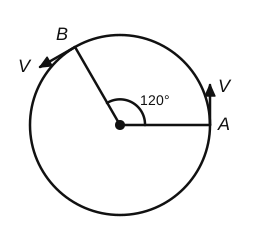
As shown in the figure, a particle is moving with constant speed $\pi\ \text{m s}^{-1}$. Considering its motion from $A$ to $B$, the magnitude of the average velocity is
Q 11-03-101JEE MainJEE Main 2023 (8 Apr, Shift 1)Easy
Two projectiles $A$ and $B$ are thrown with initial velocities of $40\ \text{m s}^{-1}$ and $60\ \text{m s}^{-1}$ at angles $30^\circ$ and $60^\circ$ with the horizontal respectively. The ratio of their ranges respectively is ($g=10\ \text{m s}^{-2}$)
Concept. $R = \dfrac{u^2\sin2\theta}{g}$, and $\sin60° = \sin120°$.
Step 1. Ratio. $R_A : R_B = 40^2 : 60^2 = 4 : 9$.
Answer. $4 : 9$ (Option A).
Solution by Sreeraj P, M.Sc Physics
Q 11-03-102JEE MainJEE Main 2023 (8 Apr, Shift 2)Easy
The trajectory of projectile, projected from the ground is given by $y=x-\dfrac{x^2}{20}$, where $x$ and $y$ are measured in metre. The maximum height attained by the projectile will be
Concept. The trajectory $y=ax-bx^2$ is a downward parabola. The highest point is where the slope $\dfrac{dy}{dx}$ is zero (the velocity is horizontal there), which also gives the shortcut $H=\dfrac{a^2}{4b}$.
Step 1. Find where the slope is zero. $$\frac{dy}{dx}=1-\frac{2x}{20}=1-\frac{x}{10}=0\ \Rightarrow\ x=10\ \text{m}$$
Step 3. Check with the shortcut. $a=1$, $b=\dfrac1{20}$: $H=\dfrac{a^2}{4b}=\dfrac{1}{4/20}=5$ m.
Answer. $5$ m (Option C). The range is $\dfrac ab=20$ m, and the top is at half of it.
Solution by Sreeraj P, M.Sc Physics
Q 11-03-103JEE MainJEE Main 2023 (10 Apr, Shift 1)Easy
The range of the projectile projected at an angle of $15^\circ$ with horizontal is $50$ m. If the projectile is projected with same velocity at an angle of $45^\circ$ with horizontal, then its range will be
Q 11-03-104JEE MainJEE Main 2023 (1 Feb, Shift 1)Easy
A child stands on the edge of the cliff $10$ m above the ground and throws a stone horizontally with an initial speed of $5\ \text{m s}^{-1}$. Neglecting the air resistance, the speed with which the stone hits the ground will be ______ $\text{m s}^{-1}$ (given $g=10\ \text{m s}^{-2}$).
Concept. For a horizontal throw, the horizontal velocity $u$ stays constant, and the vertical velocity grows as in free fall from rest: $v_y^2=2gh$. The landing speed combines the two: $v=\sqrt{u^2+2gh}$ (also what energy conservation gives).
Step 1. Vertical velocity at the ground. $$v_y^2=2gh=2(10)(10)=200\ \text{m}^2\text{s}^{-2}$$
Step 2. Combine with the horizontal velocity. $$v=\sqrt{u^2+v_y^2}=\sqrt{25+200}=\sqrt{225}=15\ \text{m s}^{-1}$$
Answer. $15$ m s$^{-1}$ (Option B). The direction of the throw does not matter for the landing speed, only the height and the launch speed.
Solution by Sreeraj P, M.Sc Physics
Q 11-03-105JEE MainJEE Main 2023 (1 Feb, Shift 2)Easy
For a body projected at an angle with the horizontal from the ground, choose the correct statement.
Answer: (A) Gravitational potential energy is maximum at the highest point.
Concept. At the highest point the height is greatest, $v_y = 0$ and $v_x$ is unchanged.
Step 1. Check. PE is maximum ✓; horizontal velocity and KE are not zero ✗; vertical momentum is zero, not maximum ✗.
Answer. Gravitational potential energy is maximum at the highest point (Option A).
Solution by Sreeraj P, M.Sc Physics
Q 11-03-106JEE MainJEE Main 2022 (24 Jun, Shift 1)Medium
A projectile is projected with velocity of $25\ \text{m s}^{-1}$ at an angle $\theta$ with the horizontal. After $t$ seconds its inclination with horizontal becomes zero. If $R$ represents horizontal range of the projectile, the value of $\theta$ will be: [use $g = 10\ \text{m s}^{-2}$]
Q 11-03-107JEE MainJEE Main 2022 (24 Jun, Shift 2)Medium
A body is projected from the ground at an angle of $45^\circ$ with the horizontal. Its velocity after $2\ \text{s}$ is $20\ \text{m s}^{-1}$. The maximum height reached by the body during its motion is ______ m. (use $g = 10\ \text{m s}^{-2}$)
Concept. At $45^\circ$ both components start equal, $a=u/\sqrt2$. The horizontal one stays $a$; the vertical one becomes $a-gt$. Use the given speed at $t=2$ s to find $a$, then $H=\dfrac{a^2}{2g}$.
Step 1. Speed at $t=2$ s. $$a^2+(a-20)^2=20^2\ \Rightarrow\ 2a^2-40a=0\ \Rightarrow\ a=20\ \text{m/s}$$ (At $t=2$ s the body is at the top: $v_y=0$, $v=v_x=20$.)
Step 2. Maximum height. $$H=\frac{u_y^2}{2g}=\frac{400}{20}=20\ \text{m}$$
Answer. $20$.
Solution by Sreeraj P, M.Sc Physics
Q 11-03-108JEE MainJEE Main 2022 (25 Jun, Shift 1)Easy
$\vec A$ is a vector quantity such that $|\vec A| =$ non-zero constant. Which of the following expressions is true for $\vec A$?
Answer: (B) $|\hat A - \hat B| = |\hat A + \hat B|\tan\dfrac\theta2$
Concept. For unit vectors at angle $\theta$: $|\hat A \pm \hat B| = \sqrt{2 \pm 2\cos\theta}$.
Step 1. Half-angle forms. $|\hat A + \hat B| = 2\cos\dfrac\theta2$, $|\hat A - \hat B| = 2\sin\dfrac\theta2$.
Step 2. Relation. $|\hat A - \hat B| = |\hat A + \hat B|\tan\dfrac\theta2$.
Answer. $|\hat A - \hat B| = |\hat A + \hat B|\tan\dfrac\theta2$ (Option B).
Solution by Sreeraj P, M.Sc Physics
Q 11-03-110JEE MainJEE Main 2022 (25 Jun, Shift 2)Medium
Given below are two statements. One is labelled as Assertion A and the other is labelled as Reason R.
Assertion A: Two identical balls $A$ and $B$ thrown with same velocity $u$ at two different angles with horizontal attained the same range $R$. If $A$ and $B$ reached the maximum heights $h_1$ and $h_2$ respectively, then $R = 4\sqrt{h_1h_2}$.
Reason R: Product of said heights, $h_1h_2 = \left(\dfrac{u^2\sin^2\theta}{2g}\right)\cdot\left(\dfrac{u^2\cos^2\theta}{2g}\right)$.
Answer: (A) Both A and R are true and R is the correct explanation of A.
Concept. Two angles with the same range at the same speed are complementary, $\theta$ and $90^\circ-\theta$. Their heights are $h_1=\dfrac{u^2\sin^2\theta}{2g}$ and $h_2=\dfrac{u^2\cos^2\theta}{2g}$.
Step 1. Reason. $h_1h_2$ is the product written in R: true.
Step 2. Assertion. $$4\sqrt{h_1h_2}=4\cdot\frac{u^2\sin\theta\cos\theta}{2g}=\frac{u^2\sin2\theta}{g}=R$$ True, and it follows directly from R.
Answer. Both A and R are true and R is the correct explanation of A (Option A).
Solution by Sreeraj P, M.Sc Physics
Q 11-03-111JEE MainJEE Main 2022 (25 Jun, Shift 2)Easy
For a particle in uniform circular motion, the acceleration $\vec a$ at any point $P(R, \theta)$ on the circular path of radius $R$ is (when $\theta$ is measured from the positive $x$-axis and $v$ is uniform speed):
Answer: (C) $-\dfrac{v^2}{R}\cos\theta\,\hat i - \dfrac{v^2}{R}\sin\theta\,\hat j$
Concept. In uniform circular motion the acceleration has size $\dfrac{v^2}{R}$ and points from the particle to the centre, i.e. opposite to the position vector. So $\vec a=-\dfrac{v^2}{R}\hat r$.
Step 1. Unit vector from the centre to $P$. $P$ is at angle $\theta$ from the $+x$-axis: $$\hat r=\cos\theta\,\hat i+\sin\theta\,\hat j$$
Answer. Option C. Check at $\theta=0$: $P$ is on the $+x$-axis and $\vec a=-\dfrac{v^2}{R}\hat i$, pointing back to the centre. Option A is perpendicular to $\hat r$, i.e. along the tangent.
Solution by Sreeraj P, M.Sc Physics
Q 11-03-112JEE MainJEE Main 2022 (26 Jun, Shift 1)Easy
A fighter jet is flying horizontally at a certain altitude with a speed of $200\ \text{m s}^{-1}$. When it passes directly overhead an anti-aircraft gun, a bullet is fired from the gun, at an angle $\theta$ with the horizontal, to hit the jet. If the bullet speed is $400\ \text{m s}^{-1}$, the value of $\theta$ will be ______ $^\circ$.
Concept. The jet keeps a constant horizontal velocity, and so does the bullet (gravity acts only vertically). The bullet starts directly below the jet, so it can meet the jet only if it keeps up with it horizontally at every moment: $u\cos\theta=v_{\text{jet}}$.
Step 1. Match horizontal velocities. $$400\cos\theta=200\ \Rightarrow\ \cos\theta=\frac12$$
Step 2. Angle. $$\theta=60^\circ$$
Answer. $60^\circ$. Seen from the jet, the bullet simply rises straight up; it still needs enough vertical speed ($400\sin60^\circ$) to reach the altitude.
Solution by Sreeraj P, M.Sc Physics
Q 11-03-113JEE MainJEE Main 2022 (25 Jul, Shift 1)Medium
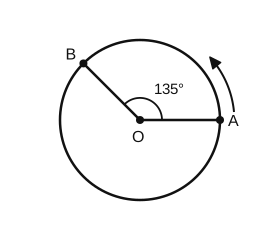
A person moved from $A$ to $B$ on a circular path as shown in figure. If the distance travelled by him is $60\ \text{m}$, then the magnitude of displacement would be: (Given $\cos135^\circ = -0.7$)
Q 11-03-114JEE MainJEE Main 2022 (25 Jul, Shift 2)Easy
A ball is projected from the ground with a speed $15\ \text{m s}^{-1}$ at an angle $\theta$ with the horizontal so that its range and maximum height are equal. Then $\tan\theta$ will be equal to
Q 11-03-115JEE MainJEE Main 2022 (26 Jul, Shift 1)Easy
Two projectiles thrown at $30^\circ$ and $45^\circ$ with the horizontal respectively reach the maximum height in the same time. The ratio of their initial velocities is
Q 11-03-116JEE MainJEE Main 2022 (26 Jul, Shift 1)Easy
If the initial velocity in the horizontal direction of a projectile is the unit vector $\hat i$ and the equation of trajectory is $y = 5x(1 - x)$, the $y$ component vector of the initial velocity is ______ $\hat j$. (Take $g = 10\ \text{m s}^{-2}$)
Concept. Compare with $y=x\tan\theta-\dfrac{g}{2u_x^2}x^2$. The coefficient of $x$ is $\dfrac{u_y}{u_x}$.
Step 1. Expand. $y=5x-5x^2$.
Step 2. Read off. $\dfrac{u_y}{u_x}=5$ with $u_x=1$: $u_y=5$. Check: $\dfrac{g}{2u_x^2}=\dfrac{10}{2}=5$, which matches the $x^2$ term.
Answer. $5$.
Solution by Sreeraj P, M.Sc Physics
Q 11-03-117JEE MainJEE Main 2022 (26 Jul, Shift 2)Easy
Two projectiles are thrown with the same initial velocity making angles of $45^\circ$ and $30^\circ$ with the horizontal respectively. The ratio of their respective ranges will be
Q 11-03-118JEE MainJEE Main 2022 (26 Jul, Shift 2)Easy
If $\vec A = (2\hat i + 3\hat j - \hat k)\ \text{m}$ and $\vec B = (\hat i + 2\hat j + 2\hat k)\ \text{m}$, the magnitude of the component of vector $\vec A$ along vector $\vec B$ will be ______ m.
Concept. The scalar component (projection) of $\vec A$ along $\vec B$ is $A\cos\theta=\dfrac{\vec A\cdot\vec B}{|\vec B|}$: the dot product with the unit vector $\hat B$.
Answer. $2$ m. Trap: divide by $|\vec B|$, not $|\vec A|$; the component is along $\vec B$.
Solution by Sreeraj P, M.Sc Physics
Q 11-03-119JEE MainJEE Main 2022 (27 Jun, Shift 1)Medium
A projectile is launched at an angle $\alpha$ with the horizontal with a velocity $20\ \text{m s}^{-1}$. After $10$ s, its inclination with horizontal is $\beta$. The value of $\tan\beta$ will be : $(g = 10\ \text{m s}^{-2})$.
Q 11-03-120JEE MainJEE Main 2022 (27 Jun, Shift 1)Medium
A girl standing on road holds her umbrella at $45^\circ$ with the vertical to keep the rain away. If she starts running without umbrella with a speed of $15\sqrt{2}\ \text{km h}^{-1}$, the rain drops hit her head vertically. The speed of rain drops with respect to the moving girl is
Concept. The velocity of rain relative to the girl is $\vec v_{rg}=\vec v_r-\vec v_g$. Rain looks vertical to her only when her velocity cancels the horizontal part of the rain's velocity. The umbrella angle while she stands still gives the ratio of the rain's horizontal and vertical parts.
Step 1. Horizontal part of the rain. Running at $15\sqrt2$ km h$^{-1}$, the rain hits her vertically, so $$v_{rx}=15\sqrt2\ \text{km h}^{-1}$$
Step 2. Vertical part of the rain. Standing still, she sees the true rain velocity at $45^\circ$ to the vertical, so the two parts are equal: $$\tan45^\circ=\frac{v_{rx}}{v_{ry}}=1\ \Rightarrow\ v_{ry}=v_{rx}=15\sqrt2\ \text{km h}^{-1}$$
Step 3. Speed relative to the running girl. The horizontal part is cancelled; only the vertical part remains: $$|\vec v_{rg}|=v_{ry}=15\sqrt2=\frac{30}{\sqrt2}\ \text{km h}^{-1}$$
Answer. $\dfrac{30}{\sqrt2}$ km h$^{-1}$ (Option C). Trap: $30$ km h$^{-1}$ is the rain's speed relative to the ground, not to her.
Solution by Sreeraj P, M.Sc Physics
Q 11-03-121JEE MainJEE Main 2022 (27 Jul, Shift 1)Easy
A ball of mass $m$ is thrown vertically upward. Another ball of mass $2m$ is thrown at an angle $\theta$ with the vertical. Both the balls stay in air for the same period of time. The ratio of the heights attained by the two balls respectively is $\dfrac1x$. The value of $x$ is ______ .
Concept. Time in air depends only on the vertical component: $T=\dfrac{2u_y}{g}$. Height depends only on it too: $H=\dfrac{u_y^2}{2g}$. Mass plays no part.
Step 2. Heights. Equal $u_y$ gives equal $H$: ratio $1$.
Answer. $x=1$.
Solution by Sreeraj P, M.Sc Physics
Q 11-03-122JEE MainJEE Main 2022 (27 Jul, Shift 2)Hard
A body of mass $10$ kg is projected at an angle of $45^\circ$ with the horizontal. The trajectory of the body is observed to pass through a point $(20, 10)$. If $T$ is the time of flight, then its momentum vector, at time $t = \dfrac{T}{\sqrt2}$, is ______ .
Q 11-03-124JEE MainJEE Main 2021 (27 Jul, Shift 1)Medium
Given below are two statements: one is labelled as Assertion $A$ and the other is labelled as Reason $R$.
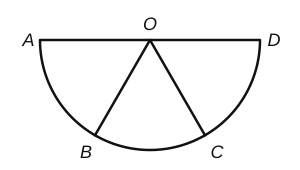
Assertion $A$: If $A, B, C, D$ are four points on a semi-circular arc with centre at $O$ such that $|\vec{AB}| = |\vec{BC}| = |\vec{CD}|$, then $\vec{AB} + \vec{AC} + \vec{AD} = 4\vec{AO} + \vec{OB} + \vec{OC}$.
Reason $R$: Polygon law of vector addition yields $\vec{AB} + \vec{BC} + \vec{CD} = \vec{AD} = 2\vec{AO}$.
In the light of the above statements, choose the most appropriate answer from the options given below.
Answer: (D) Both $A$ and $R$ are correct but $R$ is not the correct explanation of $A$.
Concept. Write each vector from $A$ through the centre: $\overrightarrow{AX}=\overrightarrow{AO}+\overrightarrow{OX}$. Since $D$ is the other end of the diameter, $\overrightarrow{OD}=\overrightarrow{AO}$.
Step 2. Reason. Head to tail, $\overrightarrow{AB}+\overrightarrow{BC}+\overrightarrow{CD}=\overrightarrow{AD}$, and $\overrightarrow{AD}=2\overrightarrow{AO}$ (the diameter). True.
Step 3. Explanation? The Assertion is proved by splitting each vector at $O$, not by the chain $AB+BC+CD$. So R does not explain A.
Answer. Both are correct but R is not the correct explanation of A (Option D).
Solution by Sreeraj P, M.Sc Physics
Q 11-03-125JEE MainJEE Main 2021 (27 Jul, Shift 2)Medium
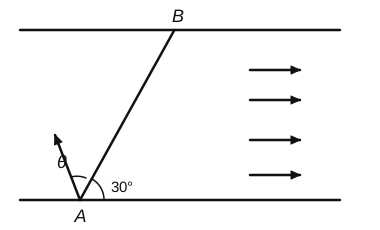
A swimmer wants to cross a river from point $A$ to point $B$. Line $AB$ makes an angle of $30^\circ$ with the flow of the river. The magnitude of the velocity of the swimmer is the same as that of the river. The angle $\theta$ with the line $AB$ should be ______$^\circ$, so that the swimmer reaches point $B$.
Concept. The swimmer's ground velocity is the sum of the river velocity and the swimmer's velocity relative to the water; it must point along $AB$. With equal magnitudes, the sum of two vectors bisects the angle between them.
Step 1. Geometry. The river velocity makes $30^\circ$ with $AB$ (on one side). For the sum to lie along $AB$, the swimmer's velocity must make the same angle with $AB$ on the other side (upstream side).
Step 2. Angle. $\theta=30^\circ$ (so the swimmer heads at $60^\circ$ to the flow).
Answer. $30$.
Solution by Sreeraj P, M.Sc Physics
Q 11-03-126JEE MainJEE Main 2021 (31 Aug, Shift 1)Easy
A helicopter is flying horizontally with a speed $v$ at an altitude $h$ and has to drop a food packet for a man on the ground. What is the distance of the helicopter from the man when the food packet is dropped?
Concept. A packet dropped from the helicopter keeps its horizontal velocity $v$. It falls $h$ in $t=\sqrt{2h/g}$ and moves $vt$ horizontally. The helicopter's distance from the man at release is the hypotenuse.
Q 11-03-127JEE MainJEE Main 2021 (31 Aug, Shift 2)Medium
Statement I: Two forces $(\vec P + \vec Q)$ and $(\vec P - \vec Q)$ where $\vec P \perp \vec Q$, when act at an angle $\theta_1$ to each other, the magnitude of their resultant is $\sqrt{3(P^2 + Q^2)}$; when they act at an angle $\theta_2$, the magnitude of their resultant becomes $\sqrt{2(P^2 + Q^2)}$. This is possible only when $\theta_1 < \theta_2$.
Statement II: In the situation given above, $\theta_1 = 60^\circ$ and $\theta_2 = 90^\circ$.
In the light of the above statements, choose the most appropriate answer from the options given below:
Answer: (B) Both Statement I and Statement II are true.
Concept. The two forces are $\vec P+\vec Q$ and $\vec P-\vec Q$. With $\vec P\perp\vec Q$ both have the same magnitude $s=\sqrt{P^2+Q^2}$. Two equal vectors at angle $\theta$ have a resultant $R^2=2s^2(1+\cos\theta)$.
Step 1. First case. $R^2=3s^2$: $$2s^2(1+\cos\theta_1)=3s^2\ \Rightarrow\ \cos\theta_1=\tfrac12\ \Rightarrow\ \theta_1=60^\circ$$
Step 2. Second case. $R^2=2s^2$: $$2s^2(1+\cos\theta_2)=2s^2\ \Rightarrow\ \cos\theta_2=0\ \Rightarrow\ \theta_2=90^\circ$$
Step 3. Judge. $\theta_1=60^\circ\lt\theta_2=90^\circ$: Statement I is true; Statement II gives exactly these values: true.
Answer. Both Statement I and Statement II are true (Option B).
Solution by Sreeraj P, M.Sc Physics
Q 11-03-128JEE MainJEE Main 2021 (25 Feb, Shift 1)Medium
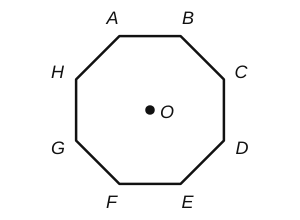
In an octagon $ABCDEFGH$ of equal side, what is the sum of $\overrightarrow{AB} + \overrightarrow{AC} + \overrightarrow{AD} + \overrightarrow{AE} + \overrightarrow{AF} + \overrightarrow{AG} + \overrightarrow{AH}$, if $\overrightarrow{AO} = 2\hat i + 3\hat j - 4\hat k$?
Concept. Route every vector through the centre: $\overrightarrow{AX}=\overrightarrow{AO}+\overrightarrow{OX}$. For a regular polygon the vectors from the centre to all the vertices cancel in pairs, because each has an equal and opposite partner at the opposite vertex.
Step 1. Rewrite each term. In the figure the vertices go $A,B,\dots,H$ around the octagon with centre $O$. For $X=B,C,\dots,H$ (seven vertices): $$\sum\overrightarrow{AX}=7\,\overrightarrow{AO}+\left(\overrightarrow{OB}+\overrightarrow{OC}+\dots+\overrightarrow{OH}\right)$$
Step 2. Use the symmetry of the octagon. All eight centre-to-vertex vectors add to zero (opposite vertices cancel: $\overrightarrow{OA}+\overrightarrow{OE}=\vec0$, and so on). Hence $$\overrightarrow{OB}+\dots+\overrightarrow{OH}=-\overrightarrow{OA}=\overrightarrow{AO}$$
Answer. Option A. General rule: for a regular $n$-gon, the vectors from one vertex to all the others add to $n\,\overrightarrow{AO}$.
Solution by Sreeraj P, M.Sc Physics
Q 11-03-129JEE MainJEE Main 2021 (18 Mar, Shift 2)Easy
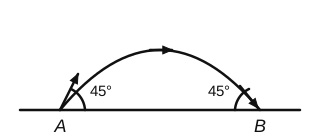
The projectile motion of a particle of mass 5 g is shown in the figure.
The initial velocity of the particle is $5\sqrt2\ \text{m s}^{-1}$ and the air resistance is assumed to be negligible. The magnitude of the change in momentum between the points $A$ and $B$ is $x\times10^{-2}\ \text{kg m s}^{-1}$. The value of $x$, to the nearest integer, is ______.
Concept. Between two points at the same height the horizontal velocity is unchanged and the vertical velocity reverses. So $|\Delta\vec p|=2mu\sin\theta$.
Step 2. Change in momentum. $$|\Delta\vec p|=2\times0.005\times5=0.05=5\times10^{-2}\ \text{kg m s}^{-1}$$
Answer. $5$.
Solution by Sreeraj P, M.Sc Physics
Q 11-03-130JEE MainJEE Main 2021 (20 Jul, Shift 1)Easy
If $\vec A$ and $\vec B$ are two vectors satisfying the relation $\vec A\cdot\vec B = |\vec A\times\vec B|$. Then the value of $|\vec A - \vec B|$ will be:
Concept. $\vec A\cdot\vec B=AB\cos\theta$ and $|\vec A\times\vec B|=AB\sin\theta$. Setting them equal fixes the angle between the vectors; then the law of cosines gives the magnitude of the difference.
Step 1. Find the angle. $$AB\cos\theta=AB\sin\theta\ \Rightarrow\ \tan\theta=1\ \Rightarrow\ \theta=45^\circ$$
Step 2. Magnitude of the difference. For $\vec A-\vec B$ the cosine term is subtracted: $$|\vec A-\vec B|^2=A^2+B^2-2AB\cos45^\circ=A^2+B^2-2AB\cdot\frac{1}{\sqrt2}=A^2+B^2-\sqrt2AB$$
Answer. $\sqrt{A^2+B^2-\sqrt2AB}$ (Option D). Trap: option B is the magnitude of the sum, not the difference.
Solution by Sreeraj P, M.Sc Physics
Q 11-03-131JEE MainJEE Main 2021 (20 Jul, Shift 1)Easy
A butterfly is flying with a velocity $4\sqrt2\ \text{m s}^{-1}$ in north-east direction. Wind is slowly blowing at $1\ \text{m s}^{-1}$ from north to south. The resultant displacement of the butterfly in 3 seconds is:
Concept. The butterfly's velocity over the ground is its velocity relative to the air plus the wind velocity.
Step 1. Components (east $=x$, north $=y$). Butterfly: $4\sqrt2$ m/s towards north-east $=(4,4)$. Wind from north to south: $(0,-1)$.
Step 2. Resultant. $(4,3)$: speed $5$ m/s.
Step 3. Displacement in 3 s. $5\times3=15$ m.
Answer. $15$ m (Option D).
Solution by Sreeraj P, M.Sc Physics
Q 11-03-132JEE MainJEE Main 2021 (20 Jul, Shift 2)Medium
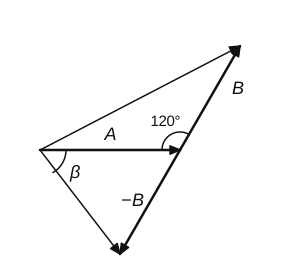
Two vectors $\vec P$ and $\vec Q$ have equal magnitudes. If the magnitude of $\vec P + \vec Q$ is $n$ times the magnitude of $\vec P - \vec Q$, then angle between $\vec P$ and $\vec Q$ is
Answer. $\hat i+\hat j$ (Option D). (The scalar component is $2/\sqrt2=\sqrt2$.)
Solution by Sreeraj P, M.Sc Physics
Q 11-03-134JEE MainJEE Main 2021 (22 Jul, Shift 1)Medium
Three particles $P$, $Q$ and $R$ are moving along the vectors $\vec A = \hat i + \hat j$, $\vec B = \hat j + \hat k$ and $\vec C = -\hat i + \hat j$, respectively. They strike on a point and start to move in different directions. Now particle $P$ is moving normal to the plane which contains vector $\vec A$ and $\vec B$. Similarly particle $Q$ is moving normal to the plane which contains vector $\vec A$ and $\vec C$. The angle between the direction of motion of $P$ and $Q$ is $\cos^{-1}\left(\dfrac{1}{\sqrt x}\right)$. Then the value of $x$ is ______.
Concept. A direction normal to the plane of two vectors is their cross product. The angle between two directions follows from the dot product of those normals.
Step 1. Normal for $P$. $$\vec A\times\vec B=(\hat i+\hat j)\times(\hat j+\hat k)=\hat k-\hat j+\hat i=(1,-1,1)$$
Step 2. Normal for $Q$. $$\vec A\times\vec C=(\hat i+\hat j)\times(-\hat i+\hat j)=\hat k+\hat k=(0,0,2)$$
Q 11-03-135JEE MainJEE Main 2021 (26 Feb, Shift 2)Easy
The trajectory of a projectile in a vertical plane is $y = \alpha x - \beta x^2$, where $\alpha$ and $\beta$ are constants and $x$ & $y$ are respectively the horizontal and vertical distances of the projectile from the point of projection. The angle of projection $\theta$ and the maximum height attained $H$ are respectively given by
Q 11-03-136JEE MainJEE Main 2021 (25 Jul, Shift 2)Medium
Two vectors $\vec{X}$ and $\vec{Y}$ have equal magnitude. The magnitude of $(\vec{X} - \vec{Y})$ is $n$ times the magnitude of $(\vec{X} + \vec{Y})$. The angle between $\vec{X}$ and $\vec{Y}$ is:
Q 11-03-137JEE MainJEE Main 2021 (26 Aug, Shift 1)Medium
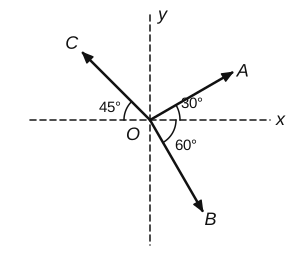
The magnitude of vectors $\overrightarrow{OA}$, $\overrightarrow{OB}$ and $\overrightarrow{OC}$ in the given figure are equal. The direction of $\overrightarrow{OA} + \overrightarrow{OB} - \overrightarrow{OC}$ with $x$-axis will be:
Concept. All three vectors have the same magnitude (take it as 1). Write each in components from its angle in the figure, form $\overrightarrow{OA}+\overrightarrow{OB}-\overrightarrow{OC}$, and $\tan\phi=R_y/R_x$.
Answer: (A) straight line vertically down the plane
Concept. The bomb leaves with the plane's horizontal velocity, which it keeps (no air drag), so it stays directly below the plane. Relative to the plane, only the vertical free fall remains.
Step 2. Path. A straight line vertically down from the plane. (From the ground the path is a parabola.)
Answer. Option A.
Solution by Sreeraj P, M.Sc Physics
Q 11-03-140JEE MainJEE Main 2021 (27 Aug, Shift 1)Medium
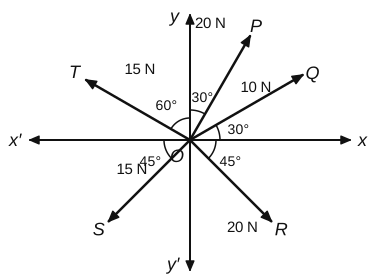
The resultant of these forces $\overrightarrow{OP}$, $\overrightarrow{OQ}$, $\overrightarrow{OR}$, $\overrightarrow{OS}$ and $\overrightarrow{OT}$ is approximately ______ N. [Take $\sqrt{3} = 1.7$, $\sqrt{2} = 1.4$. Given $\hat{i}$ and $\hat{j}$ unit vectors along $x$, $y$ axis]
Concept. Resolve each force from the $+x$ axis and add components ($\sqrt3 = 1.7$, $\sqrt2 = 1.4$).
Step 1. Components.
$OP = 20$ N at $60°$: $(10,\ 17)$.
$OQ = 10$ N at $30°$: $(8.5,\ 5)$.
$OT = 15$ N at $150°$: $(-12.75,\ 7.5)$.
$OS = 15$ N at $225°$: $(-10.5,\ -10.5)$.
$OR = 20$ N at $-45°$: $(14,\ -14)$.
Step 2. Sum. $x = 9.25$, $y = 5$.
Answer. $9.25\hat i + 5\hat j$ (Option B).
Solution by Sreeraj P, M.Sc Physics
Q 11-03-141JEE MainJEE Main 2021 (27 Aug, Shift 2)Easy
A player kicks a football with an initial speed of $25$ m s$^{-1}$ at an angle of $45^\circ$ from the ground. What are the maximum height and the time taken by the football to reach at the highest point during motion? (Take $g = 10$ m s$^{-2}$)
Concept. Projectile motion is free fall in the vertical direction with initial vertical speed $u\sin\theta$. At the highest point the vertical velocity is zero, which gives both $H=\dfrac{u^2\sin^2\theta}{2g}$ and the time to the top $t=\dfrac{u\sin\theta}{g}$.
Step 1. Vertical component of the initial velocity. $$u\sin45^\circ=\frac{25}{\sqrt2}\approx17.68\ \text{m s}^{-1}$$
Step 2. Maximum height (from $v_y^2=u_y^2-2gH$ with $v_y=0$): $$H=\frac{u^2\sin^2\theta}{2g}=\frac{625\times\frac12}{20}=15.625\ \text{m}$$
Step 3. Time to the top (from $v_y=u_y-gt=0$): $$t=\frac{u\sin\theta}{g}=\frac{17.68}{10}\approx1.77\ \text{s}$$
Answer. Option A. Trap: option D gives the time of the whole flight, $3.54$ s, not the time to the top.
Solution by Sreeraj P, M.Sc Physics
Q 11-03-142JEE MainJEE Main 2020 (8 Jan, Shift 2)Easy
A particle moves such that its position vector $\vec{r}(t) = \cos\omega t\,\hat{i} + \sin\omega t\,\hat{j}$ where $\omega$ is a constant and $t$ is time. Then which of the following statements is true for the velocity $\vec{v}(t)$ and acceleration $\vec{a}(t)$ of the particle:
Answer: (D) $\vec{v}$ is perpendicular to $\vec{r}$ and $\vec{a}$ is directed towards the origin
Concept. $\vec r=\cos\omega t\,\hat i+\sin\omega t\,\hat j$ is uniform circular motion of radius 1. Differentiate twice.
Step 1. Velocity. $\vec v=\omega(-\sin\omega t\,\hat i+\cos\omega t\,\hat j)$, and $\vec v\cdot\vec r=0$: perpendicular to $\vec r$.
Step 2. Acceleration. $\vec a=-\omega^2(\cos\omega t\,\hat i+\sin\omega t\,\hat j)=-\omega^2\vec r$: towards the origin.
Answer. Option D.
Solution by Sreeraj P, M.Sc Physics
Q 11-03-143JEE MainJEE Main 2020 (9 Jan, Shift 2)Easy
A particle starts from the origin at $t = 0$ with an initial velocity of $3.0\hat{i}$ m/s and moves in the $x$-$y$ plane with a constant acceleration $\left(6.0\hat{i} + 4.0\hat{j}\right)$ m/s$^2$. The $x$-coordinate of the particle at the instant when its $y$-coordinate is $32$ m is $D$ meters. The value of $D$ is:
Concept. Constant acceleration in a plane splits into two independent straight-line motions sharing the same time $t$. The $y$-motion has all its data (start, initial velocity, acceleration, final position), so it gives $t$; then use that $t$ in the $x$-motion.
Step 1. Time from the $y$-motion. Initial velocity has no $y$-part, $a_y=4$ m s$^{-2}$: $$y=\tfrac12a_yt^2\ \Rightarrow\ 32=\tfrac12(4)t^2=2t^2\ \Rightarrow\ t=4\ \text{s}$$
Step 2. $x$-coordinate at that time. $u_x=3$ m s$^{-1}$, $a_x=6$ m s$^{-2}$: $$D=u_xt+\tfrac12a_xt^2=3(4)+\tfrac12(6)(16)=12+48=60\ \text{m}$$
Answer. $D=60$ m (Option C).
Solution by Sreeraj P, M.Sc Physics
Q 11-03-144JEE MainJEE Main 2020 (6 Sep, Shift 1)Easy
A clock has a continuously moving second's hand of $0.1$ m length. The average acceleration of the tip of the hand (in units of m s$^{-2}$) is of the order of:
Q 11-03-145JEE MainJEE Main 2020 (6 Sep, Shift 2)Easy
When a car is at rest, its driver sees rain drops falling on it vertically. When driving the car with speed $v$, he sees the rain drops coming at an angle $60^\circ$ from the horizontal. On further increasing the speed of the car to $(1+\beta)v$, this angle changes to $45^\circ$. The value of $\beta$ is close to:
Concept. Rain falling vertically at speed $u$ appears, to a driver moving at $v_c$, to have an extra horizontal component $v_c$ (backwards). So the angle $\theta$ with the horizontal satisfies $\tan\theta=\dfrac{u}{v_c}$. Writing this for both speeds and dividing removes $u$.
Step 1. First speed. $$\tan60^\circ=\frac uv\ \Rightarrow\ u=\sqrt3\,v$$
Step 2. Second speed. $$\tan45^\circ=\frac{u}{(1+\beta)v}\ \Rightarrow\ (1+\beta)v=u=\sqrt3\,v$$
Answer. $0.73$ (Option D). A faster car makes the rain look more slanted, so the angle with the horizontal falls from $60^\circ$ to $45^\circ$.
Solution by Sreeraj P, M.Sc Physics
Q 11-03-146JEE MainJEE Main 2020 (7 Jan, Shift 2)Easy
The sum of two forces $\vec P$ and $\vec Q$ is $\vec R$ such that $|\vec R| = |\vec P|$. The angle (in degrees) between the resultant of $2\vec P$ and $\vec Q$ and the force $\vec Q$ is ______.
Concept. Squaring a vector equation turns it into a scalar one: $|\vec P+\vec Q|^2=P^2+2\vec P\cdot\vec Q+Q^2$. This gives $\vec P\cdot\vec Q$, which is all we need to find the angle between $2\vec P+\vec Q$ and $\vec Q$ through a dot product.
Step 1. Square the given condition $|\vec P+\vec Q|=|\vec P|$: $$P^2+2\vec P\cdot\vec Q+Q^2=P^2\ \Rightarrow\ 2\vec P\cdot\vec Q=-Q^2$$
Step 2. Dot the new vector with $\vec Q$. The angle $\phi$ between $2\vec P+\vec Q$ and $\vec Q$ has $\cos\phi$ proportional to $$(2\vec P+\vec Q)\cdot\vec Q=2\vec P\cdot\vec Q+Q^2=-Q^2+Q^2=0$$
Step 3. Interpret. A zero dot product (with both vectors non-zero) means the vectors are perpendicular.
Answer. $90^\circ$. Geometrically: $\vec P$, $\vec Q$ and $\vec R$ form an isosceles triangle with $|\vec R|=|\vec P|$.
Solution by Sreeraj P, M.Sc Physics
Q 11-03-147JEE MainJEE Main 2020 (8 Jan, Shift 1)Easy
A particle is moving along the $x$-axis with its coordinate with time $t$ given by $x(t) = 10 + 8t - 3t^2$. Another particle is moving along the $y$-axis with its coordinate as a function of time given by $y(t) = 5 - 8t^3$. At $t = 1$ s, the speed of the second particle as measured in the frame of the first particle is given as $\sqrt v$. Then $v$ (in m s$^{-1}$) is ______.
Concept. The velocity of particle 2 seen from particle 1 is $\vec v_{21}=\vec v_2-\vec v_1$. Each velocity comes from differentiating its position, so find both at $t=1$ s and subtract as vectors.
Step 1. Velocity of the first particle (along $x$): $$v_1=\frac{dx}{dt}=8-6t\ \Rightarrow\ \vec v_1=2\hat i\ \text{m s}^{-1}\ \text{at } t=1$$
Step 2. Velocity of the second particle (along $y$): $$v_2=\frac{dy}{dt}=-24t^2\ \Rightarrow\ \vec v_2=-24\hat j\ \text{m s}^{-1}\ \text{at } t=1$$
Answer. $v=580$. The two velocities are perpendicular, so the relative speed is simply $\sqrt{v_1^2+v_2^2}$.
Solution by Sreeraj P, M.Sc Physics
Q 11-03-148JEE MainJEE Main 2020 (2 Sep, Shift 1)Easy
Train A and train B are running on parallel tracks in the opposite directions with speed of $36\ \text{km hour}^{-1}$ and $72\ \text{km hour}^{-1}$, respectively. A person is walking in train A in the direction opposite to its motion with a speed of $1.8\ \text{km hour}^{-1}$. Speed (in $\text{m s}^{-1}$) of this person as observed from train B will be close to: (take the distance between the tracks as negligible)
Concept. Velocity of the person relative to train B $=$ (person relative to ground) $-$ (B relative to ground).
Step 1. Values. Train A direction positive: $v_A = 10$ m/s, $v_B = -20$ m/s, person relative to A $= -0.5$ m/s.
Step 2. Person relative to ground. $9.5$ m/s.
Step 3. Relative to B. $9.5 + 20 = 29.5$ m/s.
Answer. $29.5\ \text{m s}^{-1}$ (Option A).
Solution by Sreeraj P, M.Sc Physics
Q 11-03-149JEE MainJEE Main 2020 (4 Sep, Shift 1)Easy
Starting from the origin at time $t = 0$, with initial velocity $5\hat j\ \text{m s}^{-1}$, a particle moves in the $x$-$y$ plane with a constant acceleration of $(10\hat i + 4\hat j)\ \text{m s}^{-2}$. At time $t$, its coordinates are $(20\ \text{m}, y_0\ \text{m})$. The values of $t$ and $y_0$ are, respectively:
Concept. Constant acceleration in a plane: each coordinate obeys $s=ut+\tfrac12at^2$ with its own components. Use $x$ (complete data) to find $t$, then $y$.
Step 1. $x$ motion. $u_x=0$, $a_x=10$: $20=\tfrac12(10)t^2\Rightarrow t=2$ s.
Step 2. $y$ motion. $u_y=5$, $a_y=4$: $y_0=5(2)+\tfrac12(4)(4)=10+8=18$ m.
Answer. $2$ s and $18$ m (Option A).
Solution by Sreeraj P, M.Sc Physics
Q 11-03-150JEE MainJEE Main 2020 (5 Sep, Shift 1)Medium
A balloon is moving up in air vertically above a point $A$ on the ground. When it is at a height $h_1$, a girl standing at a distance $d$ (point $B$) from $A$ (see figure) sees it at an angle $45^\circ$ with respect to the vertical. When the balloon climbs up a further height $h_2$, it is seen at an angle $60^\circ$ with respect to the vertical if the girl moves further by a distance $2.464\,d$ (point $C$). Then the height $h_2$ is (given $\tan30^\circ = 0.5774$):
Step 2. Speed. $$v=\sqrt{a^2\omega^2(\sin^2\omega t+\cos^2\omega t)+a^2\omega^2}=\sqrt2\,a\omega$$ constant: the particle moves on a helix at uniform speed.
Answer. $\sqrt2\,a\omega$ (Option A).
Solution by Sreeraj P, M.Sc Physics
Q 11-03-152JEE MainJEE Main 2019 (10 Jan, Shift 1)Medium
In the cube of side $a$ shown in the figure, the vector from the central point of the face $ABOD$ to the central point of the face $BEFO$ will be:
Q 11-03-153JEE MainJEE Main 2019 (10 Jan, Shift 1)Easy
Two guns $A$ and $B$ can fire bullets at speeds $1\ \text{km/s}$ and $2\ \text{km/s}$ respectively. From a point on a horizontal ground, they are fired in all possible directions. The ratio of maximum areas covered by the bullets fired by the two guns, on the ground is:
Q 11-03-154JEE MainJEE Main 2019 (10 Jan, Shift 2)Medium
Two vectors $\vec A$ and $\vec B$ have equal magnitudes. The magnitude of $\left(\vec A + \vec B\right)$ is $n$ times the magnitude of $\left(\vec A - \vec B\right)$. The angle between $\vec A$ and $\vec B$ is:
Concept. For equal magnitudes, $|\vec A+\vec B|^2$ and $|\vec A-\vec B|^2$ differ only in the sign of the $\cos\theta$ term. Taking their ratio removes the unknown magnitude and leaves an equation in $\cos\theta$ alone.
Step 1. Write both magnitudes. Let $|\vec A|=|\vec B|=a$: $$|\vec A+\vec B|^2=2a^2(1+\cos\theta),\qquad |\vec A-\vec B|^2=2a^2(1-\cos\theta)$$
Step 2. Use the given ratio. $|\vec A+\vec B|=n|\vec A-\vec B|$, so squaring, $$\frac{1+\cos\theta}{1-\cos\theta}=n^2$$
Step 3. Solve for $\cos\theta$. $$1+\cos\theta=n^2-n^2\cos\theta\ \Rightarrow\ \cos\theta(1+n^2)=n^2-1\ \Rightarrow\ \cos\theta=\frac{n^2-1}{n^2+1}$$
Answer. $\theta=\cos^{-1}\left[\dfrac{n^2-1}{n^2+1}\right]$ (Option A). Check: $n=1$ gives $\cos\theta=0$, i.e. $90^\circ$, as expected when sum and difference are equal.
Solution by Sreeraj P, M.Sc Physics
Q 11-03-155JEE MainJEE Main 2019 (10 Jan, Shift 2)Easy
Two forces $P$ and $Q$, of magnitude $2F$ and $3F$, respectively, are at an angle $\theta$ with each other. If the force $Q$ is doubled, then their resultant also gets doubled. Then, the angle $\theta$ is:
Concept. The resultant of two forces at angle $\theta$ is given by $R^2=P^2+Q^2+2PQ\cos\theta$. We can write this law twice, once before and once after $Q$ is doubled, and the unknown resultant $R$ then cancels out, leaving only $\theta$.
Step 1. Before doubling. With $P=2F$, $Q=3F$: $$R^2=4F^2+9F^2+12F^2\cos\theta=13F^2+12F^2\cos\theta$$
Step 2. After doubling $Q$. Now $Q=6F$ and the resultant is $2R$: $$4R^2=4F^2+36F^2+24F^2\cos\theta=40F^2+24F^2\cos\theta$$
Step 3. Eliminate $R$. Multiply the first equation by 4 and set it equal to the second: $$52F^2+48F^2\cos\theta=40F^2+24F^2\cos\theta\ \Rightarrow\ 24\cos\theta=-12\ \Rightarrow\ \cos\theta=-\frac12$$
Answer. $\theta=120^\circ$ (Option A). Check: at $120^\circ$, $R^2=13-6=7$ and $(2R)^2=40-12=28=4\times7$.
Solution by Sreeraj P, M.Sc Physics
Q 11-03-156JEE MainJEE Main 2019 (10 Apr, Shift 2)Medium
A plane is inclined at an angle $\alpha = 30^\circ$ with respect to the horizontal. A particle is projected up the plane with a speed $u = 2\ \text{m s}^{-1}$, from the base of the plane, making an angle $\theta = 15^\circ$ with respect to the plane. The distance from the base, at which the particle hits the plane is close to: (Take $g = 10\ \text{m s}^{-2}$)
Concept. On an incline it is easiest to use axes along the plane ($x$) and perpendicular to it ($y$). Gravity then has two components: $g\sin\alpha$ down the plane and $g\cos\alpha$ into the plane. The particle lands when its perpendicular displacement returns to zero.
Step 1. Components of the motion. With $\theta=15^\circ$ from the plane and $\alpha=30^\circ$:
along the plane: initial $u\cos\theta$, acceleration $-g\sin\alpha$
Step 2. Time of flight (perpendicular displacement zero): $$T=\frac{2u\sin\theta}{g\cos\alpha}=\frac{2(2)\sin15^\circ}{10\cos30^\circ}=\frac{4(0.259)}{8.66}\approx0.1196\ \text{s}$$
Step 3. Distance along the plane. $$R=u\cos\theta\,T-\tfrac12g\sin\alpha\,T^2=2(0.966)(0.1196)-\tfrac12(10)(0.5)(0.1196)^2$$ $$R\approx0.2311-0.0358\approx0.195\ \text{m}$$
Step 4. Check with the standard formula. $$R=\frac{2u^2\sin\theta\cos(\theta+\alpha)}{g\cos^2\alpha}=\frac{2(4)\sin15^\circ\cos45^\circ}{10(0.75)}=\frac{8(0.259)(0.707)}{7.5}\approx0.195\ \text{m}$$
Answer. About $20$ cm (Option A).
Solution by Sreeraj P, M.Sc Physics
Q 11-03-157JEE MainJEE Main 2019 (9 Jan, Shift 1)Easy
A particle is moving with a velocity $\vec v = K(y\hat i + x\hat j)$, where $K$ is a constant. The general equation for its path is
Concept. The velocity is always tangent to the path, so the slope of the path is $\dfrac{dy}{dx}=\dfrac{v_y}{v_x}$. Integrating this differential equation gives the path.
Step 1. Slope of the path. $v_x=Ky$, $v_y=Kx$: $$\frac{dy}{dx}=\frac{Kx}{Ky}=\frac xy$$
Answer. Option D. The path is a rectangular hyperbola; the constant is fixed by the starting point.
Solution by Sreeraj P, M.Sc Physics
Q 11-03-158JEE MainJEE Main 2019 (8 Apr, Shift 1)Medium
Ship A is sailing towards north-east with velocity $\vec v = 30\hat i + 50\hat j\ \text{km h}^{-1}$ where $\hat i$ points east and $\hat j$, north. The ship B is at a distance of $80\ \text{km}$ east and $150\ \text{km}$ north of Ship A and is sailing towards the west at $10\ \text{km h}^{-1}$. A will be at the minimum distance from B in
Concept. Work in the frame of ship A. Then B moves in a straight line with constant relative velocity $\vec v_{BA}=\vec v_B-\vec v_A$, starting from relative position $\vec r_0$. The distance is least when the relative position is perpendicular to $\vec v_{BA}$, giving $t=-\dfrac{\vec r_0\cdot\vec v_{BA}}{v_{BA}^2}$.
Step 1. Initial relative position (B from A, $\hat i$ east, $\hat j$ north): $$\vec r_0=80\hat i+150\hat j\ \text{km}$$
Step 2. Relative velocity. B moves west at $10$ km h$^{-1}$: $$\vec v_{BA}=(-10\hat i)-(30\hat i+50\hat j)=-40\hat i-50\hat j\ \text{km h}^{-1}$$
Step 3. Condition for the minimum. The separation is $\vec r(t)=\vec r_0+\vec v_{BA}t$. Minimising $|\vec r|^2$, $\dfrac{d}{dt}|\vec r|^2=2\vec r\cdot\vec v_{BA}=0$: $$\vec r_0\cdot\vec v_{BA}+v_{BA}^2\,t=0\ \Rightarrow\ t=-\frac{\vec r_0\cdot\vec v_{BA}}{v_{BA}^2}$$
Concept. A dot product of two combinations of vectors expands like ordinary algebra. We only need $A_1^2$, $A_2^2$ and $\vec A_1\cdot\vec A_2$; the last one comes from squaring the given magnitude of the sum.
Answer. $-118.5$ (Option B). Common slip: forgetting that the two cross terms combine to $+5\,\vec A_1\cdot\vec A_2$, not $-5$ or $+13$.
Solution by Sreeraj P, M.Sc Physics
Q 11-03-160JEE MainJEE Main 2019 (9 Apr, Shift 1)Easy
The stream of a river is flowing with a speed of $2\ \text{km h}^{-1}$. A swimmer can swim at a speed of $4\ \text{km h}^{-1}$. The direction of the swimmer with respect to the flow of the river, to cross the river straight, is
Concept. The swimmer's velocity over the ground is (velocity relative to water) + (river velocity). To go straight across, the ground velocity must have no component along the flow, so the swimmer must head partly upstream so that this component cancels the river: $u\sin\alpha=v$, $\alpha$ measured from the straight-across direction.
Step 1. Cancel the flow. $$4\sin\alpha=2\ \Rightarrow\ \sin\alpha=\frac12\ \Rightarrow\ \alpha=30^\circ\ \text{(upstream of the normal)}$$
Step 2. Convert to the angle with the flow. The straight-across direction is $90^\circ$ from the flow; tilting a further $30^\circ$ upstream gives $$90^\circ+30^\circ=120^\circ$$
Answer. $120^\circ$ with the direction of flow (Option C). Trap: $30^\circ$ is the angle with the normal, not with the flow.
Solution by Sreeraj P, M.Sc Physics
Q 11-03-161JEE MainJEE Main 2019 (9 Apr, Shift 2)Easy
The position vector of a particle changes with time according to the relation $\vec r(t) = 15t^2\hat i + (4 - 20t^2)\hat j$. What is the magnitude of the acceleration at $t = 1$?
Step 1. Differentiate. $\vec a = 30\hat i - 40\hat j$ (constant).
Step 2. Magnitude. $\sqrt{900 + 1600} = 50$.
Answer. $50$ (Option D).
Solution by Sreeraj P, M.Sc Physics
Q 11-03-162JEE MainJEE Main 2019 (11 Jan, Shift 1)Easy
A particle is moving along a circular path with a constant speed of $10\ \text{m s}^{-1}$. What is the magnitude of the change in velocity of the particle, when it moves through an angle of $60^\circ$ around the centre of the circle?
Concept. In uniform circular motion the velocity is always perpendicular to the radius, so when the radius turns through $60^\circ$ the velocity also turns through $60^\circ$. Its magnitude stays $v$, so $\vec v_1$, $\vec v_2$ and $\Delta\vec v$ form an isosceles triangle: $|\Delta\vec v|=2v\sin\dfrac\theta2$.
Step 1. Use the law of cosines on the vector difference. $$|\Delta\vec v|^2=v^2+v^2-2v^2\cos60^\circ=2v^2(1-\cos60^\circ)=4v^2\sin^2 30^\circ$$
Answer. $10$ m s$^{-1}$ (Option D). The triangle is in fact equilateral at $60^\circ$. Trap: the change in speed is zero, but the change in velocity is not.
Solution by Sreeraj P, M.Sc Physics
Q 11-03-163JEE MainJEE Main 2019 (11 Jan, Shift 1)Hard
A body is projected at $t = 0$ with a velocity $10\ \text{m s}^{-1}$ at an angle of $60^\circ$ with the horizontal. The radius of curvature of its trajectory at $t = 1$ s is $R$. Neglecting air resistance and taking acceleration due to gravity $g = 10\ \text{m s}^{-2}$, the value of $R$ is:
Concept. The radius of curvature at any point is $r=\dfrac{v^2}{a_\perp}$, where $a_\perp$ is the part of the acceleration perpendicular to the velocity (the part that turns the path). For a projectile the acceleration is $g$ downward, and its perpendicular part is $g\cos\phi=g\dfrac{v_x}{v}$, where $\phi$ is the angle of the velocity with the horizontal.
Step 1. Velocity at $t=1$ s. $$v_x=10\cos60^\circ=5\ \text{m s}^{-1},\qquad v_y=10\sin60^\circ-10(1)=8.66-10=-1.34\ \text{m s}^{-1}$$
Step 3. Normal acceleration. $$a_\perp=g\frac{v_x}{v}=10\times\frac{5}{5.18}\approx9.66\ \text{m s}^{-2}$$
Step 4. Radius of curvature. $$r=\frac{v^2}{a_\perp}=\frac{26.8}{9.66}\approx2.8\ \text{m}$$
Answer. $2.8$ m (Option B). Equivalently $r=\dfrac{v^3}{g\,v_x}=\dfrac{(5.18)^3}{50}\approx2.8$ m.
Solution by Sreeraj P, M.Sc Physics
Q 11-03-164JEE MainJEE Main 2019 (11 Jan, Shift 2)Easy
A particle moves from the point $(2.0\hat{i} + 4.0\hat{j})$ m, at $t = 0$, with an initial velocity $(5.0\hat{i} + 4.0\hat{j})\ \text{m s}^{-1}$. It is acted upon by a constant force which produces a constant acceleration $(4.0\hat{i} + 4.0\hat{j})\ \text{m s}^{-2}$. What is the distance of the particle from the origin at time $2$ s?
Concept. $\vec r = \vec r_0 + \vec ut + \dfrac12\vec at^2$.
Step 1. Position at 2 s. $$\vec r = (2\hat i + 4\hat j) + (10\hat i + 8\hat j) + (8\hat i + 8\hat j) = 20\hat i + 20\hat j$$
Step 2. Distance. $20\sqrt2$ m.
Answer. $20\sqrt2$ m (Option B).
Solution by Sreeraj P, M.Sc Physics
Q 11-03-165JEE MainJEE Main 2019 (12 Jan, Shift 1)Medium
A person standing on an open ground hears the sound of a jet aeroplane, coming from north at an angle $60^\circ$ with ground level, but he finds the aeroplane right vertically above his position. If $v$ is the speed of sound, speed of the plane is:
Concept. The sound the person hears now left the plane some time ago, along a line at $60^\circ$ to the ground. In that time the plane has flown to the point overhead.
Step 1. Geometry. Sound travels along the slant distance $s=vt$. The plane's horizontal travel in the same time is the horizontal side of the triangle: $s\cos60^\circ$.
Q 11-03-167JEE MainJEE Main 2019 (12 Apr, Shift 1)Medium
The trajectory of a projectile near the surface of the earth is given as $y = 2x - 9x^2$. If it were launched at an angle $\theta_0$ with speed $v_0$ then ($g = 10\ \text{m s}^{-2}$):
Concept. Any projectile launched from the origin follows $y=x\tan\theta_0-\dfrac{gx^2}{2v_0^2\cos^2\theta_0}$. Matching coefficients with the given equation gives $\tan\theta_0$ from the $x$ term and $v_0$ from the $x^2$ term.
Step 1. Angle from the $x$ term. $$\tan\theta_0=2\ \Rightarrow\ \cos\theta_0=\frac1{\sqrt{1+4}}=\frac{1}{\sqrt5},\quad \sin\theta_0=\frac{2}{\sqrt5}$$
Step 2. Speed from the $x^2$ term. $$\frac{g}{2v_0^2\cos^2\theta_0}=9\ \Rightarrow\ \frac{10}{2v_0^2\cdot\frac15}=9\ \Rightarrow\ \frac{25}{v_0^2}=9\ \Rightarrow\ v_0=\frac53\ \text{m s}^{-1}$$
Answer. $\theta_0=\cos^{-1}\dfrac1{\sqrt5}$ and $v_0=\dfrac53$ m s$^{-1}$ (Option A). Option D names the same angle (as $\sin^{-1}\frac{2}{\sqrt5}$) but has the wrong speed.
Solution by Sreeraj P, M.Sc Physics
Q 11-03-168JEE MainJEE Main 2019 (12 Apr, Shift 1)Medium
A shell is fired from a fixed artillery gun with an initial speed $u$ such that it hits the target on the ground at a distance $R$ from it. If $t_1$ and $t_2$ are the values of the time taken by it to hit the target in two possible ways, the product $t_1t_2$ is:
Q 11-03-169JEE MainJEE Main 2019 (12 Apr, Shift 2)Medium
Two particles are projected from the same point with the same speed $u$ such that they have the same range $R$, but different maximum heights, $h_1$ and $h_2$. Which of the following is correct?
Concept. Equal ranges at the same speed mean complementary angles $\theta$ and $90^\circ-\theta$. The heights then contain $\sin^2\theta$ and $\cos^2\theta$, and their product contains $(\sin\theta\cos\theta)^2$, which is exactly what appears in $R^2$.
Step 1. The two heights. $$h_1=\frac{u^2\sin^2\theta}{2g},\qquad h_2=\frac{u^2\cos^2\theta}{2g}$$
Step 2. Their product. $$h_1h_2=\frac{u^4\sin^2\theta\cos^2\theta}{4g^2}$$
Step 3. Compare with $R^2$. $$R^2=\left(\frac{2u^2\sin\theta\cos\theta}{g}\right)^2=\frac{4u^4\sin^2\theta\cos^2\theta}{g^2}=16\,h_1h_2$$
Answer. $R^2=16h_1h_2$ (Option D), i.e. $R=4\sqrt{h_1h_2}$.
Solution by Sreeraj P, M.Sc Physics
Q 11-03-170JEE MainJEE Main 2018 (15 Apr, Shift 2)Medium
A man in a car at location $Q$ on a straight highway is moving with speed $v$. He decides to reach a point $P$ in a field at a distance $d$ from the highway (point $M$ on the highway is the foot of the perpendicular from $P$). He leaves the highway at a point $R$ between $Q$ and $M$ and drives straight to $P$. Speed of the car in the field is half to that on the highway. What should be the distance $RM$, so that the time taken to reach $P$ is minimum?
Concept. The total time is (road distance)/(road speed) + (field distance)/(field speed). It depends on the turn-off point, so write it as a function of $x=RM$ and set $\dfrac{dt}{dx}=0$ for the minimum.
Step 1. Set up the distances. Let $QM=D$ (fixed) and $RM=x$. Along the highway the car covers $QR=D-x$ at speed $v$. In the field it covers $RP=\sqrt{x^2+d^2}$ (right triangle $RMP$) at speed $\dfrac v2$.
Step 2. Total time. $$t(x)=\frac{D-x}{v}+\frac{\sqrt{x^2+d^2}}{v/2}=\frac{D-x}{v}+\frac{2\sqrt{x^2+d^2}}{v}$$
Step 3. Differentiate and set to zero. $$\frac{dt}{dx}=-\frac1v+\frac{2x}{v\sqrt{x^2+d^2}}=0\ \Rightarrow\ \sqrt{x^2+d^2}=2x$$
Answer. $RM=\dfrac{d}{\sqrt3}$ (Option A). Note $\dfrac{x}{\sqrt{x^2+d^2}}=\dfrac12$: the field path makes $30^\circ$ with $PM$, the same rule as refraction, $\sin\theta=\dfrac{v_{\text{field}}}{v_{\text{road}}}$.
Solution by Sreeraj P, M.Sc Physics
Q 11-03-171JEE MainJEE Main 2018 (16 Apr, Shift 1)Medium
Let $\vec A = \hat i + \hat j$ and $\vec B = 2\hat i - \hat j$. The magnitude of a coplanar vector $\vec C$ such that $\vec A\cdot\vec C = \vec B\cdot\vec C = \vec A\cdot\vec B$ is given by:
A ball is projected with a velocity, $10\ \text{m s}^{-1}$, at an angle of $60°$ with the vertical direction. Its speed at the highest point of its trajectory will be
Q 11-03-173JEE MainJEE Main 2025 (2 Apr, Shift 1)Easy
A river is flowing from west to east direction with a speed of $9\ \text{km h}^{-1}$. A boat capable of moving at a maximum speed of $27\ \text{km h}^{-1}$ in still water crosses the river in half a minute, while moving with maximum speed at an angle of $150^\circ$ to the direction of river flow. The width of the river is:
Concept. The river velocity is along the bank, so it cannot help the boat across. Only the component of the boat's own velocity (relative to water) perpendicular to the flow carries it across: width $=v_\perp t$.
Step 1. Perpendicular component. The boat heads at $150^\circ$ to the flow: $$v_\perp=27\sin150^\circ=27\times\frac12=13.5\ \text{km h}^{-1}$$
Step 3. Width. Half a minute is $30$ s: $$d=v_\perp t=3.75\times30=112.5\ \text{m}$$
Answer. $112.5$ m (Option B). The river speed $9$ km h$^{-1}$ only affects the drift along the bank, not the width.
Solution by Sreeraj P, M.Sc Physics
Q 11-03-174JEE MainJEE Main 2025 (3 Apr, Shift 1)Easy
The angle of projection of a particle is measured from the vertical axis as $\phi$ and the maximum height reached by the particle is $h_m$. Which graph (shown in the figure) correctly represents $h_m$ as a function of $\phi$ for $0 \le \phi \le 90^\circ$?
Concept. With $\phi$ measured from the vertical, the vertical component is $u\cos\phi$, so $h_m=\dfrac{u^2\cos^2\phi}{2g}$.
Step 1. Shape. At $\phi=0$: $h_m=\dfrac{u^2}{2g}$ (largest), and $\dfrac{dh_m}{d\phi}\propto-\sin2\phi=0$ (flat start). At $\phi=90^\circ$: $h_m=0$.
Step 2. Choose. The graph that starts at its maximum with zero slope and falls to zero at $90^\circ$.
Answer. Graph (3) (Option C).
Solution by Sreeraj P, M.Sc Physics
Q 11-03-175JEE MainJEE Main 2025 (3 Apr, Shift 2)Easy
A particle is projected with velocity $u$ so that its horizontal range is three times the maximum height attained by it. The horizontal range of the projectile is given as $\dfrac{nu^2}{25g}$, where the value of $n$ is: (Given $g$ is the acceleration due to gravity)
Concept. Range and maximum height both depend on $u$ and $\theta$, and their ratio is $\dfrac RH=4\cot\theta$. The condition $R=3H$ therefore fixes $\tan\theta$; then $R=\dfrac{u^2\sin2\theta}{g}$ gives the range.
Step 1. Use $R=3H$. $$\frac{2u^2\sin\theta\cos\theta}{g}=3\cdot\frac{u^2\sin^2\theta}{2g}\ \Rightarrow\ 4\cos\theta=3\sin\theta\ \Rightarrow\ \tan\theta=\frac43$$
Step 2. Sine and cosine. A $3$–$4$–$5$ triangle gives $$\sin\theta=\frac45,\qquad \cos\theta=\frac35$$
Step 3. The range. $$R=\frac{2u^2\sin\theta\cos\theta}{g}=\frac{2u^2}{g}\cdot\frac45\cdot\frac35=\frac{24u^2}{25g}$$
Answer. $n=24$ (Option D).
Solution by Sreeraj P, M.Sc Physics
Q 11-03-176JEE MainJEE Main 2025 (4 Apr, Shift 1)Easy
If $\vec L$ and $\vec P$ represent the angular momentum and linear momentum respectively of a particle of mass $m$ having position vector $\vec r = a(\hat i\cos\omega t + \hat j\sin\omega t)$, the direction of the force is:
Step 1. Force. $\vec F = -m\omega^2\vec r$, opposite to $\vec r$. ($\vec L$ is along $\hat k$, perpendicular to $\vec F$; $\vec L \times \vec P$ points along $\vec F$, not opposite.)
Answer. Opposite to the direction of $\vec r$ (Option A).
Solution by Sreeraj P, M.Sc Physics
Q 11-03-177JEE MainJEE Main 2025 (7 Apr, Shift 1)Easy
Two projectiles are fired from the ground with the same initial speeds from the same point at angles $(45^\circ + \alpha)$ and $(45^\circ - \alpha)$ with the horizontal. The ratio of their times of flight is:
Q 11-03-178JEE MainJEE Main 2025 (7 Apr, Shift 2)Easy
A helicopter flying horizontally with a speed of $360\ \text{km/h}$ at an altitude of $2\ \text{km}$ drops an object at an instant. The object hits the ground at a point O, $20\ \text{s}$ after it is dropped. The displacement of O from the position of the helicopter where the object was released is: (use $g = 10\ \text{m/s}^2$ and neglect air resistance)
Concept. Horizontal projection: the object keeps the helicopter's horizontal velocity and falls freely. Its displacement from the release point has a horizontal part $ut$ and a vertical part $h$.
Step 1. Horizontal part. $360$ km/h $=100$ m/s: $x=100\times20=2000$ m $=2$ km.
Step 2. Vertical part. $\tfrac12(10)(20)^2=2000$ m $=2$ km (matches the altitude).
Step 3. Displacement. $\sqrt{2^2+2^2}=2\sqrt2$ km.
Answer. $2\sqrt2$ km (Option D).
Solution by Sreeraj P, M.Sc Physics
Q 11-03-179JEE MainJEE Main 2025 (8 Apr, Shift 2)Easy
Two balls with the same mass and initial velocity are projected at different angles in such a way that the maximum height reached by the first ball is 8 times that of the second ball. $T_1$ and $T_2$ are the total flying times of the first and second ball, respectively. Then the ratio of $T_1$ and $T_2$ is:
Concept. Same speed: $H \propto \sin^2\theta$ and $T \propto \sin\theta$, so $T \propto \sqrt H$.
Step 1. Ratio. $\sqrt8 = 2\sqrt2$.
Answer. $2\sqrt2 : 1$ (Option A).
Solution by Sreeraj P, M.Sc Physics
Q 11-03-180JEE MainHard
A particle is projected up a fixed inclined plane of inclination $30^\circ$, from the foot of the plane, with a speed of $20$ m/s. It strikes the inclined plane at right angles. The time of flight of the particle is ($g = 10\ \text{m/s}^2$)
Concept. Take axes along and perpendicular to the incline. Gravity has components $g\sin\theta$ down the incline and $g\cos\theta$ into it. Let the velocity make angle $\alpha$ with the incline. Striking at right angles means the velocity component along the incline is zero at landing.
Step 1. Time of flight. Perpendicular motion returns to the incline after $$t = \frac{2u\sin\alpha}{g\cos\theta}$$
Step 2. Perpendicular-strike condition. Along the incline: $$u\cos\alpha = (g\sin\theta)\,t = 2u\sin\alpha\tan\theta \;\Rightarrow\; \cot\alpha = 2\tan\theta = \frac{2}{\sqrt3}$$ So $\tan\alpha = \dfrac{\sqrt3}{2}$ and $\sin\alpha = \dfrac{\sqrt3}{\sqrt7}$.
A boat whose speed in still water is $v$ crosses a river of width $d$ flowing with speed $u$ $(u < v)$. The time taken to cross along the shortest path is $\dfrac54$ times the minimum possible time of crossing. The ratio $\dfrac uv$ is
Concept. Minimum time: head straight across, $t_1 = \dfrac dv$. Shortest path (straight across, possible since $u < v$): head upstream so that the resultant is perpendicular to the banks, with crossing speed $\sqrt{v^2 - u^2}$.
A particle starts from rest and moves on a circle of radius $2$ m with its speed increasing as $v = 2t$ ($v$ in m/s, $t$ in s). The distance it covers before its total acceleration makes an angle of $45^\circ$ with its velocity is
Concept. The tangential acceleration is $\dfrac{dv}{dt}$ and the centripetal acceleration is $\dfrac{v^2}{R}$. The total acceleration is at $45^\circ$ to the velocity when the two are equal.
Step 2. Condition. $2t^2 = 2 \Rightarrow t = 1$ s.
Step 3. Distance. $s = \displaystyle\int_0^1 2t\,dt = 1$ m.
Answer. $1$ m (Option D).
Solution by Sreeraj P, M.Sc Physics
Q 11-03-183JEE MainMedium
A particle projected from level ground is at a height of $15$ m above the ground at $t = 1$ s and again at $t = 3$ s. If its horizontal range is $60$ m, its speed of projection is ______ m/s. (Take $g = 10\ \text{m/s}^2$)
Concept. The motion is symmetric about the highest point, so the particle is at equal heights at times equally spaced about $\dfrac T2$. Hence $T = t_1 + t_2$.

 Solution by Sreeraj P, M.Sc Physics