

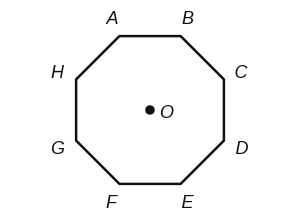
In an octagon $ABCDEFGH$ of equal side, what is the sum of $\overrightarrow{AB} + \overrightarrow{AC} + \overrightarrow{AD} + \overrightarrow{AE} + \overrightarrow{AF} + \overrightarrow{AG} + \overrightarrow{AH}$, if $\overrightarrow{AO} = 2\hat i + 3\hat j - 4\hat k$?
Answer: (A) $16\hat i + 24\hat j - 32\hat k$
Concept. Route every vector through the centre: $\overrightarrow{AX}=\overrightarrow{AO}+\overrightarrow{OX}$. For a regular polygon the vectors from the centre to all the vertices cancel in pairs, because each has an equal and opposite partner at the opposite vertex.
Step 1. Rewrite each term. In the figure the vertices go $A,B,\dots,H$ around the octagon with centre $O$. For $X=B,C,\dots,H$ (seven vertices):
$$\sum\overrightarrow{AX}=7\,\overrightarrow{AO}+\left(\overrightarrow{OB}+\overrightarrow{OC}+\dots+\overrightarrow{OH}\right)$$
Step 2. Use the symmetry of the octagon. All eight centre-to-vertex vectors add to zero (opposite vertices cancel: $\overrightarrow{OA}+\overrightarrow{OE}=\vec0$, and so on). Hence
$$\overrightarrow{OB}+\dots+\overrightarrow{OH}=-\overrightarrow{OA}=\overrightarrow{AO}$$
Step 3. Add.
$$\sum\overrightarrow{AX}=7\,\overrightarrow{AO}+\overrightarrow{AO}=8\,\overrightarrow{AO}=8(2\hat i+3\hat j-4\hat k)=16\hat i+24\hat j-32\hat k$$
Answer. Option A. General rule: for a regular $n$-gon, the vectors from one vertex to all the others add to $n\,\overrightarrow{AO}$.
 Solution by Sreeraj P, M.Sc Physics


