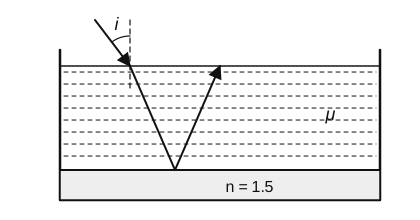
Answer: (A) reflected light is completely polarized and the angle of reflection is close to $60°$
Concept. Brewster's law $\tan i_B = n$; at $i_B$ the reflected light is completely polarised and the transmitted light only partially.
Step 1. Brewster angle. $\tan i_B = 1.73 \approx \sqrt3 \Rightarrow i_B = 60°$; the angle of reflection is $60°$.
Step 2. Check the options. Reflected: completely polarised. Transmitted (refraction $30°$): only partially polarised. So statement (1) is correct.
Answer. Reflected light is completely polarized and the angle of reflection is close to $60°$ (Option A).
Solution by Sreeraj P, M.Sc Physics
Q 12-10-002NEETNEET 2025Top questionMedium
The intensity of transmitted light when a polaroid sheet, placed between two crossed polaroids at $22.5°$ from the polarization axis of one of the polaroid, is ($I_0$ is the intensity of polarised light after passing through the first polaroid):
Step 2. Refracted light. It still has both components (one only partly removed): partially polarised.
Answer. The reflected light will be completely polarised but the refracted light will be partially polarised (Option B).
Solution by Sreeraj P, M.Sc Physics
Q 12-10-005NEETNEET 2023Top questionMedium
For Young's double slit experiment, two statements are given below:
Statement I : If screen is moved away from the plane of slits, angular separation of the fringes remains constant.
Statement II : If the monochromatic source is replaced by another monochromatic source of larger wavelength, the angular separation of fringes decreases.
In the light of the above statements, choose the correct answer from the options given below:
Concept. Brewster's law $\tan i_b = n$, with $n > 1$ for a denser medium.
Step 1. Range. $\tan i_b > 1$ and $i_b < 90°$, so $45° < i_b < 90°$.
Answer. $45° < i_b < 90°$ (Option C).
Solution by Sreeraj P, M.Sc Physics
Q 12-10-007NEETNEET 2020Top questionEasy
In Young's double slit experiment, if the separation between coherent sources is halved and the distance of the screen from the coherent sources is doubled, then the fringe width becomes :
Two point white dots are $1$ mm apart on a black paper. They are viewed by an eye of pupil diameter $3$ mm. Approximately, what is the maximum distance at which these dots can be resolved by the eye? [Take wavelength of light $= 500$ nm]
Step 2. Maximum distance. $x = \dfrac{10^{-3}}{2.03 \times 10^{-4}} \approx 4.9$ m $\approx 5$ m.
Answer. $5$ m (Option C).
Solution by Sreeraj P, M.Sc Physics
Q 12-10-010JEE MainAIEEE 2011Medium
In Young's double slit experiment, the two slits act as coherent sources of waves of equal amplitude $A$ and wavelength $\lambda$. In another experiment with the same arrangement the two slits are made to act as incoherent sources of waves of same amplitude and wavelength. If the intensity at the middle point of the screen in the first case is $I_1$ and in the second case $I_2$, then the ratio $\dfrac{I_1}{I_2}$ is
Concept. Coherent waves add amplitudes; incoherent waves add intensities. At the centre the path difference is zero.
Step 1. Coherent. Amplitude $2A$, so $I_1\propto4A^2$.
Step 2. Incoherent. $I_2\propto A^2+A^2=2A^2$.
Step 3. Ratio. $\dfrac{I_1}{I_2}=2$.
Answer. $2$ (Option B).
Solution by Sreeraj P, M.Sc Physics
Q 12-10-011JEE MainAIEEE 2009Medium
A mixture of light, consisting of wavelength $590$ nm and an unknown wavelength, illuminates Young's double slit and gives rise to two overlapping interference patterns on the screen. The central maximum of both lights coincide. Further, it is observed that the third bright fringe of known light coincides with the $4^{\text{th}}$ bright fringe of the unknown light. The wavelength of the unknown light is
A thin transparent sheet of refractive index $1.5$ placed over one slit of a Young's double slit arrangement shifts the central fringe by $5$ fringes. If the wavelength is $600$ nm, the thickness of the sheet is
Concept. Interference and diffraction occur for all waves; only transverse waves can be polarised.
Step 1. Identify. Polarisation.
Answer. Polarisation (Option B).
Solution by Sreeraj P, M.Sc Physics
Q 12-10-026JEE MainMedium
In Young's experiment with slit separation $1$ mm, the fringe width is $0.6$ mm. When the screen is moved $50$ cm farther from the slits, the fringe width becomes $0.9$ mm. Find the wavelength of the light in nm.
Unpolarised light passes through three polaroids. The axis of the second is at $45°$ to the first, and the third is at $90°$ to the first. What percentage of the original intensity emerges?
Q 12-10-028JEE MainJEE Main 2026 (8 Apr, Shift 2)Medium
Some distant star is to be observed by some telescope of diameter of objective lens $a$, at an angular resolution of $3.0 \times 10^{-7}$ radian. If the wavelength of light from the star reaching the telescope is $500$ nm, the minimum diameter of the objective lens of the telescope is ______ cm. (nearest integer)
Concept. Angular resolution of a circular objective: $\theta=\dfrac{1.22\lambda}{D}$.
Step 1. Diameter. $D=\dfrac{1.22\times500\times10^{-9}}{3\times10^{-7}}=2.03$ m.
Answer. $203$ cm.
Solution by Sreeraj P, M.Sc Physics
Q 12-10-029JEE MainJEE Main 2026 (6 Apr, Shift 1)Easy
In interference experiment the path difference between two interfering waves at a point $A$ on the screen is $\lambda/3$, where $\lambda$ is the wavelength of these waves, and at another point $B$ the path difference is $\lambda/6$. The ratio of intensities at points $A$ and $B$ is ______.
Q 12-10-030JEE MainJEE Main 2026 (6 Apr, Shift 1)Medium
An unpolarized light of intensity $I_0$ passes through polarizer and then through a certain optically active solution and finally it goes to analyser. If the angle between analyser and polariser is $0^\circ$ and intensity of light emerged from analyser is $\dfrac{3}{8}I_0$, the angle of rotation of the light by the solution with respect to analyser is ______ degrees.
Concept. The polariser passes $\dfrac{I_0}{2}$. The solution turns the plane of polarisation by $\theta$, so with the analyser parallel to the polariser Malus's law gives $\dfrac{I_0}{2}\cos^2\theta$.
Step 1. Malus's law. $\dfrac{I_0}2\cos^2\theta=\dfrac38I_0$, so $\cos^2\theta=\dfrac34$.
Step 2. Rotation. $\theta=30^\circ$.
Answer. $30$.
Solution by Sreeraj P, M.Sc Physics
Q 12-10-031JEE MainJEE Main 2026 (6 Apr, Shift 2)Medium
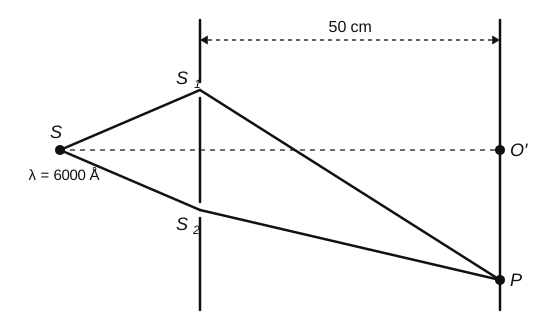
In a Young double slit experiment, the wavelength of incident light is $6000$ Å, the separation between slits $S_1$ and $S_2$ is $5$ cm and the distance between slits plane and screen is $50$ cm, as shown in the figure below. If the resultant intensity at $P$ is equal to the intensity due to individual slits, the path difference between interfering waves is ______ Å.
Q 12-10-032JEE MainJEE Main 2026 (5 Apr, Shift 1)Easy
In Young's double slit experiment, the fringe width of the interference pattern produced on the screen is $2.4\,\mu$m. If the experiment is carried out in another medium having refractive index $1.2$, the fringe width will be ______ $\mu$m.
Concept. In a medium $\lambda \to \dfrac{\lambda}{\mu}$, and $\beta \propto \lambda$.
Step 1. New width. $\dfrac{2.4}{1.2} = 2\ \mu$m.
Answer. $2$ (Option B).
Solution by Sreeraj P, M.Sc Physics
Q 12-10-033JEE MainJEE Main 2026 (5 Apr, Shift 2)Medium
The maximum intensity in a Young's double slit experiment is $I_0$. Distance between the slits ($d$) is $5\lambda$, where $\lambda$ is the wavelength of light used. The intensity of the fringe, exactly opposite to one of the slits on the screen, placed at $D = 10d$ is ______.
Q 12-10-034JEE MainJEE Main 2026 (4 Apr, Shift 2)Medium
An unpolarized light of certain intensity passes through a combination of two polarizers whose transmission axes are at $30^\circ$ and $90^\circ$, respectively, with respect to the horizontal axis. A third polarizer with its transmission axis at $60^\circ$ with the horizontal axis is placed between the two existing polarizers. The ratio of the output intensities with and without the third polarizer is ______.
Concept. Apply Malus's law at each polariser using the angle between successive axes.
Step 1. Without the third. $\dfrac I2\cos^260^\circ=\dfrac I8$.
Step 2. With it ($30^\circ$ then $30^\circ$). $\dfrac I2\cos^230^\circ\cos^230^\circ=\dfrac{9I}{32}$.
Step 3. Ratio. $\dfrac{9/32}{1/8}=\dfrac94$.
Answer. Option C.
Solution by Sreeraj P, M.Sc Physics
Q 12-10-035JEE MainJEE Main 2026 (4 Apr, Shift 2)Medium
In a double slit experiment, when one of the slits is covered by a transparent mica sheet of refractive index $1.56$, the central fringe shifts to the position of $7^{\text{th}}$ bright fringe, obtained with both slits uncovered. If the light source wavelength is $450$ nm, the thickness of mica sheet is $\alpha \times 10^{-9}$ m. The value of $\alpha$ is ______.
Q 12-10-036JEE MainJEE Main 2026 (4 Apr, Shift 1)Easy
A slit of width $a$ is illuminated by light of wavelength $\lambda$. The linear separation between $1^{\text{st}}$ and $3^{\text{rd}}$ minima in the diffraction pattern produced on a screen placed at a distance $D$ from the slit system is ______.
Q 12-10-037JEE MainJEE Main 2026 (2 Apr, Shift 1)Easy
In single slit diffraction pattern, the wavelength of light used is $628$ nm and slit width is $0.2$ mm, the angular width of central maximum is $\alpha\times10^{-2}$ degrees. The value of $\alpha$ is ______.
Concept. The central maximum spans from $-\theta_1$ to $+\theta_1$, with $\sin\theta_1=\dfrac\lambda a$; for small angles its angular width is $\dfrac{2\lambda}{a}$.
Q 12-10-038JEE MainJEE Main 2026 (2 Apr, Shift 2)Easy
In a Young's double slit experiment, the intensity at some point on the screen is found to be $\dfrac34$ times of the maximum of the interference pattern. The path difference between the interfering waves at this point is $\dfrac{\lambda}{x}$ where $\lambda$ is wavelength of the incident light. The value of $x$ is ______.
Q 12-10-039JEE MainJEE Main 2026 (28 Jan, Shift 2)Medium
A beam of light consisting of wavelengths 650 nm and 550 nm illuminates the Young's double slits with separation of 2 mm such that the interference fringes are formed on a screen, placed at a distance of 1.2 m from the slits. The least distance of a point from the central maximum, where the bright fringes due to both the wavelengths coincide, is ______ $\times10^{-5}$ m.
Answer: (C) Statement I is true but Statement II is false
Concept. A prism only bends a plane wave, keeping it plane. A very small opening acts as a point source of secondary wavelets, so it gives a spherical wave. A wider slit diffracts less, so the emerging wave is flatter.
Step 1. Statement I. True.
Step 2. Statement II. A wider slit gives less curvature, not more: false.
Answer. Option C.
Solution by Sreeraj P, M.Sc Physics
Q 12-10-041JEE MainJEE Main 2026 (24 Jan, Shift 2)Medium
In the Young's double slit experiment the intensity produced by each one of the individual slits is $I_o$. The distance between two slits is 2 mm . The distance of screen from slits is 10 m . The wavelength of light is $6000\ \text{Å}$. The intensity of light on the screen in front of one of the slits is ______
Q 12-10-042JEE MainJEE Main 2026 (24 Jan, Shift 1)Easy
An unpolarised light is incident at an interface of two dielectric media having refractive indices of 2 (incident medium) and $2\sqrt3$ (medium) respectively. To satisfy the condition that reflected and refracted rays are perpendicular to each other, the angle of incidence is ______
Answer: (B) Both (A) and (R) are true and (R) is the correct explanation of (A)
Concept. In a medium of index $n$ the frequency is unchanged, the speed falls to $\dfrac cn$, so the wavelength falls to $\dfrac{\lambda}{n}$, and the fringe width $\beta=\dfrac{\lambda D}{d}$ falls to $\dfrac\beta n$.
Step 1. Assertion. Fringes come closer: true.
Step 2. Reason. True, and it is the cause (smaller wavelength).
Answer. Option B.
Solution by Sreeraj P, M.Sc Physics
Q 12-10-044JEE MainJEE Main 2025 (22 Jan, Shift 2)Medium
A transparent film of refractive index $2.0$ is coated on a glass slab of refractive index $1.45$. What is the minimum thickness of transparent film to be coated for the maximum transmission of green light of wavelength $550\ \text{nm}$? [Assume that the light is incident nearly perpendicular to the glass surface.]
Concept. Maximum transmission means minimum reflection. Reflection at air–film (going to higher $n$) gains a phase $\pi$; at film–glass ($2\to1.45$) it does not. So the two reflected rays already differ by $\pi$, and they cancel when the extra path $2nt$ is a whole wavelength.
Step 1. Condition. $2nt=\lambda$ for the thinnest film.
Concept. $\beta=\dfrac{\lambda D}{d}$, so a longer wavelength gives wider fringes. Red has a longer wavelength than blue.
Step 1. Assertion. Red fringes are wider, not closer: false.
Step 2. Reason. $\beta\propto\lambda$: true.
Answer. A is false but R is true (Option D).
Solution by Sreeraj P, M.Sc Physics
Q 12-10-046JEE MainJEE Main 2025 (24 Jan, Shift 1)Easy
The Young's double slit interference experiment is performed using light consisting of $480\ \text{nm}$ and $600\ \text{nm}$ wavelengths to form interference patterns. The least number of the bright fringes of $480\ \text{nm}$ light that are required for the first coincidence with the bright fringes formed by $600\ \text{nm}$ light is
Step 1. Ratio. $\dfrac{n_1}{n_2}=\dfrac{600}{480}=\dfrac54$, so $n_1=5$.
Answer. $5$ (Option A).
Solution by Sreeraj P, M.Sc Physics
Q 12-10-047JEE MainJEE Main 2025 (24 Jan, Shift 2)Easy
Young's double slit interference apparatus is immersed in a liquid of refractive index $1.44$. It has slit separation of $1.5\ \text{mm}$. The slits are illuminated by a parallel beam of light whose wavelength in air is $690\ \text{nm}$. The fringe-width on a screen placed behind the plane of slits at a distance of $0.72\ \text{m}$ will be
Concept. $\beta=\dfrac{\lambda D}{nd}$ when the whole apparatus is in a liquid.
Step 1. Value. $\dfrac{690\times10^{-9}\times0.72}{1.44\times1.5\times10^{-3}}=2.3\times10^{-4}$ m.
Answer. $0.23$ mm (Option A).
Solution by Sreeraj P, M.Sc Physics
Q 12-10-048JEE MainJEE Main 2025 (24 Jan, Shift 2)Hard
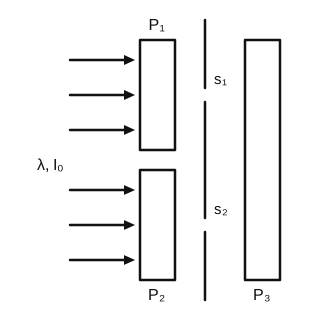
In a Young's double slit experiment, three polarizers are kept as shown in the figure. The transmission axes of $P_1$ and $P_2$ are orthogonal to each other. The polarizer $P_3$ covers both the slits with its transmission axis at $45^\circ$ to those of $P_1$ and $P_2$. An unpolarized light of wavelength $\lambda$ and intensity $I_0$ is incident on $P_1$ and $P_2$. The intensity at a point after $P_3$ where the path difference between the light waves from $s_1$ and $s_2$ is $\dfrac{\lambda}{3}$, is
Concept. Light from $P_1$ and $P_2$ is polarised at right angles, so on its own it would not interfere. $P_3$ at $45^\circ$ to both passes the same direction from each, so the beams now interfere.
Step 1. Each beam. After $P_1$ (or $P_2$): $\dfrac{I_0}{2}$. After $P_3$: $\dfrac{I_0}{2}\cos^245^\circ=\dfrac{I_0}{4}$.
Q 12-10-049JEE MainJEE Main 2025 (28 Jan, Shift 1)Easy
A double slit interference experiment performed with light of wavelength $600\ \text{nm}$ forms an interference fringe pattern on a screen with the $10^{\text{th}}$ bright fringe having its centre at a distance of $10\ \text{mm}$ from the central maximum. The distance of the centre of the same $10^{\text{th}}$ bright fringe from the central maximum when the source of light is replaced by another source of wavelength $660\ \text{nm}$ would be ______ mm.
Q 12-10-050JEE MainJEE Main 2025 (28 Jan, Shift 2)Hard
A thin transparent film with refractive index $1.4$ is held on a circular ring of radius $1.8\ \text{cm}$. The fluid in the film evaporates such that transmission through the film at wavelength $560\ \text{nm}$ goes to a minimum every 12 seconds. Assuming that the film is flat on its two sides, the rate of evaporation is ______ $\pi\times10^{-13}\ \text{m}^3/\text{s}$.
Concept. At normal incidence successive transmission minima occur each time $2nt$ changes by $\lambda$, i.e. each time the thickness drops by $\dfrac{\lambda}{2n}$.
Step 1. Thickness step. $\dfrac{560}{2\times1.4}=200$ nm every $12$ s.
Q 12-10-051JEE MainJEE Main 2024 (1 Feb, Shift 1)Easy
A monochromatic light of wavelength $6000\ \text{\AA}$ is incident on a single slit of width $0.01\ \text{mm}$. If the diffraction pattern is formed at the focus of a convex lens of focal length $20\ \text{cm}$, the linear width of the central maximum is
Concept. Width of the central maximum $=\dfrac{2\lambda f}{a}$ (screen in the focal plane).
Step 1. Value. $\dfrac{2\times6\times10^{-7}\times0.2}{10^{-5}}=0.024$ m.
Answer. $24$ mm (Option B).
Solution by Sreeraj P, M.Sc Physics
Q 12-10-052JEE MainJEE Main 2024 (1 Feb, Shift 2)Easy
A microwave of wavelength $2.0\ \text{cm}$ falls normally on a slit of width $4.0\ \text{cm}$. The angular spread of the central maximum of the diffraction pattern obtained on a screen $1.5\ \text{m}$ away from the slit will be
Step 2. Spread. From $-30^\circ$ to $+30^\circ$: $60^\circ$. (The screen distance is not needed.)
Answer. $60^\circ$ (Option C).
Solution by Sreeraj P, M.Sc Physics
Q 12-10-053JEE MainJEE Main 2024 (1 Feb, Shift 2)Medium
In Young's double slit experiment, monochromatic light of wavelength $5000\ \text{\AA}$ is used. The slits are $1.0\ \text{mm}$ apart and the screen is placed at $1.0\ \text{m}$ away from the slits. The distance from the centre of the screen where the intensity becomes half of the maximum intensity for the first time is ______ $\times10^{-6}\ \text{m}$.
Concept. Half the maximum: $\cos^2\dfrac\phi2=\dfrac12$, so $\phi=\dfrac\pi2$, path $\dfrac\lambda4$. Position $y=\dfrac{D}{d}\Delta x$.
Step 1. Position. $y=\dfrac{1}{10^{-3}}\times\dfrac{5000\times10^{-10}}{4}=1.25\times10^{-4}$ m.
Answer. $125$.
Solution by Sreeraj P, M.Sc Physics
Q 12-10-054JEE MainJEE Main 2024 (4 Apr, Shift 1)Medium
Two wavelengths $\lambda_1$ and $\lambda_2$ are used in Young's double slit experiment: $\lambda_1 = 450\ \text{nm}$ and $\lambda_2 = 650\ \text{nm}$. The minimum order of the fringe produced by $\lambda_2$ which overlaps with a fringe produced by $\lambda_1$ is $n$. The value of $n$ is ______.
Q 12-10-055JEE MainJEE Main 2024 (4 Apr, Shift 2)Easy
The width of one of the two slits in a Young's double slit experiment is 4 times that of the other slit. The ratio of the maximum to the minimum intensity in the interference pattern is
Concept. Rays from a point at the focus leave a convex lens parallel to the axis. Parallel rays have wavefronts perpendicular to them: flat planes.
Answer. Plane (Option B).
Solution by Sreeraj P, M.Sc Physics
Q 12-10-057JEE MainJEE Main 2024 (5 Apr, Shift 1)Easy
In Young's double slit experiment carried out with light of wavelength $5000\ \text{\AA}$, the distance between the slits is $0.3\ \text{mm}$ and the screen is at $200\ \text{cm}$ from the slits. The central maximum is at $x = 0\ \text{cm}$. The value of $x$ for the third maximum is ______ mm.
Concept. The $n$th bright fringe is at $y_n=\dfrac{n\lambda D}{d}$.
Step 1. Fringe width. $\beta=\dfrac{5\times10^{-7}\times2}{3\times10^{-4}}=3.33\times10^{-3}$ m.
Step 2. Third maximum. $y_3=3\beta=10\times10^{-3}$ m $=10$ mm.
Answer. $10$.
Solution by Sreeraj P, M.Sc Physics
Q 12-10-058JEE MainJEE Main 2024 (5 Apr, Shift 2)Easy
In a single slit experiment, a parallel beam of green light of wavelength $550\ \text{nm}$ passes through a slit of width $0.20\ \text{mm}$. The transmitted light is collected on a screen $100\ \text{cm}$ away. The distance of the first order minimum from the central maximum will be $x\times10^{-5}\ \text{m}$. The value of $x$ is ______.
Concept. The first minimum is at $\sin\theta=\dfrac\lambda a$, i.e. at $y=\dfrac{\lambda D}{a}$ on the screen.
Step 1. Position. $y=\dfrac{550\times10^{-9}\times1}{0.2\times10^{-3}}=2.75\times10^{-3}$ m $=275\times10^{-5}$ m.
Answer. $x=275$.
Solution by Sreeraj P, M.Sc Physics
Q 12-10-059JEE MainJEE Main 2024 (6 Apr, Shift 1)Easy
Which of the following phenomena is not explained by the wave nature of light? A. reflection B. diffraction C. photoelectric effect D. interference E. polarization. Choose the most appropriate answer from the options given below:
Concept. Reflection, refraction, interference, diffraction and polarisation all follow from light being a transverse wave. The photoelectric effect (emission only above a threshold frequency, at once, with energy set by frequency, not intensity) needs photons.
Step 1. Pick out. Only C, the photoelectric effect, is not explained by the wave model.
Answer. C only (Option C).
Solution by Sreeraj P, M.Sc Physics
Q 12-10-060JEE MainJEE Main 2024 (6 Apr, Shift 2)Easy
Two coherent monochromatic light beams of intensities $I$ and $4I$ are superimposed. The difference between the maximum and minimum possible intensities in the resulting beam is $xI$. The value of $x$ is ______.
Concept. A sheet at $\theta$ between crossed polaroids gives $I=\dfrac{I_0}{2}\cos^2\theta\sin^2\theta=\dfrac{I_0}{8}\sin^22\theta$.
Step 1. Maximum. $\sin^22\theta=1$ at $\theta=45^\circ$, giving $\dfrac{I_0}8$.
Answer. $45^\circ$ (Option D).
Solution by Sreeraj P, M.Sc Physics
Q 12-10-062JEE MainJEE Main 2024 (27 Jan, Shift 2)Easy
A parallel beam of monochromatic light of wavelength $5000\ \text{Å}$ is incident normally on a single narrow slit of width $0.001\ \text{mm}$. The light is focused by a convex lens on a screen placed in its focal plane. The first minima will be formed for the angle of diffraction of ______ (degree).
Q 12-10-063JEE MainJEE Main 2024 (29 Jan, Shift 1)Hard
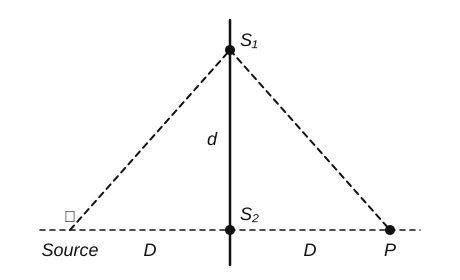
In a double slit experiment shown in figure, when light of wavelength $400\ \text{nm}$ is used, a dark fringe is observed at $P$. If $D = 0.2\ \text{m}$, the minimum distance between the slits $S_1$ and $S_2$ is $\alpha\ \text{mm}$. Write the value of $10\alpha$ to the nearest integer.
Concept. Both the source and P are on the axis through $S_2$, each a distance $D$ from the slits. The path via $S_1$ is longer on both sides: $\Delta=2\left(\sqrt{D^2+d^2}-D\right)\approx\dfrac{d^2}{D}$.
Step 1. Dark fringe (least $d$). $\dfrac{d^2}{D}=\dfrac\lambda2$.
Step 2. Separation. $d^2=\dfrac{400\times10^{-9}\times0.2}{2}=4\times10^{-8}$ m$^2$, $d=2\times10^{-4}$ m $=0.2$ mm.
Step 3. Report. $\alpha=0.2$, $10\alpha=2$.
Answer. $2$.
Solution by Sreeraj P, M.Sc Physics
Q 12-10-064JEE MainJEE Main 2024 (29 Jan, Shift 2)Easy
In Young's double slit experiment, light from two identical sources is superimposing on a screen. The path difference between the two lights reaching at a point on the screen is $\dfrac{7\lambda}{4}$. The ratio of intensity of the fringe at this point with respect to the maximum intensity of the fringe is:
Q 12-10-065JEE MainJEE Main 2024 (29 Jan, Shift 2)Easy
In a single slit diffraction pattern, a light of wavelength $6000\ \text{Å}$ is used. The distance between the first and third minima in the diffraction pattern is found to be $3\ \text{mm}$ when the screen is placed $50\ \text{cm}$ away from the slit. The width of the slit is ______ $\times10^{-4}\ \text{m}$.
Q 12-10-066JEE MainJEE Main 2024 (8 Apr, Shift 1)Easy
A parallel beam of monochromatic light of wavelength $600\ \text{nm}$ passes through a single slit of $0.4\ \text{mm}$ width. Angular divergence corresponding to second order minima would be ______ $\times10^{-3}\ \text{rad}$.
Q 12-10-067JEE MainJEE Main 2024 (8 Apr, Shift 2)Medium
Two slits are $1\ \text{mm}$ apart and the screen is located $1\ \text{m}$ away from the slits. A light of wavelength $500\ \text{nm}$ is used. The width of each slit to obtain 10 maxima of the double slit pattern within the central maximum of the single slit pattern is ______ $\times10^{-4}\ \text{m}$.
Concept. The central diffraction maximum has angular width $\dfrac{2\lambda}{a}$; double-slit fringes are $\dfrac\lambda d$ apart. Ten fringes fit if $\dfrac{2\lambda}{a}=10\dfrac{\lambda}{d}$.
Step 1. Width. $a=\dfrac d5=0.2$ mm.
Answer. $2$.
Solution by Sreeraj P, M.Sc Physics
Q 12-10-068JEE MainJEE Main 2024 (9 Apr, Shift 1)Medium
In a Young's double slit experiment, the intensity at a point is $\left(\dfrac14\right)^{\text{th}}$ of the maximum intensity. The minimum distance of the point from the central maximum is ______ $\mu\text{m}$. (Given: $\lambda = 600\ \text{nm}$, $d = 1.0\ \text{mm}$, $D = 1.0\ \text{m}$)
Concept. A quarter of the maximum: $\cos\dfrac\phi2=\dfrac12$, so $\phi=\dfrac{2\pi}{3}$, path $\dfrac\lambda3$.
Step 1. Position. $y=\dfrac{D}{d}\cdot\dfrac\lambda3=\dfrac{1}{10^{-3}}\times\dfrac{600\times10^{-9}}{3}=2\times10^{-4}$ m.
Answer. $200\ \mu$m.
Solution by Sreeraj P, M.Sc Physics
Q 12-10-069JEE MainJEE Main 2024 (9 Apr, Shift 2)Easy
Monochromatic light of wavelength $500\ \text{nm}$ is used in Young's double slit experiment. An interference pattern is obtained on a screen. When one of the slits is covered with a very thin glass plate (refractive index $= 1.5$), the central maximum is shifted to a position previously occupied by the $4^{\text{th}}$ bright fringe. The thickness of the glass plate is ______ $\mu\text{m}$.
Q 12-10-070JEE MainJEE Main 2024 (30 Jan, Shift 1)Medium
The diffraction pattern of a light of wavelength $400\ \text{nm}$ diffracting from a slit of width $0.2\ \text{mm}$ is focused on the focal plane of a convex lens of focal length $100\ \text{cm}$. The width of the 1st secondary maxima will be:
Concept. Secondary maxima lie between consecutive minima, so each has width $\dfrac{\lambda f}{a}$, half the central one.
Step 1. Value. $\dfrac{400\times10^{-9}\times1}{0.2\times10^{-3}}=2\times10^{-3}$ m.
Answer. $2$ mm (Option A).
Solution by Sreeraj P, M.Sc Physics
Q 12-10-071JEE MainJEE Main 2024 (30 Jan, Shift 2)Easy
A beam of unpolarised light of intensity $I_0$ is passed through a polaroid $A$ and then through another polaroid $B$ which is oriented so that its principal plane makes an angle of $45^\circ$ relative to that of $A$. The intensity of the emergent light is:
Q 12-10-072JEE MainJEE Main 2024 (31 Jan, Shift 1)Medium
Two waves of intensity ratio $1:9$ cross each other at a point. The resultant intensities at the point, when (a) the waves are incoherent is $I_1$, and (b) the waves are coherent and differ in phase by $60^\circ$ is $I_2$. If $\dfrac{I_1}{I_2} = \dfrac{10}{x}$, then $x = $ ______.
Q 12-10-073JEE MainJEE Main 2024 (31 Jan, Shift 2)Easy
When unpolarized light is incident at an angle of $60^\circ$ on a transparent medium from air, the reflected ray is completely polarized. The angle of refraction in the medium is
Q 12-10-074JEE MainJEE Main 2023 (29 Jan, Shift 1)Medium
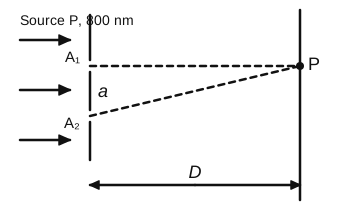
In a Young's double slit experiment, two slits are illuminated with a light of wavelength $800\ \text{nm}$. The line joining $A_1P$ is perpendicular to $A_1A_2$ as shown in the figure. If the first minimum is detected at $P$, the value of slits separation $a$ will be
The distance of screen from slits $D=5\ \text{cm}$.
Q 12-10-075JEE MainJEE Main 2023 (29 Jan, Shift 1)Medium
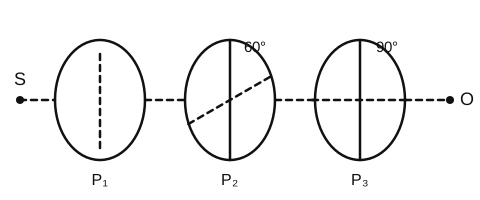
As shown in figures, three identical polaroids $P_1$, $P_2$ and $P_3$ are placed one after another. The pass axis of $P_2$ and $P_3$ are inclined at angle of $60^\circ$ and $90^\circ$ with respect to axis of $P_1$. The source $S$ has an intensity of $256\ \text{W m}^{-2}$. The intensity of light at point $O$ is ______ $\text{W m}^{-2}$.
Concept. The first polaroid halves unpolarised light; each later one multiplies by $\cos^2$ of the angle from the one before.
Step 1. After $P_1$. $128$ W m$^{-2}$.
Step 2. After $P_2$ ($60^\circ$). $128\times\dfrac14=32$ W m$^{-2}$.
Step 3. After $P_3$ ($30^\circ$ from $P_2$). $32\times\dfrac34=24$ W m$^{-2}$.
Answer. $24$.
Solution by Sreeraj P, M.Sc Physics
Q 12-10-076JEE MainJEE Main 2023 (29 Jan, Shift 2)Easy
A scientist is observing a bacteria through a compound microscope. For better analysis and to improve its resolving power he should (select the best option)
Answer: (B) Increase the refractive index of the medium between the object and objective lens
Concept. Resolving power of a microscope $= \dfrac{2\mu\sin\theta}{1.22\lambda}$.
Step 1. Apply. It increases with larger $\mu$ (oil immersion), larger aperture and shorter $\lambda$; the eyepiece does not affect it.
Answer. Increase the refractive index of the medium between the object and objective lens (Option B).
Solution by Sreeraj P, M.Sc Physics
Q 12-10-077JEE MainJEE Main 2023 (29 Jan, Shift 2)Medium
Unpolarised light is incident on the boundary between two dielectric media, whose dielectric constants are $2.8$ (medium 1) and $6.8$ (medium 2), respectively. To satisfy the condition, so that the reflected and refracted rays are perpendicular to each other, the angle of incidence should be $\tan^{-1}\left(1+\dfrac{10}{\theta}\right)^{1/2}$, the value of $\theta$ is ______. (Given for dielectric media, $\mu_r=1$)
Q 12-10-078JEE MainJEE Main 2023 (30 Jan, Shift 1)Medium
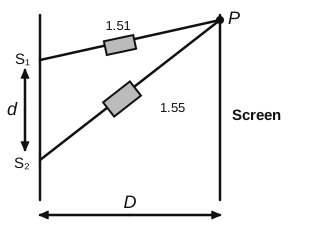
In Young's double slit experiment, two slits $S_1$ and $S_2$ are $d$ distance apart and the separation from slits to screen is $D$ (as shown in figure). Now if two transparent slabs of equal thickness $0.1\ \text{mm}$ but refractive index $1.51$ and $1.55$ are introduced in the path of beam $\lambda=4000\ \text{Å}$ from $S_1$ and $S_2$ respectively, the central bright fringe spot will shift by ______ number of fringes.
Concept. A sheet adds optical path $(\mu-1)t$. With sheets on both beams the net extra path is $(\mu_2-\mu_1)t$, and the pattern shifts by that many wavelengths.
Step 1. Net path. $(1.55-1.51)\times0.1\times10^{-3}=4\times10^{-6}$ m.
Step 2. Fringes. $N=\dfrac{4\times10^{-6}}{4\times10^{-7}}=10$ (towards $S_2$, the denser sheet).
Answer. $10$.
Solution by Sreeraj P, M.Sc Physics
Q 12-10-079JEE MainJEE Main 2023 (30 Jan, Shift 2)Easy
In a Young's double slit experiment, the intensities at two points, for the path difference $\dfrac\lambda4$ and $\dfrac\lambda3$ ($\lambda$ being the wavelength of light used) are $I_1$ and $I_2$ respectively. If $I_0$ denotes the intensity produced by each one of the individual slits, then $\dfrac{I_1+I_2}{I_0}=$ ______.
Concept. With $I_0$ from each slit, $I=4I_0\cos^2\dfrac\phi2$, $\phi=\dfrac{2\pi}\lambda\Delta$. Note that $I_0$ is a single slit's intensity, a quarter of the maximum.
Q 12-10-081JEE MainJEE Main 2023 (31 Jan, Shift 2)Medium
Two light waves of wavelengths $800$ and $600\ \text{nm}$ are used in Young's double slit experiment to obtain interference fringes on a screen placed $7\ \text{m}$ away from plane of slits. If the two slits are separated by $0.35\ \text{mm}$, then shortest distance from the central bright maximum to the point where the bright fringes of the two wavelengths coincide will be ______ mm.
Concept. Bright fringes coincide where $n_1\lambda_1=n_2\lambda_2$; the first time is at the lowest common multiple.
Step 1. Orders. $3\times800=4\times600=2400$ nm.
Step 2. Position. $y=\dfrac{2400\times10^{-9}\times7}{0.35\times10^{-3}}=0.048$ m.
Answer. $48$ mm.
Solution by Sreeraj P, M.Sc Physics
Q 12-10-082JEE MainJEE Main 2023 (24 Jan, Shift 1)Medium
Given below are two statements:
Statement I: If the Brewster's angle for the light propagating from air to glass is $\theta_B$, then Brewster's angle for the light propagating from glass to air is $\dfrac\pi2-\theta_B$.
Statement II: The Brewster's angle for the light propagating from glass to air is $\tan^{-1}\mu_g$, where $\mu_g$ is the refractive index of glass.
In the light of the above statements, choose the correct answer from the options given below:
Answer: (B) Statement I is true but Statement II is false
Concept. Brewster: $\tan\theta_B=\dfrac{n_2}{n_1}$. From glass to air, $\tan\theta_B'=\dfrac1{\mu_g}=\cot\theta_B$.
Step 1. Statement I. $\theta_B'=\dfrac\pi2-\theta_B$: true.
Step 2. Statement II. It is $\tan^{-1}\dfrac{1}{\mu_g}$, not $\tan^{-1}\mu_g$: false.
Answer. Option B.
Solution by Sreeraj P, M.Sc Physics
Q 12-10-083JEE MainJEE Main 2023 (25 Jan, Shift 1)Easy
In Young's double slits experiment, the position of $5^\text{th}$ bright fringe from the central maximum is $5\ \text{cm}$. The distance between slits and screen is $1\ \text{m}$ and wavelength of used monochromatic light is $600\ \text{nm}$. The separation between the slits is
Concept. The $n$th bright fringe is at $y_n=\dfrac{n\lambda D}{d}$.
Step 1. Solve for $d$. $d=\dfrac{5\times600\times10^{-9}\times1}{0.05}=6\times10^{-5}$ m.
Answer. $60\ \mu$m (Option A).
Solution by Sreeraj P, M.Sc Physics
Q 12-10-084JEE MainJEE Main 2023 (13 Apr, Shift 2)Easy
In a Young's double slit experiment, the ratio of amplitude of light coming from slits is $2:1$. The ratio of the maximum to minimum intensity in the interference pattern is
Concept. $I_{max}\propto(a_1+a_2)^2$ and $I_{min}\propto(a_1-a_2)^2$.
Step 1. Ratio. $\dfrac{(2+1)^2}{(2-1)^2}=9$.
Answer. $9:1$ (Option D).
Solution by Sreeraj P, M.Sc Physics
Q 12-10-085JEE MainJEE Main 2023 (15 Apr, Shift 1)Easy
A single slit of width $a$ is illuminated by a monochromatic light of wavelength $600\ \text{nm}$. The value of $a$ for which first minimum appears at $\theta=30^\circ$ on the screen will be
Q 12-10-086JEE MainJEE Main 2023 (10 Apr, Shift 2)Easy
The ratio of intensities at two points P and Q on the screen in a Young's double slit experiment where phase difference between two waves of same amplitude are $\dfrac\pi3$ and $\dfrac\pi2$, respectively are
Q 12-10-087JEE MainJEE Main 2023 (6 Apr, Shift 2)Easy
Given below are two statements: one is labelled as Assertion A and the other is labelled as Reason R.
Assertion A: The phase difference of two light waves changes if they travel through different media having same thickness, but different indices of refraction.
Reason R: The wavelengths of waves are different in different media.
In the light of the above statements, choose the most appropriate answer from the options given below.
Answer: (D) Both A and R are correct and R is the correct explanation of A
Concept. Over the same thickness $t$, a wave covers $\dfrac{nt}{\lambda_0}$ wavelengths, because its wavelength in the medium is $\dfrac{\lambda_0}{n}$. Different media give different numbers of cycles, so the phase difference changes by $\dfrac{2\pi}{\lambda_0}(n_1-n_2)t$.
Step 1. Assertion. True.
Step 2. Reason. True, and it is exactly why the phase changes.
Answer. Both correct, R explains A (Option D).
Solution by Sreeraj P, M.Sc Physics
Q 12-10-088JEE MainJEE Main 2023 (6 Apr, Shift 2)Medium
A beam of light consisting of two wavelengths $7000\ \text{Å}$ and $5500\ \text{Å}$ is used to obtain interference pattern in Young's double slit experiment. The distance between the slits is $2.5\ \text{mm}$ and the distance between the plane of slits and the screen is $150\ \text{cm}$. The least distance from the central fringe, where the bright fringes due to both the wavelengths coincide, is $n\times10^{-5}$ m. The value of $n$ is ______.
Q 12-10-089JEE MainJEE Main 2023 (8 Apr, Shift 2)Easy
The width of fringe is $2$ mm on the screen in a double slit experiment for the light of wavelength of $400$ nm. The width of the fringe for the light of wavelength $600$ nm will be
Concept. With $d$ and $D$ unchanged, $\beta\propto\lambda$.
Step 1. New width. $\beta=2\times\dfrac{600}{400}=3$ mm.
Answer. $3$ mm (Option D).
Solution by Sreeraj P, M.Sc Physics
Q 12-10-090JEE MainJEE Main 2023 (10 Apr, Shift 1)Medium
Unpolarised light of intensity $32\ \text{W m}^{-2}$ passes through the combination of three polaroids such that the pass axis of the last polaroid is perpendicular to that of the pass axis of first polaroid. If intensity of emerging light is $3\ \text{W m}^{-2}$, then the angle between pass axis of first two polaroids is ______ $^\circ$.
Q 12-10-091JEE MainJEE Main 2023 (1 Feb, Shift 1)Medium
$n$ polarizing sheets are arranged such that each makes an angle $45^\circ$ with the preceding sheet. An unpolarized light of intensity $I$ is incident into this arrangement. The output intensity is found to be $\dfrac I{64}$. The value of $n$ will be
Q 12-10-092JEE MainJEE Main 2023 (1 Feb, Shift 2)Medium
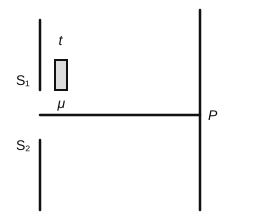
As shown in the figure, in Young's double slit experiment, a thin plate of thickness $t=10\ \mu$m and refractive index $\mu=1.2$ is inserted in front of slit $S_1$. The experiment is conducted in air ($\mu=1$) and uses a monochromatic light of wavelength $\lambda=500$ nm. Due to the insertion of the plate, central maxima is shifted by a distance of $x\beta_0$, where $\beta_0$ is the fringe-width before the insertion of the plate. The value of $x$ is ______.
Q 12-10-093JEE MainJEE Main 2022 (24 Jun, Shift 1)Medium
Sodium light of wavelengths $650\ \text{nm}$ and $655\ \text{nm}$ is used to study diffraction at a single slit of aperture $0.5\ \text{mm}$. The distance between the slit and the screen is $2.0\ \text{m}$. The separation between the positions of the first maxima of diffraction pattern obtained in the two cases is ______ $\times10^{-5}\ \text{m}$.
Concept. The first secondary maximum lies about midway between the first and second minima, at $y\approx\dfrac{3\lambda D}{2a}$. For two wavelengths the separation is $\dfrac{3D\,\Delta\lambda}{2a}$.
Step 1. Separation. $\dfrac{3\times2.0\times5\times10^{-9}}{2\times0.5\times10^{-3}}=3\times10^{-5}$ m.
Answer. $3$.
Solution by Sreeraj P, M.Sc Physics
Q 12-10-094JEE MainJEE Main 2022 (24 Jun, Shift 2)Easy
Two light beams of intensities in the ratio of $9 : 4$ are allowed to interfere. The ratio of the intensity of maxima and minima will be:
Q 12-10-095JEE MainJEE Main 2022 (25 Jun, Shift 1)Easy
Two light beams having intensities $I$ and $9I$ interfere to produce a fringe pattern on a screen. The phase difference between the beams is $\dfrac\pi2$ at point $P$ and $\pi$ at point $Q$. Then the difference between the resultant intensities at $P$ and $Q$ will be:
Q 12-10-096JEE MainJEE Main 2022 (25 Jun, Shift 2)Easy
An interference pattern is obtained with two coherent light sources of intensity ratio $4 : 1$. And the ratio $\dfrac{I_{\max} + I_{\min}}{I_{\max} - I_{\min}}$ is $\dfrac5x$. Then, the value of $x$ will be equal to:
Q 12-10-097JEE MainJEE Main 2022 (25 Jun, Shift 2)Medium
A light whose electric field vectors are completely removed by using a good polaroid is allowed to be incident on the surface of a prism at Brewster's angle. Choose the most suitable option for the phenomenon related to the prism.
Answer: (D) No reflection, and there will be total transmission of light.
Concept. At Brewster's angle the reflected light contains only the component of $\vec E$ perpendicular to the plane of incidence. Light polarised with $\vec E$ in the plane of incidence (the other component removed by the polaroid) is therefore not reflected at all.
Step 1. Result. All of it is transmitted; there is no reflected beam.
Answer. Option D.
Solution by Sreeraj P, M.Sc Physics
Q 12-10-098JEE MainJEE Main 2022 (26 Jun, Shift 2)Easy
For a specific wavelength $670\ \text{nm}$ of light coming from a galaxy moving with velocity $v$, the observed wavelength is $670.7\ \text{nm}$. The value of $v$ is
Step 1. Speed. $v=3\times10^8\times\dfrac{0.7}{670}=3.13\times10^5$ m/s (moving away, as $\lambda$ increased).
Answer. Option B.
Solution by Sreeraj P, M.Sc Physics
Q 12-10-099JEE MainJEE Main 2022 (26 Jul, Shift 1)Easy
In Young's double slit experiment, the fringe width is $12\ \text{mm}$. If the entire arrangement is placed in water of refractive index $\dfrac43$, then the fringe width becomes (in mm)
Concept. In a medium the wavelength becomes $\dfrac{\lambda}{n}$, so $\beta$ also divides by $n$.
Step 1. New width. $\dfrac{12}{4/3}=9$ mm.
Answer. Option B.
Solution by Sreeraj P, M.Sc Physics
Q 12-10-100JEE MainJEE Main 2022 (27 Jun, Shift 1)Medium
In Young's double slit experiment the two slits are $0.6$ mm distance apart. Interference pattern is observed on a screen at a distance $80$ cm from the slits. The first dark fringe is observed on the screen directly opposite to one of the slits. The wavelength of light will be ______ nm.
Concept. Opposite a slit the path difference is $\dfrac{d^2}{2D}$. First dark fringe: path $=\dfrac\lambda2$.
Step 1. Wavelength. $\lambda=\dfrac{d^2}{D}=\dfrac{(0.6\times10^{-3})^2}{0.8}=4.5\times10^{-7}$ m.
Answer. $450$ nm.
Solution by Sreeraj P, M.Sc Physics
Q 12-10-101JEE MainJEE Main 2022 (27 Jul, Shift 1)Easy
A microscope was initially placed in air (refractive index $1$). It is then immersed in oil (refractive index $2$). For a light whose wavelength in air is $\lambda$, calculate the change of microscope's resolving power due to oil and choose the correct option
Answer: (B) Resolving power will be twice in the oil than it was in the air.
Concept. Resolving power of a microscope $=\dfrac{2n\sin\theta}{1.22\lambda}\propto n$.
Step 1. Oil. $n$ goes from $1$ to $2$.
Answer. Twice (Option B).
Solution by Sreeraj P, M.Sc Physics
Q 12-10-102JEE MainJEE Main 2022 (27 Jul, Shift 1)Easy
Two beams of light having intensities $I$ and $4I$ interfere to produce a fringe pattern on a screen. The phase difference between the two beams are $\dfrac\pi2$ and $\dfrac\pi3$ at points $A$ and $B$ respectively. The difference between the resultant intensities at the two points is $xI$. The value of $x$ will be ______ .
Step 1. At A ($\phi = \dfrac{\pi}{2}$). $I_A = 5I$.
Step 2. At B ($\phi = \dfrac{\pi}{3}$). $I_B = 7I$.
Step 3. Difference. $2I$, so $x = 2$.
Answer. $2$.
Solution by Sreeraj P, M.Sc Physics
Q 12-10-103JEE MainJEE Main 2022 (27 Jul, Shift 2)Medium
Two coherent sources of light interfere. The intensity ratio of two sources is $1 : 4$. For this interference pattern if the value of $\dfrac{I_{\max} + I_{\min}}{I_{\max} - I_{\min}}$ is equal to $\dfrac{2\alpha + 1}{\beta + 3}$, then $\dfrac\alpha\beta$ will be
Q 12-10-104JEE MainJEE Main 2022 (28 Jul, Shift 1)Easy
In a Young's double slit experiment, a laser light of $560$ nm produces an interference pattern with consecutive bright fringes' separation of $7.2$ mm. Now another light is used to produce an interference pattern with consecutive bright fringes' separation of $8.1$ mm. The wavelength of second light is ______ nm.
Answer: (B) the distance between consecutive fringes will decrease.
Concept. $\beta = \dfrac{\lambda D}{d}$; the centre stays bright and minima stay dark.
Step 1. Apply. Blue has a shorter wavelength than orange, so the fringes come closer.
Answer. The distance between consecutive fringes will decrease (Option B).
Solution by Sreeraj P, M.Sc Physics
Q 12-10-106JEE MainJEE Main 2021 (27 Jul, Shift 2)Easy
The difference in the number of waves when yellow light propagates through air and vacuum columns of the same thickness is one. The thickness of the air column is ______ mm. [Refractive index of air $= 1.0003$, the wavelength of yellow light in vacuum $= 6000$ Å]
Concept. The number of waves in a length $t$ is $\dfrac{t}{\lambda}$, and $\lambda=\dfrac{\lambda_0}{n}$ in a medium. So air holds $(n-1)\dfrac{t}{\lambda_0}$ more waves than vacuum.
Step 1. Condition. $(n-1)\dfrac{t}{\lambda_0}=1$.
Step 2. Thickness. $t=\dfrac{6000\times10^{-10}}{0.0003}=2\times10^{-3}$ m $=2$ mm.
Answer. $2$.
Solution by Sreeraj P, M.Sc Physics
Q 12-10-107JEE MainJEE Main 2021 (31 Aug, Shift 2)Easy
In a Young's double slit experiment, the slits are separated by $0.3$ mm and the screen is $1.5$ m away from the plane of slits. Distance between fourth bright fringes on both sides of central bright fringe is $2.4$ cm. The frequency of light used is $x\times10^{14}$ Hz.
Concept. The fourth bright fringes on the two sides are $4\beta$ each from the centre, so $8\beta$ apart. Then $\lambda=\dfrac{\beta d}{D}$ and $f=\dfrac c\lambda$.
Step 1. Fringe width. $8\beta=2.4$ cm, so $\beta=3$ mm.
Step 2. Wavelength. $\lambda=\dfrac{3\times10^{-3}\times3\times10^{-4}}{1.5}=6\times10^{-7}$ m.
Step 3. Frequency. $f=\dfrac{3\times10^8}{6\times10^{-7}}=5\times10^{14}$ Hz.
Answer. $x=5$.
Solution by Sreeraj P, M.Sc Physics
Q 12-10-108JEE MainJEE Main 2021 (24 Feb, Shift 1)Easy
In a Young's double slit experiment, the width of the one of the slit is three times the other slit. The amplitude of the light coming from a slit is proportional to the slit-width. Find the ratio of the maximum to the minimum intensity in the interference pattern.
Q 12-10-109JEE MainJEE Main 2021 (24 Feb, Shift 1)Easy
An unpolarized light beam is incident on the polarizer of a polarization experiment and the intensity of light beam emerging from the analyzer is measured as 100 Lumens. Now, if the analyzer is rotated around the horizontal axis (direction of light) by 30° in clockwise direction, the intensity of emerging light will be ______ Lumens.
Answer: (A) consecutive fringe lines will come closer.
Concept. $\beta = \dfrac{\lambda D}{d}$.
Step 1. Apply. Violet has a shorter wavelength than red, so the fringes come closer; the centre stays bright and the minima dark.
Answer. Consecutive fringe lines will come closer (Option A).
Solution by Sreeraj P, M.Sc Physics
Q 12-10-111JEE MainJEE Main 2021 (25 Feb, Shift 1)Medium
Two coherent light sources having intensity in the ratio $2x$ produce an interference pattern. The ratio $\dfrac{I_{max} - I_{min}}{I_{max} + I_{min}}$ will be
Q 12-10-112JEE MainJEE Main 2021 (18 Mar, Shift 2)Easy
A galaxy is moving away from the earth at a speed of 286 km s$^{-1}$. The shift in the wavelength of a red line at 630 nm is $x\times10^{-10}$ m. The value of $x$, to the nearest integer, is ______.
[Take the value of the speed of the light $c$, as $3\times10^8\ \text{m s}^{-1}$]
Q 12-10-114JEE MainJEE Main 2021 (26 Feb, Shift 1)Easy
In a Young's double slit experiment two slits are separated by $2$ mm and the screen is placed one meter away. When a light of wavelength $500$ nm is used, the fringe separation will be:
Step 1. Value. $\dfrac{500\times10^{-9}\times1}{2\times10^{-3}}=2.5\times10^{-4}$ m.
Answer. $0.25$ mm (Option D).
Solution by Sreeraj P, M.Sc Physics
Q 12-10-115JEE MainJEE Main 2021 (26 Aug, Shift 1)Easy
White light is passed through a double slit and interference is observed on a screen $1.5$ m away. The separation between the slits is $0.3$ mm. The first violet and red fringes are formed $2.0$ mm and $3.5$ mm away from the central white fringes. The difference in wavelengths of red and violet light is (in nm).
Concept. First bright fringe at $y=\dfrac{\lambda D}{d}$, so $\Delta\lambda=\dfrac{d\,\Delta y}{D}$.
Step 1. Difference. $\dfrac{0.3\times10^{-3}\times1.5\times10^{-3}}{1.5}=3\times10^{-7}$ m.
Answer. $300$ nm.
Solution by Sreeraj P, M.Sc Physics
Q 12-10-116JEE MainJEE Main 2021 (26 Aug, Shift 2)Easy
A source of light is placed in front of a screen. The intensity of light on the screen is $I$. Two Polaroids $P_1$ and $P_2$ are so placed in between the source of light and screen that the intensity of light on the screen is $\frac{I}{2}$. Then the $P_2$, should be rotated by an angle of (degrees) so that the intensity of light on the screen becomes $\frac{3I}{8}$.
Q 12-10-117JEE MainJEE Main 2021 (27 Aug, Shift 2)Easy
The light waves from two coherent sources have same intensity $I_1 = I_2 = I_0$. In interference pattern the intensity of light at minima is zero. What will be the intensity of light at maxima?
Q 12-10-118JEE MainJEE Main 2020 (8 Jan, Shift 2)Easy
In a double-slit experiment, at a certain point on the screen the path difference between the two interfering waves is $\dfrac{1}{8}$th of a wavelength. The ratio of the intensity of light at that point to that at the centre of a bright fringe is:
Q 12-10-119JEE MainJEE Main 2020 (9 Jan, Shift 1)Medium
Three harmonic waves having equal frequency $\nu$ and same intensity $I_0$, have phase angles $0$, $\dfrac{\pi}{4}$ and $-\dfrac{\pi}{4}$ respectively. When they are superimposed the intensity of the resultant wave is close to:
Concept. Add amplitudes as phasors. The two waves at $\pm\dfrac\pi4$ have components along the first wave $a\cos45^\circ$ each, and their perpendicular parts cancel.
Q 12-10-120JEE MainJEE Main 2020 (9 Jan, Shift 1)Easy
The aperture diameter of a telescope is $5$ m. The separation between the moon and the earth is $4\times10^5$ km. With light of wavelength of $5500$ Å, the minimum separation between objects on the surface of moon, so that they are just resolved, is close to:
Step 2. Separation. $1.34\times10^{-7}\times4\times10^8=54$ m.
Answer. About $60$ m (Option A).
Solution by Sreeraj P, M.Sc Physics
Q 12-10-121JEE MainJEE Main 2020 (9 Jan, Shift 2)Easy
In a Young's double slit experiment $15$ fringes are observed on a small portion of the screen when light of wavelength $500$ nm is used. Ten fringes are observed on the same section of the screen when another light source of wavelength $\lambda$ is used. Then the value of $\lambda$ is (in nm) ______.
Q 12-10-122JEE MainJEE Main 2020 (6 Sep, Shift 1)Medium
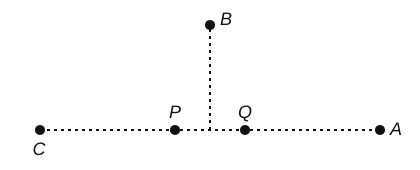
In the figure below, $P$ and $Q$ are two equally intense coherent sources emitting radiation of wavelength $20$ m. The separation between $P$ and $Q$ is $5$ m and the phase of $P$ is ahead of that of $Q$ by $90^\circ$. A, B and C are three distinct points of observation, each equidistant from the midpoint of PQ. The intensities of radiation at A, B, C will be in the ratio:
Concept. Total phase difference $=$ (P's lead) $\pm$ (phase from the path difference). Here $PQ=5$ m $=\dfrac\lambda4$, a phase of $\dfrac\pi2$.
Step 1. At A (beyond Q). P's wave travels $\dfrac\lambda4$ farther, losing $\dfrac\pi2$, which cancels its lead: $\phi=0$, $I=4I_0$.
Step 2. At C (beyond P). Q's wave travels farther: $\phi=\dfrac\pi2+\dfrac\pi2=\pi$, $I=0$.
Step 3. At B (broadside). Equal paths: $\phi=\dfrac\pi2$, $I=2I_0$.
Step 4. Ratio. $4:2:0=2:1:0$.
Answer. Option B.
Solution by Sreeraj P, M.Sc Physics
Q 12-10-123JEE MainJEE Main 2020 (6 Sep, Shift 2)Easy
A Young's double-slit experiment is performed using monochromatic light of wavelength $\lambda$. The intensity of light at a point on the screen, where the path difference is $\lambda$, is $K$ units. The intensity of light at a point where the path difference is $\dfrac\lambda6$ is given by $\dfrac{nK}{12}$, where $n$ is an integer. The value of $n$ is ______.
Q 12-10-124JEE MainJEE Main 2020 (7 Jan, Shift 1)Medium
A polarizer-analyser set is adjusted such that the intensity of light coming out of the analyser is just $36\%$ of the original intensity. Assuming that the polarizer-analyser set does not absorb any light, the angle by which the analyser needs to be rotated further, to reduce the output intensity to zero, is: $\left(\sin^{-1}\left(\tfrac35\right) = 37^\circ\right)$
Step 2. Further rotation. $90^\circ-53^\circ=37^\circ$.
Answer. Option B.
Solution by Sreeraj P, M.Sc Physics
Q 12-10-125JEE MainJEE Main 2020 (7 Jan, Shift 1)Easy
Visible light of wavelength $6000\times10^{-8}$ cm falls normally on a single slit and produces a diffraction pattern. It is found that the second diffraction minimum is at $60^\circ$ from the central maximum. If the first minimum is produced at $\theta_1$, then $\theta_1$ is close to:
Concept. Minima at $a\sin\theta=n\lambda$, so $\sin\theta_1=\dfrac{\sin\theta_2}{2}$.
Step 1. First minimum. $\sin\theta_1=\dfrac{\sin60^\circ}{2}=0.433$, $\theta_1\approx25.7^\circ$.
Answer. About $25^\circ$ (Option C).
Solution by Sreeraj P, M.Sc Physics
Q 12-10-126JEE MainJEE Main 2020 (7 Jan, Shift 2)Easy
In a Young's double slit experiment, the separation between the slits is $0.15$ mm. In the experiment, a source of light of wavelength $589$ nm is used and the interference pattern is observed on a screen kept $1.5$ m away. The separation between the successive bright fringes on the screen is:
Q 12-10-127JEE MainJEE Main 2020 (2 Sep, Shift 1)Easy
Interference fringes are observed on a screen by illuminating two thin slits $1\ \text{mm}$ apart with a light source $(\lambda = 632.8\ \text{nm})$. The distance between the screen and the slits is $100\ \text{cm}$. If a bright fringe is observed on a screen at distance of $1.27\ \text{mm}$ from the central bright fringe, then the path difference between the waves, which are reaching this point from the slits is close to:
Concept. At height $y$ on the screen the path difference is $\Delta=\dfrac{yd}{D}$.
Step 1. Path difference. $\Delta=\dfrac{1.27\times10^{-3}\times10^{-3}}{1}=1.27\times10^{-6}$ m.
Step 2. Check. $\beta=0.633$ mm, so $1.27$ mm is the second bright fringe and $\Delta\approx2\lambda=1.27\ \mu$m.
Answer. $1.27\ \mu$m (Option A).
Solution by Sreeraj P, M.Sc Physics
Q 12-10-128JEE MainJEE Main 2020 (2 Sep, Shift 2)Easy
In a Young's double slit experiment, $16$ fringes are observed in a certain segment of the screen when light of wavelength $700\ \text{nm}$ is used. If the wavelength of light is changed to $400\ \text{nm}$, the number of fringes observed in the same segment of the screen would be:
Concept. The number of fringes in a fixed length is $\dfrac{\text{length}}{\beta}\propto\dfrac1\lambda$.
Step 1. New count. $16\times\dfrac{700}{400}=28$.
Answer. Option D.
Solution by Sreeraj P, M.Sc Physics
Q 12-10-129JEE MainJEE Main 2020 (3 Sep, Shift 1)Easy
In a Young's double slit experiment, light of $500\ \text{nm}$ is used to produce an interference pattern. When the distance between the slits is $0.05\ \text{mm}$, the angular width (in degree) of the fringes formed on the distant screen is close to:
Q 12-10-130JEE MainJEE Main 2020 (3 Sep, Shift 2)Easy
Two light waves having the same wavelength $\lambda$ in vacuum are in phase initially. Then the first wave travels a path $L_1$ through a medium of refractive index $n_1$ while the second wave travels a path of length $L_2$ through a medium of refractive index $n_2$. After this the phase difference between the two waves is:
Q 12-10-131JEE MainJEE Main 2020 (4 Sep, Shift 1)Medium
A beam of plane polarized light of large cross-sectional area and uniform intensity of $3.3\ \text{W m}^{-2}$ falls normally on a polarizer (cross-sectional area $3\times10^{-4}\ \text{m}^{2}$), which rotates about its axis with an angular speed of $31.4\ \text{rad s}^{-1}$. The energy of light passing through the polarizer per revolution, is close to:
Concept. As the polariser turns, the transmitted intensity is $I\cos^2\theta$, whose average over a turn is $\dfrac I2$.
Step 1. Period. $T=\dfrac{2\pi}{\omega}=\dfrac{6.28}{31.4}=0.2$ s.
Step 2. Energy. $E=\dfrac I2AT=1.65\times3\times10^{-4}\times0.2=9.9\times10^{-5}\approx1.0\times10^{-4}$ J.
Answer. Option B.
Solution by Sreeraj P, M.Sc Physics
Q 12-10-133JEE MainJEE Main 2019 (9 Jan, Shift 2)Medium
In a Young's double slit experiment, the slits are placed $0.320\ \text{mm}$ apart. Light of wavelength $\lambda = 500\ \text{nm}$ is incident on the slits. The total number of bright fringes that are observed in the angular range $-30^\circ \le \theta \le 30^\circ$ is:
Concept. Bright fringes occur at $d\sin\theta=n\lambda$. Count the integers $n$ allowed in the range.
Step 1. Largest order. $n_{max}=\dfrac{d\sin30^\circ}{\lambda}=\dfrac{0.32\times10^{-3}\times0.5}{5\times10^{-7}}=320$.
Step 2. Count. $n=-320$ to $+320$, including the central one: $2\times320+1=641$.
Answer. $641$ (Option B).
Solution by Sreeraj P, M.Sc Physics
Q 12-10-134JEE MainJEE Main 2019 (10 Jan, Shift 1)Medium
In a Young's double slit experiment with slit separation $0.1\ \text{mm}$, one observes a bright fringe at angle $\dfrac1{40}\ \text{rad}$ by using light of wavelength $\lambda_1$. When the light of wavelength $\lambda_2$ is used a bright fringe is seen at the same angle in the same set up. Given that $\lambda_1$ and $\lambda_2$ are in visible range ($380\ \text{nm}$ to $740\ \text{nm}$), their values are:
Concept. A bright fringe at angle $\theta$ needs $d\sin\theta=n\lambda$. Find $d\theta$, then the visible wavelengths that divide it a whole number of times.
Step 1. Path difference. $d\theta=\dfrac{10^{-4}}{40}=2.5\times10^{-6}$ m $=2500$ nm.
Q 12-10-136JEE MainJEE Main 2019 (10 Apr, Shift 2)Easy
In a Young's double-slit experiment, the ratio of the slits' widths is $4:1$. The ratio of the intensity of maxima to minima, close to the central fringe on the screen, will be
Q 12-10-137JEE MainJEE Main 2019 (9 Jan, Shift 1)Easy
Two coherent sources produce waves of different intensities which interfere. After interference, the ratio of the maximum intensity to the minimum intensity is $16$. The intensity of the waves are in the ratio
Q 12-10-138JEE MainJEE Main 2019 (9 Jan, Shift 1)Hard
Consider a tank made of glass (refractive index $1.5$) with a thick bottom. It is filled with a liquid of refractive index $\mu$. A student finds that, irrespective of what the incident angle $i$ (see figure) is for a beam of light entering the liquid, the light reflected from the liquid glass interface is never completely polarized. For this to happen, the minimum value of $\mu$ is
Concept. Reflection at the liquid–glass face is completely polarised at Brewster's angle, $\tan\theta_B=\dfrac{1.5}{\mu}$. Light entering the liquid from air can reach that face at most at the angle $r_{max}$ with $\sin r_{max}=\dfrac1\mu$ (grazing entry). If $\theta_B\ge r_{max}$, polarisation can never happen.
Step 2. Solve. $2.25\mu^2\ge\mu^2+2.25$, so $\mu^2\ge1.8$, $\mu\ge\dfrac{3}{\sqrt5}$.
Answer. Option A.
Solution by Sreeraj P, M.Sc Physics
Q 12-10-139JEE MainJEE Main 2019 (8 Apr, Shift 1)Easy
In an interference experiment the ratio of amplitudes of coherent waves is $\dfrac{a_1}{a_2} = \dfrac13$. The ratio of maximum and minimum intensities of fringes will be
Q 12-10-140JEE MainJEE Main 2019 (8 Apr, Shift 2)Easy
Calculate the limit of resolution of a telescope objective having a diameter of $200\ \text{cm}$, if it has to detect light of wavelength $500\ \text{nm}$ coming from a star.
Q 12-10-141JEE MainJEE Main 2019 (9 Apr, Shift 1)Easy
In a Young's double slit experimental setup (slit separation $a$, screen at distance $D$), when a thin transparent sheet of thickness $t$ and refractive index $\mu$ is put in front of one of the slits, the central maximum gets shifted by a distance equal to $n$ fringe width. If the wavelength of light used is $\lambda$ then $t$ will be
Q 12-10-142JEE MainJEE Main 2019 (9 Apr, Shift 2)Easy
Diameter of the objective lens of a telescope is $250\ \text{cm}$. For light of wavelength $600\ \text{nm}$ coming from a distant object, the limit of resolution of the telescope is close to
Q 12-10-143JEE MainJEE Main 2019 (11 Jan, Shift 1)Easy
In a Young's double slit experiment, the path difference, at a certain point on the screen, between two interfering waves is $\dfrac18$th of wavelength. The ratio of the intensity at this point to that at the centre of a bright fringe is close to:
Q 12-10-144JEE MainJEE Main 2019 (11 Jan, Shift 2)Medium
In a double-slit experiment, green light ($5303$ Å) falls on a double slit having a separation of $19.44\ \mu$m and a width of $4.05\ \mu$m. The number of bright fringes between the first and the second diffraction minima is
Concept. Bright fringes at $\sin\theta=\dfrac{m\lambda}{d}$; diffraction minima at $\dfrac{\lambda}{a}$ and $\dfrac{2\lambda}{a}$. Count orders $m$ with $\dfrac da<m<\dfrac{2d}{a}$.
Q 12-10-145JEE MainJEE Main 2019 (12 Apr, Shift 1)Easy
In a double slit experiment, when a thin film of thickness $t$ having refractive index $\mu$ is introduced in front of one of the slits, the maximum at the centre of the fringe pattern shifts by one fringe width. The value of $t$ is ($\lambda$ is the wavelength of the light used):
Q 12-10-146JEE MainJEE Main 2019 (12 Apr, Shift 2)Easy
A system of three polarizers $P_1$, $P_2$, $P_3$ is set up such that the pass axis of $P_3$ is crossed with respect to that of $P_1$. The pass axis of $P_2$ is inclined at $60^\circ$ to the pass axis of $P_3$. When a beam of unpolarized light of intensity $I_0$ is incident on $P_1$, the intensity of light transmitted by the three polarizers is $I$. The ratio $(I_0/I)$ equals (nearly):
Q 12-10-147JEE MainJEE Main 2018 (15 Apr, Shift 1)Easy
Light of wavelength $550\ \text{nm}$ falls normally on a slit of width $22.0 \times 10^{-5}\ \text{cm}$. The angular position of the second minima from the central maximum will be (in radians):
Step 1. Second minimum. $\sin\theta=\dfrac{2\times550\times10^{-9}}{22\times10^{-7}}=\dfrac12$.
Step 2. Angle. $\theta=\dfrac\pi6$.
Answer. Option D.
Solution by Sreeraj P, M.Sc Physics
Q 12-10-148JEE MainJEE Main 2018 (15 Apr, Shift 2)Medium
A plane polarized light is incident on a polariser with its pass axis making angle $\theta$ with $x$-axis. At four different values of $\theta$, $\theta = 8^\circ, 38^\circ, 188^\circ$ and $218^\circ$, the observed intensities are same. What is the angle between the direction of polarization and $x$-axis?
Concept. $I=I_0\cos^2(\theta-\alpha)$ repeats every $180^\circ$ and is symmetric about the polarisation direction $\alpha$. Two angles with equal intensity lie symmetrically about $\alpha$ (or about $\alpha+90^\circ$).
Step 1. Midpoint. $8^\circ$ and $38^\circ$ give $\alpha=23^\circ$ (also $188^\circ$ and $218^\circ$ give $203^\circ$, the same line).
Step 2. Choose. $23^\circ+180^\circ=203^\circ$ is the option offered.
Answer. $203^\circ$ (Option A).
Solution by Sreeraj P, M.Sc Physics
Q 12-10-149JEE MainJEE Main 2018 (16 Apr, Shift 1)Medium
Unpolarized light of intensity $I$ is incident on a system of two polarizers, $A$ followed by $B$. The intensity of emergent light is $\dfrac I2$. If a third polarizer $C$ is placed between $A$ and $B$ the intensity of emergent light is reduced to $\dfrac I3$. The angle between the polarizers $A$ and $C$ is $\theta$, then
In a Young's double slit experiment, slits are separated by $0.5$ mm, and the screen is placed $150$ cm away. A beam of light consisting of two wavelengths, $650$ nm and $520$ nm, is used to obtain interference fringes on the screen. The least distance from the common central maximum to the point where the bright fringes due to both the wavelengths coincide is:
A single slit of width $b$ is illuminated by a coherent monochromatic light of wavelength $\lambda$. If the second and fourth minima in the diffraction pattern at a distance $1$ m from the slit are at $3$ cm and $6$ cm respectively from the central maximum, what is the width of the central maximum? (i.e. distance between first minimum on either side of the central maximum)
Concept. Minima are equally spaced, $\dfrac{\lambda D}{b}$ apart; the central maximum is twice that.
Step 1. Spacing. 2nd to 4th: $6-3=3$ cm $=\dfrac{2\lambda D}{b}$, so $\dfrac{\lambda D}{b}=1.5$ cm.
Step 2. Central width. $3.0$ cm.
Answer. Option D.
Solution by Sreeraj P, M.Sc Physics
Q 12-10-152JEE MainJEE Main 2017 (9 Apr)Easy
A single slit of width $0.1$ mm is illuminated by a parallel beam of light of wavelength $6000$ Å and diffraction bands are observed on a screen $0.5$ m from the slit. The distance of the third dark band from the central bright band is:
Unpolarized light of intensity $I$ passes through an ideal polariser $A$. Another identical polariser $B$ is placed behind $A$. The intensity of light beyond $B$ is found to be $\dfrac I2$. Now another identical polariser $C$ is placed between $A$ and $B$. The intensity beyond $B$ is now found to be $\dfrac I8$. The angle between polariser $A$ and $C$ is:
Concept. $B$ passes all of $\dfrac I2$, so $A$ and $B$ are parallel. With $C$ at $\theta$ between them: $I'=\dfrac I2\cos^2\theta\cos^2\theta$.
Step 1. Condition. $\dfrac I2\cos^4\theta=\dfrac I8$, so $\cos^4\theta=\dfrac14$, $\cos^2\theta=\dfrac12$.
Step 2. Angle. $\theta=45^\circ$.
Answer. Option D.
Solution by Sreeraj P, M.Sc Physics
Q 12-10-154JEE MainJEE Main 2018 (8 Apr)Medium
The angular width of the central maximum in a single slit diffraction pattern is $60^\circ$. The width of the slit is $1\ \mu$m. The slit is illuminated by monochromatic plane waves. If another slit of the same width is made near it, Young's fringes can be observed on a screen placed at a distance $50$ cm from the slits. If the observed fringe width is $1$ cm, what is slit separation distance? (i.e., the distance between the centres of each slit.)
In a Young's double slit experiment, a student observes $8$ fringes in a certain segment of screen when a monochromatic light of $600$ nm wavelength is used. If the wavelength of light is changed to $400$ nm, then the number of fringes he would observe in the same region of the screen is
Q 12-10-157JEE MainJEE Main 2025 (2 Apr, Shift 1)Easy
A light wave is propagating with plane wavefronts of the type $x + y + z = \text{constant}$. The angle made by the direction of wave propagation with the $x$-axis is:
Concept. The wave travels along the normal to its wavefronts. For the plane $x+y+z=$ const the normal is $\hat i+\hat j+\hat k$.
Step 1. Unit vector. $\dfrac{\hat i+\hat j+\hat k}{\sqrt3}$.
Step 2. Angle with $x$. $\cos\theta=\dfrac{1}{\sqrt3}$.
Answer. Option A.
Solution by Sreeraj P, M.Sc Physics
Q 12-10-158JEE MainJEE Main 2025 (2 Apr, Shift 1)Medium
If the measured angular separation between the second minimum to the left of the central maximum and the third minimum to the right of the central maximum is $30^\circ$ in a single slit diffraction pattern recorded using $628\ \text{nm}$ light, then the width of the slit is ______ $\mu\text{m}$.
Concept. For small angles the $n$th minimum is at $\dfrac{n\lambda}{a}$ on either side. From the 2nd on the left to the 3rd on the right spans $\dfrac{5\lambda}{a}$.
Step 2. Width. $a=\dfrac{30\times628\times10^{-9}}{3.14}=6\times10^{-6}$ m.
Answer. $6\ \mu$m.
Solution by Sreeraj P, M.Sc Physics
Q 12-10-159JEE MainJEE Main 2025 (3 Apr, Shift 1)Easy
Two coherent monochromatic light beams of intensities $4I$ and $9I$ are superimposed. The difference between the maximum and minimum intensities in the resulting interference pattern is $xI$. The value of $x$ is ______.
Q 12-10-160JEE MainJEE Main 2025 (3 Apr, Shift 2)Medium
The width of one of the two slits in a Young's double slit interference experiment is half of the other slit. The ratio of the maximum to the minimum intensity in the interference pattern is:
Q 12-10-161JEE MainJEE Main 2025 (3 Apr, Shift 2)Easy
Two monochromatic light beams have intensities in the ratio $1 : 9$. An interference pattern is obtained by these beams. The ratio of the intensities of maximum to minimum is:
Q 12-10-162JEE MainJEE Main 2025 (4 Apr, Shift 1)Easy
In a Young's double slit experiment, the slits are separated by $0.2\ \text{mm}$. If the slit separation is increased to $0.4\ \text{mm}$, the percentage change of the fringe width is:
Step 1. Double $d$. $\beta$ halves: a $50\%$ change (decrease).
Answer. $50\%$ (Option C).
Solution by Sreeraj P, M.Sc Physics
Q 12-10-163JEE MainJEE Main 2025 (4 Apr, Shift 2)Easy
Two polarisers $P_1$ and $P_2$ are placed in such a way that the intensity of the transmitted light will be zero. A third polariser $P_3$ is inserted in between $P_1$ and $P_2$, at a particular angle between $P_2$ and $P_3$. The transmitted intensity of the light passing through all three polarisers is maximum. The angle between the polarisers $P_2$ and $P_3$ is:
Concept. With $P_1$ and $P_2$ crossed and $P_3$ at $\theta$ to $P_1$: $I = \dfrac{I_1}{4}\sin^22\theta$.
Step 1. Maximise. $2\theta = 90° \Rightarrow \theta = 45°$, so $P_3$ is also at $45°$ to $P_2$.
Answer. $\dfrac{\pi}{4}$ (Option A).
Solution by Sreeraj P, M.Sc Physics
Q 12-10-164JEE MainJEE Main 2025 (4 Apr, Shift 2)Medium
In a Young's double slit experiment, two slits are located $1.5\ \text{mm}$ apart. The distance of the screen from the slits is $2\ \text{m}$ and the wavelength of the source is $400\ \text{nm}$. If the 20 maxima of the double slit pattern are contained within the central maximum of the single slit diffraction pattern, then the width of each slit is $x\times10^{-3}\ \text{cm}$, where the value of $x$ is ______.
Q 12-10-165JEE MainJEE Main 2025 (7 Apr, Shift 1)Easy
Two plane polarized light waves (with the same plane of polarization) combine at a certain point, and their electric field components are $E_1 = E_0\sin\omega t$ and $E_2 = E_0\sin\left(\omega t + \dfrac\pi3\right)$. Find the amplitude of the resultant wave.
Q 12-10-166JEE MainJEE Main 2025 (8 Apr, Shift 2)Easy
In a Young's double slit experiment, the source is white light. One of the slits is covered by a red filter and the other by a green filter. In this case:
Answer: (B) There shall be no interference fringes.
Concept. Interference needs coherent sources of the same frequency. Red and green filters send different frequencies, so their phase difference changes too fast to form a steady pattern.


 Solution by Sreeraj P, M.Sc Physics