

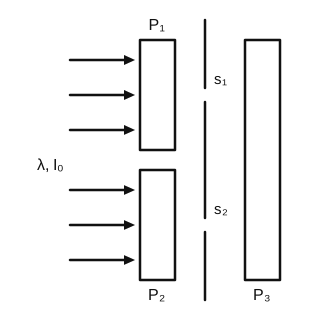
In a Young's double slit experiment, three polarizers are kept as shown in the figure. The transmission axes of $P_1$ and $P_2$ are orthogonal to each other. The polarizer $P_3$ covers both the slits with its transmission axis at $45^\circ$ to those of $P_1$ and $P_2$. An unpolarized light of wavelength $\lambda$ and intensity $I_0$ is incident on $P_1$ and $P_2$. The intensity at a point after $P_3$ where the path difference between the light waves from $s_1$ and $s_2$ is $\dfrac{\lambda}{3}$, is
Answer: (B) $\dfrac{I_0}{4}$
Each of $P_1$ and $P_2$ passes half of the unpolarized light: $I_0/2$, polarized along perpendicular directions.
$P_3$ is at $45^\circ$ to both, so by Malus's law each beam becomes $\dfrac{I_0}{2}\cos^2 45^\circ = \dfrac{I_0}{4}$, and both are now polarized along the same direction, so they interfere.
Path difference $\lambda/3$ gives phase difference $\phi = \dfrac{2\pi}{3}$:
$$I = I_1 + I_2 + 2\sqrt{I_1I_2}\cos\phi = \frac{I_0}{4} + \frac{I_0}{4} + 2\cdot\frac{I_0}{4}\left(-\frac{1}{2}\right) = \frac{I_0}{4}$$
 Solution by Sreeraj P, M.Sc Physics