An electromagnetic wave travelling in a lossless dielectric medium having a dielectric constant, $\epsilon_r = 9$, has the electric field, $E_x = E_0\sin(kz - 2\pi \times 10^6 t)\ \text{V m}^{-1}$ where $E_0$ is the amplitude and $k$ is the wave vector. Among the following options, the incorrect choice is :
Frequency: $2\pi f = 2\pi \times 10^6$, so $f = 10^6$ Hz. $$\lambda = \frac{v}{f} = \frac{10^8}{10^6} = 100\ \text{m}$$ So statement (2), which says $300$ m, is incorrect. ($300$ m is the wavelength in vacuum.)
The phase $(kz - \omega t)$ shows that the wave travels along $+z$, so statement (4) is correct. With $\vec{E}$ along $x$ and propagation along $z$, $\vec{B}$ is along $y$ and in phase with $\vec{E}$, with amplitude $E_0/v$. Statement (3) describes this; the printed $B_0$ stands for this amplitude.
The incorrect choice is (2).
Solution by Sreeraj P, M.Sc Physics
Q 12-08-002NEETNEET 2026Top questionEasy
The following table presents the part of the electromagnetic spectrum and their corresponding major applications.
Part of the electromagnetic spectrum: P. Microwave Q. UV rays R. Gamma rays S. Radio wave
Applications: I. For purifying the water II. For warming the food III. For AM and FM communication systems IV. For treating the Cancer cells
The phase $(5x + \omega t)$ means the wave travels along $-x$. $\vec{B}$ must be perpendicular to both $\vec{E}$ (along $z$) and the direction of travel (along $x$), so $\vec{B}$ is along $y$.
Check the direction: $\vec{E} \times \vec{B}$ must point along $-x$, and $\hat{z} \times \hat{y} = -\hat{x}$. So $B_y$ is in phase with $E_z$ (same sign): $$B_y = 2 \times 10^{-7}\cos(5x + 1.5 \times 10^9 t)\ \text{T}$$
A parallel plate capacitor made of circular plates is being charged such that the surface charge density on its plates is increasing at a constant rate with time. The magnetic field arising due to displacement current is :
Answer: (C) non-zero everywhere with maximum at the imaginary cylindrical surface connecting peripheries of the plates
The displacement current $I_d = \epsilon_0\dfrac{d\phi_E}{dt}$ is constant and spread uniformly over the plate area (radius $R$).
Ampère–Maxwell law at distance $r$ from the axis:
Inside ($r < R$): $B \cdot 2\pi r = \mu_0 I_d\dfrac{r^2}{R^2}$, so $B = \dfrac{\mu_0 I_d r}{2\pi R^2}$, which increases with $r$.
Outside ($r > R$): $B = \dfrac{\mu_0 I_d}{2\pi r}$, which decreases with $r$.
So $B$ is non-zero everywhere (except on the axis) and is maximum at $r = R$, the cylindrical surface joining the edges of the plates.
Solution by Sreeraj P, M.Sc Physics
Q 12-08-005NEETNEET 2024Top questionEasy
A parallel plate capacitor is charged by connecting it to a battery through a resistor. If I is the current in the circuit, then in the gap between the plates :
Answer: (D) displacement current of magnitude equal to I flows in the same direction as I.
The conduction current $I$ in the wires continues across the gap as displacement current $I_d = \epsilon_0\dfrac{d\phi_E}{dt}$.
The total current (conduction + displacement) is continuous, so $I_d = I$. It flows in the same direction as $I$: the field between the plates grows in the direction of the current.
Solution by Sreeraj P, M.Sc Physics
Q 12-08-006NEETNEET 2024Top questionEasy
The property which is not of an electromagnetic wave travelling in free space is that :
Answer: (B) they originate from charges moving with uniform speed.
Electromagnetic waves are produced by accelerated charges. A charge moving with uniform velocity produces steady electric and magnetic fields but does not radiate.
The other statements are true: EM waves travel at $c = \dfrac{1}{\sqrt{\mu_0\epsilon_0}}$ in free space, they are transverse, and the average energy densities in the electric and magnetic fields are equal.
Solution by Sreeraj P, M.Sc Physics
Q 12-08-007NEETNEET 2023Top questionEasy
In a plane electromagnetic wave travelling in free space, the electric field component oscillates sinusoidally at a frequency of $2.0 \times 10^{10}$ Hz and amplitude $48\ \text{V m}^{-1}$. Then the amplitude of oscillating magnetic field is : (Speed of light in free space $= 3 \times 10^8\ \text{m s}^{-1}$)
The displacement current equals the conduction current that charges the plates: $$I_d = \frac{dq}{dt} = C\frac{dV}{dt} = CV_0\omega\cos\omega t$$
Solution by Sreeraj P, M.Sc Physics
Q 12-08-009NEETNEET 2021Top questionMedium
For a plane electromagnetic wave propagating in $x$-direction, which one of the following combination gives the correct possible directions for electric field (E) and magnetic field (B) respectively ?
$\vec{E}$ and $\vec{B}$ must be perpendicular to each other, and $\vec{E} \times \vec{B}$ must point along $+\hat{i}$.
Options (1), (2) and (4) have $\vec{E}$ parallel or antiparallel to $\vec{B}$, so they are ruled out.
Option (3): $(-\hat{j} + \hat{k})\cdot(-\hat{j} - \hat{k}) = 1 - 1 = 0$, so they are perpendicular. And $$(-\hat{j} + \hat{k}) \times (-\hat{j} - \hat{k}) = \hat{j}\times\hat{k} - \hat{k}\times\hat{j} = \hat{i} + \hat{i} = 2\hat{i}$$ which is along $+x$.
Solution by Sreeraj P, M.Sc Physics
Q 12-08-010NEETNEET 2020Top questionEasy
The ratio of contributions made by the electric field and magnetic field components to the intensity of an electromagnetic wave is : (c = speed of electromagnetic waves)
Average energy densities: $$u_E = \frac{1}{4}\epsilon_0E_0^2, \qquad u_B = \frac{B_0^2}{4\mu_0}$$
With $B_0 = \dfrac{E_0}{c}$ and $c^2 = \dfrac{1}{\mu_0\epsilon_0}$: $$u_B = \frac{E_0^2}{4\mu_0c^2} = \frac{1}{4}\epsilon_0E_0^2 = u_E$$
The electric and magnetic fields contribute equally: $1 : 1$.
Solution by Sreeraj P, M.Sc Physics
Q 12-08-011NEETNEET 2020Top questionEasy
Light with an average flux of $20\ \text{W/cm}^2$ falls on a non-reflecting surface at normal incidence having surface area $20\ \text{cm}^2$. The energy received by the surface during time span of $1$ minute is :
The displacement current between the plates of a capacitor, of plate area $A$, when the electric field between them changes at the rate $\dfrac{dE}{dt}$, is
A parallel plate capacitor with plates of area $0.01\ \text{m}^2$ has the field between them changing at $10^{12}$ V m$^{-1}$ s$^{-1}$. The displacement current is ($\epsilon_0 = 8.85 \times 10^{-12}$ F/m)
The peak electric field of sunlight at the Earth is about $1000$ V/m. The average intensity of the radiation is about ($c = 3 \times 10^8$ m/s, $\epsilon_0 = 8.85 \times 10^{-12}$ F/m)
Answer: (C) time-varying fields, such as in a charging capacitor
In a charging capacitor, no conduction current crosses the gap, yet a magnetic field exists there. Maxwell added the displacement current $\epsilon_0\dfrac{d\phi_E}{dt}$, which makes the total current continuous.
Solution by Sreeraj P, M.Sc Physics
Q 12-08-027NEETJEE MainEasy
A plane EM wave travels along the $+x$ direction and its electric field at an instant points along $+y$. At that instant, the magnetic field points along
The direction of travel is along $\vec{E} \times \vec{B}$. With $\vec{E}$ along $\hat{j}$, we need $\hat{j} \times \vec{B} = \hat{i}$, which gives $\vec{B}$ along $\hat{k}$ ($\hat{j} \times \hat{k} = \hat{i}$): the $+z$ direction.
Solution by Sreeraj P, M.Sc Physics
Q 12-08-028JEE MainEasy
An FM radio station broadcasts at $100$ MHz. Find the wavelength of the waves, in metres.
$\lambda = \dfrac{c}{f} = \dfrac{3 \times 10^8}{10^8} = 3$ m.
Solution by Sreeraj P, M.Sc Physics
Q 12-08-029JEE MainMedium
A point source emits $100$ W of electromagnetic radiation uniformly in all directions. Find the peak electric field, in V/m, at a distance of $2$ m, to the nearest whole number. ($c = 3 \times 10^8$ m/s, $\epsilon_0 = 8.85 \times 10^{-12}$ F/m)
Q 12-08-030JEE MainJEE Main 2026 (6 Apr, Shift 1)Easy
A point light source emits E.M. waves in free space. A detector, placed at a distance of $L$ m, measures the intensity as $I_0$. The detector is now shifted to another location on the same spherical surface ensuring the angle between original location and new location as $45^\circ$. The measured intensity at new location will be ______.
Concept. A point source radiates equally in all directions, so the intensity $I=\dfrac{P}{4\pi r^2}$ depends only on the distance $r$ from the source.
Step 1. Distance at the new position. The detector stays on the same sphere, so $r=L$ again; the $45^\circ$ angle does not change $r$.
Step 2. Intensity. Same $r$, same intensity: $I_0$.
Answer. $I_0$ (Option B).
Solution by Sreeraj P, M.Sc Physics
Q 12-08-031JEE MainJEE Main 2026 (6 Apr, Shift 2)Easy
For an electromagnetic wave propagating through vacuum, $\vec{k}$, $\vec{E}$ and $\omega$ represent propagation vector, electric field and angular frequency, respectively. The magnetic field associated with this wave is represented by:
Concept. For a plane wave in vacuum, $\vec B=\dfrac1c\,\hat k\times\vec E$: $\vec B$ is perpendicular to both, with magnitude $E/c$.
Step 1. Write with $\vec k$. $\hat k=\dfrac{\vec k}{k}$ and $k=\dfrac\omega c$, so $\dfrac1c\hat k\times\vec E=\dfrac{\vec k\times\vec E}{ck}=\dfrac{\vec k\times\vec E}{\omega}$.
Step 2. Check the order. $\vec E\times\vec B$ must point along $\vec k$; with $\vec B\propto\vec k\times\vec E$ this holds (option A would reverse it).
Q 12-08-032JEE MainJEE Main 2026 (5 Apr, Shift 1)Easy
A displacement current of $4.0$ A can be set up in the space between two parallel plates of $6\,\mu\text{F}$ capacitor. The rate of change of potential difference across the plates of the capacitor is nearly $\alpha \times 10^6$ V/s. The value of $\alpha$ is ______.
Concept. Between the plates no charge flows, but the changing field carries a displacement current equal to the conduction current in the wires: $I_d=\varepsilon_0\dfrac{d\Phi_E}{dt}=C\dfrac{dV}{dt}$.
Step 1. Rate of change of voltage. $\dfrac{dV}{dt}=\dfrac{I_d}{C}=\dfrac{4.0}{6\times10^{-6}}=0.67\times10^6$ V/s.
Answer. $\alpha\approx0.67$ (Option B).
Solution by Sreeraj P, M.Sc Physics
Q 12-08-033JEE MainJEE Main 2026 (5 Apr, Shift 2)Easy
Given below are two statements : one is labelled as Assertion (A) and the other is labelled as Reason (R).
Assertion (A) : The electromagnetic wave exerts pressure on the surface on which they are allowed to fall.
Reason (R) : There is no mass associated with the electromagnetic waves.
In the light of the above statements, choose the correct answer from the options given below :
Answer: (B) Both (A) and (R) are true but (R) is not the correct explanation of (A)
Concept. EM waves carry momentum $p=\dfrac Uc$ (photon momentum $\dfrac h\lambda$) even though the photon has no rest mass. Momentum, not mass, is what produces radiation pressure.
Step 1. Assertion. True: a wave falling on a surface transfers momentum, so it exerts pressure.
Step 2. Reason. True: no mass is associated with EM waves.
Step 3. Explanation? No. Having no mass does not explain the pressure; the momentum carried by the wave does.
Answer. Both true, R not the correct explanation (Option B).
Solution by Sreeraj P, M.Sc Physics
Q 12-08-034JEE MainJEE Main 2026 (4 Apr, Shift 2)Medium
A magnetic field vector in an electromagnetic wave is represented by $\vec{B} = B_0\sin\left(2\pi vt - \dfrac{2\pi x}{\lambda}\right)\hat{j}$. Its associated electric field vector is ______.
The wave travels along $+x$, so $\vec{E} \times \vec{B}$ must point along $+\hat{i}$. With $\vec{B}$ along $\hat{j}$: $(-\hat{k}) \times \hat{j} = \hat{i}$, so $\vec{E}$ is along $-\hat{k}$.
Magnitude: $E_0 = cB_0 = v\lambda B_0$ (here $v$ is the frequency).
Q 12-08-035JEE MainJEE Main 2026 (2 Apr, Shift 1)Easy
An electromagnetic wave travelling in x-direction is described by field equation
$E_y=300\sin\omega\left(t-\dfrac{x}{c}\right)$.
If the electron is restricted to move in y-direction only with speed of $1.5\times10^{6}$ m/s then ratio of maximum electric and magnetic forces acting on the electron is ______.
Concept. Electric force $qE$; magnetic force on a charge moving along $\vec E$ (perpendicular to $\vec B$) is $qvB$. With $B=\dfrac Ec$, the ratio is $\dfrac{c}{v}$.
Q 12-08-036JEE MainJEE Main 2026 (2 Apr, Shift 2)Easy
An electromagnetic wave travels in free space along the $x$-direction. At a particular point in space and time, $\vec B=2\times10^{-7}\hat j$ T is associated with this wave. The value of corresponding electric field $\vec E$ at this point is ______ V/m.
Step 2. Direction. Need $\hat E\times\hat j=\hat i$. Since $\hat k\times\hat j=-\hat i$, take $\hat E=-\hat k$.
Answer. $-60\hat k$ V/m (Option B).
Solution by Sreeraj P, M.Sc Physics
Q 12-08-037JEE MainJEE Main 2026 (28 Jan, Shift 2)Easy
A plane electromagnetic wave is moving in free space with velocity $c = 3\times10^8$ m/s and its electric field is given as $\vec E = 54\sin(kz-\omega t)\,\hat j$ V/m, where $\hat j$ is the unit vector along y-axis. The magnetic field vector $\vec B$ of the wave is :
Answer: (A) $-1.8\times10^{-7}\sin(kz-\omega t)\,\hat i$ T
Concept. $\sin(kz-\omega t)$ travels along $+z$. $B_0=\dfrac{E_0}{c}$ and $\vec E\times\vec B$ along $+\hat k$.
Step 1. Amplitude. $B_0=\dfrac{54}{3\times10^8}=1.8\times10^{-7}$ T.
Step 2. Direction. $\hat j\times(-\hat i)=\hat k$, so $\vec B$ is along $-\hat i$ when $\vec E$ is along $+\hat j$.
Answer. $-1.8\times10^{-7}\sin(kz-\omega t)\,\hat i$ T (Option A).
Solution by Sreeraj P, M.Sc Physics
Q 12-08-038JEE MainJEE Main 2026 (28 Jan, Shift 1)Easy
The electric field of an electromagnetic wave travelling through a medium is given by $\vec E(x,t) = 25\sin\left(2.0\times10^{15}t - 10^7x\right)\hat n$ then the refractive index of the medium is ______ .
Step 1. Match. Radio waves: rapid acceleration of electrons in aerials (IV). Microwaves: magnetron valve (I). Infrared: vibration of atoms and molecules (II). X-rays: inner-shell electron transitions (III).
Answer. A-IV, B-I, C-II, D-III (Option C).
Solution by Sreeraj P, M.Sc Physics
Q 12-08-041JEE MainJEE Main 2025 (22 Jan, Shift 2)Easy
A parallel plate capacitor of area $A = 16\ \text{cm}^2$ and separation between the plates $10\ \text{cm}$ is charged by a DC current. Consider a hypothetical plane surface of area $A_0 = 3.2\ \text{cm}^2$ inside the capacitor and parallel to the plates. At an instant, the current through the circuit is $6\ \text{A}$. At the same instant the displacement current through $A_0$ is ______ mA.
Concept. The field between the plates is uniform, so the displacement current density $J_d=\varepsilon_0\dfrac{dE}{dt}$ is the same everywhere. The whole plate area carries the full $6$ A; a smaller area carries its share.
Step 1. Fraction of the area. $\dfrac{A_0}{A}=\dfrac{3.2}{16}=0.2$.
Step 2. Displacement current through $A_0$. $0.2\times6=1.2$ A $=1200$ mA. The plate separation is not needed.
Answer. $1200$ mA.
Solution by Sreeraj P, M.Sc Physics
Q 12-08-042JEE MainJEE Main 2025 (23 Jan, Shift 1)Medium
The electric field of an electromagnetic wave in free space is $\vec E = 57\cos\left[7.5\times10^6t - 5\times10^{-3}(3x+4y)\right](4\hat i - 3\hat j)\ \text{N/C}$. The associated magnetic field in tesla is
Step 3. Field. $\vec B=-\dfrac{57}{3\times10^8}\cos[\ldots](5\hat k)$; its magnitude is $\dfrac{57\times5}{c}=\dfrac{|\vec E|}{c}$ as required.
Answer. Option C.
Solution by Sreeraj P, M.Sc Physics
Q 12-08-043JEE MainJEE Main 2025 (23 Jan, Shift 2)Easy
A plane electromagnetic wave of frequency $20\ \text{MHz}$ travels in free space along the $+x$ direction. At a particular point in space and time, the electric field vector of the wave is $E_y = 9.3\ \text{V m}^{-1}$. Then, the magnetic field vector of the wave at that point is
In an EM wave $B = \dfrac{E}{c}$: $$B = \frac{9.3}{3\times10^8} = 3.1\times10^{-8}\ \text{T}$$
$\vec E\times\vec B$ must point along $+x$; with $\vec E$ along $\hat j$, $\vec B$ is along $\hat k$ ($\hat j\times\hat k = \hat i$). So $B_z = 3.1\times10^{-8}\ \text{T}$.
Solution by Sreeraj P, M.Sc Physics
Q 12-08-044JEE MainJEE Main 2025 (23 Jan, Shift 2)Easy
A time varying potential difference is applied between the plates of a parallel plate capacitor of capacitance $2.5\ \mu\text{F}$. The dielectric constant of the medium between the capacitor plates is 1. It produces an instantaneous displacement current of $0.25\ \text{mA}$ in the intervening space between the capacitor plates. The magnitude of the rate of change of the potential difference will be ______ $\text{V s}^{-1}$.
Q 12-08-046JEE MainJEE Main 2025 (28 Jan, Shift 1)Medium
Due to the presence of an em-wave whose electric component is given by $E = 100\sin(\omega t - kx)\ \text{N C}^{-1}$, a cylinder of length $200\ \text{cm}$ holds a certain amount of em-energy inside it. If another cylinder of the same length but half the diameter of the previous one holds the same amount of em-energy, the magnitude of the electric field of the corresponding em-wave should be modified as
Answer: (B) $200\sin(\omega t - kx)\ \text{N C}^{-1}$
Concept. Energy $=\tfrac12\varepsilon_0E_0^2\times\text{volume}$. Half the diameter gives a quarter of the volume (same length).
Step 1. Same energy. $E_0^2\times\dfrac V4=100^2\times V\Rightarrow E_0^2=4\times100^2$.
Step 2. Field. $E_0=200$ N/C.
Answer. $200\sin(\omega t-kx)$ (Option B).
Solution by Sreeraj P, M.Sc Physics
Q 12-08-047JEE MainJEE Main 2025 (28 Jan, Shift 2)Medium
The magnetic field of an E.M. wave is given by $\vec B = \left(\dfrac{\sqrt3}{2}\hat i + \dfrac{1}{2}\hat j\right)30\sin\left[\omega\left(t - \dfrac{z}{c}\right)\right]$ (S.I. units). The corresponding electric field in S.I. units is
Step 2. Field. $\vec E=\left(\dfrac12\hat i-\dfrac{\sqrt3}{2}\hat j\right)30c\sin\left[\omega\left(t-\dfrac zc\right)\right]$, perpendicular to $\vec B$ and with the same phase.
Answer. Option A.
Solution by Sreeraj P, M.Sc Physics
Q 12-08-048JEE MainJEE Main 2025 (29 Jan, Shift 1)Easy
Given below are two statements: one is labelled as Assertion (A) and the other is labelled as Reason (R).
Assertion (A): Electromagnetic waves carry energy but not momentum.
Reason (R): Mass of a photon is zero.
In the light of the above statements, choose the most appropriate answer from the options given below:
(A) EM waves carry momentum as well as energy: a wave carrying energy $U$ carries momentum $U/c$, which is why light exerts radiation pressure. False.
(R) A photon has zero rest mass. True. (Its momentum $p = E/c = h/\lambda$ is non-zero despite this.)
Solution by Sreeraj P, M.Sc Physics
Q 12-08-049JEE MainJEE Main 2025 (29 Jan, Shift 2)Easy
A plane electromagnetic wave propagates along the $+x$ direction in free space. The components of the electric field $\vec E$ and magnetic field $\vec B$ vectors associated with the wave in the Cartesian frame are
EM waves are transverse: $\vec E$ and $\vec B$ are both perpendicular to $\hat x$, so neither can have an $x$-component. Also $\vec E\times\vec B$ must point along $+x$: $\hat j\times\hat k = \hat i$, so $E_y$ with $B_z$.
(Option 3, $E_z$ with $B_y$, is transverse too, but $\hat k\times\hat j = -\hat i$ would send the wave along $-x$.)
Solution by Sreeraj P, M.Sc Physics
Q 12-08-050JEE MainJEE Main 2024 (1 Feb, Shift 1)Easy
A parallel plate capacitor has a capacitance $C = 200\ \text{pF}$. It is connected to a $230\ \text{V}$ ac supply with an angular frequency of $300\ \text{rad s}^{-1}$. The rms value of the conduction current in the circuit and the displacement current in the capacitor respectively are
Answer: (D) $13.8\ \mu\text{A}$ and $13.8\ \mu\text{A}$
Concept. The displacement current inside the capacitor always equals the conduction current in the wires (current is continuous round the loop). For a pure capacitor $I=\dfrac{V}{X_C}=V\omega C$.
Step 1. rms current. $I_{\text{rms}}=230\times300\times200\times10^{-12}=1.38\times10^{-5}$ A $=13.8\ \mu$A.
Step 2. Displacement current. The same, $13.8\ \mu$A.
Answer. Option D.
Solution by Sreeraj P, M.Sc Physics
Q 12-08-051JEE MainJEE Main 2024 (1 Feb, Shift 2)Easy
If the frequency of an electromagnetic wave is $60\ \text{MHz}$ and it travels in air along the $z$ direction, then the corresponding electric and magnetic field vectors will be mutually perpendicular to each other and the wavelength of the wave in m is
Concept. In air the wave travels at $c$, so $\lambda=\dfrac cf$. The statement about perpendicular fields is just a property of every EM wave.
Step 1. Wavelength. $\lambda=\dfrac{3\times10^8}{60\times10^6}=5$ m.
Answer. $5$ m (Option C).
Solution by Sreeraj P, M.Sc Physics
Q 12-08-052JEE MainJEE Main 2024 (4 Apr, Shift 1)Easy
The electric field in an electromagnetic wave is given by $\vec E = \hat i\,40\cos\omega(t - z/c)\ \text{N C}^{-1}$. The magnetic field induction of this wave is (in SI units)
Answer: (D) $\vec B = \hat j\dfrac{40}{c}\cos\omega(t - z/c)$
The wave travels along $+z$ and $\vec E$ is along $\hat i$. Since $\vec E\times\vec B$ must point along $+\hat k$ and $\hat i\times\hat j = \hat k$, $\vec B$ is along $\hat j$ with $B_0 = \dfrac{E_0}{c} = \dfrac{40}{c}$: $$\vec B = \hat j\frac{40}{c}\cos\omega(t - z/c)$$
Solution by Sreeraj P, M.Sc Physics
Q 12-08-053JEE MainJEE Main 2024 (4 Apr, Shift 2)Easy
Arrange the following in ascending order of wavelength: A. Gamma rays $(\lambda_1)$ B. X-rays $(\lambda_2)$ C. Infrared waves $(\lambda_3)$ D. Microwaves $(\lambda_4)$. Choose the most appropriate answer from the options given below.
In the electromagnetic spectrum the wavelength increases in the order gamma rays < X-rays < infrared < microwaves. So $\lambda_1 < \lambda_2 < \lambda_3 < \lambda_4$.
Solution by Sreeraj P, M.Sc Physics
Q 12-08-054JEE MainJEE Main 2024 (5 Apr, Shift 1)Easy
An alternating voltage of amplitude $40\ \text{V}$ and frequency $4\ \text{kHz}$ is applied directly across a capacitor of $12\ \mu\text{F}$. The maximum displacement current between the plates of the capacitor is nearly
Concept. Standard ranges: IR $1$ mm to $700$ nm; UV $400$ nm to $1$ nm; X-rays $1$ nm to $10^{-3}$ nm; gamma below $10^{-3}$ nm.
Answer. A-III, B-II, C-IV, D-I (Option A).
Solution by Sreeraj P, M.Sc Physics
Q 12-08-056JEE MainJEE Main 2024 (6 Apr, Shift 1)Easy
Electromagnetic waves travel in a medium with a speed of $1.5\times10^8\ \text{m s}^{-1}$. The relative permeability of the medium is $2.0$. The relative permittivity will be
Q 12-08-057JEE MainJEE Main 2024 (6 Apr, Shift 2)Easy
For the electromagnetic wave $E_y = 600\sin(\omega t - kx)\ \text{V m}^{-1}$, the intensity of the associated light beam is (in $\text{W/m}^2$) (Given $\varepsilon_0 = 9\times10^{-12}\ \text{C}^2\text{N}^{-1}\text{m}^{-2}$)
Q 12-08-058JEE MainJEE Main 2024 (27 Jan, Shift 1)Easy
A plane electromagnetic wave propagating in $x$-direction is described by $$E_y = (200\ \text{V m}^{-1})\sin\left[1.5\times10^7 t - 0.05x\right]$$ The intensity of the wave is: (Use $\epsilon_0 = 8.85\times10^{-12}\ \text{C}^2\,\text{N}^{-1}\,\text{m}^{-2}$)
Q 12-08-059JEE MainJEE Main 2024 (27 Jan, Shift 2)Medium
An object is placed in a medium of refractive index 3. An electromagnetic wave of intensity $6\times10^8\ \text{W m}^{-2}$ falls normally on the object and it is absorbed completely. The radiation pressure on the object would be (speed of light in free space $= 3\times10^8\ \text{m s}^{-1}$):
Concept. Recognise the four Maxwell equations by what they contain.
Step 1. Match. A: line integral of $\vec B$ with conduction plus displacement current is the Ampere–Maxwell law (IV). B: line integral of $\vec E$ equal to $-d\phi_B/dt$ is Faraday's law (III). C: flux of $\vec E$ through a closed surface is Gauss's law for electricity (I). D: flux of $\vec B$ through a closed surface is zero, Gauss's law for magnetism (II).
Answer. A-IV, B-III, C-I, D-II (Option C).
Solution by Sreeraj P, M.Sc Physics
Q 12-08-061JEE MainJEE Main 2024 (29 Jan, Shift 2)Easy
A plane electromagnetic wave of frequency $35\ \text{MHz}$ travels in free space along the $X$-direction. At a particular point (in space and time) $\vec E = 9.6\,\hat j\ \text{V m}^{-1}$. The value of magnetic field at this point is:
Concept. At every point $B=\dfrac Ec$, and $\vec B$ is perpendicular to $\vec E$ with $\vec E\times\vec B$ along the direction of travel. The frequency does not enter.
Step 1. Magnitude. $B=\dfrac{9.6}{3\times10^8}=3.2\times10^{-8}$ T.
Q 12-08-062JEE MainJEE Main 2024 (8 Apr, Shift 1)Medium
Average force exerted on a non-reflecting surface at normal incidence is $2.4\times10^{-4}\ \text{N}$. If $360\ \text{W/cm}^2$ is the light energy flux during a span of 1 hour 30 minutes, then the area of the surface is:
Q 12-08-063JEE MainJEE Main 2024 (9 Apr, Shift 1)Easy
A plane EM wave is propagating along the $x$ direction. It has a wavelength of $4\ \text{mm}$. If the electric field is in the $y$ direction with the maximum magnitude of $60\ \text{V m}^{-1}$, the equation for magnetic field is:
With $\vec E$ along $y$ and propagation along $x$, $\vec B$ is along $z$ ($\hat j\times\hat k = \hat i$): $$B_z = 2\times10^{-7}\sin\left[\frac\pi2\times10^3(x - 3\times10^8t)\right]\hat k\ \text{T}$$
Solution by Sreeraj P, M.Sc Physics
Q 12-08-064JEE MainJEE Main 2024 (9 Apr, Shift 2)Medium
The magnetic field in a plane electromagnetic wave is $B_y = (3.5\times10^{-7})\sin(1.5\times10^3x + 0.5\times10^{11}t)\ \text{T}$. The corresponding electric field will be:
The phase $(kx + \omega t)$ means the wave travels along $-x$. $\vec E$ must be perpendicular to $\vec B$ (along $y$) and to the direction of travel, so it is along $z$ (check: $\hat k\times\hat j = -\hat i$). $$E_z = 105\sin(1.5\times10^3x + 0.5\times10^{11}t)\ \text{V m}^{-1}$$
Solution by Sreeraj P, M.Sc Physics
Q 12-08-065JEE MainJEE Main 2024 (30 Jan, Shift 1)Easy
The electric field of an electromagnetic wave in free space is represented as $\vec E = E_0\cos(\omega t - kz)\,\hat i$. The corresponding magnetic induction vector will be:
Answer: (B) $\vec B = \dfrac{E_0}{C}\cos(\omega t - kz)\,\hat j$
The wave travels along $+z$ (phase $\omega t - kz$), and $B$ is in phase with $E$ with $B_0 = E_0/C$. The direction of propagation is $\hat E\times\hat B$: $\hat i\times\hat j = \hat k$, so $\vec B$ is along $\hat j$: $$\vec B = \frac{E_0}{C}\cos(\omega t - kz)\,\hat j$$
Solution by Sreeraj P, M.Sc Physics
Q 12-08-066JEE MainJEE Main 2024 (30 Jan, Shift 2)Easy
Match List I with List II.
$$\begin{array}{l|l} \textbf{List I} & \textbf{List II} \\ \hline \text{A. Gauss's law of magnetostatics} & \text{i. } \oint\vec E\cdot d\vec a = \dfrac1{\varepsilon_0}\int\rho\,dV \\ \text{B. Faraday's law of electromagnetic induction} & \text{ii. } \oint\vec B\cdot d\vec a = 0 \\ \text{C. Ampere's law} & \text{iii. } \oint\vec E\cdot d\vec l = -\dfrac{d}{dt}\int\vec B\cdot d\vec a \\ \text{D. Gauss's law of electrostatics} & \text{iv. } \oint\vec B\cdot d\vec l = \mu_0 I \end{array}$$
Choose the correct answer from the options given below:
Gauss's law of magnetism: net magnetic flux through a closed surface is zero → ii.
Faraday's law: emf round a loop equals minus the rate of change of flux → iii.
Ampere's law: line integral of $\vec B$ equals $\mu_0 I$ → iv.
Gauss's law of electrostatics: flux of $\vec E$ equals enclosed charge$/\varepsilon_0$ → i.
Solution by Sreeraj P, M.Sc Physics
Q 12-08-067JEE MainJEE Main 2024 (30 Jan, Shift 2)Easy
If the total energy transferred to a surface in time $t$ is $6.48\times10^5\ \text{J}$, then the magnitude of the total momentum delivered to this surface for complete absorption will be:
Answer: (B) $2.16\times10^{-3}\ \text{kg m s}^{-1}$
For complete absorption $$p = \frac Uc = \frac{6.48\times10^5}{3\times10^8} = 2.16\times10^{-3}\ \text{kg m s}^{-1}$$
Solution by Sreeraj P, M.Sc Physics
Q 12-08-068JEE MainJEE Main 2024 (31 Jan, Shift 1)Medium
In a plane EM wave, the electric field oscillates sinusoidally at a frequency of $5\times10^{10}\ \text{Hz}$ and an amplitude of $50\ \text{V m}^{-1}$. The total average energy density of the electromagnetic field of the wave is: [Use $\varepsilon_0 = 8.85\times10^{-12}\ \text{C}^2\text{N}^{-1}\text{m}^{-2}$]
Concept. The average energy density of each field is $\tfrac14\varepsilon_0E_0^2$, and the two are equal, so the total average energy density is $\langle u\rangle=\tfrac12\varepsilon_0E_0^2$. The frequency is not needed.
Answer: (B) Both Statement I and Statement II are correct
Concept. In an EM wave $u_E=\tfrac12\varepsilon_0E^2$ equals $u_B=\dfrac{B^2}{2\mu_0}$ because $B=E/c$ and $c^2=\dfrac1{\mu_0\varepsilon_0}$. The wave also carries momentum $U/c$.
Step 1. Statement I. Correct: the energy is shared equally between the two fields.
Step 2. Statement II. Correct: the momentum carried by the wave is transferred to a surface, which feels a radiation pressure.
Answer. Both statements correct (Option B).
Solution by Sreeraj P, M.Sc Physics
Q 12-08-070JEE MainJEE Main 2023 (29 Jan, Shift 1)Easy
Which of the following are true?
A. Speed of light in vacuum is dependent on the direction of propagation.
B. Speed of light in a medium is independent of the wavelength of light.
C. The speed of light is independent of the motion of the source.
D. The speed of light in a medium is independent of intensity.
Choose the correct answer from the options given below:
Concept. The speed of light in vacuum is a universal constant. In a medium it depends on the refractive index, which varies with wavelength (dispersion), but not on intensity.
Step 1. Check each statement.
A: false. In vacuum light travels at $c$ in every direction.
B: false. In a medium the speed depends on wavelength; that is why white light disperses in a prism.
C: true. The speed of light does not depend on the motion of the source.
D: true. Intensity does not change the speed in ordinary media.
Answer. C and D only (Option D).
Solution by Sreeraj P, M.Sc Physics
Q 12-08-071JEE MainJEE Main 2023 (29 Jan, Shift 1)Easy
If the height of transmitting and receiving antennas are $80\ \text{m}$ each, the maximum line of sight distance will be
Q 12-08-072JEE MainJEE Main 2023 (29 Jan, Shift 2)Easy
Given below are two statements:
Statement I: Electromagnetic waves are not deflected by electric and magnetic field.
Statement II: The amplitude of electric field and the magnetic field in electromagnetic waves are related to each other as $E_0=\sqrt{\dfrac{\mu_0}{\varepsilon_0}}B_0$.
In the light of the above statements, choose the correct answer from the options given below:
Answer: (A) Statement I is true but statement II is false
Concept. EM waves carry no charge, so electric and magnetic fields do not deflect them. The amplitude relation is $E_0=cB_0=\dfrac{B_0}{\sqrt{\mu_0\varepsilon_0}}$.
Step 1. Statement I. True.
Step 2. Statement II. $\sqrt{\dfrac{\mu_0}{\varepsilon_0}}$ (about $377$ Ω) relates $E_0$ to $H_0$, not to $B_0$; false.
Answer. Option A.
Solution by Sreeraj P, M.Sc Physics
Q 12-08-073JEE MainJEE Main 2023 (29 Jan, Shift 2)Easy
The modulation index for an A.M. wave having maximum and minimum peak to peak voltages of $14\ \text{mV}$ and $6\ \text{mV}$ respectively is
Q 12-08-074JEE MainJEE Main 2023 (30 Jan, Shift 1)Easy
A small object at rest absorbs a light pulse of power $20\ \text{mW}$ and duration $300\ \text{ns}$. Assuming speed of light as $3\times10^8\ \text{m s}^{-1}$, the momentum of the object becomes equal to
Concept. Absorbed light energy $U$ brings momentum $\dfrac Uc$.
Step 1. Energy. $20\times10^{-3}\times300\times10^{-9}=6\times10^{-9}$ J.
Step 2. Momentum. $\dfrac{6\times10^{-9}}{3\times10^8}=2\times10^{-17}$ kg m/s.
Answer. Option B.
Solution by Sreeraj P, M.Sc Physics
Q 12-08-075JEE MainJEE Main 2023 (30 Jan, Shift 1)Easy
A sinusoidal carrier voltage is amplitude modulated. The resultant amplitude modulated wave has maximum and minimum amplitude of $120\ \text{V}$ and $80\ \text{V}$ respectively. The amplitude of each side band is
Each side band has amplitude $\dfrac{\mu A_c}{2}=\dfrac{A_m}{2}=10\ \text{V}$.
Solution by Sreeraj P, M.Sc Physics
Q 12-08-076JEE MainJEE Main 2023 (30 Jan, Shift 1)Hard
A point source of light is placed at the centre of curvature of a hemispherical surface. The source emits a power of $24\ \text{W}$. The radius of curvature of hemisphere is $10\ \text{cm}$ and the inner surface is completely reflecting. The force on the hemisphere due to the light falling on it is ______ $\times10^{-8}\ \text{N}$.
Concept. Light from the centre strikes the hemisphere normally everywhere, and reflection doubles the momentum: force on area $dA$ is $\dfrac{2I\,dA}{c}$, radially outward. Sideways parts cancel; the axial parts add, and $\int\cos\theta\,dA$ is the projected flat area $\pi R^2$.
Step 1. Intensity. $I=\dfrac{24}{4\pi R^2}$.
Step 2. Net force. $F=\dfrac{2I}{c}\pi R^2=\dfrac{2\times24}{4c}=\dfrac{12}{3\times10^8}=4\times10^{-8}$ N. The radius cancels.
Answer. $4$.
Solution by Sreeraj P, M.Sc Physics
Q 12-08-077JEE MainJEE Main 2023 (30 Jan, Shift 2)Medium
A point source of $100\ \text{W}$ emits light with $5\%$ efficiency. At a distance of $5\ \text{m}$ from the source, the intensity produced by the electric field component is
Q 12-08-078JEE MainJEE Main 2023 (30 Jan, Shift 2)Easy
Match List I with List II.
$$\begin{array}{|l|l|l|l|}\hline & \text{List I} & & \text{List II} \\ \hline \text{A.} & \text{Attenuation} & \text{I.} & \text{Combination of a receiver and transmitter} \\ \hline \text{B.} & \text{Transducer} & \text{II.} & \text{Process of retrieval of information from the carrier wave at receiver} \\ \hline \text{C.} & \text{Demodulation} & \text{III.} & \text{Converts one form of energy into another} \\ \hline \text{D.} & \text{Repeater} & \text{IV.} & \text{Loss of strength of a signal while propagating through a medium} \\ \hline \end{array}$$
Choose the correct answer from the options given below:
An AM wave contains $f_c$ and the side bands $f_c\pm f_m$: $500$, $498$ and $502\ \text{Hz}$.
Solution by Sreeraj P, M.Sc Physics
Q 12-08-080JEE MainJEE Main 2023 (31 Jan, Shift 1)Easy
In a medium the speed of light wave decreases to $0.2$ times its speed in free space. The ratio of relative permittivity to the refractive index of the medium is $x:1$. The value of $x$ is ______. (Given speed of light in free space $=3\times10^8\ \text{m s}^{-1}$ and for the given medium $\mu_r=1$)
Q 12-08-083JEE MainJEE Main 2023 (24 Jan, Shift 1)Medium
If $\vec E$ and $\vec K$ represent electric field and propagation vectors of the EM waves in vacuum, then magnetic field vector is given by ($\omega$ = angular frequency)
From Faraday's law for a plane wave, $\vec K\times\vec E=\omega\vec B$, so $\vec B=\dfrac1\omega\vec K\times\vec E$. (Check: $|B|=\dfrac{KE}{\omega}=\dfrac Ec$.)
Solution by Sreeraj P, M.Sc Physics
Q 12-08-084JEE MainJEE Main 2023 (24 Jan, Shift 1)Easy
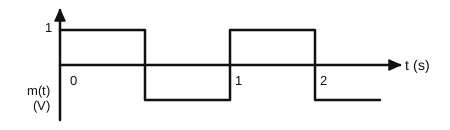
A modulating signal is a square wave, as shown in the figure. If the carrier wave is given as $c(t)=2\sin8\pi t$ volts, the modulation index is
The message amplitude is $A_m=1\ \text{V}$ and the carrier amplitude is $A_c=2\ \text{V}$: $$\mu=\frac{A_m}{A_c}=\frac12$$
Solution by Sreeraj P, M.Sc Physics
Q 12-08-085JEE MainJEE Main 2023 (24 Jan, Shift 2)Easy
The electric field and magnetic field components of an electromagnetic wave going through vacuum are described by $$E_x=E_0\sin(kz-\omega t),\qquad B_y=B_0\sin(kz-\omega t)$$ Then the correct relation between $E_0$ and $B_0$ is given by
AM broadcast $540$–$1600\ \text{kHz}$ (II); FM $88$–$108\ \text{MHz}$ (I); TV $54$–$590\ \text{MHz}$ (IV); satellite $3.7$–$4.2\ \text{GHz}$ (III).
Solution by Sreeraj P, M.Sc Physics
Q 12-08-087JEE MainJEE Main 2023 (25 Jan, Shift 1)Easy
An electromagnetic wave is transporting energy in the negative $z$ direction. At a certain point and certain time the direction of electric field of the wave is along positive $y$ direction. What will be the direction of the magnetic field of the wave at that point and instant?
Concept. The wave travels along $\vec E\times\vec B$.
Step 1. Required. $\hat j\times\hat B=-\hat k$.
Step 2. Try. $\hat j\times\hat i=-\hat k$. So $\vec B$ is along $+x$.
Answer. Option A.
Solution by Sreeraj P, M.Sc Physics
Q 12-08-088JEE MainJEE Main 2023 (25 Jan, Shift 1)Easy
A message signal of frequency $5\ \text{kHz}$ is used to modulate a carrier signal of frequency $2\ \text{MHz}$. The bandwidth for amplitude modulation is
Troposphere extends to about $10\ \text{km}$ (III); the D layer is at about $65$–$75\ \text{km}$ (I); the E layer at about $100\ \text{km}$ (IV); the $F_2$ layer at about $300\ \text{km}$ (II).
Solution by Sreeraj P, M.Sc Physics
Q 12-08-090JEE MainJEE Main 2023 (25 Jan, Shift 2)Easy
Gauss (electric) → flux of $\vec E$ equals $q/\epsilon_0$ (IV); Faraday → circulation of $\vec E$ equals $-d\phi_B/dt$ (I); Gauss (magnetic) → net flux of $\vec B$ is zero (II); Ampere–Maxwell → III.
Solution by Sreeraj P, M.Sc Physics
Q 12-08-091JEE MainJEE Main 2023 (13 Apr, Shift 2)Easy
In an electromagnetic wave, at an instant and at a particular position, the electric field is along the negative $z$-axis and magnetic field is along the positive $x$-axis. Then the direction of propagation of electromagnetic wave is
Q 12-08-094JEE MainJEE Main 2023 (15 Apr, Shift 1)Easy
The height of transmitting antenna is $180\ \text{m}$ and the height of the receiving antenna is $245\ \text{m}$. The maximum distance between them for satisfactory communication in line of sight will be (given $R=6400\ \text{km}$)
Q 12-08-095JEE MainJEE Main 2023 (10 Apr, Shift 2)Easy
The amplitude of magnetic field in an electromagnetic wave propagating along $y$-axis is $6.0\times10^{-7}\ \text{T}$. The maximum value of electric field in the electromagnetic wave is
Q 12-08-096JEE MainJEE Main 2023 (10 Apr, Shift 2)Easy
A message signal of frequency $3\ \text{kHz}$ is used to modulate a carrier signal of frequency $1.5\ \text{MHz}$. The bandwidth of the amplitude modulated wave is
Q 12-08-097JEE MainJEE Main 2023 (11 Apr, Shift 1)Medium
The electric field in an electromagnetic wave is given as $\vec E=20\sin\omega\left(t-\dfrac xc\right)\hat j\ \text{N C}^{-1}$, where $\omega$ and $c$ are angular frequency and velocity of electromagnetic wave respectively. The energy contained in a volume of $5\times10^{-4}\ \text{m}^3$ will be (Given $\varepsilon_0=8.85\times10^{-12}\ \text{C}^2\ \text{N}^{-1}\ \text{m}^{-2}$)
Concept. Average total energy density $u=\tfrac12\varepsilon_0E_0^2$ (electric $\tfrac14\varepsilon_0E_0^2$ plus an equal magnetic part). Energy $=uV$.
Step 1. Energy density. $u=\tfrac12\times8.85\times10^{-12}\times400=1.77\times10^{-9}$ J/m$^3$.
Step 2. Energy. $1.77\times10^{-9}\times5\times10^{-4}=8.85\times10^{-13}$ J.
Answer. Option D.
Solution by Sreeraj P, M.Sc Physics
Q 12-08-098JEE MainJEE Main 2023 (11 Apr, Shift 1)Easy
A transmitting antenna is kept on the surface of the earth. The minimum height of receiving antenna required to receive the signal in line of sight at $4\ \text{km}$ distance from it is $x\times10^{-2}\ \text{m}$. The value of $x$ is ______. (Let radius of earth $R=6400\ \text{km}$)
Q 12-08-099JEE MainJEE Main 2023 (11 Apr, Shift 2)Easy
A plane electromagnetic wave of frequency $20\ \text{MHz}$ propagates in free space along $x$-direction. At a particular space and time $\vec E=6.6\hat j\ \text{V m}^{-1}$. What is $\vec B$ at this point?
$B=\dfrac Ec=\dfrac{6.6}{3\times10^8}=2.2\times10^{-8}\ \text{T}$. Propagation along $\vec E\times\vec B$: $\hat j\times\hat k=\hat i$, so $\vec B$ is along $+\hat k$.
Solution by Sreeraj P, M.Sc Physics
Q 12-08-100JEE MainJEE Main 2023 (11 Apr, Shift 2)Easy
In satellite communication, the uplink frequency band used is
Concept. Optical communication uses infrared or visible light, whose wavelength (about $1\ \mu$m) is much shorter than radar microwaves (cm). Energy per photon $=\dfrac{hc}{\lambda}$.
Step 1. Assertion. Optical waves have shorter wavelength, so A is false.
Step 2. Reason. IR has shorter wavelength than microwaves, so it is more energetic; R is true.
Answer. Option B.
Solution by Sreeraj P, M.Sc Physics
Q 12-08-102JEE MainJEE Main 2023 (12 Apr, Shift 1)Easy
The amplitude of $15\sin(1000\pi t)$ is modulated by $10\sin(4\pi t)$ signal. The amplitude modulated signal contains frequencies of
A. $500\ \text{Hz}$
B. $2\ \text{Hz}$
C. $250\ \text{Hz}$
D. $498\ \text{Hz}$
E. $502\ \text{Hz}$
Choose the correct answer from the options given below:
Concept. For static fields every time derivative is zero. An equation that contains a time derivative as an essential term holds in general, but it reduces to a different (static) form when nothing changes.
Step 1. Check each option.
(A) $\oint\vec B\cdot d\vec l=\mu_0I$ is Ampère's law without the displacement term: true only for steady currents.
(B) $\oint\vec E\cdot d\vec l=0$ is the static form of Faraday's law: wrong when $\vec B$ changes.
(C) Gauss's law holds in both cases.
(D) $\oint\vec E\cdot d\vec l=-\dfrac{\partial\phi_B}{\partial t}$ is Faraday's law: it describes time-varying conditions, and for static fields it becomes (B).
Answer. Option D.
Solution by Sreeraj P, M.Sc Physics
Q 12-08-105JEE MainJEE Main 2023 (13 Apr, Shift 1)Easy
$F_1$ about $170$–$190\ \text{km}$ (II); D layer $65$–$75\ \text{km}$ (IV); troposphere about $10\ \text{km}$ (I); E layer about $100\ \text{km}$ (III).
Solution by Sreeraj P, M.Sc Physics
Q 12-08-106JEE MainJEE Main 2023 (6 Apr, Shift 1)Easy
For the plane electromagnetic wave given by $E=E_0\sin(\omega t-kx)$ and $B=B_0\sin(\omega t-kx)$, the ratio of average electric energy density to average magnetic energy density is
$d=\sqrt{2Rh}\propto\sqrt h$: $\sqrt{1.21}=1.1$, a $10\%$ increase.
Solution by Sreeraj P, M.Sc Physics
Q 12-08-108JEE MainJEE Main 2023 (6 Apr, Shift 2)Easy
The energy density associated with electric field $\vec E$ and magnetic field $\vec B$ of an electromagnetic wave in free space is given by ($\epsilon_0$ – permittivity of free space, $\mu_0$ – permeability of free space)
Concept. Energy stored per unit volume in an electric field is $\tfrac12\epsilon_0E^2$ (as in a capacitor) and in a magnetic field is $\dfrac{B^2}{2\mu_0}$ (as in an inductor).
Step 1. Compare with the options. Only (B) has $U_E=\dfrac{\epsilon_0E^2}{2}$ and $U_B=\dfrac{B^2}{2\mu_0}$. With $B=E/c$ these two are equal, as they must be in a wave.
Answer. Option B.
Solution by Sreeraj P, M.Sc Physics
Q 12-08-109JEE MainJEE Main 2023 (6 Apr, Shift 2)Easy
For an amplitude modulated wave the minimum amplitude is $3\ \text{V}$, while the modulation index is $60\%$. The maximum amplitude of the modulated wave is
Q 12-08-110JEE MainJEE Main 2023 (8 Apr, Shift 1)Easy
A TV transmitting antenna is $98$ m high and the receiving antenna is at the ground level. If the radius of the earth is $6400$ km, the surface area covered by the transmitting antenna is approximately
The power radiated by a linear antenna is proportional to $\left(\dfrac l\lambda\right)^2$, which is why short wavelengths (high frequencies) are used for transmission.
Solution by Sreeraj P, M.Sc Physics
Q 12-08-113JEE MainJEE Main 2023 (10 Apr, Shift 1)Easy
The energy of an electromagnetic wave contained in a small volume oscillates with
Concept. Energy density $\propto E^2\propto\sin^2(\omega t)=\tfrac12(1-\cos2\omega t)$.
Step 1. Frequency. The energy varies as $\cos2\omega t$: twice the wave frequency.
Answer. Option A.
Solution by Sreeraj P, M.Sc Physics
Q 12-08-114JEE MainJEE Main 2023 (10 Apr, Shift 1)Easy
A carrier wave of amplitude $15$ V is modulated by a sinusoidal base band signal of amplitude $3$ V. The ratio of maximum amplitude to minimum amplitude in an amplitude modulated wave is
Concept. In an EM wave the electric and magnetic energy densities are equal: $\tfrac12\varepsilon_0E^2=\dfrac{B^2}{2\mu_0}$ because $B=E/c$ and $c^2=\dfrac1{\mu_0\varepsilon_0}$.
Step 1. Ratio. Electric part is half of the total.
Answer. $\dfrac12$ (Option D).
Solution by Sreeraj P, M.Sc Physics
Q 12-08-118JEE MainJEE Main 2023 (1 Feb, Shift 2)Easy
In an amplitude modulation, a modulating signal having amplitude of $X$ V is superimposed with a carrier signal of amplitude $Y$ V in first case. Then, in second case, the same modulating signal is superimposed with different carrier signal of amplitude $2Y$ V. The ratio of modulation index in the two cases respectively will be
Q 12-08-119JEE MainJEE Main 2022 (24 Jun, Shift 1)Medium
A plane electromagnetic wave travels in a medium of relative permeability $1.61$ and relative permittivity $6.44$. If magnitude of magnetic intensity is $4.5\times10^{-2}\ \text{A m}^{-1}$ at a point, what will be the approximate magnitude of electric field intensity at that point? (Given: permeability of free space $\mu_0 = 4\pi\times10^{-7}\ \text{N A}^{-2}$, speed of light in vacuum $c = 3\times10^8\ \text{m s}^{-1}$)
Concept. $E=vB$ and $B=\mu H$ in the medium, with $v=\dfrac{c}{\sqrt{\mu_r\varepsilon_r}}$ and $\mu=\mu_r\mu_0$.
Step 1. Speed. $\sqrt{1.61\times6.44}=\sqrt{10.37}=3.22$, so $v=\dfrac{c}{3.22}$.
Step 2. Field. $E=v\mu_r\mu_0H=\dfrac{3\times10^8}{3.22}\times1.61\times4\pi\times10^{-7}\times4.5\times10^{-2}$. Since $\dfrac{1.61}{3.22}=0.5$, $E=1.5\times10^8\times1.257\times10^{-6}\times0.045=8.48$ V/m.
Answer. Option C.
Solution by Sreeraj P, M.Sc Physics
Q 12-08-120JEE MainJEE Main 2022 (24 Jun, Shift 1)Easy
A baseband signal of $3.5\ \text{MHz}$ frequency is modulated with a carrier signal of $3.5\ \text{GHz}$ frequency using amplitude modulation method. What should be the minimum size of antenna required to transmit the modulated signal?
Q 12-08-121JEE MainJEE Main 2022 (24 Jun, Shift 2)Medium
An electric bulb is rated as $200\ \text{W}$. What will be the peak magnetic field at $4\ \text{m}$ distance produced by the radiation coming from this bulb? Consider this bulb as a point source with $3.5\%$ efficiency.
Step 3. Peak field. $B_0=\sqrt{\dfrac{2\times4\pi\times10^{-7}\times0.0348}{3\times10^8}}=1.71\times10^{-8}$ T.
Answer. Option B.
Solution by Sreeraj P, M.Sc Physics
Q 12-08-122JEE MainJEE Main 2022 (24 Jun, Shift 2)Medium
An antenna is placed in a dielectric medium of dielectric constant $6.25$. If the maximum size of that antenna is $5.0\ \text{mm}$, it can radiate a signal of minimum frequency of ______ GHz. (Given $\mu_r = 1$ for dielectric medium)
Speed in the medium: $v = \dfrac{c}{\sqrt{6.25}} = 1.2\times10^8\ \text{m s}^{-1}$.
Antenna length $= \dfrac\lambda4$, so the largest wavelength is $\lambda = 4\times5\ \text{mm} = 0.02\ \text{m}$. $$f_{\min} = \frac{v}{\lambda} = \frac{1.2\times10^8}{0.02} = 6\times10^9\ \text{Hz} = 6\ \text{GHz}$$
Solution by Sreeraj P, M.Sc Physics
Q 12-08-123JEE MainJEE Main 2022 (25 Jun, Shift 1)Medium
The electric field in an electromagnetic wave is given by $E = 56.5\sin\omega\left(t - \dfrac xc\right)\ \text{N C}^{-1}$. Find the intensity of the wave if it is propagating along the $x$-axis in free space. (Given $\varepsilon_0 = 8.85\times10^{-12}\ \text{C}^2\text{N}^{-1}\text{m}^{-2}$)
$100\ \text{THz}$ corresponds to $\lambda = \dfrac{3\times10^8}{10^{14}} = 3\ \mu\text{m}$, in the infrared (optical) region. Such signals are carried most efficiently by optical fibres.
Solution by Sreeraj P, M.Sc Physics
Q 12-08-125JEE MainJEE Main 2022 (25 Jun, Shift 2)Easy
Electromagnetic waves travel in a medium at a speed of $2.0\times10^8\ \text{m s}^{-1}$. The relative permeability of the medium is $1.0$. The relative permittivity of the medium will be
Facsimile (fax) transmits a static document image (A-I). An optical fibre is a guided medium (B-IV). FM is used for local broadcast radio (C-II). A digital signal is a rectangular wave (D-III).
Solution by Sreeraj P, M.Sc Physics
Q 12-08-127JEE MainJEE Main 2022 (26 Jun, Shift 1)Medium
If the electric field intensity of a uniform plane electromagnetic wave is given as $\vec E = -301.6\sin(kz - \omega t)\hat a_x + 452.4\sin(kz - \omega t)\hat a_y\ \text{V m}^{-1}$, then the magnetic intensity $\vec H$ of this wave in $\text{A m}^{-1}$ will be [Given: speed of light in vacuum $c = 3\times10^8\ \text{m s}^{-1}$, permeability of vacuum $\mu_0 = 4\pi\times10^{-7}\ \text{N A}^{-2}$]
Concept. For a plane wave $H=\dfrac{E}{\eta_0}$ with $\eta_0=\sqrt{\mu_0/\varepsilon_0}=\mu_0c\approx377\ \Omega$, and $\vec H$ points along $\hat s\times\vec E$.
Step 1. Direction of travel. Phase $(kz-\omega t)$: travel along $+z$.
In the electromagnetic spectrum, wavelength increases in the order gamma rays, X-rays, visible light, microwaves.
Solution by Sreeraj P, M.Sc Physics
Q 12-08-130JEE MainJEE Main 2022 (26 Jun, Shift 2)Medium
A sinusoidal wave $y(t) = 40\sin(10\times10^6\pi t)$ is amplitude modulated by another sinusoidal wave $x(t) = 20\sin(1000\pi t)$. The amplitude of the minimum frequency component of the modulated signal is
Modulation index $\mu = \dfrac{20}{40} = 0.5$. The AM wave has the carrier at $f_c$ and side bands at $f_c\pm f_m$, each side band of amplitude $\dfrac{\mu A_c}{2}$.
The minimum frequency component is the lower side band, of amplitude $\dfrac{0.5\times40}{2} = 10$.
Solution by Sreeraj P, M.Sc Physics
Q 12-08-131JEE MainJEE Main 2022 (25 Jul, Shift 1)Medium
The required height of a TV tower which can cover a population of $6.03$ lakh is $h$. If the average population density is $100$ per square km and the radius of earth is $6400\ \text{km}$, then the value of $h$ will be ______ m.
Q 12-08-132JEE MainJEE Main 2022 (25 Jul, Shift 2)Easy
A light wave travelling in air along the $x$-direction is given by $E_y = 540\sin\pi\times10^4(x - ct)\ \text{V m}^{-1}$. Then the peak value of the magnetic field of the wave will be (Given $c = 3\times10^8\ \text{m s}^{-1}$)
Concept. In vacuum the peak fields are related by $E_0=cB_0$. The form of the phase only fixes the direction of travel.
Step 1. Read the peak electric field. $E_0=540$ V m$^{-1}$.
Step 2. Peak magnetic field. $B_0=\dfrac{540}{3\times10^8}=1.8\times10^{-6}$ T $=18\times10^{-7}$ T.
Answer. $18\times10^{-7}$ T (Option A).
Solution by Sreeraj P, M.Sc Physics
Q 12-08-133JEE MainJEE Main 2022 (25 Jul, Shift 2)Easy
In amplitude modulation, a signal is modulated on a carrier wave such that the maximum and minimum amplitudes are found to be $6\ \text{V}$ and $2\ \text{V}$ respectively. The modulation index is
Q 12-08-134JEE MainJEE Main 2022 (26 Jul, Shift 1)Medium
The magnetic field of a plane electromagnetic wave is given by $\vec B = 2\times10^{-8}\sin(0.5\times10^3x + 1.5\times10^{11}t)\,\hat j\ \text{T}$. The amplitude of the electric field would be
The phase $(kx + \omega t)$ means the wave travels along $-x$. $\vec E$ must be perpendicular to both $\vec B$ ($\hat j$) and the direction of travel, so it lies along the $z$-axis (indeed $\hat k\times\hat j = -\hat i$).
Solution by Sreeraj P, M.Sc Physics
Q 12-08-135JEE MainJEE Main 2022 (26 Jul, Shift 1)Easy
A radio can tune to any station in the $6\ \text{MHz}$ to $10\ \text{MHz}$ band. The value of the corresponding wavelength bandwidth will be
Concept. Each frequency has wavelength $\lambda=\dfrac cf$. The wavelength band is the difference between the wavelengths at the two ends of the frequency band; the lower frequency has the longer wavelength.
Step 1. Wavelength at 6 MHz. $\lambda_1=\dfrac{3\times10^8}{6\times10^6}=50$ m.
Step 2. Wavelength at 10 MHz. $\lambda_2=\dfrac{3\times10^8}{10\times10^6}=30$ m.
Step 3. Band. $\Delta\lambda=50-30=20$ m.
Answer. $20$ m (Option B).
Solution by Sreeraj P, M.Sc Physics
Q 12-08-136JEE MainJEE Main 2022 (26 Jul, Shift 2)Medium
The oscillating magnetic field in a plane electromagnetic wave is given by $B_y = 5\times10^{-6}\sin1000\pi(5x - 4\times10^8t)\ \text{T}$. The amplitude of the electric field will be
Concept. The ratio of the field amplitudes equals the wave speed, $\dfrac{E_0}{B_0}=v=\dfrac{\omega}{k}$. Here the speed from the phase is not $c$ (the wave is in a medium), so use $\omega/k$.
Step 1. Read $\omega$ and $k$. $1000\pi(5x-4\times10^8t)$ gives $k=5000\pi$ m$^{-1}$ and $\omega=4\times10^{11}\pi$ rad s$^{-1}$.
Step 2. Speed. $v=\dfrac{4\times10^{11}\pi}{5000\pi}=8\times10^7$ m s$^{-1}$.
Step 3. Electric amplitude. $E_0=vB_0=8\times10^7\times5\times10^{-6}=400$ V m$^{-1}$.
Answer. $4\times10^2$ V m$^{-1}$ (Option D).
Solution by Sreeraj P, M.Sc Physics
Q 12-08-137JEE MainJEE Main 2022 (26 Jul, Shift 2)Easy
The maximum and minimum voltages of an amplitude modulated signal are $60\ \text{V}$ and $20\ \text{V}$ respectively. The percentage modulation index will be
Concept. Match each band to its use through its property: UV kills germs, microwaves reflect well from aircraft, IR is absorbed as heat, X-rays have wavelengths close to atomic spacing.
Infrared: greenhouse effect (heat radiation trapped by the atmosphere), (c)-(ii).
X-rays: study of crystal structure (diffraction), (d)-(i).
Answer. Option A.
Solution by Sreeraj P, M.Sc Physics
Q 12-08-139JEE MainJEE Main 2022 (27 Jun, Shift 1)Medium
The height of a transmitting antenna at the top of a tower is $25$ m and that of receiving antenna is, $49$ m. The maximum distance between them, for satisfactory communication in LOS (Line-Of-Sight) is $K\sqrt5\times10^2$ m. The value of $K$ is ______ .
(Assume radius of Earth is $64\times10^5$ m) [Calculate upto nearest integer value]
Q 12-08-140JEE MainJEE Main 2022 (27 Jun, Shift 2)Easy
Given below are two statements :
Statement I: A time varying electric field is a source of changing magnetic field and vice-versa. Thus a disturbance in electric or magnetic field creates EM waves.
Statement II: In a material medium, the EM wave travels with speed $v = \dfrac{1}{\sqrt{\mu_0\varepsilon_0}}$.
In the light of the above statements, choose the correct answer from the options given below.
Answer: (C) Statement I is correct but Statement II is false
Concept. Maxwell's idea: a changing electric field produces a magnetic field (displacement current), and a changing magnetic field produces an electric field (Faraday). Together they sustain a travelling wave. The speed $1/\sqrt{\mu_0\varepsilon_0}$ is for vacuum only.
Step 1. Statement I. Correct: a disturbance in either field creates the other, and the pair travels as an EM wave.
Step 2. Statement II. In a medium $v=\dfrac{1}{\sqrt{\mu\varepsilon}}=\dfrac{c}{\sqrt{\mu_r\varepsilon_r}}$, not $\dfrac1{\sqrt{\mu_0\varepsilon_0}}$. False.
Answer. Statement I correct, Statement II false (Option C).
Solution by Sreeraj P, M.Sc Physics
Q 12-08-141JEE MainJEE Main 2022 (27 Jun, Shift 2)Medium
We do not transmit low frequency signal to long distances because
(a) The size of the antenna should be comparable to signal wavelength which is unreal solution for a signal of longer wavelength.
(b) Effective power radiated by a long wavelength baseband signal would be high.
(c) We want to avoid mixing up signals transmitted by different transmitter simultaneously.
(d) Low frequency signal can be sent to long distances by superimposing with a high frequency wave as well.
(a) True: an antenna needs a size of order $\lambda/4$, impractically large for long wavelengths.
(b) False: radiated power varies as $(l/\lambda)^2$, so a long-wavelength signal radiates very little power.
(c) True: modulating different signals onto different carriers keeps them from mixing.
(d) True: this is modulation, where the signal rides on a high-frequency carrier.
So (a), (c) and (d) are true.
Solution by Sreeraj P, M.Sc Physics
Q 12-08-142JEE MainJEE Main 2022 (27 Jul, Shift 1)Medium
A beam of light travelling along $X$-axis is described by the electric field $E_y = 900\sin\omega\left(t - \dfrac xc\right)$. The ratio of electric force to magnetic force on a charge $q$ moving along $Y$-axis with a speed of $3\times10^7\ \text{m s}^{-1}$ will be :
[Given speed of light $= 3\times10^8\ \text{m s}^{-1}$]
Range $d = \sqrt{2Rh}$, so $h \propto d^2$. Tripling the range needs $9$ times the height:
$$h' = 9\times100 = 900\ \text{m}$$
Solution by Sreeraj P, M.Sc Physics
Q 12-08-144JEE MainJEE Main 2022 (27 Jul, Shift 2)Easy
Identify the correct statements from the following descriptions of various properties of electromagnetic waves.
A. In a plane electromagnetic wave electric field and magnetic field must be perpendicular to each other and direction of propagation of wave should be along electric field or magnetic field.
B. The energy in electromagnetic wave is divided equally between electric and magnetic fields.
C. Both electric field and magnetic field are parallel to each other and perpendicular to the direction of propagation of wave.
D. The electric field, magnetic field and direction of propagation of wave must be perpendicular to each other.
E. The ratio of amplitude of magnetic field to the amplitude of electric field is equal to speed of light.
Choose the most appropriate answer from the options given below:
Concept. In a plane EM wave $\vec E$, $\vec B$ and the direction of travel are mutually perpendicular, the energy is shared equally, and $E_0=cB_0$.
Step 1. Check each. A: travel is along $\vec E\times\vec B$, not along $\vec E$ or $\vec B$; false. B: true. C: $\vec E$ and $\vec B$ are perpendicular, not parallel; false. D: true. E: $\dfrac{B_0}{E_0}=\dfrac1c$, not $c$; false.
Answer. B and D only (Option B).
Solution by Sreeraj P, M.Sc Physics
Q 12-08-145JEE MainJEE Main 2022 (27 Jul, Shift 2)Easy
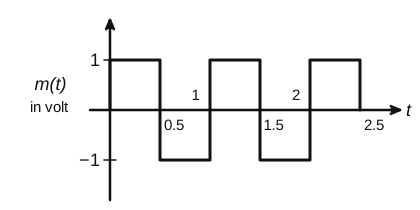
A square wave of the modulating signal is shown in the figure. The carrier wave is given by $C(t) = 5\sin(8\pi t)$ Volt. The modulation index is
The modulating signal has amplitude $A_m = 1$ V and the carrier has amplitude $A_c = 5$ V.
$$\mu = \frac{A_m}{A_c} = \frac15 = 0.2$$
Solution by Sreeraj P, M.Sc Physics
Q 12-08-146JEE MainJEE Main 2022 (28 Jul, Shift 1)Easy
Light travelling in air passes through medium 1 ($\mu_r = 1$, $\varepsilon_r = 4$) and then into medium 2 ($\mu_r = 1$, $\varepsilon_r = 9$). The speed of light $v_2$ in medium 2 will be :
Q 12-08-149JEE MainJEE Main 2021 (27 Jul, Shift 1)Easy
The amplitude of upper and lower side bands of AM wave where a carrier signal with frequency $11.21$ MHz, peak voltage $15$ V is amplitude modulated by a $7.7$ kHz sine wave of $5$ V amplitude are $\dfrac{a}{10}$ V and $\dfrac{b}{10}$ V respectively. Then the value of $\dfrac ab$ is ______.
Modulation index $\mu = \dfrac{A_m}{A_c} = \dfrac{5}{15} = \dfrac13$.
Each side band has amplitude $\dfrac{\mu A_c}{2} = \dfrac{A_m}{2} = 2.5$ V, so $a = b = 25$ and $\dfrac ab = 1$.
Solution by Sreeraj P, M.Sc Physics
Q 12-08-150JEE MainJEE Main 2021 (27 Jul, Shift 2)Easy
The maximum amplitude for an amplitude modulated wave is found to be $12$ V while the minimum amplitude is found to be $3$ V. The modulation index is $0.6x$ where $x$ is ______.
Q 12-08-151JEE MainJEE Main 2021 (31 Aug, Shift 1)Medium
The electric field in an electromagnetic wave is given by $E = (50\ \text{N C}^{-1})\sin\omega\left(t - \dfrac xc\right)$. The energy contained in a cylinder of volume $V$ is $5.5\times10^{-12}$ J. The value of $V$ is ______ $\text{cm}^3$. (given $\epsilon_0 = 8.8\times10^{-12}\ \text{C}^2\text{N}^{-1}\text{m}^{-2}$)
Average energy density (electric + magnetic): $u = \dfrac12\epsilon_0E_0^2 = \dfrac12\times8.8\times10^{-12}\times2500 = 1.1\times10^{-8}\ \text{J m}^{-3}$.
Q 12-08-152JEE MainJEE Main 2021 (31 Aug, Shift 1)Medium
If the sum of the heights of transmitting and receiving antennas in the line of sight of communication is fixed at $160$ m, then the maximum range of LOS communication is ______ km. (Take radius of Earth $= 6400$ km)
Q 12-08-153JEE MainJEE Main 2021 (31 Aug, Shift 2)Hard
The magnetic field vector of an electromagnetic wave is given by $\vec B = B_0\dfrac{\hat i + \hat j}{\sqrt2}\cos(kz - \omega t)$, where $\hat i$, $\hat j$ represent unit vectors along $x$ and $y$-axis respectively. At $t = 0$ s, two electric charges $q_1$ of $4\pi$ coulomb and $q_2$ of $2\pi$ coulomb located at $\left(0, 0, \dfrac\pi k\right)$ and $\left(0, 0, \dfrac{3\pi}{k}\right)$, respectively, have the same velocity of $0.5c\,\hat i$ (where $c$ is the velocity of light). The ratio of the force acting on charge $q_1$ to $q_2$ is:
Concept. The wave repeats every $\dfrac{2\pi}{k}$ in $z$. If both charges sit at points of the same phase with the same velocity, they feel the same $\vec E$ and $\vec B$, so $\vec F=q(\vec E+\vec v\times\vec B)$ scales only with $q$.
Step 1. Phases. At $t=0$: $\cos(\pi)=-1$ and $\cos(3\pi)=-1$, so the fields are identical at the two points.
Q 12-08-154JEE MainJEE Main 2021 (31 Aug, Shift 2)Easy
A bandwidth of $6$ MHz is available for A.M. transmission. If the maximum audio signal frequency used for modulating the carrier wave is not to exceed $6$ kHz, the number of stations that can be broadcasted within this band simultaneously without interfering with each other will be ______.
Q 12-08-155JEE MainJEE Main 2021 (24 Feb, Shift 1)Easy
An electromagnetic wave of frequency 5 GHz, is travelling in a medium whose relative electric permittivity and relative magnetic permeability both are 2. Its velocity in this medium is ______ $\times10^7\ \text{m s}^{-1}$.
Microwaves are produced by a magnetron (ii); infrared by vibrations of atoms and molecules (iv); gamma rays by radioactive decay of nuclei (i); X-rays by transitions of inner shell electrons (iii).
Solution by Sreeraj P, M.Sc Physics
Q 12-08-157JEE MainJEE Main 2021 (24 Feb, Shift 2)Easy
An electromagnetic wave of frequency 3 GHz enters a dielectric medium of relative electric permittivity 2.25 from vacuum. The wavelength of this wave in that medium will be ______ $\times10^{-2}$ cm.
Concept. Frequency does not change when a wave enters a medium; the speed and the wavelength both drop by the refractive index $n=\sqrt{\mu_r\varepsilon_r}$ (here $\mu_r=1$).
Step 1. Wavelength in vacuum. $\lambda_0=\dfrac{3\times10^8}{3\times10^9}=0.1$ m $=10$ cm.
Step 2. Refractive index. $n=\sqrt{2.25}=1.5$.
Step 3. Wavelength in the medium. $\lambda=\dfrac{10}{1.5}=6.67$ cm $=667\times10^{-2}$ cm.
Answer. $667$.
Solution by Sreeraj P, M.Sc Physics
Q 12-08-158JEE MainJEE Main 2021 (25 Feb, Shift 1)Medium
A transmitting station releases waves of wavelength 960 m. A capacitor of $2.56\ \mu\text{F}$ is used in the resonant circuit. The self-inductance of coil necessary for resonance is $x\times10^{-8}$ H. Find $x$.
Concept. The transmitter's LC circuit oscillates at the frequency of the waves it sends: $f=\dfrac c\lambda=\dfrac{1}{2\pi\sqrt{LC}}$.
Step 1. Frequency. $f=\dfrac{3\times10^8}{960}=3.125\times10^5$ Hz.
Step 2. Inductance. $L=\dfrac{1}{4\pi^2f^2C}=\dfrac{1}{39.48\times9.77\times10^{10}\times2.56\times10^{-6}}=1.0\times10^{-7}$ H $=10\times10^{-8}$ H.
Answer. $x=10$.
Solution by Sreeraj P, M.Sc Physics
Q 12-08-159JEE MainJEE Main 2021 (18 Mar, Shift 2)Easy
A plane electromagnetic wave propagating along $y$-direction can have the following pair of electric field $(\vec E)$ and magnetic field $(\vec B)$ components.
Concept. $\vec E$ and $\vec B$ are both perpendicular to the direction of travel and to each other. For travel along $y$ neither field may have a $y$ component, so one is along $x$ and the other along $z$.
Step 1. Remove options with a $y$ component. (A), (B) and (D) all contain $E_y$ or $B_y$.
Step 2. Check (C). $E_x$ with $B_z$: $\hat i\times\hat k=-\hat j$; $E_z$ with $B_x$: $\hat k\times\hat i=+\hat j$. Both pairs are perpendicular and give travel along the $y$-axis (one each way), so both are possible.
Answer. $E_x,B_z$ or $E_z,B_x$ (Option C).
Solution by Sreeraj P, M.Sc Physics
Q 12-08-160JEE MainJEE Main 2021 (20 Jul, Shift 1)Medium
AC voltage $V(t) = 20\sin\omega t$ of frequency 50 Hz is applied to a parallel plate capacitor. The separation between the plates is 2 mm and the area is $1\ \text{m}^2$. The amplitude of the oscillating displacement current for the applied AC voltage is [Take $\varepsilon_0 = 8.85\times10^{-12}\ \text{F m}^{-1}$]
Concept. First find $C=\dfrac{\varepsilon_0A}{d}$; then the displacement current amplitude is $I_0=V_0\omega C$.
Step 1. Capacitance. $C=\dfrac{8.85\times10^{-12}\times1}{2\times10^{-3}}=4.425\times10^{-9}$ F.
Step 2. Amplitude. $I_0=20\times(2\pi\times50)\times4.425\times10^{-9}=2.78\times10^{-5}$ A.
Answer. $27.79\ \mu$A (Option C).
Solution by Sreeraj P, M.Sc Physics
Q 12-08-161JEE MainJEE Main 2021 (20 Jul, Shift 2)Easy
In an electromagnetic wave, the electric field vector and magnetic field vector are given as $\vec E = E_0\hat i$ and $\vec B = B_0\hat k$, respectively. The direction of propagation of electromagnetic wave is along:
The wave travels along $\vec E\times\vec B$, i.e. along $\hat i\times\hat k = -\hat j$.
Solution by Sreeraj P, M.Sc Physics
Q 12-08-162JEE MainJEE Main 2021 (22 Jul, Shift 1)Medium
Intensity of sunlight is observed as $0.092\ \text{W m}^{-2}$ at a point in free space. What will be the peak value of magnetic field at that point? ($\varepsilon_0 = 8.85\times10^{-12}\ \text{C}^2\text{ N}^{-1}\text{ m}^{-2}$)
Concept. $I=\tfrac12\varepsilon_0cE_0^2$ gives the peak electric field; then $B_0=E_0/c$.
Step 1. Peak electric field. $E_0=\sqrt{\dfrac{2I}{\varepsilon_0c}}=\sqrt{\dfrac{2\times0.092}{8.85\times10^{-12}\times3\times10^8}}=\sqrt{69.3}=8.33$ V m$^{-1}$.
Step 2. Peak magnetic field. $B_0=\dfrac{8.33}{3\times10^8}=2.77\times10^{-8}$ T.
Answer. Option A.
Solution by Sreeraj P, M.Sc Physics
Q 12-08-163JEE MainJEE Main 2021 (26 Feb, Shift 1)Medium
A radiation is emitted by $1000$ W bulb and it generates an electric field and magnetic field at $P$, placed at a distance of $2$ m. The efficiency of the bulb is $1.25\%$. The value of peak electric field at $P$ is $x\times10^{-1}$ V m$^{-1}$. Value of $x$ is ______ (Rounded-off to the nearest integer) [Take $\varepsilon_0 = 8.85\times10^{-12}$ C$^2$ N$^{-1}$ m$^{-2}$, $c = 3\times10^8$ m s$^{-1}$]
Q 12-08-164JEE MainJEE Main 2021 (26 Feb, Shift 1)Easy
The maximum and minimum amplitude of an amplitude modulated wave is $16$ V and $8$ V respectively. The modulation index for this amplitude modulated wave is $x\times10^{-2}$. The value of $x$ is ______. (Round off your answer to the nearest integer)
Each AM station occupies a bandwidth of $2f_m = 2\times5 = 10$ kHz.
Number of stations $= \dfrac{90}{10} = 9$.
Solution by Sreeraj P, M.Sc Physics
Q 12-08-166JEE MainJEE Main 2021 (25 Jul, Shift 2)Easy
A message signal of frequency $20$ kHz and peak voltage of $20$ V is used to modulate a carrier wave of frequency $1$ MHz and peak voltage of $20$ V. The modulation index will be:
Q 12-08-167JEE MainJEE Main 2021 (26 Aug, Shift 1)Medium
The electric field in a plane electromagnetic wave is given by $\vec{E} = 200\cos\left[(0.5\times10^3\ \text{m}^{-1})x - (1.5\times10^{11}\ \text{rad s}^{-1})t\right]\ \text{V m}^{-1}\ \hat{j}$. If this wave falls normally on a perfectly reflecting surface having an area of $100$ cm$^2$. If the radiation pressure exerted by the E.M. wave on the surface during a $10$ min exposure is $\frac{k}{10^9}$ N m$^{-2}$. Find the value of $k$
Concept. Find the intensity from the field amplitude, $I=\tfrac12\varepsilon_0cE_0^2$. A perfectly reflecting surface reverses the momentum, so the pressure is $\dfrac{2I}{c}$. The area and exposure time do not affect the pressure.
Step 1. Check the speed. $\dfrac\omega k=\dfrac{1.5\times10^{11}}{0.5\times10^3}=3\times10^8$ m s$^{-1}$: the wave is in vacuum.
Step 2. Intensity. $I=\tfrac12\times8.85\times10^{-12}\times3\times10^8\times200^2=53.1$ W m$^{-2}$.
Step 3. Pressure. $P=\dfrac{2\times53.1}{3\times10^8}=3.54\times10^{-7}$ N m$^{-2}=\dfrac{354}{10^9}$ N m$^{-2}$.
Answer. $k=354$.
Solution by Sreeraj P, M.Sc Physics
Q 12-08-168JEE MainJEE Main 2021 (26 Aug, Shift 1)Easy
An amplitude-modulated wave is represented by $C_m(t) = 10(1 + 0.2\cos12560t)\sin(111\times10^4t)$ V. The modulating frequency in kHz will be
The modulating signal is $\cos(12560t)$, so $\omega_m = 12560$ rad s$^{-1}$. $$f_m = \frac{12560}{2\pi} \approx 2000\ \text{Hz} = 2\ \text{kHz}$$
Solution by Sreeraj P, M.Sc Physics
Q 12-08-169JEE MainJEE Main 2021 (26 Aug, Shift 2)Medium
A light beam is described by $E = 800\sin\omega\left(t - \frac{x}{c}\right)$. An electron is allowed to move normal to the propagation of light beam with a speed of $3\times10^7$ m s$^{-1}$. What is the maximum magnetic force exerted on the electron?
Q 12-08-170JEE MainJEE Main 2021 (26 Aug, Shift 2)Easy
A transmitting antenna at top of a tower has a height of $50$ m, and the height of receiving antenna is, $80$ m. What is the range of communication for the line of sight (LOS) mode? [use radius of the earth $= 6400$ km]
Concept. Write the units of each field. $E$ is in V m$^{-1}$ and the magnetising field $H$ is in A m$^{-1}$.
Step 1. Ratio of units. $\dfrac{\text{V m}^{-1}}{\text{A m}^{-1}}=\dfrac{\text V}{\text A}=$ ohm.
Step 2. Check. For a plane wave $\dfrac EH=\sqrt{\dfrac{\mu_0}{\varepsilon_0}}\approx377\ \Omega$, the impedance of free space.
Answer. Ohm (Option B).
Solution by Sreeraj P, M.Sc Physics
Q 12-08-172JEE MainJEE Main 2021 (27 Aug, Shift 1)Easy
The electric field in a plane electromagnetic wave is given by, $E = 50\sin(500x - 10\times10^{10}t)$ V m$^{-1}$. The velocity of an electromagnetic wave in this medium is: (Given $c = $ the speed of light in vacuum).
Concept. $v=\dfrac\omega k$ from the phase $(kx-\omega t)$.
Step 1. Speed. $v=\dfrac{10\times10^{10}}{500}=2\times10^8$ m/s $=\dfrac23c$.
Answer. Option D.
Solution by Sreeraj P, M.Sc Physics
Q 12-08-173JEE MainJEE Main 2021 (27 Aug, Shift 1)Easy
A transmitting antenna has a height of $320$ m and that of receiving antenna is $2000$ m. The maximum distance between them for satisfactory communication in line of sight mode is $d$. The value of $d$ is ______ km.
Taking the radius of the earth as $6400$ km: $$d = \sqrt{2Rh_T} + \sqrt{2Rh_R} = \sqrt{2\times6.4\times10^6\times320} + \sqrt{2\times6.4\times10^6\times2000}$$ $$d = 64\ \text{km} + 160\ \text{km} = 224\ \text{km}$$
Solution by Sreeraj P, M.Sc Physics
Q 12-08-175JEE MainJEE Main 2021 (27 Aug, Shift 2)Easy
A plane electromagnetic wave with a frequency of $30$ MHz travels in free space. At a particular point in space and time, the electric field is $6$ V m$^{-1}$. The magnetic field at this point will be $x\times10^{-8}$ T. The value of $x$ is,
Q 12-08-176JEE MainJEE Main 2020 (8 Jan, Shift 2)Easy
A plane electromagnetic wave of frequency $25$ GHz is propagating in vacuum along the $z$-direction. At a particular point in space and time, the magnetic field is given by $\vec{B} = 5\times10^{-8}\,\hat{j}$ T. The corresponding electric field $\vec{E}$ is (speed of light $= 3\times10^8$ m s$^{-1}$)
Direction: the wave travels along $\vec{E}\times\vec{B}$, which must be $+\hat{k}$. With $\vec{B}$ along $\hat{j}$, $\hat{i}\times\hat{j} = \hat{k}$, so $\vec{E}$ is along $+\hat{i}$. $$\vec{E} = 15\,\hat{i}\ \text{V/m}$$
Solution by Sreeraj P, M.Sc Physics
Q 12-08-177JEE MainJEE Main 2020 (9 Jan, Shift 1)Hard
The electric fields of two plane electromagnetic waves in vacuum are given by $\vec{E}_1 = E_0\hat{j}\cos(\omega t - kx)$ and $\vec{E}_2 = E_0\hat{k}\cos(\omega t - ky)$. At $t = 0$, a particle of charge $q$ is at origin with a velocity $\vec{v} = 0.8c\,\hat{j}$ ($c$ is the speed of light in vacuum). The instantaneous force experienced by the particle is:
Q 12-08-178JEE MainJEE Main 2020 (9 Jan, Shift 2)Medium
A plane electromagnetic wave is propagating along the direction $\dfrac{\hat{i} + \hat{j}}{\sqrt{2}}$, with its polarization along the direction $\hat{k}$. The correct form of the magnetic field of the wave would be (here $B_0$ is an appropriate constant):
Q 12-08-180JEE MainJEE Main 2020 (6 Sep, Shift 1)Medium
Suppose that the intensity of a laser is $\left(\dfrac{315}{\pi}\right)\ \text{W m}^{-2}$. The rms electric field, in units of V m$^{-1}$, associated with this source is close to the nearest integer ______. ($\varepsilon_0 = 8.86\times10^{-12}\ \text{C}^2\text{ N}^{-1}\text{ m}^{-2}$; $c = 3\times10^8\ \text{m s}^{-1}$)
Concept. In terms of the rms field, $I=\varepsilon_0cE_{\text{rms}}^2$ (the same as $\tfrac12\varepsilon_0cE_0^2$ with $E_0=\sqrt2E_{\text{rms}}$).
Step 1. Intensity. $I=\dfrac{315}{\pi}=100.3$ W m$^{-2}$.
Step 2. rms field. $E_{\text{rms}}=\sqrt{\dfrac{I}{\varepsilon_0c}}=\sqrt{\dfrac{100.3}{8.86\times10^{-12}\times3\times10^8}}=\sqrt{3.77\times10^4}\approx194$ V m$^{-1}$.
Answer. $194$.
Solution by Sreeraj P, M.Sc Physics
Q 12-08-181JEE MainJEE Main 2020 (6 Sep, Shift 2)Medium
For a plane electromagnetic wave, the magnetic field at a point $x$ and time $t$ is $$\vec B(x, t) = \left[1.2\times10^{-7}\sin\left(0.5\times10^3x + 1.5\times10^{11}t\right)\hat k\right]\ \text{T}$$
The instantaneous electric field $\vec E$ corresponding to $\vec B$ is:
Q 12-08-182JEE MainJEE Main 2020 (7 Jan, Shift 1)Medium
If the magnetic field in a plane electromagnetic wave is given by $\vec B = 3\times10^{-8}\sin\left(1.6\times10^3x + 48\times10^{10}t\right)\hat j$ T, then what will be the expression for the electric field?
The phase contains $kx + \omega t$, so the wave travels along $-x$. $\vec E\times\vec B$ must point along $-\hat i$; with $\vec B$ along $\hat j$, $\hat k\times\hat j = -\hat i$, so $\vec E$ is along $+\hat k$: $$\vec E = 9\sin\left(1.6\times10^3x + 48\times10^{10}t\right)\hat k\ \text{V/m}$$
(The official answer key lists the $60$ V/m option, which does not satisfy $E_0 = cB_0$.)
Solution by Sreeraj P, M.Sc Physics
Q 12-08-183JEE MainJEE Main 2020 (7 Jan, Shift 2)Hard
The electric field of a plane electromagnetic wave is given by $\vec E = E_0\dfrac{\hat i + \hat j}{\sqrt2}\cos(kz + \omega t)$. At $t = 0$, a positively charged particle is at the point $(x, y, z) = \left(0, 0, \dfrac\pi k\right)$. If its instantaneous velocity at $t = 0$ is $v_0\hat k$, the force acting on it due to the wave is:
Answer: (C) Antiparallel to $\dfrac{\hat i + \hat j}{\sqrt2}$
At the particle, $\cos(k\cdot\frac\pi k + 0) = \cos\pi = -1$, so $$\vec E = -E_0\frac{\hat i + \hat j}{\sqrt2}$$
The phase $kz + \omega t$ means the wave travels along $-z$, so $\vec B = \dfrac1c(-\hat k)\times\vec E$.
Magnetic force: $$q\vec v\times\vec B = \frac{qv_0}{c}\hat k\times(-\hat k\times\vec E) = \frac{qv_0}{c}\vec E$$ (using $\vec E\perp\hat k$).
Total force: $q\vec E\left(1 + \dfrac{v_0}{c}\right)$, which points along $\vec E$, i.e. antiparallel to $\dfrac{\hat i + \hat j}{\sqrt2}$.
(The official answer key lists 'parallel to $\frac{\hat i + \hat j}{\sqrt2}$', which ignores that $\cos\pi = -1$ at this point.)
Solution by Sreeraj P, M.Sc Physics
Q 12-08-184JEE MainJEE Main 2020 (8 Jan, Shift 1)Easy
The critical angle of a medium for a specific wavelength, if the medium has relative permittivity $3$ and relative permeability $\dfrac43$ for this wavelength, will be:
Q 12-08-185JEE MainJEE Main 2020 (2 Sep, Shift 1)Medium
A plane electromagnetic wave has frequency of $2.0 \times 10^{10}\ \text{Hz}$ and its energy density is $1.02 \times 10^{-8}\ \text{J m}^{-3}$ in vacuum. The amplitude of the magnetic field of the wave is close to $\left(\dfrac{1}{4\pi\varepsilon_0} = 9 \times 10^{9}\ \dfrac{\text{N m}^{2}}{\text{C}^{2}}\right.$ and speed of light $\left.= 3 \times 10^{8}\ \text{m s}^{-1}\right)$
Concept. The energy density of the wave (total, averaged) is $\langle u\rangle=\tfrac12\varepsilon_0E_0^2=\dfrac{B_0^2}{2\mu_0}$. Find $E_0$ with the given constant, then $B_0=E_0/c$. The frequency is not needed.
Step 1. Permittivity. $\varepsilon_0=\dfrac{1}{4\pi\times9\times10^9}=8.84\times10^{-12}$ F m$^{-1}$.
Step 2. Electric amplitude. $E_0=\sqrt{\dfrac{2\times1.02\times10^{-8}}{8.84\times10^{-12}}}=\sqrt{2.31\times10^3}=48$ V m$^{-1}$.
Step 3. Magnetic amplitude. $B_0=\dfrac{48}{3\times10^8}=1.6\times10^{-7}$ T $=160$ nT.
Answer. $160$ nT (Option B).
Solution by Sreeraj P, M.Sc Physics
Q 12-08-186JEE MainJEE Main 2020 (2 Sep, Shift 2)Easy
In a plane electromagnetic wave, the directions of electric field and magnetic field are represented by $\hat k$ and $2\hat i - 2\hat j$, respectively. What is the unit vector along direction of propagation of the wave?
Step 2. Unit vector. $\dfrac{\hat i+\hat j}{\sqrt2}$.
Answer. Option A.
Solution by Sreeraj P, M.Sc Physics
Q 12-08-188JEE MainJEE Main 2020 (3 Sep, Shift 2)Medium
The electric field of a plane electromagnetic wave propagating along the $x$ direction in vacuum is $\vec E = E_0\hat j\cos(\omega t - kx)$. The magnetic field $\vec B$, at the moment $t = 0$ is:
Answer: (A) $\dfrac{E_0}{c}(-\hat x + \hat y)\sin(kz - \omega t)$
The wave travels along $+\hat z$, and $\vec B = \dfrac1c\hat z\times\vec E$ (in phase with $\vec E$): $$\vec B = \frac{E_0}{c}(\hat z\times\hat x + \hat z\times\hat y)\sin(kz - \omega t) = \frac{E_0}{c}(\hat y - \hat x)\sin(kz - \omega t)$$
Solution by Sreeraj P, M.Sc Physics
Q 12-08-191JEE MainJEE Main 2020 (5 Sep, Shift 1)Medium
An electron is constrained to move along the $y$-axis with a speed of $0.1c$ ($c$ is the speed of light) in the presence of an electromagnetic wave, whose electric field is $\vec E = 30\hat j\sin(1.5\times10^{7}t - 5\times10^{-2}x)\ \text{V m}^{-1}$, where $t$ is in seconds and $x$ is in metres. The maximum magnetic force experienced by the electron will be: (given $c = 3\times10^{8}\ \text{m s}^{-1}$ and electron charge $= 1.6\times10^{-19}$ C)
In free space $E = cB$ and $c^2 = \dfrac{1}{\mu_0\epsilon_0}$, so $$u_E = \tfrac12\epsilon_0E^2 = \tfrac12\epsilon_0c^2B^2 = \frac{B^2}{2\mu_0} = u_B$$ The electric and magnetic energies are equal: $U_E = U_B$.
Solution by Sreeraj P, M.Sc Physics
Q 12-08-193JEE MainJEE Main 2019 (9 Jan, Shift 2)Easy
In a communication system operating at wavelength $800\ \text{nm}$, only one percent of source frequency is available as signal bandwidth. The number of channels accommodated for transmitting TV signals of band width $6\ \text{MHz}$ are (Take velocity of light $c = 3\times10^8\ \text{m/s}$, $h = 6.6\times10^{-34}\ \text{J s}$)
Available bandwidth $= 1\%$ of this $= 3.75\times10^{12}\ \text{Hz}$. $$N = \frac{3.75\times10^{12}}{6\times10^6} = 6.25\times10^5$$
Solution by Sreeraj P, M.Sc Physics
Q 12-08-194JEE MainJEE Main 2019 (10 Jan, Shift 1)Easy
If the magnetic field of a plane electromagnetic wave is given by $B = 100\times10^{-6}\sin\left[2\pi\times2\times10^{15}\left(t - \dfrac xc\right)\right]$, then the maximum electric field associated with it is: (speed of light $= 3\times10^8\ \text{m/s}$)
Q 12-08-195JEE MainJEE Main 2019 (10 Jan, Shift 1)Easy
A TV transmission tower has a height of $140\ \text{m}$ and the height of the receiving antenna is $40\ \text{m}$. What is the maximum distance up to which signals can be broadcasted from this tower in LOS (line of sight) mode? (Given: radius of earth $= 6.4\times10^6\ \text{m}$)
Q 12-08-196JEE MainJEE Main 2019 (10 Jan, Shift 2)Medium
The electric field of a plane polarized electromagnetic wave in free space at time $t = 0$ is given by the expression $\vec E(x, y) = 10\,\hat j\cos(6x + 8z)$. The magnetic field $\vec B(x, z, t)$ is given by ($c$ is the velocity of light)
Concept. The phase $6x+8z$ gives the wave vector $\vec k=6\hat i+8\hat k$, $|\vec k|=10$, so $\omega=10c$. A wave travelling along $+\vec k$ has phase $6x+8z-10ct$. Then $\vec B=\dfrac{\vec k\times\vec E}{\omega}$.
Q 12-08-197JEE MainJEE Main 2019 (10 Jan, Shift 2)Medium
The modulation frequency of an AM radio station is $250\ \text{kHz}$, which is $10\%$ of the carrier wave. If another AM station approaches you for license what broadcast frequency will you allot?
Carrier $= \dfrac{250}{0.1} = 2500\ \text{kHz}$, so this station occupies $2500 \pm 250$, i.e. $2250$–$2750\ \text{kHz}$.
A new station with the same $250\ \text{kHz}$ modulation must not overlap this band. At $2000\ \text{kHz}$ it occupies $1750$–$2250\ \text{kHz}$, which does not overlap. $2250$, $2750$ and $2900\ \text{kHz}$ all fall inside or overlap the existing band.
Solution by Sreeraj P, M.Sc Physics
Q 12-08-198JEE MainJEE Main 2019 (10 Apr, Shift 1)Easy
Given below in the left column are different modes of communication using the kinds of waves given in the right column.
Optical fibres carry infrared light (1 – Q). Sonar uses ultrasound (3 – P). Mobile phones work with microwaves (4 – R), and radar is matched with radio waves (2 – S).
Only option (1) has these pairings.
Solution by Sreeraj P, M.Sc Physics
Q 12-08-199JEE MainJEE Main 2019 (10 Apr, Shift 1)Medium
The electric field of a plane electromagnetic wave is given by $\vec E = E_0\,\hat i\cos(kz)\cos(\omega t)$. The corresponding magnetic field $\vec B$ is then given by:
Answer: (C) $\vec B = \dfrac{E_0}{c}\,\hat j\sin(kz)\sin(\omega t)$
Concept. This is a standing wave, so $\vec E$ and $\vec B$ are not in phase; use Faraday's law $\dfrac{\partial\vec B}{\partial t}=-\nabla\times\vec E$.
Q 12-08-200JEE MainJEE Main 2019 (10 Apr, Shift 1)Easy
A message signal of frequency $100\ \text{MHz}$ and peak voltage $100\ \text{V}$ is used to execute amplitude modulation on a carrier wave of frequency $300\ \text{GHz}$ and peak voltage $400\ \text{V}$. The modulation index and difference between the two side band frequencies are:
Modulation index $= \dfrac{A_m}{A_c} = \dfrac{100}{400} = 0.25$.
Side bands are at $f_c \pm f_m$, so they differ by $2f_m = 200\ \text{MHz} = 2\times10^8\ \text{Hz}$.
Solution by Sreeraj P, M.Sc Physics
Q 12-08-201JEE MainJEE Main 2019 (10 Apr, Shift 2)Easy
Light is incident normally on a completely absorbing surface with an energy flux of $25\ \text{W cm}^{-2}$. If the surface has an area of $25\ \text{cm}^2$, the momentum transferred to the surface in $40\ \text{min}$ time duration will be:
Q 12-08-202JEE MainJEE Main 2019 (9 Jan, Shift 1)Easy
A plane electromagnetic wave of frequency $50\ \text{MHz}$ travels in free space along the positive $x$-direction. At a particular point in space and time, $\vec E = 6.3\,\hat j\ \text{V/m}$. The corresponding magnetic field $\vec B$, at that point will be
Direction: $\vec E\times\vec B$ must point along $+\hat i$. Since $\hat j\times\hat k = \hat i$, $\vec B$ is along $+\hat k$: $$\vec B = 2.1\times10^{-8}\,\hat k\ \text{T}$$
Solution by Sreeraj P, M.Sc Physics
Q 12-08-203JEE MainJEE Main 2019 (8 Apr, Shift 1)Easy
A plane electromagnetic wave travels in free space along the $x$-direction. The electric field component of the wave at a particular point of space and time is $E = 6\ \text{V m}^{-1}$ along $y$-direction. Its corresponding magnetic field component, $B$ would be
Answer: (A) $2\times10^{-8}\ \text{T}$ along $z$-direction
$B = \dfrac Ec = \dfrac{6}{3\times10^8} = 2\times10^{-8}\ \text{T}$. The wave travels along $\vec E\times\vec B$; with $\vec E$ along $y$ and propagation along $x$, $\vec B$ is along $z$ ($\hat j\times\hat k = \hat i$).
Solution by Sreeraj P, M.Sc Physics
Q 12-08-204JEE MainJEE Main 2019 (8 Apr, Shift 1)Easy
The wavelength of the carrier waves in a modern optical fiber communication network is close to
Silica optical fibres have their lowest loss (and low dispersion) in the near infrared around $1.3$ to $1.55\ \mu\text{m}$, so modern networks use carriers near $1500\ \text{nm}$.
Solution by Sreeraj P, M.Sc Physics
Q 12-08-206JEE MainJEE Main 2019 (8 Apr, Shift 2)Medium
In a line of sight radio communication, a distance of about $50\ \text{km}$ is kept between the transmitting and receiving antennas. If the height of the receiving antenna is $70\ \text{m}$, then the minimum height of the transmitting antenna should be (Radius of the Earth $= 6.4\times10^6\ \text{m}$)
Q 12-08-207JEE MainJEE Main 2019 (9 Apr, Shift 1)Hard
The magnetic field of a plane electromagnetic wave is given by $\vec B = B_0\hat i[\cos(kz - \omega t)] + B_1\hat j\cos(kz + \omega t)$, where $B_0 = 3\times10^{-5}\ \text{T}$ and $B_1 = 2\times10^{-6}\ \text{T}$. The rms value of the force experienced by a stationary charge $Q = 10^{-4}\ \text{C}$ at $z = 0$ is closest to
Concept. A stationary charge feels only the electric force. Find $\vec E$ of each wave from $E_0=cB_0$, perpendicular to $\vec B$ and to the direction of travel.
Step 1. Wave 1 ($kz-\omega t$, along $+z$). $E=cB_0=9\times10^3$ V/m, along $\hat j$ (perpendicular to $\hat i$ and $\hat k$).
Step 2. Wave 2 ($kz+\omega t$, along $-z$). $E=cB_1=600$ V/m, along $\hat i$.
Step 3. At $z=0$. Both vary as $\cos\omega t$ and are perpendicular, so the peak field is $\sqrt{9000^2+600^2}\approx9.02\times10^3$ V/m.
Step 4. rms force. $F_{\text{rms}}=\dfrac{QE_{\text{peak}}}{\sqrt2}=\dfrac{10^{-4}\times9.02\times10^3}{\sqrt2}=0.64$ N.
Answer. About $0.6$ N (Option D).
Solution by Sreeraj P, M.Sc Physics
Q 12-08-208JEE MainJEE Main 2019 (9 Apr, Shift 1)Easy
A signal $A\cos\omega t$ is transmitted using $v_0\sin\omega_0t$ as carrier wave. The correct amplitude modulated (AM) signal is
Answer: (D) inversely proportional to carrier frequency
An antenna must be comparable in size to the wavelength it radiates (typically $\lambda/4$). The radiated wave is the carrier, and $\lambda = c/f_c$, so the antenna size is inversely proportional to the carrier frequency.
Solution by Sreeraj P, M.Sc Physics
Q 12-08-211JEE MainJEE Main 2019 (11 Jan, Shift 1)Medium
An electromagnetic wave of intensity $50\ \text{W m}^{-2}$ enters in a medium of refractive index $n$ without any loss. The ratio of the magnitudes of electric fields, and the ratio of the magnitudes of magnetic fields of the wave before and after entering into the medium are respectively, given by:
Answer: (C) $\left(\sqrt n, \dfrac{1}{\sqrt n}\right)$
Concept. No loss means the intensity stays the same. In a medium of index $n$, $I=\tfrac12\varepsilon vE_0^2=\tfrac12\varepsilon_0n^2\cdot\dfrac cn\,E_0^2=\tfrac12\varepsilon_0c\,nE_0^2$, and $B_0=\dfrac{E_0}{v}=\dfrac{nE_0}{c}$.
Step 1. Electric field. $E_1^2=nE_2^2\Rightarrow\dfrac{E_1}{E_2}=\sqrt n$.
Step 2. Magnetic field. $\dfrac{B_1}{B_2}=\dfrac{E_1/c}{nE_2/c}=\dfrac{\sqrt n}{n}=\dfrac1{\sqrt n}$.
Q 12-08-213JEE MainJEE Main 2019 (11 Jan, Shift 2)Medium
A $27$ mW laser beam has a cross-sectional area of $10\ \text{mm}^2$. The magnitude of the maximum electric field in this electromagnetic wave is given by: [Given permittivity of space $\varepsilon_0 = 9\times10^{-12}$ SI units, speed of light $c = 3\times10^8$ m/s]
Q 12-08-215JEE MainJEE Main 2019 (12 Jan, Shift 1)Medium
A light wave is incident normally on a glass slab of refractive index $1.5$. If $4\%$ of light gets reflected and the amplitude of the electric field of the incident light is $30$ V/m, then the amplitude of the electric field for the wave propagating in the glass medium will be:
Concept. The intensity that enters the glass is what is not reflected. In a non-magnetic medium of index $n$, the intensity is $I=\tfrac12\varepsilon vE_0^2=\tfrac12\varepsilon_0c\,nE_0^2$ (because $\varepsilon=n^2\varepsilon_0$ and $v=c/n$).
Step 1. Transmitted intensity. $96\%$ of the incident intensity enters: $I_t=0.96I_i$.
Q 12-08-217JEE MainJEE Main 2019 (12 Jan, Shift 2)Medium
The mean intensity of radiation on the surface of the Sun is about $10^{8}\ \text{W/m}^2$. The rms value of the corresponding magnetic field is closest to:
$I = \dfrac{cB_{\text{rms}}^2}{\mu_0}$, so $$B_{\text{rms}} = \sqrt{\frac{\mu_0I}{c}} = \sqrt{\frac{4\pi\times10^{-7}\times10^8}{3\times10^8}} \approx 6.5\times10^{-4}\ \text{T}$$ which is of the order of $10^{-4}$ T.
Solution by Sreeraj P, M.Sc Physics
Q 12-08-218JEE MainJEE Main 2019 (12 Jan, Shift 2)Easy
To double the covering range of a TV transmitting tower, its height should be multiplied by:
Range $d = \sqrt{2hR}$, so $d \propto \sqrt h$. To double $d$, the height must be multiplied by $4$.
Solution by Sreeraj P, M.Sc Physics
Q 12-08-219JEE MainJEE Main 2019 (12 Apr, Shift 1)Easy
An electromagnetic wave is represented by the electric field $\vec{E} = E_0\hat{n}\sin[\omega t + (6y - 8z)]$. Taking unit vectors in $x$, $y$ and $z$ directions to be $\hat{i}$, $\hat{j}$, $\hat{k}$, the direction of propagation $\hat{s}$ is:
Concept. A wave $\sin(\omega t-\vec k\cdot\vec r)$ travels along $\vec k$. A plus sign, $\sin(\omega t+\vec k\cdot\vec r)$, means travel along $-\vec k$.
Step 1. Rewrite the phase. $\omega t+(6y-8z)=\omega t-(-6y+8z)$, so the wave vector is $\vec k=-6\hat j+8\hat k$.
Step 2. Unit vector. $|\vec k|=\sqrt{36+64}=10$, so $\hat s=\dfrac{-6\hat j+8\hat k}{10}=\dfrac{-3\hat j+4\hat k}{5}$.
Answer. Option B.
Solution by Sreeraj P, M.Sc Physics
Q 12-08-220JEE MainJEE Main 2019 (12 Apr, Shift 2)Medium
A plane electromagnetic wave having a frequency $f = 23.9$ GHz propagates along the positive $z$-direction in free space. The peak value of the electric field is $60$ V/m. Which among the following is the acceptable magnetic field component in the electromagnetic wave?
Concept. A valid magnetic field for this wave must have: amplitude $B_0=E_0/c$, a phase in $z$ and $t$ with $k=\omega/c$ and the form $(kz-\omega t)$ for travel along $+z$, and a direction perpendicular to $z$.
Step 1. Amplitude. $B_0=\dfrac{60}{3\times10^8}=2\times10^{-7}$ T. This removes (C) and (D).
Step 2. Phase. $\omega=2\pi\times23.9\times10^9\approx1.5\times10^{11}$ rad s$^{-1}$, $k=\dfrac\omega c=0.5\times10^3$ m$^{-1}$. The phase must contain $z$ (not $x$), which removes (B).
Step 3. Check (A). $\sin(0.5\times10^3z-1.5\times10^{11}t)\,\hat i$: right $k$, $\omega$, travel along $+z$, field along $x$ (perpendicular to $z$).
Answer. Option A.
Solution by Sreeraj P, M.Sc Physics
Q 12-08-222JEE MainJEE Main 2018 (15 Apr, Shift 2)Medium
A plane polarized monochromatic EM wave is travelling in vacuum along $z$ direction such that at $t = t_1$ it is found that the electric field is zero at a spatial point $z_1$. The next zero that occurs in its neighbourhood is at $z_2$. The frequency of the electromagnetic wave is:
Q 12-08-223JEE MainJEE Main 2018 (16 Apr, Shift 1)Medium
A plane electromagnetic wave of wavelength $\lambda$ has an intensity $I$. It is propagating along the positive $Y$-direction. The allowed expressions for the electric and magnetic fields are given by:
Answer: (A) $\vec E = \sqrt{\dfrac{2I}{\varepsilon_0c}}\cos\left[\dfrac{2\pi}{\lambda}(y - ct)\right]\hat k,\quad \vec B = +\dfrac1cE\,\hat i$
Concept. Intensity gives the electric amplitude: $I=\tfrac12\varepsilon_0cE_0^2$. For travel along $+y$ the phase must be $(y-ct)$, and $\vec E\times\vec B$ must point along $+\hat j$.
Step 1. Amplitude. $E_0=\sqrt{\dfrac{2I}{\varepsilon_0c}}$. This removes (B) and (D).
Step 2. Phase. $(y-ct)$ travels along $+y$; $(y+ct)$ travels along $-y$. This removes (C).
Step 3. Directions in (A). $\vec E$ along $\hat k$, $\vec B$ along $+\hat i$: $\hat k\times\hat i=\hat j$, along the travel. $B=E/c$ is also right.
Answer. Option A.
Solution by Sreeraj P, M.Sc Physics
Q 12-08-224JEE MainJEE Main 2017 (2 Apr)Medium
An observer is moving with half the speed of light towards a stationary microwave source emitting waves at frequency $10$ GHz. What is the frequency of the microwave measured by the observer? (speed of light $= 3\times10^8\ \text{m s}^{-1}$)
At $v = c/2$ the relativistic Doppler formula for light must be used (source and observer approaching, $\beta = 0.5$): $$f' = f\sqrt{\frac{1+\beta}{1-\beta}} = 10\sqrt{\frac{1.5}{0.5}} = 10\sqrt3 \approx 17.3\ \text{GHz}$$
Solution by Sreeraj P, M.Sc Physics
Q 12-08-225JEE MainJEE Main 2017 (2 Apr)Easy
In amplitude modulation, the sinusoidal carrier frequency used is denoted by $\omega_c$ and the signal frequency is denoted by $\omega_m$. The bandwidth $\Delta\omega_m$ of the signal is such that $\Delta\omega_m \ll \omega_c$. Which of the following frequencies is not contained in the modulated wave?
An AM wave $(A_c + A_m\sin\omega_mt)\sin\omega_ct$ expands into $$A_c\sin\omega_ct + \frac{A_m}{2}\cos(\omega_c - \omega_m)t - \frac{A_m}{2}\cos(\omega_c + \omega_m)t$$ It contains $\omega_c$ and the side bands $\omega_c\pm\omega_m$, but not the signal frequency $\omega_m$ itself.
Solution by Sreeraj P, M.Sc Physics
Q 12-08-226JEE MainJEE Main 2017 (8 Apr)Medium
Magnetic field in a plane electromagnetic wave is given by $\vec B = B_0\sin(kx + \omega t)\hat j$ T. Expression for corresponding electric field will be (where $c$ is speed of light):
The phase $kx + \omega t$ means the wave travels along $-x$. In an EM wave $\vec E$, $\vec B$ and the propagation direction satisfy: $\vec E\times\vec B$ is along the direction of travel, and $E_0 = cB_0$ with $E$ and $B$ in phase.
With $\vec B$ along $\hat j$, $\vec E$ must be along $\pm\hat k$. Since $\hat k\times\hat j = -\hat i$, $\vec E$ is along $+\hat k$: $$\vec E = B_0c\sin(kx + \omega t)\hat k\ \text{V m}^{-1}$$
Solution by Sreeraj P, M.Sc Physics
Q 12-08-227JEE MainJEE Main 2017 (8 Apr)Easy
A signal of frequency $20$ kHz and peak voltage of $5$ volt is used to modulate a carrier wave of frequency $1.2$ MHz and peak voltage $25$ volts. Choose the correct statement.
Answer: (C) Modulation index $= 0.2$, side frequency bands are at $1220$ kHz and $1180$ kHz.
$$\mu = \frac{A_m}{A_c} = \frac{5}{25} = 0.2$$ Side bands: $f_c\pm f_m = 1200\pm20$ kHz, i.e. $1220$ kHz and $1180$ kHz.
Solution by Sreeraj P, M.Sc Physics
Q 12-08-228JEE MainJEE Main 2017 (9 Apr)Hard
The electric field component of a monochromatic radiation is given by $\vec E = 2E_0\cos kz\cos\omega t\,\hat i$. Its magnetic field $\vec B$ is then given by:
Use Faraday's law $\nabla\times\vec E = -\dfrac{\partial\vec B}{\partial t}$. For $\vec E = E_x(z,t)\hat i$, only the $y$-component of the curl survives: $$(\nabla\times\vec E)_y = \frac{\partial E_x}{\partial z} = -2E_0k\sin kz\cos\omega t$$ $$\frac{\partial B_y}{\partial t} = 2E_0k\sin kz\cos\omega t \;\Rightarrow\; B_y = \frac{2E_0k}{\omega}\sin kz\sin\omega t$$ With $\omega/k = c$: $$\vec B = \frac{2E_0}{c}\sin kz\sin\omega t\,\hat j$$ (This is a standing wave: $\vec B$ is shifted by a quarter period and a quarter wavelength from $\vec E$.)
Solution by Sreeraj P, M.Sc Physics
Q 12-08-229JEE MainJEE Main 2017 (9 Apr)Easy
A signal is to be transmitted through a wave of wavelength $\lambda$, using a linear antenna. The length $l$ of the antenna and effective power radiated $P_{\text{eff}}$ will be given, respectively, as ($K$ is a constant of proportionality):
For efficient radiation the antenna length must be comparable to the wavelength (at least of the order of $\lambda/4$), and the power radiated by a linear antenna varies as $$P_{\text{eff}} \propto \left(\frac l\lambda\right)^2$$ Only option (4) has this dependence, with $l$ of the order of $\lambda$.
Solution by Sreeraj P, M.Sc Physics
Q 12-08-230JEE MainJEE Main 2018 (8 Apr)Medium
An EM wave from air enters a medium. The electric fields are $\vec E_1 = E_{01}\hat x\cos\left[2\pi\nu\left(\dfrac zc - t\right)\right]$ in air and $\vec E_2 = E_{02}\hat x\cos[k(2z - ct)]$ in medium, where the wave number $k$ and frequency $\nu$ refer to their values in the air. The medium is non-magnetic. If $\varepsilon_{r_1}$ and $\varepsilon_{r_2}$ refer to relative permittivities of air and medium respectively, which of the following options is correct?
A telephonic communication service is working at a carrier frequency of $10$ GHz. Only $10\%$ of it is utilized for transmission. How many telephonic channels can be transmitted simultaneously if each channel requires a bandwidth of $5$ kHz?
AM radio waves: hundreds of metres, $10^2$ m (ii).
Microwaves: millimetres to centimetres, $10^{-2}$ m (iii).
Infrared: around $10^{-4}$ m to $10^{-6}$ m, so $10^{-4}$ m (iv).
X-rays: about $10^{-10}$ m (i).
(a)-(ii), (b)-(iii), (c)-(iv), (d)-(i).
Solution by Sreeraj P, M.Sc Physics
Q 12-08-233NEETNEET 2022Top questionEasy
When light propagates through a material medium of relative permittivity $\varepsilon_r$ and relative permeability $\mu_r$, the velocity of light, $v$ is given by ($c$ - velocity of light in vacuum)
Q 12-08-235JEE MainJEE Main 2025 (4 Apr, Shift 1)Medium
A small mirror of mass $m$ is suspended by a massless thread of length $l$. Then the small angle through which the thread will be deflected when a short pulse of laser of energy $E$ falls normal on the mirror is: ($c$ = speed of light in vacuum and $g$ = acceleration due to gravity)
Concept. The reflected pulse gives the mirror momentum $\dfrac{2E}{c}$. The mirror then swings like a pendulum: its kinetic energy becomes potential energy.
Step 1. Speed of the mirror. $v=\dfrac{2E}{mc}$.
Step 2. Small swing. $\tfrac12mv^2=mgl(1-\cos\theta)\approx\tfrac12mgl\theta^2\Rightarrow\theta=\dfrac{v}{\sqrt{gl}}$.
Q 12-08-236JEE MainJEE Main 2025 (4 Apr, Shift 2)Easy
If an optical medium possesses a relative permeability of $\dfrac{10}{\pi}$ and relative permittivity of $\dfrac{1}{0.0885}$, then the velocity of light is greater in vacuum than that in this medium by ______ times. ($\mu_0 = 4\pi\times10^{-7}\ \text{H/m}$, $\varepsilon_0 = 8.85\times10^{-12}\ \text{F/m}$, $c = 3\times10^8\ \text{m/s}$)
Q 12-08-237JEE MainJEE Main 2025 (7 Apr, Shift 1)Easy
If $\epsilon_0$ denotes the permittivity of free space and $\Phi_E$ is the flux of the electric field through the area bounded by a closed surface, then the dimensions of $\left(\epsilon_0\dfrac{d\Phi_E}{dt}\right)$ are that of:


 Solution by Sreeraj P, M.Sc Physics