

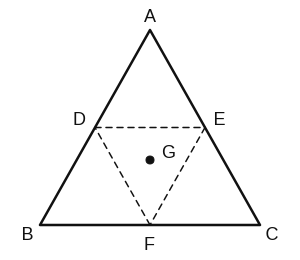
An equilateral triangle ABC is cut from a thin solid sheet of wood (see figure). D, E and F are the mid-points of its sides as shown and G is the centre of the triangle. The moment of inertia of the triangle about an axis passing through G and perpendicular to the plane of the triangle is $I_0$. If the smaller triangle DEF is removed from ABC, the moment of inertia of the remaining figure about the same axis is $I$. Then
Answer: (A) $I = \dfrac{15}{16}I_0$
Concept. Scaling. For a flat shape, $I=c\,Ma^2$ about its own centroid, with $c$ fixed by the shape. A triangle with half the side has $\tfrac14$ the area, so $\tfrac14$ the mass, and $I$ scales as $\tfrac14\times\left(\tfrac12\right)^2=\tfrac1{16}$.
Step 1. The removed triangle $DEF$. Joining the mid-points gives an equilateral triangle of side $\dfrac a2$ with the same centroid $G$.
$$I_{DEF}=c\cdot\frac M4\cdot\left(\frac a2\right)^2=\frac{1}{16}\,cMa^2=\frac{I_0}{16}$$
Step 2. No parallel-axis term is needed, because $DEF$ is centred on $G$ itself.
Step 3. Subtract: $I=I_0-\dfrac{I_0}{16}=\dfrac{15}{16}I_0$.
Answer. Option A.
 Solution by Sreeraj P, M.Sc Physics


