

Q 11-06-230JEE MainJEE Main 2019 (12 Jan, Shift 2)Medium
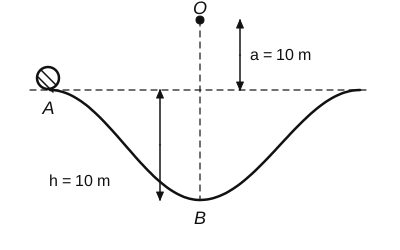
A particle of mass $20$ g is released with an initial velocity $5\ \text{m s}^{-1}$ along the curve from the point A, as shown in the figure. The point A is at height $h$ from point B. The particle slides along the frictionless surface. When the particle reaches point B, its angular momentum about O will be: (Take $g = 10\ \text{m s}^{-2}$)
Answer: (C) $6\ \text{kg m}^2\text{s}^{-1}$
Speed at B (smooth surface):
$$v^2 = 5^2 + 2\times10\times10 = 225 \Rightarrow v = 15\ \text{m/s}$$
At B the velocity is horizontal and O is vertically above B at a height $a + h = 20$ m, which is the perpendicular distance from O to the line of motion:
$$L = mvr_\perp = 0.02\times15\times20 = 6\ \text{kg m}^2\text{s}^{-1}$$
 Solution by Sreeraj P, M.Sc Physics