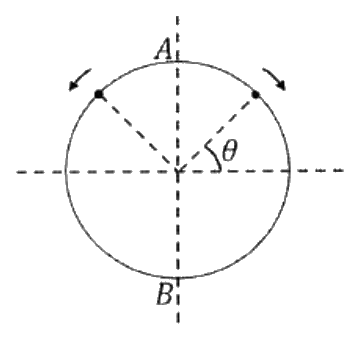
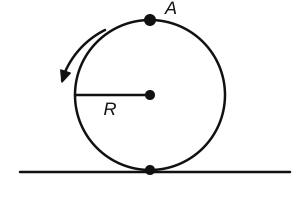
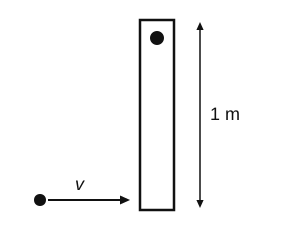
A frictionless circular wire of unit radius is fixed on the horizontal plane. Two point particles of unit mass start moving simultaneously from point $A\left(\theta = \dfrac{\pi}{2}\right)$ with identical uniform angular speeds in opposite directions, and meet again at point $B\left(\theta = -\dfrac{\pi}{2}\right)$. During this time, which of the following figures schematically represent the magnitude of the total linear momentum $P$ of the system, as a function of $\theta$ ?
By symmetry, the two particles are always at angles $\theta$ and $\pi - \theta$, mirror images about the line AB. Each has speed $v$ along the tangent.
A particle at angle $\theta$ moving along the circle has velocity components $(\pm v\sin\theta,\ -v\cos\theta)$. For the mirror-image particle, the components along the horizontal diameter are opposite and cancel, while the components along AB add: $$P = 2mv\,|\cos\theta|$$
As $\theta$ goes from $\dfrac{\pi}{2}$ to $-\dfrac{\pi}{2}$:
$P = 0$ at the start (at A the velocities are equal and opposite),
$P$ is maximum ($2mv$) at $\theta = 0$,
$P = 0$ again at B.
So $P$ rises from zero to a maximum and falls back to zero along a smooth $\cos\theta$ curve, which is option (3).
Solution by Sreeraj P, M.Sc Physics
Q 11-06-003NEETNEET 2026Top questionMedium
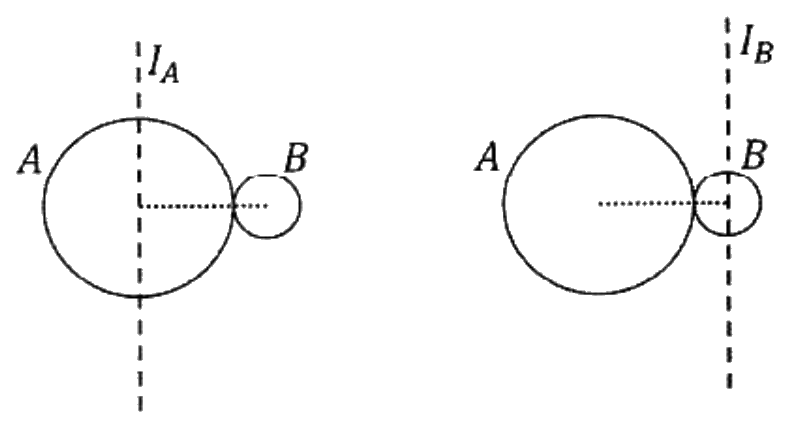
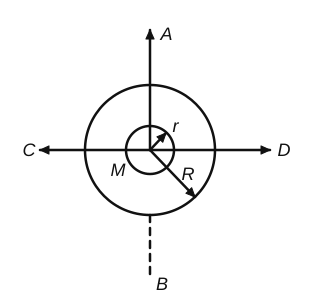
A solid sphere $A$ of radius $R$ and mass $M$ is attached at a point to a smaller solid sphere $B$ of radius $r < R$ and mass $m < M$. Assume that the line joining their centres lies along the horizontal. The moment of inertia of the system calculated about a vertical axis passing through the centre of $A$ is $I_A$ and that calculated about a vertical axis passing through the centre of $B$ is $I_B$. The difference $I_A - I_B$ is :
The spheres touch, so their centres are $d = R + r$ apart.
About the axis through the centre of A (parallel axis theorem for B): $$I_A = \frac{2}{5}MR^2 + \frac{2}{5}mr^2 + m(R + r)^2$$
About the axis through the centre of B: $$I_B = \frac{2}{5}MR^2 + M(R + r)^2 + \frac{2}{5}mr^2$$
$$I_A - I_B = (m - M)(R + r)^2$$
Solution by Sreeraj P, M.Sc Physics
Q 11-06-004NEETNEET 2026Top questionMedium
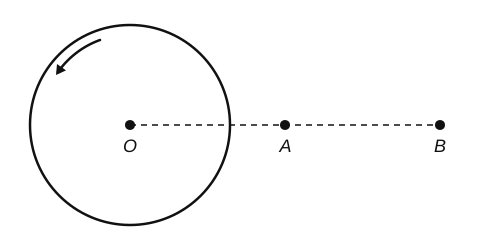
A thin horizontal disc is rotating about a vertical axis passing through its fixed centre $O$. Its angular momentum is $L_A$ and $L_B$ computed about points $A$ and $B$, respectively, with $OB = 2 \times OA$. The value of $\dfrac{L_A}{L_B}$ is :
The angular momentum about any point P is $$\vec{L}_P = \vec{L}_{cm} + \vec{r}_{P\to cm} \times M\vec{v}_{cm}$$
The disc rotates about its fixed centre, so its centre of mass is at rest: $\vec{v}_{cm} = 0$. The second term vanishes, and the angular momentum is the same ($I\omega$) about every point.
$$\frac{L_A}{L_B} = 1$$
Solution by Sreeraj P, M.Sc Physics
Q 11-06-005NEETNEET 2025Top questionEasy
The Sun rotates around its centre once in $27$ days. What will be the period of revolution if the Sun were to expand to twice its present radius without any external influence? Assume the Sun to be a sphere of uniform density.
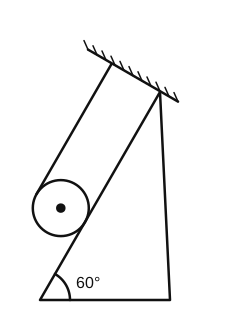
A uniform rod of mass $20$ kg and length $5$ m leans against a smooth vertical wall making an angle of $60°$ with it. The other end rests on a rough horizontal floor. The friction force that the floor exerts on the rod is
The smooth wall gives only a horizontal normal force $N_w$. Horizontal equilibrium: friction $f = N_w$.
The rod makes $60°$ with the wall. Its top is at height $L\cos 60°$, and its centre is a horizontal distance $\dfrac{L}{2}\sin 60°$ from the foot.
Torques about the foot of the rod: $$N_w \cdot L\cos 60° = mg\cdot\frac{L}{2}\sin 60°$$ $$N_w = \frac{mg}{2}\tan 60° = \frac{200}{2}\sqrt{3} = 100\sqrt{3}\ \text{N}$$
So the friction force is $f = 100\sqrt{3}$ N.
Solution by Sreeraj P, M.Sc Physics
Q 11-06-007NEETNEET 2025Top questionMedium
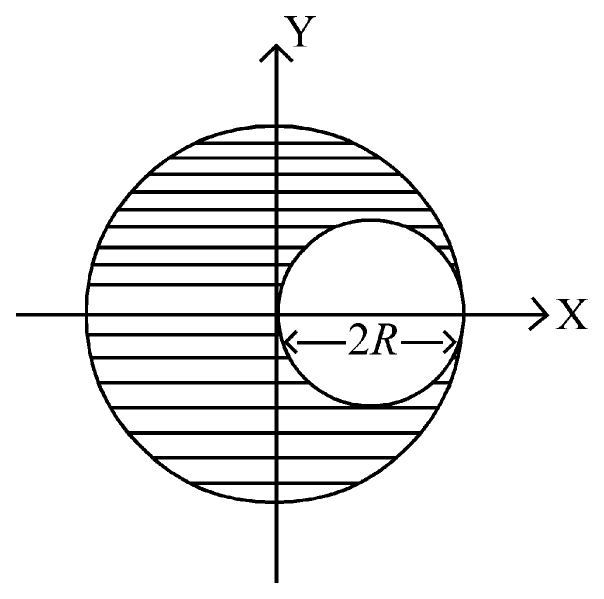
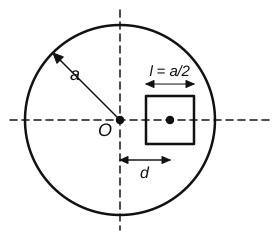
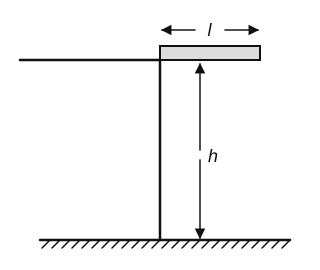
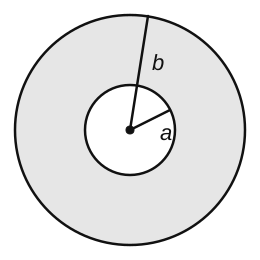
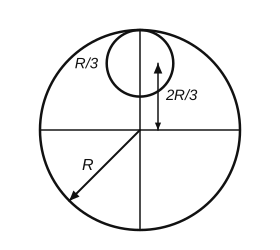
A sphere of radius $R$ is cut from a larger solid sphere of radius $2R$ as shown in the figure. The ratio of the moment of inertia of the smaller sphere to that of the rest part of the sphere about the Y-axis is :
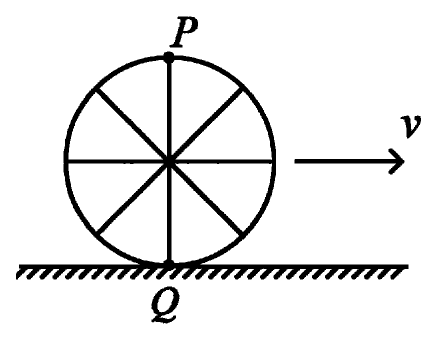
A wheel of a bullock cart is rolling on a level road as shown in the figure below. If its linear speed is $v$ in the direction shown, which one of the following options is correct ($P$ and $Q$ are any highest and lowest points on the wheel, respectively)?
Answer: (D) Point $P$ moves faster than point $Q$.
In rolling without slipping, the velocity of any point is the velocity of the centre plus the velocity due to rotation, with $\omega R = v$.
Top point $P$: $v + \omega R = 2v$.
Bottom point $Q$ (in contact with the road): $v - \omega R = 0$.
So $P$ moves faster than $Q$.
Solution by Sreeraj P, M.Sc Physics
Q 11-06-009NEETNEET 2024Top questionEasy
The moment of inertia of a thin rod about an axis passing through its mid point and perpendicular to the rod is $2400\ \text{g cm}^2$. The length of the $400$ g rod is nearly :
The ratio of radius of gyration of a solid sphere of mass $M$ and radius $R$ about its own axis to the radius of gyration of the thin hollow sphere of same mass and radius about its axis is :
Strictly, the ratio of the radii of gyration is $\sqrt{3} : \sqrt{5}$, which is not among the options. Option (1), $3 : 5$, is the ratio of their squares, $k_1^2 : k_2^2$, and is the intended answer.
Solution by Sreeraj P, M.Sc Physics
Q 11-06-011NEETNEET 2023Top questionEasy
The angular acceleration of a body, moving along the circumference of a circle, is :
Angular velocity and angular acceleration are axial vectors. For motion in a circle they point along the axis of rotation (perpendicular to the plane of the circle), with the direction given by the right-hand rule.
Solution by Sreeraj P, M.Sc Physics
Q 11-06-012NEETNEET 2021Top questionEasy
From a circular ring of mass 'M' and radius 'R' an arc corresponding to a $90°$ sector is removed. The moment of inertia of the remaining part of the ring about an axis passing through the centre of the ring and perpendicular to the plane of the ring is 'K' times '$MR^2$'. Then the value of 'K' is :
The remaining $270°$ arc has mass $\dfrac{3}{4}M$, and all of it is at distance $R$ from the axis: $$I = \frac{3}{4}MR^2 \;\Rightarrow\; K = \frac{3}{4}$$
Solution by Sreeraj P, M.Sc Physics
Q 11-06-013NEETNEET 2021Top questionMedium
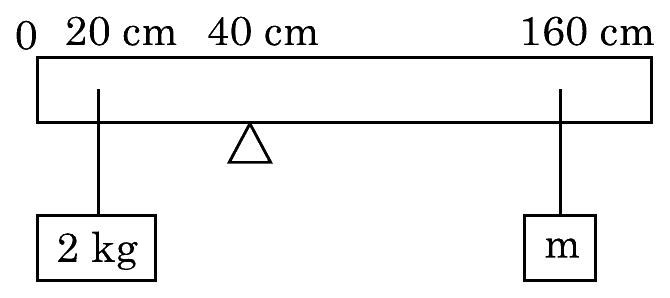
A uniform rod of length $200$ cm and mass $500$ g is balanced on a wedge placed at $40$ cm mark. A mass of $2$ kg is suspended from the rod at $20$ cm and another unknown mass 'm' is suspended from the rod at $160$ cm mark as shown in the figure. Find the value of 'm' such that the rod is in equilibrium. ($g = 10\ \text{m/s}^2$)
Two particles of mass $5$ kg and $10$ kg respectively are attached to the two ends of a rigid rod of length $1$ m with negligible mass. The centre of mass of the system from the $5$ kg particle is nearly at a distance of :
A thin rod of length $L$ is lying along the $x$-axis with its ends at $x = 0$ and $x = L$. Its linear density (mass/length) varies with $x$ as $k\left(\dfrac{x}{L}\right)^n$, where $n$ can be zero or any positive number. If the position $X_{CM}$ of the centre of mass of the rod is plotted against $n$, which of the following graphs best approximates the dependence of $X_{CM}$ on $n$?
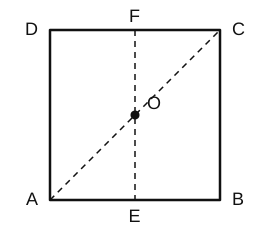
Concept. For a square lamina, by symmetry and the perpendicular-axis theorem, every axis in its plane through the centre has the same moment of inertia, $\tfrac1{12}Ma^2$.
Step 1. Why. $I_z=I_{EF}+I_{\perp EF}=2I_{EF}$ and also $I_z=I_{AC}+I_{BD}=2I_{AC}$ (each pair is perpendicular and equal by symmetry). So $I_{AC}=I_{EF}$.
Answer. Option C.
Solution by Sreeraj P, M.Sc Physics
Q 11-06-018JEE MainAIEEE 2008Easy
Consider a uniform square plate of side $a$ and mass $m$. The moment of inertia of this plate about an axis perpendicular to its plane and passing through one of its corners is
Concept. Find $I$ about the normal axis through the centre with the perpendicular-axis theorem, then shift to the corner with the parallel-axis theorem.
Step 1. Centre, normal axis. For a square plate, the axis through the centre parallel to a side gives $\dfrac{ma^2}{12}$ (like a rod of length $a$). Two such axes are perpendicular, so $$I_{O}=\frac{ma^2}{12}+\frac{ma^2}{12}=\frac{ma^2}{6}$$
Step 2. Distance from the centre to a corner: $d=\dfrac{a}{\sqrt2}$ (half the diagonal).
Two solid spheres A and B are made of metals of different densities $\rho_A$ and $\rho_B$ respectively. If their masses are equal, the ratio of their moments of inertia $\dfrac{I_A}{I_B}$ about their respective diameters is
The moment of inertia of a thin circular disc about an axis passing through its centre and perpendicular to its plane is $I$. Then, the moment of inertia of the disc about an axis parallel to its diameter and touching the edge of the rim is
Two solid spheres A and B, each of radius $R$, are made of materials of densities $\rho_A$ and $\rho_B$ respectively. Their moments of inertia about a diameter are $I_A$ and $I_B$ respectively. The value of $\dfrac{I_A}{I_B}$ is
Same radius, so $I = \dfrac{2}{5}mR^2 \propto m \propto \rho$: $$\frac{I_A}{I_B} = \frac{\rho_A}{\rho_B}$$
Solution by Sreeraj P, M.Sc Physics
Q 11-06-022JEE MainAIEEE 2009Medium
A thin uniform rod of length $l$ and mass $m$ is swinging freely about a horizontal axis passing through its end. Its maximum angular speed is $\omega$. Its centre of mass rises to a maximum height of
Concept. At the lowest point the rod's KE is greatest; it all turns into PE at the top of the swing: $\tfrac12I\omega^2=mgh_{cm}$, with $I=\tfrac13ml^2$ about the end.
A pulley of radius $2$ m is rotated about its axis by a force $F = (20t - 5t^2)$ N (where $t$ is measured in seconds) applied tangentially. If the moment of inertia of the pulley about its axis of rotation is $10\ \text{kg m}^2$, the number of rotations made by the pulley before its direction of motion is reversed, is
Concept. A time-varying torque: $\alpha(t)=\dfrac{F(t)R}{I}$. Integrate for $\omega(t)$; the direction reverses when $\omega=0$. Integrate again for the angle turned.
A central force always acts along the line joining the particle to the centre, i.e. along $\vec{r}$. So its torque about the centre is $\vec{\tau} = \vec{r}\times\vec{F} = 0$.
With zero torque, $\dfrac{d\vec{L}}{dt} = 0$ and the angular momentum is conserved.
Solution by Sreeraj P, M.Sc Physics
Q 11-06-025JEE MainIIT JEE 2004Medium
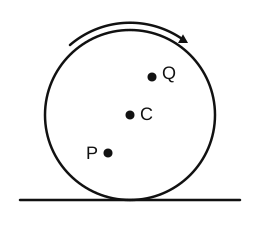
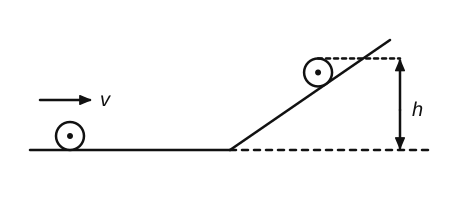
A disc is rolling (without slipping) on a frictionless surface. C is its centre, and Q and P are two points equidistant from C, as shown. Let $V_P$, $V_Q$ and $V_C$ be the magnitudes of the velocities of points P, Q and C respectively. Then
In rolling without slipping, every point moves as if rotating about the contact point with angular speed $\omega$, so its speed is $\omega \times$ (its distance from the contact point).
Q is above C, so it is farther from the contact point than C. P is below C, so it is nearer. Hence $$V_Q > V_C > V_P$$
Solution by Sreeraj P, M.Sc Physics
Q 11-06-026NEETJEE MainEasy
Masses of $1$ kg, $2$ kg and $3$ kg are placed at the points $(0, 0)$, $(2, 0)$ and $(0, 2)$ m respectively. The position of their centre of mass is
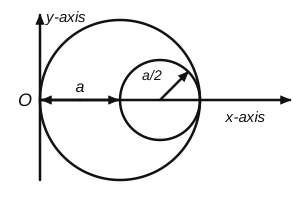
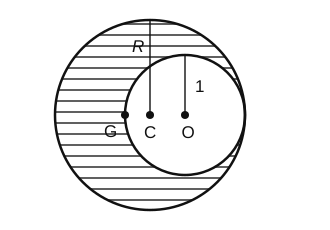
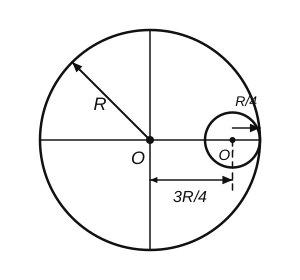
A circular hole of radius $\dfrac{R}{2}$ is cut from a uniform disc of radius $R$. The edge of the hole touches the edge of the disc. The centre of mass of the remaining part is at a distance from the centre of the original disc of
Treat the hole as negative mass. Areas are in the ratio $1 : \dfrac{1}{4}$, so take masses $4m$ (full disc) and $m$ (hole). The hole's centre is at $\dfrac{R}{2}$ from O. $$x_{cm} = \frac{4m(0) - m\left(\frac{R}{2}\right)}{4m - m} = -\frac{R}{6}$$
The centre of mass shifts $\dfrac{R}{6}$ away from the hole.
Solution by Sreeraj P, M.Sc Physics
Q 11-06-028NEETJEE MainMedium
A shell fired from a gun explodes in mid-air into several fragments. Ignoring air resistance, the centre of mass of the fragments
Answer: (B) continues along the original parabolic path
The explosion forces are internal, so they cannot change the motion of the centre of mass. The only external force is still gravity, so the centre of mass keeps following the same parabola (until a fragment hits the ground).
Solution by Sreeraj P, M.Sc Physics
Q 11-06-029NEETJEE MainEasy
The moment of inertia of a uniform ring of mass $M$ and radius $R$ about a tangent in its plane is
$I = \dfrac{ML^2}{3} = Mk^2$, so $k = \dfrac{L}{\sqrt{3}}$.
Solution by Sreeraj P, M.Sc Physics
Q 11-06-031NEETJEE MainTop questionMedium
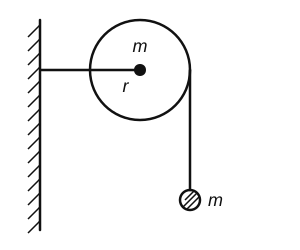
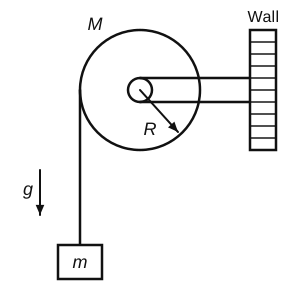
A light string is wound round a pulley (uniform disc) of mass $2$ kg and radius $0.1$ m, free to rotate about a fixed horizontal axis. A $1$ kg block hangs from the free end of the string. The acceleration of the block is ($g = 10\ \text{m/s}^2$)
For rolling, $a = \dfrac{g\sin\theta}{1 + k^2/R^2}$. For a solid cylinder $\dfrac{k^2}{R^2} = \dfrac{1}{2}$: $$a = \frac{10 \times 0.5}{1.5} = \frac{10}{3}\ \text{m/s}^2$$
Solution by Sreeraj P, M.Sc Physics
Q 11-06-034NEETJEE MainMedium
A ring, a disc, a solid sphere and a hollow sphere, all of the same mass and radius, are released together from rest at the top of the same incline and roll without slipping. The one that reaches the bottom first is the
A man stands at the centre of a turntable rotating freely at $30$ rpm, holding two dumbbells at arm's length. The moment of inertia of the system is $6\ \text{kg m}^2$. When he pulls the dumbbells in, it becomes $2\ \text{kg m}^2$. The new rate of rotation and the ratio of final to initial kinetic energy are
No external torque, so $I_1\omega_1 = I_2\omega_2$: $\omega_2 = \dfrac{6}{2} \times 30 = 90$ rpm.
$K = \dfrac{L^2}{2I}$ with $L$ constant, so $\dfrac{K_2}{K_1} = \dfrac{I_1}{I_2} = 3$. The extra energy comes from the work the man does pulling his arms in.
Solution by Sreeraj P, M.Sc Physics
Q 11-06-037NEETJEE MainMedium
A disc of moment of inertia $2\ \text{kg m}^2$ spinning at $6$ rad/s is gently placed on an identical disc at rest on the same axis. They soon rotate together. The kinetic energy lost is
Lost $= 18$ J, turned into heat by friction between the discs.
Solution by Sreeraj P, M.Sc Physics
Q 11-06-038NEETJEE MainEasy
A constant torque of $20$ N m acts on a wheel of moment of inertia $4\ \text{kg m}^2$, initially at rest, for $3$ s. The angular momentum and the kinetic energy of the wheel afterwards are
A flywheel starts from rest with a constant angular acceleration and reaches $20$ rad/s in $5$ s. Find the number of revolutions it makes in this time, rounded to the nearest whole number.
Q 11-06-043JEE MainJEE Main 2026 (8 Apr, Shift 2)Hard
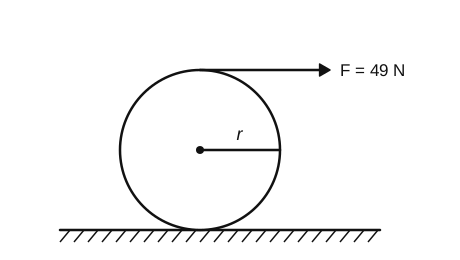
A solid cylinder having radius $R$ and length $L$ is slipping on a rough horizontal plane. At time $t = 0$ the cylinder has a translational velocity $v_0 = 49\ \text{m/s}$, perpendicular to its axis and a rotational velocity $v_0/4R$ about the centre. The time taken by the cylinder to start rolling is ______ seconds. (coefficient of kinetic friction $\mu_K = 0.25$ and $g = 9.8\ \text{m/s}^2$)
Concept. While slipping, kinetic friction $\mu mg$ acts backwards at the contact point. It decelerates the centre and increases the spin. Rolling starts when $v=\omega R$.
Step 1. Translation. $a=-\mu g=-0.25\times9.8=-2.45$ m s$^{-2}$, so $v=49-2.45t$.
Step 2. Rotation. Torque $\mu mgR=\tfrac12mR^2\alpha$ gives $\alpha R=2\mu g=4.9$ m s$^{-2}$. Starting from $\omega_0R=\dfrac{v_0}{4}=12.25$ m s$^{-1}$: $$\omega R=12.25+4.9t$$
Step 3. Rolling condition. $$49-2.45t=12.25+4.9t\ \Rightarrow\ 36.75=7.35t\ \Rightarrow\ t=5\ \text{s}$$
Answer. $5$ s (Option B).
Solution by Sreeraj P, M.Sc Physics
Q 11-06-044JEE MainJEE Main 2026 (6 Apr, Shift 1)Medium
A solid sphere of radius $4$ cm and mass $5$ kg is rotating (rotation axis is passing through the centre of the sphere) with an angular velocity of $1200$ rpm. It is brought to rest in $10$ s by applying a constant torque. The torque applied and the number of rotations it made before it comes to rest are ______ and ______ respectively.
Concept. Constant torque gives constant $\alpha=\Delta\omega/t$, and $\tau=I\alpha$. The number of turns is the average angular speed (in rev/s) times the time.
Step 1. Moment of inertia. $I=\tfrac25(5)(0.04)^2=3.2\times10^{-3}$ kg m$^2$.
Step 3. Torque. $\tau=3.2\times10^{-3}\times4\pi=0.0128\pi$ N m.
Step 4. Rotations. Average $10$ rev/s for $10$ s: $100$.
Answer. $0.0128\pi$ N m, $100$ (Option D).
Solution by Sreeraj P, M.Sc Physics
Q 11-06-045JEE MainJEE Main 2026 (6 Apr, Shift 1)Medium
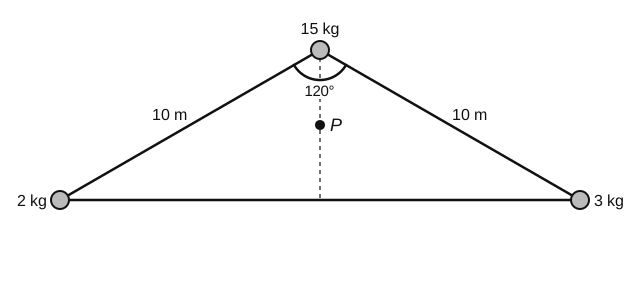
The position of center of mass of three masses $2$ kg, $3$ kg and $15$ kg placed with respect to mid point ($p$) of normal bisector, as shown in the figure is ______.
Concept. Write each mass's coordinates with the origin at $P$, the midpoint of the altitude, then use $\vec r_{cm}=\sum m\vec r/\sum m$.
Step 1. Geometry. Sides $10$ m with an apex angle of $120^\circ$: altitude $10\cos60^\circ=5$ m, half-base $10\sin60^\circ=5\sqrt3$ m. With $P$ at the middle of the altitude: apex $(0,2.5)$, base corners $(-5\sqrt3,-2.5)$ (2 kg) and $(5\sqrt3,-2.5)$ (3 kg), as in the figure.
Step 2. $x$-coordinate. $\dfrac{-2(5\sqrt3)+3(5\sqrt3)+0}{20}=\dfrac{5\sqrt3}{20}=\dfrac{\sqrt3}{4}$ m.
Step 3. $y$-coordinate. $\dfrac{15(2.5)+5(-2.5)}{20}=\dfrac{25}{20}=1.25$ m.
Q 11-06-046JEE MainJEE Main 2026 (6 Apr, Shift 2)Hard
A solid sphere ($A$) of mass $5m$ and a spherical shell ($B$) of mass $m$, both having same radius, are placed on a rough surface. When a force of same magnitude is applied tangentially at the highest points of $A$ and $B$, they start rolling without slipping with an acceleration of $a_A$ and $a_B$, respectively. The ratio of $a_A$ and $a_B$ is ______.
Concept. A force at the top of a rolling body: write $F+f=ma$ (friction $f$ unknown) and $(F-f)R=I\alpha$ with $a=\alpha R$. Adding gives $a=\dfrac{2F}{m(1+k^2/R^2)}$.
Step 1. Sphere A ($5m$, $k^2/R^2=\tfrac25$). $a_A=\dfrac{2F}{5m\cdot\tfrac75}=\dfrac{2F}{7m}$.
Step 2. Shell B ($m$, $k^2/R^2=\tfrac23$). $a_B=\dfrac{2F}{m\cdot\tfrac53}=\dfrac{6F}{5m}$.
Q 11-06-047JEE MainJEE Main 2026 (6 Apr, Shift 2)Medium
Two identical bodies A and B of equal masses have initial velocities $\vec{v_1} = 4\hat{i}$ m/s and $\vec{v_2} = 4\hat{j}$ m/s respectively. The body A has acceleration $\vec{a_1} = 6\hat{i} + 6\hat{j}\ \text{m/s}^2$ while the acceleration of the other body B is zero. The centre of mass of the two bodies moves in ______ path.
Concept. The centre of mass moves like a single particle with velocity $\vec v_{cm}=\dfrac{\sum m\vec v}{\sum m}$ and acceleration $\vec a_{cm}=\dfrac{\sum m\vec a}{\sum m}$. If $\vec a_{cm}$ is constant and parallel to $\vec v_{cm}$, the path is a straight line; if not parallel, a parabola.
Step 1. Initial velocity of the centre of mass (equal masses, so a plain average): $$\vec v_{cm}=\frac{4\hat i+4\hat j}{2}=2\hat i+2\hat j$$
Step 2. Acceleration of the centre of mass: $$\vec a_{cm}=\frac{(6\hat i+6\hat j)+\vec 0}{2}=3\hat i+3\hat j$$
Step 3. Compare directions. Both vectors point along $\hat i+\hat j$. A constant acceleration along the velocity only changes the speed, not the direction.
Answer. Straight line (Option C).
Solution by Sreeraj P, M.Sc Physics
Q 11-06-048JEE MainJEE Main 2026 (5 Apr, Shift 2)Easy
A wheel initially at rest is subjected to a uniform angular acceleration about its axis. In the first $2$ s it rotates through an angle $\theta_1$ and in the next $2$ s it rotates through an angle $\theta_2$. The ratio $\dfrac{\theta_2}{\theta_1}$ is ______.
Q 11-06-049JEE MainJEE Main 2026 (5 Apr, Shift 2)Medium
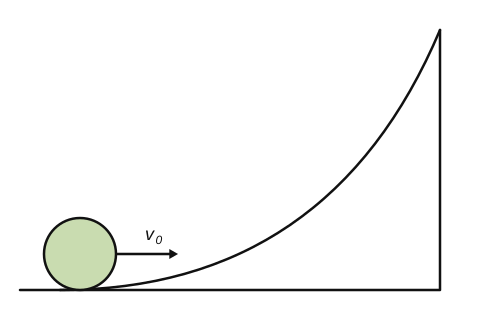
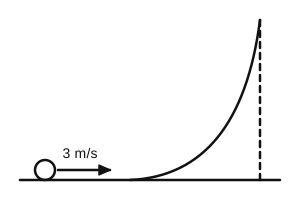
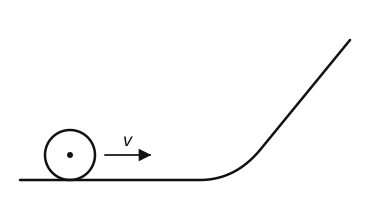
An object of uniform density rolls up the curved path with the initial velocity $v_0$ as shown in the figure. If the maximum height attained by an object is $\dfrac{7v_0^2}{10g}$ ($g =$ acceleration due to gravity), the object is a ______.
Concept. Rolling up without slipping (static friction does no work): all the KE, translational and rotational, becomes PE: $h=\dfrac{v_0^2}{2g}\left(1+\dfrac{k^2}{R^2}\right)$.
Step 2. Identify. $\dfrac{k^2}{R^2}=\dfrac25$: a solid sphere.
Answer. Option D.
Solution by Sreeraj P, M.Sc Physics
Q 11-06-050JEE MainJEE Main 2026 (4 Apr, Shift 1)Hard
A solid sphere of mass $M$ and radius $R$ is divided into two unequal parts. The smaller part having mass $M/8$ is converted into a sphere of radius $r$ and the larger part is converted into a circular disc of thickness $t$ and radius $2R$. If $I_1$ is moment of inertia of a sphere having radius $r$ about an axis through its centre and $I_2$ is the moment of inertia of a disc about its diameter, the ratio of their moment of inertia $I_2/I_1 =$ ______
Q 11-06-053JEE MainJEE Main 2026 (2 Apr, Shift 2)Medium
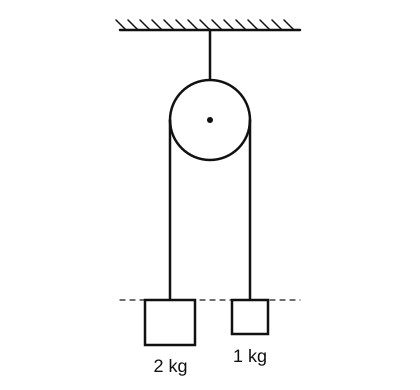
Two blocks of masses $2$ kg and $1$ kg respectively, are tied to the ends of a string which passes over a light frictionless pulley as shown in the figure below. The masses are held at rest at the same horizontal level and then released. The distance traversed by the centre of mass in $2$ s is ______ m. (Take $g=10\ \text{m/s}^2$)
Concept. The centre of mass of the two blocks moves with $a_{cm}=\dfrac{m_1a_1+m_2a_2}{m_1+m_2}$, where the accelerations are taken with signs. Here the blocks move in opposite directions, so their contributions partly cancel.
Step 1. Acceleration of each block (Atwood machine). $$a=\frac{(m_1-m_2)g}{m_1+m_2}=\frac{(2-1)(10)}{3}=\frac{10}{3}\ \text{m s}^{-2}$$ The $2$ kg block goes down, the $1$ kg block goes up.
Step 2. Acceleration of the centre of mass (downward positive): $$a_{cm}=\frac{2\left(\frac{10}{3}\right)+1\left(-\frac{10}{3}\right)}{3}=\frac{10}{9}\ \text{m s}^{-2}\ \text{(downward)}$$
Step 3. Distance in $2$ s from rest. Both blocks start at rest, so the centre of mass does too: $$s=\tfrac12a_{cm}t^2=\tfrac12\cdot\frac{10}{9}\cdot4=\frac{20}{9}=2.22\ \text{m}$$
Answer. $2.22$ m (Option C). Shortcut: for an Atwood machine $a_{cm}=\left(\dfrac{m_1-m_2}{m_1+m_2}\right)^2g$.
Solution by Sreeraj P, M.Sc Physics
Q 11-06-054JEE MainJEE Main 2026 (2 Apr, Shift 2)Medium
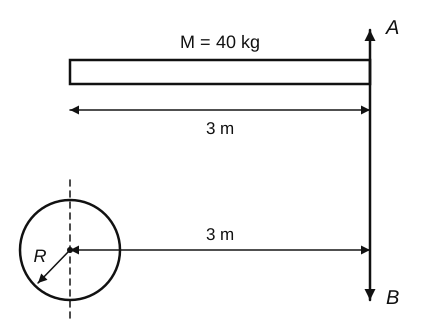
Moment of inertia about an axis $AB$ for a rod of mass $40$ kg and length $3$ m is same as that of a solid sphere of mass of $10$ kg and radius $R$ about an axis parallel to $AB$ axis with separation of $3$ m as shown in figure below. The value of $R$ is given as $\sqrt{\dfrac{\alpha}{2}}$. The value of $\alpha$ is ______.
Setting them equal: $4R^2+90=120\Rightarrow R^2=7.5=\dfrac{15}{2}$, so $R=\sqrt{\dfrac{15}{2}}$ and $\alpha=15$.
Solution by Sreeraj P, M.Sc Physics
Q 11-06-055JEE MainJEE Main 2026 (28 Jan, Shift 2)Easy
When the position vector $\vec r = x\hat i + y\hat j + z\hat k$ changes sign as $-\vec r$, which one of the following vector will not flip under sign change?
Under $\vec r\to -\vec r$: $\vec v = \dfrac{d\vec r}{dt}\to -\vec v$, $\vec p = m\vec v \to -\vec p$ and $\vec a \to -\vec a$ all flip.
Angular momentum $\vec L = \vec r\times\vec p \to (-\vec r)\times(-\vec p) = \vec r\times\vec p$, so it does not flip (it is an axial vector).
Solution by Sreeraj P, M.Sc Physics
Q 11-06-056JEE MainJEE Main 2026 (28 Jan, Shift 2)Medium
A fly wheel having mass 3 kg and radius 5 m is free to rotate about a horizontal axis. A string having negligible mass is wound around the wheel and the loose end of the string is connected to 3 kg mass. The mass is kept at rest initially and released. Kinetic energy of the wheel when the mass descends by 3 m is ______ J. ($g = 10\ \text{m/s}^2$)
Treat the flywheel as a uniform disc: $I = \frac12MR^2$. With no slipping, $v = \omega R$.
Energy conservation: $$mgh = \frac12mv^2 + \frac12I\omega^2 = \frac12mv^2 + \frac14Mv^2$$ $$3\times10\times3 = \frac12(3)v^2 + \frac14(3)v^2 = \frac94v^2 \Rightarrow v^2 = 40\ \text{m}^2/\text{s}^2$$ Kinetic energy of the wheel: $$K = \frac14Mv^2 = \frac14\times3\times40 = 30\ \text{J}$$
Solution by Sreeraj P, M.Sc Physics
Q 11-06-057JEE MainJEE Main 2026 (28 Jan, Shift 1)Hard
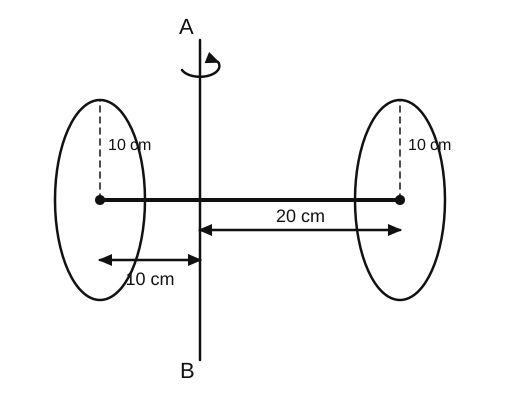
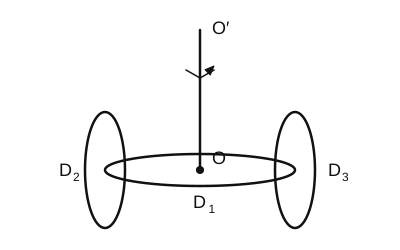
Two circular discs of radius each 10 cm are joined at their centres by a rod of length 30 cm and mass 600 gm as shown in figure.
If the mass of each disc is 600 gm and applied torque between two discs is $43\times10^5$ dyne.cm, the angular acceleration of the discs about the given axis $AB$ is ______ $\text{rad/s}^2$.
The axis $AB$ is perpendicular to the rod, $10$ cm from the left disc's centre and $20$ cm from the right disc's centre. Each disc's plane is perpendicular to the rod, so $AB$ is parallel to a diameter of each disc. Use CGS units ($M = 600$ g, $R = 10$ cm).
Disc about its diameter: $\frac14MR^2 = \frac14(600)(100) = 15000$ g·cm².
Left disc: $15000 + 600(10)^2 = 75000$ g·cm²
Right disc: $15000 + 600(20)^2 = 255000$ g·cm²
Rod ($L = 30$ cm, centre at $5$ cm from $AB$): $\frac{1}{12}(600)(30)^2 + 600(5)^2 = 45000 + 15000 = 60000$ g·cm²
Q 11-06-058JEE MainJEE Main 2026 (28 Jan, Shift 1)Easy
A solid sphere of radius 10 cm is rotating about an axis which is at a distance 15 cm from its centre. The radius of gyration about this axis is $\sqrt n$ cm. The value of $n$ is
Q 11-06-059JEE MainJEE Main 2026 (24 Jan, Shift 2)Medium
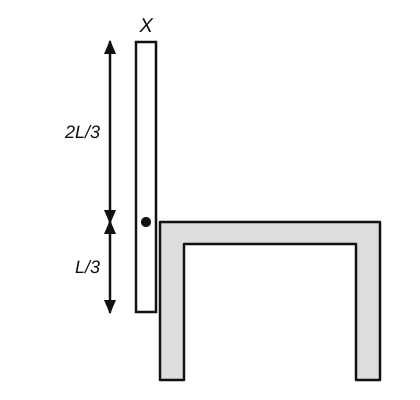
A thin uniform rod $(X)$ of mass $M$ and length $L$ is pivoted at a height $\left(\frac L3\right)$ as shown in the figure. The rod is allowed to fall from a vertical position and lie horizontally on the table. The angular velocity of this rod when it hits the table top, is ______ .
Concept. The rod turns about the pivot from vertical to horizontal; the loss of PE of its centre of mass becomes rotational KE about the pivot.
Step 1. CM height above the pivot. From the figure, $\tfrac{2L}{3}$ is above the pivot and $\tfrac L3$ below. The CM (at $\tfrac L2$ from the bottom) is $\tfrac L2-\tfrac L3=\tfrac L6$ above the pivot; it ends level with the pivot, a drop of $\tfrac L6$.
Step 2. Moment of inertia about the pivot. $\tfrac1{12}ML^2+M\left(\tfrac L6\right)^2=\tfrac{ML^2}{12}+\tfrac{ML^2}{36}=\tfrac{ML^2}{9}$.
Q 11-06-060JEE MainJEE Main 2026 (24 Jan, Shift 2)Easy
A uniform solid cylinder of length $L$ and radius $R$ has moment of inertia about its axis equal to $I_1$. A small co-centric cylinder of length $L/2$ and radius $R/3$ carved from this cylinder has moment of inertia about its axis equals to $I_2$. The ratio $I_1/I_2$ is ______ .
Mass $\propto$ volume $\propto LR^2$. The small cylinder has mass $$m = M\times\frac12\times\frac19 = \frac M{18}$$ $$I_1 = \frac12MR^2,\qquad I_2 = \frac12\cdot\frac M{18}\cdot\frac{R^2}{9} = \frac{MR^2}{324}$$ $$\frac{I_1}{I_2} = \frac{1/2}{1/324} = 162$$
Solution by Sreeraj P, M.Sc Physics
Q 11-06-061JEE MainJEE Main 2026 (24 Jan, Shift 1)Medium
Two masses 400 g and 350 g are suspended from the ends of a light string passing over a heavy pulley of radius 2 cm . When released from rest the heavier mass is observed to fall 81 cm in 9 s . The rotational inertia of the pulley is ______ $\text{kg}\cdot\text{m}^2$.
From $s = \frac12at^2$: $a = \dfrac{2\times0.81}{81} = 0.02\ \text{m/s}^2$.
For an Atwood machine with a pulley of moment of inertia $I$: $$a = \frac{(m_1 - m_2)g}{m_1 + m_2 + I/r^2}\Rightarrow 0.02 = \frac{0.05\times9.8}{0.75 + I/r^2}$$ $$0.75 + \frac{I}{r^2} = 24.5\Rightarrow\frac I{r^2} = 23.75\ \text{kg}$$ $$I = 23.75\times(0.02)^2 = 9.5\times10^{-3}\ \text{kg·m}^2$$
Solution by Sreeraj P, M.Sc Physics
Q 11-06-062JEE MainJEE Main 2025 (22 Jan, Shift 1)Medium
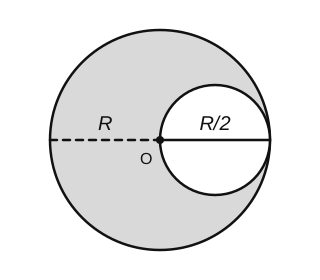
A uniform circular disc of radius $R$ and mass $M$ is rotating about an axis perpendicular to its plane and passing through its centre. A small circular part of radius $R/2$ is removed from the original disc as shown in the figure. Find the moment of inertia of the remaining part of the original disc about the axis as given above.
Concept. $I_{\text{remaining}}=I_{\text{full}}-I_{\text{removed}}$, all about the same axis. The removed disc is off-centre, so its $I$ needs the parallel-axis theorem. Its mass follows from area.
Step 1. Mass removed. Radius halves, so area (and mass) is $\dfrac14$: $m=\dfrac M4$.
Step 2. Where is it? The hole touches the rim and has radius $\dfrac R2$, so its centre is $\dfrac R2$ from $O$.
Step 3. Removed piece about the axis through $O$: $$I_{\text{rem}}=\frac12\cdot\frac M4\left(\frac R2\right)^2+\frac M4\left(\frac R2\right)^2=\frac{MR^2}{32}+\frac{MR^2}{16}=\frac{3MR^2}{32}$$
Step 4. Subtract from the full disc ($\tfrac12MR^2=\tfrac{16}{32}MR^2$): $$I=\frac{16}{32}MR^2-\frac{3}{32}MR^2=\frac{13}{32}MR^2$$
Answer. Option D.
Solution by Sreeraj P, M.Sc Physics
Q 11-06-063JEE MainJEE Main 2025 (22 Jan, Shift 1)Hard
The position vectors of two $1\ \text{kg}$ particles, (A) and (B), are given by $\vec r_A = (\alpha_1t^2\hat i + \alpha_2t\hat j + \alpha_3t\hat k)\ \text{m}$ and $\vec r_B = (\beta_1t\hat i + \beta_2t^2\hat j + \beta_3t\hat k)\ \text{m}$, respectively; ($\alpha_1 = 1\ \text{m/s}^2$, $\alpha_2 = 3n\ \text{m/s}$, $\alpha_3 = 2\ \text{m/s}$, $\beta_1 = 2\ \text{m/s}$, $\beta_2 = -1\ \text{m/s}^2$, $\beta_3 = 4p\ \text{m/s}$), where $t$ is time, $n$ and $p$ are constants. At $t = 1\ \text{s}$, $|\vec V_A| = |\vec V_B|$ and velocities $\vec V_A$ and $\vec V_B$ of the particles are orthogonal to each other. At $t = 1\ \text{s}$, the magnitude of angular momentum of particle (A) with respect to the position of particle (B) is $\sqrt{L}\ \text{kg m}^2\text{s}^{-1}$. The value of $L$ is ______.
Concept. Use the two conditions at $t=1$ s ($|\vec V_A|=|\vec V_B|$ and $\vec V_A\perp\vec V_B$) to find $n$ and $p$. Then $\vec L=\vec r_{AB}\times m\vec V_A$, with $\vec r_{AB}=\vec r_A-\vec r_B$.
Step 1. Velocities at $t=1$. $\vec V_A=(2,\,3n,\,2)$, $\vec V_B=(2,\,-2,\,4p)$.
Step 2. Conditions. Equal magnitudes: $9n^2=16p^2$, so $3n=\pm4p$. Perpendicular: $4-6n+8p=0$. With $3n=4p$ this gives $4=0$ (impossible), so $3n=-4p$: $4+16p=0\Rightarrow p=-\tfrac14$, $n=\tfrac13$.
Step 3. Positions at $t=1$. $\vec r_A=(1,1,2)$, $\vec r_B=(2,-1,-1)$, so $\vec r_{AB}=(-1,2,3)$; $\vec V_A=(2,1,2)$.
Q 11-06-064JEE MainJEE Main 2025 (22 Jan, Shift 2)Easy
The torque due to the force $(2\hat i + \hat j + 2\hat k)$ about the origin, acting on a particle whose position vector is $(\hat i + \hat j + \hat k)$, would be
Q 11-06-065JEE MainJEE Main 2025 (23 Jan, Shift 1)Medium
Consider a circular disc of radius $20\ \text{cm}$ with centre located at the origin. A circular hole of radius $5\ \text{cm}$ is cut from this disc in such a way that the edge of the hole touches the edge of the disc. The distance of the centre of mass of the residual (remaining) disc from the origin will be
Concept. A body with a hole = full body minus the removed piece. Treat the hole as a "negative mass" at its own centre: $x_{cm}=\dfrac{M x_1-m x_2}{M-m}$. For a uniform plate, mass is proportional to area.
Step 1. Locate the hole. Disc radius $R=20$ cm at the origin. The hole (radius $5$ cm) touches the rim, so its centre is at $x_2=20-5=15$ cm.
Step 2. Masses by area. Take the mass per unit area as $\sigma$. $$M=\sigma\pi(20)^2=400\pi\sigma,\qquad m=\sigma\pi(5)^2=25\pi\sigma$$
Step 3. Apply the negative-mass formula. The full disc's centre is at $x_1=0$: $$x_{cm}=\frac{400\pi\sigma(0)-25\pi\sigma(15)}{400\pi\sigma-25\pi\sigma}=\frac{-375}{375}=-1\ \text{cm}$$
Answer. $1.0$ cm from the origin, on the side opposite the hole (Option C). The centre of mass always shifts away from a hole.
Solution by Sreeraj P, M.Sc Physics
Q 11-06-066JEE MainJEE Main 2025 (23 Jan, Shift 1)Medium
A solid sphere of mass $m$ and radius $r$ is allowed to roll without slipping from the highest point of an inclined plane of length $L$ that makes an angle $30^\circ$ with the horizontal. The speed of the sphere at the bottom of the plane is $v_1$. If the angle of inclination is increased to $45^\circ$ while keeping $L$ constant, then the new speed of the sphere at the bottom of the plane is $v_2$. The ratio $v_1^2 : v_2^2$ is
Q 11-06-067JEE MainJEE Main 2025 (23 Jan, Shift 2)Medium
A circular disk of radius $R$ metre and mass $M$ kg is rotating around the axis perpendicular to the disk. An external torque is applied to the disk such that $\theta(t) = 5t^2 - 8t$, where $\theta(t)$ is the angular position of the rotating disc as a function of time $t$. How much power is delivered by the applied torque when $t = 2\ \text{s}$?
Taking the axis through the centre, $I = \tfrac{1}{2}MR^2$: $$\tau = I\alpha = \frac{1}{2}MR^2\times10 = 5MR^2$$ $$P = \tau\omega = 5MR^2\times12 = 60MR^2$$
Solution by Sreeraj P, M.Sc Physics
Q 11-06-068JEE MainJEE Main 2025 (24 Jan, Shift 1)Easy
A uniform solid cylinder of mass $m$ and radius $r$ rolls along an inclined rough plane of inclination $45^\circ$. If it starts to roll from rest from the top of the plane, then the linear acceleration of the cylinder's axis will be
Q 11-06-069JEE MainJEE Main 2025 (24 Jan, Shift 1)Medium
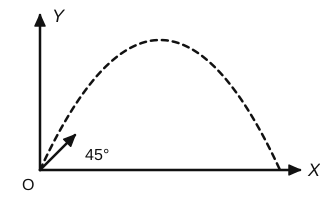
An object of mass $m$ is projected from the origin in a vertical $xy$ plane at an angle $45^\circ$ with the $x$-axis with an initial velocity $v_0$. The magnitude and direction of the angular momentum of the object with respect to the origin, when it reaches the maximum height, will be ($g$ is acceleration due to gravity)
Answer: (C) $\dfrac{mv_0^3}{4\sqrt2g}$ along negative $z$-axis
Concept. At the top the velocity is horizontal, $v_0\cos45^\circ$, at height $H$. About the origin, $L=mvH$ (perpendicular distance $H$); the direction follows from $\vec r\times\vec v$.
Step 3. Direction. $L_z=xp_y-yp_x=0-H(mv)\lt0$: along $-z$.
Answer. Option C.
Solution by Sreeraj P, M.Sc Physics
Q 11-06-070JEE MainJEE Main 2025 (24 Jan, Shift 2)Easy
A solid sphere and a hollow sphere of the same mass and of same radius are rolled on an inclined plane. Let the time taken to reach the bottom by the solid sphere and the hollow sphere be $t_1$ and $t_2$, respectively, then
$a_1 > a_2$, and for the same length $t = \sqrt{2L/a}$, so $t_1 < t_2$.
Solution by Sreeraj P, M.Sc Physics
Q 11-06-071JEE MainJEE Main 2025 (24 Jan, Shift 2)Easy
A solid sphere is rolling without slipping on a horizontal plane. The ratio of the linear kinetic energy of the centre of mass of the sphere and rotational kinetic energy is
Q 11-06-072JEE MainJEE Main 2025 (28 Jan, Shift 1)Medium
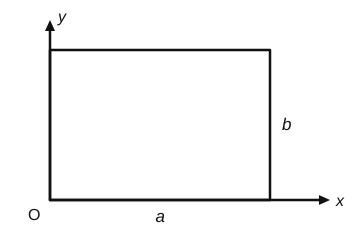
The centre of mass of a thin rectangular plate (fig - x) with sides of length $a$ and $b$, whose mass per unit area $(\sigma)$ varies as $\sigma = \dfrac{\sigma_0x}{ab}$ (where $\sigma_0$ is a constant), would be
Centre of mass: $\left(\dfrac{2a}{3}, \dfrac{b}{2}\right)$
Solution by Sreeraj P, M.Sc Physics
Q 11-06-073JEE MainJEE Main 2025 (28 Jan, Shift 1)Easy
Two iron solid discs of negligible thickness have radii $R_1$ and $R_2$ and moments of inertia $I_1$ and $I_2$, respectively. For $R_2 = 2R_1$, the ratio of $I_1$ and $I_2$ would be $1/x$, where $x$ = ______.
Q 11-06-074JEE MainJEE Main 2025 (28 Jan, Shift 1)Medium
The moment of inertia of a solid disc rotating about its diameter is $2.5$ times the moment of inertia of a ring rotating in a similar way. The moment of inertia of a solid sphere which has the same radius as the disc and rotates in a similar way is $n$ times the moment of inertia of the given ring. Here, $n$ = ______. Consider all the bodies to have equal masses.
Q 11-06-075JEE MainJEE Main 2025 (28 Jan, Shift 2)Easy
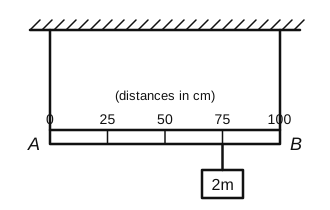
A uniform rod of mass $250\ \text{g}$ having length $100\ \text{cm}$ is balanced on a sharp edge at the $40\ \text{cm}$ mark. A mass of $400\ \text{g}$ is suspended at the $10\ \text{cm}$ mark. To maintain the balance of the rod, the mass to be suspended at the $90\ \text{cm}$ mark is
Concept. A body balanced on a pivot has zero net torque about that pivot: clockwise moments = anticlockwise moments. The rod's own weight acts at its centre (the $50$ cm mark).
Q 11-06-076JEE MainJEE Main 2025 (29 Jan, Shift 1)Easy
The coordinates of a particle with respect to the origin in a given reference frame are $(1, 1, 1)$ metres. If a force $\vec F = \hat i - \hat j + \hat k$ acts on the particle, then the magnitude of the torque (with respect to the origin) in the $z$-direction is ______.
Concept. The $z$ component of $\vec r\times\vec F$ is $\tau_z=xF_y-yF_x$.
Step 1. Substitute. $\tau_z=(1)(-1)-(1)(1)=-2$ N m.
Answer. Magnitude $2$.
Solution by Sreeraj P, M.Sc Physics
Q 11-06-077JEE MainJEE Main 2024 (1 Feb, Shift 1)Easy
Three identical spheres, each of mass $2M$, are placed at the corners of a right angled triangle with mutually perpendicular sides equal to $4\ \text{m}$ each. Taking the point of intersection of these two sides as origin, the magnitude of the position vector of the centre of mass of the system is $\dfrac{4\sqrt2}{x}$, where the value of $x$ is ______.
Concept. $\vec r_{cm}=\dfrac{\sum m_i\vec r_i}{\sum m_i}$. Put the origin at the right-angle corner, where one mass sits.
Step 1. Positions. $(0,0)$, $(4,0)$, $(0,4)$ m, all of mass $2M$.
Step 2. Centre of mass. Equal masses: the average position $\left(\tfrac43,\tfrac43\right)$ m.
Step 3. Magnitude. $\sqrt{\tfrac{16}9+\tfrac{16}9}=\dfrac{4\sqrt2}{3}$ m, so $x=3$.
Answer. $3$.
Solution by Sreeraj P, M.Sc Physics
Q 11-06-078JEE MainJEE Main 2024 (1 Feb, Shift 2)Top questionMedium
A disc of radius $R$ and mass $M$ is rolling horizontally without slipping with speed $v$. It then moves up an inclined smooth surface as shown in the figure. The maximum height that the disc can go up the incline is
Concept. On a smooth incline there is no friction, so nothing can change the disc's spin (gravity and the normal force pass through the centre). The rotational energy stays locked in rotation; only the translational energy converts into height.
Step 1. What converts. $\tfrac12Mv^2=Mgh$.
Step 2. Solve. $h=\dfrac{v^2}{2g}$.
Answer. Option C. On a rough incline (rolling up) the disc would rise higher, to $\dfrac{3v^2}{4g}$.
Solution by Sreeraj P, M.Sc Physics
Q 11-06-079JEE MainJEE Main 2024 (1 Feb, Shift 2)Medium
A uniform rod $AB$ of mass $2\ \text{kg}$ and length $30\ \text{cm}$ is at rest on a smooth horizontal surface. An impulse of $0.2\ \text{N s}$ is applied to end B. The time taken by the rod to turn through a right angle will be $\dfrac{\pi}{x}\ \text{s}$, where $x = $ ______.
Concept. On a smooth surface the rod is free. An impulse $J$ at the end gives $v_{cm}=J/M$ and an angular impulse about the CM $J\tfrac l2=I_{cm}\omega$. The rod then turns at constant $\omega$.
Step 2. Time for a right angle. $t=\dfrac{\pi/2}{2}=\dfrac\pi4$ s.
Answer. $x=4$.
Solution by Sreeraj P, M.Sc Physics
Q 11-06-080JEE MainJEE Main 2024 (4 Apr, Shift 1)Medium
A solid sphere and a hollow cylinder roll up without slipping on the same inclined plane with the same initial speed $v$. The sphere and the cylinder reach up to maximum heights $h_1$ and $h_2$, respectively, above the initial level. The ratio $h_1 : h_2$ is $\dfrac{n}{10}$. The value of $n$ is ______.
Q 11-06-081JEE MainJEE Main 2024 (4 Apr, Shift 2)Easy
In a system, two particles of masses $m_1 = 3\ \text{kg}$ and $m_2 = 2\ \text{kg}$ are placed at a certain distance from each other. The particle of mass $m_1$ is moved towards the centre of mass of the system through a distance of $2\ \text{cm}$. In order to keep the centre of mass of the system at the original position, the particle of mass $m_2$ should move towards the centre of mass by a distance of ______ cm.
Concept. The centre of mass stays where it is only if the mass-weighted shifts cancel: $m_1\,\Delta x_1+m_2\,\Delta x_2=0$. So the two particles must move in opposite directions along the line joining them.
Step 1. Write the condition. Take the line through the particles as the $x$-axis. Moving $m_1$ towards the centre of mass by $2$ cm gives $\Delta x_1=+2$ cm (say). For the centre of mass not to move, $$m_1\Delta x_1+m_2\Delta x_2=0\ \Rightarrow\ 3(2)+2\,\Delta x_2=0\ \Rightarrow\ \Delta x_2=-3\ \text{cm}$$
Step 2. Read the sign. $\Delta x_2$ is opposite to $\Delta x_1$. Since $m_2$ lies on the other side of the centre of mass, moving opposite to $m_1$ means moving towards the centre of mass.
Answer. $m_2$ moves $3$ cm towards the centre of mass. The lighter particle has to move farther: shifts are in the inverse ratio of the masses.
Solution by Sreeraj P, M.Sc Physics
Q 11-06-082JEE MainJEE Main 2024 (5 Apr, Shift 1)Hard
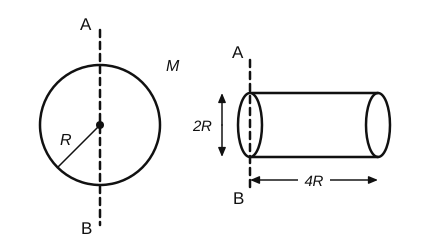
The ratio of the radius of gyration of a hollow sphere to that of a solid cylinder of equal mass, for moments of inertia about their diameter axes AB as shown in the figure, is $\sqrt{8/x}$. The value of $x$ is
Hollow sphere about a diameter: $k_1^2 = \dfrac23R^2$.
Solid cylinder (radius $R$, length $L = 4R$) about a diameter of its end face (perpendicular to its length): $$I = M\left(\frac{R^2}{4} + \frac{L^2}{3}\right) = M\left(\frac{R^2}{4} + \frac{16R^2}{3}\right) = \frac{67}{12}MR^2 \Rightarrow k_2^2 = \frac{67}{12}R^2$$ $$\frac{k_1}{k_2} = \sqrt{\frac{2/3}{67/12}} = \sqrt{\frac{8}{67}} \Rightarrow x = 67$$
Solution by Sreeraj P, M.Sc Physics
Q 11-06-083JEE MainJEE Main 2024 (5 Apr, Shift 2)Easy
A hollow sphere is rolling on a plane surface about its axis of symmetry. The ratio of its rotational kinetic energy to its total kinetic energy is $\dfrac{x}{5}$. The value of $x$ is ______.
Q 11-06-084JEE MainJEE Main 2024 (6 Apr, Shift 1)Medium
If the radius of the earth is reduced to three-fourths of its present value without change in its mass, then the duration of the day on earth will be ______ hours 30 minutes.
Concept. No external torque: $I\omega$ is conserved. With $I=\tfrac25MR^2$ and fixed $M$, $T\propto R^2$.
Step 1. New day. $T'=24\times\left(\tfrac34\right)^2=24\times\tfrac9{16}=13.5$ h $=13$ h $30$ min.
Answer. $13$.
Solution by Sreeraj P, M.Sc Physics
Q 11-06-085JEE MainJEE Main 2024 (6 Apr, Shift 2)Medium
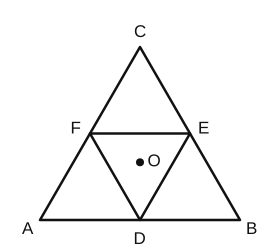
Three balls of masses $2\ \text{kg}$, $4\ \text{kg}$ and $6\ \text{kg}$ are placed at the midpoints of the sides of an equilateral triangle of side $2\ \text{m}$. The moment of inertia of the system about an axis through the centroid and perpendicular to the plane of the triangle will be ______ $\text{kg m}^2$.
Concept. For point masses $I=\sum mr^2$. The midpoint of each side of an equilateral triangle is the inradius $r=\dfrac{a}{2\sqrt3}$ from the centroid.
Step 1. Distance. $r=\dfrac{2}{2\sqrt3}=\dfrac1{\sqrt3}$ m, so $r^2=\tfrac13$.
Step 2. Sum. $I=(2+4+6)\times\tfrac13=4$ kg m$^2$.
Answer. $4$.
Solution by Sreeraj P, M.Sc Physics
Q 11-06-086JEE MainJEE Main 2024 (27 Jan, Shift 1)Easy
Four particles, each of mass $1\ \text{kg}$, are placed at four corners of a square of side $2\ \text{m}$. The moment of inertia of the system about an axis perpendicular to its plane and passing through one of its vertices is ______ $\text{kg m}^2$.
Q 11-06-087JEE MainJEE Main 2024 (27 Jan, Shift 2)Medium
A heavy iron bar of weight $12\ \text{kg-wt}$ is having its one end on the ground and the other on the shoulder of a man. The rod makes an angle $60^\circ$ with the horizontal. The normal force applied by the man on the bar is:
Concept. The man's force is normal to the bar. Take moments about the end on the ground: the weight acts at the middle, with horizontal arm $\tfrac L2\cos60^\circ$; the man's force acts at the far end with arm $L$ (it is perpendicular to the bar).
Q 11-06-088JEE MainJEE Main 2024 (27 Jan, Shift 2)Medium
A ring and a solid sphere roll down the same inclined plane without slipping. They start from rest. The radii of both bodies are identical and the ratio of their kinetic energies is $\dfrac{7}{x}$, where $x$ is ______.
In rolling without slipping, static friction does no work, so mechanical energy is conserved. Taking bodies of equal mass that descend the same height $h$, each gains kinetic energy (translational + rotational) equal to the loss in potential energy: $$K_{ring} = K_{sphere} = mgh$$ Only the split between translational and rotational energy differs. The ratio is $1 = \dfrac77$, so $x = 7$.
Solution by Sreeraj P, M.Sc Physics
Q 11-06-089JEE MainJEE Main 2024 (29 Jan, Shift 1)Easy
A cylinder is rolling down on an inclined plane of inclination $60^\circ$. Its acceleration during rolling down will be $\dfrac{x}{\sqrt3}\ \text{m s}^{-2}$, where $x =$ ______ (use $g = 10\ \text{m s}^{-2}$).
For a solid cylinder $\dfrac{k^2}{R^2} = \dfrac12$: $$a = \frac{g\sin\theta}{1 + \frac{k^2}{R^2}} = \frac23\times10\times\frac{\sqrt3}{2} = \frac{10}{\sqrt3}\ \text{m s}^{-2}$$ So $x = 10$.
Solution by Sreeraj P, M.Sc Physics
Q 11-06-090JEE MainJEE Main 2024 (29 Jan, Shift 2)Medium
A body of mass $5\ \text{kg}$ moving with a uniform speed $3\sqrt2\ \text{m s}^{-1}$ in the $X$–$Y$ plane along the line $y = x + 4$. The angular momentum of the particle about the origin will be ______ $\text{kg m}^2\,\text{s}^{-1}$.
Concept. For a particle moving in a straight line, $L=mv\,d$, where $d$ is the perpendicular distance from the reference point to the line of motion. It stays constant along the line.
Step 1. Perpendicular distance from the origin to $x-y+4=0$: $$d=\frac{|0-0+4|}{\sqrt{1^2+1^2}}=\frac{4}{\sqrt2}=2\sqrt2\ \text{m}$$
Q 11-06-091JEE MainJEE Main 2024 (8 Apr, Shift 1)Medium
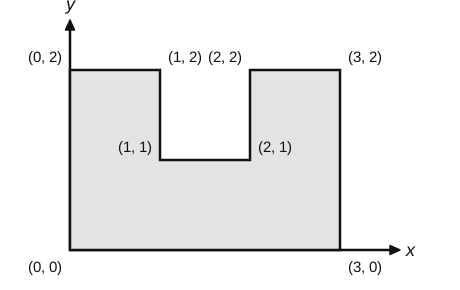
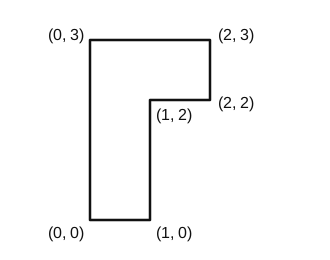
A uniform thin metal plate of mass $10\ \text{kg}$ with dimensions is shown. The ratio of $x$ and $y$ coordinates of the centre of mass of the plate is $\dfrac n9$. The value of $n$ is ______.
Concept. A cut-out acts as negative mass (mass $\propto$ area for a uniform plate). Use the whole rectangle minus the square.
Step 1. Pieces. Rectangle $3\times2$: area $6$, centre $(1.5,1)$. Square from $(1,1)$ to $(2,2)$: area $1$, centre $(1.5,1.5)$.
Step 2. Coordinates. $x_{cm}=1.5$ by symmetry. $$y_{cm}=\frac{6(1)-1(1.5)}{6-1}=\frac{4.5}{5}=0.9$$
Step 3. Ratio. $\dfrac{1.5}{0.9}=\dfrac{15}{9}$, so $n=15$.
Answer. $15$.
Solution by Sreeraj P, M.Sc Physics
Q 11-06-092JEE MainJEE Main 2024 (8 Apr, Shift 2)Easy
A thin circular disc of mass $M$ and radius $R$ is rotating in a horizontal plane about an axis passing through its centre and perpendicular to its plane with angular velocity $\omega$. If another disc of same dimensions but of mass $M/2$ is placed gently on the first disc co-axially, then the new angular velocity of the system is:
Q 11-06-093JEE MainJEE Main 2024 (9 Apr, Shift 1)Easy
A heavy iron bar of weight $W$ is having its one end on the ground and the other on the shoulder of a person. The bar makes an angle $\theta$ with the horizontal. The weight experienced by the person is:
Take the person's supporting force $F$ as vertical. Taking torques about the end on the ground (bar length $L$, weight acting at the middle): $$F\,(L\cos\theta) = W\left(\frac L2\cos\theta\right) \;\Rightarrow\; F = \frac W2$$
Solution by Sreeraj P, M.Sc Physics
Q 11-06-094JEE MainJEE Main 2024 (9 Apr, Shift 1)Easy
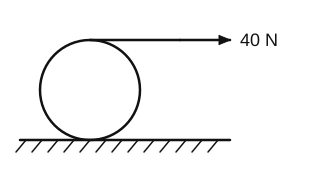
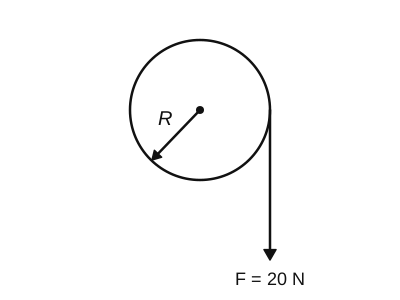
A string is wrapped around the rim of a wheel of moment of inertia $0.40\ \text{kg m}^2$ and radius $10\ \text{cm}$. The wheel is free to rotate about its axis. Initially the wheel is at rest. The string is now pulled by a force of $40\ \text{N}$. The angular velocity of the wheel after $10\ \text{s}$ is $x\ \text{rad/s}$, where $x$ is ______.
Q 11-06-095JEE MainJEE Main 2024 (9 Apr, Shift 2)Easy
A circular disc reaches from top to bottom of an inclined plane of length $l$. When it slips down the plane, it takes $t$ s. When it rolls down the plane, it takes $\left(\dfrac\alpha2\right)^{1/2}t$ s, where $\alpha$ is ______.
Concept. Down a plane of length $l$ from rest, $l=\tfrac12at^2$, so $t\propto\dfrac1{\sqrt a}$. Sliding (no friction): $a=g\sin\theta$. Rolling: $a=\dfrac{g\sin\theta}{1+k^2/R^2}$.
Step 1. Accelerations. For a disc $\dfrac{k^2}{R^2}=\dfrac12$: $$a_{\text{slip}}=g\sin\theta,\qquad a_{\text{roll}}=\frac{g\sin\theta}{3/2}=\frac23g\sin\theta$$
Step 3. Match the form. $\left(\dfrac\alpha2\right)^{1/2}=\left(\dfrac32\right)^{1/2}$, so $\alpha=3$.
Answer. $3$.
Solution by Sreeraj P, M.Sc Physics
Q 11-06-096JEE MainJEE Main 2024 (30 Jan, Shift 1)Medium
A particle of mass $m$ is projected with a velocity $u$ making an angle of $30^\circ$ with the horizontal. The magnitude of angular momentum of the projectile about the point of projection when the particle is at its maximum height $h$ is:
Concept. $L=mv_\perp\,d$. At the top of the flight the velocity is horizontal ($u\cos\theta$), and its line is at height $H$ above the point of projection. So $L=m(u\cos\theta)H$.
Step 1. Maximum height. $$H=\frac{u^2\sin^2 30^\circ}{2g}=\frac{u^2}{8g}$$
Step 2. Speed at the top. $u\cos30^\circ=\dfrac{\sqrt3}{2}u$.
Q 11-06-097JEE MainJEE Main 2024 (30 Jan, Shift 1)Medium
Consider a disc of mass $5\ \text{kg}$ and radius $2\ \text{m}$, rotating with angular velocity of $10\ \text{rad s}^{-1}$ about an axis through its centre perpendicular to its plane. An identical disc is kept gently over the rotating disc along the same axis. The energy dissipated so that both the discs continue to rotate together without slipping is ______ J.
Concept. Angular momentum is conserved; kinetic energy is not (friction between the discs). Identical disc: $\omega$ halves and $I$ doubles, so half the KE is lost.
Step 1. Initial KE. $I=\tfrac12(5)(4)=10$ kg m$^2$; $K=\tfrac12(10)(100)=500$ J.
Step 2. Final KE. $\omega'=5$ rad/s, $I'=20$: $K'=\tfrac12(20)(25)=250$ J.
Step 3. Dissipated. $500-250=250$ J.
Answer. $250$.
Solution by Sreeraj P, M.Sc Physics
Q 11-06-098JEE MainJEE Main 2024 (30 Jan, Shift 2)Medium
Two discs of moment of inertia $I_1 = 4\ \text{kg m}^2$ and $I_2 = 2\ \text{kg m}^2$ about their central axes and normal to their planes, rotating with angular speeds $10\ \text{rad s}^{-1}$ and $4\ \text{rad s}^{-1}$ respectively, are brought into contact face to face with their axes of rotation coincident. The loss in kinetic energy of the system in the process is ______ J.
Assuming both rotate in the same sense, angular momentum is conserved: $$\omega = \frac{4\times10 + 2\times4}{6} = 8\ \text{rad s}^{-1}$$ $$K_i = \tfrac12(4)(100) + \tfrac12(2)(16) = 216\ \text{J},\qquad K_f = \tfrac12(6)(64) = 192\ \text{J}$$ Loss $= 24\ \text{J}$.
Solution by Sreeraj P, M.Sc Physics
Q 11-06-099JEE MainJEE Main 2024 (31 Jan, Shift 1)Medium
A solid circular disc of mass $50\ \text{kg}$ rolls along a horizontal floor so that its centre of mass has a speed of $0.4\ \text{m s}^{-1}$. The absolute value of work done on the disc to stop it is ______ J.
For a rolling disc $K = \tfrac12mv^2\left(1 + \dfrac{k^2}{R^2}\right) = \tfrac34mv^2$. $$K = \tfrac34\times50\times0.16 = 6\ \text{J}$$ By the work–energy theorem $|W| = 6\ \text{J}$.
Solution by Sreeraj P, M.Sc Physics
Q 11-06-100JEE MainJEE Main 2024 (31 Jan, Shift 2)Medium
Two identical spheres each of mass $2\ \text{kg}$ and radius $50\ \text{cm}$ are fixed at the ends of a light rod so that the separation between the centres is $150\ \text{cm}$. Then, the moment of inertia of the system about an axis perpendicular to the rod and passing through its middle point is $\dfrac{x}{20}\ \text{kg m}^2$, where the value of $x$ is ______.
Concept. Each sphere: $I_{cm}=\tfrac25mR^2$ plus $md^2$ (parallel axes), with $d$ half the centre separation.
Step 1. One sphere. $\tfrac25(2)(0.5)^2+2(0.75)^2=0.2+1.125=1.325$ kg m$^2$.
Step 2. Two spheres. $2.65=\dfrac{53}{20}$ kg m$^2$.
Answer. $53$.
Solution by Sreeraj P, M.Sc Physics
Q 11-06-101JEE MainJEE Main 2024 (31 Jan, Shift 2)Medium
A body of mass $m$ is projected with a speed $u$ making an angle of $45^\circ$ with the ground. The angular momentum of the body about the point of projection, at the highest point, is expressed as $\dfrac{\sqrt2\,mu^3}{Xg}$. The value of $X$ is ______.
At the top, $v = u\cos45^\circ = \dfrac{u}{\sqrt2}$ (horizontal) and $H = \dfrac{u^2\sin^245^\circ}{2g} = \dfrac{u^2}{4g}$. $$L = mvH = m\frac{u}{\sqrt2}\cdot\frac{u^2}{4g} = \frac{mu^3}{4\sqrt2\,g} = \frac{\sqrt2\,mu^3}{8g}$$ $X = 8$.
Solution by Sreeraj P, M.Sc Physics
Q 11-06-102JEE MainJEE Main 2023 (29 Jan, Shift 1)Easy
A solid sphere of mass $2\ \text{kg}$ is making pure rolling on a horizontal surface with kinetic energy $2240\ \text{J}$. The velocity of centre of mass of the sphere will be ______ $\text{m s}^{-1}$.
Q 11-06-103JEE MainJEE Main 2023 (29 Jan, Shift 2)Medium
A particle of mass $100\ \text{g}$ is projected at time $t=0$ with a speed $20\ \text{m s}^{-1}$ at an angle $45^\circ$ to the horizontal as given in the figure. The magnitude of the angular momentum of the particle about the starting point at time $t=2\ \text{s}$ is found to be $\sqrt{K}\ \text{kg m}^2\ \text{s}^{-1}$. The value of $K$ is ______. (Take $g=10\ \text{m s}^{-2}$)
The angular momentum about the launch point is $L=m\,|\vec r\times\vec v|$. With $\vec r=(u_xt,\ u_yt-\tfrac12gt^2)$ and $\vec v=(u_x,\ u_y-gt)$: $$L=m\left[u_xt(u_y-gt)-u_x\left(u_yt-\tfrac12gt^2\right)\right]=-\tfrac12mgu_xt^2$$ Magnitude: $L=\tfrac12mg\,u\cos45^\circ\,t^2=\tfrac12\times0.1\times10\times\dfrac{20}{\sqrt2}\times4=20\sqrt2=\sqrt{800}$.
So $K=800$.
Solution by Sreeraj P, M.Sc Physics
Q 11-06-104JEE MainJEE Main 2023 (30 Jan, Shift 1)Easy
A thin uniform rod of length $2\ \text{m}$, cross sectional area $A$ and density $d$ is rotated about an axis passing through the centre and perpendicular to its length with angular velocity $\omega$. If value of $\omega$ in terms of its rotational kinetic energy $E$ is $\sqrt{\dfrac{\alpha E}{Ad}}$, then the value of $\alpha$ is ______.
Q 11-06-105JEE MainJEE Main 2023 (30 Jan, Shift 2)Hard
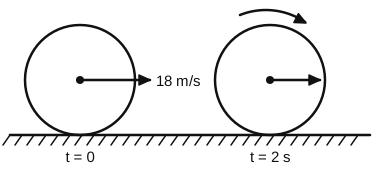
A uniform disc of mass $0.5\ \text{kg}$ and radius $r$ is projected with velocity $18\ \text{m s}^{-1}$ at $t=0$ s on a rough horizontal surface. It starts off with a purely sliding motion at $t=0$ s. After $2$ s it acquires a purely rolling motion (see figure). The total kinetic energy of the disc after $2$ s will be ______ J. (given, coefficient of friction is $0.3$ and $g=10\ \text{m s}^{-2}$)
Concept. At first the disc slides, so kinetic friction $\mu mg$ acts backwards. It slows the centre and spins the disc up. Pure rolling starts when $v=\omega R$. Angular momentum about the contact point is conserved (friction passes through it), which gives the final speed directly.
Step 1. Final speed from angular momentum about the contact point. Initially $L=mv_0R$ (no spin). Finally $L=mvR+\tfrac12mR^2\cdot\dfrac vR=\tfrac32mvR$. $$mv_0R=\frac32mvR\ \Rightarrow\ v=\frac23v_0=12\ \text{m s}^{-1}$$
Step 2. Check the time. Friction decelerates the centre: $v=18-\mu gt=18-3t$. Its torque $\mu mgR=\tfrac12mR^2\alpha$ gives $\alpha R=2\mu g$, so $\omega R=2\mu gt=6t$. They are equal at $t=2$ s, as given.
Step 3. Kinetic energy when rolling. $$K=\frac12mv^2\left(1+\frac12\right)=\frac34mv^2=\frac34\times0.5\times144=54\ \text{J}$$
Answer. $54$ J.
Solution by Sreeraj P, M.Sc Physics
Q 11-06-106JEE MainJEE Main 2023 (31 Jan, Shift 1)Easy
A solid sphere of mass $1\ \text{kg}$ rolls without slipping on a plane surface. Its kinetic energy is $7\times10^{-3}\ \text{J}$. The speed of the centre of mass of the sphere is ______ $\text{cm s}^{-1}$.
For a rolling solid sphere $K=\dfrac7{10}mv^2$: $$7\times10^{-3}=0.7\times1\times v^2\Rightarrow v=0.1\ \text{m s}^{-1}=10\ \text{cm s}^{-1}$$
Solution by Sreeraj P, M.Sc Physics
Q 11-06-107JEE MainJEE Main 2023 (31 Jan, Shift 2)Medium
Two discs of same mass and different radii are made of different materials such that their thicknesses are $1\ \text{cm}$ and $0.5\ \text{cm}$ respectively. The densities of materials are in the ratio $3:5$. The moment of inertia of these discs respectively about their diameters will be in the ratio of $\dfrac x6$. The value of $x$ is ______.
Equal masses: $\rho_1\pi r_1^2t_1=\rho_2\pi r_2^2t_2$, so $$\frac{r_1^2}{r_2^2}=\frac{\rho_2t_2}{\rho_1t_1}=\frac{5\times0.5}{3\times1}=\frac56$$ About a diameter $I=\dfrac{mr^2}{4}$, so $\dfrac{I_1}{I_2}=\dfrac{r_1^2}{r_2^2}=\dfrac56$ and $x=5$.
Solution by Sreeraj P, M.Sc Physics
Q 11-06-108JEE MainJEE Main 2023 (24 Jan, Shift 1)Easy
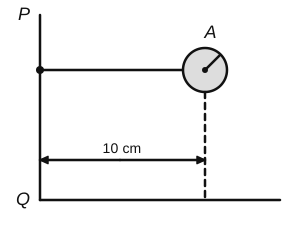
Solid sphere $A$ is rotating about an axis $PQ$. If the radius of the sphere is $5\ \text{cm}$, then its radius of gyration about $PQ$ will be $\sqrt x$ cm. The value of $x$ is ______.
Q 11-06-109JEE MainJEE Main 2023 (24 Jan, Shift 2)Medium
A uniform solid cylinder with radius $R$ and length $L$ has moment of inertia $I_1$ about the axis of cylinder. A concentric solid cylinder of radius $R'=\dfrac R2$ and length $L'=\dfrac L2$ is carved out of the original cylinder. If $I_2$ is the moment of inertia of the carved out portion of the cylinder, then $\dfrac{I_1}{I_2}=$ ______. (Both $I_1$ and $I_2$ are about the axis of the cylinder)
The carved part has $\dfrac14$ of the cross-section and $\dfrac12$ the length, so its mass is $\dfrac M8$. $$I_1=\frac12MR^2,\qquad I_2=\frac12\cdot\frac M8\cdot\frac{R^2}{4}=\frac{MR^2}{64}$$ $\dfrac{I_1}{I_2}=32$.
Solution by Sreeraj P, M.Sc Physics
Q 11-06-110JEE MainJEE Main 2023 (25 Jan, Shift 1)Medium
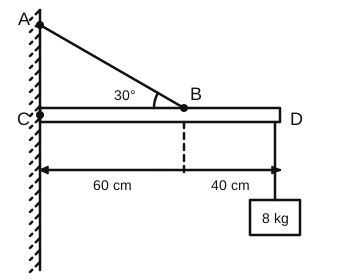
An object of mass $8\ \text{kg}$ is hanging from one end of a uniform rod $CD$ of mass $2\ \text{kg}$ and length $1\ \text{m}$ pivoted at its end $C$ on a vertical wall as shown in figure. It is supported by a cable $AB$ such that the system is in equilibrium. The tension in the cable is (Take $g=10\ \text{m s}^{-2}$)
Concept. For the rod in equilibrium, take torques about the hinge $C$. The hinge force then has zero lever arm and drops out, leaving one equation for the tension.
Step 1. Clockwise torques (weights) about $C$.
$8$ kg at $D$, $1$ m away: $80\times1=80$ N m
rod's weight $20$ N at its centre, $0.5$ m: $10$ N m
Total: $90$ N m.
Step 2. Anticlockwise torque (cable). The cable meets the rod at $B$, $0.6$ m from $C$, at $30^\circ$. Only the component perpendicular to the rod turns it: $$\tau_T=T\sin30^\circ\times0.6=0.3\,T$$
Step 3. Balance: $0.3\,T=90\Rightarrow T=300$ N.
Answer. Option C.
Solution by Sreeraj P, M.Sc Physics
Q 11-06-111JEE MainJEE Main 2023 (25 Jan, Shift 1)Easy
$I_{CM}$ is moment of inertia of a circular disc about an axis (CM) passing through its center and perpendicular to the plane of disc. $I_{AB}$ is its moment of inertia about an axis AB perpendicular to plane and parallel to axis CM at a distance $\dfrac23R$ from center, where $R$ is the radius of the disc. The ratio of $I_{AB}$ and $I_{CM}$ is $x:9$. The value of $x$ is ______.
Parallel axis theorem: $$I_{AB}=\frac12MR^2+M\left(\frac23R\right)^2=MR^2\left(\frac12+\frac49\right)=\frac{17}{18}MR^2$$ $\dfrac{I_{AB}}{I_{CM}}=\dfrac{17/18}{1/2}=\dfrac{17}{9}$, so $x=17$.
Solution by Sreeraj P, M.Sc Physics
Q 11-06-112JEE MainJEE Main 2023 (25 Jan, Shift 2)Medium
If a solid sphere of mass $5\ \text{kg}$ and a disc of mass $4\ \text{kg}$ have the same radius, then the ratio of moment of inertia of the disc about a tangent in its plane to the moment of inertia of the sphere about its tangent will be $\dfrac x7$. The value of $x$ is ______.
Q 11-06-113JEE MainJEE Main 2023 (13 Apr, Shift 2)Easy
A light rope is wound around a hollow cylinder of mass $5\ \text{kg}$ and radius $70\ \text{cm}$. The rope is pulled with a force of $52.5\ \text{N}$. The angular acceleration of the cylinder will be ______ $\text{rad s}^{-2}$.
Q 11-06-114JEE MainJEE Main 2023 (15 Apr, Shift 1)Easy
A solid sphere and a solid cylinder of same mass and radius are rolling on a horizontal surface without slipping. The ratio of their radius of gyrations respectively $(k_{sph}:k_{cyl})$ is $2:\sqrt x$. The value of $x$ is ______.
$k_{sph}=\sqrt{\tfrac25}R$, $k_{cyl}=\sqrt{\tfrac12}R$ (about their symmetry axes). $$\frac{k_{sph}}{k_{cyl}}=\sqrt{\frac{2/5}{1/2}}=\sqrt{\frac45}=\frac2{\sqrt5}$$ So $x=5$.
Solution by Sreeraj P, M.Sc Physics
Q 11-06-115JEE MainJEE Main 2023 (10 Apr, Shift 2)Easy
Given below are two statements: one is labelled as Assertion A and the other is labelled as Reason R.
Assertion A: An electric fan continues to rotate for some time after the current is switched off.
Reason R: Fan continues to rotate due to inertia of motion.
In the light of above statements, choose the most appropriate answer from the options given below.
Answer: (C) Both A and R are correct and R is the correct explanation of A
Concept. A rotating body keeps rotating unless a torque stops it (rotational inertia, the analogue of Newton's first law). Friction at the bearings and air drag slow the fan only gradually.
Step 1. Assertion. True: the fan runs on after switch-off.
Step 2. Reason. True, and it is exactly why: inertia of (rotational) motion.
Answer. Both correct and R is the correct explanation of A (Option C).
Solution by Sreeraj P, M.Sc Physics
Q 11-06-116JEE MainJEE Main 2023 (10 Apr, Shift 2)Medium
A force of $-P\hat k$ acts on the origin of the coordinate system. The torque about the point $(2,-3)$ is $P\left(a\hat i+b\hat j\right)$. The ratio of $\dfrac ab$ is $\dfrac x2$. The value of $x$ is ______.
Position of the point of application relative to $(2,-3)$: $\vec r=(0-2)\hat i+(0+3)\hat j=-2\hat i+3\hat j$. $$\vec\tau=\vec r\times\vec F=(-2\hat i+3\hat j)\times(-P\hat k)=2P(\hat i\times\hat k)-3P(\hat j\times\hat k)=-3P\hat i-2P\hat j$$ $a=-3$, $b=-2$, $\dfrac ab=\dfrac32$, so $x=3$.
Solution by Sreeraj P, M.Sc Physics
Q 11-06-117JEE MainJEE Main 2023 (11 Apr, Shift 1)Medium
A solid sphere of mass $500\ \text{g}$ and radius $5\ \text{cm}$ is rotated about one of its diameters with angular speed of $10\ \text{rad s}^{-1}$. If the moment of inertia of the sphere about its tangent is $x\times10^{-2}$ times its angular momentum about the diameter, then the value of $x$ will be ______.
Ratio $=\dfrac{1.75\times10^{-3}}{5\times10^{-3}}=0.35=35\times10^{-2}$.
Solution by Sreeraj P, M.Sc Physics
Q 11-06-118JEE MainJEE Main 2023 (11 Apr, Shift 2)Easy
A circular plate is rotating in horizontal plane, about an axis passing through its centre and perpendicular to the plate, with an angular velocity $\omega$. A person sits at the centre having two dumbbells in his hands. When he stretches out his hands, the moment of inertia of the system becomes triple. If $E$ be the initial kinetic energy of the system, then final kinetic energy will be $\dfrac Ex$. The value of $x$ is ______.
For a shell $I=\tfrac23mR^2$: $K_{rot}=\tfrac13mv^2$, $K_{total}=\tfrac12mv^2+\tfrac13mv^2=\tfrac56mv^2$.
Ratio $=\dfrac{1/3}{5/6}=\dfrac25$, so $x=2$.
Solution by Sreeraj P, M.Sc Physics
Q 11-06-120JEE MainJEE Main 2023 (13 Apr, Shift 1)Medium
A disc is rolling without slipping on a surface. The radius of the disc is $R$. At $t=0$, the top most point on the disc is $A$ as shown in figure. When the disc completes half of its rotation, the displacement of point $A$ from its initial position is
In half a rotation the centre moves $\pi R$ forward and $A$ goes from the top to the bottom (down by $2R$): $$d=\sqrt{(\pi R)^2+(2R)^2}=R\sqrt{\pi^2+4}$$
Solution by Sreeraj P, M.Sc Physics
Q 11-06-121JEE MainJEE Main 2023 (13 Apr, Shift 1)Medium
A solid sphere is rolling on a horizontal plane without slipping. If the ratio of angular momentum about axis of rotation of the sphere to the total energy of moving sphere is $\pi:22$, then the value of its angular speed will be ______ $\text{rad s}^{-1}$.
$L=\tfrac25mR^2\omega$, $E=\tfrac7{10}mR^2\omega^2$, so $\dfrac LE=\dfrac{4}{7\omega}=\dfrac{\pi}{22}$. $$\omega=\frac{88}{7\pi}=\frac{88}{22}=4\ \text{rad s}^{-1}\quad\left(\pi=\tfrac{22}{7}\right)$$
Solution by Sreeraj P, M.Sc Physics
Q 11-06-122JEE MainJEE Main 2023 (6 Apr, Shift 1)Medium
Two identical solid spheres each of mass $2\ \text{kg}$ and radii $10\ \text{cm}$ are fixed at the ends of a light rod. The separation between the centres of the spheres is $40\ \text{cm}$. The moment of inertia of the system about an axis perpendicular to the rod passing through its middle point is ______ $\times10^{-3}\ \text{kg m}^2$.
Concept. As above: each sphere $\tfrac25mR^2+md^2$ with $d=20$ cm.
Step 1. One sphere. $\tfrac25(2)(0.1)^2+2(0.2)^2=0.008+0.08=0.088$ kg m$^2$.
Step 2. Two spheres. $0.176=176\times10^{-3}$ kg m$^2$.
Answer. $176$.
Solution by Sreeraj P, M.Sc Physics
Q 11-06-123JEE MainJEE Main 2023 (6 Apr, Shift 2)Easy
A ring and a solid sphere rotating about an axis passing through their centres have same radii of gyration. The axis of rotation is perpendicular to plane of ring. The ratio of radius of ring to that of sphere is $\sqrt{\dfrac2x}$. The value of $x$ is ______.
$k_{ring}=R_r$, $k_{sphere}=\sqrt{\tfrac25}R_s$. Equal: $\dfrac{R_r}{R_s}=\sqrt{\dfrac25}$, so $x=5$.
Solution by Sreeraj P, M.Sc Physics
Q 11-06-124JEE MainJEE Main 2023 (8 Apr, Shift 1)Easy
The moment of inertia of a semicircular ring about an axis, passing through the center and perpendicular to the plane of ring, is $\dfrac1xMR^2$, where $R$ is the radius and $M$ is the mass of the semicircular ring. The value of $x$ will be ______.
Every element of the semicircular ring is at distance $R$ from the axis, so $I=MR^2$ and $x=1$.
Solution by Sreeraj P, M.Sc Physics
Q 11-06-125JEE MainJEE Main 2023 (8 Apr, Shift 2)Medium
A hollow spherical ball of uniform density rolls up a curved surface with an initial velocity $3\ \text{m s}^{-1}$ (as shown in figure). Maximum height with respect to the initial position covered by it will be ______ cm. (take $g=10\ \text{m s}^{-2}$)
For a rolling hollow sphere $K=\tfrac12mv^2\left(1+\tfrac23\right)=\tfrac56mv^2=7.5m$ (J). It rolls up until all of this becomes potential energy: $$mgh=7.5m\ \Rightarrow\ h=0.75\ \text{m}=75\ \text{cm}$$
Solution by Sreeraj P, M.Sc Physics
Q 11-06-126JEE MainJEE Main 2023 (10 Apr, Shift 1)Medium
If the earth suddenly shrinks to $\dfrac1{64}$th of its original volume with its mass remaining the same, the period of rotation of earth becomes $\dfrac{24}{x}$ h. The value of $x$ is ______.
Step 1. New period. $T'=24\times\tfrac1{16}=\tfrac{24}{16}$ h.
Answer. $x=16$.
Solution by Sreeraj P, M.Sc Physics
Q 11-06-127JEE MainJEE Main 2023 (1 Feb, Shift 1)Easy
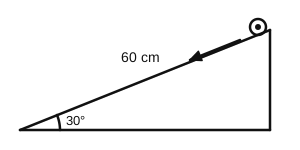
A solid cylinder is released from rest from the top of an inclined plane of inclination $30^\circ$ and length $60$ cm. If the cylinder rolls without slipping, its speed upon reaching the bottom of the inclined plane is ______ $\text{m s}^{-1}$. (Given $g=10\ \text{m s}^{-2}$)
Concept. Energy for rolling from rest: $v^2=\dfrac{2gh}{1+k^2/R^2}=\dfrac{4gh}{3}$ for a solid cylinder.
Step 1. Height. $h=0.6\sin30^\circ=0.3$ m.
Step 2. Speed. $v^2=\dfrac{4(10)(0.3)}{3}=4\Rightarrow v=2$ m s$^{-1}$.
Answer. $2$.
Solution by Sreeraj P, M.Sc Physics
Q 11-06-128JEE MainJEE Main 2023 (1 Feb, Shift 2)Easy
Moment of inertia of a disc of mass $M$ and radius $R$ about any of its diameters is $\dfrac{MR^2}{4}$. The moment of inertia of this disc about an axis normal to the disc and passing through a point on its edge will be $\dfrac x2MR^2$. The value of $x$ is ______.
Concept. To move an axis from the centre to a parallel axis at distance $d$, use the parallel-axis theorem $I=I_{cm}+Md^2$. The axis here is normal to the disc, so start from the normal axis through the centre.
Step 1. Normal axis through the centre. By the perpendicular-axis theorem, $I_z=I_x+I_y=\dfrac{MR^2}{4}+\dfrac{MR^2}{4}=\dfrac{MR^2}{2}$.
Step 2. Shift to the rim ($d=R$): $$I=\frac{MR^2}{2}+MR^2=\frac32MR^2$$
Answer. $\dfrac x2=\dfrac32$, so $x=3$.
Solution by Sreeraj P, M.Sc Physics
Q 11-06-129JEE MainJEE Main 2022 (24 Jun, Shift 1)Easy
A metre scale is balanced on a knife edge at its centre. When two coins, each of mass $10\ \text{g}$, are put one on top of the other at the $10.0\ \text{cm}$ mark, the scale is found to be balanced at the $40.0\ \text{cm}$ mark. The mass of the metre scale is found to be $x\times10^{-2}\ \text{kg}$. The value of $x$ is ______.
Concept. Moments about the new balance point: the coins' moment equals the moment of the scale's weight, which acts at its centre ($50$ cm).
Step 1. Arms. Coins ($20$ g) at $10$ cm: arm $30$ cm. Scale's weight at $50$ cm: arm $10$ cm.
Step 2. Balance. $20\times30=M\times10\Rightarrow M=60$ g $=6\times10^{-2}$ kg.
Answer. $6$.
Solution by Sreeraj P, M.Sc Physics
Q 11-06-130JEE MainJEE Main 2022 (24 Jun, Shift 2)Easy
A fly wheel is accelerated uniformly from rest and rotates through $5\ \text{rad}$ in the first second. The angle rotated by the fly wheel in the next second will be:
Concept. Uniform angular acceleration obeys the same equations as uniform linear acceleration: $\theta=\omega_0t+\tfrac12\alpha t^2$. From rest, $\theta\propto t^2$.
Step 1. First second. $5=\tfrac12\alpha(1)^2\Rightarrow\alpha=10$ rad s$^{-2}$.
Step 2. First two seconds. $\theta(2)=\tfrac12(10)(2)^2=20$ rad.
Step 3. Next second only. $20-5=15$ rad.
Answer. $15$ rad (Option B). The angles in successive equal intervals from rest go as $1:3:5:\dots$
Solution by Sreeraj P, M.Sc Physics
Q 11-06-131JEE MainJEE Main 2022 (25 Jun, Shift 1)Easy
If force $\vec F = 3\hat i + 4\hat j - 2\hat k$ acts on a particle having position vector $2\hat i + \hat j + 2\hat k$, then the torque about the origin will be:
Q 11-06-133JEE MainJEE Main 2022 (26 Jun, Shift 1)Easy
A thin circular ring of mass $M$ and radius $R$ is rotating with a constant angular velocity $2\ \text{rad s}^{-1}$ in a horizontal plane about an axis perpendicular to its plane and passing through the center of the ring. If two objects each of mass $m$ are attached gently to the opposite ends of a diameter of the ring, the ring will then rotate with an angular velocity (in $\text{rad s}^{-1}$)
No external torque acts, so angular momentum is conserved: $$MR^2\times2 = (M + 2m)R^2\omega\ \Rightarrow\ \omega = \frac{2M}{M+2m}$$
Solution by Sreeraj P, M.Sc Physics
Q 11-06-134JEE MainJEE Main 2022 (26 Jun, Shift 2)Easy
A solid spherical ball is rolling on a frictionless horizontal plane surface about its axis of symmetry. The ratio of rotational kinetic energy of the ball to its total kinetic energy is
Concept. A rolling body has $K_{\text{trans}}=\tfrac12mv^2$ and $K_{\text{rot}}=\tfrac12I\omega^2$ with $\omega=\dfrac vR$. Writing $I=mk^2$, $K_{\text{rot}}=\tfrac12mv^2\dfrac{k^2}{R^2}$.
Step 1. For a solid sphere $\dfrac{k^2}{R^2}=\dfrac25$, so $$K_{\text{rot}}=\frac25\cdot\frac12mv^2,\qquad K_{\text{total}}=\left(1+\frac25\right)\frac12mv^2=\frac75\cdot\frac12mv^2$$
Answer. Option C. ("Frictionless" here just means no energy is lost; the ball is already rolling.)
Solution by Sreeraj P, M.Sc Physics
Q 11-06-135JEE MainJEE Main 2022 (25 Jul, Shift 1)Easy
A solid cylinder and a solid sphere, having the same mass $M$ and radius $R$, roll down the same inclined plane from top without slipping. They start from rest. The ratio of velocity of the solid cylinder to that of the solid sphere, with which they reach the ground, will be
Concept. Rolling without slipping wastes no energy (static friction does no work), so $mgh=\tfrac12mv^2\left(1+\dfrac{k^2}{R^2}\right)$. This gives $v^2=\dfrac{2gh}{1+k^2/R^2}$, independent of mass and radius.
Answer. Option D. The body with the smaller $k^2/R^2$ (the sphere) is faster.
Solution by Sreeraj P, M.Sc Physics
Q 11-06-136JEE MainJEE Main 2022 (25 Jul, Shift 2)Easy
Three identical spheres each of mass $M$ are placed at the corners of a right angled triangle with mutually perpendicular sides equal to $3\ \text{m}$ each. Taking the point of intersection of the mutually perpendicular sides as origin, the magnitude of position vector of the centre of mass of the system will be $\sqrt x\ \text{m}$. The value of $x$ is ______.
Masses at $(0,0)$, $(3,0)$, $(0,3)$: centre of mass $= (1, 1)$, so $|\vec r| = \sqrt2\ \text{m}$ and $x = 2$.
Solution by Sreeraj P, M.Sc Physics
Q 11-06-137JEE MainJEE Main 2022 (26 Jul, Shift 1)Medium
A disc of mass $1\ \text{kg}$ and radius $R$ is free to rotate about a horizontal axis passing through its centre and perpendicular to the plane of the disc. A body of the same mass as that of the disc is fixed at the highest point of the disc. Now the system is released. When the body comes to the lowest position, its angular speed will be $4\sqrt{\dfrac{x}{3R}}\ \text{rad s}^{-1}$ where $x$ = ______.
The body falls through $2R$. Moment of inertia: $I = \dfrac12(1)R^2 + (1)R^2 = \dfrac32R^2$. Taking $g = 10\ \text{m s}^{-2}$: $$1\times g\times2R = \frac12\cdot\frac32R^2\omega^2\ \Rightarrow\ \omega^2 = \frac{8g}{3R} = \frac{80}{3R}$$ $$\omega = \sqrt{\frac{16\times5}{3R}} = 4\sqrt{\frac{5}{3R}}\ \Rightarrow\ x = 5$$
Solution by Sreeraj P, M.Sc Physics
Q 11-06-138JEE MainJEE Main 2022 (26 Jul, Shift 2)Easy
The radius of gyration of a cylindrical rod about an axis of rotation perpendicular to its length and passing through the center will be ______ m. Given, the length of the rod is $10\sqrt3\ \text{m}$.
$I = \dfrac{ML^2}{12} = Mk^2\Rightarrow k = \dfrac{L}{\sqrt{12}} = \dfrac{10\sqrt3}{2\sqrt3} = 5\ \text{m}$ (treating the rod as thin).
Solution by Sreeraj P, M.Sc Physics
Q 11-06-139JEE MainJEE Main 2022 (27 Jun, Shift 1)Easy
Two blocks of masses $10$ kg and $30$ kg are placed on the same straight line with coordinates $(0, 0)$ cm and $(x, 0)$ cm respectively. The block of $10$ kg is moved on the same line through a distance of $6$ cm towards the other block. The distance through which the block of $30$ kg must be moved to keep the position of centre of mass of the system unchanged is
Concept. With no external force the centre of mass stays put: $m_1\Delta x_1+m_2\Delta x_2=0$. If one block moves towards the other, the other must move towards it.
Step 1. Displacement of the 30 kg block. $10(+6)+30\,\Delta x_2=0\Rightarrow\Delta x_2=-2$ cm.
Step 2. Direction. Negative $x$: towards the 10 kg block.
Answer. $2$ cm towards the 10 kg block (Option C).
Solution by Sreeraj P, M.Sc Physics
Q 11-06-140JEE MainJEE Main 2022 (27 Jun, Shift 2)Hard
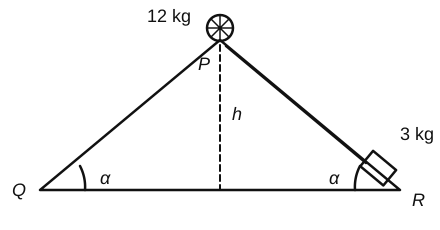
A rolling wheel of $12$ kg is on an inclined plane at position $P$ and connected to a mass of $3$ kg through a string of fixed length and pulley as shown in figure.
Consider $PR$ as friction free surface.
The velocity of centre of mass of the wheel when it reaches at the bottom $Q$ of the inclined plane $PQ$ will be $\dfrac12\sqrt{xgh}\ \text{m s}^{-1}$. The value of $x$ (rounded off to the nearest integer) is ______.
Concept. Energy for the whole system: as the wheel rolls down $PQ$ through height $h$, the block on the smooth face $PR$ rises through the same height $h$ (equal angles $\alpha$, same string length). Treat the wheel as a ring, with its mass at the rim ($I=MR^2$).
Step 1. Energy equation. Both move at speed $v$: $$12gh-3gh=\tfrac12(12)v^2+\tfrac12(12R^2)\frac{v^2}{R^2}+\tfrac12(3)v^2=13.5v^2$$
Step 2. Speed. $v^2=\dfrac{9gh}{13.5}=\dfrac{2gh}{3}$, so $v=\tfrac12\sqrt{\tfrac83gh}$ and $x=\tfrac83\approx2.7$.
Step 3. Round. $x\approx3$. (A uniform disc, $I=\tfrac12MR^2$, gives $x=\tfrac{24}{7}\approx3.4$, which also rounds to $3$.)
Answer. $3$.
Solution by Sreeraj P, M.Sc Physics
Q 11-06-141JEE MainJEE Main 2022 (27 Jul, Shift 1)Hard
A pulley of radius $1.5$ m is rotated about its axis by a force $F = (12t - 3t^2)$ N applied tangentially (while $t$ is measured in seconds). If moment of inertia of the pulley about its axis of rotation is $4.5\ \text{kg m}^2$, the number of rotations made by the pulley before its direction of motion is reversed, will be $\dfrac K\pi$. The value of $K$ is ______ .
Concept. A variable torque gives a variable $\alpha$, so integrate: $\alpha=\dfrac{\tau}{I}$, then $\omega=\int\alpha\,dt$, then $\theta=\int\omega\,dt$. The direction reverses when $\omega$ returns to zero.
Step 1. Angular acceleration. $\tau=FR=1.5(12t-3t^2)=18t-4.5t^2$, so $$\alpha=\frac{\tau}{I}=\frac{18t-4.5t^2}{4.5}=4t-t^2$$
Q 11-06-142JEE MainJEE Main 2022 (27 Jul, Shift 2)Medium
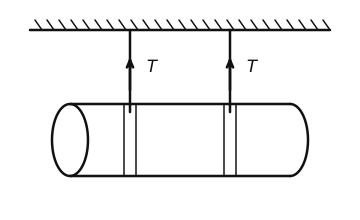
A solid cylinder is suspended symmetrically through two massless strings wound on it, as shown in the figure. The distance from the initial rest position, the cylinder should be unbinding the strings to achieve a speed of $4\ \text{m s}^{-1}$, is ______ cm.
Concept. The cylinder falls and spins at the same time, like a yo-yo. Use Newton's law for the centre and $\tau=I\alpha$ about the centre, linked by $a=\alpha R$ (the strings unwind without slipping). Then use kinematics.
Step 2. Rotation about the centre. Each string pulls at the rim: $$2T\cdot R=\frac12mR^2\cdot\frac aR\ \Rightarrow\ 2T=\frac12ma$$
Step 3. Combine. $mg=\dfrac32ma\Rightarrow a=\dfrac{2g}{3}=\dfrac{20}{3}$ m s$^{-2}$.
Step 4. Distance to reach $4$ m s$^{-1}$ from rest. $$v^2=2as\ \Rightarrow\ 16=2\cdot\frac{20}{3}s\ \Rightarrow\ s=1.2\ \text{m}=120\ \text{cm}$$
Answer. $120$.
Solution by Sreeraj P, M.Sc Physics
Q 11-06-143JEE MainJEE Main 2022 (28 Jul, Shift 1)Medium
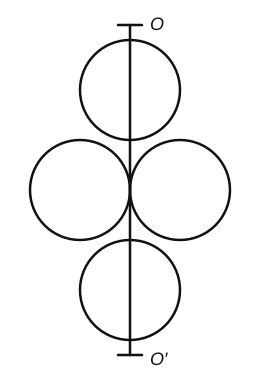
Four identical discs each of mass $M$ and diameter $a$ are arranged in a small plane as shown in figure. If the moment of inertia of the system about $OO'$ is $\dfrac x4Ma^2$. Then, the value of $x$ will be ______ .
Concept. $OO'$ lies in the plane of the discs, so each disc rotates about an axis in its own plane: a diameter ($\tfrac14Mr^2$) or a parallel line ($\tfrac14Mr^2+Md^2$). Here $r=\tfrac a2$.
Step 1. Discs on the axis (top and bottom). $\tfrac14M\left(\tfrac a2\right)^2=\dfrac{Ma^2}{16}$ each.
Step 2. Side discs. Centres $\tfrac a2$ from the axis: $\dfrac{Ma^2}{16}+M\dfrac{a^2}{4}=\dfrac{5Ma^2}{16}$ each.
Step 3. Total. $\dfrac{2+10}{16}Ma^2=\dfrac34Ma^2$, so $x=3$.
Answer. $3$.
Solution by Sreeraj P, M.Sc Physics
Q 11-06-144JEE MainJEE Main 2021 (27 Jul, Shift 1)Easy
Match List-I with List-II.
List-I
(a) MI of the rod (length $L$, mass $M$) about an axis $\perp$ to the rod passing through the midpoint
(b) MI of the rod (length $L$, mass $2M$) about an axis $\perp$ to the rod passing through one of its ends
(c) MI of the rod (length $2L$, mass $M$) about an axis $\perp$ to the rod passing through its midpoint
(d) MI of the rod (length $2L$, mass $2M$) about an axis $\perp$ to the rod passing through one of its ends
List-II
(i) $\dfrac{8ML^2}{3}$
(ii) $\dfrac{ML^2}{3}$
(iii) $\dfrac{ML^2}{12}$
(iv) $\dfrac{2ML^2}{3}$
Choose the correct answer from the options given below:
Concept. Rod: about its centre $\tfrac1{12}ML^2$, about an end $\tfrac13ML^2$. Put in the given mass and length each time.
Step 1. Each case.
(a) $\tfrac1{12}ML^2$: (iii).
(b) $\tfrac13(2M)L^2=\tfrac23ML^2$: (iv).
(c) $\tfrac1{12}M(2L)^2=\tfrac13ML^2$: (ii).
(d) $\tfrac13(2M)(2L)^2=\tfrac83ML^2$: (i).
Answer. Option C.
Solution by Sreeraj P, M.Sc Physics
Q 11-06-145JEE MainJEE Main 2021 (27 Jul, Shift 1)Medium
The figure shows two solid discs with radius $R$ and $r$ respectively. If mass per unit area is the same for both, what is the ratio of MI of bigger disc around axis $AB$ (which is $\perp$ to the plane of the disc and passing through its centre) to MI of smaller disc around one of its diameters lying on its plane? Given $M$ is the mass of the larger disc.
Q 11-06-146JEE MainJEE Main 2021 (27 Jul, Shift 2)Easy
In the given figure, two wheels $P$ and $Q$ are connected by a belt $B$. The radius of $P$ is three times that of $Q$. In the case of the same rotational kinetic energy, the ratio of rotational inertias $\left(\dfrac{I_1}{I_2}\right)$ will be $x : 1$. The value of $x$ will be ______.
Concept. A belt that does not slip gives both rims the same linear speed: $\omega_PR_P=\omega_QR_Q$. Equal rotational KE then fixes the ratio of moments of inertia.
Answer: (B) remains same in magnitude and direction
About the centre, $\vec L = m\vec r\times\vec v$ has magnitude $mvr$, which is constant, and its direction is always perpendicular to the plane of the circle.
So $\vec L$ stays the same in magnitude and direction (there is no torque about the centre).
Solution by Sreeraj P, M.Sc Physics
Q 11-06-148JEE MainJEE Main 2021 (31 Aug, Shift 2)Easy
A system consists of two identical spheres each of mass $1.5$ kg and radius $50$ cm at the ends of a light rod. The distance between the centres of the two spheres is $5$ m. What will be the moment of inertia of the system about an axis perpendicular to the rod passing through its midpoint?
Concept. Use the standard moments of inertia (same $M$, $R$): ring about a diameter $\tfrac12MR^2$; disc about its axis $\tfrac12MR^2$; solid cylinder about its axis $\tfrac12MR^2$; solid sphere about a diameter $\tfrac25MR^2$.
Q 11-06-150JEE MainJEE Main 2021 (24 Feb, Shift 2)Medium
A circular hole of radius $\left(\dfrac{a}{2}\right)$ is cut out of a circular disc of radius $a$ as shown in figure. The centroid of the remaining circular portion with respect to point $O$ will be:
Concept. Hole as negative mass, mass $\propto$ area. With $O$ at the left edge of the disc, the disc's centre is at $a$ and the hole's centre (touching the right rim) at $a+\tfrac a2=\tfrac{3a}{2}$.
Q 11-06-151JEE MainJEE Main 2021 (24 Feb, Shift 2)Medium
A uniform thin bar of mass 6 kg and length 2.4 meter is bent to make an equilateral hexagon. The moment of inertia about an axis passing through the centre of mass and perpendicular to the plane of hexagon is ______ $\times10^{-1}$ kg m$^2$.
Each side has mass $m = 1$ kg and length $l = 0.4$ m. The centre of each side is at distance $\frac{\sqrt3}{2}l$ from the centre of the hexagon. By the parallel axis theorem, for one side: $$I_1 = \frac{ml^2}{12} + m\left(\frac{\sqrt3 l}{2}\right)^2 = ml^2\left(\frac{1}{12} + \frac34\right) = \frac56ml^2$$ $$I = 6\times\frac56\times1\times(0.4)^2 = 0.8\ \text{kg m}^2 = 8\times10^{-1}\ \text{kg m}^2$$
Solution by Sreeraj P, M.Sc Physics
Q 11-06-152JEE MainJEE Main 2021 (18 Mar, Shift 2)Easy
Consider a uniform wire of mass $M$ and length $L$. It is bent into a semicircle. Its moment of inertia about a line perpendicular to the plane of the wire passing through the centre is:
$\pi R = L \Rightarrow R = \dfrac{L}{\pi}$. Every element of the wire is at distance $R$ from the axis, so $I = MR^2 = \dfrac{ML^2}{\pi^2}$.
Solution by Sreeraj P, M.Sc Physics
Q 11-06-153JEE MainJEE Main 2021 (18 Mar, Shift 2)Hard
A solid cylinder of mass $m$ is wrapped with an inextensible light string and, is placed on a rough inclined plane as shown in the figure. The frictional force acting between the cylinder and the inclined plane is:
[The coefficient of static friction, $\mu_s$, is 0.4]
Concept. First assume equilibrium and find the friction it needs; then compare with the maximum $\mu N$. The string leaves the top of the cylinder parallel to the incline (from the figure) and pulls up the slope; friction at the contact point also acts up the slope.
Step 1. Torque about the centre. $TR=fR\Rightarrow T=f$.
Step 2. Along the incline. $T+f=mg\sin60^\circ\Rightarrow f=\dfrac{\sqrt3}{4}mg\approx0.43mg$.
Step 3. Compare. $\mu N=0.4\,mg\cos60^\circ=0.2\,mg\lt0.43\,mg$. Static friction cannot hold it, so the surface slips and the friction is kinetic: $f=\mu N=0.2mg$.
Answer. $\dfrac{mg}{5}$ (Option C).
Solution by Sreeraj P, M.Sc Physics
Q 11-06-154JEE MainJEE Main 2021 (20 Jul, Shift 1)Hard
A rod of mass $M$ and length $L$ is lying on a horizontal frictionless surface. A particle of mass $m$ travelling along the surface hits at one end of the rod with a velocity $u$ in a direction perpendicular to the rod. The collision is completely elastic. After collision, particle comes to rest. The ratio of masses $\left(\dfrac{m}{M}\right)$ is $\dfrac1x$. The value of $x$ will be ______.
Concept. The rod is free (no pivot), so three things are conserved in the collision: linear momentum, angular momentum (about the rod's centre), and, since it is elastic, kinetic energy.
Step 1. Linear momentum. The particle stops, so the rod's centre moves at $v$: $$mu=Mv\ \Rightarrow\ v=\frac{mu}{M}$$
Step 2. Angular momentum about the centre. The particle hits at $\dfrac L2$: $$mu\frac L2=\frac{ML^2}{12}\omega\ \Rightarrow\ \omega=\frac{6mu}{ML}$$
Step 4. Solve. $mu^2=\dfrac{4m^2u^2}{M}\Rightarrow M=4m$, so $\dfrac mM=\dfrac14$.
Answer. $x=4$.
Solution by Sreeraj P, M.Sc Physics
Q 11-06-155JEE MainJEE Main 2021 (20 Jul, Shift 1)Easy
A circular disc reaches from top to bottom of an inclined plane of length $L$. When it slips down the plane, it takes time $t_1$. When it rolls down the plane, it takes time $t_2$. The value of $\dfrac{t_2}{t_1}$ is $\sqrt{\dfrac3x}$. The value of $x$ will be ______.
$\dfrac{K_{rot}}{K_{trans}} = \dfrac{\frac12I\omega^2}{\frac12mv^2} = \dfrac{k^2}{R^2} = \dfrac12$, which is the solid cylinder ($I = \frac12mR^2$).
Solution by Sreeraj P, M.Sc Physics
Q 11-06-157JEE MainJEE Main 2021 (20 Jul, Shift 2)Easy
Two bodies, a ring and a solid cylinder of same material are rolling down without slipping an inclined plane. The radii of the bodies are same. The ratio of velocity of the centre of mass at the bottom of the inclined plane of the ring to that of the cylinder is $\dfrac{\sqrt x}{2}$. Then, the value of $x$ is ______.
Q 11-06-158JEE MainJEE Main 2021 (20 Jul, Shift 2)Easy
A body rotating with an angular speed of 600 rpm is uniformly accelerated to 1800 rpm in 10 sec. The number of rotations made in the process is ______.
Concept. For uniform angular acceleration, angle turned $=$ average angular speed $\times$ time, the rotational version of $s=\dfrac{u+v}{2}t$.
Step 1. Convert to rotations per second. $600$ rpm $=10$ rps; $1800$ rpm $=30$ rps.
Step 2. Average. $\dfrac{10+30}{2}=20$ rps.
Step 3. Rotations. $20\times10=200$.
Answer. $200$.
Solution by Sreeraj P, M.Sc Physics
Q 11-06-159JEE MainJEE Main 2021 (22 Jul, Shift 1)Easy
Consider a situation in which a ring, a solid cylinder and a solid sphere roll down on the same inclined plane without slipping. Assume that they start rolling from rest and having identical diameter. The correct statement for this situation is
The smallest $k^2/R^2$ gives the largest speed: sphere fastest, ring slowest.
Solution by Sreeraj P, M.Sc Physics
Q 11-06-160JEE MainJEE Main 2021 (22 Jul, Shift 1)Easy
The position of the centre of mass of a uniform semi-circular wire of radius $R$ placed in $x$-$y$ plane with its centre at the origin and the line joining its ends as $x$-axis is given by $\left(0, \dfrac{xR}{\pi}\right)$. Then, the value of $|x|$ is ______.
Concept. For a continuous body, $y_{cm}=\dfrac{1}{M}\int y\,dm$. For a wire, take small arc elements and add their contributions.
Step 1. Choose an element. Put the centre of the semicircle at the origin, ends on the $x$-axis. An element at angle $\theta$ from the $x$-axis has length $R\,d\theta$, mass $dm=\lambda R\,d\theta$ with $\lambda=\dfrac{M}{\pi R}$, and height $y=R\sin\theta$.
Step 2. Integrate from $\theta=0$ to $\pi$. $$y_{cm}=\frac1M\int_0^{\pi}R\sin\theta\cdot\lambda R\,d\theta=\frac{\lambda R^2}{M}\Big[-\cos\theta\Big]_0^{\pi}=\frac{\lambda R^2}{M}\cdot2=\frac{M}{\pi R}\cdot\frac{2R^2}{M}=\frac{2R}{\pi}$$
Step 3. Symmetry. Every element at $+x$ has a partner at $-x$, so $x_{cm}=0$.
Q 11-06-161JEE MainJEE Main 2021 (22 Jul, Shift 1)Easy
The centre of a wheel rolling on a plane surface moves with a speed $v_0$. A particle on the rim of the wheel at the same level as the centre will be moving at a speed $\sqrt x\,v_0$. Then the value of $x$ is ______.
Concept. Rolling = translation of the centre at $v_0$ + rotation with $\omega R=v_0$. Add the two velocities at the point as vectors. Equivalently, every point moves as if rotating about the contact point: speed $=\omega\times$ (distance from the contact point).
Step 1. The two parts at the side point. Translation: $v_0$ horizontally. Rotation: $\omega R=v_0$, tangential, which at the side point is vertical.
Step 2. Add as perpendicular vectors. $v=\sqrt{v_0^2+v_0^2}=\sqrt2\,v_0$.
Check. The point is $\sqrt2R$ from the contact point, so $v=\omega\sqrt2R=\sqrt2v_0$.
Answer. $x=2$.
Solution by Sreeraj P, M.Sc Physics
Q 11-06-162JEE MainJEE Main 2021 (26 Feb, Shift 1)Medium
Four identical solid spheres each of mass $m$ and radius $a$ are placed with their centres on the four corners of a square of side $b$. The moment of inertia of the system about one side of the square where the axis of rotation is parallel to the plane of the square is:
Two spheres have their centres on the axis: each contributes $\frac{2}{5}ma^2$.
The other two are at distance $b$ from the axis: each contributes $\frac{2}{5}ma^2 + mb^2$ (parallel axis theorem). $$I = 4\cdot\frac{2}{5}ma^2 + 2mb^2 = \frac{8}{5}ma^2 + 2mb^2$$
Solution by Sreeraj P, M.Sc Physics
Q 11-06-163JEE MainJEE Main 2021 (26 Feb, Shift 2)Easy
A cord is wound round the circumference of wheel of radius $r$. The axis of the wheel is horizontal and the moment of inertia about it is $I$. A weight $mg$ is attached to the cord at the end. The weight falls from rest. After falling through a distance $h$, the square of angular velocity of wheel will be
Concept. As in any wheel-and-weight problem: $mgh=\tfrac12mv^2+\tfrac12I\omega^2$ with $v=\omega r$.
Step 1. Energy. $mgh=\tfrac12(mr^2+I)\omega^2$.
Step 2. Solve. $\omega^2=\dfrac{2mgh}{I+mr^2}$.
Answer. Option A.
Solution by Sreeraj P, M.Sc Physics
Q 11-06-164JEE MainJEE Main 2021 (25 Jul, Shift 2)Easy
A solid disc of radius $20$ cm and mass $10$ kg is rotating with an angular velocity of $600$ rpm, about an axis normal to its circular plane and passing through its centre of mass. The retarding torque required to bring the disc at rest in $10$ s is ______ $\pi\times10^{-1}$ N m
Concept. $\tau=I\alpha$ with $\alpha=\dfrac{\omega_0}{t}$ (uniform retardation to rest).
Step 1. Values. $I=\tfrac12(10)(0.2)^2=0.2$ kg m$^2$; $\omega_0=600$ rpm $=20\pi$ rad/s; $\alpha=2\pi$ rad s$^{-2}$.
Step 2. Torque. $\tau=0.2\times2\pi=0.4\pi=4\pi\times10^{-1}$ N m.
Answer. $4$.
Solution by Sreeraj P, M.Sc Physics
Q 11-06-165JEE MainJEE Main 2021 (26 Aug, Shift 1)Hard
Consider a badminton racket with length scales as shown in the figure. If the mass of the linear and circular portions of the badminton racket are same ($M$) and the mass of the threads are negligible, the moment of inertia of the racket about an axis perpendicular to the handle and in the plane of the ring at, $\frac{r}{2}$ distance from the end $A$ of the handle will be ______ $Mr^2$.
Handle (rod of length $6r$): its centre is $3r - \frac{r}{2} = 2.5r$ from the axis. $$I_1 = \frac{M(6r)^2}{12} + M(2.5r)^2 = 3Mr^2 + 6.25Mr^2 = 9.25Mr^2$$ Ring (radius $r$): the axis is parallel to a diameter, and the ring's centre is at $6r + r - \frac{r}{2} = 6.5r$ from it. $$I_2 = \frac{Mr^2}{2} + M(6.5r)^2 = 0.5Mr^2 + 42.25Mr^2 = 42.75Mr^2$$ $I = 9.25Mr^2 + 42.75Mr^2 = 52Mr^2$.
Solution by Sreeraj P, M.Sc Physics
Q 11-06-166JEE MainJEE Main 2021 (26 Aug, Shift 2)Medium
The solid cylinder of length $80$ cm and mass $M$ has a radius of $20$ cm. Calculate the density of the material used if the moment of inertia of the cylinder about an axis $CD$ parallel to $AB$ as shown in figure is $2.7$ kg m$^2$.
$AB$ is the cylinder's own axis, and $CD$ is parallel to it at distance $\frac{L}{2} = 0.4$ m. $$I = \frac{1}{2}MR^2 + M(0.4)^2 = M(0.02 + 0.16) = 0.18M = 2.7 \Rightarrow M = 15\ \text{kg}$$ Volume $= \pi R^2L = \pi(0.2)^2(0.8) = 0.1005$ m$^3$. $$\rho = \frac{15}{0.1005} \approx 1.49\times10^2\ \text{kg m}^{-3}$$
Solution by Sreeraj P, M.Sc Physics
Q 11-06-167JEE MainJEE Main 2021 (27 Aug, Shift 1)Easy
Moment of inertia of a square plate of side $l$ about the axis passing through one of the corner and perpendicular to the plane of square plate is given by:
Concept. About the centre, perpendicular to a square plate: $\tfrac16Ml^2$. The corner is at $\dfrac{l}{\sqrt2}$ from the centre; use the parallel-axis theorem.
Q 11-06-168JEE MainJEE Main 2021 (27 Aug, Shift 2)Medium
Two discs have moments of intertia $I_1$ and $I_2$ about their respective axes perpendicular to the plane and passing through the centre. They are rotating with angular speeds, $\omega_1$ and $\omega_2$ respectively and are brought into contact face to face with their axes of rotation coaxial. The loss in kinetic energy of the system in the process is given by:
Concept. Friction between the faces is internal, so angular momentum is conserved and both discs end with a common $\omega$. Kinetic energy is not conserved; the friction turns some of it into heat. This is the rotational version of a perfectly inelastic collision.
Step 1. Common angular velocity. $$\omega=\frac{I_1\omega_1+I_2\omega_2}{I_1+I_2}$$
Step 2. Energy before and after. $$K_i=\frac12I_1\omega_1^2+\frac12I_2\omega_2^2,\qquad K_f=\frac{(I_1\omega_1+I_2\omega_2)^2}{2(I_1+I_2)}$$
Step 3. Subtract. Put everything over $2(I_1+I_2)$: $$K_i-K_f=\frac{I_1^2\omega_1^2+I_1I_2\omega_1^2+I_1I_2\omega_2^2+I_2^2\omega_2^2-I_1^2\omega_1^2-2I_1I_2\omega_1\omega_2-I_2^2\omega_2^2}{2(I_1+I_2)}$$ $$=\frac{I_1I_2(\omega_1-\omega_2)^2}{2(I_1+I_2)}$$
Answer. Option C. Compare with collisions: $\tfrac12\dfrac{m_1m_2}{m_1+m_2}(u_1-u_2)^2$.
Solution by Sreeraj P, M.Sc Physics
Q 11-06-169JEE MainJEE Main 2020 (8 Jan, Shift 2)Hard
As shown in figure, a spherical cavity (centred at $O$) of radius $1$ is cut out of a uniform sphere of radius $R$ (centred at $C$). The centre of mass of the remaining (shaded) part of the sphere is at $G$, i.e., on the surface of the cavity. $R$ can be determined by the equation:
The cavity touches the sphere from inside, so $CO = R - 1$. $G$ is on the cavity surface on the far side of $C$, so $OG = 1$ and $$CG = 1 - (R-1) = 2 - R$$
Masses are proportional to volumes. Taking moments about $C$ (the full sphere has its centre of mass at $C$): $$(R^3 - 1)\cdot CG = 1^3\cdot CO$$ $$(R-1)(R^2+R+1)(2-R) = R-1$$ $$(R^2+R+1)(2-R) = 1$$
Solution by Sreeraj P, M.Sc Physics
Q 11-06-170JEE MainJEE Main 2020 (8 Jan, Shift 2)Easy
A uniform sphere of mass $500$ g rolls without slipping on a plane horizontal surface with its centre moving at a speed of $5.00$ cm s$^{-1}$. Its kinetic energy is:
For rolling without slipping, $\omega = v/R$ and $I = \tfrac{2}{5}mR^2$ for a solid sphere: $$K = \frac{1}{2}mv^2 + \frac{1}{2}\cdot\frac{2}{5}mR^2\cdot\frac{v^2}{R^2} = \frac{7}{10}mv^2$$ $$K = 0.7\times0.5\times(0.05)^2 = 8.75\times10^{-4}\ \text{J}$$
Solution by Sreeraj P, M.Sc Physics
Q 11-06-171JEE MainJEE Main 2020 (9 Jan, Shift 1)Medium
Three solid spheres each of mass $m$ and diameter $d$ are stuck together such that the lines connecting the centres form an equilateral triangle of side of length $d$. The ratio $\dfrac{I_0}{I_A}$ of moment of inertia $I_0$ of the system about an axis passing through the centroid and $I_A$ about the centre of any of the spheres, both perpendicular to the plane of the triangle, is:
Each sphere has radius $d/2$, so about its own centre $I = \dfrac{2}{5}m\left(\dfrac{d}{2}\right)^2 = \dfrac{md^2}{10}$.
About the centroid: each centre is at $\dfrac{d}{\sqrt{3}}$, so by the parallel axis theorem $$I_0 = 3\left(\frac{md^2}{10} + \frac{md^2}{3}\right) = \frac{13}{10}md^2$$
About the centre of sphere A: the other two centres are at distance $d$: $$I_A = \frac{md^2}{10} + 2\left(\frac{md^2}{10} + md^2\right) = \frac{23}{10}md^2$$
$$\frac{I_0}{I_A} = \frac{13}{23}$$
Solution by Sreeraj P, M.Sc Physics
Q 11-06-172JEE MainJEE Main 2020 (9 Jan, Shift 1)Medium
One end of a straight uniform $1$ m long bar is pivoted on a horizontal table. It is released from rest when it makes an angle $30^\circ$ from the horizontal. Its angular speed when it hits the table is given as $\sqrt{n}$ rad s$^{-1}$, where $n$ is an integer. The value of $n$ is ______. (Take $g = 10$ m s$^{-2}$)
The centre of mass falls through $\dfrac{L}{2}\sin30^\circ = 0.25$ m. The bar rotates about the pivot with $I = \dfrac{mL^2}{3}$: $$mg(0.25) = \frac{1}{2}\cdot\frac{m(1)^2}{3}\,\omega^2$$ $$\omega^2 = 6\times0.25\times10 = 15 \Rightarrow \omega = \sqrt{15}\ \text{rad s}^{-1}$$
Solution by Sreeraj P, M.Sc Physics
Q 11-06-173JEE MainJEE Main 2020 (9 Jan, Shift 2)Medium
A rod of length $l$ has non-uniform linear mass density given by $\rho(x) = a + b\left(\dfrac{x}{l}\right)^2$, where $a$ and $b$ are constants and $0 \le x \le l$. The value of $x$ for the centre of mass of the rod is at:
Answer. Option B. Check: with $b=0$ (uniform rod) this gives $\tfrac34\cdot\tfrac23\,l=\tfrac l2$, as it should.
Solution by Sreeraj P, M.Sc Physics
Q 11-06-174JEE MainJEE Main 2020 (9 Jan, Shift 2)Medium
A uniformly thick wheel with moment of inertia $I$ and radius $R$ is free to rotate about its centre of mass, which is fixed. A massless string is wrapped over its rim and two blocks of masses $m_1$ and $m_2$ $(m_1 > m_2)$ hang from the two ends of the string. The system is released from rest. The angular speed of the wheel when $m_1$ descends by a distance $h$ is:
Step 2. Kinetic energy gained. Both blocks move at $v=\omega R$, and the wheel turns at $\omega$: $$K=\frac12(m_1+m_2)\omega^2R^2+\frac12I\omega^2$$
Step 3. Equate and solve. $$(m_1-m_2)gh=\frac12\omega^2\left[(m_1+m_2)R^2+I\right]\ \Rightarrow\ \omega=\left[\frac{2(m_1-m_2)gh}{(m_1+m_2)R^2+I}\right]^{1/2}$$
Answer. Option A.
Solution by Sreeraj P, M.Sc Physics
Q 11-06-175JEE MainJEE Main 2020 (5 Sep, Shift 2)Easy
A thin rod of mass $0.9$ kg and length $1$ m is suspended, at rest, from one end so that it can freely oscillate in the vertical plane. A particle of mass $0.1$ kg moving in a straight line with velocity $80\ \text{m s}^{-1}$ hits the rod at its bottom most point and sticks to it (see figure). The angular speed (in rad s$^{-1}$) of the rod immediately after the collision will be ______.
Concept. At the pivot there is a large impulsive force during the impact, so linear momentum is not conserved. But that force passes through the pivot, so angular momentum about the pivot is conserved.
Step 1. Angular momentum before (about the pivot; the particle moves horizontally at $1$ m below it): $$L=mvd=0.1\times80\times1=8\ \text{kg m}^2\text{s}^{-1}$$
Step 2. Moment of inertia after (rod about its end plus the particle stuck at the bottom): $$I=\frac{0.9\times1^2}{3}+0.1\times1^2=0.3+0.1=0.4\ \text{kg m}^2$$
Step 3. Conserve. $\omega=\dfrac LI=\dfrac{8}{0.4}=20$ rad s$^{-1}$.
Answer. $20$.
Solution by Sreeraj P, M.Sc Physics
Q 11-06-176JEE MainJEE Main 2020 (6 Sep, Shift 1)Medium
Shown in the figure is a hollow ice-cream cone (it is open at the top). If its mass is $M$, the radius of its top is $R$ and its height is $H$, then its moment of inertia about its axis is:
Cut the cone surface into thin rings. A ring at slant distance $s$ from the tip has radius $r = \dfrac{Rs}{L}$ ($L$ = slant height) and mass proportional to its area $2\pi r\,ds$, i.e. $dm = \dfrac{2M s\,ds}{L^2}$. $$I = \int r^2\,dm = \int_0^L \frac{R^2 s^2}{L^2}\cdot\frac{2Ms}{L^2}\,ds = \frac{2MR^2}{L^4}\cdot\frac{L^4}{4} = \frac{MR^2}{2}$$
(The result does not depend on $H$.)
Solution by Sreeraj P, M.Sc Physics
Q 11-06-177JEE MainJEE Main 2020 (6 Sep, Shift 1)Medium
Four point masses, each of mass $m$, are fixed at the corners of a square of side $l$. The square is rotating with angular frequency $\omega$ about an axis passing through one of the corners of the square and parallel to its diagonal, as shown in the figure. The angular momentum of the square about the axis is:
Concept. $I=\sum mr^2$ with $r$ the perpendicular distance to the axis, then $L=I\omega$. The axis passes through one corner and is parallel to the diagonal joining the two neighbouring corners.
Step 1. Distances. Let the axis pass through corner $P$, parallel to diagonal $QS$ (the corners next to $P$).
$P$ is on the axis: $r=0$.
$Q$ and $S$ lie on the diagonal, which is parallel to the axis. Their distance from it equals the distance from $P$ to that diagonal: half the other diagonal, $\dfrac{l}{\sqrt2}$.
The far corner $R$ is twice as far: $\sqrt2\,l$.
Step 2. Moment of inertia. $$I=m(0)+2m\left(\frac{l^2}{2}\right)+m(2l^2)=3ml^2$$
Step 3. Angular momentum about a fixed axis: $L=I\omega=3ml^2\omega$.
Answer. Option C.
Solution by Sreeraj P, M.Sc Physics
Q 11-06-178JEE MainJEE Main 2020 (6 Sep, Shift 2)Medium
The linear mass density of a thin rod AB of length $L$ varies from A to B as $\lambda(x) = \lambda_0\left(1 + \dfrac xL\right)$, where $x$ is the distance from A. If $M$ is the mass of the rod, then its moment of inertia about an axis passing through A and perpendicular to the rod is:
Concept. For a non-uniform rod, $I=\int x^2\,dm$ with $dm=\lambda(x)\,dx$. Express the answer in terms of the total mass $M=\int\lambda\,dx$.
Step 1. Total mass. $$M=\int_0^L\lambda_0\left(1+\frac xL\right)dx=\lambda_0\left(L+\frac L2\right)=\frac32\lambda_0L$$
Step 2. Moment of inertia about $A$ ($x=0$). $$I=\int_0^L\lambda_0\left(1+\frac xL\right)x^2dx=\lambda_0\left(\frac{L^3}{3}+\frac{L^3}{4}\right)=\frac{7}{12}\lambda_0L^3$$
Step 3. Eliminate $\lambda_0$. From step 1, $\lambda_0=\dfrac{2M}{3L}$: $$I=\frac{7}{12}\cdot\frac{2M}{3L}\cdot L^3=\frac{7}{18}ML^2$$
Answer. Option B.
Solution by Sreeraj P, M.Sc Physics
Q 11-06-179JEE MainJEE Main 2020 (6 Sep, Shift 2)Easy
The centre of mass of a solid hemisphere of radius $8$ cm is $x$ cm from the centre of the flat surface. Then the value of $x$ is ______.
Concept. Standard result: the centre of mass of a solid hemisphere is $\dfrac{3R}{8}$ from the centre of its flat face.
Step 1. Substitute. $\dfrac38\times8=3$ cm.
Answer. $3$.
Solution by Sreeraj P, M.Sc Physics
Q 11-06-180JEE MainJEE Main 2020 (7 Jan, Shift 1)Easy
Three point particles of masses $1.0$ kg, $1.5$ kg and $2.5$ kg are placed at three corners of a right angle triangle of sides $4.0$ cm, $3.0$ cm and $5.0$ cm as shown in the figure. The centre of mass of the system is at a point:
Answer: (D) $0.9$ cm right and $2.0$ cm above the $1$ kg mass
Take the $1$ kg mass (at the right angle) as origin, the $1.5$ kg mass at $(3, 0)$ cm and the $2.5$ kg mass at $(0, 4)$ cm. Total mass $= 5$ kg. $$x_{cm} = \frac{1.5\times3}{5} = 0.9\ \text{cm}, \qquad y_{cm} = \frac{2.5\times4}{5} = 2.0\ \text{cm}$$
Solution by Sreeraj P, M.Sc Physics
Q 11-06-181JEE MainJEE Main 2020 (7 Jan, Shift 1)Medium
As shown in the figure, a bob of mass $m$ is tied to a massless string whose other end portion is wound on a flywheel (disc) of radius $r$ and mass $m$. When released from rest the bob starts falling vertically. When it has covered a distance of $h$, the angular speed of the wheel will be:
Q 11-06-182JEE MainJEE Main 2020 (7 Jan, Shift 1)Easy
The radius of gyration of a uniform rod of length $l$, about an axis passing through a point $\dfrac l4$ away from the centre of the rod, and perpendicular to it, is:
Concept. Radius of gyration $k$ is defined by $I=Mk^2$. Find $I$ about the new axis with the parallel-axis theorem, then divide by $M$.
Step 1. About the centre: $I_{cm}=\dfrac{Ml^2}{12}$.
Step 2. Shift by $d=\dfrac l4$: $$I=\frac{Ml^2}{12}+M\frac{l^2}{16}=Ml^2\,\frac{4+3}{48}=\frac{7}{48}Ml^2$$
Step 3. Radius of gyration: $k=\sqrt{I/M}=\sqrt{\dfrac{7}{48}}\,l$.
Answer. Option C.
Solution by Sreeraj P, M.Sc Physics
Q 11-06-183JEE MainJEE Main 2020 (7 Jan, Shift 2)Medium
The mass per unit area of a circular disc of radius $a$ depends on the distance $r$ from its centre as $\sigma(r) = A + Br$. The moment of inertia of the disc about the axis perpendicular to the plane and passing through its centre is:
Q 11-06-184JEE MainJEE Main 2020 (8 Jan, Shift 1)Easy
The coordinates of the centre of mass of a uniform flag-shaped lamina (thin flat plate) of mass $4$ kg are: (The coordinates of the corners are shown in the figure, in metres.)
Concept. Split the flag into two rectangles, each with its mass at its own centre (mass $\propto$ area).
Step 1. Rectangles (from the corner coordinates). Pole: $0\le x\le1$, $0\le y\le2$, area $2$, centre $(0.5,1)$. Flag: $0\le x\le2$, $2\le y\le3$, area $2$, centre $(1,2.5)$.
Step 2. Equal areas: average the centres. $\left(\dfrac{0.5+1}{2},\dfrac{1+2.5}{2}\right)=(0.75,1.75)$ m.
Answer. Option B.
Solution by Sreeraj P, M.Sc Physics
Q 11-06-185JEE MainJEE Main 2020 (8 Jan, Shift 1)Medium
Consider a uniform rod of mass $M = 4m$ and length $l$ pivoted about its centre. A mass $m$ moving with velocity $v$ making angle $\theta = \dfrac\pi4$ to the rod's long axis collides with one end of the rod and sticks to it. The angular speed of the rod-mass system just after the collision is:
Concept. The rod is pivoted at its centre, so take angular momentum about the pivot (the pivot force has no torque about it). The particle's angular momentum is $mv\times$(perpendicular distance) $=mv\tfrac l2\sin45^\circ$.
Q 11-06-186JEE MainJEE Main 2020 (2 Sep, Shift 1)Medium
A uniform cylinder of mass $M$ and radius $R$ is to be pulled over a step of height $a$ $(a < R)$ by applying a force $F$ at its centre $O$, perpendicular to the plane through the axis of the cylinder and the edge of the step (see figure). The minimum value of $F$ required is:
Concept. At the moment the cylinder just leaves the floor, the floor's force vanishes and the cylinder pivots about the step edge $E$. Take torques about $E$: the force at $E$ drops out. $F$ is least when its lever arm is largest, which is when it acts perpendicular to $OE$, giving lever arm $R$.
Step 1. Torque of the weight about $E$. The weight acts down through $O$. Its lever arm is the horizontal distance from $E$ to $O$. The centre is $R-a$ above the step's top, and $OE=R$: $$d=\sqrt{R^2-(R-a)^2}$$
Step 2. Balance torques about $E$. $$F\cdot R=Mg\sqrt{R^2-(R-a)^2}\ \Rightarrow\ F=Mg\sqrt{1-\left(\frac{R-a}{R}\right)^2}$$
Answer. Option A.
Solution by Sreeraj P, M.Sc Physics
Q 11-06-187JEE MainJEE Main 2020 (2 Sep, Shift 1)Easy
Shown in the figure is a rigid and uniform one metre long rod $AB$ held in horizontal position by two strings tied to its ends and attached to the ceiling. The rod is of mass $m$ and has another weight of mass $2m$ hung at a distance of $75\ \text{cm}$ from $A$. The tension in the string at $A$ is:
Concept. Take moments about $B$ to remove $T_B$. The rod's weight acts at its centre ($50$ cm from $A$).
Step 1. Moments about $B$ (arms from $B$: string at $A$ $100$ cm, rod's weight $50$ cm, load $25$ cm). $$T_A(100)=mg(50)+2mg(25)=100mg$$
Step 2. Solve. $T_A=mg$.
Answer. $1\,mg$ (Option D).
Solution by Sreeraj P, M.Sc Physics
Q 11-06-188JEE MainJEE Main 2020 (2 Sep, Shift 2)Easy
Two uniform circular discs are rotating independently in the same direction around their common axis passing through their centres. The moment of inertia and angular velocity of the first disc are $0.1\ \text{kg m}^{2}$ and $10\ \text{rad s}^{-1}$ respectively while those for the second one are $0.2\ \text{kg m}^{2}$ and $5\ \text{rad s}^{-1}$ respectively. At some instant they get stuck together and start rotating as a single system about their common axis with some angular speed. The kinetic energy of the combined system is:
Q 11-06-189JEE MainJEE Main 2020 (2 Sep, Shift 2)Medium
A square shaped hole of side $l = \dfrac{a}{2}$ is carved out at a distance $d = \dfrac{a}{2}$ from the centre $O$ of a uniform circular disk of radius $a$. If the distance of the centre of mass of the remaining portion from $O$ is $-\dfrac{a}{X}$, value of $X$ (to the nearest integer) is ______.
Take mass proportional to area. Full disc: area $\pi a^{2}$ at $O$. Hole: area $\dfrac{a^{2}}{4}$ with centre at $x = \dfrac a2$. $$x_{cm} = \frac{0 - \dfrac{a^{2}}{4}\cdot\dfrac{a}{2}}{\pi a^{2} - \dfrac{a^{2}}{4}} = -\frac{a}{8\pi - 2} \approx -\frac{a}{23.1}$$ So $X \approx 23$.
Solution by Sreeraj P, M.Sc Physics
Q 11-06-190JEE MainJEE Main 2020 (3 Sep, Shift 1)Medium
Moment of inertia of a cylinder of mass $M$, length $L$ and radius $R$ about an axis passing through its centre and perpendicular to the axis of the cylinder is $I = M\left(\dfrac{R^{2}}{4} + \dfrac{L^{2}}{12}\right)$. If such a cylinder is to be made for a given mass of a material, the ratio $\dfrac{L}{R}$ for it to have minimum possible $I$ is:
Q 11-06-191JEE MainJEE Main 2020 (3 Sep, Shift 1)Medium
A block of mass $m = 1\ \text{kg}$ slides with velocity $v = 6\ \text{m s}^{-1}$ on a frictionless horizontal surface and collides with a uniform vertical rod and sticks to it as shown. The rod is pivoted about $O$ and swings as a result of the collision making angle $\theta$ before momentarily coming to rest. If the rod has mass $M = 2\ \text{kg}$ and length $l = 1\ \text{m}$, the value of $\theta$ is approximately (take $g = 10\ \text{m s}^{-2}$)
The block hits the lower end of the rod. Angular momentum about $O$ is conserved: $$mvl = \left(\frac{Ml^{2}}{3} + ml^{2}\right)\omega \Rightarrow 6 = \left(\frac23 + 1\right)\omega \Rightarrow \omega = 3.6\ \text{rad s}^{-1}$$ Energy after the collision is converted into potential energy (rod's centre rises $\tfrac l2(1-\cos\theta)$, block rises $l(1-\cos\theta)$): $$\frac12\cdot\frac53\cdot(3.6)^{2} = \left(Mg\frac l2 + mgl\right)(1-\cos\theta) \Rightarrow 10.8 = 20(1-\cos\theta)$$ $\cos\theta = 0.46 \Rightarrow \theta \approx 63^\circ$.
Solution by Sreeraj P, M.Sc Physics
Q 11-06-192JEE MainJEE Main 2020 (3 Sep, Shift 1)Medium
A person of $80\ \text{kg}$ mass is standing on the rim of a circular platform of mass $200\ \text{kg}$ rotating about its axis at $5$ revolutions per minute (rpm). The person now starts moving towards the centre of the platform. What will be the rotational speed (in rpm) of the platform when the person reaches its centre ______.
Concept. The person walking inward exerts only internal forces on the person–platform system, so there is no external torque about the axis. Angular momentum is conserved: $I_1\omega_1=I_2\omega_2$.
Step 1. Initial $I$. Platform (disc): $\dfrac12(200)R^2=100R^2$. Person at the rim: $80R^2$. Total $180R^2$.
Step 2. Final $I$. The person is at the centre and adds nothing: $100R^2$.
Step 3. Conserve. rpm can be used directly, since it is proportional to $\omega$: $$180R^2\times5=100R^2\times n\ \Rightarrow\ n=9\ \text{rpm}$$
Answer. $9$.
Solution by Sreeraj P, M.Sc Physics
Q 11-06-193JEE MainJEE Main 2020 (3 Sep, Shift 2)Medium
A uniform rod of length $l$ is pivoted at one of its ends on a vertical shaft of negligible radius. When the shaft rotates at angular speed $\omega$ the rod makes an angle $\theta$ with it (see figure). To find $\theta$ equate the rate of change of angular momentum (direction going into the paper) $\dfrac{ml^{2}}{12}\omega^{2}\sin\theta\cos\theta$ about the centre of mass (CM) to the torque provided by the horizontal and vertical forces $F_H$ and $F_V$ about the CM. The value of $\theta$ is then such that:
Concept. As the question sets up: about the CM, the rate of change of angular momentum equals the torque of the pivot forces. Vertically $F_V=mg$; horizontally $F_H=m\omega^2\cdot\tfrac l2\sin\theta$ (centripetal force on the CM).
Step 1. Torque about the CM. The pivot is $\tfrac l2$ from the CM along the rod: $\tau=F_V\tfrac l2\sin\theta-F_H\tfrac l2\cos\theta$.
Step 2. Equate to the given rate. $$mg\frac l2\sin\theta-m\omega^2\frac l2\sin\theta\cdot\frac l2\cos\theta=\frac{ml^2}{12}\omega^2\sin\theta\cos\theta$$
Step 3. Simplify (divide by $m\tfrac l2\sin\theta$). $g=\omega^2l\cos\theta\left(\tfrac12+\tfrac16\right)=\tfrac23\omega^2l\cos\theta$.
Q 11-06-194JEE MainJEE Main 2020 (3 Sep, Shift 2)Medium
A massless equilateral triangle $EFG$ of side $a$ (as shown in figure) has three particles of mass $m$ situated at its vertices. The moment of inertia of the system about the line $EX$ perpendicular to $EG$ in the plane of $EFG$ is $\dfrac{N}{20}ma^{2}$ where $N$ is an integer. The value of $N$ is ______.
Distances from the axis $EX$: $E$ is on it ($0$), $G$ is at $a$, and $F$ (above the midpoint of $EG$) is at $\dfrac a2$. $$I = m\cdot0 + ma^{2} + m\frac{a^{2}}{4} = \frac54ma^{2} = \frac{25}{20}ma^{2}$$ So $N = 25$.
Solution by Sreeraj P, M.Sc Physics
Q 11-06-195JEE MainJEE Main 2020 (4 Sep, Shift 1)Medium
$ABC$ is a plane lamina of the shape of an equilateral triangle. $D$, $E$ are mid-points of $AB$, $AC$ and $G$ is the centroid of the lamina. Moment of inertia of the lamina about an axis passing through $G$ and perpendicular to the plane $ABC$ is $I_0$. If part $ADE$ is removed, the moment of inertia of the remaining part about the same axis is $\dfrac{NI_0}{16}$ where $N$ is an integer. Value of $N$ is ______.
For an equilateral lamina of mass $M$ and side $a$, $I_0 = \dfrac{Ma^{2}}{12}$.
Triangle $ADE$ has side $\dfrac a2$ and mass $\dfrac M4$, so about its own centroid $I' = \dfrac M4\cdot\dfrac{(a/2)^{2}}{12} = \dfrac{I_0}{16}$.
Its centroid is at height $\tfrac23h$ and $G$ at $\tfrac13h$ ($h = \tfrac{\sqrt3}{2}a$), so they are $\tfrac h3 = \dfrac{a}{2\sqrt3}$ apart. Parallel axes: $$I_{ADE} = \frac{I_0}{16} + \frac M4\cdot\frac{a^{2}}{12} = \frac{I_0}{16} + \frac{I_0}{4} = \frac{5I_0}{16}$$ Remaining: $I_0 - \dfrac{5I_0}{16} = \dfrac{11I_0}{16}$, so $N = 11$.
Solution by Sreeraj P, M.Sc Physics
Q 11-06-196JEE MainJEE Main 2020 (4 Sep, Shift 1)Medium
A circular disc of mass $M$ and radius $R$ is rotating about its axis with angular speed $\omega_1$. If another stationary disc having radius $\dfrac R2$ and same mass $M$ is dropped co-axially on to the rotating disc, gradually both discs attain constant angular speed $\omega_2$. The energy lost in the process is $p\%$ of the initial energy. Value of $p$ is ______.
Angular momentum: $I_1\omega_1 = \dfrac54I_1\omega_2 \Rightarrow \omega_2 = \dfrac45\omega_1$. $$\frac{K_f}{K_i} = \frac{\tfrac54I_1\omega_2^{2}}{I_1\omega_1^{2}} = \frac54\cdot\frac{16}{25} = \frac45$$ Energy lost $= 20\%$, so $p = 20$.
Solution by Sreeraj P, M.Sc Physics
Q 11-06-197JEE MainJEE Main 2020 (4 Sep, Shift 2)Easy
Consider two uniform discs of the same thickness and different radii $R_1 = R$ and $R_2 = \alpha R$ made of the same material. If the ratio of their moments of inertia $I_1$ and $I_2$, respectively, about their axes is $I_1 : I_2 = 1 : 16$ then the value of $\alpha$ is:
Concept. As above, $I\propto R^4$ for discs of the same material and thickness.
Step 1. Solve. $\alpha^4=16\Rightarrow\alpha=2$.
Answer. Option C.
Solution by Sreeraj P, M.Sc Physics
Q 11-06-198JEE MainJEE Main 2020 (4 Sep, Shift 2)Medium
For a uniform rectangular sheet of sides $60\ \text{cm}$ and $80\ \text{cm}$, the ratio of moments of inertia about the axes perpendicular to the sheet and passing through $O$ (the centre of mass) and $O'$ (a corner point) is:
About the centre: $I_O = \dfrac{M(a^{2}+b^{2})}{12}$. The corner is at distance $\dfrac{\sqrt{a^{2}+b^{2}}}{2}$ from the centre, so $$I_{O'} = \frac{M(a^{2}+b^{2})}{12} + \frac{M(a^{2}+b^{2})}{4} = \frac{M(a^{2}+b^{2})}{3}$$ $\dfrac{I_O}{I_{O'}} = \dfrac14$ (independent of the actual side lengths).
Solution by Sreeraj P, M.Sc Physics
Q 11-06-199JEE MainJEE Main 2020 (5 Sep, Shift 1)Medium
A wheel is rotating freely with an angular speed $\omega$ on a shaft. The moment of inertia of the wheel is $I$ and the moment of inertia of the shaft is negligible. Another wheel of moment of inertia $3I$ initially at rest is suddenly coupled to the same shaft. The resultant fractional loss in the kinetic energy of the system is:
Q 11-06-200JEE MainJEE Main 2020 (5 Sep, Shift 1)Easy
A force $\vec F = (\hat i + 2\hat j + 3\hat k)$ N acts at a point $(4\hat i + 3\hat j - \hat k)$ m. Then the magnitude of torque about the point $(\hat i + 2\hat j + \hat k)$ m will be $\sqrt x$ N m. The value of $x$ is ______.
Concept. Torque about a point $P$ is $\vec\tau=\vec r\times\vec F$, where $\vec r$ runs from $P$ to the point where the force acts, not from the origin.
Step 1. Position relative to $P$. $$\vec r=(4\hat i+3\hat j-\hat k)-(\hat i+2\hat j+\hat k)=3\hat i+\hat j-2\hat k$$
The mass stays the same, so $8$ times the density means $\dfrac{1}{8}$ of the volume, i.e. half the radius.
With no external torque, $I\omega$ is constant and $I \propto R^2$, so $\omega$ becomes $4$ times and the day becomes $\dfrac{24}{4} = 6$ hours.
Solution by Sreeraj P, M.Sc Physics
Q 11-06-202JEE MainJEE Main 2019 (9 Jan, Shift 2)Medium
A rod of length $50\ \text{cm}$ is pivoted at one end. It is raised such that it makes an angle of $30^\circ$ from the horizontal as shown and released from rest. Its angular speed when it passes through the horizontal (in $\text{rad s}^{-1}$) will be $(g = 10\ \text{m s}^{-2})$
Concept. The pivot does no work, so energy is conserved. The rod's potential energy depends on how far its centre of mass drops; its kinetic energy is $\tfrac12I\omega^2$ about the pivot.
Step 1. Drop of the centre of mass. The centre is $\dfrac l2$ from the pivot. At $30^\circ$ it is $\dfrac l2\sin30^\circ=\dfrac l4$ above the horizontal position.
Step 2. Energy conservation. $$Mg\frac l4=\frac12\cdot\frac{Ml^2}{3}\omega^2\ \Rightarrow\ \omega^2=\frac{3g}{2l}$$
Step 3. Numbers ($l=0.5$ m): $\omega^2=\dfrac{3\times10}{2\times0.5}=30$, so $\omega=\sqrt{30}$ rad s$^{-1}$.
Answer. Option B.
Solution by Sreeraj P, M.Sc Physics
Q 11-06-203JEE MainJEE Main 2019 (10 Jan, Shift 1)Medium
To mop-clean a floor, a cleaning machine presses a circular mop of radius $R$ vertically down with a total force $F$ and rotates it with a constant angular speed about its axis. If the force $F$ is distributed uniformly over the mop and if coefficient of friction between the mop and the floor is $\mu$, the torque, applied by the machine on the mop is:
Concept. Friction acts all over the mop, so add up the torques of thin rings. At constant angular speed, the machine's torque equals the total friction torque.
Step 1. Force on a thin ring. The pressure is $\dfrac{F}{\pi R^2}$. A ring of radius $r$, width $dr$, has area $2\pi r\,dr$, so it presses with $\dfrac{F}{\pi R^2}2\pi r\,dr$ and the friction on it is $\mu$ times that.
Step 2. Its torque (friction is tangential, lever arm $r$): $$d\tau=\mu\frac{F}{\pi R^2}\,2\pi r\,dr\cdot r=\frac{2\mu F}{R^2}r^2dr$$
Step 3. Integrate from $0$ to $R$. $$\tau=\frac{2\mu F}{R^2}\cdot\frac{R^3}{3}=\frac{2\mu FR}{3}$$
Answer. Option A.
Solution by Sreeraj P, M.Sc Physics
Q 11-06-204JEE MainJEE Main 2019 (10 Jan, Shift 1)Medium
A homogeneous solid cylindrical roller of radius $R$ and mass $M$ is pulled on a cricket pitch by a horizontal force. Assuming rolling without slipping, angular acceleration of the cylinder is:
The force $F$ acts at the axle. With friction $f$ backwards at the ground: $$F - f = Ma,\qquad fR = \frac{MR^2}{2}\alpha,\qquad a = R\alpha$$ So $f = \dfrac{MR\alpha}{2}$ and $F = MR\alpha + \dfrac{MR\alpha}{2} = \dfrac32MR\alpha$: $$\alpha = \frac{2F}{3MR}$$
Solution by Sreeraj P, M.Sc Physics
Q 11-06-205JEE MainJEE Main 2019 (10 Jan, Shift 2)Medium
Two identical spherical balls of mass $M$ and radius $R$ each are stuck on two ends of a rod of length $2R$ and mass $M$ (see figure). The moment of inertia of the system about the axis passing perpendicularly through the centre of the rod is
Concept. Add the parts. Each sphere needs the parallel-axis theorem ($\tfrac25MR^2$ about its own centre plus $Md^2$); the rod is a rod about its centre.
Step 1. Geometry. The rod is $2R$ long between the surfaces. So each sphere's centre is at $R+R=2R$ from the middle of the rod.
Step 2. One sphere about the axis: $$I_s=\frac25MR^2+M(2R)^2=\frac25MR^2+4MR^2=\frac{22}{5}MR^2$$
Step 3. Rod about its centre (length $2R$): $I_r=\dfrac{M(2R)^2}{12}=\dfrac{MR^2}{3}$.
Q 11-06-206JEE MainJEE Main 2019 (10 Jan, Shift 2)Medium
A rigid massless rod of length $3l$ has two masses attached at its ends: $5M_0$ at one end and $2M_0$ at the other. The rod is pivoted at a point $P$ on the horizontal axis, at a distance $l$ from the $5M_0$ end. When released from the initial horizontal position, its instantaneous angular acceleration will be
Torques about $P$: $5M_0g\cdot l$ one way and $2M_0g\cdot2l$ the other, so the net torque is $$\tau = 5M_0gl - 4M_0gl = M_0gl$$ $$I = 5M_0l^2 + 2M_0(2l)^2 = 13M_0l^2$$ $$\alpha = \frac{\tau}{I} = \frac{g}{13l}$$
Solution by Sreeraj P, M.Sc Physics
Q 11-06-207JEE MainJEE Main 2019 (10 Apr, Shift 1)Medium
A particle of mass $m$ is moving along a trajectory given by
$$x = x_0 + a\cos\omega_1t,\qquad y = y_0 + b\sin\omega_2t$$
The torque, acting on the particle about the origin, at $t = 0$ is:
At $t = 0$ the position is $(x_0 + a,\ y_0)$. The accelerations are $$a_x = -a\omega_1^2\cos\omega_1t = -a\omega_1^2,\qquad a_y = -b\omega_2^2\sin\omega_2t = 0$$ so $\vec F = -ma\omega_1^2\,\hat i$. $$\vec\tau = \vec r\times\vec F = \left[(x_0+a)\hat i + y_0\hat j\right]\times\left(-ma\omega_1^2\hat i\right) = my_0a\omega_1^2\,\hat k$$
Solution by Sreeraj P, M.Sc Physics
Q 11-06-208JEE MainJEE Main 2019 (10 Apr, Shift 1)Medium
A thin disc of mass $M$ and radius $R$ has mass per unit area $\sigma(r) = kr^2$ where $r$ is the distance from its centre. Its moment of inertia about an axis going through its centre of mass and perpendicular to its plane is:
Concept. For a disc with density depending on $r$, use thin rings: a ring of radius $r$ and width $dr$ has $dm=\sigma(r)\,2\pi r\,dr$ and contributes $r^2\,dm$.
Step 1. Total mass. $$M=\int_0^R kr^2\cdot2\pi r\,dr=2\pi k\frac{R^4}{4}=\frac{\pi kR^4}{2}$$
Step 2. Moment of inertia. $$I=\int_0^R r^2\cdot kr^2\cdot2\pi r\,dr=2\pi k\frac{R^6}{6}=\frac{\pi kR^6}{3}$$
Answer. Option D. More mass near the rim gives a larger $I$ than a uniform disc ($\tfrac12MR^2$).
Solution by Sreeraj P, M.Sc Physics
Q 11-06-209JEE MainJEE Main 2019 (10 Apr, Shift 1)Medium
Two coaxial discs, having moments of inertia $I_1$ and $\dfrac{I_1}{2}$, are rotating with respective angular velocities $\omega_1$ and $\dfrac{\omega_1}{2}$, about their common axis. They are brought in contact with each other and thereafter they rotate with a common angular velocity. If $E_f$ and $E_i$ are the final and initial total energies, then $(E_f - E_i)$ is:
Q 11-06-210JEE MainJEE Main 2019 (10 Apr, Shift 2)Medium
A solid sphere of mass $M$ and radius $R$ is divided into two unequal parts. The first part has a mass of $\dfrac{7M}{8}$ and is converted into a uniform disc of radius $2R$. The second part is converted into a uniform solid sphere. Let $I_1$ be the moment of inertia of the disc about its axis and $I_2$ be the moment of inertia of the new sphere about its axis. The ratio $I_1/I_2$ is given by:
Q 11-06-211JEE MainJEE Main 2019 (10 Apr, Shift 2)Medium
A metal coin of mass $5\ \text{g}$ and radius $1\ \text{cm}$ is fixed to a thin stick $AB$ of negligible mass. The stick lies in the plane of the coin and touches its rim, so $AB$ is a tangent to the coin in its plane. The system is initially at rest. The constant torque, that will make the system rotate about $AB$ at $25$ rotations per second in $5\ \text{s}$, is close to:
About a tangent in its plane, a disc has $I = \dfrac{MR^2}{4} + MR^2 = \dfrac54MR^2$: $$I = 1.25\times0.005\times(0.01)^2 = 6.25\times10^{-7}\ \text{kg m}^2$$ $\omega = 2\pi\times25 = 157\ \text{rad/s}$ in $5\ \text{s}$, so $\alpha = 31.4\ \text{rad/s}^2$. $$\tau = I\alpha = 6.25\times10^{-7}\times31.4 \approx 2.0\times10^{-5}\ \text{N m}$$
Solution by Sreeraj P, M.Sc Physics
Q 11-06-212JEE MainJEE Main 2019 (10 Apr, Shift 2)Easy
The time dependence of the position of a particle of mass $m = 2$ is given by $\vec r(t) = 2t\,\hat i - 3t^2\,\hat j$. Its angular momentum, with respect to the origin, at time $t = 2$ is:
Q 11-06-213JEE MainJEE Main 2019 (9 Jan, Shift 1)Medium
An $L$-shaped object, made of thin rods of uniform mass density, is suspended with a string as shown in the figure. If $AB = BC$, and the angle made by $AB$ with the downward vertical is $\theta$, then
Concept. A body hanging freely from a point comes to rest with its centre of mass vertically below that point.
Step 1. CM of the L. Put $B$ at the origin with $BA$ along $+y$ and $BC$ along $+x$, each of length $l$ and equal mass. Midpoints: $(0,\tfrac l2)$ and $(\tfrac l2,0)$, so the CM is at $(\tfrac l4,\tfrac l4)$.
Step 2. Line from $A$ to the CM. $A=(0,l)$: the vector to the CM is $\left(\tfrac l4,-\tfrac{3l}4\right)$, and this line is vertical.
Step 3. Angle of $AB$ with it. $AB$ points along $-y$ in the body's frame, so $$\tan\theta=\frac{l/4}{3l/4}=\frac13$$
Answer. Option B.
Solution by Sreeraj P, M.Sc Physics
Q 11-06-214JEE MainJEE Main 2019 (8 Apr, Shift 1)Easy
Four particles A, B, C and D with masses $m_A = m$, $m_B = 2m$, $m_C = 3m$ and $m_D = 4m$ are at the corners of a square. They have accelerations of equal magnitude with directions as shown. The acceleration of the centre of mass of the particles is
Step 3. Divide by the total mass $10m$. $$\vec a_{cm}=\frac{2ma(\hat i-\hat j)}{10m}=\frac a5(\hat i-\hat j)$$
Answer. Option B.
Solution by Sreeraj P, M.Sc Physics
Q 11-06-215JEE MainJEE Main 2019 (8 Apr, Shift 1)Medium
A thin circular plate of mass $M$ and radius $R$ has its density varying as $\rho(r) = \rho_0 r$ with $\rho_0$ as constant and $r$ is the distance from its centre. The moment of inertia of the circular plate about an axis perpendicular to the plate and passing through its edge is $I = aMR^2$. The value of the coefficient $a$ is
Take rings of radius $r$ and width $dr$ (area $2\pi r\,dr$): $$M = \int_0^R \rho_0 r\cdot2\pi r\,dr = \frac{2\pi\rho_0R^3}{3}$$ $$I_{centre} = \int_0^R \rho_0 r\cdot2\pi r\cdot r^2\,dr = \frac{2\pi\rho_0R^5}{5} = \frac35MR^2$$ By the parallel axis theorem, about a perpendicular axis through the edge: $$I = \frac35MR^2 + MR^2 = \frac85MR^2 \Rightarrow a = \frac85$$
Solution by Sreeraj P, M.Sc Physics
Q 11-06-216JEE MainJEE Main 2019 (8 Apr, Shift 2)Easy
A uniform rectangular thin sheet $ABCD$ of mass $M$ has length $a$ and breadth $b$, as shown in the figure. If the shaded portion $HBGO$ is cut-off, the coordinates of the centre of mass of the remaining portion will be
The removed quarter $HBGO$ has mass $M/4$ and centre $\left(\frac{3a}{4}, \frac{3b}{4}\right)$. The full sheet has centre $\left(\frac a2, \frac b2\right)$. Treating the cut-off part as negative mass: $$x_{cm} = \frac{M\cdot\frac a2 - \frac M4\cdot\frac{3a}{4}}{M - \frac M4} = \frac{\frac a2 - \frac{3a}{16}}{\frac34} = \frac{5a}{16}\cdot\frac43 = \frac{5a}{12}$$ By symmetry of the calculation, $y_{cm} = \dfrac{5b}{12}$.
Solution by Sreeraj P, M.Sc Physics
Q 11-06-217JEE MainJEE Main 2019 (8 Apr, Shift 2)Hard
A rectangular solid box of length $0.3\ \text{m}$ is held horizontally, with one of its sides on the edge of a platform of height $5\ \text{m}$. When released, it slips off the table in a very short time $\tau = 0.01\ \text{s}$, remaining essentially horizontal. The angle by which it would rotate when it hits the ground will be (in radians) close to
While its end rests on the edge, the box turns about that edge under the torque of its weight acting at the centre, $l/2$ away. The angular impulse gives it an angular velocity: $$mg\frac l2\,\tau = \frac{ml^2}{3}\,\omega \Rightarrow \omega = \frac{3g\tau}{2l} = \frac{3\times10\times0.01}{2\times0.3} = 0.5\ \text{rad/s}$$ Time to fall $5\ \text{m}$: $t = \sqrt{2h/g} = 1\ \text{s}$. Angle turned before hitting the ground: $$\theta = \omega t \approx 0.5\ \text{rad}$$
Solution by Sreeraj P, M.Sc Physics
Q 11-06-218JEE MainJEE Main 2019 (8 Apr, Shift 2)Easy
A solid sphere and solid cylinder of identical radii approach an incline with the same linear velocity (see figure). Both roll without slipping all throughout. The two climb maximum heights $h_{sph}$ and $h_{cyl}$ on the incline. The ratio $\dfrac{h_{sph}}{h_{cyl}}$ is given by
Concept. Rolling up all the way, the total kinetic energy $\tfrac12mv^2\left(1+\dfrac{k^2}{R^2}\right)$ turns into $mgh$. So $h=\dfrac{v^2}{2g}\left(1+\dfrac{k^2}{R^2}\right)$: more rotational energy means a higher climb.
Step 2. Ratio (same $v$): $$\frac{h_{sph}}{h_{cyl}}=\frac{7/5}{3/2}=\frac{14}{15}$$
Answer. Option C.
Solution by Sreeraj P, M.Sc Physics
Q 11-06-220JEE MainJEE Main 2019 (9 Apr, Shift 1)Easy
The following bodies are made to roll up (without slipping) the same inclined plane from a horizontal plane: (i) a ring of radius $R$, (ii) a solid cylinder of radius $\frac R2$ and (iii) a solid sphere of radius $\frac R4$. If, in each case, the speed of the center of mass at the bottom of the incline is same, the ratio of the maximum heights they climb is
Rolling kinetic energy $\frac12mv^2\left(1 + \frac{k^2}{r^2}\right)$ becomes $mgh$, so $h \propto 1 + \frac{k^2}{r^2}$ (the radii do not matter):
ring: $1 + 1 = 2$
solid cylinder: $1 + \frac12 = \frac32$
solid sphere: $1 + \frac25 = \frac75$
$$h_1:h_2:h_3 = 2:\frac32:\frac75 = 20:15:14$$
Solution by Sreeraj P, M.Sc Physics
Q 11-06-221JEE MainJEE Main 2019 (9 Apr, Shift 2)Easy
A thin smooth rod of length $L$ and mass $M$ is rotating freely with angular speed $\omega_0$ about an axis perpendicular to the rod and passing through its center. Two beads of mass $m$ and negligible size are at the center of the rod initially. The beads are free to slide along the rod. The angular speed of the system, when the beads reach the opposite ends of the rod, will be
Concept. The beads slide because the rod rotates; the forces between beads and rod are internal. With no external torque about the axis, $I\omega$ stays constant.
Step 1. Initial $I$. The beads are at the centre and contribute nothing: $I_1=\dfrac{ML^2}{12}$.
Step 2. Final $I$. Each bead is at $\dfrac L2$: $$I_2=\frac{ML^2}{12}+2m\left(\frac L2\right)^2=\frac{ML^2}{12}+\frac{mL^2}{2}=\frac{L^2(M+6m)}{12}$$
Q 11-06-222JEE MainJEE Main 2019 (9 Apr, Shift 2)Easy
Moment of inertia of a body about a given axis is $1.5\ \text{kg m}^2$. Initially the body is at rest. In order to produce a rotational kinetic energy of $1200\ \text{J}$, the angular acceleration of $20\ \text{rad/s}^2$ must be applied about the axis for a duration of
Q 11-06-223JEE MainJEE Main 2019 (11 Jan, Shift 1)Medium
A slab is subjected to two forces $\vec{F_1}$ and $\vec{F_2}$ of same magnitude $F$ as shown in the figure. Force $\vec{F_2}$ is in XY-plane while force $\vec{F_1}$ acts along $z$-axis at the point $(2\hat{i} + 3\hat{j})$. The moment of these forces about point O will be:
Torque of $\vec{F_1} = F\hat{k}$ acting at $(2\hat{i} + 3\hat{j})$: $$\vec{\tau}_1 = (2\hat{i} + 3\hat{j})\times F\hat{k} = F(-2\hat{j} + 3\hat{i})$$
$\vec{F_2}$ acts at the corner $6\hat{j}$ and makes $30^\circ$ with the $y$-axis, pointing towards the corner as drawn: $$\vec{F_2} = -F\sin30^\circ\,\hat{i} - F\cos30^\circ\,\hat{j}$$ $$\vec{\tau}_2 = 6\hat{j}\times\left(-\frac F2\hat{i}\right) = 3F\hat{k}$$ (the $\hat{j}$ component of $\vec{F_2}$ is parallel to the position vector and gives no torque).
Q 11-06-224JEE MainJEE Main 2019 (11 Jan, Shift 1)Medium
An equilateral triangle ABC is cut from a thin solid sheet of wood (see figure). D, E and F are the mid-points of its sides as shown and G is the centre of the triangle. The moment of inertia of the triangle about an axis passing through G and perpendicular to the plane of the triangle is $I_0$. If the smaller triangle DEF is removed from ABC, the moment of inertia of the remaining figure about the same axis is $I$. Then
Concept. Scaling. For a flat shape, $I=c\,Ma^2$ about its own centroid, with $c$ fixed by the shape. A triangle with half the side has $\tfrac14$ the area, so $\tfrac14$ the mass, and $I$ scales as $\tfrac14\times\left(\tfrac12\right)^2=\tfrac1{16}$.
Step 1. The removed triangle $DEF$. Joining the mid-points gives an equilateral triangle of side $\dfrac a2$ with the same centroid $G$. $$I_{DEF}=c\cdot\frac M4\cdot\left(\frac a2\right)^2=\frac{1}{16}\,cMa^2=\frac{I_0}{16}$$
Step 2. No parallel-axis term is needed, because $DEF$ is centred on $G$ itself.
Q 11-06-225JEE MainJEE Main 2019 (11 Jan, Shift 2)Easy
The magnitude of torque on a particle of mass $1$ kg is $2.5$ N m about the origin. If the force acting on it is $1$ N, and the distance of the particle from the origin is $5$ m, the angle between the force and the position vector is (in radians):
Q 11-06-226JEE MainJEE Main 2019 (11 Jan, Shift 2)Medium
A string is wound around a hollow cylinder of mass $5$ kg and radius $0.5$ m. If the string is now pulled with a horizontal force of $40$ N, and the cylinder is rolling without slipping on a horizontal surface (see figure), then the angular acceleration of the cylinder will be (Neglect the mass and thickness of the string)
Concept. The string leaves the top of the cylinder horizontally (from the figure), so this is a force at the top: $a=\dfrac{2F}{m(1+k^2/R^2)}$; hollow cylinder $k^2/R^2=1$.
Q 11-06-227JEE MainJEE Main 2019 (11 Jan, Shift 2)Medium
A circular disc $D_1$ of mass $M$ and radius $R$ has two identical discs $D_2$ and $D_3$ of the same mass $M$ and radius $R$ attached rigidly at its opposite ends (see figure). The moment of inertia of the system about the axis OO′, passing through the centre of $D_1$, as shown in the figure, will be
$D_1$ is horizontal and OO′ is perpendicular to it through its centre: $I_1 = \dfrac{MR^2}{2}$.
$D_2$ and $D_3$ are vertical and centred at the ends of a diameter of $D_1$ (distance $R$ from the axis). OO′ is parallel to a diameter of each, so by the parallel axis theorem $$I_2 = I_3 = \frac{MR^2}{4} + MR^2 = \frac54MR^2$$ $$I = \frac{MR^2}{2} + 2\times\frac54MR^2 = 3MR^2$$
Solution by Sreeraj P, M.Sc Physics
Q 11-06-228JEE MainJEE Main 2019 (12 Jan, Shift 1)Medium
The position vector of the centre of mass $\vec{r}_{cm}$ of an asymmetric uniform bar of negligible area of cross-section as shown in figure is:
Q 11-06-229JEE MainJEE Main 2019 (12 Jan, Shift 1)Easy
Let the moment of inertia of a hollow cylinder of length $30$ cm (inner radius $10$ cm and outer radius $20$ cm), about its axis be $I$. The radius of a thin cylinder of the same mass such that its moment of inertia about its axis is also $I$, is:
Thin cylinder: $I = MR^2$, so $R^2 = 250$ and $R \approx 15.8 \approx 16$ cm.
Solution by Sreeraj P, M.Sc Physics
Q 11-06-230JEE MainJEE Main 2019 (12 Jan, Shift 2)Medium
A particle of mass $20$ g is released with an initial velocity $5\ \text{m s}^{-1}$ along the curve from the point A, as shown in the figure. The point A is at height $h$ from point B. The particle slides along the frictionless surface. When the particle reaches point B, its angular momentum about O will be: (Take $g = 10\ \text{m s}^{-2}$)
Speed at B (smooth surface): $$v^2 = 5^2 + 2\times10\times10 = 225 \Rightarrow v = 15\ \text{m/s}$$
At B the velocity is horizontal and O is vertically above B at a height $a + h = 20$ m, which is the perpendicular distance from O to the line of motion: $$L = mvr_\perp = 0.02\times15\times20 = 6\ \text{kg m}^2\text{s}^{-1}$$
Solution by Sreeraj P, M.Sc Physics
Q 11-06-231JEE MainJEE Main 2019 (12 Jan, Shift 2)Easy
The moment of inertia of a solid sphere, about an axis parallel to its diameter and at a distance of $x$ from it, is $I(x)$. Which one of the graphs represents the variation of $I(x)$ with $x$ correctly?
Concept. By the parallel-axis theorem $I(x)=\tfrac25MR^2+Mx^2$: a parabola in $x$ with a positive value at $x=0$ and zero slope there.
Step 1. Choose. The graph that starts above the origin and curves upward (not a straight line, not through the origin).
Answer. Option A.
Solution by Sreeraj P, M.Sc Physics
Q 11-06-232JEE MainJEE Main 2019 (12 Apr, Shift 1)Medium
A uniform rod of length $l$ is being rotated in a horizontal plane with a constant angular speed about an axis passing through one of its ends. If the tension generated in the rod due to rotation is $T(x)$ at a distance $x$ from the axis, then which of the following graphs depicts it most closely?
Concept. The tension at distance $x$ supplies the centripetal force for the part of the rod beyond $x$: $T(x)=\displaystyle\int_x^l\omega^2r\,\lambda\,dr$.
Step 2. Shape. Largest at the axis ($x=0$), with zero slope there, falling as a downward parabola to zero at the free end.
Answer. Option C.
Solution by Sreeraj P, M.Sc Physics
Q 11-06-233JEE MainJEE Main 2019 (12 Apr, Shift 1)Medium
A circular disc of radius $b$ has a hole of radius $a$ at its centre (see figure). If the mass per unit area of the disc varies as $\dfrac{\sigma_0}{r}$, then the radius of gyration of the disc about its axis passing through the centre is
A ring of radius $r$ and width $dr$ has mass $dm = \dfrac{\sigma_0}{r}2\pi r\,dr = 2\pi\sigma_0\,dr$. $$M = 2\pi\sigma_0(b - a),\qquad I = \int r^2dm = \frac{2\pi\sigma_0}{3}(b^3 - a^3)$$ $$k^2 = \frac IM = \frac{b^3 - a^3}{3(b - a)} = \frac{a^2 + ab + b^2}{3}$$
Solution by Sreeraj P, M.Sc Physics
Q 11-06-234JEE MainJEE Main 2019 (12 Apr, Shift 2)Easy
Three particles of masses $50$ g, $100$ g and $150$ g are placed at the vertices of an equilateral triangle of side $1$ m (as shown in the figure). The $(x, y)$ coordinates of the centre of mass will be:
Positions: $m_1 = 50$ g at $(0, 0)$, $m_2 = 100$ g at $(1, 0)$, $m_3 = 150$ g at $\left(0.5, \dfrac{\sqrt3}{2}\right)$. $$x = \frac{100(1) + 150(0.5)}{300} = \frac{7}{12}\ \text{m},\qquad y = \frac{150\times\frac{\sqrt3}{2}}{300} = \frac{\sqrt3}{4}\ \text{m}$$
Solution by Sreeraj P, M.Sc Physics
Q 11-06-235JEE MainJEE Main 2018 (15 Apr, Shift 1)Medium
A uniform rod $AB$ is suspended from a point $X$, at a variable distance $x$ from $A$, as shown. To make the rod horizontal, a mass $m$ is suspended from its end $A$. A set of $(m, x)$ value is recorded. The appropriate variables that give a straight line, when plotted, are:
Let the rod have mass $M$ and length $L$; its weight acts at the midpoint, a distance $\left(\frac L2 - x\right)$ from $X$.
Taking moments about $X$ for the horizontal rod: $$mg\,x = Mg\left(\frac{L}{2} - x\right)$$ $$m = \frac{ML}{2}\cdot\frac{1}{x} - M$$
So $m$ is a linear function of $\dfrac1x$: plotting $m$ against $\dfrac1x$ gives a straight line (slope $\dfrac{ML}{2}$, intercept $-M$).
Solution by Sreeraj P, M.Sc Physics
Q 11-06-236JEE MainJEE Main 2018 (15 Apr, Shift 1)Medium
A force of $40\ \text{N}$ acts on a point $B$ at the end of an L-shaped object as shown in the figure. The angle $\theta$ that will produce the maximum moment of the force about point $A$ is given by:
Concept. The moment of $\vec F$ about $A$ is $|\vec r\times\vec F|$ with $\vec r=\overrightarrow{AB}$; it is largest when $\vec F\perp\overrightarrow{AB}$.
Step 1. Vectors. From the figure, $B$ is $2$ m to the right of and $4$ m below $A$: $\overrightarrow{AB}=(2,-4)$. The force points towards $B$ from the upper right at angle $\theta$ to the horizontal: $\vec F=40(-\cos\theta,-\sin\theta)$.
The $z$-axis passes through the centre perpendicular to the disc: $I_z = \dfrac12MR^2$.
The $z'$-axis is parallel to it through a point on the rim, a distance $R$ away. By the parallel axis theorem, $$I_{z'} = \frac12MR^2 + MR^2 = \frac32MR^2$$
$$I_z : I_{z'} = 1 : 3$$
Solution by Sreeraj P, M.Sc Physics
Q 11-06-240JEE MainJEE Main 2017 (2 Apr)Hard
The moment of inertia of a uniform cylinder of length $l$ and radius $R$ about its perpendicular bisector is $I$. What is the ratio $l/R$ such that the moment of inertia is minimum?
A slender uniform rod of mass $M$ and length $l$ is pivoted at one end so that it can rotate in a vertical plane (see figure). There is negligible friction at the pivot. The free end is held vertically above the pivot and then released. The angular acceleration of the rod when it makes an angle $\theta$ with the vertical is:
Concept. For a body rotating about a fixed pivot, $\tau=I\alpha$ about that pivot. Gravity acts at the centre of mass.
Step 1. Torque of gravity. The centre of mass is $\dfrac l2$ from the pivot. With the rod at $\theta$ from the vertical, the lever arm of the weight is $\dfrac l2\sin\theta$: $$\tau=Mg\frac l2\sin\theta$$
Step 2. Moment of inertia about the end: $I=\dfrac{Ml^2}{3}$.
A uniform disc of radius $R$ and mass $M$ is free to rotate only about its axis. A string is wrapped over its rim and a body of mass $m$ is tied to the free end of the string as shown in the figure. The body is released from rest. Then the acceleration of the body is:
Answer. Option D. The disc behaves like an extra mass $\dfrac{I}{R^2}=\dfrac M2$ that must be accelerated.
Solution by Sreeraj P, M.Sc Physics
Q 11-06-243JEE MainJEE Main 2017 (8 Apr)Medium
Moment of inertia of an equilateral triangular lamina $ABC$, about the axis passing through its centre $O$ and perpendicular to its plane is $I_0$ as shown in the figure. A cavity $DEF$ is cut out from the lamina, where $D, E, F$ are the mid points of the sides. Moment of inertia of the remaining part of lamina about the same axis is:
For a uniform equilateral triangle of mass $M$ and side $a$, the moment of inertia about the perpendicular axis through its centroid is $I = kMa^2$ (with $k$ a fixed number).
Triangle $DEF$ is equilateral with side $a/2$, so its area (and mass) is $M/4$, and its centroid is also $O$: $$I_{DEF} = k\cdot\frac M4\cdot\frac{a^2}{4} = \frac{I_0}{16}$$ $$I_{\text{remaining}} = I_0 - \frac{I_0}{16} = \frac{15}{16}I_0$$
Solution by Sreeraj P, M.Sc Physics
Q 11-06-244JEE MainJEE Main 2017 (8 Apr)Easy
In a physical balance working on the principle of moments, when $5$ mg weight is placed on the left pan, the beam becomes horizontal. Both the empty pans of the balance are of equal mass. Which of the following statements is correct?
Answer: (B) Left arm is shorter than the right arm
Let each pan have mass $m$ and the arms have lengths $l_L$ and $l_R$. With $5$ mg added on the left, moments balance: $$(m + 5\ \text{mg})\,g\,l_L = m\,g\,l_R \;\Rightarrow\; l_L < l_R$$ The left pan needs extra weight to balance, so the left arm is shorter than the right arm.
Solution by Sreeraj P, M.Sc Physics
Q 11-06-245JEE MainJEE Main 2017 (9 Apr)Medium
A circular hole of radius $\dfrac R4$ is made in a thin uniform disc having mass $M$ and radius $R$, as shown in figure. The moment of inertia of the remaining portion of the disc about an axis passing through the point $O$ and perpendicular to the plane of the disc is:
Concept. Removed portion: $I_{\text{left}}=I_{\text{disc}}-I_{\text{hole}}$, both about the axis through $O$. The hole has mass $\dfrac{M}{16}$ (area ratio) and its centre is $\tfrac{3R}4$ from $O$.
Step 1. Hole about $O$. $$\frac12\cdot\frac M{16}\left(\frac R4\right)^2+\frac M{16}\left(\frac{3R}{4}\right)^2=\frac{MR^2}{512}+\frac{9MR^2}{256}=\frac{19MR^2}{512}$$
Seven identical circular planar disks, each of mass $M$ and radius $R$ are welded symmetrically as shown. The moment of inertia of the arrangement about the axis normal to the plane and passing through the point $P$ is:
About the centre $O$: the middle disc gives $\dfrac{MR^2}{2}$; each of the six outer discs has its centre at $2R$ from $O$: $$I_O = \frac{MR^2}{2} + 6\left(\frac{MR^2}{2} + M(2R)^2\right) = \frac{MR^2}{2} + 27MR^2 = \frac{55}{2}MR^2$$ $P$ is on the rim of an outer disc, at $3R$ from $O$. With total mass $7M$, by the parallel axis theorem: $$I_P = \frac{55}{2}MR^2 + 7M(3R)^2 = \frac{55}{2}MR^2 + 63MR^2 = \frac{181}{2}MR^2$$
Solution by Sreeraj P, M.Sc Physics
Q 11-06-247JEE MainJEE Main 2018 (8 Apr)Medium
From a uniform circular disc of radius $R$ and mass $9M$, a small disc of radius $\dfrac R3$ is removed as shown in the figure. The moment of inertia of the remaining disc about an axis perpendicular to the plane of the disc and passing through centre of disc is:
Concept. Same method: full disc minus the removed disc, both about the centre $O$. Use area to get the removed mass and the parallel-axis theorem for its $I$.
Step 1. Removed mass. Radius $\dfrac R3$ means area $\dfrac19$, so $m=\dfrac{9M}{9}=M$.
Step 2. Removed disc about $O$ (its centre is $\dfrac{2R}{3}$ from $O$): $$I_{\text{rem}}=\frac12M\left(\frac R3\right)^2+M\left(\frac{2R}{3}\right)^2=\frac{MR^2}{18}+\frac{4MR^2}{9}=\frac{MR^2}{2}$$
Step 3. Full disc: $\dfrac12(9M)R^2=\dfrac92MR^2$.
The ratio of the radius of gyration of a thin uniform disc about an axis passing through its centre and normal to its plane to the radius of gyration of the disc about its diameter is
Two objects of mass $10$ kg and $20$ kg respectively are connected to the two ends of a rigid rod of length $10$ m with negligible mass. The distance of the center of mass of the system from the $10$ kg mass is
Take the $10$ kg mass at $x = 0$ and the $20$ kg mass at $x = 10$ m. $$x_{cm} = \frac{10 \times 0 + 20 \times 10}{10 + 20} = \frac{200}{30} = \frac{20}{3}\ \text{m}$$
Solution by Sreeraj P, M.Sc Physics
Q 11-06-250NEETNEET 2022Top questionEasy
The angular speed of a fly wheel moving with uniform angular acceleration changes from $1200$ rpm to $3120$ rpm in $16$ seconds. The angular acceleration in $\text{rad/s}^2$ is
Q 11-06-251JEE MainJEE Main 2025 (2 Apr, Shift 1)Easy
A cord of negligible mass is wound around the rim of a wheel supported by spokes with negligible mass. The mass of the wheel is $10\ \text{kg}$ and radius is $10\ \text{cm}$ and it can freely rotate without any friction. Initially the wheel is at rest. If a steady pull of $20\ \text{N}$ is applied on the cord, the angular velocity of the wheel, after the cord is unwound by $1\ \text{m}$, would be:
The spokes are massless, so all the mass is on the rim: $I = MR^2 = 10 \times (0.1)^2 = 0.1\ \text{kg m}^2$.
Work done by the pull while $1\ \text{m}$ of cord unwinds: $W = 20 \times 1 = 20\ \text{J}$. There is no friction, so all of it becomes rotational kinetic energy: $$\tfrac12 I\omega^2 = 20 \Rightarrow \tfrac12(0.1)\omega^2 = 20 \Rightarrow \omega^2 = 400 \Rightarrow \omega = 20\ \text{rad/s}$$
Solution by Sreeraj P, M.Sc Physics
Q 11-06-252JEE MainJEE Main 2025 (2 Apr, Shift 1)Medium
A square lamina OABC of side $10\ \text{cm}$ is pivoted at O. Forces act on the lamina as shown in the figure. If the lamina remains stationary, then the magnitude of $F$ is:
The pivot can supply any force, so only the net torque about O must vanish. Take O as origin with A $(l, 0)$, B $(l, l)$, C $(0, l)$, $l = 10\ \text{cm}$, and anticlockwise as positive.
At A: $10\ \text{N}$ to the right passes through the line OA, so no torque; $10\ \text{N}$ downward gives $-10l$.
At B: $10\ \text{N}$ upward gives $+10l$; $10\ \text{N}$ to the right gives $-10l$.
At C: $10\ \text{N}$ upward passes through O's vertical line, so no torque; $F$ to the left gives $+Fl$.
Q 11-06-253JEE MainJEE Main 2025 (2 Apr, Shift 1)Easy
The moment of inertia of a rod of mass $M$ and length $L$ about an axis passing through its center and normal to its length is $\alpha$. Now the rod is cut into two equal parts and these parts are joined symmetrically to form a cross shape. The moment of inertia of the cross about an axis passing through its center and normal to the plane containing the cross is:
Each half has mass $M/2$ and length $L/2$, and in the cross each half is centred on the axis. So each contributes $$\frac{(M/2)(L/2)^2}{12} = \frac{ML^2}{96}$$ $$I_{\text{cross}} = 2\times\frac{ML^2}{96} = \frac{ML^2}{48} = \frac{\alpha}{4}$$
Solution by Sreeraj P, M.Sc Physics
Q 11-06-254JEE MainJEE Main 2025 (2 Apr, Shift 2)Easy
The moment of inertia of a circular ring of mass $M$ and diameter $r$ about a tangential axis lying in the plane of the ring is:
Concept. A tangent lying in the plane of the ring is parallel to a diameter, at distance equal to the radius. So start from $I$ about a diameter (perpendicular-axis theorem) and shift it (parallel-axis theorem).
Step 1. Radius. The diameter is $r$, so the radius is $\dfrac r2$. Watch this; it is the trap.
Step 2. About a diameter. For a ring, $I_z=MR^2$ and $I_x=I_y$, so $I_{\text{dia}}=\dfrac{MR^2}{2}$.
Step 3. Shift to the tangent ($d=R$): $$I=\frac{MR^2}{2}+MR^2=\frac32MR^2=\frac32M\left(\frac r2\right)^2=\frac38Mr^2$$
Answer. Option B.
Solution by Sreeraj P, M.Sc Physics
Q 11-06-255JEE MainJEE Main 2025 (2 Apr, Shift 2)Easy
A wheel of radius $0.2\ \text{m}$ rotates freely about its center when a string that is wrapped over its rim is pulled by a force of $10\ \text{N}$ as shown in the figure. The established torque produces an angular acceleration of $2\ \text{rad/s}^2$. The moment of inertia of the wheel is ______ $\text{kg m}^2$. (Acceleration due to gravity $= 10\ \text{m/s}^2$)
Concept. A string pulled off the rim gives a torque $\tau=FR$ about the axle; $\tau=I\alpha$. (The wheel's weight acts at the axle and gives no torque.)
Step 1. Torque. $\tau=10\times0.2=2$ N m.
Step 2. Moment of inertia. $I=\dfrac{\tau}{\alpha}=\dfrac22=1$ kg m$^2$.
Answer. $1$.
Solution by Sreeraj P, M.Sc Physics
Q 11-06-256JEE MainJEE Main 2025 (3 Apr, Shift 1)Medium
A force of $49\ \text{N}$ acts tangentially at the highest point of a solid sphere of mass $20\ \text{kg}$, kept on a rough horizontal plane. If the sphere rolls without slipping, then the acceleration of the center of the sphere is:
Concept. Two unknowns: the acceleration $a$ and the friction $f$. Use Newton's law for the centre and $\tau=I\alpha$ about the centre, with $\alpha=\dfrac aR$ for rolling. Assume friction acts forward; the sign will tell.
Step 1. Translation. $F+f=ma$.
Step 2. Rotation about the centre. $F$ acts at the top (lever arm $R$, forward spin); $f$ at the bottom (lever arm $R$, opposite spin): $$(F-f)R=\frac25mR^2\cdot\frac aR\ \Rightarrow\ F-f=\frac25ma$$
Step 3. Add the two equations. $$2F=\frac75ma\ \Rightarrow\ a=\frac{10F}{7m}=\frac{10\times49}{7\times20}=3.5\ \text{m s}^{-2}$$
Answer. Option A. Friction is $f=ma-F=70-49=21$ N, forward. A pull at the top makes friction help.
Solution by Sreeraj P, M.Sc Physics
Q 11-06-257JEE MainJEE Main 2025 (4 Apr, Shift 1)Easy
Which of the following are correct expressions for the torque acting on a body?
A. $\vec\tau = \vec r\times\vec L$
B. $\vec\tau = \dfrac{d}{dt}(\vec r\times\vec p)$
C. $\vec\tau = \vec r\times\dfrac{d\vec p}{dt}$
D. $\vec\tau = I\vec\alpha$
E. $\vec\tau = \vec r\times\vec F$
($\vec r$ = position vector; $\vec p$ = linear momentum; $\vec L$ = angular momentum; $\vec\alpha$ = angular acceleration; $I$ = moment of inertia; $\vec F$ = force; $t$ = time)
Choose the correct answer from the options given below:
Concept. Torque is the rate of change of angular momentum $\vec L=\vec r\times\vec p$, and $\vec\tau=\vec r\times\vec F$; about a fixed axis $\tau=I\alpha$.
Step 1. Check each.
A: $\vec r\times\vec L$ has the wrong dimensions. Wrong.
C: $\dfrac{d}{dt}(\vec r\times\vec p)=\vec v\times\vec p+\vec r\times\dfrac{d\vec p}{dt}$ and $\vec v\times\vec p=0$, so $\vec r\times\dfrac{d\vec p}{dt}=\vec\tau$. Correct.
D: $I\vec\alpha$ for rotation about a fixed axis. Correct.
E: $\vec r\times\vec F$. Correct.
Answer. B, C, D and E only (Option C).
Solution by Sreeraj P, M.Sc Physics
Q 11-06-258JEE MainJEE Main 2025 (4 Apr, Shift 1)Medium
A circular ring and a solid sphere having the same radius roll down an inclined plane from rest without slipping. The ratio of their velocities when they reach the bottom of the plane is $\sqrt{\dfrac x5}$, where $x$ = ______.
So $x = 3.5$. (The official answer key gives 4, i.e. $x$ rounded to the nearest integer.)
Solution by Sreeraj P, M.Sc Physics
Q 11-06-259JEE MainJEE Main 2025 (4 Apr, Shift 2)Easy
A wheel is rolling on a plane surface. The speed of a particle on the highest point of the rim is $8\ \text{m/s}$. The speed of the particle on the rim of the wheel at the same level as the centre of the wheel will be:
Concept. For rolling, $\vec v_P=\vec v_{cm}+\vec\omega\times\vec r$: the top moves at $2v$; a point level with the centre has $v$ forward and $v$ vertical, so $\sqrt2v$.
Step 1. Centre speed. $2v=8\Rightarrow v=4$ m/s.
Step 2. Side point. $\sqrt2\times4=4\sqrt2$ m/s.
Answer. Option A.
Solution by Sreeraj P, M.Sc Physics
Q 11-06-260JEE MainJEE Main 2025 (4 Apr, Shift 2)Medium
A solid sphere with uniform density and radius $R$ is rotating initially with constant angular velocity $\omega_1$ about its diameter. After some time during the rotation it starts losing mass at a uniform rate, with no change in its shape. The angular velocity of the sphere when its radius becomes $R/2$ is $x\omega_1$. The value of $x$ is ______.
The density stays uniform, so $M \propto R^3$: at radius $R/2$ the mass is $M/8$.
With no external torque, angular momentum is conserved: $$\tfrac25MR^2\omega_1 = \tfrac25\cdot\frac M8\cdot\frac{R^2}{4}\omega_2 \Rightarrow \omega_2 = 32\omega_1$$
So $x = 32$.
Solution by Sreeraj P, M.Sc Physics
Q 11-06-261JEE MainJEE Main 2025 (7 Apr, Shift 1)Easy
A uniform rod of length $5L$ is bent at a right angle, keeping one side of length $2L$, and placed as shown in the figure (the $3L$ side along the $y$-axis and the $2L$ side along the $x$-axis, with the bend at the origin). The position of the centre of mass of the system is: (Consider $L = 10\ \text{cm}$; positions in cm)
Q 11-06-262JEE MainJEE Main 2025 (7 Apr, Shift 1)Medium
A, B and C are a disc, a solid sphere and a spherical shell respectively, with the same radii and masses. They are placed touching each other as shown in the figure, with the plane of the disc A in the plane of the paper. The axis PQ lies in this plane, passes through the centre of A and through the point where B and C touch. The moment of inertia of the system about PQ is $\dfrac{x}{15}I$, where $I$ is the moment of inertia of the disc about its diameter. The value of $x$ is ______.
Q 11-06-263JEE MainJEE Main 2025 (7 Apr, Shift 2)Medium
$M$ and $R$ are the mass and radius of a uniform disc. A small disc of radius $R/3$ is removed from the bigger disc as shown in the figure (the small disc touches the rim and its centre lies on a diameter, at distance $2R/3$ from O). The moment of inertia of the remaining part of the bigger disc about an axis AB passing through the centre O and perpendicular to the plane of the disc is $\dfrac4xMR^2$. The value of $x$ is ______.
The removed disc has $\tfrac19$ of the area, so its mass is $\dfrac M9$. Its moment of inertia about the axis through O (parallel axis theorem): $$I_2 = \frac12\cdot\frac M9\left(\frac R3\right)^2 + \frac M9\left(\frac{2R}{3}\right)^2 = \frac{MR^2}{162} + \frac{4MR^2}{81} = \frac{MR^2}{18}$$ $$I = \frac{MR^2}{2} - \frac{MR^2}{18} = \frac{4MR^2}{9}$$
So $x = 9$.
Solution by Sreeraj P, M.Sc Physics
Q 11-06-264JEE MainJEE Main 2025 (8 Apr, Shift 2)Easy
A rod of linear mass density $\lambda$ and length $L$ is bent to form a ring of radius $R$. The moment of inertia of the ring about any of its diameters is:
Q 11-06-265JEE MainJEE Main 2025 (8 Apr, Shift 2)Medium
A thin solid disk of $1\ \text{kg}$ is rotating about its diameter axis at a speed of $1800\ \text{rpm}$. By applying an external torque of $25\pi\ \text{N m}$ for $40\ \text{s}$, the speed increases to $2100\ \text{rpm}$. The diameter of the disk is ______ m.
About a diameter, $I = \dfrac{mR^2}{4}$: $$\tau = I\alpha \Rightarrow 25\pi = \frac{R^2}{4}\cdot\frac\pi4 \Rightarrow R^2 = 400 \Rightarrow R = 20\ \text{m}$$
Diameter $= 40\ \text{m}$. (An unrealistically large disk, but this is what the data give.)
Solution by Sreeraj P, M.Sc Physics
Q 11-06-266JEE MainJEE Main 2025 (8 Apr, Shift 2)Hard
A cube of side $10\ \text{cm}$ with unknown mass and a $200\ \text{g}$ mass are hung at the two ends of a light rigid rod $27\ \text{cm}$ long. The rod with the masses is placed on a wedge, the distance between the wedge point and the $200\ \text{g}$ mass being $25\ \text{cm}$. Initially the masses are not balanced. A beaker is placed beneath the unknown mass and water is added slowly to it. At a certain point the masses balance, with half the volume of the unknown mass inside the water. (Take the density of the unknown mass to be more than that of water, the mass does not absorb water, the water density is $1\ \text{g/cm}^3$ and $g = 10\ \text{m/s}^2$.) The unknown mass is ______ kg.
The cube hangs $27 - 25 = 2\ \text{cm}$ from the wedge. Half its volume ($500\ \text{cm}^3$) is under water, so the buoyant force is $F_B = 0.5\ \text{kg}\times10 = 5\ \text{N}$.
Torques about the wedge: $$(mg - F_B)\times2 = 0.2\times10\times25 \Rightarrow 10m - 5 = 25 \Rightarrow m = 3\ \text{kg}$$
Solution by Sreeraj P, M.Sc Physics
Q 11-06-267JEE MainHard
A uniform rod of mass $M$ and length $L$ is free to rotate in a vertical plane about a horizontal axis through a point $O$ at a distance $\dfrac L4$ from one end, as shown. The rod is held horizontal and released. Just after release, the force exerted on the rod by the pivot is
Concept. Just after release $\omega = 0$, so there is no centripetal acceleration and the pivot force is vertical. Find the angular acceleration from torque about $O$, then the acceleration of the centre of mass, then use $Mg - N = Ma_{cm}$.
Step 1. Moment of inertia about $O$. The centre is $\dfrac L4$ from $O$: $$I_O = \frac{ML^2}{12} + M\left(\frac L4\right)^2 = \frac{7ML^2}{48}$$
Step 2. Angular acceleration. Gravity acts at the centre, arm $\dfrac L4$: $$\alpha = \frac{Mg\,\frac L4}{\frac{7ML^2}{48}} = \frac{12g}{7L}$$
Step 3. Acceleration of the centre. $$a_{cm} = \alpha\cdot\frac L4 = \frac{3g}{7}\ \text{(downward)}$$
Step 4. Pivot force. $$Mg - N = M\cdot\frac{3g}{7} \;\Rightarrow\; N = \frac{4Mg}{7}$$
Answer. $\dfrac{4Mg}{7}$ (Option D).
Solution by Sreeraj P, M.Sc Physics
Q 11-06-268JEE MainMedium
A solid sphere of mass $m$ rolls without slipping down a rough inclined plane of inclination $\theta$. Consider the following statements:
A. The friction on the sphere acts up the incline and has magnitude $\dfrac27 mg\sin\theta$.
B. Friction does no work on the sphere.
C. The acceleration of the centre of the sphere is $\dfrac57 g\sin\theta$.
D. Rolling without slipping is possible only if the coefficient of friction $\mu \ge \dfrac27\tan\theta$.
E. At every instant the translational and rotational kinetic energies of the sphere are equal.
Choose the correct answer from the options given below:
Concept. For rolling, $a = \dfrac{g\sin\theta}{1 + I/mR^2}$ and friction supplies the torque. With no slipping the contact point is at rest, so static friction does no work.
A uniform disc of mass $M$ and radius $R$ is rotating with angular speed $\omega_0$ about its axis. It is gently placed on a ring of the same mass $M$ and radius $R$, initially at rest, so that their axes coincide. Friction between them soon makes them rotate together. The fraction of the initial kinetic energy lost is
A circular hole of radius $\dfrac R2$ is cut from a uniform disc of radius $R$ such that the edge of the hole passes through the centre $O$ of the disc. If the mass of the remaining part is $M$, its moment of inertia about the axis through $O$ perpendicular to the plane of the disc is
Concept. Treat the remaining part as (full disc) $-$ (hole). Masses are in the ratio of areas. Use the parallel-axis theorem for the hole, whose centre is $\dfrac R2$ from $O$.
Step 1. Masses. The hole has $\dfrac14$ of the full disc's area. If the full disc has mass $M_0$, the remaining part has $\dfrac34M_0 = M$: $$M_0 = \frac43M,\qquad m_{hole} = \frac13M$$
Step 2. Full disc about $O$. $$I_1 = \frac12\cdot\frac43M\cdot R^2 = \frac23MR^2$$
A solid cylinder is given a speed of $10$ m/s up a rough incline of inclination $30^\circ$ and rolls without slipping all the way up and back down. The time after which it returns to its starting point is ______ s. (Take $g = 10\ \text{m/s}^2$)
Concept. While rolling without slipping, the acceleration along the incline is $\dfrac{g\sin\theta}{1 + I/mR^2}$, directed down the incline both on the way up and on the way down (static friction adjusts its direction so the cylinder keeps rolling). So the motion is uniformly accelerated, like a ball thrown up.
Step 1. Acceleration. For a solid cylinder $\dfrac{I}{mR^2} = \dfrac12$: $$a = \frac{g\sin30^\circ}{1 + \frac12} = \frac{5}{1.5} = \frac{10}{3}\ \text{m/s}^2$$
Step 2. Time up. $t_1 = \dfrac{v_0}{a} = \dfrac{10}{10/3} = 3$ s.
Step 3. Time down. Same acceleration and distance, so $t_2 = 3$ s.


 Solution by Sreeraj P, M.Sc Physics