

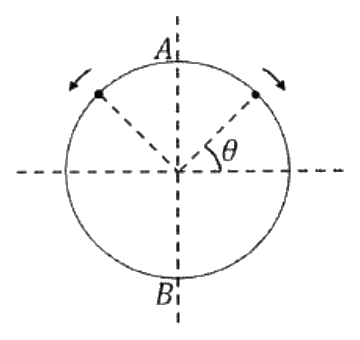
A frictionless circular wire of unit radius is fixed on the horizontal plane. Two point particles of unit mass start moving simultaneously from point $A\left(\theta = \dfrac{\pi}{2}\right)$ with identical uniform angular speeds in opposite directions, and meet again at point $B\left(\theta = -\dfrac{\pi}{2}\right)$. During this time, which of the following figures schematically represent the magnitude of the total linear momentum $P$ of the system, as a function of $\theta$ ?
Answer: (C) see figure
By symmetry, the two particles are always at angles $\theta$ and $\pi - \theta$, mirror images about the line AB. Each has speed $v$ along the tangent.
A particle at angle $\theta$ moving along the circle has velocity components $(\pm v\sin\theta,\ -v\cos\theta)$. For the mirror-image particle, the components along the horizontal diameter are opposite and cancel, while the components along AB add:
$$P = 2mv\,|\cos\theta|$$
As $\theta$ goes from $\dfrac{\pi}{2}$ to $-\dfrac{\pi}{2}$:
- $P = 0$ at the start (at A the velocities are equal and opposite),
- $P$ is maximum ($2mv$) at $\theta = 0$,
- $P = 0$ again at B.
So $P$ rises from zero to a maximum and falls back to zero along a smooth $\cos\theta$ curve, which is option (3).
 Solution by Sreeraj P, M.Sc Physics